




Abstract
Mate retention behaviors are designed to reduce the likelihood of partner infidelity and relationship withdrawal. We investigated the psychometric properties of the Persian translation of The Coalitional Mate Retention Inventory (CMRI) in Iran and explored the sex differences in the performance frequencies of these behaviors. Participants in a committed heterosexual romantic relationship (n = 508, 270 female and 238 male) were drawn from a community sample. Participants reported demographic information (including age, duration of relationship), the Persian translation of CMRI, and the Persian translation of the Mate Retention Inventory–Short Form. The results of the confirmatory factor analyses demonstrated a good fit of the CMRI seven-factor model and achieved good reliability for CMRI and its subscales. We further documented sex differences in the frequency with which coalitional mate retention behaviors were performed. The results revealed that CMRI is a valuable instrument for assessing mate retention across diverse cultures.
Keywords
Infidelity is prevalent among committed, romantic relationships (Kruger, Fisher, & Fitzgerald, 2015) and is the leading cause of separation and divorce in couples (Allen & Atkins, 2012). To address these problems, people perform mate retention—behaviors designed to reduce the likelihood of partner infidelity and relationship dissolution (Buss & Shackelford, 1997). Recent research shows that allies, such as friends, can assist in mate retention efforts, a strategy that also occurs in other nonhuman species (reviewed in Pham, Barbaro, & Shackelford, 2015). These behaviors can range from positive behaviors (e.g., your friend says positive things about you in front of your partner) to negative behaviors (e.g., your friend monitors your partner’s whereabouts) (Pham, Barbaro, Mogilski, & Shackelford, 2015).
Mate retention has been documented across several cultures such as Spain (de Miguel & Buss, 2011), Croatia (Kardum, Hudek-Knezevic, & Gracanin, 2006), and Brazil (Lopes, Shackelford, Santos, Farias, & Segundo, 2016), suggesting that mate retention is a solution to the cross-cultural problem of partner infidelity. Additionally, sex-specific adaptive problems are addressed by sex-specific mate retention behaviors (men: resource display, women: appearance enhancement; Buss & Shackelford, 1997), suggesting that mate retention may be behaviors that have recurred over human evolution. An evolutionary psychological framework appears most profitable when researching mate retention, given the cross-cultural ubiquity of partner infidelity.
Allies, such as friends, can assist in mate retention (known as “coalitional mate retention” [CMR]) and is a strategy that occurs in other nonhuman species (reviewed in Pham et al., 2015). CMR can range from positive (e.g., your friend says positive things about you in front of your partner) to negative behaviors (e.g., your friend covertly monitors your partner’s whereabouts). Pham et al., (2017) developed the Coalitional Mate Retention Inventory (CMRI) to catalog CMR behaviors in the United States. Although individual mate retention has been documented across several cultures, the occurrence of CMR has not yet been documented outside the United States. The current research extends the work by Pham et al. (2017) to explore the occurrence of CMR in Iran.
An Iranian population provides information about the potential ubiquity of CMR because of important cultural differences from the United States. The current research draws a sample from Tehran, which is the largest city of Iran and plays many significant roles in Iran’s cultural, social, and political relationships. It is the most populated city in western Asia. The most common religion is Islam and Christianity, whereas Judaism and Zoroastrianism are minorities (Atari, Barbaro, Shackelford, & Chegeni, 2017). The official language is Persian (Farsi).
Mating behavior can vary in response to local social factors such as kinship, population density, and cultural traditions, all of which may influence CMR (Sefcek, Brumbach, Vasquez, & Miller, 2007). Therefore, culture can be considered as a specific core theme—individualism, collectivism, or honor—which includes the main frameworks of what and how people think about ambiguous situations (Oyserman, 2011). For example, “Qeirati” is an Iranian concept in which masculine behaviors are socially acceptable (Atari, Barbaro, Shackelford, et al., 2017) and is similar to the “culture of honor” in the United States (Mosquera, Manstead, & Fischer, 2002). Qeirati means a sense of protecting a spouse or other female family members from interactions with other men. Further, in Iranian culture, there is a close connectedness between family members and close friends. Because CMR involves (1) guarding women and (2) recruitment from allies, CMR may be particularly prevalent under these cultural contexts. Thus, the sociosexual and cultural aspects merit investigation of CMR in Iran and because of abovementioned characteristics, Iranian samples may have interesting contrast in the cultural, religious, and political aspects, comparing with the samples in the U.S. cities (Barbaro, Sela, Atari, Shackelford, & Zeigler-Hill, 2019). Given the novelty of the CMRI, it is also important to investigate the psychometric properties of this new scale, especially using a different sample (Pham et al., 2015).
Research results have shown that the CMR inventory has good psychometric properties (Barbaro, Pham, & Shackelford, 2015; Pham et al., 2015). To extend the work by Barbaro, Pham, and Shackelford (2015), the current research also investigates the psychometric properties of the CMR inventory using an Iranian sample. Therefore, we designed the present study to examine the factor structure of the CMRI using confirmatory factor analyses (CFAs) and to examine the convergent validity of the CMRI.
Method
Participants and Procedures
Participants (270 women and 238 men) were recruited through announcements and flyers in the state and private consulting, psychological, and educational service centers in Tehran in 2017. The participants were at least of 18 years of age and involved in a committed, heterosexual relationship for at least 5 months. The mean age of all participants was 29.7 (SD = 7.6) years (women: M = 28.4, SD = 9.7; men: M = 32.1, SD = 8.5). The average length of relationship was 6.4 years (SD = 5.7).
An important issue in factor analysis is determining the minimum sample size. According to Meyers, Gamst, and Guarino (2005), the defensible minimum sample size in factor analysis is 200, and Comrey and Lee (1992) argue that a sample size of 500 would be appropriate. Also, Kline (2010) believes that a sample of 10–20 subjects is required for each item in exploratory factor analysis. Even though the sample size of 440 subjects was sufficient for this study, more subjects were recruited to further enhance the generalizability of the results and conclusions.
Procedure
We randomly invited prospective participants via convenience sampling to take part in the study. To encourage honest responses, we explained to participants that their participation would remain anonymous. Potential participants were asked whether they were interested in participating in a study to investigate behaviors performed to maintain a romantic relationship. Eligible participants who expressed interest in participating in this study completed a questionnaire package that included demographic information (including age, duration of relationship) and mate retention questionnaires. The participation was voluntary, and the participants were not compensated in any way.
Measures
CMRI
The questionnaire was designed to measure performance frequencies of specific behaviors of CMR behaviors (Pham et al., 2015). Participants completed CMRI 1 twice—once for a male friend and once for a female friend. The questionnaire has 44 items and was comprised of seven CMR tactics on a 4-point scale (0 = never; 3 = often): Manipulation, Praise, Vigilance, Monopolizing Time, Therapy, Gifts, and Violence. The participants replied to each item twice (once for their male friend and again for their female friend). To investigate the psychometric properties of this questionnaire, the researchers tested whether the seven-factor structure was a good model fit (Barbaro et al., 2015).
This scale was translated into Persian. This process consisted of an initial translation from English into Persian and then having the Persian version converted to English by two professional translators. The distinctions between the English and Persian versions were evaluated and minimized through the iterative review process. In this way, the semantic similarity of the two Persian and English versions was carefully examined. Subsequently, five psychological experts in the fields of evolutionary psychology confirmed its content-related validity and cultural adaptation. We conducted a pilot version of the questionnaire, completed by 30 men and women to eliminate any possible errors in the translation and to ensure that the questionnaire was understandable. Finally, after addressing discrepancies, the translation of the main questionnaire was carried out. The results of the pilot indicated that the translated Persian CMRI items were clear and understandable.
Mate Retention Inventory–Short Form (MRI-SF)
This questionnaire was used to measure the frequency of mate retention behaviors and to evaluate its convergent validity to the CMRI. The MRI-SF (Buss, Shackelford, & McKibbin, 2008) is a self-reported 38-item questionnaire that evaluates the performance frequencies of mate retention behaviors over the past year on a Likert-type scale ranging from 0 (never) to 3 (often). Buss, Shackelford, and McKibbin (2008) showed that this instrument has an appropriate internal consistency and convergent validity. Atari, Barbaro, Shackelford, and Chegeni (2017) have provided further evidence of its validity and reliability.
The MRI-SF was translated into Persian and used for an Iranian population in a separate study (Atari, Barbaro, Sela, Shackelford, & Chegeni, 2017) that examined the psychometric properties of this questionnaire. Atari, Barbaro, Sela, Shackelford, and Chegeni (2017) reported that its psychometric properties were acceptable. The Persian version of this questionnaire confirmed two superordinate factors: benefit-provisioning and cost-inflicting (Atari, Barbaro, Sela, et al., 2017). We found the reliability coefficients of the Persian versions of the MRI-SF for the higher order domains of benefit-provisioning (α = .89) and cost-inflicting (α = .85) mate retention behaviors.
Results
Preliminary Analyses
To assess the normality of the data, the skewness coefficient and the kurtosis coefficient were used. According to Curran, West, and Finch (1996), the proposed range for skewness is <2 and for kurtosis <7. Our analyses showed acceptable values within this range: skewness (.51–1.27) and kurtosis (.29–1.34). Because the participants completed the CMRI twice (once for a male friend and once for a female friend), two sets of analyses were tested (i.e., one set of seven-factor for participants’ male friend and one set of seven-factor for participants’ female friend).
Exploratory Factor Analysis
Exploratory factor analysis method was used to determine the construct validity by using main component analysis with an oblique solution which is a rotation method that minimizes the number of variables that have high loadings on each factor and simplifies the interpretation of the factors. Also, Cronbach’s α was evaluated to determine the reliability and the number of extraction factors from the scree plot and the parallel analysis method (O’connor, 2000, consistent with Pincus et al. (2009)). Prior to exploratory analysis, the Kaiser–Meyer–Olkin (KMO) measure of sampling adequacy and Bartlett’s tests also were calculated to evaluate sampling adequacy for performing a satisfactory factor analysis. The KMO was 0.88, indicating the adequacy of the sample size for analysis. Also, the result of the Bartlett’s test of sphericity was significant (χ2 = 1411190, p < .001), indicating a correlation between the variables and the adequacy of the data for factor analysis. Furthermore, the number of factors was identified by performing parallel analysis (Horn, 1965) and by using syntax proposed by O’connor (2000) in SPSS software (Version 23.0). The parallel analysis results of CMR female friend and CMR male friend showed that only seven factors had greater real eigenvalues than the mean of random eigenvalues and the 95th percentiles (Table 1). In order to evaluate the reliability of both versions of CMRI and its subscales, Cronbach’s α coefficient was used. The results of the Cronbach’s α coefficients for the participants’ male friend version show that an α coefficient was at the value of .91 for the whole scale (.91 for men and for .92 women). And the internal consistency for the seven subscales of Manipulation, Praise, Vigilance, Monopolizing Time, Therapy, Gifts, and Violence are .89, .90, .87, .89, .87, .89, and .82, respectively. Moreover, the results for participants’ female friend version show that an α coefficient value was .92 for the whole scale (.91 for men and for .91 women). And the internal consistency for the seven subscales of Manipulation, Praise, Vigilance, Monopolizing Time, Therapy, Gifts, and Violence are .89, .91, .92, .92, .91, .91, and .92, respectively.
Parallel Analysis to Determine Number of Factors on CMR Female Friend and Male Friend.

Note. CMR = coalitional mate retention.
In order to assess the convergent validity of the two versions of CMRI, the MRI-SF was used. In the participant’s male friend’s version of CMRI, out of the 133 correlation coefficients obtained, 75 (male friends version) and 69 (female friends version) were statistically significant (see Tables 2 and 3)
Zero-Order Correlations Between CMRI Tactics of Participants’ Male Friend (Columns) and MRI Tactics (Rows).

Note. CMRI = Coalitional Mate Retention Inventory; MRI = Mate Retention Inventory.
*p < .05. **p < .01. ***p < .001.
Zero-Order Correlations Between CMRI Tactics of Participants’ Female Friend (Columns) and MRI Tactics (Rows).

Note. CMRI = Coalitional Mate Retention Inventory.
*p < .05. **p < .01. ***p < .001.
Sex Differences in CMR
We conducted repeated measures t tests comparing male friends against female friends (within-sex participants). Men received more frequent CMR from their same-sex friends (than their opposite-sex friends) in Manipulation, Vigilance, Therapy, and Violence Tactics, t(454) = 6.41, 5.73, 13.71, 15.24, respectively, p < .001, and more frequent CMR from their opposite-sex friends (than their same-sex friends) in Praise, Monopolizing time, and Gift tactics, t(456) = −9.22, −7.01, −7.35, respectively, p < .001. Women received more frequent CMR from their same-sex friends (than their opposite-sex friends) in Manipulation, Praise, Gift, and Violence Tactics, t(452) = 3.48, −8.27, 5.41, −4.28, respectively, p < .001, and more frequent CMR from their opposite-sex friends (than their same-sex friends) in Vigilance, Monopolizing Time, and Therapy Tactics, t(455) = 3.39, 6.14, 7.29, respectively, p < .001.
We conducted between-subjects t tests comparing male participants against female participants. Our first series of tests focused on male friends. We found significant differences in the scores for Manipulation, Praise, Therapy, and Violence tactics, t(452) = 2.32, 3.26, 6.19, 14.14, respectively, p < .001, as well as Vigilance and Monopolization, t(453) = 1.98, −2.98, respectively, p < .05. Our subsequent series of tests focused on female friends. We found significant differences in the scores for Manipulation, Praise, Vigilance, Monopolize, Therapy, Gifts, and Violence tactics, t(452) = −8.71, 7.17, −8.23, 9.13, 8.74, 7.28, −3.79, respectively, p < .001. Cohen’s d was also calculated as a measure of effect size. All sex differences comparisons are presented in Table 4. Results indicate that men more frequently used the tactics of Vigilance (d = .62), Therapy (d = .72), and Violence (d = .92) than women, while women more frequently used the tactics of Manipulation (d = .12), Praise (d = .55), Monopolize (d = .51), and Gifts (d = .14).
Mean Performance Frequencies (Standard Deviations) of Each CMR Tactic, Separated by Participant’s Sex and by Friend’s Sex.

Note. CMR = coalitional mate retention.
aRepeated measures t tests comparing male friends against female friends (within-sex participants). bBetween-subjects t tests comparing male participants against female participants (within-sex friends).
*p < .05. **p < .01. ***p < .001.
Discussion
The primary purpose of this study was to evaluate the psychometric properties and factor structure of the CMRI (Pham et al., 2015). The results of the CFAs confirmed the good fit of the CMRI seven-factor model, which indicates the desirable fit of the CMRI’s seven-factor model. This finding is in alignment with the results of Barbaro, Sela, Lopes, and Shackelford (2017). In that study, they confirmed that the seven-factor model has a higher fit compared to the single-factor model, and it also has a slightly better fit in comparison with the two-factor higher order model. Additionally, given the unique cultural features of Iran, the current study also served as an important cross-cultural exploration to test evolutionary hypotheses concerning CMR.
Pham, Barbaro, and Shackelford (2015) found that the performance of CMR behaviors was positively related to the performance of individual mate retention. Similar results were found in the current research (see Tables 5, 6 and 7). Consistent with findings from Pham et al. (2015), those who use more individual mate retention tactics also used more CMR.
Total Variance Explained on CMR Female Friend and Male Friend.
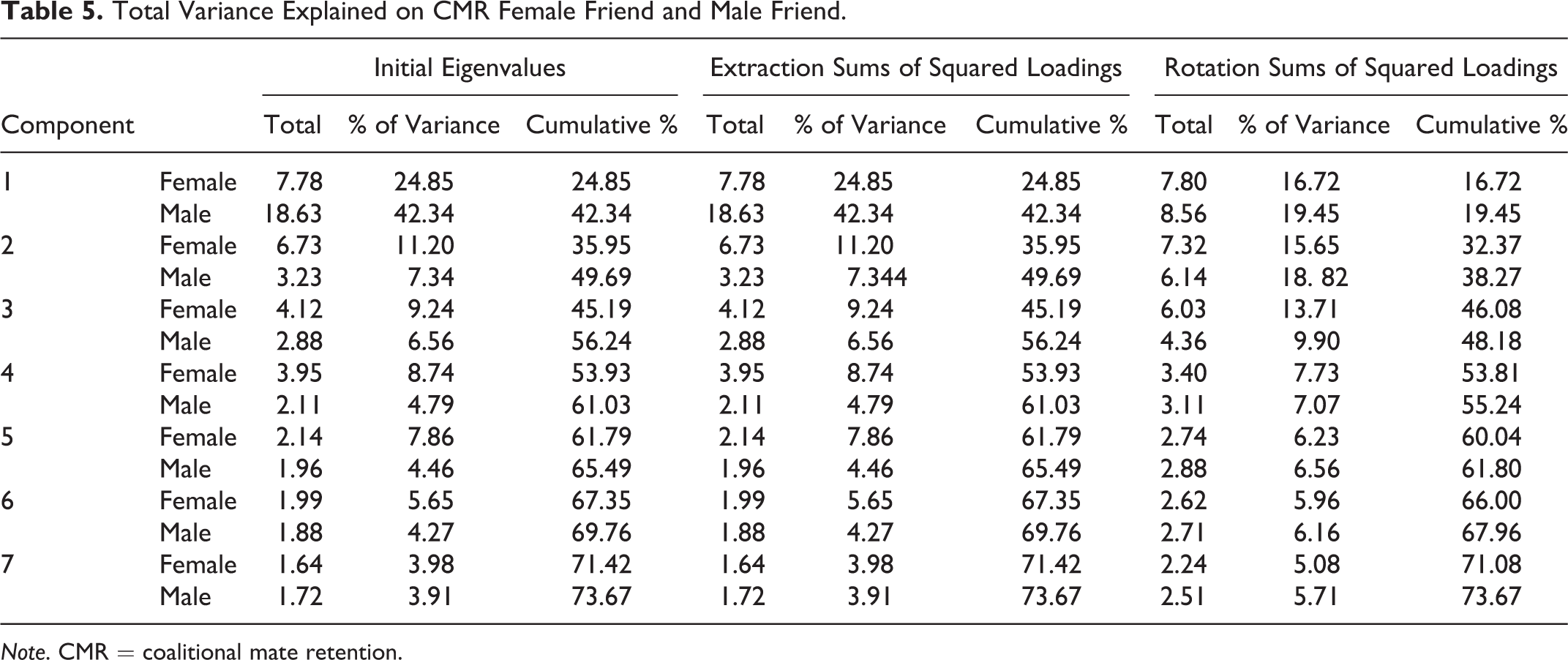
Note. CMR = coalitional mate retention.
Rotated Component Loadings on CMR Female Friend.

Note: Values in boldface type indicate the highest factor loading for each item. CMR = coalitional mate retention.
Rotated Component Loadings on CMR Male Friend.

Note. MRI = Mate Retention Inventory; CMR = coalitional mate retention.
The results of examination of the convergent validity of CMRI with Persian version of MRI-SF showed that more than half of correlations between the tactics of these two scales were statistically significant (see Tables 5, 6 and 7). Therefore, it seems that individual and CMR behaviors are widely shared by their possible effects in reducing the likelihood of partner infidelity and relationship dissolution (Pham et al., 2015). Also, less than half of correlations between tactics of individual mate retention and CMR were weak. In the explanation of the insignificance of some correlation coefficients (see Tables 5 and 6), it can be said that the Cronbach’s α coefficient is based on the internal coordination of the items. Also, this coefficient is the function of the number of items. Increasing the number of items will often add to the amount of the coefficient, while a small number of items (e.g., 2 items) lead to low variations in the type of responses and cause strong effects on the correlation coefficient between the items, so its stability is less.
Another purpose of this study was to explore sex differences in CMR. There were notable differences between the findings of the current study and the findings from Pham et al. (2015). The results of sex differences regarding the use of CMR tactics showed that male participants asked for help from their same-sex friends in most tactics (except monopolizing time), while female participants asked for help from their same-sex friends only in three tactics (Manipulation, Praise, and Gift), they asked for help from their opposite-sex friends in the other four tactics (Vigilance, Monopolizing Time, Therapy, and Violence). This finding is not consistent with the findings of Pham et al. (2015). These differences indicate that the characteristics of same-sex and opposite-sex friendships can affect CMR tactics (Lopes et al., 2017). Also, considering that culture has an impact on mate selection behaviors and mate retention ways (Sefcek et al., 2007), because human behavior is influenced by the culture in which it grows (Hofsted, 1991), it is possible that same-sex and opposite-sex friendships of male and female individuals have their own specific characteristics in different cultures. On the other hand, while the mate selection is commonly seen across the globe, societal circumstances have the crucial role in the mate selection and relationships maintaining processes (Nesteruk & Gramescu, 2012) because people’s attitudes and behaviors are shaped and guided by common norms, customs, and duties in their own particular social environment (Lykes & Kemmelmeier, 2014). So, it is expected that there would be sex differences in the getting help from same-sex and opposite-sex friends.
Limitations and Future Directions
There are limitations of the present study. First, the sampling method of this study is a nonrandom method, and research data were collected in only one Iranian city. The cultural features of Tehran may not be generalizable to other parts of Iran, given that Tehran is a major city. Future research should use other sampling methods like a random stratified sampling technique drawn from other cities in Iran to enhance the generalizability of the findings.
Conclusion
The current study examined the psychometric properties of the CMRI in Iran. The current study showed an acceptable reliability and factor structure for the Iranian version of the CMRI. CMRI is a valuable instrument that can be used in research areas focusing on relationships, family, and friends. The research also shows the utility of an evolutionary psychological perspective when investigating solutions to adaptive problems that transcend cultural differences. In conclusion, the current research adds to the growing body of knowledge surrounding mate retention.
Footnotes
Authors’ note
Michael Pham is now affiliated with California Community Colleges CTE Employment Outcomes Survey; Institutional Research Analyst Santa Rosa Junior College; Institutional Research; Santa Rosa, United States.
Declaration of Conflicting Interests
The author(s) declared no potential conflicts of interest with respect to the research, authorship, and/or publication of this article.
Funding
The author(s) received no financial support for the research, authorship, and/or publication of this article.
