




Abstract
Deceptive affectionate messages (DAMs) have been proposed to act as relational maintenance techniques and, as such, might be part of a greater repertoire of mate retention behaviors. We analyzed data from 1,993 Mechanical Turk participants to examine the relations between DAMs and mate retention, and whether these relations were mediated by the perceived risk of partner infidelity. In line with predictions, frequency of DAMs positively predicted general mate retention and cost-inflicting mate retention through the perceived risk of partner infidelity. In line with our nondirectional prediction, we also found that frequency of DAMs negatively predicted benefit-provisioning mate retention behaviors. In an exploratory mediation analysis of DAMs on benefit-provisioning mate retention via perceived partner infidelity, we surprisingly found that DAMs negatively predicted benefit-provisioning behavior due to the perceived risk of partner infidelity, suggesting that DAMs—but not benefit-provisioning mate retention—are deployed under the threat of partner infidelity. Overall, these findings suggest that DAMs might belong to a greater repertoire of mate retention (especially cost-inflicting) behaviors to thwart the possibility of partner infidelity.
Keywords
Affectionate communication is a vital component in maintaining a romantic relationship due to its enhancing effects on personal well-being (Floyd, 2002, 2014), relationships with relationship satisfaction and commitment (Horan & Booth-Butterfield, 2010), and relational maintenance (Baumeister & Leary, 1995; Horan & Booth-Butterfield, 2019). Still, there are many means by which we communicate affection to our partners but not always do we express our true feelings of affection. In some instances, we might withhold our affection by showing less affection than we feel (Carton & Horan, 2013); in other instances, we might express affection we do not feel (Horan & Booth-Butterfield, 2011). The previous examples, then, describe deceptive affection (Horan & Booth-Butterfield, 2011). Deceptive affectionate messages (DAMs) are a specific form of deceptive affection wherein communicators express affectionate messages that are not consistent with their internal feelings of affection in the moment (e.g., stating our affinity for our partner when we are, in the moment, upset at them; deceptively telling our partner that we like their current interests [e.g., taste in music, movies, or food] or appearance [e.g., haircut, outfit]; or faking sexual pleasure; Horan & Booth-Butterfield, 2019). These messages are not uncommon in romantic relationships (Horan & Booth-Butterfield, 2013) and have been described as a form of relational maintenance (Horan & Booth-Butterfield, 2019).
Embedded within evolutionary psychology, previous research has argued that DAMs might facilitate relational maintenance (Horan & Booth-Butterfield, 2011, 2013, 2019). Though various maintenance typologies exist (e.g., Dainton & Gross, 2008; Dainton & Stafford, 1993) and maintenance has been studied in conjunction with affection (Dainton, Stafford, & Canary, 1994; Guerrero & Bachman, 2006; Horan, 2013; Myers, Brann, & Rittenour, 2008; Myers, Byrnes, Frisby, & Mansson, 2011), less examined is the use of inauthentic affection as a tool for mate retention. Consequently, this study adds to the affection as maintenance research by uniquely examining the use of deceptive affection in a unique retention context—the adaptive problem of partner infidelity. Specifically, the reported study examined the frequency of DAMs, the frequency of overall (cost-inflicting and benefit-provisioning) mate retention behaviors, and the perceived risk of partner infidelity. Given the focus on affectionate communication, affection exchange theory (AET; Floyd, 2001, 2006) framed this study.
DAMs, AET, and Mate Retention
Deceptive affection was a process originally proposed within the frame of AET (Horan & Booth-Butterfield, 2011). Drawing on evolutionary principles, AET argues that affectionate communication is an adaptive behavior that enhances survival and reproductive success by enhancing pair bonds (Floyd, 2006). That is, affectionate communication promotes the bond itself, the increased resource access provided by the pair bond, and demonstrates to one’s partner that one might be a good prospect for parenthood (as a parent’s affectionate communication to their offspring contributes to their offspring’s development; Floyd, 2006). More broadly, by communicating affection to our partner, we are able to maintain our relationship and retain our mate (Floyd, 2006). This theory, however, clearly distinguishes between feeling and communicating affection, delineating that these “are distinct experiences that often, but need not, covary” (Floyd 2006, p. 163). With this argument in mind, diary studies described the two types of deceptive affection: DAMs (Horan & Booth-Butterfield, 2013) and withheld affectionate expressions (Carton & Horan, 2013). These diary studies revealed that deceptive affection is not uncommon, with DAMs expressed about 3 times a week to romantic partners (Horan & Booth-Butterfield, 2013). Uniquely, romantic partners often reported feeling negatively yet expressing affection for prosocial motives. Consequently, Horan and Booth-Butterfield proposed that DAMs might function as a relational maintenance behavior.
The relational maintenance idea was further examined by Horan (2013). He found that the maintenance behaviors of positivity and assurances were inversely related to the frequency of DAMs. In terms of negative relational maintenance behaviors (Dainton & Gross, 2008), allowing control was positively related to the frequency of DAMs. Together, then, the emerging evidence suggests that deceptive affection is a form of relational maintenance in romantic relationships. This reasoning is in line with AET, which argues that affectionate communication evolutionarily aided “the establishment and maintenance of significant human pair bonds” (Floyd, 2006, p. 165). Given that it is not always possible to communicate genuine affection, or advantageous to communicate affection when feeling negatively, this might place evolutionary pressure on the development of deceptive affection. This is particularly relevant in times of partner infidelity, which is a threat to relational maintenance, and often triggered by a perceived absence of relational affection (Barta & Kiene, 2005; Glass & Wright, 1985; Pestrak, Martin, & Martin, 1985). Indeed, partner infidelity has been argued to be a powerful selection pressure that has driven the evolutionary development of mate retention (Buss & Shackelford, 1997; Kaighobadi, Shackelford, & Weekes-Shackelford, 2012; McKibbin, Starratt, Shackelford, & Goetz, 2011). This investigation explored this theoretical argument by specifically looking at mate retention and, in particular, proposing that DAMs might serve as mate retention to combat the adaptive problem of partner infidelity.
Similar to deceptive affection, mate retention behaviors can be both beneficial and costly (Miner, Starratt, & Shackelford, 2009). Recent research has examined whether various behaviors are part of a broader mate retention repertoire, dividing these tactics into benefit-provisioning (i.e., provisioning your partner with financial, physical, or emotional benefits to maintain or heighten satisfaction) and cost-inflicting (i.e., inflicting real or potential costs on one’s partner) strategies (Miner et al., 2009). For instance, recent research has found that partner-directed insults (Kaighobadi, Shackelford, & Goetz, 2009) and violence (Shackelford, Goetz, Buss, Euler, & Hoier, 2005) are positively associated with one’s tendency to use cost-inflicting mate retention strategies. In contrast, sexual behaviors, such as oral sex, are positively associated with one’s tendency to use benefit-provisioning strategies (Pham & Shackelford, 2013). With implications for DAMs, women who pretend orgasm (a DAM; Denes, Horan, & Bennett, 2019; Horan & Booth-Butterfield, 2019) are more likely to enact both cost-inflicting and benefit-provisioning tactics (Kaighobadi et al., 2012). By showing that pretending orgasm predicted mate retention, Kaighobadi, Shackelford, and Weekes-Shackelford (2012) argued that pretending orgasm may belong to a broader scheme of mate retention. These correlations, then, arguably demonstrate that certain behaviors are used as part of a broader mate retention repertoire. Given that DAMs are suggested to heighten satisfaction, commitment, and the uses of maintenance, it might then function as one of the various mate retention strategies (Horan & Booth-Butterfield, 2013). Considering AET’s beneficial and risky implications for affectionate communication, DAMs might serve as part of a broader benefit-provisioning and cost-inflicting repertoire.
DAMs and Benefit-Provisioning Mate Retention Behaviors
Assuming the deception goes undetected, those who enact DAMs provide their partner with emotional, physiological, and psychological benefits that AET studies document (see Floyd, 2006)—and this enactment might be part of a broader benefit-provisioning mate retention scheme. To provision a partner with benefits, one might compliment them or purchase them a gift (Buss, Shackelford, & McKibbin, 2008). In doing so, one provides their partner with an emotional or financial benefit that should enhance satisfaction and, in turn, maintain the relationship (Miner et al., 2009). As with benefit-provisioning behavior, individuals report being motivated to enact DAMs to “save face” (e.g., avoid making one’s partner sad, hurt, or embarrassed), alleviate or circumvent conflict (e.g., stop, avoid, or settle an argument with their partner), or manage emotions (e.g., avoid inducing negative emotions; Horan & Booth-Butterfield, 2013). Given that affection elevates closeness (Floyd, 2006), partners might see DAMs as rewarding and beneficial to the relationship (Horan & Booth-Butterfield, 2013). That said, DAMs might belong to a greater benefit-provisioning scheme, yet there are limitations in the current research.
The existing research is limited in that it has predominantly focused on sources of deceptive affection. Given that receivers of deceptive affection are yet to be studied, their perspective is less understood. For instance, reactions to discovered deceptive affection could be significant given the inauthentic affection and larger communicative and relational context. Particularly problematic might be those messages used for significant manipulation (see Floyd, 2006; Horan & Booth-Butterfield, 2019). In addition, and although this is positioned as maintenance, too much deceptive affection might be problematic as it limits the frequency of authentic affectionate interaction. Returning to sources of deceptive affection, though motives describing maintenance are largely offered, researchers have highlighted concerns with altruistic motives (see Carton & Horan, 2013; Horan & Booth-Butterfield, 2019).
With the previous discussion/review in mind, findings suggest that the risks of losing a valuable partner outweigh the benefits of DAMs, supporting the idea that DAMs are a risky strategy that might potentially backfire (Redlick & Vangelisti, 2018). For this reason, DAMs might negatively predict our tendency to use benefit-provisioning behaviors because benefit-provisioning behaviors are low-risk strategies that do not often backfire. Items from the Benefit-Provisioning Mate Retention Scale include, for example, complimenting one’s partner, buying a partner a gift, and making one appear attractive for a partner, which are arguably low-risk strategies unlikely to result in negative partner reactions (Buss et al., 2008; Miner at al., 2009). Some of these, if not authentic, constitute DAMs. Therefore, engaging in DAMs—such as deceptively telling our partner that we like their appearance (e.g., clothes, weight) or activities (e.g., cooking, singing ability, athleticism)—might be risky because they mask negative feelings and attitudes, which are often about the partner themselves (Horan & Booth-Butterfield, 2013). Consequently, this might be risky if the negative feelings persist over time and/or the deception is discovered. Repeated patterns of discovered DAMs likely negatively influence partner perceptions—inflicting costs on one’s relationship.
DAMs and Cost-Inflicting Mate Retention Behaviors
In line with the view that DAMs carry risks, cost-inflicting tactics are risky mate retention strategies that inflict real or potential costs on one’s partner (e.g., Miner et al., 2009; Shackelford et al., 2005). Cost-inflicting tactics include, for example, emotional manipulation (e.g., pleading to our partner that we are unable to live without them), guarding behavior (e.g., spending all our free time with our partner to prevent them from meeting others), or mate derogation (e.g., telling other men or women that our relationship is painful). As with deceptive affection, we are more likely to enact our cost-inflicting repertoire when we lack the psychological or emotional resources to deploy the beneficial behavior (e.g., genuine affection; Starratt & Shackelford, 2012). Externally, DAMs might indeed showcase one’s positive emotions, but internally, both DAMs (Horan & Booth-Butterfield, 2013) and cost-inflicting behaviors (Starratt & Shackelford, 2012) are underpinned by negative emotions. Similar to cost-inflicting mate retention behaviors, Horan and Booth-Butterfield (2013) found that DAMs mask negative self-oriented (e.g., jealousy, anger), partner-related (e.g., dislike of partner’s appearance), and context-specific (e.g., stress, exhaustion) feelings. When unsuccessfully enacted, then, both DAMs and cost-inflicting behaviors are risky behaviors that might engender relational conflict or defection (Horan & Booth-Butterfield, 2011). Even if one’s partner is unaware of the DAM, the source might still feel psychological discomfort about using DAMs (Horan & Booth-Butterfield, 2011). Repeated expression of DAMs in place of an ongoing negative feeling is likely problematic, as the underlying issue is not addressed (and therefore persists).
Overly frequent DAMs might not only incite real or potential costs on the relationship if the partner is aware of the DAM, as undetected DAMs might still invoke psychological discomfort and negative affect (Horan & Booth-Butterfield, 2011, 2013). As with cost-inflicting behavior, the source’s negativity and discomfort might, in turn, lead to increased conflict or relational dissolution (Impett et al., 2012; Kaighobadi et al., 2009; Richards, Butler, & Gross, 2003; Shackelford et al., 2005). By regularly masking our negativity toward our partner, our negativity does not disappear but instead persists because DAMs (and, more broadly, cost-inflicting retention; Kaighobadi et al., 2009; Shackelford et al., 2005) do not rectify, but avoid, relational concerns (Horan & Booth-Butterfield, 2013). As with cost-inflicting mate retention, then, too many DAMs might incite real or potential costs in situations wherein the DAM is both detected and undetected by our partner (Horan & Booth-Butterfield, 2011, 2013). Given the aforementioned similarities between DAMs and cost-inflicting behavior, DAMs might belong to a greater repertoire of cost-inflicting mate retention strategies designed to combat partner infidelity. Indeed, mate retention is argued to be an evolutionary response to partner infidelity (Buss & Shackelford, 1997) which, if DAMs serves as mate retention, should also be the case for DAMs.
Perceived Risk of Partner Infidelity
Mate retention is argued to be an evolutionary response to the adaptive problem of partner infidelity, and thus one of the most crucial signals of unsuccessful mate retention is the perceived risk of partner infidelity (Buss & Shackelford, 1997). For partners, partner infidelity might imperil their paternity certainty, incur reputational damage, and might signal the division of physical (e.g., finances, sustenance) and psychological (e.g., commitment, energy) resources dedicated to women and children other than oneself (Buss & Shackelford, 1997). One of the times to engage in mate retention, then, is when there is a perceived risk of partner infidelity (Buss & Shackelford, 1997; Caton, Redlick, & O’Shannessy, forthcoming; Starratt, Shackelford, Goetz, & McKibbin, 2007). Kaighobadi et al. (2012) showed that women who pretend orgasm (a DAM; Denes et al., 2019; Horan & Booth-Butterfield, 2019) enact more cost-inflicting mate retention, and this association was mediated by the perceived risk of partner infidelity. They interpreted these findings such that pretending orgasm may be a form of mate retention used to thwart partner infidelity. This devotion toward mate retention because of perceived partner infidelity has found to extend to cost-inflicting, but not benefit-provisioning, mate retention (Kaighobadi et al., 2012) and as such might further extend to DAMs.
Given that partner infidelity is a powerful adaptive problem, DAMs might be one retention strategy evolutionarily designed to thwart potential infidelity. The expression of inauthentic affection would, ideally, enhance relational qualities—as AET argues that affection has been evolutionarily designed to enhance such qualities (Floyd, 2006; Horan & Booth-Butterfield, 2010). As partner infidelity is often triggered by a perceived absence of relational affection (Barta & Kiene, 2005; Glass & Wright, 1985; Pestrak et al., 1985; Shackelford & Buss, 1997), individuals might be motivated to communicate affection to their partners when they perceive that they might be unfaithful (Buss et al., 2008; Kaighobadi et al., 2012; Pham & Shackelford, 2013). As it is not always possible to show genuine affection, we might instead resort to deceptive affection as a maintenance, therefore, retention strategy (Horan & Booth-Butterfield, 2013, 2019). This idea is supported by other mate retention strategies activated under the threat of partner infidelity, which also involve providing our partner with more affection than experienced—for example, pretending orgasm (Denes et al., 2019), heightened interest in oral sex (Pham & Shackelford, 2013)—and these messages, when enacted deceptively, would be specific forms of DAMs. This suggests, then, that other DAMs might be active in this context.
This DAMs-based retention strategy might be even more evolutionarily effective than other retention strategies designed to thwart infidelity (e.g., partner-directed abuse; Kaighobadi et al., 2009; Shackelford et al., 2005). Other cost-inflicting strategies (e.g., partner-directed abuse) are often risky because they might inadvertently increase the risk of partner infidelity (Kaighobadi et al., 2009; Shackelford et al., 2005), are illegal, hurtful, and unethical. While not without risk, DAMs might better avoid negative partner reactions due to their concealed nature and, in turn, better avoid the inadvertent increased risk of partner infidelity. Indeed, the ordinary physiological cues of deception (e.g., nervousness, increased heart rate) that receiver psychologies have arguably evolved to detect might not be generated when communicating DAMs (Horan & Booth-Butterfield, 2011). Consequently, it might be harder for partners to detect, devalue, and negatively react to DAMs, suggesting that this DAMs-based retention strategy might be a more efficient evolutionary solution to the adaptive problem of partner infidelity than other retention tactics.
Hypotheses
The present study extends research in important ways. It has been argued that DAMs are an adaptive, strategically chosen relational maintenance technique (Horan & Booth-Butterfield, 2011, 2013, 2019). Despite being rooted in evolutionary psychology, however, limited research explored DAMs using evolutionarily important variables, which in this case, are perceived infidelity and mate retention behaviors. This is especially important in light of the adaptationist hypothesis that DAMs might act as mate retention under the perceived threat of partner infidelity. Thus, in light of its evolutionary basis and the suggestion that DAMs might serve as a mate retention technique, we addressed this research void by specifically examining individual mate retention tactics, categories, and superordinate (cost-inflicting and benefit-provisioning) domains. Moreover, although limited research has examined the role of affection in relational transgressions (Horan, 2012), no research has examined deceptive affection within the adaptive problem of partner infidelity. Given that we engage in mate retention when there is a perceived risk of partner infidelity, this should also apply to DAMs as mate retention. Thus, it was hypothesized as follows:
DAMs might broadly function as a general mate retention behavior but, in particular, as a cost-inflicting mate retention behavior. It has been previously found that we engage in cost-inflicting mate retention when there is a perceived risk of partner infidelity (Kaighobadi et al., 2012). As cost-inflicting mate retention, then, DAMs should also be used enacted when under the threat of partner infidelity. Thus, it was hypothesized:
In light of the limitations of previous research, DAMs might be either positively or negatively related to benefit-provisioning mate retention behavior. For this reason, we posited a nondirectional hypothesis for the relation between DAMs and benefit-provisioning mate retention:
However, we made no explicit predictions regarding partner infidelity mediating the relation between DAMs and benefit-provisioning behavior because benefit-provisioning behavior has not been shown to be related to perceived partner infidelity (Kaighobadi et al., 2012). Thus, partner infidelity would not be expected to correlate with benefit-provisioning mate retention and, therefore, should not mediate the relation between DAMs and mate retention. Despite this, we conducted exploratory analyses of perceived infidelity as a possible mediator of the relation between DAMs and benefit-provisioning mate retention to provide a complete picture of the relations between DAMs, partner infidelity, and each form of mate retention.
Method
Participants
A total of 1,993 U.S.-based Mechanical Turk (MTurk) participants (M age = 37.10; standard deviation (SD) age = 11.24) compensated with US$0.50 completed the survey as part of a larger project (Caton, Redlick, & O’Shannessy, forthcoming) which aimed to assess the outcomes of perceived discrepancies between one’s own and their partner’s satisfaction. This sample size is the result of the larger project’s aim to collect data on those who are approximately 2 SDs above and below the mean on these perceived satisfaction discrepancies (i.e., those who are very satisfied with their relationship but perceive that their partner is very dissatisfied, and vice versa).
In line with prior recommendations (Peer, Vosgerau, & Acquisti, 2014), MTurk workers could participate in the study if they had successfully completed at least 500 studies and held a 95% approval rate. Individuals must have been at least 18 years of age and currently involved in a romantic relationship lasting 6 or more months to participate, with participants who did not satisfy these initial criteria being directed out of the survey. If participants’ answers to the demographic variable (e.g., “age [in years]”) also did not meet these criteria, they were removed from the finaldata set. One participant incorrectly entered their relationship months as a symbol (i.e., “#”) and was thus removed via listwise deletion. Our survey was pitched as 15–30 min in length, with the average time to completion being 25 min and 13 s. There were 19 participants whose completion times were deemed extremely quick (i.e., less than 5 min) but as the removal of these participants did not change our results, these participants remained in our final analyses.
The sample comprised 666 (48.9%) men and 1,327 (51.1%) women from the United States, defined as sex determined at birth. For gender, 667 (33.5%) respondents indicated that they were male, 1,310 (65.7%) as female, 9 (0.5%) as genderqueer, 4 (0.2%) as trans*, and 3 (0.2%) as other. For sexual orientation, 1,721 (86.4%) were heterosexual/“straight,” 36 (1.8%) were homosexual/gay, 28 (1.4%) were lesbian, 186 (9.3%) were bisexual, 6 (0.3%) were trans*/queer, and 16 (0.8%) indicated other. One-hundred twenty three (6.2%) and 1,870 (93.8%) participants indicated that their partner was of the same or different sex to themselves, respectively; and 102 (5.1%) and 1,891 (94.9%) participants indicated that their partner was of the same or different gender to themselves, respectively. The majority of participants were Caucasian/White (1,582, 79.4%), followed by African/Black (151, 7.6%), Hispanic/Latinx (115, 5.8%), Asian/Pacific Islander (90, 4.5%), other (40, 2.0%), and Southeast Asian/Indian (15, 0.8%). In addition, most participants were married (1,082, 54.3%), followed by those never married (698, 35.0%), divorced (162, 8.1%), separated but not divorced (31, 1.6%), and widowed (20, 1.0%).
Materials
Tendency to use DAMs
In line with previous research (Gillen & Horan, 2013), an adapted version of Cole’s (2001) frequency of deception scale was used to measure an individual’s tendency to use DAMs. The modified version is a 7-point Likert-type scale (1 = strongly disagree, 7 = strongly agree) consisting of 8 Likert-type items, with example items including “I sometimes express affection that I am not feeling toward my partner,” “There are times when I try to mislead my partner about my feelings of affection,” “I express my true feelings of affection to my partner, whether good or bad” (reverse-coded). Prior studies (e.g., Cole, 2001; Gillen & Horan, 2013; Horan & Booth-Butterfield, 2011, 2013) have used a 9th item that requires participants to estimate how often they have engaged in deceptive affection over the past week and then summed the scores across all items. This item was not used (see Carton & Horan, 2013). The modified scale demonstrated strong reliability in the current study (α = .88).
Risk of partner infidelity
In line with previous research (Kaighobadi et al., 2012; McKibbin et al., 2011), perceived risk of partner infidelity was measured using the following 2 items modified to a 7-point Likert-type scale, “As far as you know, has your current partner had sexual intercourse with someone other than you since you have been involved in a relationship together?” (1 = definitely no to 7 = definitely yes) and, “How likely do you think it is that your current partner will in the future have sexual intercourse with someone other than you, while still in a relationship with you?” modified to a 7-point Likert-type scale (1 = not at all likely to 7 = extremely likely). A total perceived risk of partner infidelity was calculated by summing the scores on these 2 items (Cronbach’s α = .84).
Mate retention
Mate retention was assessed using the Mate Retention Inventory–Short Form (MRI-SF; Buss et al., 2008). The measure asks participants to report the frequency with which they engaged in various mate retention behaviors over the past month. They rated this frequency on 38 different behaviors (e.g., made myself “extra attractive” for my partner, showed interest in another person to make my partner angry) over five subscales. The Direct Guarding (e.g., “Called to make sure my partner where they said they would be” and “Spent all my free time with my partner so that they could not meet anyone else”), Intersexual Negative Inducements (e.g., “Pleaded that I could not live without my partner” and “Told my partner that we needed a total commitment to each other”), and Intrasexual Negative Inducements (e.g., “Told other people my partner was a pain” and “Stared coldly at a person who was looking at my partner”) subscales were summed to create the “cost-inflicting behavior” domain, and the Positive Inducements (e.g., “Bought my partner an expensive gift,” “Performed sexual favors to keep my partner around”) and Public Signals of Possession (“Put my arm around my partner in front of others,” “Bragged about my partner to other men”) subscales were summed to create the “benefit-provisioning behavior” domain. The MRI-SF was adapted for use in the current study to be a Likert-type scale with seven steps (1 = never, 7 = always) and was found to be reliable for general mate retention (α = .95) as well as the cost-inflicting (α = .96) and benefit-provisioning domains (α = .92).
Procedure
Data were collected as part of a larger project via Amazon.com’s MTurk with the survey itself being hosted on Qualtrics.com. The project received institutional review board (IRB) approval from The University of Texas at Austin (protocol number: 2018-09-0082). Participants accessed the survey after providing written consent and satisfying the inclusion criteria. After completing the inclusion criteria, participants were provided with an attention check. They were told that they would be asked of the age of a hypothetical person on the following page but must double the correct answer and add 2. After continuing to the following page, they were told that “Alexandra” was 1 year older than her 5-year-old brother and 1 year younger than her 7-year-old sister. Answers were multiple-choice ranging from 1 to 30, with those who did not indicate “14” being directed out of the survey.
Participants then completed a range of demographic questions. They then answered scales, presented in random order, designed to assess their perceived risk of partner infidelity, tendency to communicate DAMs, and the frequency with which they have performed mate retention behaviors in the last month. In line with Horan and Booth-Butterfield (2011), when asked about their tendency to communicate DAMs, they were asked to think about their current romantic relationship and were shown a brief definition and description of affection and deceptive affection. As part of the larger project, they also completed scales on relational uncertainty, perceived self and partner mate value, relationship satisfaction, relationship commitment, and their own and perceived partner’s intention to stay in the relationship (Caton, Redlick, & O’Shannessy, forthcoming).
Finally, upon submitting this information, respondents were directed to a page thanking them for their participation in the study and providing them with their survey code. They entered this code on MTurk to receive their small monetary reward.
Results
Statistical analyses were conducted using the SPSS 25 package. Mediation analyses were conducted using the SPSS Version of PROCESS. PROCESS is a computational modeling tool that can be used to estimate the direct and indirect effects in mediation models using bootstrapping (Hayes, 2013).
Descriptive Statistics and Intercorrelations
Descriptive statistics and intercorrelations were conducted. The results are presented in Table 1. As predicted by Hypothesis 1a, DAMs were positively related to overall mate retention behaviors, meaning that the more one used DAMs, the more they also engaged in general mate retention. Further central to DAMs, there were significant positive relations between DAMS and the perceived risk of partner infidelity, as well as between DAMs and cost-inflicting mate retention, but no relation between DAMs and benefit-provisioning mate retention. Thus, the more one used DAMs, the greater the perceived infidelity and the greater the use of those retention tactics designed to inflict costs on one’s partner (but not tactics designed to provision one’s partner with benefits). It should be noted, however, that these results did not yet control for the effect of relationship length nor the respective mate retention domain.
Means, Standard Deviations (SDs), and Intercorrelations for Deceptive Affectionate Messages (DAMs), Perceived Infidelity, Mate Retention, and Relationship Length.

***p < .001.
For perceived infidelity, there were significant positive relations between the perceived risk of infidelity and general, benefit-provisioning, and cost-inflicting mate retention. As perceptions of infidelity increased, then, the more likely the use of all forms of mate retention. To provide a complete picture of perceived infidelity, scatterplots documenting the relations between perceived infidelity and DAMs, and general, benefit-provisioning, and cost-inflicting mate retention are presented in Appendix A.
There was also a significant negative relation between perceived infidelity and relationship length (months), suggesting that the longer the relationship, the less perceived infidelity. Relevant to relationship length, there were significant negative relations between relationship length and general, benefit-provisioning, and cost-inflicting mate retention, meaning that the longer the relationship, the less use of all forms of mate retention.
Regression Analysis of DAMs and Mate Retention
Correlations were conducted for general, cost-inflicting, and benefit-provisioning mate retention, the five categories, and the individual items. The results are presented in Table 2 (see Appendix B for further correlations between DAMs and the MRI-SF individual items). There were significant positive relations between DAMs and direct guarding, intersexual negative inducements, and intrasexual negative inducements, and a significant negative relation between DAMs and public signals of possession. In other words, as there was a greater tendency to use DAMs, there was a greater tendency to guard and inflict costs upon our partner, as well as potential rivals, but a lesser tendency to publicly display our relational commitment.
Correlations Between the Mate Retention Inventory-Short Form and Deceptive Affectionate Messages.
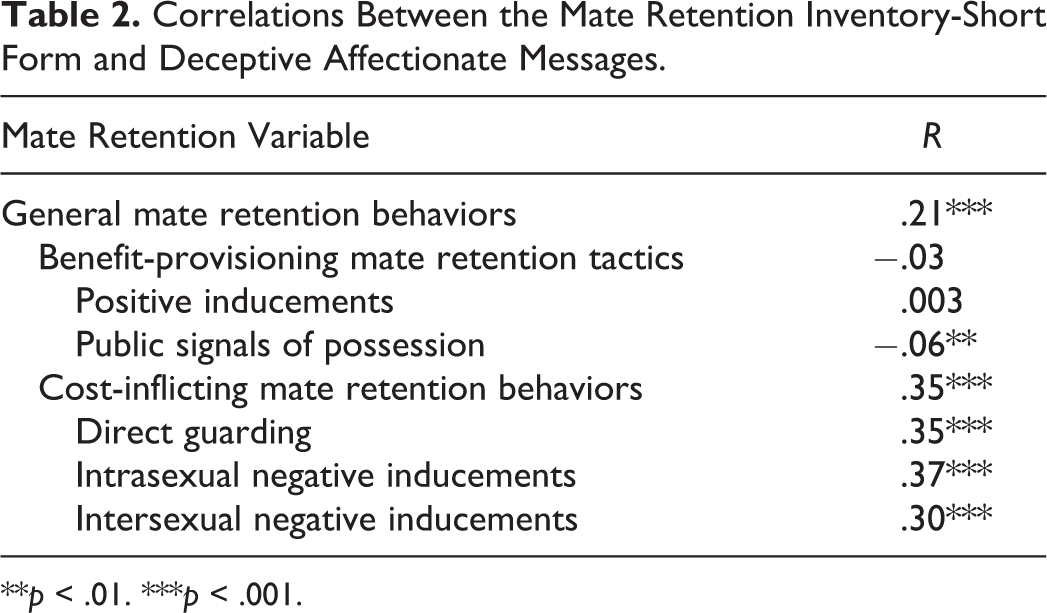
**p < .01. ***p < .001.
Finally, the benefit-provisioning and cost-inflicting mate retention variables were entered into multiple regression equations to identify the unique effect each mate retention domain has on DAMs. In line with prior research (Sela, Shackelford, Pham, & Euler, 2015), relationship length and the respective mate retention domain were controlled. Consistent with Hypotheses 2a and 3, respectively, those who reported a greater tendency to use DAMs performed more cost-inflicting mate retention behaviors, B = .82, t(1,988) = 20.93, p < .001, 95% confidence interval (CI) [.75, .90], but less benefit-provisioning mate retention behaviors, B = −.44, t(1988) = −12.21, p < .001, 95% CI [−.51, −.37], meaning that the more one communicated DAMs, the greater one’s tendency to retain one’s partner by inflicting costs upon them but the lesser one’s tendency to retain them by provisioning them with benefits.
DAMs on General Mate Retention Via Perceived Risk of Partner Infidelity
It was hypothesized that the perceived risk of partner infidelity would mediate the positive relation between DAMs and general mate retention (Hypothesis 1b). To that end, a mediation analysis was conducted, controlling for relationship length. In line with the recommendations of Hayes (2013), the significance of the mediated (i.e., indirect) effects was examined using the bootstrapping procedures outlined by Preacher and Hayes (2004). Bootstrapping uses the original sample as the population from which random samples with replacement are used to provide the best estimate of the true indirect effect. Employing the Hayes (2013) SPSS PROCESS macro (Model 4; Ver. 3.2.01), 10,000 bootstrap samples were created to estimate bias-corrected standard errors (SEs) and 95% percentile CIs for the indirect effect of DAMs on general mate retention via perceived risk of partner infidelity. The indirect effect is considered significant at p < .05 if zero is not included in its 95% CI. Effect sizes were not calculated due to their recent controversy (see Wen & Fan, 2015).
Findings are depicted in Figure 1. Results of the bias-corrected bootstrapped analyses found that the tendency to use DAMs had a significant indirect effect on general mate retention behaviors via perceived risk of partner infidelity (ab path = .30, bootstrap SE = .04), with a 95% bias-corrected CI ranging from .23 to .39. As predicted by Hypothesis 1b, the absence of zero within the CI range supports the hypothesis that the perceived risk of partner infidelity would significantly mediate the relationship between the DAMs and general mate retention. In other words, the greater the use of DAMs, the greater the use of general mate retention strategies, and this is in part due to the perceived risk of partner infidelity. The full model accounted for 38.3% of the variance in general mate retention behaviors.

Unstandardized regression coefficients with standard errors and 95% confidence intervals for the relationship between deceptive affectionate messages and general mate retention as mediated by perceived risk of partner infidelity. Relationship length was included as a covariate but not included in the figure. ***p < .001.
DAMs on Cost-Inflicting Behaviors Via Perceived Risk of Partner Infidelity
It was hypothesized that the perceived risk of partner infidelity would mediate the positive correlation between DAMs and cost-inflicting mate retention behaviors (Hypothesis 2b). Similar to the previous analysis, a mediation analysis using the PROCESS macro was conducted, controlling for benefit-provisioning mate retention behavior and relationship length.
Findings are depicted in Figure 2. Results of the bias-corrected bootstrapped analyses found that the tendency to use DAMs had a significant indirect effect on cost-inflicting mate retention behavior via perceived risk of partner infidelity (ab path = .20, bootstrap SE = .02), with a 95% bias-corrected CI ranging from .16 to .25. In line with Hypothesis 2b, the absence of zero within the CI range supports the hypothesis that the perceived risk of partner infidelity would significantly mediate the relationship between the DAMs and cost-inflicting mate retention behavior. That is, the greater the use of DAMs, the greater the use of cost-inflicting strategies, and this is in part due to the perceived risk of partner infidelity. The full model accounted for 70.7% of the variance in cost-inflicting mate retention behavior.
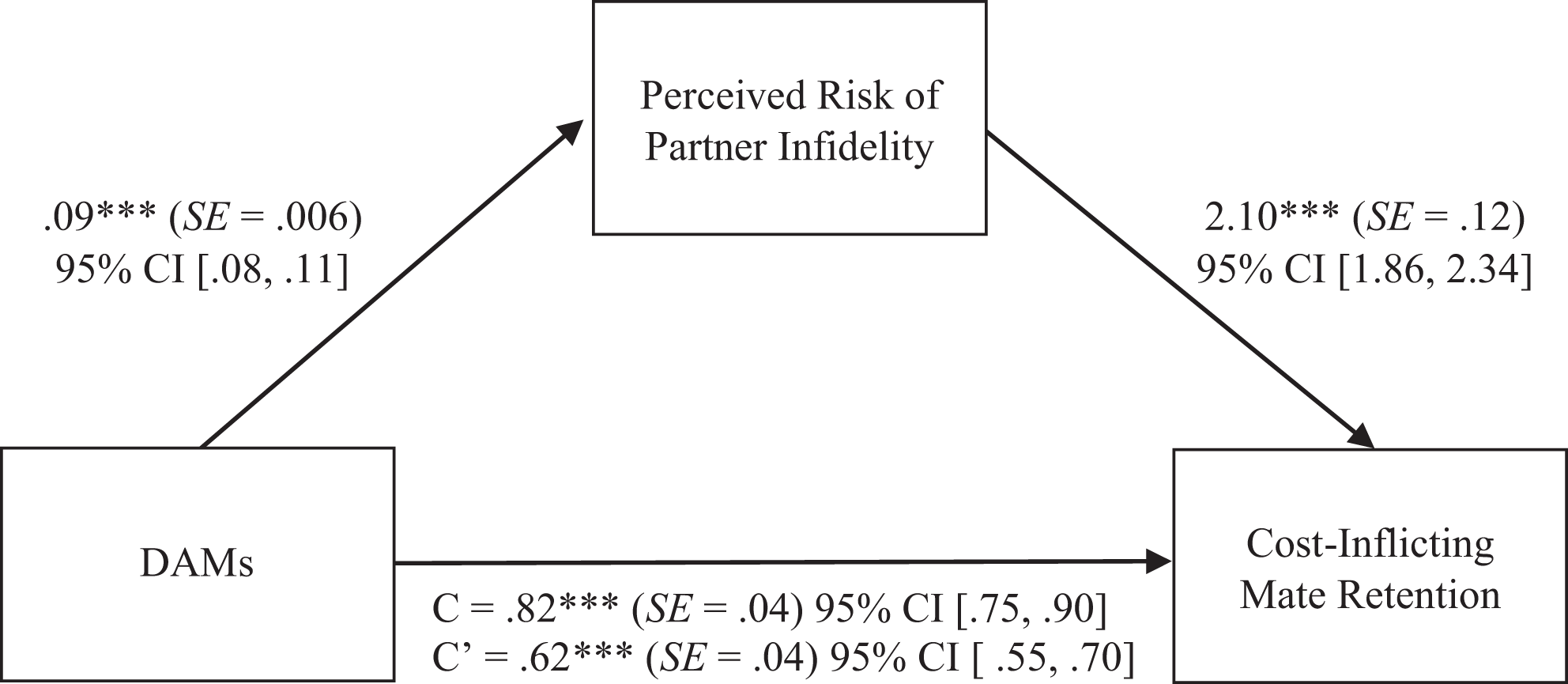
Unstandardized regression coefficients with standard errors and 95% confidence intervals for the relationship between deceptive affectionate messages and cost-inflicting mate retention behavior as mediated by perceived risk of partner infidelity. Benefit-provisioning mate retention behavior and relationship length were included as covariates though not included in figure. ***p < .001.
DAMs on Benefit-Provisioning Behaviors Via Perceived Risk of Partner Infidelity
In providing a more complete understanding of the relations between DAMs, perceived infidelity, and mate retention, we performed exploratory analyses to test the possibility that perceived infidelity mediated the relation between DAMs and benefit-provisioning mate retention. To this end, a mediation analysis using the PROCESS macro was conducted, controlling for cost-inflicting mate retention behavior and relationship length.
Findings are depicted in Figure 3. Results of the bias-corrected bootstrapped analyses found that the tendency to use DAMs had a significant indirect effect on benefit-provisioning mate retention behavior via perceived risk of partner infidelity (ab path = −.03, bootstrap SE = .008), with a 95% bias-corrected CI ranging from −.05 to −.02. That is, the greater the use of DAMs, the lesser the use of benefit-provisioning strategies, and this is in part due to the perceived risk of partner infidelity. Interestingly, the more one used DAMs, the more they tended to avoid the use of benefit-provisioning mate retention due to their perceived risk of partner infidelity. The full model accounted for 58.2% of the variance in benefit-provisioning mate retention behavior.

Unstandardized regression coefficients with standard errors and 95% confidence intervals for the relationship between deceptive affectionate messages and benefit-provisioning mate retention behavior as mediated by perceived risk of partner infidelity. Cost-inflicting mate retention behavior and relationship length were included as covariates though not included in figure. ***p < .001.
Discussion
DAMs are messages in which individuals deliberately communicate more affection than they genuinely feel toward their partner (Horan & Booth-Butterfield, 2011). Evolutionarily, previous work has argued that affection serves to enhance pair bonds (Floyd, 2006), and similarly, deceptive affection might act as a relationship maintenance technique that preserves or heightens our partner’s satisfaction (Horan & Booth-Butterfield, 2019). In so doing, DAMs might have been evolutionarily designed to combat the adaptive problem of partner infidelity by acting as mate retention. In the present study, we sought to support this claim by examining whether DAMs belong to a broader repertoire of mate retention tactics. We then analyzed whether individuals employ DAMs as a mate retention behavior based on the perception that a partner might be unfaithful in the future. We found support for the predictions that those who enact DAMs would be more likely to deploy general and cost-inflicting mate retention behaviors, as mediated by perceived partner infidelity, and also found support for the nondirectional prediction that DAMs would predict benefit-provisioning behaviors.
In line with predictions, the tendency to use DAMs predicted the tendency to enact general mate retention behaviors (Hypothesis 1a). This is not surprising, as AET holds that affectionate communication serves to maintain our relationship (Floyd, 2006). We further supported the claim that DAMs are a relational maintenance technique (Horan & Booth-Butterfield, 2019) by demonstrating that the relation between DAMs and general mate retention was mediated by the perceived risk of partner infidelity (Hypothesis 1b). Those who enacted DAMs were more likely to enact general mate retention behaviors, and this was because they thought their partner might be unfaithful toward them. Consistent with prior work that suggests that mate retention behaviors are deployed to thwart infidelity (Buss & Shackelford, 1997; Kaighobadi et al., 2012), our findings suggest that we use DAMs, as one mate retention behavior aimed to prevent a partner’s infidelity or relationship defection.
We also discovered that the propensity to use DAMs positively predicted the use of cost-inflicting mate retention behaviors (Hypothesis 2a) and that this relation was also mediated by the perceived risk of partner infidelity (Hypothesis 2b). Given that DAMs are risky behaviors that might instigate relational conflict or defection (Horan & Booth-Butterfield, 2011), it is also not unexpected that it may be one form of cost-inflicting mate retention behavior. This risk may be warranted under some circumstances, however, as our findings suggest that DAMs may be used as a form of cost-inflicting mate retention to thwart partner infidelity. In other words, we might deploy DAMs as a risky strategy to retain our mate because the alternative is to risk partner infidelity.
Our final prediction was also supported in that DAMs predicted benefit-provisioning mate retention behavior (Hypothesis 3). We discovered that DAMs negatively predicted benefit-provisioning behaviors. Unlike benefit-provisioning behaviors, which are low risk (Miner at al., 2009), DAMs are argued to be risky behaviors that might be enacted for selfish reasons (Redlick & Vangelisti, 2018). Our exploratory mediation analyses support the idea that DAMs, and not benefit-provisioning mate retention, might be enacted for selfish reasons because DAMs, and not benefit-provisioning mate retention, are deployed under the threat of partner infidelity. This would constitute a partially selfish motive for individual protection but might also include a collective selfless motive in protecting the overall relationship for both parties. This speaks to the generally complex nature among selfish and altruistic motives in general deception as well as specific to deceptive affection (see, for a full discussion, Carton & Horan, 2013; Horan & Booth-Butterfield, 2019).
Our exploratory analyses demonstrated that perceived infidelity mediated the negative relation between DAMs and benefit-provisioning mate retention. That is, the more one enacted DAMs, the less one used benefit-provisioning mate retention because of the heightened perceived risk of partner infidelity. This suggests that those who enacted DAMs tended to avoid benefit-provisioning behavior because DAMs (and not benefit-provisioning behavior) are deployed under the threat of partner infidelity. This is contrary to previous research, which documents no relation between perceived infidelity and benefit-provisioning behavior (Kaighobadi et al., 2012). Nonetheless, these results are consistent with the idea that cost-inflicting mate retention may be more effective at thwarting potential partner infidelity (Kaighobadi et al., 2012). Given that this result is contrary to previous research, however, future research should seek to replicate these findings.
Limitations
Findings should be interpreted within the context of the following limitations. Given that data were self-reported, individuals may have been less inclined to disclose their deceptive behavior toward their partner. This is especially the case as data were collected online and their partners may have been in the immediate vicinity. Secondly, despite the fact that mediation implies causality, we did not experimentally manipulate any variables nor collect data over multiple time points. For these reasons, we cannot infer causality but only state that the relation between DAMs and mate retention behaviors was accounted for by the perceived risk of partner infidelity. Third, this study examined the use of deceptive affection in conjunction with perceived risk of infidelity—potentially, attachment styles play a role in these findings and should be studied in subsequent research.
Finally, the risk of infidelity was examined but partners’ norms for fidelity were not assessed. That is, the risk of infidelity likely differs across open, exclusive, and nonmonogamous relationships. Still, each of these relationships has norms for what infidelity would be within their relationship, and the use of our general scale accounted for this variation. Similarly, despite our perceived infidelity measure having been previously used in mate retention research (e.g., Kaighobadi et al., 2012; McKibbin et al., 2011), this measure only asks participants for their belief of their partner’s past and future behavior (i.e., the belief that one’s partner has had, or will have, an affair). This measure does not, then, explicitly address one’s belief that their partner might merely consider intimacy with another person. Indeed, it might be possible for partners to desire intimacy with another person, or hold positive attitudes about infidelity, but not engage in actual infidelity (DeWall, Maner, Deckman, & Rouby, 2011; Lydon & Karremans, 2015). With this in mind, our findings might not be generalizable to situations wherein partners are simply perceived as desiring extradyadic intimacy and only to situations wherein infidelity is perceived as present or imminent. To our knowledge, this possibility has not been examined within mate retention research, and thus future research should employ broader infidelity measures when investigating DAMs or, more broadly, mate retention.
Implications and Future Directions
This study represents a promising foundation upon which future research examining deceptive affection can build. We employed a high-powered cross-sectional design which, to our knowledge, contains the largest sample size in both the DAMs and mate retention literature. Given that our study was the first to investigate the relation between DAMs and mate retention, future research might be able to explore additional factors that contribute to the opposing relations between DAMs and cost-inflicting and benefit-provisioning behavior. In this regard, future research might be able to explore these relations between DAMs and mate retention on two fronts: whether DAMs serves as a mate retention strategy (i.e., DAMs positively predicts mate retention) and also whether enacting certain mate retention strategies lead us to enact DAMs (i.e., harmful mate retention strategies might lead to our partner’s negative reactance which, in turn, might lead us to enact DAMs to reduce their negative response). These possibilities need not be mutually exclusive, as DAMs could act as mate retention to thwart partner infidelity and, as mate retention, be enacted to reduce the repercussions of other harmful retention behaviors that might inadvertently instigate partner infidelity (e.g., partner-directed abuse; Kaighobadi et al., 2009; Shackelford et al., 2005).
Future research could test more predictions based on our previous adaptationist hypothesis of DAMs as mate retention. As previously discussed, partner infidelity might have driven the adaptation of mate retention, with one strategy being DAMs. If DAMs do indeed function as mate retention to thwart the possibility of partner infidelity, then further predictions based on this adaptationist hypothesis might be posited. For instance, it has been argued that the costs of partner infidelity are more reproductively severe for males than females (Buss & Shackelford, 1997). Given that men should be more evolutionarily attuned to partner infidelity (Buss & Shackelford, 1997), men should be more likely to enact DAMs as mate retention than women. Another prediction can be made regarding a partner’s personality traits as partner personality traits—especially low conscientiousness and low agreeableness—have been found to predict their future infidelity across 10 world regions (Schmitt, 2004). If DAMs are a mate retention behavior evolutionarily designed to thwart infidelity, then we would expect individuals to deploy DAMs more if their partner is low in conscientiousness and agreeableness.
Future research might also benefit from exploring the personality traits associated with DAMs, such as the dark triad or the HEXACO model. Because those high in the dark triad traits more often impose cost-inflicting mate retention on their partner (Jonason, Li, & Buss, 2010), report more problematic conflict communication (Horan, Guinn, & Banghart, 2015), and DAMs might be one such cost-inflicting tactic, we predict that DAMs might explain some of the variance between the dark triad traits and cost-inflicting mate retention. Lastly, this study only reported one form of deceptive affection, and as noted, it is unknown how the two forms of deceptive affection (DAMs vs. withholding) might operate differently (Horan & Booth-Butterfield, 2019).
Conclusion
For better or worse, our relational behavior often affects our romantic partner. For some behaviors, we maintain our relationship by provisioning our partner with benefits; for other behaviors, we maintain our relationship by inflicting costs on our partner. DAMs, in particular, appear to belong to a greater repertoire of cost-inflicting but not benefit-provisioning mate retention behaviors. Findings suggest that one motive for DAMs is the fear of partner infidelity, with DAMs used as mate retention. By continuing to explore this phenomenon, we may better understand how our deceptive communication may incite costs or benefits on our relationship and, as a result, enhance our understanding of the functional and dysfunctional aspects of our relational behavior.
Footnotes
Appendix A
Appendix B
The following table is an elaboration of Table 2, featuring additional correlations between deceptive affectionate messages and the Mate Retention Inventory–Short Form individual items.
Declaration of Conflicting Interests
The author(s) declared no potential conflicts of interest with respect to the research, authorship, and/or publication of this article.
Funding
The author(s) received no financial support for the research, authorship, and/or publication of this article.
