



Abstract
This study explored how partner mate value (PMV) and factors indicative of the relational climate (i.e., commitment and satisfaction) might affect individuals’ tendency to use deceptive affectionate messages (DAMs). Participants (N = 203) responded to a survey including measures regarding these variables. Contrary to predictions, PMV and the tendency to engage in DAMs were significantly and negatively associated with one another. Analyses further indicated that commitment significantly moderated the negative association between PMV and DAMs. The present study also provided evidence that when commitment to the relationship is low, satisfaction mediates the negative association between PMV and DAMs.
Introduction
Giving and receiving affection in close relationships has been identified as a basic human need (Rotter, Chance, & Phares, 1972; Schutz, 1958, 1966) connected to a host of important consequences such as relational formation, maintenance (Baumeister & Leary, 1995); commitment, satisfaction (Horan & Booth-Butterfield, 2010); and happiness, self-esteem, and overall mental health (Floyd, 2002, 2014). Affectionate messages can take many forms and may reflect a discrepancy between the level of affection individuals are currently experiencing and the level that they are expressing (Floyd, 2006). When individuals express less affection than they feel, they are withholding affection (Carton & Horan, 2014). By contrast, when they express more affection than they feel, they are engaging in deceptive affection (Horan & Booth-Butterfield, 2011). A deceptive affectionate message (DAM) involves the intentional communication of a positively valenced message in which the intensity of the feeling communicated is greater than that which is genuinely felt by the sender (Horan & Booth-Butterfield, 2011). The latter case is the focus on this investigation.
Previous work relating to DAMs (Horan & Booth-Butterfield, 2011, 2013) has taken up the question of how and why DAMs are communicated. The purpose of this study is to build upon this work by examining how partner mate value (PMV) may motivate DAMs as well as whether factors associated with the relational climate might act to inhibit or intensify individuals’ tendency to communicate DAMs. To pursue these questions, the present study draws upon affection exchange theory (AET; Floyd, 2001, 2006) and its assertions that DAMs may be adaptive, strategically chosen behaviors employed as mate retention tactics (Horan, 2012; Horan & Booth-Butterfield, 2011).
DAMs and AET
Of the somewhat limited corpus of research that has been done on DAMs, almost all has been rooted in Floyd’s (2006; AET). AET is a neo-Darwinian theory that conceptualizes giving and receiving affection as behavioral patterns that, while possibly advantageous and beneficial to relationships, also carry an aspect of risk (Floyd, 2006). The identified risks of affectionate communication include competition, nonreciprocation, and turbulence and termination if the affection is deemed inappropriate (Floyd, 1997; Messman & Mikesell, 2000). AET is a particularly apt lens to study DAMs, as it is positioned to consider both the positive and negative outcomes of affectionate behaviors, such as DAMs (Floyd, 2006). That is to say that, in spite of culturally held beliefs that deception is detrimental to relational health (DePaulo, Kashy, Kirkendol, Wyer, & Epstein, 1996) and affection is beneficial (Floyd, 2006), AET enables researchers to consider the ways in which deceptive behaviors (i.e., DAMs) may be related to positive or negative relational climates.
Relevant to the study of DAMs, AET makes the centrally important point that “affectionate feelings and affectionate expressions are distinct experiences that often, but need not, covary” (p. 163). As such, while affectionate expressions often reflect affectionate feelings, they may also occur in the absence of those feelings (Floyd, 2006; Gillen & Horan, 2013; Horan & Booth-Butterfield, 2011, 2013). DAMs are messages that involve the expression, but not necessarily the experience, of affection. DAMs are considered to be, “the overt expressions of affection that are not consistent with sources’ internal feelings” (Horan & Booth-Butterfield, 2011, p. 79). DAMs occur over 3 times per week on average in romantic relationships. They may be communicated both verbally and nonverbally, through comments or actions. Some motivations behind DAMs are face-saving (for the self or the other), conflict management/avoidance, and emotion management (Horan & Booth-Butterfield, 2013).
Another dimension of AET that is relevant to the study of DAMs is the proposition that there is a range of tolerance for affection that varies by individual, and that falling either above or below that range may result in negative physical, emotional, and relational consequences (Floyd, 2006). 1 Failure to meet a mate’s needs for affection, then, represents a threat to relational stability. Inasmuch as relational stability is desirable, individuals may use DAMs to ensure that their relationship stays within the optimal range of affection that their partner desires, even in situations when individuals do not genuinely feel that level of affection. Indeed, theories of evolutionary psychology (other than AET) suggest that when individuals perceive potential threats to the viability of their relationships (such as the threat posed by expressing negative feelings in a relationship or failing to meet their partner’s optimal level of affection), they engage in mate retention behaviors to avoid termination. Losing a mate is often undesirable from an evolutionary perspective as it involves the loss of reproductive opportunities and no further gains can be realized from resources already invested in the relationship. Thus, individuals seek to avoid the dissolution of a relationship by retaining their mates once they have attracted them. Individuals are particularly wont to engage in mate retention behaviors toward particularly attractive mates (Buss, 2000; Gangestad, Thornhill, & Garver, 2002).
DAMs and Successful Mate Retention
Horan and Booth-Butterfield (2013) have suggested that DAMs may be conceived of as mate retention behaviors in romantic relationships. For example, DAMs may function as an attempt to increase a partner’s satisfaction with the relationship in the face of a host of perceived threats. Indeed, AET suggests that one of the ways in which affection produces some of its beneficial outcomes is by acting as a buffer against other, more negative forces (Floyd, 2006). Even if individuals are not feeling affectionate toward their partner, they may aim to satisfy that partner’s needs for affection (as suggested by AET) by simulating messages that communicate affection. Additionally, DAMs may be employed if individuals perceive the potentially negative consequences of communicating their true feelings to be greater than the risk posed to the relationship by communicating a DAM.
Employing a DAM as a mate retention tactic to produce beneficial outcomes is not done without the threat of negative consequences. AET explicitly recognizes that sending even genuinely affectionate messages is a potentially perilous endeavor as these messages may elicit asymmetrical responses. With regard to DAMs, the notion that discovering deception in romantic relationships may prompt intense negative emotions (McCornack & Levine, 1990) compounds these risks. Thus, individuals may find themselves making an evaluation of the potential hazard of communicating their true feelings versus communicating a DAM. When considering the possibility of enacting a DAM, people may guess at their partner’s feelings toward the present relationship. Following this possibly imperfect inference, individuals must decide whether or not they need to engage in a mate retention tactic that could potentially backfire, such as a DAM.
If individuals fail to perceive that their mate is dissatisfied with the relationship or if they do not believe that expressing their true feelings will threaten the relationship, they may choose not to engage in a DAM. The result of this may be that their partner chooses to terminate the relationship as a result of not having his or her optimal range of affection met. Conversely, if individuals perceive that not expressing affection will evoke negative responses, they may engage in a DAM in an effort to increase the likelihood of successfully retaining their mate. Recent research has offered oblique support for the suggestion that deception in romantic relationships may be enacted to enhance or maintain relational the relational bond (Guthrie & Kunkel, 2013; Horan, 2012). It is possible that DAMs may be used for this same purpose.
The Issue of Mate Value
Importantly, there may be more at hand than a simple calculation of risk when attempting to understand the phenomenon of DAMs. Neo-Darwinian theories of mating (like AET), as well as social exchange theories, suggest that individuals seek mates with a level of attractiveness that is similar to or slightly greater than theirs or mates who can offer an equitable or somewhat favorable level of social resources in exchange for their attractiveness (Buss, 1989; Thibaut & Kelly, 1959). In the parlance of AET and other neo-Darwinian theories, individuals’ level of attractiveness, comprised of their physical and personality-related characteristics, is known as mate value (Buss, 1994; Lippa, 2007). Evolutionary theorists argue that it is advantageous to obtain a mate with the highest possible mate value, so as to produce the highest quality offspring. When individuals enter into a romantic relationship, the mate value of their partner is then called PMV. While obtaining a particularly high-quality mate may seem at first to be a positive event, high-PMV mates do not come without challenges.
Acquiring a high-PMV mate carries with it an increased likelihood of that mate exiting the relationship, as high-PMV mates are likely to be the target of mate-poaching attempts by outsiders (Buss, 1994) and are likely to have many options for alternative mating opportunities. These threats are concomitantly exacerbated as PMV increases. As such, individuals with high-PMV mates may be given to exhibit an attitude of hypervigilance surrounding the state of their relationship. These individuals seek to guard against any threat, real or imagined, as the cost of failing to perceive a threat and losing a high-PMV mate is likely to be greater than the cost of guarding against a threat that does not truly exist (Buss, 2000). The loss of a high-PMV mate is troubling since it may be difficult to replace that mate with someone who is similarly valuable. Thus, engaging in mate retention tactics is an adaptive habit, particularly for those individuals who have partnered with high-PMV mates.
In the face of perceived threats, individuals with high-PMV mates may be particularly likely to engage in a variety of retention tactics, even those that are somewhat risky, such as DAMs. Previous research has confirmed that mate value is associated with relational communication (Sidelinger & Booth-Butterfield, 2007, 2009). Most relevant to this study is the finding that higher PMV predicts increased use of mate retention tactics that are similar to DAMs (Buss & Shackleford, 1997; Starratt & Shackleford, 2012). DAMs carry the possibility of damaging the relationship but may still be selected as a tactic because of the perception that the reward of enacting the behavior is greater than the cost of not doing so. As AET and research conducted under its guidance have confirmed, receiving affection is associated with a host of rewarding relational indicators such as closeness, satisfaction, and love (Floyd, 2006; Floyd & Mikkelson, 2002). Additional research from the field of deception has supported the notion that individuals find it relatively difficult to detect deception in those with whom they are particularly familiar, such as relational partners, and also that falsification of information (as in DAMs) is the least readily detected form of deception (Burgoon, Buller, Ebesu, & Rockwell, 1994). In light of such findings, a DAM could be a cost-effective choice for people with a high-PMV mate, as it poses a relatively low risk of detection and harm to the relationship and may, in fact, contribute to its health (Horan & Booth-Butterfield, 2013). Even if the deception associated with a DAM is detected, Horan and Dillow (2009) found that many couples stay together after deceptive episodes are revealed, so the potential cost of engaging in a DAM is further mitigated.
By contrast, individuals may perceive the cost of engaging in mate retention tactics to be relatively larger when compared to the benefits of maintaining their relationship, especially if their mate is of low PMV. As PMV decreases, the balance of risks and rewards associated with DAMs becomes more precarious. Specifically, the risk of detection and the cognitive dissonance that may be associated with sending a deceptive message (Horan & Booth-Butterfield, 2011; Horan & Dillow, 2009) may not be offset by the relatively smaller rewards that a relationship with low-PMV mates can offer, and thus the inclination to send a DAM may be lower. As PMV decreases, the ratio of benefits associated with retaining that mate, as compared to the costs required for keeping him or her, becomes increasingly less favorable. In light of this reasoning, the following hypothesis is offered:
The Role of the Relational Climate
While the interplay of mate value and DAMs is complex and not yet fully understood, it is important to consider one further layer of complexity. To begin, Eastwick and Hunt (2014) argued for and found evidence supporting the value of considering relational factors when attempting to understand the functions of PMV. Their study indicated that as people formed closer relationships with individuals, their estimates of those individuals’ PMV changed significantly over the course of time. Extending the findings of Eastwick and Hunt, the current study considers how two major dimensions of the climate of romantic relationships, commitment and satisfaction, may affect any significant association between PMV and individuals’ tendency to engage in DAMs.
Commitment
Commitment to a relationship is commonly used to assess one dimension of individuals’ perceptions of their relational climate. This construct captures the degree to which people desire their current relationship to continue indefinitely into the future (Rusbult, Martz, & Agnew, 1998). In the language of many evolutionary theories, varying levels of commitment are often referred to as long or short term in mating orientations, representing more or less commitment, respectively. The influence of mating orientation on mate retention behaviors has been demonstrated in a variety of research endeavors (DeMiguel & Buss, 2011; Gangestad & Simpson, 2000; Haselton & Gangestad, 2006; Jonason & Buss, 2012). Concordant with these findings, studies have suggested that commitment to a relationship is associated with the use of mate retention tactics (Tran & Simpson, 2009) and that higher levels of commitment are associated with mate retention tactics that are qualitatively similar to DAMs (DeMiguel & Buss, 2011). Further, studies have shown that commitment may be positively correlated with PMV (Sidelinger & Booth-Butterfield, 2007, 2008).
However, evidence also exists that raises questions about the exact function of commitment as it relates to PMV and mate retention. For example, Metts (1989) found no relationship between deception that involved communicating exaggerated information (similar to a DAM) in relationships and individuals’ commitment, though the study did find a significant positive association between the motivations for engaging in partner-focused deception and perceived partner commitment. However, Kaighobadi, Shackleford, and Buss (2010) suggested that deepening levels of commitment and trust engendered during the course of a relationship may partially explain the decreased use of mate retention tactics over time. Additionally, Sidelinger and McMullen (2008) found that commitment was not associated with perceptions of PMV in married couples (relatively higher commitment) but did affect perceptions of PMV in dating couples (relatively lower commitment). In the face of this mixed set of findings, it is unclear exactly how commitment interacts with PMV, DAMs, or the relationship between the two. Considering the role of variables as mediators is essential to unraveling questions of how (Hayes, 2009). Further, investigating the role of variables as moderators can be profitable when patterns of results are weak or inconsistent (Baron & Kenny, 1986). Given the relatively unclear, inconsistent findings of extant research, the first of two research questions was proposed:
Satisfaction
Satisfaction represents another widely studied aspect of relationships (Fincham, Rogge, & Beach, in press; Graham, Diebels, & Barnow, 2011; Vangelisti, 2011). Satisfaction is a global construct that captures the degree to which individuals feel that their current relationship meets or exceeds their expectations and desires (Hendrick, 1988). Significant associations between mate value, mate retention tactics, and satisfaction have been found in a variety of studies (e.g., Neal & LeMay, 2014; Sidelinger & McMullen, 2008). For instance, PMV was found to be positively associated with relational satisfaction (Sidelinger & Madlock, 2013). In a separate study, PMV was associated with mate retention tactics similar to DAMs, and these tactics were also significantly and positively associated with relational satisfaction (Salkicevic, Stanic, & Grabovac, 2014). However, like commitment, the nature of the linkages between these variables has not been entirely consistent. For example, a negative correlation has been found between deception (such as in DAMs) and satisfaction in close relationships (Peterson, 1996), but Metts (1989) reported a positive correlation between satisfaction and partner-focused deception. To further complicate this set of findings, Gillen and Horan (2013) reported no significant relationship between the frequency of DAMs and commitment or satisfaction. While it seems likely that satisfaction has some role to play in the proposed relationship between PMV and people’s tendency to use DAMs, the nature of the relationship has yet to be settled. As Nowak and Danel (2014) aptly note, the role of satisfaction in studies grounded in evolutionary principles is an area that is underresearched and in need of further development. As such, and with similar logic with regard to mediation and moderation as noted for Research Question 1, a second research question was proposed:
Method
Participants
Participants in this study were all U.S. residents and were all currently involved in a romantic relationship (N = 203). The sample was comprised of 34.0% men and 64.5% women (three participants did not report their sex). Respondents were aged 19–66 years (M = 34.48, SD = 10.59) and had been in a romantic relationship for an average of 7.64 years (SD = 9.41 years). All participants in the study reported their sexual orientation as heterosexual. 2 The majority of respondents reported their ethnicity as White/Caucasian (77.8%), 9.4% as Black/African American, 5.4% as Hispanic/Latino, 4.4% reported their race as Asian/Pacific Islander, and 2.0% reported their ethnicity as Other.
Procedure
Data for this study were collected via Amazon.com’s Mechanical Turk, a website that allows people to participate in research studies in exchange for a small monetary reward (in this study, US$0.50). The survey itself was hosted on Qualtrics.com, an online data collection website. After providing consent, participants were given access to the survey. They then were asked to think about their current romantic relationship and were shown an abbreviated description of affection consistent with that presented in Horan and Booth-Butterfield (2010). Following this, respondents were given a description of DAMs that read as follows: “A deceptive affectionate message occurs when you actively communicate affection to your partner that you are not genuinely feeling” (Horan & Booth-Butterfield, 2013, p. 203). Next, participants were presented with scales designed to assess their perception of their partner’s mate value, their tendency to communicate DAMs in their relationship, and finally, measures of their commitment to and satisfaction with their current relationship. After completing the survey, participants answered a set of demographic questions about their age, sex, ethnicity, and the length of the romantic relationship that they initially described. Finally, upon submitting this information, respondents were directed to a page thanking them for their participation in the study.
Measures
Trait-specific dependence
The Trait-Specific Dependence Inventory (TSDI; Ellis, Simpson, & Campbell, 2002) was used to measure PMV in this study. The measure asks participants to rate the difficulty of replacing both themselves (self-mate value) and their partner (PMV) with a different mate of equal value. Only the ratings of PMV were used in the present study. Participants rated their partner on 34 characteristics in six subcategories. Some examples of the characteristics asked about on the scale are considerate, devoted, hardworking, athletic, intelligent, assertive, sexually appealing, and honest. PMV is calculated as an average of all of the ratings. The TSDI uses a Likert-type scale, adapted in this study to have seven steps (1 = not at all difficult, 7 = extremely difficult) and was reliable in this study (α = .98, M = 4.22, SD = 1.37). Higher values on this scale indicate that participants perceive their partners to have higher PMV.
Commitment
A subscale of the Investment Model Scale (Rusbult et al., 1998) was used to assess how committed individuals were to their relationships. Example items from the scale include “I am committed to maintaining my relationship with my partner” and “I want our relationship to last forever.” The scale includes seven Likert-type items, adapted to have seven steps (1= strongly disagree, 7 = strongly agree), with higher scores indicating greater commitment. The scale demonstrated good reliability (α = .93, M = 5.97, SD = 1.26).
Satisfaction
The Marital Opinion Questionnaire (MOQ; Huston, McHale, & Crouter, 1986) is a well-established measure of relational satisfaction. The reliability of the MOQ has been extensively demonstrated, and that reliability was also found in the present study (α = .91, M = 5.41, SD = 1.38). One significant advantage of employing the MOQ is that when the instructions are slightly modified, its items are appropriate for use with participants who are in relationships but are not married (Tucker & Aron, 1993), as was the case with participants in this study. The scale presents participants with a series of semantic differential items (e.g., miserable/enjoyable, rewarding/disappointing) and asks them to use the items to rate their relationship. There are 11 total items on the scale. Two scale items (free/tied-down and easy/hard) are dropped. The final item asks participants to indicate the degree to which they are “completely satisfied” or “completely dissatisfied” with their current relationship. This item is weighted as much as the sum of the remaining 8 items on the scale. Higher scores on the scale represent greater relational satisfaction.
Tendency to use DAMs
Consistent with prior research on DAMs (Gillen & Horan, 2013; Horan & Booth-Butterfield, 2011, 2013), Cole’s (2001) frequency of deception measure was adapted for use in the current study to determine the “extent to which people conceal information, mislead, and/or deceive their partner” (p. 114) using DAMs. The original scale assesses individuals’ propensity to use deception in their relationships, whereas the modified scale includes language that narrows the assessment to individuals’ propensity to enact deceptive affection; specifically, the presentation of affection that exceeded that which was genuinely felt by the sender. The modified scale consists of nine Likert-type items, with responses on seven steps (1 = strongly agree, 7 = strongly disagree). Example items include “I sometimes express affection that I am not feeling toward my partner,” “There are times when I try to mislead my partner about my feelings of affection,” and “I express my true feelings of affection to my partner, whether good or bad” (reverse coded). 3 The scale demonstrated strong reliability (α = .87, M = 4.21, SD = 0.90).
Results
Primary Analyses
Hypothesis 1 suggested that there would be a significant and positive association between PMV and the tendency to engage in DAMs. To test this assertion, a partial correlation between PMV and participants’ tendency to use DAMs was calculated, controlling for relationship length. 4 Hypothesis 1 was not supported, r(195) = −.26, p < .001. There was a significant association between the tendency to engage in DAMs and PMV. However, the direction of the association was negative rather than positive (as was originally predicted).
Research Question 1 was put forth to explore whether commitment would either mediate or moderate any association between PMV and individuals’ tendency to use DAMs. To probe this question, the PROCESS macro for SPSS Version 25 (Hayes, 2013) was utilized. The PROCESS macro can be used to determine the presence of direct effects (i.e., moderation) or indirect effects (i.e., mediation). To increase power, bootstrapping with 5,000 resamples was requested, all variables were mean centered before use in the analysis, and relationship length was controlled. The results of Hypothesis 1 confirmed that there was a statistically significant association between PMV and the tendency to use DAMs. Further analysis revealed that this association was significantly moderated by commitment, t = −3.27, p = .001; ΔR 2 = .05, F(1, 193) = 10.69, p = .001. Plots produced using PROCESS suggested that, for individuals who reported relatively low levels of commitment, as PMV increases, so too does the tendency to use DAMs. By contrast, for those who reported average or relatively high levels of commitment, as PMV increases, the tendency to use DAMs decreases (see Figure 1). A Sobel’s test for mediation, also obtained through PROCESS, revealed that commitment did not significantly mediate the relationship between PMV and the tendency to use DAMs (z = −1.76, p = .08). A bias-corrected bootstrap confidence interval indicated commitment’s mediating effect surrounded zero, CI [−.085, .003], further suggesting that there was no significant effect.

Moderation of the relationship between partner mate value and tendency to use deceptive affectionate messages by commitment.
Research Question 2 probed whether satisfaction either mediated or moderated the association between PMV and individuals’ tendency to engage in DAMs. Analyses using PROCESS revealed that there was no significant moderating effect of satisfaction on the relationship between PMV and the tendency to use DAMs, t = −1.16, ns; ΔR 2 = .006, F(1, 187) = 1.34, ns. A Sobel’s test for mediation revealed that satisfaction did have a significant mediating effect on the relationship between PMV and tendency to engage in DAMs (z = −2.79, p = .005), and the bias-corrected bootstrap confidence interval for this indirect effect did not surround zero, CI [−.145, −.003]. PMV was found to be significantly and positively associated with satisfaction (β = .46, t = 6.98, p < .001). In turn, satisfaction was found to be significantly and negatively associated with individuals’ tendency to use DAMs (β = −.15, t = −3.08, p < .005).
Post Hoc Analyses
In light of the results associated with Hypothesis 1, Research Question 1, and Research Question 2, post hoc analyses were conducted to see whether commitment and satisfaction might both act on the relationship between PMV and the tendency to engage in DAMs in a moderated meditational fashion. As is suggested by the investment model (Rusbult, 1983), commitment and satisfaction are two components of relationships that often act in concert rather than in isolation. PROCESS allows for the testing of such interactions among variables through its ability to assess conditional indirect effects. Multiple models were tested. For the sake of brevity, only results for the model that achieved significance are presented in Table 1. A visual representation of this model is offered in Figure 2. Values for the conditional direct effect of PMV on the tendency to engage in DAMs at different levels of commitment are presented in Table 2, and values for the indirect effect of satisfaction on the relationship between PMV and the tendency to use DAMs are offered in Table 3. The results indicate that at high or moderate levels of commitment, satisfaction does not significantly mediate the relationship between PMV and DAMs. However, the findings suggest that the mediating effect of satisfaction is present and statistically significant when levels of commitment are low.
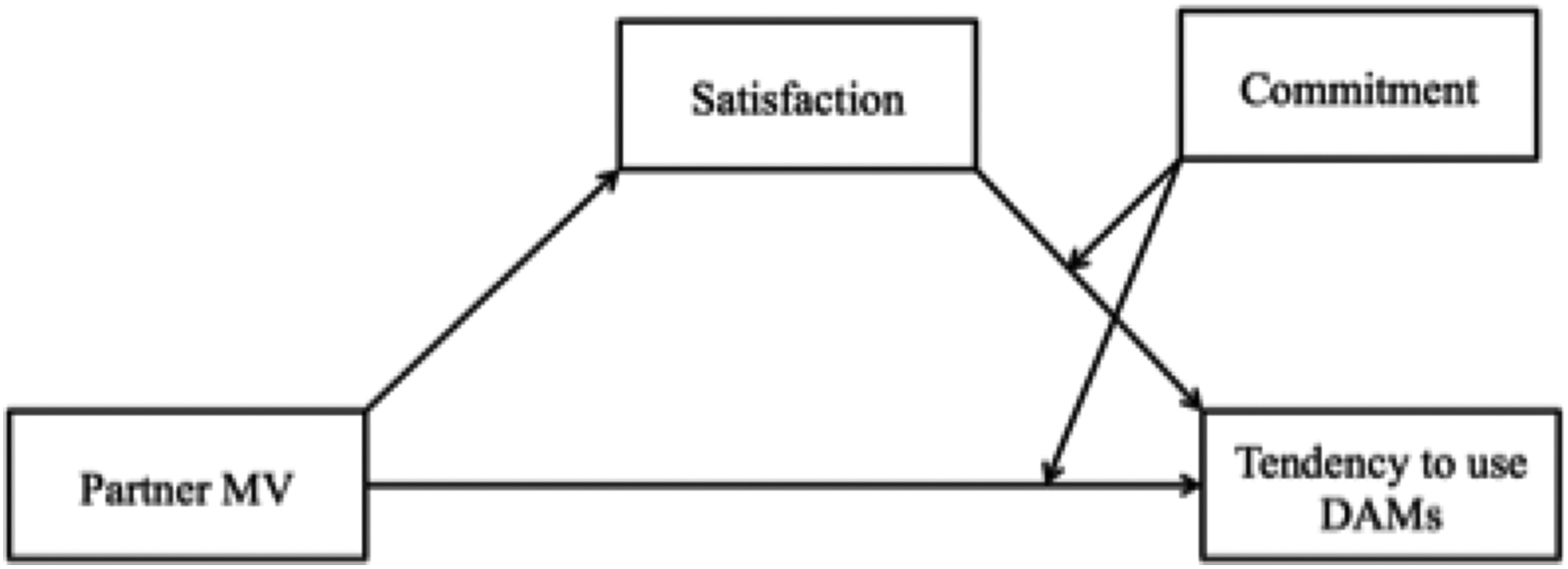
Visual representation of the moderated meditational relationship.
Moderated Meditational Model Results and Statistics.

Note. Interactions: Interaction 1: Satisfaction × Commitment; Interaction 2: PMV × Commitment. PMV = partner mate value; LLCI = lower limit confidence interval; ULCI = upper limit confidence interval.
Conditional Direct Effects of Partner Mate Value on Tendency to Use Deceptive Affectionate Messages at Varying Values of Commitment.

Note. LLCI = lower limit confidence interval; ULCI = upper limit confidence interval.
Indirect Effect of Satisfaction on the Relationship Between Partner Mate Value and the Tendency to Use Deceptive Affectionate Messages at Varying Levels of Commitment.

Note. LLCI = lower limit confidence interval; ULCI = upper limit confidence interval.
Discussion
DAMs are messages sent by one individual to another that intentionally convey more affinity for the receiver than the sender is experiencing in the moment the message is sent (Horan & Booth-Butterfield, 2011). In considering DAMs as a strategically chosen mate retention tactic, the current study set out to investigate how such messages might be related to and influenced by the perceived value of a romantic partner and two aspects of the relational climate: commitment and satisfaction. Contrary to the study’s predictions, PMV and the tendency to engage in DAMs were significantly and negatively associated with one another. Analyses further indicated that commitment significantly moderated the negative association between PMV and DAMs. The present study also provided evidence that when commitment to the relationship is low, satisfaction mediates the negative relationship between PMV and DAMs.
The original logic that led to the hypothesized positive association between PMV and DAMs (Hypothesis 1) suggested that when individuals felt that their partner was more valuable, they would be more open to engaging in many forms of mate retention tactics, even those that carried a degree of risk. As previously explained, DAMs carry a potentially high cost if they are not successfully enacted, as the detection of deception may prove to be a considerable blow to the relationship (Jang, Smith, & Levine, 2002; McCornack & Levine, 1990; Planalp & Honeycutt, 1985). The results of Hypothesis 1, however, paint a different picture of how PMV may be associated with DAMs. More specifically, the results of this study indicated that as individuals value their partner more, they are less likely to place their relationship at risk by engaging in DAMs.
This finding might be interpreted in several ways. First, it suggests that individuals who place high value on their partner will not do anything to retain him or her (e.g., berate, deceive, or conceal information from him or her), but rather that they carefully select from a range of functional tactics to avoid risk and protect their relationship from harm. This suggestion is consistent with previous research that has found positive associations between PMV and benefit-provisioning mate retention tactics, and negative associations between PMV and cost-inflicting tactics (DeMiguel & Buss, 2011; Miner, Shackleford, & Starratt, 2009; Starratt & Shackleford, 2012). Second, the finding might suggest that those with high-PMV mates may view the risks associated with engaging in DAMs as outweighing the potential benefits. Those with high-PMV mates may value their partner and their relationship so much that they evaluate even the relatively low risk typically associated with DAMs as too high. Third, it is possible that individuals with high-PMV mates do not have as much opportunity to enact DAMs as do those with low-PMV mates because, on average, they feel more genuine affection for their partners.
Although the findings of Hypothesis 1 were unexpected, they fit nicely with the results associated with Research Question 1. Commitment was found to moderate the negative association between PMV and DAMs. Thus, for individuals who feel they have a valuable partner and who are also highly committed to said partner, the likelihood of using a DAM to preserve the relationship may be even less than for those who are not as committed. Again, there is research that supports this pattern of results. Across a host of studies, greater levels of commitment have been found to motivate a variety of prosocial relationship behaviors, ranging from conflict resolution to positive cognitive biases to openness and inclusion in the social network (Dailey, Hampel, & Roberts, 2010; Rusbult, Van Lange, Wildschut, Yovetich, & Verette, 2000; Rusbult, Verrette, Whitney, Slovik, & Lipkus, 1991). Further, lower levels of commitment have been associated with an increased tendency to use negative maintenance behaviors such as jealousy inductions, infidelity, avoidance, and spying (Goodboy, Meyers, & Members of Investigating Communication, 2010; Pytlak, Zerega, & Houser, 2015). DAMs might be conceived of as fitting into a category of behaviors associated with negative maintenance or mate retention strategies insofar as the behaviors associated with enacting said DAMs are employed in the service of avoiding undesired relational events or outcomes. Indeed, avoidance of topics or interactions that might lead to arguments or turbulence has been conceptualized both as a negative maintenance behavior and as a motivating factor underlying DAMs (Dainton & Gross, 2008; Horan & Booth-Butterfield, 2013). Thus, commitment’s moderating role on individuals’ tendency to use DAMs is supported by prior research.
The findings from Research Question 2 further enhance the picture that is sketched out by the results of Hypothesis 1 and Research Question 1. Satisfaction was found to mediate the relationship between PMV and individuals’ tendency to engage in DAMs. However, post hoc analysis revealed that this mediating relationship was only significant for individuals who felt low levels of commitment toward their partners. For individuals experiencing either moderate or high levels of commitment toward their partner, satisfaction does not significantly intervene in the negative association between PMV and DAMs. By contrast, in the case that individuals are not particularly committed to their partner, satisfaction does influence this relationship. For those who are not highly committed, but who are highly satisfied, the tendency to use DAMs is diminished. In the case that individuals are neither highly committed nor highly satisfied, the negative relationship between satisfaction and DAMs is further weakened. A high-level explanation for this complex pattern of results can be derived from the postulate of AET that specifies that humans vary in their desired level of affection (Floyd, 2006). It may be that, as relationships exist at the intersection of different levels of commitment and satisfaction, individuals’ assessment of their partner’s desired level of affection fluctuates. To accommodate these shifting perceptions, individuals may find themselves more or less inclined to use DAMs to meet the moving target of their partner’s need for affection.
Another explanation for why commitment moderates satisfaction’s mediating role in this way draws more from the investment model (Rusbult, 1986) than from AET. Scholars have conceived of commitment as a stable and long-term orientation toward keeping the current relationship functioning and alive (Arriaga & Agnew, 2001; Rusbult & Buunk, 1993). Consistent with conceptualizations of the interplay of commitment and satisfaction as specified in Rusbult’s (1986) model, commitment may impact the ways that individuals’ more fleeting affective orientation toward their relationship (i.e., their satisfaction) influence the behaviors they choose to engage in toward their partners. That is to say that commitment may shape the considerations that individuals make when they evaluate their options for maintaining their relationship. If low satisfaction and low commitment are coupled together, individuals may find risky or negative maintenance or retention tactics like DAMs to be somewhat more tolerable or acceptable. However, if commitment to the relationship is moderate or high, these tactics may be dismissed in order to ensure the survival of the relationship, irrespective of the current and somewhat temporary state of relational satisfaction.
Individuals’ judgment about whether to employ DAMs is potentially attributable to their assessments of the ratio of the costs and benefits associated with DAMs. As commitment increases, the potential cost of losing the relationship becomes increasingly aversive, while the benefits accrued by selecting a potentially risky tactic (e.g., DAMs) over a more benign choice (e.g., love and care) remain the same. As such, people may eschew DAMs and pursue a more positive or prosocial retention strategy instead. Indeed, AET suggests that the need to give and receive affection is innate and invaluable to relational stability (Floyd, 2006). Thus, even though the tendency to engage in DAMs may decrease, other forms of affectionate communication may occur in its stead. Additionally, as commitment increases, individuals may believe that their relationship is strong enough to endure whatever troubling situation DAMs might be used to avoid or soften. There is also some evidence to suggest that retention tactics (both positive and negative) decline as couples maintain high levels of commitment over time (Kaigobadi, Shackleford, & Buss, 2010).
Commitment, however, did not significantly moderate the association between PMV and satisfaction. This is potentially surprising, as satisfaction and commitment are usually positively related (e.g., Lemay, 2016; Pytlak et al., 2015; Weigel & Ballard-Reisch, 2008). One simple explanation for this finding may be that while commitment is strongly linked to a host of relationship behaviors (reviewed above and also see Weigel, 2008; Weigel & Ballard-Reisch, 2002), satisfaction is not a behavior and thus the interplay between PMV, commitment, and satisfaction may function differently than it would if behavioral variables were examined. Feeling more committed to a partner might encourage individuals to engage in more behaviors that contribute to preserving the relationship (e.g., resolving conflict prosocially). However, the same increased levels of desire for the relationship to continue may not necessarily influence satisfaction with the relationship. For example, high levels of shared or invested resources (e.g., property, children) in a relationship may contribute to increased commitment and commitment-related behaviors, but may not influence the way individuals feel about their relationship, as specified in much writing on the investment model (Rusbult, 1986).
Another explanation may relate to one of the several limitations present in this study. Commitment may have moderated the association between PMV and satisfaction if an alternative measure of satisfaction had been used (i.e., the measure proffered by the investment model). Given that measures of satisfaction tend to reflect the same underlying construct, and are highly intercorrelated (Fincham et al., in press), this qualification does not likely represent a threat to the validity of the results. Another limitation regarding measurement is the self-reported nature of the data. A social desirability bias may have affected individuals’ reports of their tendency to lie to their partners. A final issue of measurement lies in the use of Cole’s (2001) deception scale. While consistently employed in research related to DAMs, the scale has yet to be subjected to rigorous statistical analysis to interrogate individual items and factor structure. While the scale’s structure is neither the main focus nor the driver of value for the current study, these questions represent an important task that should be taken up in future research on DAMs.
Additionally, as data for this study were collected as part of a larger project, only individuals in heterosexual relationships were surveyed. An interesting and important avenue moving forward exists in determining if the pattern of results found here would hold in relationships composed of individuals with more diverse sexual identities. Further, it might be important to analyze the role that geographic location plays in considering the relationship between PMV and DAMs. For example, in locations where there are considerably more available mates or alternatives, is the relationship between PMV and DAMs strengthened or weakened? Answering such questions would contribute substantially to researchers’ ability to establish the generalizability of their results. For researchers interested in continuing to examine the association between PMV and DAMs, there is certainly value in seeking out other mediators and moderators of the relationship, such as relational uncertainty, jealousy, or individual difference variables. It may also be interesting to determine whether DAMs vary by situation (i.e., public vs. private settings) or relationship type (e.g., married, engaged, and seriously dating).
Conclusion
Both affection and deception appear to be common components of relationships. As such, continued investigation of each as well as their nexus provides an open and fertile space for thought that may impact many individuals in a meaningful way. As suggested by Horan and Booth-Butterfield (2011), continuing to explore phenomena associated with DAMs may help us to better understand how they operate as both functional and dysfunctional aspects of relationships and deepen our knowledge of individuals’ relational lives.
Footnotes
Declaration of Conflicting Interests
The author(s) declared no potential conflicts of interest with respect to the research, authorship, and/or publication of this article.
Funding
The author(s) received no financial support for the research, authorship, and/or publication of this article.