




Abstract
Heterosexual men, as opposed to heterosexual women, desire mates who experience same-sex attractions and are willing to have same-sex sexual contacts. Yet not all men share such desires, and the current study aims to examine whether the male preferences for same-sex attraction and contact are predicted by desires for sexual variety and having sex without commitment. Using an online sample of 1,277 Greek-speaking participants, we found that men and women who experienced same-sex attractions and desired sexual variety and sex without commitment were more likely to prefer same-sex attraction and contact in a partner. Moreover, we found that a considerable proportion of heterosexual men, but only a small proportion of heterosexual women, preferred same-sex attraction and contact in partner. This sex-difference was statistically significant even after the desire for sexual variety and sociosexual orientation were controlled for.
Heterosexual people prefer as romantic partners opposite-sex heterosexual individuals. There appears to be, however, an exception to this rule, as a substantial proportion of heterosexual men prefer as partners women who are also attracted to women and who have sex with other women (Apostolou, Shialos, Khalil, & Paschali, 2017). Men appear to be divided in their preferences (Apostolou & Christoforou, 2018b), and the current study aims to address the question why some men prefer same-sex attraction and contact in a partner and others do not. It aims further to replicate previous findings in a different sample, as well as to examine whether the sex-difference in preferences for same-sex attraction and contact, with men being considerably more likely to exhibit such preferences than women, was due to men’s higher desire for sexual variety and willingness to have uncommitted sex, or whether it constituted a distinct set of preferences for which a sex-difference has been present.
Why Men Like Women Who Like Women
Men, as opposed to women, can increase their reproductive success by having sex with multiple partners (Buss, 2017; Buss & Schmitt, 1993). Yet, in doing so, they face constraints, one of which is their actual partner. In particular, if a woman’s male partner has sex with other women, she risks losing him and his investment to other women. Thus, women have evolved to demand exclusivity from their partners (Buss, 2017). It has been proposed that a strategy which men adopt to circumvent this constrain is to prefer as partners women who are attracted to other women (Apostolou et al., 2017). In a scenario where a man has a female partner who is also attracted to women, he can gain sexual access to these women with his partner’s consent. In a recent study, heterosexual women were asked whether they would be willing to have sex with another woman in order to satisfy their partners who would also participate (Apostolou & Christoforou, 2018a). It was found that, women who experienced same-sex attractions were considerably more willing to do so than women without such attractions.
It has also been argued that preferring women with same-sex attractions could enable men to reduce the risk of being cuckolded (Apostolou et al., 2017). More specifically, because men do not give birth to their children, they are uncertain about paternity. Men have evolved mechanisms, such as jealousy, that enable them to reduce this risk (Buss, 2000; Easton, Schipper, & Shackelford, 2007). A male preference for same-sex attraction in women could also act as a protection mechanism. A woman cheating with other women does not incur a risk of being cuckolded, as it does not lead to conception. It can actually reduce this risk because a woman who experiences same-sex attractions is more likely to cheat with a woman than with a man, in contrast to a woman without such attractions. Accordingly, it was found that heterosexual women with same-sex attractions were much more willing than women without such attractions to cheat with a woman than with a man (Apostolou & Christoforou, 2018a).
On the other hand, women’s reproductive success or fitness is not contingent to the number of sexual partners they have, and women do not face the risk of being cuckolded. Accordingly, there is no selection pressure on them to evolve a preference for same-sex attraction in an opposite-sex partner. Overall, this theoretical framework predicts that heterosexual men would prefer same-sex attraction and contact in a partner, but heterosexual women would not.
Consistent with this prediction, one study employed a Greek-speaking sample and found that about one in five heterosexual men indicated a desire for their long-term partners and about one in three for their short-term partners, to be attracted to and have sex with women (Apostolou et al., 2017). The vast majority of heterosexual women did not share these preferences. A subsequent study, which also employed a Greek-speaking sample, produced similar results (Apostolou & Christoforou, 2018b). It was further found that men preferred same-sex attraction and contact more in a short-term than in a long-term partner, while they indicated a stronger preference for their partners to engage in same-sex contacts where they would also participate rather than to engage in same-sex contacts without themselves participating. Another study found that, across different cultural contexts, heterosexual men were considerably more likely than heterosexual women to prefer same-sex attraction and contact in a partner (Apostolou, Wang, & Jiaqing, 2018). It was also found that, heterosexual participants who experienced same-sex attractions indicated a stronger preference for same-sex attraction and contact in a partner than exclusively heterosexual participants.
Mating Strategies
Despite the possible fitness benefits of having female partners who experience same-sex attractions and have sex with other women, not all heterosexual men share these preferences: About half prefer same-sex attraction and contact in a partner and about half do not (Apostolou & Christoforou, 2018b). The proposed evolutionary theoretical framework does not explain why not all men exhibit such preferences.
One possibility is that preferences for same-sex attraction and contact constitute a part of the repertoire of a short-term mating strategy that not all men adopt. More specifically, people can adopt a long-term mating strategy that involves having few partners, having children with them, and investing heavily to these children. Otherwise, they can adopt a short-term mating strategy that involves having casual sex with many partners without investing much to children coming from these relationships. People can also adopt a mixed strategy that involves adopting a combination of long- and short-term strategies; having, for instance, a long-term partner; and investing heavily to children that come from this relationship, but in parallel exploit opportunities for casual sex (Buss & Schmitt, 1993, 2018).
A preference for same-sex attraction and contact may constitute part of the repertoire of a short-term mating strategy. That is, in a short-term mating strategy, men increase their fitness by having sex with many different partners. Having as a casual partner a woman who experiences same-sex attractions and is willing to have sex with other women facilitates the adoption of a short-term mating strategy. Thus, if some men adopt a long-term mating strategy, others a short-term mating strategy, and others a mixed strategy, assuming that the preference for same-sex attraction and contact is part of the repertoire of the short-term mating strategy, then it would be observed in some men (those who adopt the short-term or the mixed-mating strategies) and not in others (those who adopt the long-term mating strategy).
One goal of the current study is to examine whether men’s preferences for same-sex attraction and contact are actually predicted by their adoption of a short-term mating strategy. More specifically, a short-term mating strategy involves two key components, namely a desire for sexual variety and willingness to have sex without commitment. If men do not desire to have sex with different partners, they would not be motivated to engage in a short-term mating strategy. Moreover, a short-term mating strategy is characterized by limited or no commitment; thus, men who were unwilling to have sexual contact without commitment would not be able to adopt a short-term mating strategy. In effect, a high willingness to engage in sex without commitment (frequently called unrestricted sociosexuality, see Simpson & Gangestad, 1991) and a high desire for sexual variety indicate the adoption of a short-term or a mixed-mating strategy. Accordingly, in the current study, we aim to examine whether the preferences for same-sex attraction and contact are predicted by the adoption of a short-term or mixed-mating strategy, proxied by a preference for sexual variety and willingness to have sex without commitment.
Explaining the Sex-Difference
Men’s unlike women’s fitness is proportional to the number of different sexual partners they have access to (Buss & Schmitt, 1993). The reason is that men are not constrained by pregnancy, and thus, they can inseminate many different women in a very short time period. Thus, it is more beneficial for men than for women to adopt a short-term mating strategy. Consistent with this prediction, men have been found to have a higher desire for sexual variety (Buss & Schmitt, 1993; Schmitt, 2003) and are more likely to have unrestricted sociosexuality (Lippa, 2009; Schmitt, 2005; Simpson & Gangestad, 1991).
On this basis, it could be argued that the male preference for same-sex attraction and contact does not constitute a distinct preference but a manifestation of male desires for sexual variety and sex without commitment. This being the case, the sex-difference in this preference reflects only sex-differences in desire for sexual variety and willingness to have sex without commitment. Accordingly, the current research aims further to examine whether the sex-difference found in previous studies can be accounted by sex-differences in these two dimensions.
Method
Participants
The study was designed and ran online in a private university in the Republic of Cyprus. The link of the study was forwarded as a Facebook ad to participants residing in Greece. The target group was set to be men and women who were 18 years old or older. Given that the study was designed to assess the preferences of heterosexual people, only the responses of participants who indicated that they were heterosexual were included. To this end, data from 1,277 heterosexual Greek-speaking participants (552 women, 725 men) were included in the analyses. The mean age of women was 26.5 (SD = 9.2), and the mean age of men was 34.7 (SD = 11.8).
Materials
The survey questionnaire was written in Greek and consisted of six sections. In the first section, participants were asked to indicate their preference for the statement “I would prefer as a long-term mate an individual who is attracted:” which was then followed by a similar question that was posed for a short-term mate. Participants could choose one of the following options as a response: “only to members of the opposite-sex,” “predominantly to members of the opposite-sex but occasionally to members of the same-sex,” “to both sexes equally,” “predominantly to members of the same-sex but occasionally to members of the opposite-sex,” and “only to members of the same-sex.” The order of presentation of the partner type and the five options was randomized across participants.
In the second section, participants were asked to respond to the following statement “When I am in a long-term relationship, I would prefer that my partner has sexual contacts with individuals of the same-sex” and to a similar one for a short-term relationship. In the third section, participants were asked the same question for a short- and a long-term partner, with the difference that they would also participate in the sexual act. In both statements, participants were provided with three possible answers: “never,” “occasionally,” and “frequently.” The order of presentation of the two statements and the three options was randomized across participants.
In the fourth section, the desire for sexual variety was measured using the number of partners measure (Buss & Schmitt, 1993), which contained 11 open-ended scales for evaluating the number of sexual partners desired at differing time intervals over different periods of time ranging from “1 month” to “your remaining lifetime.” In order to ensure consistency, the instrument was translated in Greek and translated back in English. In the fifth section, in order to measure willingness to have uncommitted sex, we employed the revised Sociosexual Orientation Inventory (SOI-R), which consisted of nine questions (Penke & Asendorpf, 2008). The instrument was also available in Greek, so no translation was necessary. Finally, in the sixth section, demographic information was collected including age, sex, and sexual orientation. The order of presentation of the first three sections was randomized across participants.
Results
Occurrence
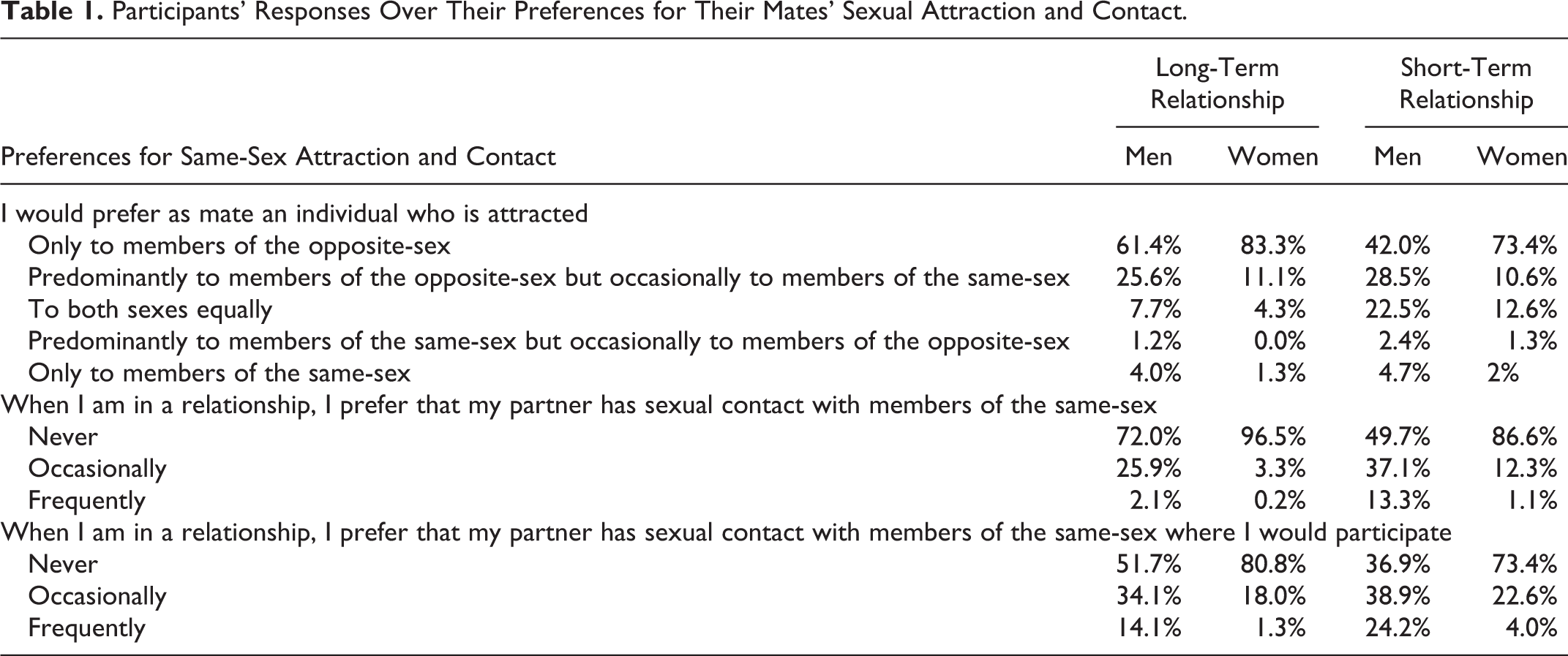
In order to investigate the occurrence of preferences for same-sex attraction and contact, we calculated the frequencies of participants’ answers in the relevant questions of the study. The results are presented in Table 1, where we can see that nearly 40% of men preferred same-sex attraction in a long-term partner and nearly 60% in a short-term partner, with the rates being considerably lower for women. Similarly, nearly 30% of men preferred their long-term partners, and nearly 50% preferred their short-term partners, to have sex with other women. These rating increased to nearly 50% and nearly 65%, respectively, for the scenario where they would also participate in the sexual act. For women, in all cases, the rates were considerably lower.
Participants’ Responses Over Their Preferences for Their Mates’ Sexual Attraction and Contact.
On the basis of their responses, we grouped participants in four groups, namely those who preferred same-sex attraction/contact in both short-term and long-term partners, only in short-term partners, only in long-term partners, and in neither short-term nor long-term partners. The results are presented in Table 2, where we can see that more than 61% of men preferred same-sex attraction, with the most frequent case being same-sex attraction to be preferred in both short- and long-term partners. Similarly, more than 67% of men preferred their partners to have sex with other women where they would participate, with same-sex contact preferred in both short- and long-term partners being the most frequent case.
Significant Sex, Desire for Sexual Variety, and Sociosexuality Effects on the Categories of Preferences.

Note. OR = odds ratio.
aThe reference category is “exclusively heterosexual.”
*p < .05. **p < .001.
Predictors of Preferences for Same-Sex Attraction and Contact
In order to examine whether desire for sexual variety and willingness to have sex without commitment predicted whether men would exhibit preferences for same-sex attraction and contact, we created a new variable, named sexual variety, by summing scores of participants’ answers in each of the 11 scenarios and dividing them by their number. With respect to the willingness to have sex without commitment, on the basis of the scoring instructions of the SOI-R, we estimated a variable that indicated global sociosexuality. As discussed previously, the desire for sexual variety and the desire for sociosexuality are related. Spearman’s ρ indicated a moderate correlation between the sociosexuality variable and the desire for sexual variety (r = .61).
Accordingly, in order to avoid the problem of multicollinearity, we applied the following procedure: We ran a regression, where the mean number of partners variable was entered as the dependent variable, and the sociosexuality was entered as the independent variable. We saved the residuals as a new variable, which reflected the desired number of sexual partners that was not explained by sociosexuality. Note that, due to the presence of extreme values, the errors were not normally distributed, so we applied a log transformation (log 10) on the mean number of partners variable. For subsequent analysis, we employed this variable as a measure of the desire for sexual variety.
In more detail, we ran a series of multinomial regressions, where the different categories of preferences in Table 2 were entered as the dependent variables, and the desire for sexual variety, sociosexual orientation, and age were entered as the independent variables. Although we did not have a prior hypothesis, we investigated whether sexual orientation (exclusively heterosexual, heterosexual with same-sex attractions) had an effect, so we have entered it as an independent variable. The analysis was performed separately for men and for women. As we can see from Table 2, having same-sex attraction, scoring high in sexual desire, and having more unrestricted sociosexuality increased considerably the probability of preferring than not preferring same-sex attraction and contact in a partner for both male and female participants.
We investigated also whether the preference for same-sex attraction and contact was present in exclusively heterosexual men who scored low in desire for sexual variety and willingness to have sex without commitment. Accordingly, we estimated the frequencies for the different categories of Table 2. Those who were exclusively heterosexual scored up to 30 in sociosexuality (the sociosexuality score was normally distributed around a mean score of about 40) and indicated a mean number of up to 10 partners. We found that 34.7% preferred same-sex attraction in any partner type, 17.8% preferred same-sex contact in any partner type, and 31.2% preferred same-sex contact where they would participate in any partner type.
Significant Sex-Differences
We proceeded with investigating the statistical significance of the sex-differences observed in Table 1, by controlling for the preference for sexual variety and willingness to have sex without commitment. For this purpose, we ran a multinomial regression, where the long-term partner’s sexual orientation was the dependent variable, and participants’ sex, sexual orientation (exclusively heterosexual, heterosexual with same-sex attractions), age, desire for sexual variety (mean number of partners), and sociosexuality scores were the independent variables. The model could not be fitted because there were very few observations in the “homosexual with opposite-sex attractions” category. To work around this problem, this category and the “exclusively homosexual” categories were collapsed into a new category, namely “predominantly homosexual.” The analysis was repeated for the short-term partner scenario.
The results are presented in Table 3, where we can see that all independent variables were statistically significant. Men were more likely to prefer same-sex attraction than women; for instance, men were 5.23 times more likely than women to prefer as a short-term partner a woman who was heterosexual with same-sex attractions than exclusively heterosexual. Heterosexual individuals with same-sex attractions were more likely to prefer same-sex attraction in a partner. For example, those who experienced same-sex attractions were 4.83 times more likely than those who did not, to prefer as long-term mates heterosexual individuals with same-sex attractions than exclusively heterosexual individuals.
Significant Sex, Desire for Sexual Variety, and Sociosexuality Effects.

Note. The first p value for each scenario refers to the χ2 while the rest refer to the Wald statistic.
aThe reference category is women.
bThe reference category is “exclusively heterosexual.”
cThe reference category is “Exclusively heterosexual.”
dThe reference category is “never.”
The mean number of partners was also significant, with a higher desire for sexual variety to indicate a higher probability to prefer same-sex attraction in a partner. For example, a 10-fold increase in the number of desired partners increased the probability to prefer as a partner an individual who was heterosexual with same-sex attractions than exclusively heterosexual by 45%. Note that such interpretation is appropriate because the independent variable was measured in logs of 10. Finally, an increase in sociosexuality was associated with an increased probability to prefer same-sex attraction in a partner. For instance, one unit increase in the sociosexuality score (moving thus toward unrestricted sociosexuality) increased by 5% the probability to prefer as a short-term partner a heterosexual with same-sex attractions than an exclusively heterosexual individual.
This analysis was repeated, with the participants’ responses for the same-sex contact of their short- and long-term partners entering as the dependent variables. For the scenario of the same-sex contact of a long-term partner, the model could not be fitted because there were very few responses from female participants to the category “frequently.” To work around this problem, the “occasionally” and the “frequently” categories were collapsed to a single category. The results are presented in Table 3, where we can see that all independent variables were statistically significant. Men and participants who experienced same-sex attractions were considerably more likely to prefer their partners to have same-sex contacts than women and participants without same-sex attractions. In addition, participants who indicated a higher desire for sexual variety and had more unrestricted sociosexuality were more likely to prefer same-sex attraction and contact than those who indicated a higher desire for sexual variety and had more restricted sociosexuality.
Discussion
Consistent with the predictions of our theoretical framework and the results of previous research, we found that a considerable proportion of heterosexual men, but only a small proportion of heterosexual women, preferred same-sex attraction and contact in a partner. We also found that this difference persisted even after controlling for desire for sexual variety and sociosexual orientation. In addition, we found that men and women who experienced same-sex attractions and desired sex without commitment and sexual variety were more likely to prefer than not to prefer same-sex attraction and contact in a partner.
The latter findings can enable us to better understand why not all men prefer same-sex attraction and contact in a partner. Same-sex attraction and contact can be more beneficial when adopting a short-term than a long-term mating strategy (Apostolou et al., 2017); thus, men who adopt the latter may be less likely to indicate a preference for same-sex attraction and contact in a partner. Furthermore, the significant effect of sexual orientation may explain why some women prefer same-sex attraction in a partner. In particular, such preferences most likely reflect preferences for assortative mating in this dimension (Apostolou et al., 2018, see also Figueredo, Sefcek, & Jones, 2006) rather than an actual preference for same-sex attraction in a partner.
It could be argued that same-sex attraction and contact are more beneficial to men adopting a long-term strategy because the risk of cuckoldry is more relevant in this scenario. However, in terms of decreasing the risk of cuckoldry, same-sex attraction and contact may be more beneficial for men in a short-term than in a long-term relationship. A man in a long-term relationship has more control over his partner’s sexual behavior and is, thus, more certain about paternity than a man who is in a short-term relationship, which is less committed. If we make the assumption that a man would not walk away if his casual partner gets pregnant but will invest to the child born, he then faces a higher risk of cuckoldry than a man who is not in such a relationship. Therefore, it would potentially be more beneficial for him to engage in casual relationships with women who exhibit same-sex attractions and are, thus, less likely to get pregnant from other men than women without such attractions.
Our results indicate further that the sex-difference in the preference for same-sex attraction and contact does not reflect sex-differences in the desire for sexual variety and contact but a genuine sex-difference in this preference. In turn, this finding can be interpreted to support the prediction of the proposed theoretical framework that men have evolved a specific preference for same-sex attraction and contact in an opposite-sex partner. Nevertheless, in order to reach more solid conclusions, controlling for more independent variables is necessary.
One limitation of the current research is that we employed a nonprobability sample. Thus, the observed prevalence rates may not reflect the true population prevalence rates. In addition, the current study was confined to the Greek culture. Attitudes toward same-sex attraction and their moderation by gender are likely to vary across cultures, so what we have found here may not be the same in different cultural contexts. In addition, some participants may have misunderstood the questions or inaccurately reported their sexuality. Such errors can account for the observation that a few participants indicated that they would prefer their mates to be attracted predominantly or only to members of the same-sex. Furthermore, there may be additional variables which could affect the observed sex-difference in preferences and which have not being controlled here. For instance, there may be sex-differences in preferences for risky situations or sex-differences in specific personality dimensions, which moderate the observed preferences. Future research may attempt to measure additional factors, which can affect the observed results.
Last but not least, our data were self-report and thus subject to different biases. For instance, participants may not have been aware that they preferred same-sex attraction and contact in a partner, or they may have been unwilling to admit it. Accordingly, future studies could benefit from using other than self-report measures for preference for same-sex attraction and contact. For instance, an experimental study could ask heterosexual participants to imagine their current partner to have sex with an individual of the same-sex and record physiological responses indicating arousal.
In conclusion, the current study offers evidence that enable us to augment our understanding of male preferences for same-sex attraction and contact. Much more research is necessary, however, in order to better understand individual differences in these preferences.
Footnotes
Declaration of Conflicting Interests
The author(s) declared no potential conflicts of interest with respect to the research, authorship, and/or publication of this article.
Funding
The author(s) received no financial support for the research, authorship, and/or publication of this article.
