




Abstract
The current study sought to answer three key questions about explaining the emotion of regret in the domain of casual sex: Are sex differences in sexual regret robust or attenuated in a highly egalitarian culture? What proximate psychological variables might explain sex differences in sexual regret? And what accounts for within-sex variation in experiences of sexual regret about casual sex. We conducted a study of 263 Norwegian students (ages 19–37) who reported how much they regretted having either engaged in, or passed up, their most recent casual sexual experience. Sex differences in sexual regret are not attenuated in this sexually egalitarian culture. The study revealed sex differences in worries about pregnancy, STIs, and reputation; however, these predictors did not succeed in accounting for the sex differences in regret engaging in casual sex. Sexual gratification and socio-sexual orientation both predicted the sex differences in casual sex regret. In contrast, only socio-sexual orientation attenuated the sex difference in regret passing up casual sex. Predictors of within-sex variation in casual sexual regret included worry about sexual reputation, experienced gratification during the encounter, and socio-sexual orientation. Discussion focuses on implications for the psychological design features of this relatively neglected emotion.
The emotion of regret has gained increasing attention from an evolutionary perspective (e.g., Galperin et al., 2013; Roese et al., 2006). Given the centrality of sex to reproduction, a good case can be made that sexual conduct is a particularly important domain for experiencing regret. Prior research has found that although women and men tend not to differ in their experiences of regret in general, a major exception occurs within the romantic and sexual domains. Roese et al. (2006) found that men and women did not differ in their regrets about having had sex but men, more than women, regretted missed sexual opportunities in the past. Eshbaugh and Gute (2008) reported that reproductive sexual acts (intercourse) predicted regret in women after sexual hookups, while nonreproductive sexual acts such as oral sex did not predict regret. These findings have been interpreted as being consistent with parental investment theory (Trivers, 1972) and sexual strategies theory (Buss & Schmitt, 1993). Recently, Galperin et al. (2013) hypothesized that regret, or anticipated regret, may be an evolved emotional–cognitive evaluation mechanism serving the specific function of avoiding past errors in decision-making, thus improving future decision-making, in this case about sexual decisions.
Although both sexes sometimes experience regret about casual sex decisions, following the logic of sexual strategies theory (Buss & Schmitt, 1993), they differ in which aspects of casual sex that they regret (Galperin et al., 2013). This is due to selective pressures ultimately stemming from a large asymmetric difference in obligatory parental investment. Men and women are expected to differ in which casual sex decisions they regret more—having had casual sex with the wrong partner versus passing up casual sexual opportunity. Because errors in sexual decisions are typically costlier for women, women are hypothesized to regret sexual actions that involve making a poor sexual partner choice or having sex in unpropitious circumstances. Conversely, men are hypothesized to regret missed casual sexual opportunities more than women because historically a man’s reproductive success was constrained primarily by the number of fertile women to whom he could gain sexual access. Both hypotheses have received empirical support, with results showing a moderate effect for having had casual sex (women regret more; Fisher, Worth, Garcia, & Meredith, 2011; Galperin et al., 2013), and a strong effect for passing up sexual opportunities (men regret more; Galperin et al., 2013; Roese et al., 2006).
Possible Proximate Explanations of Sex Differences in Casual Sexual Regret
What proximate mechanisms may account for these observed sex differences? Galperin et al. (2013) offer two possible, not mutually exclusive, alternative explanations: (1) differences in worry about consequences in the aftermath of sex, such that women worry more about pregnancy, and (2) differences in sexual gratification experienced during the sexual encounters such that men, on average, experience greater gratification than women (Fisher et al., 2011).
Despite the low risk, becoming pregnant following casual sex historically (and perhaps currently) has been costlier for women than for men. This would cause women to worry more about casual sex encounters and cause them to regret casual sex more than men (Galperin et al., 2013). Other research has shown on-average sex differences bearing on these proximate explanations: Women tend to worry more than men and are more troubled by ruminative mental processing (Nolen-Hoeksema, 2000; Nolen-Hoeksema & Jackson, 2001; Wells, 2009). Conversely, this might conceptualized as men being more hypophobic and risk-taking (Kennair, 2007; Kruger & Nesse, 2004; Wilson & Daly, 1985). However, worry about becoming pregnant following casual sex might be less relevant in populations where hormonal contraception use is common (e.g., female students in most Western societies and our population in particular; Grøntvedt, Kennair, & Mehmetoglu, 2015). On the other hand, hormonal contraception does not protect against sexually transmitted infections (STIs), and worry about contracting STIs might therefore pose a relevant problem. Men also engage in more risky sexual behavior and contract more STIs than women (Courtenay, 2000)—maybe as a result of less worry about STIs. Further, due to sexual double standards (Buss, 2013), even in a sexually liberal Western culture such as Norway (Grøntvedt & Kennair, 2013), where the current study was performed, worry about sexual reputation might be stronger among women than among men. Therefore, in addition to Galperin et al.’s (2013) suggestion that female-specific worry about pregnancy might influence casual sex regret, we suggest that increased worry among women about contracting STIs or incurring a negative sexual reputation following casual sex might be possible explanations of sex differences in sexual regret (Campbell, 2008). These explanations, of course, are not mutually exclusive—one or some combination of them could, in principle, explain the sex differences.
A number of studies on sex-related preferences, desires, and interests find that men have stronger interest in sex, enjoy sex more, are more easily stimulated and aroused, and are more open to casual sex than women (Ellis et al., 2008; Kennair, Schmitt, Fjeldavli, & Harlem, 2009; Meltzer, McNulty, & Maner, 2015). Galperin et al. (2013) suggested that because women find casual sex less physically gratifying, they will tend to regret sexual experiences more than men. However, how much and in what ways physical gratification during casual sex influence sex differences in sexual regret remains to be examined, although suggestive data reveal that quality of sexual experience may be linked to sexual regret (Fisher et al., 2011).
In addition to attempting to explain between-sex differences, another key goal of the current study is to examine individual differences in sexual regret. Individual differences in regret have received little empirical attention. Individual differences in regret may plausibly be linked with sociosexuality, a personality characteristic shown to be strongly sex differentiated, with men being less restricted across all studied cultures (Schmitt, 2005). Scoring high on the behavioral dimension of sociosexual orientation reflects more frequent casual sex and a broader range of different sexual experiences, thus giving an individual more opportunities to experience sexual regret (Simpson & Gangestad, 1991). On the other hand, short-term strategists may experience less sexual regret because casual sex is more congruent with their preferred sexual strategy. Those who are easily aroused by extrarelational partners and new encounters, characteristics of high scorers on revised Sociosexuality Orientation Inventory (SOI-R; Penke & Asendorpf, 2008), should experience less regret in the aftermath of casual sexual. In addition, no previous studies have yet considered how individual differences in worry and physical gratification may be linked to individual differences in regret.
The Current Study
The first goal of the current research is to examine whether previously documented sex differences in sexual regret can be reproduced in a sexually liberal, secularized, and highly egalitarian culture, since social role theory predicts that this key features of cultures can dramatically influence the presence or absence of psychological sex differences (Bendixen, 2014; Bendixen, Kennair, & Buss, 2015; Buss & Barnes, 1986; Eagly & Wood, 1999; Grøntvedt & Kennair, 2013; Wood & Eagly, 2007). Norway together with other Scandinavian countries during the last years have been ranked among the top nations on the Global Gender Gap Report (World Economic Forum, 2016). In comparison, the United States was recently ranked 45. In addition, Scandinavian countries are ranked among the least religious (Gallup, 2010) and among the most sexually liberal (Scott, 1998) as reflected by attitudes toward premarital sex, extramarital sex, and homosexuality. If social role theories about monomorphic psychology, and specifically sexual psychology, are correct, findings of sex differences in U.S. populations will not replicate or be diminished in more egalitarian countries, and we should not find similar patterns of sex differences in sexual regret in Norway. Second, we seek to test alternative hypotheses about different proximate explanations that may account for the sex differences in regret engaging in casual sex, notably worry about consequences in the aftermath of casual sex and physical gratification experienced during casual sex. The third goal is to examine the extent individual differences in sociosexuality may account for sex differences in sexual regret.
We tested the following hypotheses and research question:
Explorative research questions
We also wish to examine predictors of individual differences of sexual regret (for men and women separately). Specifically, we will explore (1) whether worries (about pregnancy, STIs, and sexual reputation), physical gratification during casual sex, and sociosexual orientation affect within-sex variance in regrets about having had casual sex and regrets about passing up sexual opportunities and (2) whether the factors that affect regrets are similar or different for men and women.
Method
Sample and Design
Students attending different lectures at the Faculties of Social, Natural, and Human Sciences of a Norwegian University responded to a four-page questionnaire on sexual regret. A total of 263 heterosexual students aged between 19 and 37 years reporting on their most recent casual sex incidence were eligible for analyses. Mean ages for women (n = 168) and men (n = 95) were 22.9 (SD = 2.6) and 23.5 (SD = 3.1), respectively. Sixty-one percent of the women and 66% of the men reported relationship status as “single.”
Procedure
Two research assistants, one male and one female, gave a short oral presentation of the study, “a study of sexual experiences and regret” during a lecture break. Instructions read: “The purpose of this survey is to gain more knowledge on possible sexual regret among students. The study is part of a larger collaboration among Norwegian and American researchers.” Participants were informed of the content of the questionnaire and were then invited to participate. Participation was fully voluntary and the students were assured that their responses would remain completely anonymous. Responding was done during the 15-min lecture break. No personal identification was to be written on the questionnaire. Completed questionnaires were folded and returned to a box at the podium. No course credit was given for participation.
Measures
Outcome variables
Casual sex regret
We included, from Galperin et al. (2013), 2 global items on regrets related to the most recent casual sex incidence: (1) regretting having had casual sex and (2) regretting passing up casual sex. Participants responded to the following alternatives: Not applicable—I haven’t done this (not coded), I’m glad I did it (coded 0), neutral—neither glad nor have regrets (coded 1), I regret it somewhat (coded 2), and I regret it very much (coded 3).
Predictors
In addition to sex, age, and relationship status, the below predictors were analyzed.
Worry
Six items were developed for measuring worries following most recent casual sex incident and general worries following casual sex. Three separate aspects of worry included: (1) becoming pregnant (or partner becoming pregnant), (2) contracting STIs, and (3) sexual reputation. Participants rated their level of worry on a 5-point Likert-type scale with high scores reflecting more worry.
Physical gratification
Six items were developed measuring physical gratification in relation to most recent casual sex incident and general gratification in relation to casual sex. Three separate aspects of gratification were included: (1) general sexual pleasure, (2) whether one achieved an orgasm, and (3) the subjective importance of orgasming. Participants rated their level of sexual pleasure, regularity of orgasm achieved, and orgasm importance using a 5-point Likert-type scale with high scores reflecting more gratification.
Sociosexuality
Participants completed the SOI-R (Penke & Asendorpf, 2008). Internal consistency was good for the 9-item measure (α = .86) as well as for each of the three components: SOI–Behavior (α = .86), SOI–Attitudes (α = .81), and SOI–Desire (α = .89). The three components correlated moderately (r’s between .32 and .49) were treated as separate predictors throughout the analysis. Scaling and scoring were identical to Penke and Asendorpf (2008).
All analyses were performed using Stata/IC Version 14.1 for Mac.
Results
Sex Differences
Clear sex differentiated patterns emerged for participants who reported their level of regret—having either engaged in or having passed up casual sex. As can be seen from Table 1, more women (34.2%) than men (20.4%) regretted their most recent incident of casual sex. The pattern was significantly different for women and men, χ2 (3, N = 257) = 14.61, p < .01, r τ = −.20 (Cohen’s d = .47, 95% CI [0.21, 0.73]). On the other hand, far more men (28.9%) than women (3.6%) regretted passing up casual sex the last time they had the chance. Only 43.3% of the men were glad they passed up casual sex compared to 79.3% of the women. The pattern was significantly different for the two sexes, χ2 (3, N = 259) = 45.22, p < .001, r τ = .38 (Cohen’s d = .82, 95% CI [0.70, 1.20]).
Percentages of Women’s and Men’s Responses to Most Recent Casual Sex Incident (N = 257) and Most Recent Passing Up Casual Sex Incident If Prior Casual Sex (N = 259).

Before testing whether sex differences in engaging or passing up casual sex regret could be accounted for by variables related to worry following casual sex, casual sex gratification, or sociosexuality, we need to examine the strength of sex differences in these possible moderators. For the worry measures, sex differences in the theory-expected direction were significant for two of the three aspects (see Table 2). In general, the sex effect was small to moderate as indexed by the Cohen’s d statistic. Further, sex differences in the theory-expected direction were evident for all three aspects of physical gratification when having casual sex. The sex differences were particularly strong for the orgasm measures, each showing large effect sizes. Sex differences in the theory-expected direction were evident for the three dimensions of sociosexuality.
Mean Scores on Worry, Sexual Gratification, and Sociosexuality Scores for Women and Men.
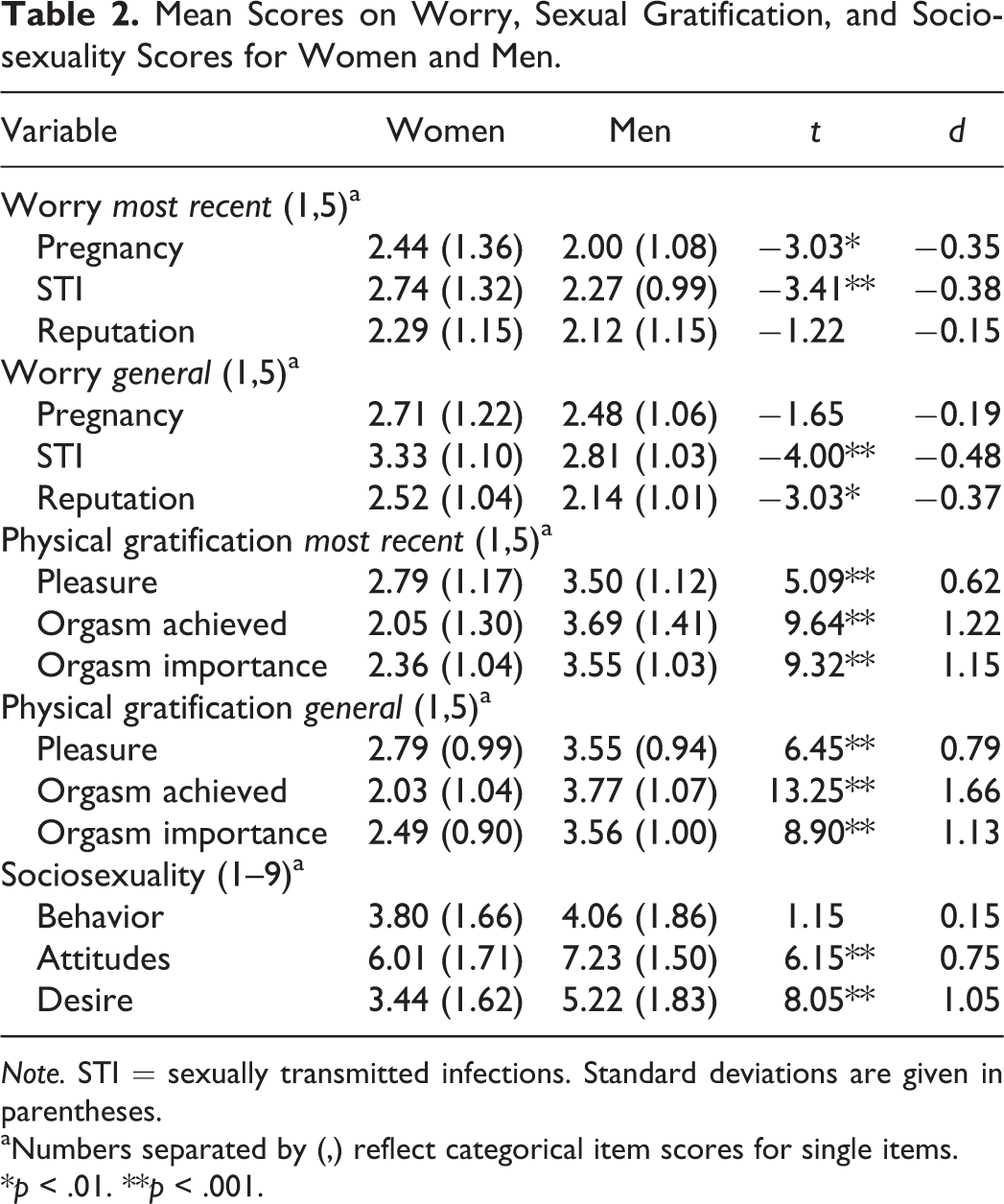
Note. STI = sexually transmitted infections. Standard deviations are given in parentheses.
aNumbers separated by (,) reflect categorical item scores for single items.
*p < .01. **p < .001.
Are Sex Differences in Regrets Following the Most Recent Casual Sex Incident Accounted for by Worry Following Casual Sex, Physical Gratification During Casual Sex, or Sociosexuality?
For predicting regret engaging in casual sex and regret passing up causal sex, respectively, we performed ordered logistic regression analyses. This statistical technique is applicable under the assumption that the levels of the dependent variable have a natural ordering (low to high), but the distances between adjacent levels are unknown (http://www.ats.ucla.edu/stat/stata/output/stata_ologit_output.htm). Demographic predictor variables were sex (women vs. men), age (continuous), and relationship status (single vs. paired). The remaining additional predictor variables were entered in separate models: Model 1, worry (pregnancy, STI, and reputation); Model 2, physical gratification (sexual pleasure, orgasm achieved, and orgasm importance); and Model 3, sociosexuality (behavior, attitudes, and desire). Initial analyses suggested that being single or being paired did not affect either casual sex or passing up casual sex regrets and revealed no Sex × Relationship Status interaction effects. Consequently, relationship status was omitted from the further regressions.
Predicting casual sex regret from participant sex and age showed that men were significantly less likely to regret than women, Z = −3.32, p < .001, OR = 0.44, suggesting that relative to women, men’s likelihood of regretting was 0.44 and women’s likelihood of regretting was 2.27 times that of men. Relative to younger participants, older participants regretted casual sex significantly less, Z = −2.48, p < .05, OR = 0.90. The effect of participant sex and age accounted for 3.0% of the variance in casual sex regret (pseudo R 2 = .030). Adding the three worry items (Model 1) did not affect the effect of participant sex and age. Men and older participants still regretted less. As shown in Table 3, participants who worried more about their reputation following the most recent causal sex incident regretted significantly more, while worries about pregnancy or sexually transmitted diseases did not affect casual sex regret. However, a marginal Sex × Worry interaction effect (Z = −1.79, p = .074) suggests that the effect of reputation worry may be moderated by participant sex. The zero-order correlation was stronger for women (r = .30) than for men (r = .01).
Ordered Logistic Regression Analyses Predicting Regret Engaging in Casual Sex From Sex and Age Controlling for Worry, Physical Gratification, and Sociosexuality.
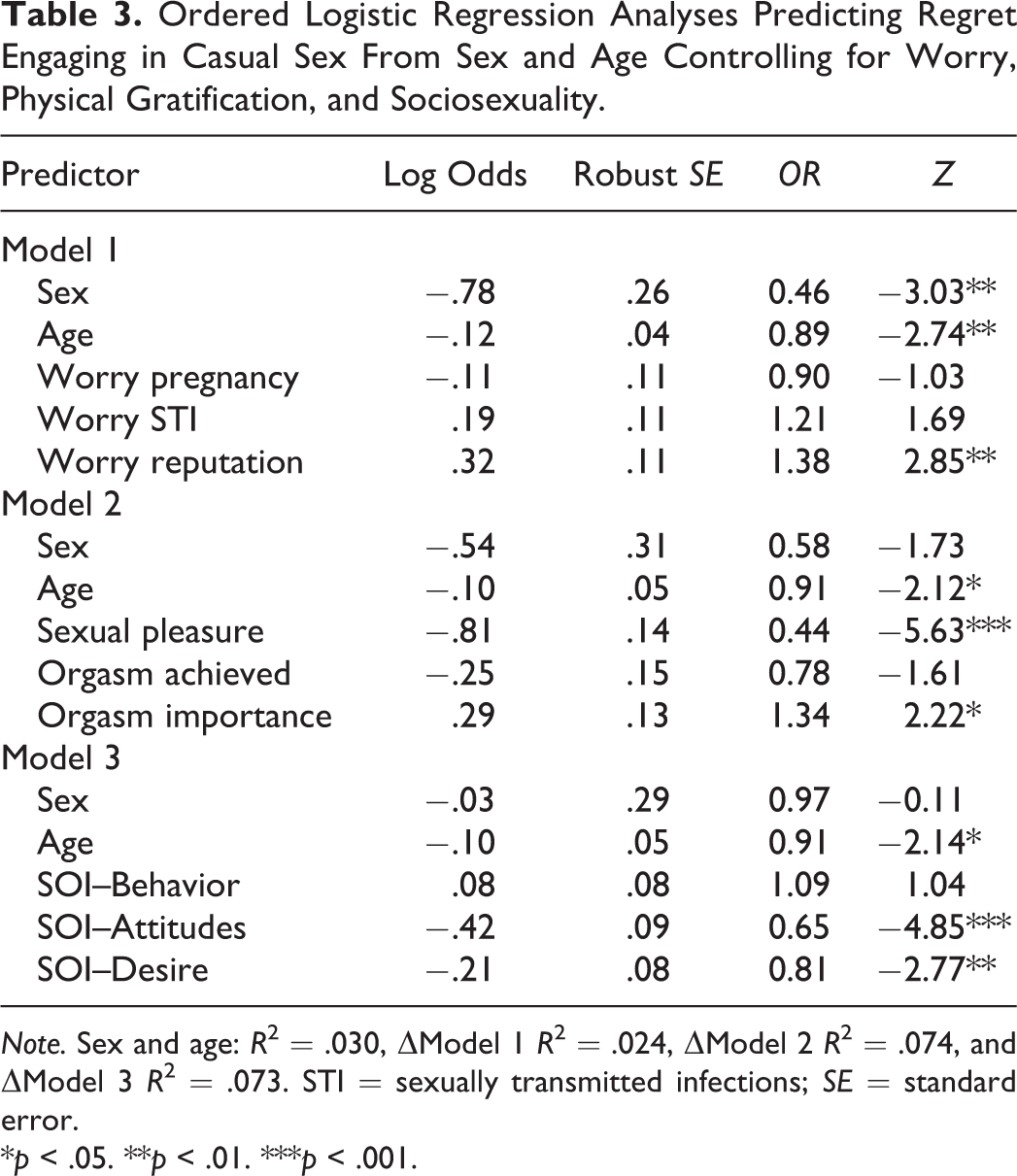
Note. Sex and age: R 2 = .030, ▵Model 1 R 2 = .024, ▵Model 2 R 2 = .074, and ▵Model 3 R 2 = .073. STI = sexually transmitted infections; SE = standard error.
*p < .05. **p < .01. ***p < .001.
In Model 2, we added the three physical gratification items to the effect of sex and age. The effect of sex was significantly reduced and no longer significant (Z = −1.73, p = .084, OR = 0.58), while the effect of age remained significant. As can be seen from Table 2, higher reported level of sexual pleasure was significantly associated with less regret and higher level of orgasm importance was associated with more regret. The latter finding is most likely an artifact because all three physical gratification items were negatively associated with regretting casual sex when analyzed individually. They all individually significantly reduced the sex effect to nonsignificant levels. However, none of the effects of the physical gratification items were moderated by participant sex (Sex × Gratification interactions were all nonsignificant).
In Model 3, we added the three sociosexuality indexes to the effect of sex and age. As seen from Table 3, sociosexuality accounted for all the sex difference in sexual regret, but older participants still regretted less than younger participants. Participants scoring high on SOI–Attitudes and SOI–Desire reported significantly less regret. These effects were not moderated by participant sex (none of the interactions were significant).
Within-Sex Predictors of Regretting Having Had Casual Sex
To investigate which of the variables included in the three model above may account for women and men’s regrets engaging in casual sex, we ran regression analyses separately for women and men controlling for age and omitting all insignificant effect from the separate models. The final model contained four predictors that accounted for 14.1% of the variance in women and two predictors accounting for 13.2% of the variance in men. The significant predictors for women were SOI–Attitudes (OR = 0.68, Z = −3.72, p < .001), sexual pleasure (OR = 0.61, Z = −3.37, p < .001), worry about reputation (OR = 1.37, Z = 2.17, p < .05), and a marginal effect for SOI–Desire (OR = 0.83, Z = −1.89, p = .059). Hence, women who worry more about their reputation, who have low physical gratification and who have a restricted sociosexuality are more likely to regret casual sex. For men, the significant predictors were sexual pleasure (OR = 0.55, Z = −2.78, p < .01) and SOI–Desire (OR = 0.72, Z = −2.53, p < .05), suggesting that men who experience less physical gratification and who have a restricted sociosexuality (low on desire) are more likely to regret casual sex.
Possible Ways Physical Gratification and Sociosexuality Account for Sex Differences in Regretting Casual Sex
Given the exceptionally strong associations between participant sex and measures of physical gratification and sociosexuality, it is unsurprising that a lion’s share of sex differences in casual sex regret disappears when controlling for the effects of these factors statistically. Therefore, a meaningful framework for interpretation is warranted. To provide further insight into how women and men differ across discrete groups of regret following casual sex (“glad” vs. “neutral” vs. “regret”), we performed a multivariate analysis of variance on the three physical gratification items as outcome variables.
There was a statistically significant difference between women and men in physical gratification, F(3, 243) = 32.97, p < .001; Wilks’s Λ = .711, partial η2 = .289, and between the three regret groups, F(6, 488) = 6.70, p < .001; Wilks’s Λ = .853, partial η2 = .076. As illustrated in Figure 1, lower levels of physical gratification were found for those who regretted. This overall effect was similar for women and men; there was no Sex × Regret Group interaction. Analysis of between-subjects effects for each of the gratification items all showed similar patterns.

Physical gratification for men and women across regret groups.
There was a statistically significant difference between women and men in sociosexuality, F(3, 243) = 19.48, p < .001; Wilks’s Λ = .806, partial η2 = .194, and between the three regret groups, F(6, 488) = 7.06, p < .001; Wilks’s Λ = .846, partial η2 = .080. A more restricted sociosexuality was found for those who regretted. This overall effect was similar for women and men again with no Sex × Regret Group interaction. As illustrated in Figure 2, analysis of between-subjects effects for the attitudes and desire dimensions of sociosexuality showed similar patterns, but unrestricted sexual behavior evinced neither any sex difference, F(1, 245) = 0.23, nor any regret group difference, F(2, 245) = 1.45.
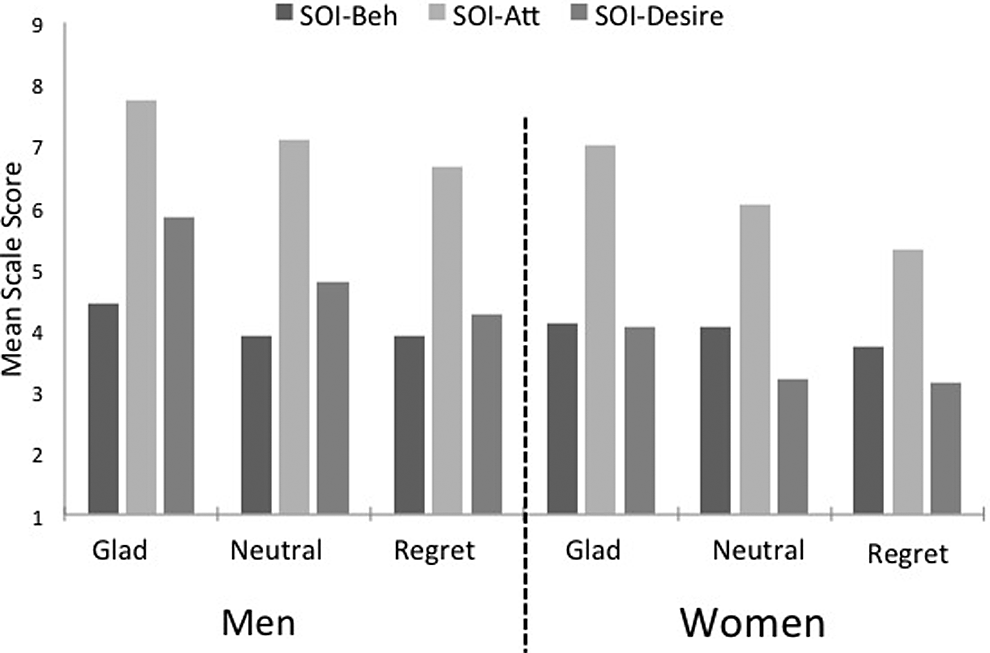
Sociosexuality for men and women across regret groups.
Predictors of Regretting Passing Up Casual Sex
Predicting regretting passing up casual sex from sex and age showed that men were significantly more likely to regret than women, Z = 6.14, p < .001, OR = 5.63. Relative to women, men were almost 6 times more likely to regret passing up their most recent potential casual sex experience. Age was not significantly related to regretting having passed up casual sex, Z = 0.63. Sex and age accounted for 9.1% of the variance in regret passing up casual sex. Adding the 3 items on general, worry in Model 1 did not affect the participant sex effect. Participants who generally worried more about their sexual reputation following casual sex were less likely to regret passing up casual sex. This effect was not moderated by participant sex, and the remaining worry items did not affect regretting having passed up casual sex.
In Model 2, we added the 3 items on general physical gratification when having had casual sex previously. The effect of sex was not affected by the inclusion of general physical gratification (log odds remained identical, but the standard error increased). Of the three predictors, only sexual pleasure affected regretting sexual opportunities passed up. Participants who reported more general sexual pleasure in relation to casual sex were more likely to regret passing up (OR = 1.44). Importantly, this effect was not moderated by participant sex.
When we added the three sociosexuality indexes to the effect of sex and age in Model 3, the effect of participant sex was reduced. Still, even when controlling for individual differences in sociosexuality, men were more than 3 times more likely to regret passing up casual sex. As evident from Table 4, participants with attitudes condoning casual sex were significantly more likely to regret passing up. This effect was partly moderated by participant sex, Z = −2.01, p < .05 (stronger for women than for men). Apparently, those who had more casual sex regretted passing up sexual opportunities less than those with few casual sex experiences but only when accounting for SOI–Attitudes. The zero-order correlation for SOI–Behavior was very close to 0 (r = −.01) and similar for women and men.
Ordered Logistic Regression Analyses Predicting Regret Passing Up Casual Sex From Sex and Age Controlling for General Worry, General Physical Gratification, and Sociosexuality.

Note. Sex and age: R 2 = .091, ▵Model 1 R 2 = .033, ▵Model 2 R 2 = .009, and ▵Model 3 R 2 = .048. STD = sexually transmitted infections; SE = standard error.
*p< .05. **p < .01. ***p < .001.
Within-Sex Predictors of Regretting Passing Up Casual Sex
To investigate which of the variables included in the three models above may account for women and men’s regrets passing up casual sex, we ran regression analyses separately for the two sexes controlling for age and omitting all nonsignificant effect from the separate models. The final model came out with only two predictors that accounted for 13.5% of the variance in women and one predictor accounting for 3.5% of the variance in men. For women and men, general worry about sexual reputation following causal sex decreased the likelihood of regretting passing up the most recent opportunity. For men, this variable was the sole predictor (OR = 0.57, Z = −2.59, p < .01), while for women unrestricted sociosexuality (SOI–Attitudes) produced lower likelihood of regretting passing up (OR = 1.91, Z = 4.47, p < .001), essentially accounting for the effect of worry (OR = 0.71, Z = −1.69, p = .092) in the final model. None of the general gratification variables affected the likelihood in women or men for regretting passing up casual sex.
Discussion
We found that men more than women regret passing up casual sexual opportunities; women more than men regret having had casual sex. This replicated the pattern of findings from Galperin and colleagues (2013), supporting the evolutionary hypotheses about sex differences in sexual regret. The study also provides a modest test of a competing theory to explain these sex differences—social role theory (Buss & Barnes, 1986; Eagly & Wood, 1999). Social role theory predicts that sex differences will be attenuated or entirely absent in sexually egalitarian cultures. Direct comparison of the effect sizes with those reported by Galperin et al. (2013) reveal that the sex differences in sexual regret show no diminution in this highly sexually egalitarian culture. This adds to a growing body of findings that fail to support the social role explanation for sex differences (Bendixen, 2014; Bendixen & Kennair, 2015; Bendixen, Kennair, Ringheim, et al., 2015; Fernandes, Kennair, Hutz, Natividade, & Kruger, 2015; Grøntvedt & Kennair, 2013; Kennair, Nordeide, Andreassen, Strønen, & Pallesen, 2011; Kennair et al., 2009).
As expected, women worried more than men about having had casual sex (Hypothesis 3, part 1), but these sex differences were generally modest, and much smaller than for sociosexual orientation and from physical gratification from sex. Galperin and colleagues (2013) suggested that women’s increased worry about pregnancy might account for sex differences in casual sex regret. We considered two other domains of worry—worry about sexual reputation and worry about STIs and neither accounted for the sex difference. Hence, we found no support for the second part of Hypothesis 3.
Galperin et al. also hypothesized that women’s increased regret about experiencing casual sex may be due to less sexual gratification experienced in these sorts of encounters. We did find than women reported markedly lower levels of physical gratification from casual sex (statistically fully accounting for the sex difference), but sexual gratification showed similar association with regret about having had casual sex for both women and men. Men have less regret and higher gratification than women, but individuals within each sex show the same pattern. In short, the hypothesis that sex differences in casual sex regret are due to women experiencing less sexual gratification than men was not supported.
There were very clear sex differences in SOI. The differences were largest for the attitude and desire subscales of SOI. SOI showed a similar association with casual sex regret within each sex. Men have a less restricted SOI, and thus less regret, but those men with the most restricted SOI scores show the most sexual regret. The same pattern is found for women: Unrestricted women report less regret; restricted women report most regret. Although SOI accounted for the sex difference in regret statistically, any hypothesis that sex differences in casual sex regret is due to individual differences in sociosexuality is questionable.
When investigating sex differences, one needs to avoid naively controlling for other fundamental aspects of being male or being female. Anything that is highly correlated with sex, when statistically controlled, will remove any statistical effect of sex. As an analogy, when predicting sex differences in upper body muscle mass, statistically controlling for height would remove any effect of sex—the proverbial throwing the baby out with the bath water. Concluding that there is no effect of sex after controlling for SOI or physical gratification would therefore be misguided (Schmitt et al., 2012). Abundant evidence suggests that the large sex differences in these variables are evolved sex differences—men’s short-term mating looms larger in their motivational priorities than does women’s (Buss, 2016; Schmitt & 118 Members of the International Sexuality Description Project, 2003).
Worrying more about reputation, experiencing less sexual pleasure, having low levels of sexual desire, and expressing attitudes disapproving of uncommitted sex all predicted higher levels of casual sex regret for women. For men, low levels of sexual pleasure and desire predicted casual sex regret. The novel model of understanding sex differences we present in this article suggests that there are fundamental sex differences in casual sex decisions that are attenuated or intensified in a similar manner by largely similar processes for both men and women.
Predicting regret associated with having passed up casual sex opportunities beyond the effect of biological sex is murkier. Despite a general expectation that this would to a large degree mirror factors related to regret of having had casual sex, we did not hypothesize about the outcomes. Biological sex is the principal predictor in regretting passing up sexual opportunities; men are far more likely than women to regret passing up casual sex. General worry about sexual reputation in relation to casual sex predicted lower levels of regret passing up in both sexes, but for women, unrestricted attitudes accounted for most of this effect. A possible interpretation of this could be that there was an association between less sex-typical responses. Apparently, women whose sexual strategy attitudes are less restricted experience more regret about passing up sexual opportunities compared to sexually restricted women.
Study Limitations and Future Research
Four possible limitations can be identified in this study. First, the nature of the cross-sectional design does not allow to directly address or to make strong inferences about what factors may cause sexual regret. However, we believe the inclusion of a number of proximate predictors in the study allows for a better understanding of psychological processes influencing sexual regret in men and women. Second, the reliabilities of our measures of worry and physical gratification remain unknown as single items were applied for these proximate predictors. Future studies may benefit from multiple item scales. Third, although the use of student samples usually represents obvious limitations with regard to generalizations to other populations, the close reproduction of central methodological aspects of Galperin et al.’s study (including the outcome variables and the type of sample) allows for a more direct comparison of the sex effects across samples. Finally, to address effects of gender egalitarianism on sexual regret, we need to add data points from several cultures, including cultures/nations ranking in the lower end on gender equality indexes. Obviously, merely testing in one extra culture is not enough to address the overall effect of culture on sexual regret. On the other hand, no similarity between Galperin et al.’s (2013) and the current findings would have weakened the idea that sex differences in sexual regret are universal. The similarity we found weakens social role theory.
Future research could expand the search for proximate psychological predictors of sexual regret. First, although we assessed worry about sexual reputation, STIs, and pregnancy, future work could explore those who have actually experienced these negative sequelae of casual sex. Do people who actually contract an STI or experience damage to their social reputations, for example, experience greater regret from casual sex? Additional candidate predictors include sexual disgust, moral disgust, and pathogen disgust (Tybur, Lieberman, & Griskevicius, 2009). The greater disgust sensitivity among women in the sexual domain, for example, may be linked to sex differences in sexual regret. Individual differences in disgust sensitivity might also explain some proportion of within-sex variance in sexual regret. Because women are more likely to have experienced sexual coercion and pressure to have casual sex (Meston & Buss, 2007), those experiences may influence regret about having had casual sex—another hypothesis that awaits future research.
Conclusions
Our first goal centered on whether sex differences in sexual regret would be found in a culture that stands out as among the most sexually liberal, secularized, and gender egalitarian cultures in the world. The findings suggest that women report regretting their last casual sex experience moderately more than men do and men report regretting markedly more having passed up their last chance to have casual sex. These sex differences show no evidence of diminution in this sexually liberal, secularized, and highly gender egalitarian culture compared to those found in the original study, mirroring findings of sex differences in other mating domains, such as sexual jealousy, sexual misperception, and age preferences for mates, in Norwegian samples (Bendixen, 2014; Bendixen & Kennair, 2015; Bendixen, Kennair, & Buss, 2015; Grøntvedt & Kennair, 2013).
Our second goal focused on proximate predictors that might account for sex differences in sexual regret—notably, worries about pregnancy, STIs, and reputation as well as physical gratification experienced during the sexual encounter. We found robust sex differences on all these variables. Women, on average, worried more about negative consequences and experienced less physical gratification from casual sexual encounters. Nonetheless, our analyses suggest that the sex difference in sexual regret is not accounted for these potential proximate predictors.
We had greater success in predicting within-sex differences in sexual regret for men and women. Low sexual gratification was associated with more sexual regret within both sexes, and individuals with a more restricted sociosexual orientation reported more sexual regret. Worry about sexual reputation was positively associated with sexual regret for women only. In short, we have established the first empirical evidence for key psychological predictors of sexual regret within women and men.
Taken together, the findings from the current study add to a deeper understanding of the robustness of sex differences across cultures and a deeper understanding of why individuals within each sex experience more or less sexual regret in the domain of casual sex encounters.
Footnotes
Declaration of Conflicting Interests
The author(s) declared no potential conflicts of interest with respect to the research, authorship, and/or publication of this article.
Funding
The author(s) received no financial support for the research, authorship, and/or publication of this article.