




Abstract
Sociosexuality refers to individual differences in willingness to engage in casual sex without emotional involvement with the partner. One of the most popular measures of sociosexuality is the Sociosexual Orientation Inventory (SOI) that was initially constructed as a one-dimensional measure. Although a multidimensional approach has been shown to be more informative, one-dimensional SOI scoring is still used. In this article, we replicate previous findings, using confirmatory procedures, that two-dimensional SOI scoring could be more adequate. Further, we demonstrate the advantages of a two-dimensional SOI structure in investigating relationships between sociosexuality and its personality correlates. These results could provide an incentive for a consensus of using multidimensional measures of sociosexuality.
Keywords
Introduction
Sociosexuality is a construct, first introduced by Kinsey (Kinsey, Pomeroy, & Martin, 1948; Kinsey, Pomeroy, Martin, & Gebhard, 1953), that refers to individual differences in the willingness to engage in casual sex without emotional involvement with the partner. This construct became popular among researchers of human sexuality, especially after Simpson and Gangestad (1991) constructed the Sociosexual Orientation Inventory (SOI). The SOI was constructed as a one-dimensional bipolar measure that consisted of 7 items regarding past sexual behaviors, expected number of future sexual partners, frequency of sexual fantasies, and attitudes toward casual sex. Since sociosexuality was assumed to be a one-dimensional construct, the SOI score was calculated by aggregating all items using a formula proposed by the scale’s authors (Simpson & Gangestad, 1991). At one end of the continuum are highly restrictive individuals who require greater closeness and emotional bonding with a partner prior to engaging in sexual activities. At the other end of the continuum are highly unrestrictive individuals who require less emotional bonding with a partner before engaging in sexual intercourse. They feel comfortable engaging in one-night stands and having short-term relationships without emotional involvement (Gangestad & Simpson, 1990; Simpson & Gangestad, 1991).
The SOI has been used as a one-dimensional measure in a great number of studies (e.g., Ellis, 1998; Mikach & Bailey, 1999; Reise & Wright, 1996; Simpson & Gangestad, 1992). However, questions have been recently raised about the dimensionality of the questionnaire as well as about the dimensionality of the construct itself. For example, Asendorpf and Penke (2005) made a comment on Schmitt et al.’s (2003, 2005b) International Sexuality Description Project, in which the SOI was used to investigate sexuality in different cultures. They pointed out an issue of heterogeneity of items used to assess sociosexuality. Overall score was a blend of attitudinal, behavioral, and affective aspects of sexuality. Sex differences could be found in each of these aspects, which would mean that the overall score was inadequate.
Meanwhile, a few new scales have been proposed, with the assumption that sociosexuality should not be considered a one-dimensional construct. For example, Bailey, Gaulin, Agyei, and Gladue (1994) proposed several new scales as an alternative to the SOI, with the intention of separating sociosexual attitudes, preferences, and behavior. Furthermore, Jackson and Kirkpatrick (2007) developed a new multidimensional measure of sociosexuality, which they considered to be a measure of human mating strategies. They distinguished sociosexual behavior and sociosexual attitudes toward short-term and long-term relationships. The rationale for including attitudes toward long-term relationships was that the one-dimensional SOI assessed only a tendency to uncommitted sex while ignoring the interest in long-term relationships. Moreover, Penke and Asendorpf (2008) proposed a new measure, the SOI-R, which is a three-dimensional solution of sociosexuality constructed of sociosexual attitudes, behavior, and desire. The hypothesized psychometric structure has been supported by confirmatory factor analysis (CFA) and the SOI-R has been used in numerous studies (e.g., Al-Shawaf, Lewis, & Buss, 2015; Jankowski, Díaz-Morales, Vollmer, & Randler, 2014; Markey & Markey, 2013; Roberts et al., 2012).
Although there was evident data from the above studies that the multidimensional approach was more adequate and informative, one-dimensional scoring of the original measure was still used in recent studies (e.g., Barriger & Vélez-Blasini, 2013; Beaussart & Kaufman, 2013; Birnbaum, Mikulincer, Szepsenwol, Shaver, & Mizrahi, 2014; Boothroyd, Cross, Gray, Coombes, & Gregson-Curtis, 2011; Hackathorn & Brantley, 2014; Hall & Pichon, 2014; Harnish, Bridges, & Rottschaefer, 2013; Hofer, Busch, Bond, Campos, & Li, 2010; Mattingly et al., 2011; Peters, Eisenlohr-Moul, Pond, & DeWall, 2014; Rammsayer & Troche, 2013; Sacco, Young, Brown, Bernstein, & Hugenberg, 2012; Sprecher, Treger, & Sakaluk, 2013). We also found it noteworthy that authors of the earlier studies examined factorial SOI structure with exploratory techniques (Schmitt, 2005b; Simpson & Gangestad, 1991) and concluded that the one-dimensional structure showed best fit. Hofer, Busch, Bond, Campos, and Li (2010) replicated these results using exploratory factor analysis (although they did not include Items 3 and 7 in the analysis because they did not show significant loadings in all four cross-cultural samples). Other studies (e.g., Barriger & Vélez-Blasini, 2013; Hackathorn & Brantley, 2014; Mattingly et al., 2011; Sprecher et al., 2013) justified the usage of the one-dimensional structure with the scale’s high internal consistency coefficients.
Webster and Bryan (2007) tested the SOI structure using CFA, which gave support to a two-dimensional model (separating sociosexual attitudes and behavior) over a traditional bipolar one-dimensional model. They also found that the correlation between sociosexual attitudes and behavior is higher among women than among men. This is assumed to be in line with the evolutionary perspective of sex differences in mating preferences: Men want a greater number of partners than they actually have (Buss & Schmitt, 1993).
Bearing in mind that original one-dimensional SOI scoring was still present in the recent studies, and following Webster and Bryan (2007), the aim of this article is to investigate the fit of the one- and two-dimensional SOI structures with confirmatory procedure. Besides replicating previous findings, in this article, we have compared the predictive power of two different SOI scorings: one dimensional and two dimensional (attitudes and behavior). In order to compare the predictive power of the two different SOI scorings, we chose personality traits as correlates. This seemed appropriate, since previous studies have found relationships between sociosexuality and personality traits. Eyesenck (1976) showed that it was more likely for extroverts to have more favorable attitudes toward multiple sex partners than introverts. Wright and Reise (1997) found that extroversion (high), neuroticism (low), and agreeableness (low), measured by Goldberg’s (1992) personality marker adjectives, were related to unrestrictive sociosexuality. Bourdage, Lee, Ashton, and Perry (2007) found that, by using NEO-Five-Factor Inventory (Costa & McCrae, 1992), the strongest relationship was between agreeableness and SOI, while extroversion, neuroticism, and conscientiousness showed near-zero correlations with SOI. Schmitt and Shackelford (2008) reported that personality traits measured by Big Five Inventory (John, Donahue, & Kentle, 1991) correlated with SOI, with high extroversion, low agreeableness, and low conscientiousness being related to unrestrictive sociosexuality (across a total of 46-nation sample). Considering the possible benefits of two- instead of one-dimensional SOI scoring, we have assumed that SOI behavior and attitudes could be differentially associated with personality traits, making two-dimensional scoring more informative about the relationships between sociosexuality and its correlates.
Material and Method
Participants
Participants were recruited through an online announcement posted on Internet pages, www.biologija.com.hr and www.edusex.org, and via an e-mail announcement sent to all the psychology students’ associations in Croatia. The initial sample consisted of 807 participants (253 men and 554 women). Results from a total of 147 participants were removed from the initial sample because they were either homosexuals or bisexuals, their results were recorded incorrectly due to technical difficulties, their answers were highly unlikely (e.g., SOI Items 1, 2, and 3 higher than 100), or their data violated assumptions of univariate or multivariate normality. Therefore, the final sample consisted of 205 heterosexual men aged between 18 and 64 years (M = 28.14, SD = 7.77) and 455 heterosexual women aged between 17 and 56 years (M = 26.27, SD = 6.64).
Materials
Sociosexuality was assessed using a Croatian version of Simpson and Gangestad’s (1991) 7-item SOI (Kardum, Gračanin, & Hudek-Knežević, 2006): With how many different partners have you had sex within the past year? How many different partners do you foresee yourself having sex with during the next 5 years? With how many partners have you had sex on only one occasion? How often do you fantasize about having sex with someone other than your current dating partner? Sex without love is okay. I can imagine myself being comfortable and enjoying “casual” sex with different partners. I would have to be closely attached to someone (both emotionally and psychologically) before I could feel comfortable and fully enjoy having sex with him or her.
Following the recommendations of Simpson and Gangestad (1991), each SOI item was standardized within gender, and all analyses were conducted using z-score values.
Big Five model personality traits (i.e., extroversion, agreeableness, conscientiousness, emotional stability, and intellect) were assessed using Croatian adjective markers for the five personality traits in the Big Five personality model (Mlačić & Šakić, 2008). The adjective markers were previously selected during a lexical study of Croatian personality adjective descriptors (Mlačić & Ostendorf, 2005). Each trait measured by adjective markers correlated highly with the five personality traits measured by a Croatian version of the 100-item set of IPIP Big Five factor markers (IPIP 100; Mlačić & Goldberg, 2007). Participants rated how well a certain adjective describes them on a scale from 1 (extremely inaccurate) to 9 (extremely accurate). Each trait was assessed using 24 adjective markers, 12 measuring the positive and 12 measuring the negative pole. (A total of 120 adjectives were used.) Adjectives that measured the negative pole of a certain trait were recoded and the total trait score was calculated by aggregating participants’ ratings on all adjective markers for each trait. As MacDonald (1998) pointed out, this Big Five measure was the most adequate for evolutionary psychology research, as it was constructed on the basis of lexical study. Therefore, it most probably revealed culture-specific dimensions of individual differences.
Procedure
Ethical approval for this research was obtained from the Department’s Committee for Ethical Issues and Research.
The procedure was set online, using the Google Drive application. At the beginning of the procedure, participants were given an assurance guaranteeing anonymity of their answers. They also had an opportunity to contact the authors for feedback or with any questions, and those who did were debriefed about the purpose of the study. Participants were informed that they could stop answering the questions at any time, in which case their answers would not be recorded. After they agreed to proceed, they completed a questionnaire containing autobiographical questions (e.g., sex, age, sexual orientation). Participants answered additional questions that were not of interest for this study.
Results
All analyses were conducted using R version 3.2.0 (R Core Team, 2014), using packages lavaan version 0.5.15 (Rossel, 2012), and car version 2.0.25 (Fox & Weisberg, 2011). CFA was performed to test the underlying structure of the SOI, while multivariate regression analyses were performed to investigate the relations between SOI scale(s) and Big Five personality traits. Prior to analysis, possible violations of multivariate tests assumptions were inspected. Univariate normality was tested for all variables, and the results were in accordance with Kline’s (2011) criteria of normal distribution (all Skewness indices <3 and all Kurtosis indices <8). Multivariate outliers were inspected using Mahalanobis distances, which led to the identification of six outliers that violated multivariate normality. These results were not included in the subsequent analyses. Possible multicolinearity issues were inspected as well. Variance inflation factors were less than 10 for all variables.
One-Dimensional and Two-Dimensional SOI Model Fit
Three alternative models were tested using CFA with maximum likelihood estimators, and all of them were tested on the overall sample and separately on the subsamples of men and women. Alternative Model 1 was one dimensional, in which 7 items loaded on one latent dimension. Model 2 was two dimensional, with separated sociosexual behaviors (SOI Items 1, 2, and 3) and sociosexual attitudes (SOI Items 4, 5, 6, and 7). In alternative Model 3, we tested the SOI structure proposed by Webster and Bryan (2007), where Item 2 was loaded on both behavioral and attitudinal factors. The CFA results and fit indices for the three alternative models on the three different samples are presented in Table 1. Generally, the proposed one-dimensional Model 1 showed poor fit, on the overall sample and the two subsamples. Model 2, with two-dimensional SOI structure, showed significantly better fit than Model 1 (whole sample Δχ2(1) = 188.24, p < .01; men Δχ2(1) = 78.82, p < .01; women Δχ2(1) = 121.62, p < .01). Model 3 also showed adequate fit but did not show significantly better overall fit than Model 2 (whole sample Δχ2(1) = .60, p > .05; men Δχ2(1) = 3.41, p > .05; women Δχ2(1) = 0, p > .05). The better fit of Model 1 than of Models 2 and 3 was the first indicator that two-dimensional SOI scoring could be more adequate in future research. For further analysis and comparison of the predictive power of the one- and two-dimensional models, we decided in favor of the more parsimonious model and SOI structure proposed by Model 2.
Fit Indices for Three Alternative SOI CFA Models for Overall Sample and for Men and Women Separately.
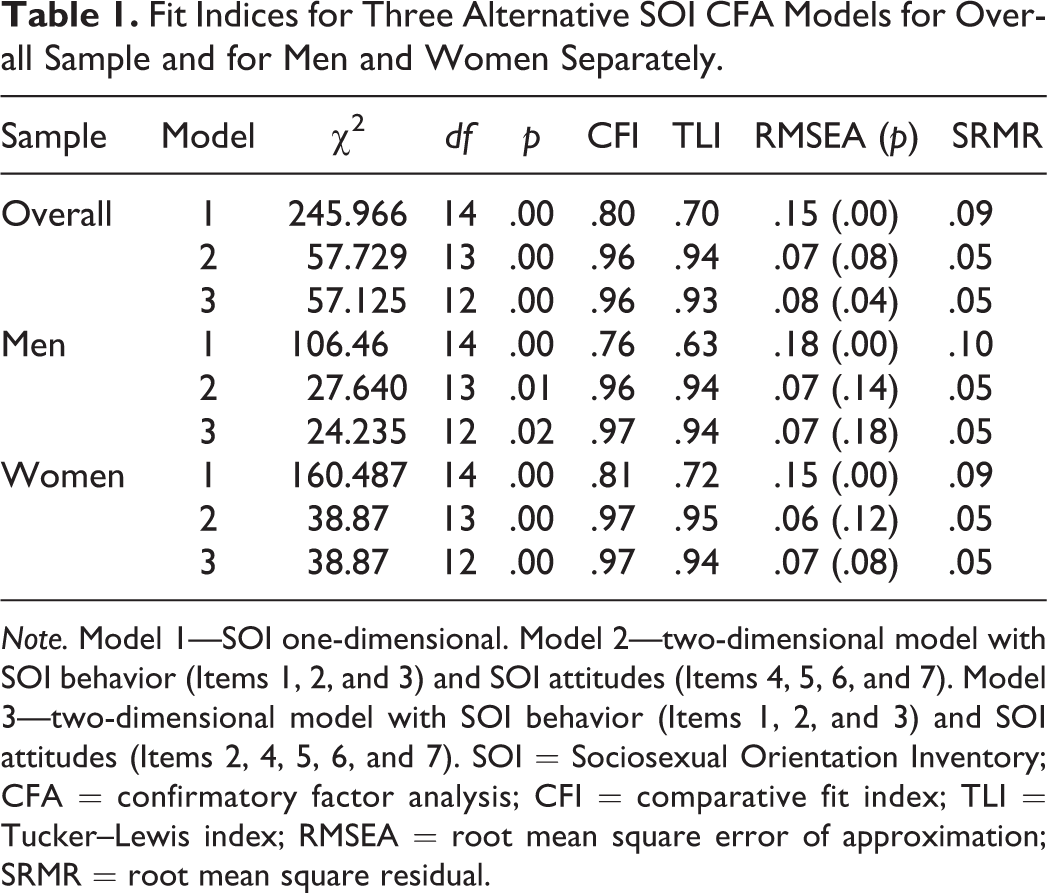
Note. Model 1—SOI one-dimensional. Model 2—two-dimensional model with SOI behavior (Items 1, 2, and 3) and SOI attitudes (Items 4, 5, 6, and 7). Model 3—two-dimensional model with SOI behavior (Items 1, 2, and 3) and SOI attitudes (Items 2, 4, 5, 6, and 7). SOI = Sociosexual Orientation Inventory; CFA = confirmatory factor analysis; CFI = comparative fit index; TLI = Tucker–Lewis index; RMSEA = root mean square error of approximation; SRMR = root mean square residual.
Relationship Between the Two SOI Dimensions
Next, we investigated correlations between attitudes and behavior among men and women. Fisher’s r to z transformation showed that the correlation was significantly higher (p < .05) among women (r = .48) than among men (r = .35). We found this result as a second indicator that two-dimensional SOI scoring might provide additional information. Specifically, it provided additional insight about sex differences in sociosexuality, which could be important for evolutionary psychology research.
Predictive Power of the One- and Two-Dimensional SOI Models
Multivariate multiple regressions were performed to investigate the predictive power of one- and two-dimensional SOI as well as the possible interaction effects of SOI and sex, in explaining variance of Big Five personality traits. One-dimensional sociosexuality was represented as all items aggregated, whereas in the two-dimensional SOI, sociosexual behaviors were represented as Items 1–3 and sociosexual attitudes were represented as Items 4–7 aggregated. Following Cohen, Cohen, West, and Aiken’s (2003) recommendations, predictors were centered prior to the analysis (variable mean being subtracted from each individual score). Sex was coded as −0.5 for women and 0.5 for men. Significance of each multivariate regression model was tested with four multivariate tests (Hotelling–Lawley’s trace, Wilks’ λ, Roy’s largest root, and Pillai’s trace).
In the first regression model, one-dimensional SOI score, sex, and SOI × Sex interaction were entered as predictors, and the Big Five personality traits were criteria. The results of regression analysis are presented in Table 2. Multivariate tests indicated that SOI score and sex, as well as their interaction, were significant predictors of personality traits. They were related to agreeableness (R 2 = .05), emotional stability (R 2 = .07), and conscientiousness (R 2 = .05). SOI score was negatively related to these three personality traits, indicating that individuals high on agreeableness, emotional stability, and conscientiousness tend to have more restrictive sociosexuality and vice versa.
Multivariate Regression Analysis Showing Predictive Power of One- and Two-Dimensional SOI Model in Explaining Personality Traits.

Note. Model 1 = one-dimensional SOI; Model 2 = two-dimensional SOI; H-L T = Hotelling–Lawley’s trace; W λ = Wilks’ λ; RLL = Roy’s largest root; PT = Pillai’s trace; B = unstandardized regression coefficient; R 2 = multiple R 2; E = extroversion; A = agreeableness; ES = emotional stability; C = conscientiousness; I = intellect; SOI = one-dimensional SOI score; SOI B = sociosexual behavior, SOI A = sociosexual attitudes; SOI = Sociosexual Orientation Inventory.
*p < .1, **p < .05, ***p < .01.
Sex was positively related to emotional stability and negatively related to agreeableness and conscientiousness, indicating that men tend to score higher on emotional stability, and lower on agreeableness and conscientiousness, than women. SOI × Sex interaction was related to higher levels of conscientiousness.
The interaction effect was further tested with simple slopes analyses, separately for men and women (Cohen, Cohen, West, & Aiken, 2003). SOI, sex, and SOI × Sex interaction were entered as predictors. Simple slopes analysis showed that SOI was a significant predictor of conscientiousness (β = −.23, p < .01) among women but not among men (β = −.06, p > .05). Interaction effects were not found for other personality traits.
In the second regression model, we tested the predictive power of the two-dimensional SOI score. Sociosexual behavior, sociosexual attitude, sex, sociosexual Behavior × Sex interaction, and Sociosexual Attitude × Sex interaction were entered as predictors, while the Big Five personality traits were criteria. Multivariate tests showed that all predictors, except Sociosexual Behavior × Sex interaction, were significantly related to personality traits. The predictors were related to extroversion (R 2 = .01), agreeableness (R 2 = .05), emotional stability (R 2 = .08), and conscientiousness (R 2 = .06). Sociosexual behavior was positively related to extroversion and negatively related to emotional stability and conscientiousness. This indicated that individuals who scored higher on those traits showed more restrictive sociosexual behavior. Sociosexual attitude was negatively related only to agreeableness, indicating that individuals who scored higher on this trait showed a more restrictive sociosexual attitude. Sociosexual Attitude × Sex interaction was again further tested with simple slopes analysis, separately for men and women. Sociosexual behavior, sociosexual attitude, sex, Sociosexual Behavior × Sex interaction and Sociosexual Attitude × Sex interaction were entered as predictors. Simple slopes analyses showed that sociosexual attitude (β = −.10, p < .05) and sociosexual behavior (β = −.18, p < .01) were significantly related to conscientiousness among women but not among men (both p > .05). Interaction effects were not found for other personality traits.
These results implied that some of the relations between sociosexuality and personality traits found in the first regression model were due to the predictive power of sociosexual attitude, and some others were due to the predictive power of sociosexual behavior. For example, SOI score was related to agreeableness and conscientiousness. However, sociosexual behavior, but not agreeableness, was related to conscientiousness. The opposite was found for sociosexual attitude, and it was related to agreeableness but not conscientiousness.
Discussion
Following Webster and Bryan (2007), the aim of this article was to investigate the fit of the one- and two-dimensional SOI structures and to compare the predictive power of the two different SOI scorings. We found three sets of analysis worth discussing. First, CFA was performed to test the underlying structure of the SOI (Simpson & Gangestad, 1991), and the results showed support for two-dimensional SOI scoring. The second analysis showed that a two-dimensional SOI provided additional information about the relationship between attitudes and behavior among men and women. This correlation was higher among women, which is in line with the previous research and the assumption that men often want more partners than they can actually get (Buss & Schmitt, 1993; Webster & Bryan, 2007). The third analysis showed that using two-dimensional SOI as a predictor of personality traits could (1) reveal different relationship patterns and (2) reveal relationships that were absent when one-dimensional SOI was entered as a predictor.
For example, one-dimensional SOI was negatively related to agreeableness, emotional stability, and conscientiousness. Two-dimensional SOI scoring showed slightly different relations to the personality traits. Sociosexual behavior was related to extroversion, while in the first (one dimensional) model, no significant associations with extroversion were found. Also, sociosexual behavior (and not attitude) was also related to emotional stability and conscientiousness.
When it comes to interpretation of the relationships between sociosexuality and personality traits, it is noteworthy that different Big Five models emerging from a lexical approach show robustness across languages (e.g., Goldberg, 1992; Mlačić & Ostendorpf, 2005). However, constructs reflecting variations in human sexuality have been largely ignored in different lexical personality studies. Therefore, these models may be insufficient for evolutionary personality psychology explanations (Schmitt & Buss, 2000). Nevertheless, it is notable that certain adaptive clusters of traits may emerge together and that different mating strategies may be reflected in unique personality profiles (Simpson, Griskevicius, & Kim, 2011). It could be expected that a more unrestrictive individual would be higher on extroversion and lower on agreeableness (Wright & Reise, 1997) or higher on openness to experience and lower on agreeableness (Bourdage, Lee, Ashton, & Perry, 2007). To be more specific, it could be expected that unrestrictive Eastern Europe men would be higher on extroversion and openness to experience and lower on agreeableness and neuroticism, while Eastern Europe women would be higher on extroversion and openness to experience and lower on agreeableness, neuroticism, and conscientiousness (Schmitt & Shackelford, 2008). We do not argue against those findings. Instead, we believe that using a two-dimensional approach to sociosexuality might provide additional information about these relationships.
It is notable that most of the results presented here are replications of previous findings. Webster and Bryan (2007) tested the latent structure of the SOI and showed better fit for two-dimensional than one-dimensional structure. Also, similar relations between sociosexuality and personality traits have been shown in several other studies (Simpson, Wilson, & Winterheld, 2004). The most consistent findings are positive correlation between extroversion and sociosexuality (Gangestad & Simpson, 1990; Schmitt & Shackelford, 2008; Wright & Reise, 1997) and negative correlation between agreeableness and sociosexuality (Bourdage et al., 2007; Schmitt & Shackelford, 2008; Wright & Reise, 1997). Negative correlation between sociosexuality and conscientiousness has also been documented (Schmitt & Shackelford, 2008).
In addition, many psychometric issues might be pointed out when discussing the SOI. First, the items measure psychologically heterogeneous aspects of sexuality, that is, past behaviors, future behavioral expectancy, frequency of unrestricted fantasies, and attitudes toward sociosexuality (Penke & Asendorpf, 2008); participants who were currently in a relationship could skip Item 4 more often than others (Clark, 2004); and Items 1–3 produce skewed distributions because of the open response format (Voracek, 2005). However, there were many proofs of construct validity as well as stability in the theorized predictability of relations between sociosexuality assessed with SOI and the variables of interest (see Schmitt, 2005a for a deeper discussion).
For researchers who are using the SOI to assess individual differences in willingness to engage in uncommitted sex, these results could be helpful, since they suggest that two-dimensional SOI scoring could yield more significant relations between constructs, account for more explained variance in models, and provide finer distinctions between constructs of interest. Also, they could be considered as an incentive for the researchers to use confirmatory procedures instead of exploratory analysis of sociosexuality measures. Moreover, data from different studies could be more comparable if there was a consensus for using the more beneficial multidimensional approach to sociosexuality and its measures.
Footnotes
Acknowledgments
We thank anonymous reviewers and the editor for their valuable and helpful comments.
Declaration of Conflicting Interests
The author(s) declared no potential conflicts of interest with respect to the research, authorship, and/or publication of this article.
Funding
The author(s) received no financial support for the research, authorship, and/or publication of this article.