




Abstract
In the current study, we reasoned that when pregnant, women should be especially motivated to protect their reproductive investments as well as their pair bond and be vigilant about intrasexual competitors. To investigate this, pregnant women (n = 66) and nonpregnant women (n = 59; age M = 27.41, SD = 3.36) in committed relationships read a jealousy-evoking scenario that was accompanied by a picture of either an attractive or an unattractive woman, after which they indicated their jealousy about such a situation. Moreover, we asked whether a mate’s emotional infidelity would evoke more jealousy than his sexual infidelity. The results showed that for pregnant women, both rivals evoked similar amounts of jealousy, whereas nonpregnant women’s jealousy was mainly evoked by the attractive rival. Moreover, pregnant women indicated they would be most upset by their partner’s emotional infidelity, and especially if they were previously exposed to the attractive rival. Nonpregnant women considered both types of infidelity equally upsetting. These results emphasize the adaptive function of jealousy and extend the literature on the influence of a rival’s attractiveness on women’s jealousy by focusing on the experiences of pregnant women.
Keywords
Being in a committed, long-term relationship has many benefits, both for the partners and for their offspring. For example, happy marriages provide a buffer against stressors and increase mental and physical health (Robles, Slatcher, Trombello, & McGinn, 2014). Moreover, pair bonding enhances both male and female reproductive success: Whereas men benefit from decreased interbirth intervals and female faithfulness—the latter increasing their paternity certainty (e.g., Gavrilets, 2012), women benefit from their mate’s provisioning and paternal care, especially when she is nursing (e.g., Marlowe, 2003). Since human infants are extremely dependent, and human childhood and adolescence is prolonged compared to other primates, biparental care enhances offspring survival (e.g., Flinn, Quinlan, Coe, & Ward, 2007; Geary, 2000). Indeed, “involved fathering” is a defining characteristic of human males, which has been associated with physical, social, and economic benefits for their children. Fathers provide their children with protection, material resources (provisioning; income, livestock, inheritance), and both direct and indirect care (play, childcare chores, role modeling; see, e.g., Gray & Anderson, 2015).
Given the benefits of biparental care and fathering, one would expect that when a woman is pregnant, she should be especially vigilant about intrasexual competitors to avoid losing these (future) paternal investments, especially in light of findings which suggest that for women, a partner’s (hypothetical) infidelity is particularly perceived as a threat to the continuation of their relationship (Leiva, Jacinto, & Ortiz, 2001). Moreover, pregnancy seems a risk factor for extra-pair sex: A wife’s pregnancy increased the likelihood of a husband’s infidelity over and above his relationship (dis)satisfaction (Whisman, Gordon, & Chatav, 2007). Further, although paternal investment is high among humans, there are large reproductive benefits for males (compared to females) from desiring and pursuing multiple mating opportunities—including extra-pair mating (e.g., Symons, 1979; Schmitt, 2005). Indeed, in general, men report to be more willing to engage in (sexual) relationships with multiple females concurrently (Hughes, Harrison, & Gallup, 2004) and that their jealousy seems to be driven by missed paternity opportunities (rather than mere paternity uncertainty; Edlund et al., in press). In contrast, due to their higher physiological investments and the costs associated with these investments, women’s reproductive interest are served best by securing commitment from a long-term, highly investing male (e.g., Buss & Schmitt, 1993). The current article investigates whether and how pregnancy influences women’s experience of jealousy, an emotion which has evolved to signal the presence of a threat to one’s reproductive success (e.g., Buunk, Dijkstra, & Massar, 2018), and whether the attractiveness of a rival influences such jealousy.
In general, individuals are more threatened by rivals who are perceived to surpass them on sex-specific domains related to mate value (Buss, Shackelford, Choe, Buunk, & Dijkstra, 2000). Specifically, if individuals feel one’s partner could easily replace them with a rival, their efforts to retain their mate increase (e.g., Sela, Mogilski, Shackelford, Zeigler-Hill, & Fink, 2017). Since men tend to value attractiveness and youthfulness in a potential mate more than women do, a woman confronted with a rival should be most jealous when this rival is physically attractive since this domain is most central to her mate value (e.g., Buss, 1989; Edlund & Sagarin, 2010). On the other hand, men are most jealous when the rival possesses status-related characteristics such as social dominance since women seem to have an evolved preference for men displaying cues indicative of the ability to provide. Indeed, research has established that precisely these sex differences in the rival characteristics that evoke jealousy do occur (e.g., Dijkstra & Buunk, 1998; Wade & Fowler, 2006) and that these occur in different cultures (e.g., Buunk, Castro Solano, Zurriaga, & González, 2011), among heterosexuals as well as homosexuals (Buunk & Dijkstra, 2001), and also outside one’s conscious awareness (Massar & Buunk, 2009, 2010). However, to date, there is no research that has examined the jealousy-evoking effect of a rival’s attractiveness among pregnant women.
There are some findings in the literature which suggest that pregnant women may be more sensitive to signals of threat in their environment than nonpregnant women. For example, a study by Pearson, Lightman, and Evans (2009) revealed that women in their third trimester had higher accuracy to encode faces that signaled threat—fear and anger—or general negative emotions (sadness) than women in early pregnancy. These authors suggest that this heightened tendency to encode emotional faces may be an adaption to prepare them for the protective and nurturing demands of motherhood by increasing their sensitivity and vigilance toward emotional signals of threat, aggression, and contagion. Further, Navarrete, Fessler, and Eng (2007) reported that pregnant women show increased in-group favoritism and out-group negativity during the first trimester of pregnancy. They argued that avoiding out-group members during a period when both maternal and fetal vulnerability to infections is especially high (the first trimester of pregnancy) reflects a disease avoidance adaptation and is part of the behavioral immune system (see also Jones et al., 2005).
Additional evidence for heightened sensitivity to social cues during pregnancy comes from research that focuses on increases in progesterone levels during the luteal phase of women’s menstrual cycle. This phase prepares women’s bodies and minds for pregnancy, and women’s emotions and cognitions experienced during this menstrual cycle phase could thus serve as a proxy for pregnancy (see Maner & Miller, 2014). Generally, these studies show that high progesterone levels increase women’s sensitivity for cues to social threats (Conway et al., 2007; van Wingen et al., 2008) and for cues to social affiliation (Maner & Miller, 2014; see also Taylor et al., 2000). Given the literature reviewed above, it might be expected that pregnant women report higher levels of jealousy when confronted with the threat of a romantic rival than nonpregnant women (Hypothesis 1). Moreover, since an attractive rival poses the largest intrasexual threat, we expect that she will evoke more jealousy than the unattractive rival among both pregnant and nonpregnant women (Hypothesis 2), especially if women are exposed to her in the context of a possible infidelity of their partner.
In addition to state jealousy after confrontation with a rival, we were interested in the type of infidelity that would evoke the most distress among pregnant women. Research (Buss, Larsen, Westen, & Semmelroth, 1992; for a recent review, see Edlund & Sagarin, 2017) on evolved sex differences in the type of infidelity that elicits most jealousy consistently shows that compared to men, for women, a partner’s emotional infidelity is more upsetting than sexual infidelity. Although the current research does not focus on between-sex differences in the type of infidelity that evokes most jealousy but rather on within-sex differences, based on theory and the literature reviewed above, we expect that emotional infidelity should be more upsetting than sexual infidelity (Hypothesis 3), and especially for pregnant women (Hypothesis 4). After all, an emotional attachment of their partner to another woman causes the rival to receive love, time, or attention, which cannot be directed at her and her unborn child anymore, ultimately jeopardizing the pregnant woman’s reproductive success. This expectation is in line with a suggestion made by Scelza (2014): In cultures where relationship stability is valued, and where fathers’ direct paternal care is common and expected (as opposed to fathers mainly providing material assistance), a partner’s emotional infidelity is likely to evoke most jealousy among women.
Method
Participants and Design
Participants were recruited via advertisements on several popular Dutch websites, on general women’s interest websites, and on websites specifically targeted at pregnant women. The advertisements asked for (pregnant) women aged 20–35 years, who were currently in a relationship. Further, to make sure that intentional childlessness would not confound our results, we specifically recruited nonpregnant participants who stated they had a desire to have children in the future. The sample consisted of 66 pregnant women (age M = 27.56, SD = 3.20) and 59 nonpregnant women (age M = 27.24, SD = 3.54), all currently in a heterosexual relationship (92% > 18 months). Of the pregnant women, 28.8% were 4–12 weeks pregnant, 42.4% were 13–26 weeks pregnant, and 28.8% were 27–42 weeks pregnant. 1 All materials and procedures were approved by the Ethics Committee of Psychology of the University of Groningen.
Materials and Procedure
Participants completed the study online and entered the survey (Qualtrics Survey Software) by clicking the link provided in the recruitment advertisements. After an information screen informing them that the researchers were interested in their opinions about relationships and emotions, they provided their informed consent. Next, they proceeded to the survey in which they first responded to some demographic questions (age, educational attainment, relationship status, relationship duration, pregnancy duration) and then responded to questions regarding their satisfaction with their relationship and partner. 2 After finishing these sections, they were randomly assigned to one of the experimental conditions (attractive versus unattractive rival).
Infidelity manipulation
Participants were instructed that they would read a scenario and should imagine the situation happening to them and that they would be asked some questions about the scenario. The scenario was taken from studies by Dijkstra and Buunk (1998) and has proven to be a successful way to evoke jealousy in participants. It describes a mutual flirtation between the participant’s partner and an unfamiliar woman. Next to this scenario, depending on the condition, a full color picture of either an attractive woman or an unattractive woman was shown. 3
Dependent measures
After reading the scenario, participants indicated their jealousy. We employed two measures: first, a sliding scale with end points 0 (not jealous at all) and 100 (extremely jealous). And second, participants indicated on a 5-point scale (1 = not at all, 5 = a lot) to what extent they would experience the following emotions: suspicious, betrayed, worried, mistrustful, rejected, anxious, angry, sad, and hurt (Cronbach’s α = .94). These emotions were averaged into one score indicating “upset.” Since these two jealousy measures were highly correlated (r = .75, p < .001), we decided to standardize (due to different scaling) and average these scores into one jealousy score. For an overview of the means and SDs before standardization, see Table 1.
Jealousy Means (SD) for Pregnant and Nonpregnant Women, Exposed to an Attractive or Unattractive Rival.
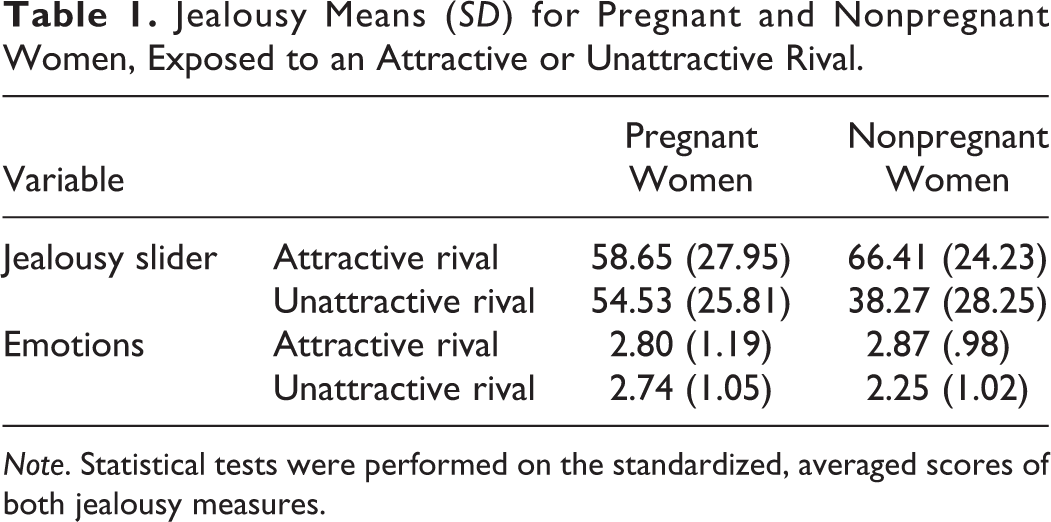
Note. Statistical tests were performed on the standardized, averaged scores of both jealousy measures.
Next, we asked participants to choose which situation they would find most upsetting: (1) if their partner would have a sexual affair with the woman in the scenario but would not fall in love with her or (2) if their partner would fall deeply in love with the woman but would not have sexual contact with her (see Buss et al., 1999). Last, as a manipulation check, participants were asked to judge the attractiveness of the woman in the picture they had just seen (1 = very unattractive, 7 = very attractive). After answering all the questions, participants were thanked for their participation and debriefed about the study’s research question and hypotheses.
Results
Manipulation Check
An analysis of variance (ANOVA) with pregnancy (yes/no) and rival appearance (attractive/unattractive) as independent variables and the attractiveness of the woman on the picture as the dependent variable yielded a significant main effect of rival appearance: F(1,121) = 97.44,
Dependent Variables
Jealousy
A 2 × 2 ANOVA with pregnancy and rival attractiveness as factors and the composite jealousy score as dependent variable was performed. In contrast to Hypothesis 1, this analysis yielded no significant main effect for pregnancy; F(1,121) = .20, ns. However, Hypothesis 2 was confirmed, since the main effect for rival attractiveness was significant: F(1,121) = 7.78,
Infidelity type
To test Hypotheses 3 and 4, χ2 analyses were performed to investigate which type of infidelity (sexual vs. emotional) participants would find most upsetting. This analysis revealed that nonpregnant women regarded each type of infidelity equally upsetting, χ2(1; N = 59) = .15, ns: 52.5% chose sexual infidelity and 47.5% chose emotional infidelity. Pregnant women, however, chose the emotional infidelity as the most upsetting: 62.1% chose this infidelity type, χ2(1; N = 66) = 3.88, p < .05. Moreover, when the attractiveness of the rival was taken into account, both pregnant and nonpregnant women found both infidelity types equally upsetting when confronted with an unattractive rival (pregnant women, emotional infidelity 53.1%; nonpregnant women, emotional infidelity 50.0%): χ2(1; N = 62) = .06, ns. When confronted with an attractive rival, nonpregnant women again did not differentiate between infidelity types; 55.2% chose sexual and 44.8% chose emotional infidelity as most upsetting. However, pregnant women did differentiate between the two types of infidelity: 29.4% chose the sexual infidelity and 70.6% chose the emotional infidelity as most upsetting, χ2(1; N = 63) = 4.29, p < .05.
Discussion
It could be argued that although the presence of an intrasexual competitor with a high mate value is threatening to anyone who is in a long-term, committed relationship, there is especially much at stake for pregnant women if their partner should commit an infidelity: A partner’s extra-pair interest in another woman may mean she will lose his (future) paternal investments, jeopardizing her reproductive success. To date, however, there has been no research that directly investigated whether pregnant women are indeed more jealous after a hypothetical infidelity of their partner than nonpregnant women. Therefore, in the current study, we compared pregnant and nonpregnant women’s responses to a hypothetical flirtation of their partner with either an attractive or an unattractive rival. Moreover, we asked them which type of infidelity would be most upsetting, an emotional or a sexual infidelity.
The results from our study provided mixed support for our hypotheses. Replicating previous research (e.g., Dijkstra & Buunk, 1998; Massar & Buunk, 2010), our results show that generally, the attractive rival evoked significantly more jealousy than the unattractive rival (Hypothesis 2). Although we did not find the expected main effect of pregnancy (Hypothesis 1), a significant interaction revealed that nonpregnant women mainly became jealous when confronted with an attractive rival but that pregnant women responded with equal amounts of jealousy to both rivals. Together with the finding that pregnant women also judged both rivals as significantly more attractive than nonpregnant women, this result suggests that when pregnant, women may appraise any intrasexual competitor as a threat. Of course, this remains rather speculative since the current data cannot establish whether pregnant women’s higher attractiveness ratings were due to the rivals’ appearance or were influenced by, for example, social comparison processes. Previous research has shown that attractiveness evaluations of other women are at least in part dependent on one’s (self-perceived) own attractiveness or mate value (e.g., Patrick, Neighbors, & Knee, 2004), and there are indications that pregnant women’s self-esteem and body image decrease due to the bodily changes in this phase (see, e.g., Kamysheva, Skouteris, Wertheim, Paxton, & Milgrom, 2008). Future research should therefore also take women’s self-reported mate value into account as a possible influencing factor.
In addition to measuring jealousy in response to the scenario, we asked participants which type of infidelity they would find most upsetting—emotional or sexual (Hypothesis 3; Buss et al., 1992). We reasoned that for pregnant women, a partner redirecting his resources and investments to another woman would be most upsetting, since this would entail losing the various benefits paternal investments offer her. The results confirm this expectation and show that pregnant women confronted with an attractive rival find their partner’s emotional infidelity most upsetting, supporting Hypothesis 4. Interestingly, and in contrast to most studies using this forced-choice paradigm (e.g., Buss et al., 1992; Sagarin et al., 2012), in the current study, the nonpregnant women found both types of infidelity equally upsetting, irrespective of the rival’s attractiveness. Notably, however, the majority of previous research focused on the between-sex differences in jealousy, whereas here we focus on within-sex differences, which makes comparisons with previous literature more difficult. However, this finding is in line with some previous research (e.g., Vaughn Becker, Sagarin, Guadagno, Millevoi, & Nicastle, 2004), which shows that the jealous reactions to an emotional infidelity best discriminate men and women, suggesting that with respect to sexual infidelity, men and women may be more similar in their emotional reactions. Moreover, Kato (2014) found that 44% of women in committed relationships—like our current sample—chose sexual infidelity as most upsetting, and this number rose to 67% if they were exposed to vivid pictorial and auditory stimuli of a sexual infidelity. In the current study, the presentation of a picture of the romantic rival could have elicited more vivid imaginations of their partner’s infidelity among nonpregnant women. Interestingly, however, our findings also suggest that once (future) offspring is involved, infidelity signaling the potential loss of paternal investments to a rival is most threatening. Since we did not inquire whether participants currently were mothers, we cannot directly test this suggestion, but future research could take motherhood into account: If the threat or losing acute paternal investments is causing women’s jealousy responses, women with one or more young infants are likely to also show this response (see also Winking, Kaplan, Gurven, & Rucas, 2007).
The current study is among the first to investigate the influence of a rival’s attractiveness on pregnant women’s jealous responses, and overall, the results emphasize the adaptive value of jealousy, showing that women are most upset about hypothetical infidelities when it is most adaptive—that is, when a high mate value rival threatens their relationship or when individual (reproductive) interests are threatened by a possible emotional investment of their partner in such a high mate value rival. However, we acknowledge that the overall jealousy reported by our participants was rather low; pregnant women’s responses were close to the scale average. This could either be due to the stimuli that were used, but given the higher attractiveness ratings the pregnant women assigned to these rivals, it is also likely that pregnancy has a “dampening” effect on emotional reactivity. Rosebrock, Hoxha, and Gollan (2015) have shown that pregnant women provide lower arousal ratings than nonpregnant women for both positive and negative stimuli. These findings are also in line with research showing that pregnant women show reduced physiological stress reactivity (e.g., De Weerth & Buitelaar, 2005) and a decrease in aggressive tendencies (De Almeida, Cabral, & Narvaes, 2015). From an evolutionary perspective, such dampening effects could prevent pregnant women from engaging in (physical) intrasexual competition since the costs of such encounters greatly outweigh the immediate benefits (e.g., Stockley & Campbell, 2013).
Some limitations should be noted. For example, the nonpregnant women in our sample might have used oral contraceptives, which are known to affect jealousy levels, particularly among partnered women (Cobey et al., 2012). Thus, future researchers should take care to control for this possible influence. Moreover, possible order effects could be taken into consideration: The questions about relationship satisfaction preceded the infidelity manipulation in the current research, which could have influenced participants’ jealous responses. However, despite these limitations and the mixed support for our hypotheses, we think the current study adds to the literature on the adaptive value of jealousy in response to a hypothetical infidelity with an attractive or unattractive rival by extending it to pregnant women. We think our research offers starting points for future research among a sample that is experiencing a unique period in their lives, both physically as well as psychologically.
Footnotes
Authors’ Note
Abraham P. Buunk is also affiliated with Netherlands Interdisciplinary Demographic Institute (NIDI), The Hague, The Netherlands. The research reported in the present study was awarded to Abraham P. Buunk and was conducted at the University of Groningen.
Acknowledgments
We thank Irma Bokx, Janke Wesselius, Laura Hoekstra, Jenny Steingassner, and Sytse Zijlstra for their help in conducting this study.
Declaration of Conflicting Interests
The author(s) declared no potential conflicts of interest with respect to the research, authorship, and/or publication of this article.
Funding
The author(s) disclosed receipt of the following financial support for the research, authorship, and/or publication of this article: The research reported in the present study was supported by an Academy Professor grant from the Royal Netherlands Academy of Arts and Sciences awarded to Abraham P. Buunk.
