




Abstract
This study examined the hypothesis that gender identity and biological sex represent independent modules and that transgender individuals respond to romantic rivals in line with their gender identity and not with their biological sex. Additionally, associations of jealousy with intrasexual competitiveness (ISC) and social comparison orientation (SCO) were explored. A total of 134 male-to-female and 94 female-to-male transgender individuals from Greater Buenos Aires, Argentina, responded to a questionnaire. In line with the predictions, female-to-male transgender individuals experienced more jealousy than male-to-female transgender individuals in response to a physically dominant rival, whereas male-to-female individuals experienced more jealousy than female-to-male individuals in response to a physically attractive rival. Regardless of their gender identity, in both groups social-communal attributes were the most jealousy-evoking characteristic. Overall, the results indicate that transgender individuals mainly respond in line with their gender identity and not in line with their biological sex when facing romantic rivals. In addition, transgender individuals high in ISC experienced relatively more jealousy in response to all rival characteristics, whereas SCO was only among male-to-female individuals associated with jealousy.
Keywords
Transgender individuals are those whose gender identity—that is their sense of themselves as male or female—differs from their biological sex, regardless of the medical interventions the individual has undergone or may desire to do in the future (American Psychological Association, 2009). There are still few psychological studies on this population, and particularly very little is known about topics such as their intimate relationships. Moreover, with some exceptions (e.g., Chivers & Bailey, 2000), transgender individuals have not been studied from an evolutionary psychological perspective, an approach increasingly used to explain sex differences in the mating arena.
There is considerable evidence that one’s gender identity, that is, one’s sense of being a man or a woman, is an innate characteristic that is already experienced in early childhood and is linked to brain structures developed when individuals are still in the womb (Swaab & Garcia-Falgueras, 2009). In line with the idea that reproduction is controlled by a series of independent mechanisms (Kenrick, Keele, Brian, Barr, & Brown, 1995; Tooby & Cosmides, 1992), it seems that one’s gender identity can be viewed as an evolutionarily developed module that is independent of one’s biological sex. Whereas in the large majority of individuals both modules coincide, in transgender individuals this is not the case.
In the present research, we examined the hypothesis that it is one’s gender identity, and not one’s biological sex, which affects how individuals respond to the characteristics of a rival in a situation that might evoke jealousy. We also examined the extent to which the jealousy responses depend on individual differences, in particular social comparison orientation (SCO) and intrasexual competitiveness (ISC).
Jealousy as an Evolved Mechanism
Jealousy is the response to a threat to, or the loss of, a valued relationship with another person, due to the actual or imagined presence of a rival vying for one’s partner’s attention (Buunk & Dijkstra, 2006). From the point of view of evolutionary psychology, jealousy has been defined as an adaptation that serves to assess the threats of rivals vying for the partner’s attention to one’s reproductive interests (Buss, 2000; Buunk, Massar, & Dijkstra, 2007). Jealousy functions as a retention strategy to ward off rivals, by alerting the individual to take action to prevent a mate from being unfaithful and from abandoning the relationship (e.g., Buunk & Dijkstra, 2006). When individuals perceive that their partners show signs of attraction to, or romantic interest in, a third person, they will in general consider that person as a rival, but the degree of jealousy will depend on the characteristics of the rival, in particular the rival characteristics that play a role in mate selection.
Rival Characteristics That Evoke Jealousy
According to most evolutionary psychologists, there are sex-linked differences in mate selection strategies (Buss, 1989; Symons, 1979). Because in humans both sexes invest resources and parental care in their offspring, as a strategy to maximize their offspring’s chances of survival, men and women differ in the characteristics they prefer in potential partners (Buss, 2005; Geary, Vigil, & Byrd-Craven, 2004; Trivers, 1972). Many cross-cultural studies have found support for this assumption (Buss, 1989; Buss et al., 1990; Shackelford, Schmitt, & Buss, 2005; Ubillos et al., 2001). In general, these studies have shown that women, more than men, value social status and dominance in a mate, reflecting women’s evolved preference for males who are able to provide them and their offspring with sufficient resources and protection. Conversely, men, more than women, tend to value youth and physical attractiveness in a partner, reflecting men’s tendency to select mates who show signs of fertility and reproductive potential. As people compare their own personal qualities with those of their rivals, they will feel particularly jealous when their rival surpasses them on characteristics of the rival that are believed to be important to the opposite sex (Buss, Shackelford, Choe, Buunk, & Dijkstra, 2000; Buunk & Dijkstra, 2005; Dijkstra & Buunk, 1998, 2001). Consequently, jealousy in males is among others evoked more by the rival’s physical dominance, whereas jealousy in females is evoked more by the rival’s physical attractiveness (Dijkstra & Buunk, 2002; Buunk, Castro Solano, Zurriaga, & González, 2011). For instance, Dijkstra and Buunk (2001) found that individuals look at different body features and body builds to evaluate the potential threat imposed by a rival: Women pay more attention to narrow waist—as a signal of body attractiveness—while men look at broad shoulders as a cue for physical dominance. There is evidence that such sex differences occur even in response to the subliminal presentation of such characteristics (Massar & Buunk, 2009).
Several studies have shown that not only physical dominance but also a rival’s social dominance evokes more jealousy in men than in women (Dijkstra & Buunk, 1998, 2002). Men experience more distress than women when facing rivals’ economic dominance, such as apparent from better financial and job prospects and rivals’ higher status and prestige (e.g., Buss et al., 2000). The attitudes toward women’s independence and dominance in society may also play a role in this domain. For example, Buunk, Castro Solano, Zurriaga, and González (2011) founded that Latin, but not Dutch women, feel more jealous than men when their rivals display attributes of power and dominance. Still, social-communal attributes for consistency (e.g., better listener, more attentive, more self-confident) were the most jealousy-evoking characteristics for both sexes, followed by physical attractiveness in women, and by social power and dominance (e.g., higher education, more popular, more authority) in men. Quite consistent sex differences in the jealousy-evoking features of rivals have been found in a variety of countries including the United States, Netherlands, and Korea (Buss et al., 2000; Dijkstra & Buunk, 2002) and Argentina and Spain (Buunk et al., 2011), although in Iraqi Kurdistan such sex differences were not observed (Buunk & Dijkstra, 2015).
Although there is considerable evidence for sex differences in the importance of specific rival characteristics, it is not clear whether these differences reflect primarily individuals’ biological sex or their gender identity. Studying transgender people, who live as the gender opposite to their biological sex, and who are often attracted to people of their own biological sex, may shed light into this question. Indeed, most transgender individuals consider themselves heterosexual, based on their gender identity (Arístegui & Zalazar, 2014; Operario, Buron, Underhill, & Sevelius, 2008), preferring mates with the opposite gender identity, but the same biological sex, and thus, their rivals would usually be individuals with the same gender identity but with a different biological sex. According to this reasoning, a male-to-female individual who has a male partner would view women as rivals, and thus, may respond with more jealousy to a rival’s physical attractiveness. Conversely, a female-to-male individual who has a female partner would consider men as rivals, and therefore, may respond with more jealousy to a rival’s physical dominance. In addition, while social-communal characteristics will be the most jealousy-evoking characteristics in both groups, this will be followed by physical attractiveness in male-to-female individuals and by social power and dominance in female-to-male individuals.
SCO and ISC
There is evidence that the jealousy-evoking effect of rival characteristics depends on individual differences. Firstly, the degree of jealousy that an individual experiences is in part determined by the outcomes of a process of social comparison (e.g., Broemer & Diehl, 2004; Dijkstra & Buunk, 2001). SCO has been defined as the extent to which individuals are interested in others’ thoughts and behaviors in similar circumstances, tend to relate to themselves what happens to others and use social comparisons to evaluate their own characteristics (Buunk, Belmonte, Peiro, Zurriaga, & Gibbons, 2005; Gibbons & Buunk, 1999; for a review, see Buunk & Gibbons, 2006). Heterosexual individuals high in SCO tend to respond with relatively more jealousy than individuals low in SCO. Particularly, rivals’ physical dominance (e.g., broader shoulder, more muscular) among males and rivals’ physical attractiveness (e.g., better figure, more attractive face) among females are more prevalent among individuals with high levels of SCO. Interestingly, among lesbian women, but not among gay men, SCO tends to influence the response to rival characteristics that contribute to mate value (Dijkstra & Buunk, 2002).
A second individual difference characteristic that may be related to experiences of jealousy is the degree of competitiveness with same-sex others (Buunk & Dijkstra, 2015; Buunk & Fischer, 2009). Intrasexual competition is an evolved adaptation that refers to the rivalry with same-sex others over access to mates (e.g., Darwin, 1871; Trivers, 1972). Not only men, but also women may be intrasexually quite competitive, using verbal and psychological aggression, and in extreme cases physical assaults, to compete within their sex (e.g., Campbell, 2002). The degree of such competition depends not only on situational factors such as a scarcity of mates (e.g., Arnocky, Ribout, Mirza, & Knack, 2014) but also on the dispositional tendency to engage in intrasexual competition. Buunk and Fisher (2009) developed a scale to assess individual differences in ISC, that is, the degree in which one views the confrontation with same-sex individuals in competitive terms, especially in the context of mating. ISC encompasses, among others, the desire to view oneself as better than others, feelings of envy and frustration when others are more popular with the opposite sex, and a tendency to derogate and exclude potential rivals. There is evidence that the rival characteristics that elicit jealousy, except for physical dominance, are related to ISC in work settings (Buunk, Zurriaga, González, & Castro Solano, 2012) and that especially among those high in ISC, sex differences in the rival characteristics that elicit jealousy are observed (Buunk, aan’t Goor, & Castro Solano, 2010).
The Present Study
To summarize, we explored in a large sample of male-to-female and female-to-male transgender individuals, sex differences in the threatening nature of rival characteristics. This particular population provides a unique opportunity to shed light on some of the processes that, according to an evolutionary perspective, underlie sex differences in mating contexts, in particular to what extent the differences in the rival characteristics that evoke jealousy depend on individuals’ biological sex or on their gender identity. Additionally, this study assessed whether individuals’ tendencies to engage in ISC and SCO are related to the jealousy-evoking nature of rival characteristics among transgender individuals.
Method
Participants
The sample consisted of 228 transgender individuals from the Metropolitan Area of Buenos Aires City, 134 (58.8%) male-to-female, and 94 (41.2%) female-to-male participants. On the basis of the Kinsey Scale of sexual orientation (1953), and following the Chivers and Bailey (2000) procedure to categorize the continuum, this convenience sample only included individuals who considered themselves as heterosexual based on their gender identity. That is, we included only male-to-female individuals with male partners and female-to-male individuals with female partners. From the original 264 participants who completed the survey, 17 male-to-female cases were excluded (of these, nine reported a bisexual sexual orientation; three were in a homosexual relationship, and one was born intersex), and 19 female-to-male cases were removed (of these, 10 reported a bisexual sexual orientation, 7 referred a homosexual sexual orientation, and 1 was in a relationship with another transgender person). As inclusion criteria, all participants identified themselves as a transgender person and were over 18 years old.
As shown in Table 1, the mean age was M = 29.21 (SD = 7.99, range 18–61 years). Participants reported being aware of having a gender identity different to one’s biological sex at an early age and beginning their process of transformation to have an appearance congruent with their gender identity during adolescence. Most participants did some sort of body interventions to masculinize or feminize their appearance, the majority had accessed hormone replacement therapy or had self-administered hormones.
Age and Body Intervention Status by Gender Identity.
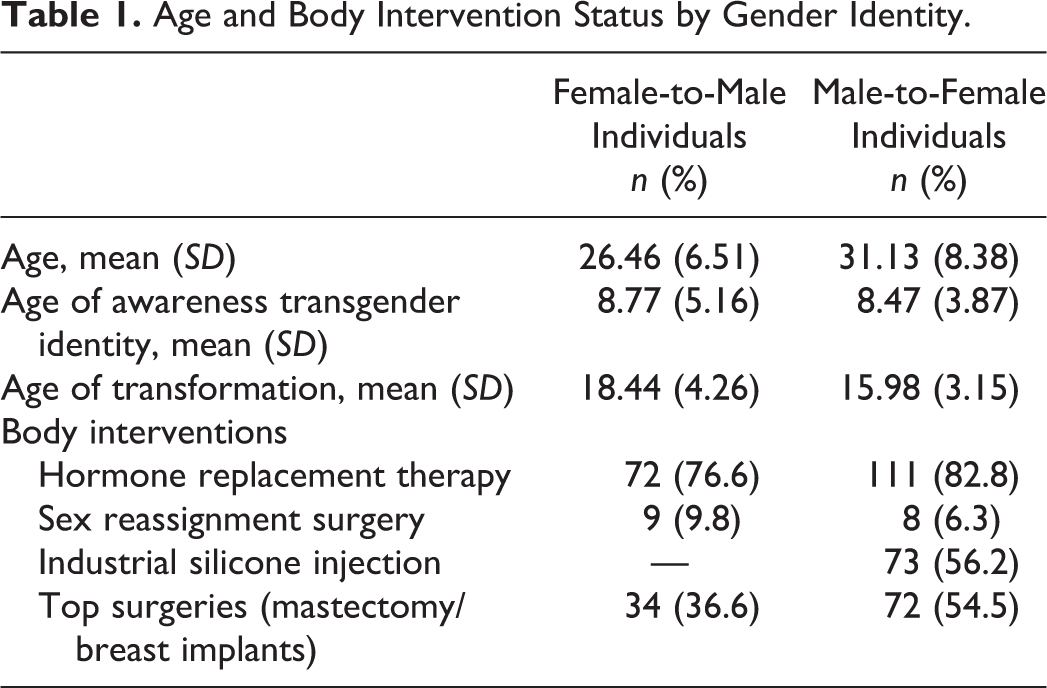
Regarding demographic information, the modal level of formal education was incomplete high school (40.4%, n = 92) and 20.6% (n = 47) of the sample had completed high school. The majority of the sample had a paid job at the moment of the study: 36.8% fulltime (n = 84) and 30.7% parttime (n = 70). It should be mentioned that 88.8% of male-to-female participants currently do or had done sex work (n = 91), while only 6.7% (n = 6) of female-to-male participants had been involved in sex work. Almost half of the sample were in some sort of relationship when the study was conducted (47.9%, n = 111).
Materials
Participants answered a questionnaire that asked about the rival characteristics that evoke jealousy, the tendency to compete with others of same gender, and the disposition to compare with others. All instruments were in Spanish and had been previously validated. On the basis of 12 tryout interviews, and after consultation with transgender activists, the language of certain scales was slightly modified where necessary to make them appropriate and better comprehensible for transgender population.
Jealousy-evoking rival characteristics
Participants were given a questionnaire developed by Dijkstra and Buunk (2002), in which participants were asked to imagine a particular scenario. Female-to-male transgender participants were provided the following vignette: You are at a party with your girlfriend and you are talking with some of your friends. You notice your girlfriend across the room talking to a man you do not know. You can see from his face that he is very interested in your girlfriend. He is listening closely to what she is saying and you notice that he casually touches her hand. You notice that he is flirting with her. After a minute, your girlfriend also begins to act flirtatiously. You can tell from the way she is looking at him that she likes him a great deal.
ISC was assessed with a 12-statement scale (Buunk & Fisher, 2009) that measures the dispositional tendency to compete with same-sex others. This instrument has been previously used in Argentinean samples (Buunk, aan’t Goor, & Castro Solano, 2010; Buunk, Castro Solano, Zurriaga, & González, 2011). Participants had to express how much some statements apply to them on a 7-interval scale (1= “not at all applicable” to 7 = “completely applicable”). As it was not clear whether transgender individuals would experience competition primarily with other transgender persons or with a nontransgender person of the same gender, for this particular study, participants filled out the scales twice, considering two types of rivals, that is other transgender individuals with the same gender identity, or same-sex heterosexual individuals. Some item examples for male-to-female transgender respondents were: “I tend to look for negative characteristics in attractive transgender women/nontransgender women”; “When I go out, I can’t stand it when men pay more attention to a same-gender transgender friend/nontransgender of mine than to me.” This resulted in two scales, that is, ISC with same-gender transgender individuals and ISC with same-gender nontransgender individuals. However, a bivariate correlation between the two scales showed a significant positive and strong association (r = .92) and repeated measures t test revealed that there was no significant difference between both scales, t(227) = −1.41, p = .160. Additionally, the total jealousy-evoking rival characteristics scale showed the same correlation with ISC with same-gender transgender individuals (r = .66) as with ISC with same-gender nontransgender individuals (r = .64). Given that both instruments worked similarly, the scale that measures ISC with same-gender transgender individuals was used for future analyses because competition with others in the mating arena is potentially influenced by opportunity. This decision was consulted with transgender key informant who explained that, as transgender individuals belong to a hidden population, they usually move in quite close gathering venues and generally, their competition for mates willing to get involved with a transgender individual usually occurs within the same community. Cronbach’s α was .93 in this sample.
SCO
The validated Spanish version of the SCO Scale (Buunk et al., 2005) that measures the dispositional tendency to compare oneself with others was administered. The 11 items were assessed on a 5-point Likert scale, ranging from 1 (strongly disagree) to 5 (strongly agree), where higher scores represented higher levels of tendency to compare with others. In order to control for inconsistencies in expression, Items 6 and 10 were reversed. Representative examples of items were “I always like to know what others in a similar situation would do”, “I often compare myself with others with respect to what I have accomplished in life” and a reverse item “I am not the type of person who compares often with others.” Cronbach’s α was .89 in this sample.
Additional sociodemographic information was collected, including birth sex, gender identity, age, age of awareness of transgender identity, age of transition, level of education attained (ranged from 1 = incomplete elementary to 8 = graduate degree completed), work status (part-time/full-time/unemployed/never employed), lifetime sex work (yes/no), relationship status (single/involved in a casual relationship/in a relationship not living together/cohabitating/married) and body interventions such as hormone replacement therapy whether prescribed or self-administered (yes/no), sex-reassignment surgery (yes/no), industrial silicone injection (yes/no), top surgeries, that is mastectomy or breast implants (yes/no).
Procedure
Between March and September 2014, data collection was coordinated by two transgender interviewers that were hired in order to reach individuals who did not feel comfortable talking with nontransgender researchers. Participants were recruited by a snowball sampling technique, a highly used method to recruit “hard-to-reach” and vulnerable populations such as transgender individuals (Magnani, Sabin, Saidel, & Heckathorn, 2005). Community-based organizations and specialized health-care services were contacted in order to ask for referrals. Before participation, the objectives of the study were explained and participants were informed that they could withdraw at any time with no explanation. Acceptance of participation was taken as an informed consent. An incentive of $10 (American dollars) was given per participation. All data were analyzed with SPSS Version 21.0.
Results
Between-Gender Differences
In order to examine gender differences, a multivariate analysis of variance (MANOVA) was performed using subject gender identity as a grouping variable and the four dimensions of rival characteristics as dependent variables. The Box’s M was 28.77, F(10, 180425.84), p < .05. This MANOVA showed a multivariate effect of gender (Wilks’s λ = .550), F(4, 216) = 44.27, p < .001, partial η2 = .45, indicating that, overall, rivals evoked more jealousy among male-to-female individuals than among female-to-male individuals.
Separate univariate analyses showed that three scales reached conventional significance levels. As Table 2 shows, male-to-female individuals indicated more jealousy than female-to-male individuals in response to a rival who was physically more attractive and possessed more social power and dominance, whereas female-to-male participants experienced more jealousy when their rival was more physically dominant. Female-to-male and male-to-female individuals did not differ in the extent to which the social-communal attributes of their rival evoked feelings of jealousy.
Means, SDs of the Four Scales for Rival Characteristics, Intrasexual Competitiveness, and Social Comparison Orientation for Complete Sample and by Gender Identity.

Note. SD = Standard Deviation.
*p < .05. **p < .01. ***p < .001.
Within-Gender Differences
Separately for each gender a within-subjects ANOVA and subsequent t tests were conducted to establish which rival characteristics evoked most jealousy. The results showed a highly significant within-subjects effect for female-to-male participants. Given that Mauchly’s test indicated that the assumption of sphericity had been violated, Mauchly’s W = .82, χ2(5) = 17,951, p < .05, the Greenhouse–Geisser correction was used, F(2.68, 244.20) = 44.72, p < .001, partial η2 = .329. In female-to-male individuals, rival’s social-communal attributes evoked more jealousy than any of the other characteristics (ts > 4.73, p < .001), followed by rival’s physical dominance that elicited more jealousy than physical attractiveness and social power and dominance (ts > 2.15, p < .05). Physical attractiveness was the rival characteristic that evoked the lowest intensity of jealousy among female-to-male participants.
Among male-to-female individuals, a significant within-subjects effect was also found. Given that Mauchly’s test indicated that the assumption of sphericity had been violated, Mauchly’s W = .84, χ2(5) = 21.77, p < .001, Greenhouse–Geisser correction was used, F(2.75, 351.46) = 95.79, p < .001, partial η2; = .428. The order from most to least jealousy-evoking rival characteristics was quite different than for male-to-female participants: The most jealousy-evoking dimension was social-communal attributes, followed by physical attractiveness, next social power and dominance, and physical dominance as the least jealousy evoking rival characteristic. While rival’s physical attractiveness aroused similar intensities of jealousy as social-communal attributes and social power and dominance (t’s < 1.67, ns), it evoked more feelings of jealousy than physical dominance (t = 13.30, p < .001). Among this group, physical dominance evoked less jealousy than social power and dominance (t = 12.06, p < .001).
Relation With ISC
For exploratory purposes, a univariate ANOVA was run in order to examine whether there were gender differences in the levels of ISC. Results showed that overall, male-to-female individuals experience significantly higher levels of ISC than female-to-male individuals, F(226) = 13.01, p < .001, partial η2 = .05. Separately for each gender, correlations between the four dimensions of rival characteristics and ISC were calculated. As shown in Table 3, quite substantial correlations were found between ISC in relation to other transgender individuals of the same gender and the four rival characteristics among male-to-female and female-to-male participants. As transgender individuals were higher in ISC, they responded with more jealousy to all four rival characteristics, that is, when the rival showed more social-communal attributes, was physically more attractive, was physically more dominant, and exhibited more social power and dominance. No significant differences were found for those correlations between male-to-female and female-to-male individuals.
Correlations Between ISC and SCO and the Four Scales for Rival Characteristics for Female-to-Male and Male-to-Female Transgender Individuals.

*p < .05. **p < .01. ***p < .001.
Relation With SCO
For exploratory purposes, a univariate analysis of varience was run in order to examine whether there were gender differences in the levels of SCO. Results showed no significant differences between male-to-female and female-to-male individuals, F(226) = .03, ns. Separately for each gender, correlations were computed between SCO and the jealousy-evoking effect for the four clusters of rival characteristics. Female-to-male participants’ scores on SCO were not related to the intensity to which they rated rival characteristics as jealousy evoking (all ps > .05, ns). However, among male-to-female individuals, SCO was related to the impact of most rival characteristics. As male-to-female individuals were higher in SCO, they responded with more jealousy when the rival showed more social-communal attributes, was physically more attractive, and had more social power and dominance. Only jealousy evoked by a more physically dominant rival did not correlate with SCO.
Discussion
This study examined gender differences in the jealousy-evoking nature of rival characteristics and whether ISC and SCO were related to that experience of jealousy in a sample of 228 Argentinean transgender individuals. The main finding was that jealousy in female-to-male individuals was, more than in male-to-female individuals, evoked by the rival’s physical dominance, whereas jealousy in male-to-female individuals was, more than in female-to-male individuals, evoked more by the rival’s physical attractiveness and social power and dominance. These sex differences are in line with those found among heterosexuals (Dijkstra & Buunk, 2001) and support the hypothesis that transgender individuals will respond according to their gender identity rather than according to their biological sex when confronted with romantic rivals.
The finding that male-to-female individuals experienced more distress than their female-to-male counterparts when a rival possessed characteristics related to social power and dominance may seem unexpected as these attributes are typically associated with male competition and mate value. However, this findings is in line with Buunk et al.’s (2011) findings that in Latin countries, women tend to experience more distress than men when confronted with a rival who shows clues of social power and dominance. Therefore, results from the present study provide additional evidence to the finding that transgender individuals in a specific culture respond based on their gender identity when facing romantic rivals. As Symons (1979) suggested, humans use different strategies according to the environmental conditions in which they are immersed.
Despite these sex differences, it must be noted that, regardless of their gender identity, in both groups social-communal attributes were the most jealousy-evoking characteristic, followed by physical attractiveness in male-to-female and by physical dominance in female-to-male transgender individuals. As has been shown in many studies on mate preferences for long-term relationships, individuals value in a potential mate those characteristics that contribute to the development and maintenance of a committed relationship (Buss, 1989; Buss et al., 1990; Shackelford et al., 2005; Ubillos et al., 2001) and thus rivals who possess that features tend to evoke high levels of jealousy.
In addition, both female-to-male and male-to-female transgender individuals high in ISC experienced relatively more jealousy in response to all rival characteristics. These results are similar to those of Buunk, aan’t Goor, and Castro Solano (2010) in work settings. Remarkably, overall, male-to-female individuals reported higher levels of ISC than female-to-male individuals. Considering that intrasexual competition is usually related to male–male competition, one might conclude that this result is associated with transgender individuals’ biological sex, rather than their gender identity. However, there may also be other explanations. In particular, as some authors have found (Arnocky et al., 2014), situational factors such as the scarcity of mates might have a substantial impact on the tendency to compete with same-gender others. In Argentina, most male-to-female individuals are sex workers (Aristegui & Zalazar, 2014), and thus, competition among same-gender others is quite fierce and a necessary and adaptive mechanism to attract clients. Gender differences also emerged in the effects of SCO. Only male-to-female individuals with a strong orientation to compare themselves with others felt particularly threatened when confronted by rivals high in social-communal attributes, physical attractiveness, and social power and dominance. Comparing the present results with those from previous studies (Buunk et al., 2011; Dijkstra & Buunk, 2002), it seems that individuals high in SCO with a feminine gender identity, whether heterosexual, lesbian, or transgender, tend to feel particularly threatened by same-gender rivals with more social-communal attributes, more physically attractive features, and more social power and dominance. Thus, the present study adds support for the notion that jealousy in individuals with a female gender identity stems more from the comparison of their own qualities with those of their rivals than jealousy in male individuals, particularly those important for mate value.
The present findings are consistent with the hypothesis of modularity and the notion that human mating psychology consists of domain-specific rather than domain-general processes, that is, that different evolutionarily developed independent mechanisms are involved in the process of reproduction (e.g., Kenrick et al., 1995; Bailey, Gaulin, Agyei, & Gladue, 1994; Tooby & Cosmides, 1992). As Swaab and Garcia-Falgueras (2009) suggested, gender identity is a cerebral programming that shapes human behavior from early age. Therefore, these domain-specific processes may be traced back to differences in the development of brain structures. The present study suggests that the characteristics that most transgender individuals try to attain when feminizing or masculinizing their bodies to match their gender identity (Aristegui & Zalazar, 2014: World Professional Association of Transgender Health, 2011) are precisely those that, if present in a real or imaginary person vying for one’s partner, make individuals more jealous. Thus, one may think that gender-affirmative interventions, besides having a strong impact on transgender people sense of wellbeing (White Hughto & Reisner, 2016), are key elements in incrementing mate value and consequently, the opportunity for attracting and acquiring mates.
Limitations and Recommendations for Future Research
The current research has a number of limitations. Firstly, as this was not a probabilistic sample, results may represent a unique subpopulation of transgender individuals who are “out” about their transgender identity and utilize special health-care facilities or those who are in contact with community-based organizations. Secondly, the sample only consisted of transgender individuals who identified themselves as heterosexual and thus, it was not possible to distinguish the effect of biological sex, gender identity, and sexual orientation on the jealousy-evoking characteristics of the rival. Future research would benefit by incorporating not only a sample of homosexual transgender people but also a control group of nontransgender heterosexual and homosexual individuals in order to better understand specific characteristics of this population, as Chivers and Bailey (2000) have previously revealed.
Thirdly, considering that most transgender women in the sample of this study engage in sex work, and this might have enhanced their ISC, in order to better explore the role of jealousy and rivalry in this population, future studies should aim at comparing male-to-female sex workers with a sample of nontransgender females who are also sex workers. Fourthly, as the great majority of the sample has taken hormones, the role of hormones on jealousy among transgender individuals could not be explored. Considering that cross-sex hormone therapy is a frequent practice to suppress endogen hormones and therefore, secondary sex features, and that previous studies have shown that jealousy is influenced by estradiol levels (e.g., Cobey, Pollet, Roberts, & Buunk, 2011), and the disposition to engage in intrasexual competition is affected by testosterone levels (Hahn, Fisher, Cobey, DeBruine, & Jones, 2016), future studies should focus on transgender individuals without any gender-affirming intervention, in particular hormone therapies. Individuals who have underwent some sort of hormonal treatment may have their gender identity more aligned with their sex, particular hormonal sex, thus, future studies would benefit from testing hormonal levels as well.
Finally, although the scales used demonstrated a relatively high internal consistency and high face validity, as Buunk and Dijkstra (2015) posit, the use of scenarios may overrule some features that elicit jealousy in real life or may not capture specific features that are important for the transgender community. Therefore, it would be interesting if future studies can replicate or expand these findings by also applying a more naturalistic design.
Contributions
The main strength of the current study is that it adds to a long tradition on research examining individuals’ jealousy responses when confronted with romantic rivals conducted with heterosexual and homosexual males and females in different cultures. Using a large sample of transgender people, it is the first study to demonstrate that the rival characteristics that evoke jealousy in transgender individuals may be similar to those that evoke jealousy in intimate relationships of nontransgender people, and that, remarkably, this occurs based on their gender identity, providing additional support to the hypothesis of modularity. As stated by evolutionary psychologists, gender-differences in the features that elicit jealousy are tightly related to components of mate value or desirability, and this mechanism is rival oriented. Given the rarity of the target population, this is a quite valuable work that provides a unique glimpse into romantic relationships among transgender people.
Footnotes
Declaration of Conflicting Interests
The author(s) declared no potential conflicts of interest with respect to the research, authorship, and/or publication of this article.
Funding
The author(s) received no financial support for the research, authorship, and/or publication of this article.
