



Abstract
One of the most consistent findings in the domain of criminal justice is that female and male offenders are perceived differently, often resulting in milder sentencing of women compared to men. Although previous studies have sought to identify factors that shape public reactions to terrorism and support for harsh interrogation techniques in its aftermath, empirical studies on differential reactions to female (vs. male) terrorist violence remain scarce. Here, it is argued that the often-violent evolutionary history of our species has shaped the way in which we perceive and react to female (vs. male) terrorist violence. Based on the framework of coalitional psychology—and specifically, the male warrior hypothesis—the assumption is tested that terror-suspect sex, in interaction with other threat cues such as in- or out-group membership and size of coalition, affects support for interrogational torture. This prediction was tested by conducting a survey experiment on a nationally representative sample of 2,126 U.S. adults. Results demonstrated that terror-suspect sex significantly shapes reactions to and perceptions of terrorist violence. Further, nuanced responses based on respondent sex revealed that these associations were exclusively driven by male participants. Gender attitudes and mere punitiveness did not account for the findings, suggesting that male coalitional psychology is deeply ingrained and readily activated by cues implying intergroup conflict.
Evolutionary psychologists agree that intergroup conflict is ubiquitous across human societies and crucial for the evolution of our species’ social behavior (Bowles, 2009). Intergroup conflict commonly involves serious forms of violence, and one finds that its perpetrators are almost exclusively males (Bowles, 2009; van Vugt, 2009) both in hunter–gatherer societies and modern nation states (Boehm, 1991; Daly & Wilson, 1988). Similarly, regional and geopolitical conflict—including warfare, genocide, rebellion, and gang fights, among others—typically involve warring male coalitions, and terrorism is no exception (Atran, 2003; Browne, 2007; Goldstein, 2003; Livingstone Smith, 2007).
Of course, some terrorist attacks are executed by women (Bloom, 2012). Such attacks—particularly those associated with the violent politics of extremist jihadist groupings—have recently drawn attention (Nacos, 2005; Rubin & Breeden, 2016). While female involvement in terrorism is not new, it is now widely acknowledged as “widening regionally, logistically and ideologically” (Cunningham, 2003, p. 171). In times where women increasingly join terrorist organizations, understanding the role of sex in treating terror suspects is imperative, as terrorist groups might be inclined to exploit more lenient reactions to female terrorists to their tactical advantage (Bloom, 2007; Davis, 2006; Nacos, 2005). Inquiries into the relation between terrorism and sex, however, have remained scarce and isolated from broader criminological debates on sex and sentencing. For example, the public perceives female and male offenders differently (Russell, 2013), and the finding that females often receive milder sentencing is considered one of the most established facts in the domain of criminal justice outcomes (Covington & Bloom, 2003; Rodriguez, Curry, & Lee, 2006; Wilczynski, 1997). Because terrorism presents a domain in which intergroup categorization may be particularly acute, most studies in the domain of terrorism research have instead focused on characteristics such as race, ethnic identity, and religious affiliation (e.g., Horry & Wright, 2008; Piazza, 2015; Shoshani & Slone, 2016). This study, then, aims to address the following question: To what extent does perpetrator sex, in interaction with other group threat cues, shape support for interrogational torture?
Evolutionary psychological accounts of aggression suggest that out-group prejudice might indeed be a gendered phenomenon. On the one hand, human beings are a tribal species, and the selection pressures posed by intergroup conflict have shaped psychological mechanisms that categorize others as in- and out-group members (Cottrell & Neuberg, 2005; Kurzban & Leary, 2001; Schaller, Park, & Mueller, 2003; van Vugt, de Cremer, & Janssen, 2007). On the other, the long history of violent intergroup conflict involving male coalitions might have resulted in sex-specific ways in which group-relevant threats are perceived and responded to. Such differences are described by the male warrior hypothesis (MWH; van Vugt et al., 2007), according to which “humans are likely to possess mechanisms to cope with the potential dangers posed by warrior males, especially those belonging to an outgroup” (McDonald, Navarrete, & van Vugt, 2012, p. 672).
Based on the MWH, a survey experiment was conducted on a nationally representative sample of 2,126 U.S. adults in order to test the hypotheses that (1) terror-suspect sex, in interaction with other threat cues, shapes support for harsh interrogation techniques in the context of terrorist violence and (2) this association itself is driven by respondent sex, such that men sanction harsh interrogation techniques more readily than women. As such, the present study aims to answer to the call by M. Taylor, Roach, and Pease (2015) for a more rigorous psychological foundation in the domain of terrorism research and attests to the relevance of considering sex differences in the domain of intergroup conflict in general and terrorist violence in particular.
Violence and the Evolution of Intergroup Bias
Evolutionary psychologists contend that many of the psychological differences between men and women can be explained in terms of sex-specific reproductive threats and opportunities faced by our ancestors. Reproduction is a costlier enterprise for women, requiring heavy investments in offspring for long periods of time (Archer, 2000; E. E. Taylor et al., 2000). As a result, engaging in aggressive behavior constitutes a risky deal for women. For men as the lower investing sex, however, engaging in aggressive and often dangerous strategies for eliminating or debilitating the same-sex competitors can offer significant reproductive advantages: Emerging victorious in battle can increase one’s status, thereby enhancing mating access to the other sex (Buss & Shackelford, 1997; Daly & Wilson, 1988; Puts, 2010; Tooby & Cosmides, 1988).
Under certain conditions, it can also pay for males to form coalitions with other males and, in so doing, acquire valuable reproductive resources despite the substantial risks inherent to violent fights between groups. Not only do male warriors benefit from engaging in violent, intrasexual conflict at the individual level, but aggression at the coalitional level—for example, attacking a rivaling coalition and seizing their females—can yield even greater gains in reproductive resources for men compared to women (Buss & Shackelford, 1997; Daly & Wilson, 1988; Tooby & Cosmides, 1988). That is, even if
the risk of failure among the aggressors is high and there are few survivors among male combatants, such risks are readily offset by the exponentially increasing benefits bestowed upon the victors, because the reproductive rewards would be split among a smaller number of beneficiaries. (McDonald, Navarette & Sidanius, 2012, p. 7).[ Please provide complete reference details for McDonald, Navarette & Sidanius, 2012 or allow us to delete the citation]
Archaeological and primatological evidence speaks to the prevalence of male-to-male coalitional aggression throughout human evolutionary history (e.g., Keeley, 1996; Kelly, 2005; Makova & Li, 2002), and hormonal correlates have been identified in this context (McDermott, Johnson, Cowden, & Rosen, 2007). For example, men exhibit higher testosterone levels than women, and higher endogenous testosterone levels in men have been linked to aggressive, dominant, criminal, and sometimes violent behavior (Berman, Gladue & Taylor, 1993; McDermott et al., 2007). Overall, across modern societies, intergroup aggression continues to be characterized by an asymmetry between men and women as both its targets and agents, 1 such that (often lethal) aggression ranging from coordinated lynchings, hate crimes, and local gang fights to full-scale regional and geopolitical conflict can be described as primarily a male activity (Daly & Wilson, 1988; Keegan, 1993; Navarrete, McDonald, Molina, & Sidanius, 2010; Sidanius & Pratto, 1999; Wrangham & Peterson, 1996).
From this follow two major implications: First, while humans tend to be prejudiced against members of out-groups, sometimes to an extent that they are openly hostile and aggressive (Cottrell & Neuberg, 2005; Fiske, 2002), these associations should be particularly strong when faced with out-group coalitions consisting of males. Second, the incentive structure of intergroup conflict is such that selection would have been particularly strong in shaping male-specific psychological traits that motivate aggression toward out-group coalitions consisting of males. For men, these psychological traits may find expression in behavioral strategies, emotions, attitudes, and cognitive biases whose function is to disadvantage, weaken, or neutralize rival male coalitions. Although women are certainly not immune to the exhibition of intergroup bias (Navarrete, Fessler, & Eng, 2007), empirical studies suggest that these mechanisms continue to influence a wide range of attitudes in modern environments including in the domains of public and foreign policy (e.g., McDermott & Hatemi, 2015). Here, attitudinal patterns are more strongly expressed by men, especially under conditions of salient intergroup violence and threat (e.g., Huddy, Feldman, Taber, & Lahav, 2005).
Intergroup Conflict and Patterns of Intergroup Bias
Since the September 11, 2001, terrorist attacks on New York City and the subsequent U.S. declaration of “war on terror,” research on intergroup bias and terrorism has increased substantially (Silke, 2008). In general, studies show that major terrorist attacks are associated with increased levels of prejudice against and hostility toward out-groups—especially those perceived to share group membership with the perpetrator(s). Anti-Muslim hostility, incidents of discrimination, and violent backlashes mounted after 9/11, the murder of Theo van Gogh in the Netherlands, and the November 2015 Paris attacks, among others (e.g., Oswald, 2005; Reilly, 2015). Negative perceptions of immigrants also increased in several countries following the October 2002 Bali attacks (Legewie, 2013), and the 2004 Madrid bombings saw an increase in racial prejudice toward Arabs and Jews (Echebarria-Echabe & Fernandez-Guede, 2006).
Following terrorist attacks, studies have documented increased support for violent military interventions designed to strike those that have caused harm (Friedland & Merari, 1985; Pyszczynski et al., 2006), for the national military (Hirschberger, Pyszczynski, & Ein-Dor, 2009), for violent resistance over more conciliatory, diplomatic policies (Hirschberger & Ein-Dor, 2006), and for endorsement of violence in war (Carnagey & Anderson, 2007). Preliminary experimental evidence on support for counterterrorism measures, including measures that subject terror suspects to a range of psychologically and physically debilitating interrogation procedures, mirrors these findings. Specifically, it has been shown that differential treatments were preferred for Muslim and domestic, non-Muslim terror suspects held by authorities (Piazza, 2015).
On a more basic level of social cognition, evidence suggests that in- and out-group members are judged differently under conditions that imply intergroup threat. For example, in the United States, White participants perceived the same mildly aggressive behavior as more severe when performed by an African American than when it was performed by a White person (Duncan, 1976), and participants were faster and more accurate in distinguishing weapons from other items when primed with an African American face as opposed to a White face (Payne, 2001). Other experimental studies showed that the threshold for labeling an act as violent was lower when perpetrators belonged to a racial out-group (e.g., Duncan, 1976), a tendency that was also observed in children (Sagar & Schofield, 1980). These findings are in line with recent experiments, showing that conditioned fear of racial out-group faces resisted extinction, whereas conditioned fear toward in-group faces readily extinguished (Olsson, Ebert, Banaji, & Phelps, 2005).
In addition to the finding that out-group members are treated different from in-group members, social psychologists frequently resort to the group threat thesis, which asserts that perceptions of threat—and with it, punitiveness—increase with the relative size of ethnic out-groups. Considerable empirical support indeed suggests a link between the size of ethnic out-groups and crime-control policy (e.g., Earl, Soule, & McCarthy, 2003; Jacobs & Carmichael, 2001). Preliminary evidence extends these findings and suggests that sex further shapes these associations, thereby offering gateways to merging and synthesizing these different literatures and findings.
The MWH and Intergroup Bias: Preliminary Evidence
Evidence for various aspects of the MWH has been documented across fields of scientific inquiry including anthropology, sociology, political science, biology, and psychology. In order to demonstrate how the male warrior phenomenon may affect men and women differently, a discussion warrants considerations both of perceptions of men and women belonging to out-groups as well as differences in how men and women perceive such out-groups.
Agent/Respondent Sex
Research has consistently reported sex differences in the endorsement of violence and punitive measures, with men choosing proforce options and women preferring antiforce options in the domains of capital punishment, gun control, disarmament, the government’s use of force, counterterrorism measures, overseas military intervention, and procedures to restrict war, among others (e.g., Silverman & Kumka, 1987; Smith, 1984). Public attitudes about the treatment of suspected criminals ranging from minor offenses to accusations of terrorist conspiracies are often found to be shaped by sex, and those sex differences were reported to be starker on force compared to nonforce issues (Lizotte, 2015).
Women have been shown to be less supportive of harsh treatment and severe sentencing of criminal offenders (Hurwitz & Smithey, 1998; Warr, 1995), a tendency that can be extrapolated to other domains of inquiry. For example, women endorse military action and support war less enthusiastically than men (Bendyna, Finucane, Kirby, O’Donnell, & Wilcox, 1996; Wilcox, Hewitt, & Allsop, 1996). Shapiro and Mahajan (1986) report that women were between 7 and 9 percentage points less supportive of World War II, Vietnam, and Korea. Similar trends have been found for the Gulf War (Conover & Sapiro, 1993; Iyengar & Simon, 1993) and the military campaigns in Afghanistan and the Iraq War (Huddy et al., 2005). Women are also consistently more likely to oppose violence in the media, violent punishment for transgressions and criminal offenses, and the violence of war as represented by casualties (Conover & Sapiro, 1993; Hurwitz & Smithey, 1998; Shapiro & Mahajan, 1986; Unnever, Cullen, & Fisher, 2005; Warr, 1995).
Particularly relevant to the context of terrorist violence, experiments have shown that women were less likely to endorse a variety of counterterrorism policies. For example, Huddy, Feldman, Taber, and Lahav (2005) showed that women were less supportive of military action in the wake of the 9/11 terrorist attacks, despite the fact that they were more anxious about possible future attacks compared to men. In line with this, a recent Pew Poll indicated that 68% of men supported U.S. drone strikes targeting extremists in countries such as Pakistan, Yemen, and Somalia, whereas only 21% of women did (Pew Research Center, 2013). These findings reconcile well with evolutionary perspectives, suggesting that women may be motivated to avoid risky confrontations, especially those that bear the risk of harsh retaliation from hostile groups (Campbell, 2013). In line with this, Lizotte (2015) showed that increased threat perceptions lead men but not women to be more likely to support the use of torture.
Target/Perpetrator Sex
Men respond differently to subtle threat cues suggesting intergroup conflict, and preliminary evidence suggests that these reactions are contingent upon target sex. For example, it has been shown that men differentiated better between angry out-group faces than women (Ackerman et al., 2006). Navarrette et al. (2009) showed that conditioned fear of out-group faces resisted extinction only when the out-group targets were male, but not female. Others showed that feelings of vulnerability lead White participants to misattribute anger to neutral facial expressions in Black people, an effect that was specific to Black men, but not Black women (Maner et al., 2005). Further, male out-group targets, relative to female out-group targets, elicited greater bias with respect to criminal sentencing (Haley, Sidanius, Lowery, & Malamuth, 2004).
Hypotheses
Modern challenges, such as terrorist violence, correspond to evolutionarily relevant threats—threats that were significant enough in ancestral social environments that humans have evolved to deal with them. One such threat is posed by hostile male out-group coalitions. According to this assumption, modern phenomena mirroring these ancestral challenges should activate a specific tribal psychology, which in settings of modern mass politics is reflected in attitudes across legal and political domains. An important implication of the MWH is that our coalitional psychology is not only designed to intuitively react to specific threats emanating from out-group coalitions consisting of males but also to generate responses designed to curb the potential of further harm. And this tendency should be more strongly expressed by men.
In the context of terrorist violence, a widely debated response is that of torture and the use of harsh interrogation techniques. Ultimately, these interrogational techniques are designed to extract important information about the operations of terrorist organizations and should therefore be distinguished from purely punitive torture (Costanzo & Gerrity, 2009; Kramer, 2014). In functional terms, they can be considered an appropriate strategy to assess the strength of a hostile coalition and, in so doing, debilitate their network and prevent further harm. As such, it differs from other forms of punishment, for example, punishment to exterminate a fitness aggressor or punishment designed to modify behavior. Given the body of reviewed literature and the operationalization of support for torture, the following hypotheses are identified:
Method
Participants
In December 2016 and January 2017, respondents were recruited by the YouGov survey agency. The sample was drawn from the agency’s standing web panels in the United States. To approximate national representativeness, participants were selected on the basis of their sex, age (>18), geographic region (Northeast, Midwest, South, and West), level of completed education, and race. Data were weighted on these dimensions in order to ensure that the sample corresponded to national proportions (for an overview of weighted and unweighted sample characteristics, see Table 1). A total of 2,126 individuals completed the survey (M age = 44.38), of which 50.7% were female. The median respondent took approximately 9 min to complete the survey. In return for their participation, participants earned 500 points, which upon accumulation can be redeemed for a monetary payment by the YouGov survey agency.
Sample Characteristics for Weighted and Unweighted Data.

Note. In order to approach national representativeness along these dimensions, weighted data were used in all analyses.
Data Availability
The data associated with this research are available at [link].
Design, Procedure, and Measures
Participants were randomly assigned to read one of the eight different vignettes originally utilized by Piazza (2015), 2 each of which was subsequently adjusted to alter the information of three factors: perpetrator sex (male vs. female), size of coalition (lone actor/small coalition vs. larger terrorist organization/coalition), and ethnic background of the perpetrator (in-group/American vs. out-group/Arab), resulting in a 2 × 2 × 2 between-subjects design.
Prior to participating in the study, respondents were told they were invited to take a voluntary survey on their attitudes about an important public policy issue. Before being assigned to one of the experimental treatments, and in addition to sociodemographic variables, a number of variables pertaining to individual differences were assessed. Political orientation was assessed using a 5-point scale, ranging from 0 (very conservative) to 4 (very liberal). In order to tap stereotypical attitudes about gender attitudes and sex role stereotypes, and prior to reading the vignette, participants answered the Social Role Questionnaire (SRQ; Baber & Tucker, 2006) consisting of 13 items. The scale was included for the sake of subsequent robustness checks. On a 7-point Likert-type scale ranging from 1 (completely disagree) to 7 (completely agree), participants indicated their support for statements such as “only some types of work are appropriate for both men and women,” “men are more sexual than women,” and “people can be both aggressive and nurturing regardless of sex” (reverse coded). The scale was found to be highly reliable (Cronbach’s α = .80) and was coded such that higher values indicated stronger endorsement of gender attitudes. See Online Appendix A for full details on the question wordings and coding of relevant variables.
Subsequently, participants were presented with the following information: “On the next page, we would like you to read a news snippet. Please read it carefully as you will be asked questions about it afterwards. Please navigate to the next page in order to read the news snippet.” Participants were then randomly assigned to one of the eight treatment groups. The treatment groups varied the three independent variables of this study: terror-suspect sex, ethnicity, and coalition size. In line with Piazza (2015), the vignettes presented a fictitious associated press news blurb describing a Federal Bureau of Investigation arrest of one terrorism suspect or three suspects 3 in suburban Chicago. Fifty percent of the vignettes identified females as terror suspect, and 50% explicitly mentioned male suspects. Fifty percent of the treatments exposed respondents to vignettes in which the suspect(s) were identified as Arab, and 50% exposed respondents to vignettes in which the suspect(s) were identified as American using easily identifiable, stereotypical Arab or Anglo-American names, respectively. 4 In order to denote coalition size, 50% of the vignettes described that the suspect(s) had acted without the broader support of any terrorist organization (lone actor; signifying a small coalition), whereas 50% of the vignettes identified the suspect(s) as belonging to a terrorist group (a larger coalition). Those terrorist organizations were explicitly described as a radical Islamist group using a contrived Arabic name combining common monikers of radical Islamist terrorist groups (Da’wa al-Jihad) or a contrived, domestic name of right-wing extremist groups (National Resistance Militia) published in the Global Terrorism Database. The treatment vignettes are available in Online Appendix B.
Similar to Piazza (2015), the vignettes were identical in narrative and length, making any differences observed across groups likely due to the experimental treatment only. They were balanced in terms of sociodemographic attributes of respondents. 5 Upon finishing reading one of the assigned vignettes, participants navigated to the next screen, on which they were presented with the following information: “We would like to ask you to evaluate a few statements regarding the news snippet you just read. You might find it difficult to evaluate some of these statements; if this is the case, please respond with the answer that first comes to mind.”
Support for (interrogational) torture
Support for interrogational torture, the main dependent variable was measured by 8 items. On a 6-point scale ranging from 1 (completely oppose) to 6 (completely support), participants were asked to indicate their support for a variety of harsh interrogation techniques designed to obtain information from the terror suspect(s). Sample items included “making the suspect(s) go naked,” “punching or kicking the suspect(s),” and “bombarding the suspect(s) with loud noise for a long period of time.” The items were phrased to match the content (e.g., singular and plural) of the vignette. The items were summed and averaged into a highly reliable scale (Cronbach’s α = .95), with higher values indicating higher support for torture.
Severity of punishment
Severity of punishment was assessed on a 9-point scale. Participants were asked to indicate how severe a punishment should be given for the offense they had read about. Answer options ranged from 1 (not at all severe) to 9 (extremely severe). The measure was included to allow for robustness checks.
Results
All analyses are based on ordinary least square regressions with unstandardized coefficients used as effect sizes. All continuous measures were coded, such that higher values correspond to higher support for interrogational torture, punishment, more conservative ideology, and higher endorsement of sex role attitudes. All three vignette factors were coded as binary variables (perpetrator sex: female = 0 and male = 1; ethnicity—in-group/American = 0 and out-group/Arab = 1; and coalition size: lone actor, implying a small coalition = 0 and three individuals operating as part of a larger coalition/network = 1). The treatments contained between 261 and 273 respondents each. Data were analyzed using Stata/IC version 14.
Preliminary Analyses
Overall, mean aggregate support for torture was well below the midpoint of the scale (M = 2.09, SD = .04), though higher for male respondents (M = 2.33, SE = .03) than for female respondents (M = 1.86, SE = .03), a difference that was statistically significant (p < .001). This is in line with previous findings that show that men are inclined to sanction offenders more harshly than women (Hurwitz & Smithey, 1998).
Next, main effects of the three experimental factors on support for torture were examined. In aggregate, none of the main effects emerged as statistically significant predictors of support for torture (all p > .16). Analyses split according to respondent sex, however, revealed more nuanced associations. For female respondents, none of the three main effects was statistically significant (all p > .41), indicating that women may not advocate harsh interrogation techniques irrespective of who committed the offense. For male respondents, the main effect of terror-suspect sex was significant (b = 0.23, p = .046), and the mean change score was greater for male terror suspects (M = 2.45, SE = .08) than for female terror suspects (M = 2.22, SE = .08), a difference that was significant at the 5% level. Similarly, the main effect of ethnicity was marginally significant (b = 0.22, p = .06), such that male respondents were more inclined to sanction torture for out-group (Arab) suspects (M = 2.45, SE = .09) compared to in-group (American) suspects (M = 2.23, SE = .08). Coalition size did not emerge as a statistically significant predictor of support for torture (p = .78).
Are Male Out-Group Coalitions Sanctioned More Harshly in Aggregate?
Yes. The three-way interaction term between target sex, coalition size, and ethnicity emerged as a statistically significant predictor of support for torture (b = 0.74, p = .01). Postestimation analyses showed that support for torture was highest for male out-group coalitions (males belonging to a radical Islamist terror organization; M = 2.42, SE = .12) and therefore considerably higher than that of female out-group coalitions (M = 1.94, SE = .11). These differences reached statistical significance (p < .05), similar to all other contrasts but one, that of female Arab lone actors (M = 2.20, SE = .10). Model A in Table 2 presents the full model for the aggregate sample.
Full Regression Models Support for Torture From the Experimental Threat Cues.

Note. Unstandardized coefficients with standard errors in parentheses. Experimental threat cues are binary variables; perpetrator sex: female (0) and male (1), ethnicity: in-group/American (0) and out-group/Arab (1); coalition size: lone actor/small (0) and larger coalition (1).
*p < .05. **p < .01. All p values are reported for two-tailed tests of significance.
As the findings show, support of torture for lone female out-group perpetrators was only slightly lower than that for male out-group coalitions. Thus, although a female out-group perpetrator acting without the support of a larger terrorist organization is not treated more leniently, these findings suggest that, in aggregate, male out-group coalitions trigger coalitional out-group prejudice as operationalized by support for interrogational torture.
Does This Association Differ Based on Respondent Gender?
Yes. The four-way interaction between respondent sex and the three threat cues did not reach statistical significance (b = 1.01, p = .09). However, given that the specified hypothesis ultimately proposes a one-tailed test and posits differential effects for female and male respondents, subsequent analyses are performed for the male and female subsamples, respectively. In line with Hypothesis 2, the three-way interaction between terror-suspect sex, ethnicity, and coalition size reached statistical significance for male respondents (b = 1.27, p = .006), whereas no statistical significant interaction emerged for female respondents (b = 0.26, p = .50). In line with previous evidence that suggests that coalitional out-group prejudice is a gendered phenomenon, none of the main effects or interaction terms emerged as statistically significant predictors in the subsample of female respondents. Thus, overall, the reported associations are driven by male respondents, thereby providing further evidence for the MWH and sex differences in the domain of public responses to terrorism. Models B and C in Table 2 provide the full models of the reported results for the male and female subsamples.
The pattern of predicted means for the male subsample resembled those found in aggregate. Support for torture was again highest for male out-group coalitions (M = 2.95, SE = .162), a rather stark difference to the predicted means for female out-group coalitions (M = 2.05, SE = .171). Contrast analyses further revealed that the three-way interaction between target sex, ethnicity, and coalition size differed from all other conditions (with only one exception) at the 5% significance level. Predicted means for each cell are provided in Table 3.
Predicted Means for Combinations of the Three Experimental Factors on Support for Torture.
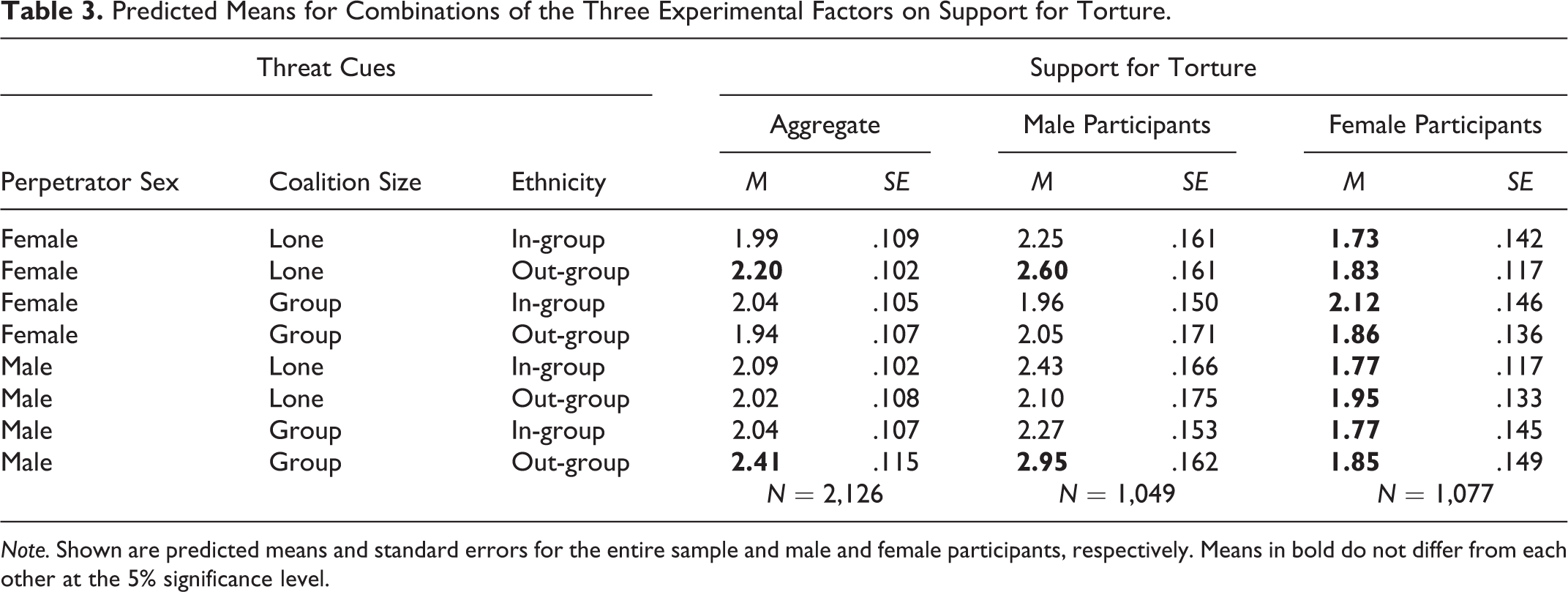
Note. Shown are predicted means and standard errors for the entire sample and male and female participants, respectively. Means in bold do not differ from each other at the 5% significance level.
Robustness Checks and Alternative Explanations
Controlling for Sociodemographic Factors
Analyses presented thus far do not include sociodemographic variables that could potentially influence the reported associations. In order to account for this possibility, the models were rerun while controlling for those sociodemographic variables that were significantly correlated with support for torture: age (b = −0.02, p = .000), level of education (b = −0.10, p = .000), and political orientation (b = −0.42, p = .000). The three-way interaction between perpetrator sex, ethnicity, and coalition size remained statistically significant when including these sociodemographic variables as covariates, both in aggregate (b = 0.84, p = .005) and for male participants (b = 1.18, p = .009), but not for female respondents (b = 0.49, p = .20). Indeed, for female respondents, the previously marginally significant main effect of coalition size disappeared, rendering all main effects and interaction terms insignificant (all p > .14).
Second, political ideology looms prominently in studies pertaining to out-group prejudice in the context of terrorist violence. Previous work has demonstrated associations between conservative political orientation and support for policies related to the war on terror (e.g., Hetherington & Suhay, 2011). Based on the extant literature, one might therefore suspect the results to differ for liberal and conservative respondents. In order to test whether political ideology had an impact on the results, an interaction term between the coalitional threat vignette (1 = male out-group coalition vignette and 0 = other vignettes) and political ideology was entered into the model. The interaction term was not statistically significant in aggregate (b = 0.05, p = .62) nor for the male and female subsamples (b = 0.16, p = .28 and b = 0.05, p = .84, respectively). Hence, there is reason to assume that the results were not influenced by individual differences in adherence to political ideology.
Third, it is known that notions of honor are more salient in Southern states and that offenses are more readily met with counteraggression (Cohen, Nisbett, Bowdle, & Schwarz, 1996; IJzerman, van Dijk, & Gallucci, 2007). Since a significant portion of the sample consisted of White males from the South, additional analyses were run in order to rule out the possibility that these factors influence the validity of the findings. First, controlling for geographic region did not influence the main findings: The interaction term between the three experimental cues remained statistically significant for male respondents (b = 1.28, p = .005). Second, and in order to avoid higher order interactions, the model was rerun on the male subsample with two dummy variables (geographic region: 1 = South and 0 = other regions; coalitional threat vignette: 1 = male out-group coalitions and 0 = other vignettes). Again, the interaction term was not statistically significant (b = 0.04, p = .91). The results thus demonstrate that reactions to the coalitional threat cues were not driven by male respondents residing in the South.
In sum, across a range of statistical model specifications including analyses controlling for sociodemographic variables, political ideology, and potentially high salience of honor norms in the South, the findings speak to the same conclusion: The presence of coalitional threat cues is associated with increased levels of coalitional out-group prejudice in the form of support for interrogational torture, and this effect is driven by male respondents.
Sex Role Attitudes
An alternative explanation for the findings of this study may concern cultural norms and stereotypes regarding sex differences, which may underlie differential public perceptions of female and male offenders. Scholars have argued that the image of violent women goes against the grain of gendered expectations of femininity, which tell us that women are gentle, peaceful, and caring, making it difficult to reconcile “nurturing female” with “calculating killer” (Patkin, 2004). Further, female terrorist violence is often described as particularly shocking since it “violate[s] the gender norms of the societies from which the attackers emerge” (O’Rourke, 2009, p. 682). Previous studies have pointed to a focus on mythical or gendered stereotypes; their psychological and motivational profile; their mental health; and discussions about their family history, social background, or love interests (Nacos, 2005; for a review, see Jacques & Taylor, 2009). Previously advocated explanations in favor of “chivalry”—a long-standing norm that protects women not only from other men but also other women and other forms of threat or danger (e.g., Felson, 2002)—fall in line with these notions.
Because people may use stereotypic associations between social categories and concepts like violence as a schema to help interpret events that might subsequently influence their response, the rhetoric of our gendered society might shape perceptions of female and male offenders. For example, people might reason that women are more nurturing and harmless than men, resulting in more lenient attitudes toward the transgressions of female perpetrators. In order to account for the potential role of gender attitudes—and hence, stereotypes pertaining to the roles of men and women—in explaining support for torture and to examine whether the reported effects are conditioned by individual differences in gender attitudes, the SRQ was included as a variable in the estimation model.
The three-way interaction between suspect sex, ethnicity, and coalition size remained statistically significant in aggregate when controlling for sex role stereotypes (b = 0.56, p = .04). The main effect of gender attitudes, however, was also statistically significant (b = 0.75, p < .001), suggesting that sex role attitudes do shape public reactions to female versus male terrorism as well. In the next step, it was checked whether the three-way interaction between the experimental factors emerged as statistically significant across all levels of gender attitudes. The interaction was statistically significant across the 25th (p = .003), 50th (p = .02), and 75th percentile (p = .05; all one-tailed). Thus, altogether, it appears that relevant group threat cues activate deeper psychological mechanism that remain largely impactful across stereotypical perceptions, although higher levels of sex role attitudes are associated with greater support of interrogational torture for male out-group coalitions.
Support for Harsh Interrogation Techniques Versus Punishment
Previous literature has addressed the conceptual differences between punishment and torture as well as different types of torture. In this study, support for torture is operationalized as interrogational rather than punitive, torture. Interrogational torture, then, constitutes a calamity-averting strategy (Kramer, 2014) and a means of deterrence—gathering information in order to deter the strength of a hostile coalition that might impose significant costs on one’s in-group in the future. Interrogational torture is thus qualitatively different from punishment, which entails a correction of and retribution for wrongdoing. While experimental research has demonstrated the centrality of retribution in laypeople’s penal sentencing preferences across a range of criminal offenses (reviewed by Carlsmith, Wilson, & Gilbert, 2008), punishing others can be costly, especially when retaliation is likely.
In order to examine whether the findings presented here can indeed be seen as evidence for the fact that male out-group coalitions are punished more harshly in order to deter their capacity, the same analyses were run with support for punishment as dependent variable. Regression analyses revealed that the three-way interaction between perpetrator sex, ethnicity, and coalition size did not emerge as a statistically significant predictor of support for punishment, neither in aggregate (b = −0.10, p = .76) nor for female and male respondents separately (b = 0.03, p = .95 and b = −0.23, p = .65, respectively).
Conclusion and Discussion
While the criminological literature consistently finds that female perpetrators are treated more mildly than their male counterparts, the terrorism literature has focused mostly on intergroup bias along group demarcation lines of race, ethnicity, and religious denomination. Testing assumptions in line with the MWH, this study examined the effects of terror-suspect sex, in interaction with other threat cues, on support for torture. Confirming the hypotheses, results show that in aggregate, support for torture most readily sanctioned for male out-group coalitions (operationalized as a number of male terror suspects belonging to a lager, radical Islamist terrorist organization). Follow-up analyses revealed that this effect was driven by male, but not female, respondents. As such, this study presents supportive evidence that deep-seated psychological mechanisms guide the way people reason about modern forms of intergroup violence and attests to the assumption that compared to women, men are particularly inclined to react to subtle threat cues signaling intergroup conflict.
This is not to say that female perpetrators are treated more leniently. Rather, male out-group coalitions appear to trigger a particularly acute and harsh response. That is, support for interrogational torture was consistently highest for male out-group coalitions and statistically significant from all other experimental conditions but one: that of a female, lone out-group perpetrator. The fact that support for torture of lone out-group females was not significantly different from that of male out-group coalitions warrants an explanation, one of which might be found in the function of and differences between various types of torture—for example, torture as a means to obtain information (interrogational torture) versus torture as a means to inflict disproportionate harm on a perpetrator (punitive torture). When met with lone, female out-group perpetrators, then, it might be less costly to impose torture, as retaliation might appear unlikely. While the finding that the interaction between the threat cues did not deliver significant results for punitiveness suggests that strategies are functionally and qualitatively different from each other, future studies should take into participants’ perceptions of what torture is designed to do into account, and whether these perceived underlying functions differ for the male and female offenders.
Importantly, the findings that torture is sanctioned more readily for male out-group coalitions held across a range of alternative model specifications including the control for sociodemographic factors, political ideology, geographic region, and sex role attitudes. Since the interaction between the three experimental factors remained statistically significant across all levels of sex role attitudes, the findings suggest that male out-group coalitions activate a deep, tribal psychology designed to deter hostile coalitional networks. This does not imply that gender attitudes do not influence these associations at all; hence, future studies should take into account the role of stereotypes about sex differences and integrate them further into evolutionary psychological accounts of coalitional out-group prejudice.
This study suffers a few limitations. One such limitation concerns the use of the dependent variable itself. Harsh interrogation techniques have been considered a sensitive topic among the American population (Barnes, 2017), and participants might be skeptical about expressing their support for such measures. However, and despite the fact that support for torture was generally very low, which may suggest a floor effect, the findings speak to the importance of considering the interplay between coalitional threat cues in shaping support for torture in the domain of terrorism. Another potential limitation concerns the wording of the vignettes, which dealt with a serious threat to human lives, but actually no loss thereof. While this was done for methodological concerns (e.g., it is likely that participants would have been aware of any terrorist event involving casualties), it is possible that reading about loss of life might have exacerbated the effects found in this study. Further, in this study, in- and out-group membership was operationalized as ethnicity. It has been noted that the phenotypic differences often used to classify people on the basis of race are likely processed by features of the mind that evolved to identify social or coalitional groups but not racial groups (Gil-White, 2001; Kurzban, Tooby, & Cosmides, 2001). Since group demarcation lines based on ethnicity, race, and religious denomination have been particularly salient in the context of terrorism since 9/11, ethnicity appeared to be an appropriate choice for the experimental design employed in this study. In the future, a closer examination of coalitional affiliation and its potential in overriding cues signaling race or ethnicity in the terrorism domain could shed further light on the associations reported in this study.
Summing up, these findings speak to the importance of reconciling different literatures from psychology, criminology, and political science. A consideration of the psychological bases underlying intergroup aggression offers a fruitful venue for understanding public reactions to terrorist violence and can assist in understanding more nuanced reactions based on both respondent and terror-suspect sex. Overall, coalitional out-group prejudice in the context of terrorism appears to be a gendered phenomenon, thereby adding to empirical evidence confirming evolutionary psychological accounts of intergroup violence in general and MWH in particular.
Supplemental Material
Supplementary_Appendix_-_Items - Public Reactions to Male Versus Female Terrorism: Experimental Evidence for the Male Warrior Hypothesis
Supplementary_Appendix_-_Items for Public Reactions to Male Versus Female Terrorism: Experimental Evidence for the Male Warrior Hypothesis by Miriam Lindner in Evolutionary Psychology
Footnotes
Acknowledgment
The author would like to thank Daniel Sznycer and Joshua M. Tybur for comments that greatly improved the manuscript.
Declaration of Conflicting Interests
The author(s) declared no potential conflicts of interest with respect to the research, authorship, and/or publication of this article.
Funding
The author(s) disclosed receipt of the following financial support for the research, authorship, and/or publication of this article: This work was supported by the Aarhus University Research Foundation (Grant #90203, 2016) and by the Aarhus University Research Foundation Starting Grant awarded to Lasse Lindekilde (AUFF-E-2015-FLS-8-3).

Notes
Supplemental Material
Supplementary material for this article is available online.
References
Supplementary Material
Please find the following supplemental material available below.
For Open Access articles published under a Creative Commons License, all supplemental material carries the same license as the article it is associated with.
For non-Open Access articles published, all supplemental material carries a non-exclusive license, and permission requests for re-use of supplemental material or any part of supplemental material shall be sent directly to the copyright owner as specified in the copyright notice associated with the article.
