



Abstract
Terror management theory (TMT) posits that the uniquely human awareness of death gives rise to a potential for debilitating terror, which is averted by the construction and maintenance of cultural worldviews. Over 300 studies have supported hypotheses derived from TMT. In a recent critique of TMT, Navarrete and Fessler (2005) argued that TMT is inconsistent with contemporary evolutionary biology and that the evidence supporting TMT can be better accounted for by an alternative “coalitional psychology” (CP), which posits a domain general mechanism whereby a wide range of adaptive threats activate an even wider range of judgments and behaviors all directed toward sustaining unspecified coalitions. In this paper, we argue that: a) Navarrete and Fessler do not adequately present either TMT or the empirical evidence in support of it; b) TMT is in no way inconsistent with modern evolutionary biology; and c) CP is not theoretically plausible and cannot provide a convincing empirical account of evidence supporting TMT. The broader goal of this paper is to encourage evolutionary theorists to move beyond overly simplistic alternatives that target superficial portrayals of TMT and the evidence supporting it, and contribute to a more useful integration of TMT and its findings with evolutionary thinking about culture and human social behavior.
Keywords
Introduction
In every calm and reasonable person there is hidden a second person scared witless about death.
Philip Roth, The Dying Animal (2001, p. 153).
Terror management theory (TMT; see Greenberg, Pyszczynski, and Solomon, 1986; Solomon, Greenberg, and Pyszczynski, 1991), inspired by the work of Ernest Becker (1971; 1973; 1975), was developed to provide a functional account of the role of culture and self-esteem in human affairs. From the very beginning, we have viewed TMT as rooted in the principles of Darwin's (1859) theory of evolution by natural selection and believed that the two perspectives are immanently compatible and provide complementary insights into the origins and contemporary functioning of humankind. However, in their recent paper “Normative Bias and Adaptive Challenges…,” Navarrete and Fessler (2005) argued that TMT is out of step with modern evolutionary theory, that the body of empirical evidence associated with TMT does not provide strong empirical support, and that an alternative account of allegiance to cultural worldviews based on their coalitional psychology (CP) offers a more useful perspective. We found their critique wide-ranging but misguided in many respects. Moreover, the CP perspective is not theoretically coherent or plausible, and it cannot account for the large body of empirical evidence supporting TMT. In the present paper we provide a brief overview of TMT and the research supporting it, respond to Navarrete and Fessler's criticisms of this work, critique their alternative CP account of allegiance to cultural worldviews, and consider how an integrated consideration of both existential psychological and evolutionary factors can lead to a richer understanding of human cognition and behavior.
Terror Management Theory
In line with Ernest Becker's theorizing, TMT starts with Darwin's (1859) insight that human beings, like all other living species, are biologically predisposed in many ways toward continued life, but that more so than other species, humans adapt to their environment and prosper largely by virtue of highly developed cognitive abilities, including the capacities for abstract, symbolic, temporally extended, and self-reflective thought 1 . Presumably these capacities conferred a significant advantage for humans in terms of flexible and innovative behaviors suited to their physical and social surroundings.
This cognitive sophistication, however, had some problematic consequences. Following thinkers in the existentialist and psychoanalytic traditions (e.g., Brown, 1959; Freud, 1937/1965; Kierkegaard, 1844/1959; Rank, 1930/1998; Zilboorg, 1943), Becker observed that humans' symbolic understanding of the world and explicit self-awareness enabled them to recognize that, even in the absence of immediate danger, life will inevitably end, and that death can occur at any time for reasons that often cannot be anticipated or controlled. This awareness of the inevitability of one's own death conflicts with the desire for continued life and engenders an ever-present potential to experience severe anxiety.
According to Becker, humans avoid a continual fearful confrontation with the fact of their mortality by denying that their physical death ends in absolute annihilation. This is accomplished, in part, through the collective construction and maintenance of cultural worldviews: widely shared beliefs about the nature of reality that imbue life with meaning and order and provide the opportunity for some form of death transcendence to those who uphold cultural standards of value. By perceiving themselves as valuable contributors to a meaningful world (i.e., by maintaining self-esteem), people can avoid viewing themselves as merely material animals fated only to obliteration upon death; instead they can view themselves as enduring, significant beings who will continue on past physical death, either literally through some form of afterlife (e.g., heaven, reincarnation, nirvana), or symbolically through enduring accomplishments and being part of larger enduring collectives (see Lifton, 1979, for an extended discussion of different modes of literal and symbolic immortality). Following this line of thought, TMT thus posits that humankind manages the potential terror (hence the term terror management) resulting from awareness of the inevitability of death by maintaining faith in a cultural worldview and procuring self-esteem by living up to the standards of value prescribed by that worldview.
Because both worldviews and self-esteem are symbolic constructions rather than absolute representations of reality, confidence in them, and hence effective mitigation of anxiety, requires ongoing consensual validation from others. Those who share one's worldview and agree that one is meeting or exceeding cultural standards of value strengthen these psychological structures and increase their effectiveness as shields against existential terror; those who view the world or oneself differently undermine these structures and their effectiveness as anxiety-buffers.
Empirical Evidence
Empirical support for TMT comes from over 300 separate experiments conducted by independent researchers in at least 15 different countries, including samples from collectivistic cultures like Japan (Heine, Harihara, and Niiya, 2002), Iran (Pyszczynski, et al., 2006), and Aboriginal Australia (Halloran and Kashima, 2004). The work has supported hypotheses concerning a diverse range of domains of human behavior, including prejudice, self-esteem striving, social judgment, creativity, health, sex and other bodily activities, aggression, altruism, risk-taking, justice, nationalism, religiosity, politics, aesthetic preferences, and close relationships. Because Navarrete and Fessler acknowledge only a highly selective subset of this evidence, we will provide a brief overview summarizing the major findings of TMT research (for more comprehensive recent reviews of this literature, see Greenberg, Solomon, and Arndt, in press; Pyszczynski, Solomon, and Greenberg, 2003; Solomon, Greenberg, and Pyszczynski, 2004).
Mortality Salience Increases Cultural Worldview Defense and Self-Esteem Striving
The mortality salience hypothesis states that if cultural worldviews and self-esteem function to provide protection against death-related concerns, then heightening the salience of mortality (mortality salience; MS) should intensify commitment to, and defense of, these psychological structures. A growing body of research, to date consisting of over 200 separate experiments, provides support for specific instantiations of this broad hypothesis. These studies have used a variety of operationalizations of MS, such as open-ended items designed to focus thoughts on one's own death (e.g., Rosenblat, Greenberg, Solomon, Pyszczynski, and Lyon, 1989), completing a death anxiety scale, writing a single sentence about death (e.g., Dechesne et al., 2003) exposure to subliminal death-related stimuli (e.g., Arndt, Greenberg, Pyszczynski, and Solomon, 1997a), or interviews in front of funeral home or cemetery (e.g., Pyszczynski, Wicklund, et al., 1996).
Early research tested hypotheses based on the notion that MS should result in worldview defense, or a heightened agreement with and affection for those who uphold or share one's beliefs (or are similar to oneself and group) and equally vigorous disagreement with and disdain for those who challenge or do not share one's beliefs (i.e., are different from oneself and group). In a typical study, participants receive a MS manipulation embedded in a packet of questionnaires purportedly designed to assess personality and interpersonal judgments. Specifically, participants in the MS condition are asked to respond to the following open-ended questions: “Please briefly describe the emotions that the thought of your own death arouses in you” and “Jot down, as specifically as you can, what you think will happen to you as you physically die and once you are physically dead.” Participants in control conditions complete parallel questions about another topic. Although participants in initial studies were led to consider benign topics such as watching television, subsequent research has utilized a variety of aversive control topics, including thoughts of intense pain, paralysis, losing a limb in an accident, social exclusion, worries about life after college, giving a speech, failing an exam, uncertainty, and imagining the death of a loved one. Afterwards, participants rated target individuals who upheld or violated cherished aspects of participants' worldviews.
For example, Greenberg et al. (1990, Study 1) had Christian participants evaluate Christian and Jewish targets (very similar demographically except for religious affiliation) after a MS or control induction. Although there were no differences in evaluation of the targets in the control condition, mortality salient participants exhibited a greater fondness for the Christian target and more adverse reactions to the Jewish target. An additional study replicated and extended this finding by showing that after a MS induction, American participants showed increased affection for an essay and its American author praising the United States and increased disdain for an anti-American essay and its American author. Other research showed that MS leads to positive reactions to those who exemplify the values of the worldview and negative reactions to those who violate them (e.g., Florian and Mikulincer, 1997; Rosenblatt et al., 1989). This work also demonstrated that MS effects are not the result of subjective anxiety or negative mood; specifically, asking participants to ponder their demise does not typically engender negative affect or self-reported anxiety, and covarying out these variables does not eliminate MS effects. Rosenblatt et al. (1989) also demonstrated that MS effects are unmediated by self-awareness or physiological arousal, and that they are quite precisely directed at worldview threatening or bolstering targets (e.g., in Rosenblatt et al., Study 2, only participants morally opposed to prostitution prescribed a higher bond for an alleged prostitute after a MS induction, and MS did not adversely affect participants' ratings of the experimenter, which one would predict if MS effects were nonspecific in nature.
Behavioral effects of MS have been obtained in addition to the attitudinal effects described above. For example, Greenberg, Simon, Porteus, Pyszczynski and Solomon (1995) found that participants took longer and felt more uncomfortable using cherished cultural icons in a blasphemous fashion (i.e., sifting colored dye through an American flag and using a Crucifix as a hammer) after a MS induction. Also, Ochsmann and Mathy (1994) showed that following a MS induction, German participants sat closer to a German confederate and further away from a Turkish confederate. And H. McGregor et al. (1998) demonstrated that MS increased physical aggression (assessed by the amount of hot sauce administered to a fellow participant known to dislike spicy food in the context of a supposed study of consumer taste preferences) toward those who attack one's political orientation.
There is also a good deal of empirical support for the hypothesis that MS increases diverse efforts to enhance and protect self-esteem (see Pyszczynski, Greenberg, Solomon, Arndt, and Schimel, 2004 for a review of this research). For example, MS leads to increased identification with the body among those who value the body as a source of self-esteem (Goldenberg, McCoy, Pyszczynski, Greeenberg, and Solomon, 2000) and increased group (e.g., ethnic) identification when such identification has positive implications for self-esteem but also decreased group identification when such identification has negative implications for self-esteem (Arndt, Greenberg, Schimel, Pyszczynski, and Solomon, 2002; Dechesne, Janssen, and van Knippenberg, 2000). Similarly, Mikulincer and Florian (2002) have found that MS increases self-serving attributions after a performance outcome. In addition, MS has been found to boost efforts to live up to the standards of value from which one's self-esteem is derived, including risky driving behavior (both self-reported and on a driving simulator; Taubman-Ben-Ari, Florian, and Mikulincer, 1999), fitness intentions (Arndt, Schimel, and Goldenberg., 2003), displays of physical strength (Peters, Greenberg, Williams and Schneider, 2005), and charitable donations (Jonas, Schimel, Greenberg, and Pyszczynski, 2002) among those who value these domains as sources of self-esteem. More recently, Landau and Greenberg (2006) found that MS leads high self-esteem individuals faced with a risky, self-relevant decision to pursue opportunities for excellence despite substantial risk of failure whereas mortality-salient low self-esteem individuals become more risk-averse in an effort to protect their self-esteem.
Self-Esteem Provides a Buffer Against Anxiety
Research also supports the hypothesis that high levels of self-esteem reduce proneness to anxiety in response to threats. In the initial test of this hypothesis, Greenberg, et al. (1992) showed that boosting self-esteem with positive feedback on a personality test led to lower levels of self-reported anxiety on the State Anxiety Inventory (Spielberger, Gorsuch, and Lushene, 1970) in response to graphic video depictions of death. They also showed that both positive personality feedback and success on a supposed test of intelligence led to lower levels of physiological arousal (skin conductance) in response to the threat of painful electric shock. Additional support for the anxiety-buffer hypothesis was provided by Greenberg, Pyszczynski et al. (1993), who demonstrated that both experimentally enhanced and dispositionally high self-esteem lead to lower levels of cognitive distortions to deny one's vulnerability to an early death. Specifically, whereas in control conditions participants reported whatever level of emotionality (high or low) they had been led to believe is associated with a long life expectancy, participants with dispositionally high or experimentally enhanced self-esteem did not show this bias.
Bolstering One Aspect of the Anxiety-Buffer Reduces the Effect of MS on Defense of Other Aspects of the Anxiety-Buffer
Research has also tested a combination of the MS and anxiety-buffer hypotheses: If self-esteem and faith in a cultural worldview provide protection against death-related concerns, then bolstering one of these components should reduce or eliminate the effects of MS on clinging to other aspects of the anxiety-buffer. For example, Harmon-Jones et al. (1997) demonstrated that participants with experimentally enhanced or dispositionally high self-esteem do not exhibit the increased worldview defense typically found in response to MS. Arndt and Greenberg (1999) replicated this finding and furthermore found that a self-esteem boost did not eliminate MS-induced derogation of a worldview-threatening target if that person attacked the domain upon which the prior self-esteem boost was based, further demonstrating the dependence of self-esteem and its anxiety-buffering properties on faith in one's cultural worldview.
Belief in Literal Immortality Eliminates the Effect of MS on Self-Esteem Striving and Worldview Defense
TMT posits that people fear death because, regardless of what they profess to believe about the possibility of life after death, they are painfully aware of the possibility that death might entail absolute annihilation. If this is the case, then increasing faith in the existence of life after death (in TMT terms, literal immortality) should reduce or eliminate the effect of MS on self-esteem striving and worldview defense. Dechesne et al. (2003) tested this hypothesis in three experiments. In Studies 1 and 2, participants were given one of two articles which supposedly summarized a recent scientific conference on the meaning of the highly publicized “near death experience.” Half of the participants read an article that argued that the near death experience was an artifact of the biological processes involved in the shutting down of brain functioning; the other half read an article that argued that the near death experience cannot be explained as the simple by-product of biological processes and that this experience can be explained only by concluding that some form of consciousness persists after biological death. After reading one of these articles, participants were induced to think about either their own death or dental pain, and were then given the same positive personality feedback that Dechesne, Janssen, and van Knippenberg (2000) previously demonstrated is rated by participants as more credible after MS. Although participants who read the article arguing that death is the absolute end of life showed the same increased ratings of the validity of the positive personality feedback in response to MS, those who read the article arguing that the near death experience provides irrefutable evidence of an afterlife did not show an exaggerated regard for the personality feedback. Study 3 replicated and extended these findings, showing that whereas priming death in the absence of afterlife-confirming information led participants to judge moral transgressions more harshly, this effect was eliminated when afterlife-confirming information was primed prior to MS. This work shows that when literal immortality is viewed as likely, the need for strengthening symbolic bases of death transcendence is lessened.
Grave Matters Matter in a Wide Variety of Domains of Human Judgment and Behavior
In accord with Becker's and TMT's assertion that concerns about death affect a substantial proportion of human activity, research has shown that in addition to exacerbating concern with culturally specific sources of meaning, MS heightens more general tendencies to seek and prefer clear and coherent interpretations of others and events. For example, MS increases preference for information that bolsters the belief that the world is just (Hirschberger, in press; Landau et al., 2004a), and decreases attraction to individuals who act in inconsistent ways (Landau et al., 2004a) and artworks that seem devoid of meaning (Landau, Greenberg, Solomon, Pyszczynski and Martens, 2006b). MS also leads to negative reactions to threats to meaningful conceptions of time, and increases perceived meaningfulness of one's personal past and the continuity of one's current self with past and anticipated experience (Landau, Greenberg, Arndt, and Routledge, 2006a).
Furthermore, and consistent with hypotheses derived from TMT, reminders of death increase: religious conviction (Jonas and Fischer, 2006), stereotyping (Schimel et al., 1999), national identification (Castano, Yzerbyt, and Paladino, 2004), conformity to norms (Jonas et al., 2006), guilt after creative activities (e.g., Arndt and Greenberg, 1999), desire for expensive luxury goods (e.g., Kasser and Sheldon, 2000), desire for children (Wisman and Goldenberg, 2005), structuring of nature (Koole and Van den Berg, 2005), and efforts to be physically attractive (Routledge et al., 2004).
In addition, MS effects are moderated by a host of theoretically specified individual difference variables including personal need for structure, self-esteem, authoritarianism, the valuing of tolerance, neuroticism, attachment style, intrinsic religiosity, and investment in specific bases of self-worth (see e.g., Goldenberg, Pyszczynski, Greenberg and Solomon, 2000b; Greenberg, Solomon and Pyszczynski, 1997; Greenberg, Solomon and Arndt, in press; Mikulincer, Florian, and Hirschberger, 2003).
A substantial line of research spearheaded by Jamie Goldenberg also shows how reminders of death lead people to distance from ideas or activities that remind them that they are animals. To avoid the recognition that they are merely material, finite creatures, people invest in worldviews that elevate them to a spiritual or symbolic plane that transcends the life and death fray of the animal world 2 . As examples of evidence supporting this analysis, following MS, people high in neuroticism or reminded of their similarities to other animals distance themselves from physical, but not romantic aspects of sex (Goldenberg et al., 1999; Goldenberg, Cox, Pyszczynski, Greenberg and Solomon, 2002), and avoid aversive and pleasurable physical sensations (Goldenberg, et al., 2006b), and are more disgusted by reminders of their animal nature (Goldenberg, et al., 2001). In addition, after MS, women are more reluctant to give themselves breast exams, and people are more negative toward mothers breast-feeding in public (Goldenberg et al., 2006a). Furthermore, MS leads men to distance from feelings of sexual attraction to sexually provocative, but not “wholesome,” women, and MS combined with reminders of carnal lust increases tolerance for physical aggression towards women (Landau et al., 2006c).
What's Death Got to do With it? A Dual Process Model of Defense Against Conscious and Nonconsious Death-Related Thoughts
As mentioned above, TMT research indicates that MS effects are specific to thoughts of one's own death; they are not elicited by other aversive stimuli, increased self-focus, subjective arousal (self-report or physiological), the salience of cultural values, or high cognitive load (Greenberg, et al., 1995). What then are the cognitive processes by which conscious and unconscious awareness of death influence cultural worldview and self-esteem defense? Pyszczynski, Greenberg, and Solomon (1999, p. 835) proposed a dual process theory to explicate these processes:
Distinct defensive responses are activated by thoughts of death that are conscious and those that are on the fringes of consciousness (highly accessible but not in current focal attention). Proximal defenses entail the suppression of death-related thoughts or pushing the problem of death into the distant future by denying one's vulnerability to various risk factors. These defenses are rational, threat-focused, and are activated when thoughts of death are in current conscious attention. Distal terror management defenses entail maintaining self-esteem and faith in one's cultural worldview and serve to control the potential for anxiety resulting from awareness of the inevitability of death. These defenses are experiential, not related to the problem of death in any semantic or rational way, and are increasingly activated as the accessibility of death-related thoughts increases, up to the point at which such thoughts enter consciousness and proximal threat-focused defenses are initiated.
In support of this dual process conception (see Figure 1 for a graphic depiction), Greenberg, Arndt, Simon, Pyszczynski, and Solomon (2000) demonstrated that immediately after a MS induction, people engage in proximal defenses (vulnerability-denying defensive distortions) but do not show evidence of distal defense (exaggerated regard and disdain for similar and dissimilar others respectively); and, as expected, distal defense was obtained after a delay, but proximal defenses were not. Additionally, defense of the cultural worldview does not occur when mortality is highly salient, or when people are forced to keep thoughts of death in consciousness following our typical subtle MS manipulation (Greenberg, Pyszczynski, Solomon, Simon, and Breus, 1994), or when they are asked to behave “rationally” (Simon, Greenberg, Harmon-Jones, Solomon, Pyszczynski, Arndt, and Abend, 1997). A variety of additional studies have shown that reactions immediately following MS are logically related to the problem of death; for example, immediately after MS people increase their intentions to get more exercise and use safe sun products. However, after a delay, when death-related thought is not in focal attention but high in accessibility, responses serve bolstering of the worldview and self-esteem, reactions that sometimes run counter to logical efforts to forestall death; for example, after MS and a delay people for whom tanning was relevant to their self-esteem actually lowered their intentions to use safe sun products (Routledge, et al., 2004).
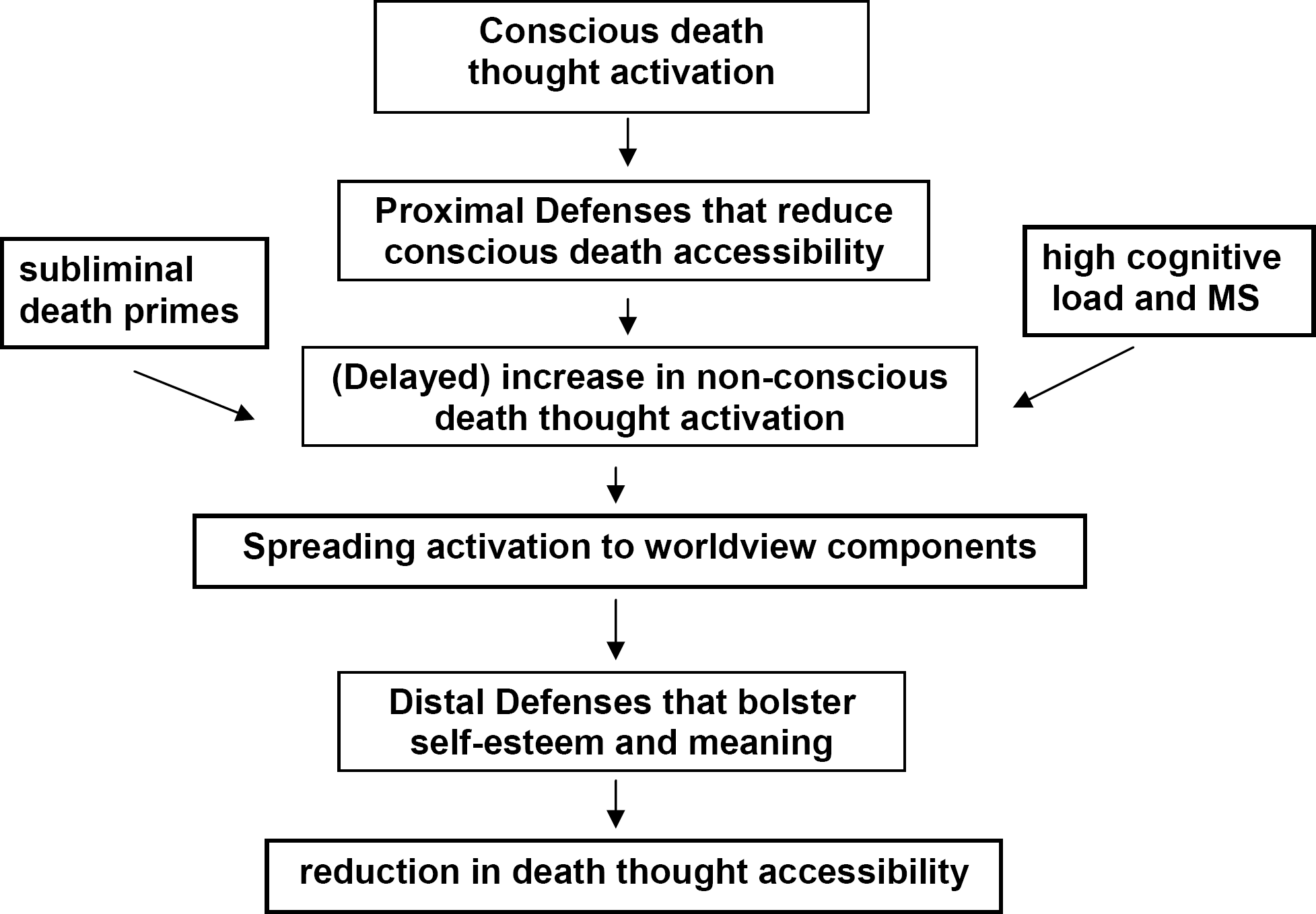
The Cognitive Architecture of Terror Management.
Arndt, Greenberg, Solomon, Pyszczynski, and Simon (1997) also demonstrated that the accessibility of death-related thoughts is low immediately following MS as a result of an active suppression of such thoughts, and that a delayed increase in the accessibility of death-related thoughts (presumably from relaxation of the suppression) is responsible for the delayed appearance of cultural worldview defense. More specifically, whereas death thought accessibility was low immediately after MS among participants under low cognitive load, death accessibility was high immediately after MS among participants with high cognitive load. As Wegner (1992) has shown, cognitive load interferes with thought suppression; thus these findings suggest that the initial response to thoughts of death is often to suppress such thoughts.
Research also shows that presenting death-related words beneath conscious awareness leads to an immediate increase in death thought accessibility and heightened worldview defense relative to negative or neutral or control words (Arndt, Greenberg, Pyszczynski, and Solomon 1997; Harmon-Jones, et al., 1997), and that cultural worldview defense and self-esteem bolstering keep levels of death-thought accessibility low. Specifically, following MS, both self-esteem and worldview bolstering bring death accessibility back down to baseline levels (Arndt et al., 1997b; Greenberg et al., 2000; Harmon-Jones et al., 1997). In addition, death-related thought increases the accessibility of chronically or situationally salient aspects of one's worldview (Arndt, Greenberg, and Cook, 2002; for a recent review of research supporting the entire model, see Arndt, Cook, and Routledge, 2004). Taken together, these findings suggest that heightened accessibility of death-related thought is a necessary and sufficient condition to produce worldview defense and self-esteem striving following MS.
According to this dual process model, it is the potential to experience anxiety, rather than the actual experience of anxiety, that is triggered by heightened death thought accessibility and that mediates worldview defense. In a test of this hypothesis, Greenberg et al. (2003) had participants consume a placebo purported to either block anxiety or enhance memory. Then, after a MS or control induction, participants evaluated pro- and anti-American essays as a measure of worldview defense. Although MS intensified worldview defense in the memory-enhancer condition, this effect was completely eliminated in the anxiety-blocker condition. These results suggest that cultural worldview defense serves to avert the experience of anxiety rather than to ameliorate actually experienced anxiety.
Threats to Terror Management Defenses Increase Death Thought Accessibility
TMT's dual process model also suggests that inductions semantically unrelated to death which threaten terror management defenses can produce heightened accessibility of implicit death thoughts. As an example of research consistent with this hypothesis, Mikulincer, Florian, and Hirschberger (2003) examined the terror management function of close relationships. They predicted and found that MS heightens the motivation to form and maintain close relationships, and that threats to close relationships result in increased death-thought accessibility. Additionally, Goldenberg et al. found that thoughts of the physical, corporeal aspects of sex (rather than the more romantic aspects) increased the accessibility of death-related thoughts among neurotics (1999) and high and low neurotics following a reminder of humans' similarity to animals (2002). Landau et al. (2004a) and Hirschberger (in press) both found that threats to belief in a just world increased death thought accessibility. Landau et al. (2004b) also found evidence of increased death-thought accessibility following subliminal reminders of the events of 9/11.
Most recently, Schimel, Hayes, Williams, and Jahrig (2007) have shown that threats to the Canadian worldview and to a pro-creationism worldview increase death thought accessibility among Canadians and creationists, respectively, on both word-stem completion and lexical decision measures. Furthermore, they found that these effects are eliminated when the threat could be easily dismissed, independent of the arousal of both anxiety and anger, and distinct from increases in the accessibility of other negative and neutral words. In another set of studies, Hayes, Schimel, and Williams (2007) found evidence of increased death thought accessibility following self-esteem threats. Specifically, participants who received negative feedback on their intelligence or personality were subsequently faster to make lexical decisions about death-related words, but not negative or neutral words.
Summary
In sum, there is now a substantial empirical literature that provides strong support for the central tenets of terror management theory: 1) in a large number of studies, priming thoughts of death, but not other aversive topics, engenders exaggerated need for the anxiety-buffering properties of cultural worldviews; this is reflected in increased regard for anything that supports the individual's worldview as well as increased disdain for anything that threatens to undermine its validity; 2) MS relative to controls similarly instigates efforts to bolster and protect self-esteem; 3) self-esteem reduces anxiety in response to threatening circumstances; 4) momentarily elevated or dispositionally high self-esteem reduces or eliminates worldview defenses following MS; 5) MS increases investment in basic ways people imbue their social and personal lives with meaning; 6) MS increases distancing from reminders that humans are animals; 6) threats to psychological beliefs that serve a terror management function increase the accessibility of death-related thought; and 7) MS effects are instigated by heightened accessibility of implicit death thoughts and the function of terror management processes is to avert the potential for anxiety engendered by death-related thought and reduce the accessibility of such thoughts.
TMT and Evolutionary Psychology
Navarrete and Fessler (2005) argue that any viable psychological theory should be consistent with what is known about how evolution works and the evolutionary history of our species, and that TMT lacks such consistency. The authors' first concern is that TMT is wedded to an outmoded assumption that human beings share with many other species a “survival instinct.” Specifically, they insist that avoiding death is too general a problem to be solved by natural selection. Second, they claim that TMT's notion that death anxiety can be debilitating and that psychological mechanisms exist to inhibit anxiety is untenable because anxiety was designed by natural selection as an adaptive response to specific threats. Third, they critique TMT's claim that culture functions to buffer anxiety on the grounds that cultural worldviews often include fear and anxiety-arousing elements. We address each of these critiques in turn.
The Instinct for Self-preservation
“…it has always seemed to me that the only painless death must be that which takes the intelligence by violent surprise and from the rear so to speak since if death be anything at all beyond a brief and peculiar emotional state of the bereaved it must be a brief and likewise peculiar state of the subject as well and if aught can be more painful to any intelligence above that of a child or an idiot than a slow and gradual confronting with that which over a long period of bewilderment and dread has been taught as an irrevocable and unplumbable finality, I do not know it.”
William Faulkner (1936/1990, p. 142)
According to Navarrete and Fessler (p. 301) contemporary evolutionary theory defines an instinct as a mechanism which, over the course of a species' evolution, reliably generated a stereotyped behavioral response to circumscribed stimuli in ways that had positive fitness consequences. Since, according to this definition, natural selection can only build instincts that respond to specific adaptive challenges in specific situations, it could not have designed an instinct for survival per se because staying alive is a broad and distal goal with no single clearly defined adaptive response (similarly, based on this reasoning there can be no language instinct, no sociability instinct, no aggressive instinct, for these are all far too domain general). The implication seems to be (the authors are never explicit about this) that, contrary to TMT, human awareness of the inevitability of death could not have conflicted with an instinctual avoidance of death (since there could be no such instinct) and thus could not have engendered the potential for terror that purportedly underlies worldview and self-esteem defense.
This critique of TMT has been lodged by others (e.g., Buss, 1997; Pelham, 1997) in the past and addressed in several of our prior writings (e.g., Solomon, Greenberg, and Pyszczynski, 1997). Becker's ideas (formulated in the late 1950's and early 1960's) were framed in terms of Darwin's (1859) original depiction of evolution by natural selection where the individual is the primary unit of selection:
Owing to this struggle for life, any variation, however slight and from whatever cause proceeding, if it be in any degree profitable to an individual of any species, in its infinitely complex relations to other organic beings and to external nature, will tend to the preservation of that individual, and will generally be inherited by its offspring.
(From Chapter 3: Struggle for Existence of The Origin of Species).
It is in this sense that TMT theorists, following Becker, have used the term “self-preservation instinct”; however, in the first complete formal statement of the theory (Solomon, Greenberg, and Pyszczynski, 1991 3 ) Footnote 2 on p. 95 reads:
Some have argued (e.g., Dawkins, 1976) that the need for self-preservation at the individual level is ultimately in the service of preserving our genes rather than ourselves per se. We have no quarrel with this assertion, and accepting it would not significantly alter our conceptual analysis.
The use of the term “instinct for self-preservation” in our earlier TMT writings was meant to highlight the general orientation toward continued life that is expressed in many of the organism's bodily systems (e.g., heart, liver, lungs, etc) and its diverse approach and avoidance tendencies (some of which qualify as instincts) that promote its survival and reproduction, ultimately leading to genes being passed on to future generations. Our use of this term also reflects the classic psychoanalytic and anthropological influences on TMT and was intended to highlight our intellectual debt to the work of theorists like Freud, Rank, Zilboorg, Oswald Spengler, and Darwin. To avoid this objection to the “instinct” term, we have taken efforts in recent writings to introduce our assumptions in terms of adaptations predisposing humans toward survival, rather than terminology suggesting a unitary instinct for self-preservation.
We concur with Navarrete and Fessler and many others that natural selection, at least initially, is unlikely to design a unitary survival instinct, but rather a series of specific adaptations that have tended over evolutionary time to promote the perpetuation of an organism's genes. However, whether one construes these adaptations as a series of discrete mechanisms or a general over-arching tendency that encompasses many specific systems (and whether they are psychologically represented as discrete or general), it is uncontroversial to assume that with few interesting exceptions, organisms are predisposed to approach things that facilitate continued existence and to avoid things that would likely cut life short.
Navarrete and Fessler place special emphasis on these exceptions, pointing to examples of adaptations that facilitate gene survival at the cost of the individual organism's own life (e.g., salmons' torturous upriver swim to spawn at their birthplace and then die as a result of injuries, exhaustion, and other vulnerabilities resulting from this journey). Although we do not dispute well-documented phenomena such as these, the fact that natural selection produces some adaptations that facilitate reproduction at the eventual cost of the individual organism's life in no way undermines the point that nature also selects for a panoply of characteristics that keep organisms alive long enough to reproduce, and in many cases, care for their offspring. We have never claimed that survival-enhancing characteristics are the only features of organisms that are selected for; rather, our point is that biological systems and characteristics that promote survival greatly enhance chances for reproduction, and for mammalian species, chances for offspring to successfully pass genes on to future generations as well. Although there are species where only certain members are eligible for reproduction (e.g., bees) and others in which most die off from various causes and only a few survive long enough to reproduce (e.g. most insects), a general tendency to seek things that increase the chances of surviving at least to the point of reproduction is one of the most common ways that genes are transmitted — and this is clearly the case within the hominid line from which humans descended.
Despite their objection that it is incompatible with contemporary evolutionary theory to view survival as an overarching motive driving behavior, Navarrete and Fessler seem to agree with this idea and dismiss it as “true to the point of banality” (p. 302). In their words, “Even if we were to grant that the concept of a self-preservation instinct is a hypothetical construct that refers only to a general predisposition to orient oneself toward continued life, it is not obvious how such an imperative could result in any practical guidance of adaptive behavior” (p. 301). Actually, hypothetical constructs are very useful for explaining behavior. Motivational and evolutionary theorists have profitably characterized human and nonhuman behaviors as ultimately regulated by motivational constructs that may or may not be explicitly represented within the organism exhibiting them. For example, it is useful to group under the same territorial instinct behaviors and traits that have the same purpose (e.g., a dog's barking and a fish's attack on another fish both reflecting territorial motives) even though they have different genetic underpinnings.
As many (e.g., Mithen, 1996; Tattersall, 1998) have argued, in addition to specific solutions to specific adaptive problems, natural selection also favors integrated systemic functioning. It is the improved survival rates and reproductive success of life forms possessing integrated systemic characteristics that determine whether those characteristics become widespread in a population. Thus we think it is appropriate and useful to characterize a glucose-approaching amoeba and a bear-avoiding salmon as oriented toward self-preservation and reproduction, even if neither species possesses a single instinctual mechanism designed to foster life or a general representation of life and death.
Furthermore, regardless of what specific genes were selected for, humans know that they are alive and want to continue living. Genes indirectly shaped our brains in ways that orient us not only toward reproduction, but also, and much more of the time, toward staying alive, healthy, and comfortable. Early in development, humans fear specific threats to survival, such as cliffs and strangers, and many of these fears represent inherited patterns of responses to certain kinds of stimuli unmediated by any awareness of death per se. However, with normal cognitive development comes the addition of symbolic reasoning to these specific emotional responses, which engenders a conscious knowledge that one is currently alive and that death is an unavoidable outcome.
An important consequence of this development is that humans are susceptible to anxiety due to events and stimuli that are not immediately present, or for which no innate fear or defense response exists. For example, we can experience anxiety in the face of threats to our individual survival, such as indications of heart disease or a gun to our head, despite the absence of any genetically determined mechanisms designed to respond to these specific threats (indeed, it's this awareness of potential and distant threats that enables us to flexibly adapt to unfamiliar and complex circumstances). So although humans, like other animals, probably don't have a single instinctual mechanism designed to avoid death per se, in our species highly adaptive and flexible approach and avoidance tendencies are profoundly affected by the knowledge that we are alive now, that we want to continue living, that there are many threats to this desire, and that it will inevitably be thwarted. We believe that this makes awareness of mortality deeply troubling and results in the many documented terror management defenses to quell potential anxiety engendered by this awareness.
According to TMT, the uniquely human awareness of death (a byproduct of evolved abilities for symbolization, future-oriented thought, and self-awareness) gave rise to potentially debilitating terror that is assuaged through the construction and maintenance of cultural worldviews that provide opportunities to acquire and maintain self-esteem in the service of psychological equanimity in this life and immortality in the next. And although TMT is the first formal theory to make this claim in academic psychology, there are other more recent lines of inquiry from evolutionary perspectives that converge on the same argument:
One of the essentially universal attributes of human culture is what might be called the mystical or religious inclination. There is no culture I know of that lacks a rich mythical, mystical, and religious tradition. And there is no culture that doesn't devote much of this intense interpretive enterprise to struggling with the very personal mystery of mortality. Knowledge of death, of the inconceivable possibility that the experiences of life will end, is a datum that only symbolic representation can impart. Other species may experience loss, and the pain of separation, and the difficulty of abandoning a dead companion; yet without the ability to represent this abstract counterfactual (at least for the moment) relationship, there can be no emotional connection to one's own future death. But this news, which all children eventually discover as they develop their symbolic abilities provides an unbidden opportunity to turn the naturally evolved social instinct of loss and separation in on itself to create a foreboding sense of fear, sorrow, and impending loss with respect to our own lives, as if looking back from an impossible future. No feature of the limbic system has evolved to handle this ubiquitous virtual sense of loss. Indeed, I wonder if this isn't one of the most maladaptive of the serendipitous consequences of the evolution of symbolic abilities. What great efforts we exert trying to forget our future fate by submerging the constant angst with innumerable distractions, or trying to convince ourselves the end isn't really what it seems by weaving marvelous alternative interpretations of what will happen in “the undiscovered country” on the other side of death.
Terrence Deacon (1997, p. 437), The Symbolic Species: The Co-evolution of Language and the Brain
Existential anxieties are by-products of evolved emotions, such as fear and the will to stay alive, and of evolved cognitive capacities, such as episodic memory and ability to track the self and others over time. For example, once you can track even the seasons—and anticipate that leaves will fall off the tree in autumn and that squirrels will bury nuts—you cannot avoid overwhelming inductive evidence favoring your own death and that of those you are emotionally bonded to. Emotions compel such inductions and make them salient, and terrifying. This is “the Tragedy of Cognition.” Dying is by nature not a telic event because once the process of dying starts (from birth on) it cannot be stopped to avoid the inevitable end state. By introducing a supernatural agent, religion resolves the Tragedy of Cognition. Dying is converted into a telic event whole goal state is an extended afterlife. The result is, in part, an allaying of an otherwise recurring and interminable existential anxiety…
Scott Atran (2002, p. 66), In Gods We Trust: The Evolutionary Landscape of Religion
Such explanations are entirely consistent with Darwin's original account of the mechanics of evolutionary change, as well as its more contemporary renderings: the psychological propensities of members of a given species are posited to be determined by the historical process of natural selection within particular environments in the service of gene perpetuation. As Tooby and Cosmides (1992, p. 69) noted: “organisms transact the business of propagation in specific environments, and the persistent characteristics of those environments…. Consequently, the structure of the environment causes corresponding adaptive organization to accumulate in the design of the organism.” However, Tooby and Cosmides also recognized (p. 69) that evolution could proceed in response to the demands of internal organismic problems entirely independent of the demands of the external environment:
Obviously…adaptations may solve endogenous adaptive problems and may improve over evolutionary time without necessarily being driven by or connected to any change in the external environment.
The notion that culture evolved to solve the “endogenous” problem engendered by the burgeoning awareness of the inevitability of death associated with human consciousness is thus completely consistent with an evolutionary point of view; indeed, this idea has been explicitly advanced by primatologist David Premack in E. O. Wilson's (1978) On Human Nature. In Wilson's (p. 27, brackets added) words:
If [for non-human primates] consciousness of self and the ability to communicate ideas with other intelligent beings exist, can other qualities of the human mind be far away? Premack has pondered the implications of transmitting the concept of personal death to chimpanzees, but he is hesitant. “What if like man,” he asks, “the ape dreads death and will deal with this knowledge as bizarrely as we have?…The desired objective would be not only to communicate the knowledge of death but, more important, to find a way of making sure the apes' response would not be that of dread, which, in the human case, has led to the invention of ritual, myth, and religion. Until I can suggest concrete steps in teaching the concept of death without fear, I have no intention of imparting the knowledge of mortality to the ape.
Our point here is that death is a very specific and universal problem for a self-conscious animal. Consequently, even if there is no general proclivity for self-preservation common to all life-forms, there most assuredly appears to be one for humans. Because of our cognitive capacities for temporal and abstract thought and symbolic self-awareness, we readily infer from our limbic system fear responses that we want to stay alive (Batson and Stocks, 2004). Do Navarrete and Fessler really want to argue that humans do not fear death? Wouldn't it be curious if a species whose bodies were designed by natural selection to stay alive and reproduce were not at all bothered by knowledge that they must die and that this knowledge did not have significant effects on the way they live their lives?
Additionally, it seems to us that Navarrete and Fessler adhere to a rather narrow characterization of contemporary evolutionary thinking based on an unequivocal acceptance of the “Swiss-army-knife” analogy of domain-specific adaptations consisting of content-rich mental modules (that are completely independent of, and insulated from, each other) advanced by Tooby and Cosmides (1992). In contrast, Mithen (1996) and others (e.g., Karmiloff-Smith, in Beyond Modularity, 1992) argue that evolutionary explanations of human behavior that rely solely on domain-specific adaptations are unable to account for uniquely human forms of creative cognition, including metaphor and analogical reasoning. Accordingly, these theorists propose that human evolutionary adaptations are both domain-specific and general in nature. Indeed, the integrative flexibility of human intelligence is one of the primary bases of our species' continuing population boom. Consequently, the fact that death is not tied to any specific situation in no way disqualifies it from exerting significant selection pressures on the human animal.
Anxiety and Inhibition
TMT (e.g., Solomon, Greenberg, Schimel, Arndt, and Pyszczynski, 2004) posits that it was and is adaptive (in all senses of the term) to keep the ever-present potential for anxiety that results from knowledge of mortality at bay, for both our ancestors and for contemporary humans. Navarrete and Fessler argue that because fear is an adaptive response designed by natural selection to respond to specific fitness challenges, inhibiting anxiety would have been maladaptive in our ancestral past and that it is therefore implausible that psychological processes for inhibiting anxiety (such as those posited by TMT) would be active today. This critique also has been previously raised by others (e.g., Leary and Schreindorfer, 1997). We believe that Navarrete and Fessler are misleadingly conflating fear over impending threats (e.g., an approaching predator) with anxiety over non-imminent threats of things that will or might happen at some point in the future. For example, they write (p. 303): “A person feeling anxious sitting on railroad tracks as a train approaches might feel some relief by thinking warm thoughts about her worldview, but the problem of imminent annihilation still looms.” We certainly agree that in cases of impending threat (e.g., facing an approaching train) embracing one's worldview would have little adaptive utility (nor would efforts to make oneself more coalition-worthy!). This critique is misplaced, however, because TMT does not predict worldview-defense in instances of fear aroused in response to imminent threats, nor does it claim that terror management defenses afford any protection from immediate threats to life or reproductive capacity. Rather, TMT addresses the role that self-esteem and cultural worldviews play in managing the potential for anxiety that results from awareness of the ultimate inevitability of death.
Pyszczynski et al.'s (1999) analysis of the distinction between proximal and distal defenses we described previously pertains directly to this issue. According to this analysis, when people are consciously thinking about the problem of death they do things - or promise themselves that they will do things - that are believed to have a real chance of forestalling death or preventing them from thinking about death. However, when thoughts of death are highly accessible but not in conscious attention, people seek security in the meaning and value provided by their worldviews and self-concepts.
The distal terror management defenses of clinging to one's worldview and self-esteem function to deal with the knowledge that death is inevitable and its potential to arouse anxiety, rather than with specific imminent threats to continued survival, like oncoming trains and the like. This is why no TMT studies have ever examined the responses of people who are actually facing looming threat to their lives; MS treatments are reminders of the abstract idea that death is inevitable given to people sitting in lab rooms (or interviewed in public places) who are as safe as could be. When reminded of death in a private cubicle in a lab (or on city streets in field studies), surely people know that they are not currently in any danger from either physical or social sources. This point seems to escape Navarrete and Fessler: These reminders affect people because they remind them of a perpetual psychological problem, not because they pose a clear and present danger to their immediate survival. Consistent with this, many studies have shown that MS effects are not mediated by subjective anxiety, affect, or mood, as might be expected if MS aroused concern with clear and present danger (Greenberg et al., in press).
Furthermore, TMT has amassed a large body of published evidence that people do in fact suppress death-related thoughts and engage in various other defenses after contemplating their death. Research in support of the dual process model explicitly demonstrates that death-related thought is actively suppressed immediately after reminders of death and subsequently increases as the suppression is lifted (Arndt et al., 1997b), and that this increase in the accessibility of death-related thought engenders the potential for anxiety, which mediates defense of one's worldview (Greenberg et al., 2003). We question the value of disputing the validity of solid evidence about contemporary human functioning based on speculations about what may have been adaptive over the millennia while our hominid ancestors faced shifting environmental conditions.
Although we strongly concur with Navarrete and Fessler, as well as with Darwin, Freud, and many others that fear evolved to serve an adaptive function, this in no way implies that fear is adaptive in all contemporary or past circumstances. Fear regarding clear and present dangers, and even anxiety regarding events in the remote future, can certainly be functional in many cases. There is no doubt that subjective concern over distant events like having enough food for the winter or even death itself can motivate behaviors to escape or avoid a threat (e.g., collecting nuts, getting exercise). However, anxiety regarding the inevitability of death is unique because it refers to an existential circumstance that cannot be avoided. Fear focused on a specific present threat can lead to adaptive action, and conscious fear of death can encourage behavior that may forestall death. But anxiety regarding the inevitability of death - a problem that has no clear boundaries and presents no obvious solution — seems unlikely to be adaptive. No matter how concerned an individual is about the inevitability of death, he or she could not devise any behaviors capable of solving this problem. More generally, Navarrete and Fessler seem to suggest that because fear was and is adaptive in some circumstances it is always adaptive. This would be news to the many people who suffer from anxiety disorders and the clinicians who try to the help them conquer their fears so that they can function more effectively in their daily lives.
If the awareness of death engenders the ever-present potential to experience non-adaptive anxiety, why weren't the cognitive capacities that gave rise to this awareness (e.g., self-consciousness) selected against by natural selection? Evolution works by trade-offs. For example, the adoption of upright bipedalism was a crucial shift in hominid evolution that conferred a number of advantages, and yet postural erectness often results in slipped disks, dislocated hips, wrenched knees, fallen arches, and other assorted woes. There is no reason to think that our evolved psychology reflects a perfect organization in which all problems have been solved. This was expressed in our response (Solomon, Greenberg, and Pyszczynski, 1997) to this same critique offered by Buss in the 1997 Psychological Inquiry paper:
Although specific fears of things that threaten one's continued existence are no doubt adaptive, and, as Buss suggests, probably evolved because they helped facilitate the survival of our ancestors' genes, generalized existential anxiety resulting from the clash between a desire for life and awareness of the inevitability of death is neither adaptive nor selected for. TMT thus views existential anxiety as an unfortunate byproduct of these two highly adaptive human proclivities rather than as an adaptation that was selected for because of its advantages.
Why do Worldviews sometimes Arouse Rather than Inhibit Anxiety?
TMT claims that cultural worldviews buffer death anxiety by providing an orderly, meaningful view of reality that provides individuals with the possibility of personal significance and value and the hope of immortality to those who uphold cultural standards of value. Navarrete and Fessler challenged these assertions by pointing out that many worldviews feature elements of fear (e.g., malevolent supernatural entities) and even use anxiety in systematic ways. For example, Protestants in the Calvinist traditions believe that with the exception of a select cadre of divinely favored individuals, humanity is destined for eternal persecution and utterly unable to save themselves. If worldviews provide a secure buffer against existential anxiety, why do cultural beliefs often include horrific scenarios, terrifying characters, and other hair-raising elements?
First, TMT does not claim that the only function of worldviews is to manage anxiety, or that all sources of anxiety are kept under constant control by worldviews. Rather, the theory posits that faith in worldviews in concert with sustained perception of personal worth and significance (self-esteem) buffers the anxiety associated with the awareness of the inevitability of death. Second, the authors seem to be confusing TMT's claim that worldviews buffer anxiety by imbuing the world and one's existence with meaning with the claim that worldviews are designed to make people feel good. The fact is that there are a lot of tragedies in life — famine, disaster, disease, etc. - and people need to somehow make sense of them. Different cultures have developed different systems for doing so, including beliefs in a just-world, Karma, worldly suffering ensuring eternal happiness, focalizing pain and suffering onto a unitary source of evil, possession by demons or witches, and so on. Indeed, there is reason to believe that our Cro-Magnon ancestors adorned their caves with powerful images of dangerous predators (e.g., lions and bears) in an attempt to comprehend and control frightening but survival-relevant aspects of the environment (interestingly, these depictions became less frequent as new technologies rendered these animals less threatening; Tattersall, 1998). In order to control death-related anxiety, worldviews help people comprehend tragedies and other survival-related events by explaining them within a broader system of meaning and causal order.
Worldviews also control fear of death by helping people affirm faith in the existence and causal efficacy of supernatural forces, and the human propensity to fear death is often used to secure faith in such entities. By making supernatural agents responsible for calamities such as rain, floods, droughts, and invasions, and by creating rituals to challenge or appease these invisible powers in the hopes of preventing such misfortunes, cultures use the fear of death to encourage allegiance to the beliefs and values that follow from their worldviews. As Aldous Huxley (1931/2002, p. 459) put it:
Men's terrors in face of the enigmatically dangerous universe led them to postulate the existences of angry gods; and, later, thinking about angry gods made them feel terror, even when the universe was giving them, for the moment, no cause of alarm.
Attributing a drought to an angry god, for instance, makes the drought seem comprehensible and, furthermore, avoidable in the future through the propitiation of supernatural entities believed to have human-like mental states.
Worldviews also enforce adherence to local norms and standards of behavior, and fear is useful toward this end. According to TMT's developmental analysis, the initial security base is the parents; as children, being viewed as “good” in their eyes sustains a sense that one is loved and protected. As the developing child becomes increasingly aware of the parents' fallibility, he or she shifts the basis of security to deities, culturally recognized authorities, and the culture at large. This process of transferring security from the parents to the broader culture is facilitated by the enduring associations, forged early in development, between being “good” (worthy) and protection, and between being “bad” and punishment or abandonment. Thus, the culture extends the capacity, first conveyed by the parents, to save or condemn as contingent on culturally sanctioned conduct.
Both terror management functions of induced fear — bolstering faith and enforcing valued conduct — are evident in the case of Calvinism, which Navarrete and Fessler erroneously argue is inexplicable from a TMT perspective. According to Calvinism, God pre-determines whether a given individual is eligible for salvation prior to his or her birth. How can people buffer anxiety if they believe that their fate is sealed before birth, and that there is nothing they can do to maximize their eligibility for immortality? For one, the doctrine of predestination bolsters faith in an all-encompassing divine order and God's intervention in all aspects of experience; it is an assurance to those who seek salvation that there is some hope of transcending death, because God is able to save all he elects to save.
More importantly, because Calvinists believed that one's virtue was a sign that they were part of God's chosen few, they viewed verbal testimony, good works, and earthly success as indicators of salvation. This was effective in encouraging people to conduct themselves “as if” they were among the elect. If a person claimed to be saved but continued to deviate from accepted standards, this was taken as evidence that he or she wasn't truly saved to begin with [“We say, the fact that this deluded man can live in willful sin is the strongest possible proof that he never was justified, and never had any grace to fall from” (Dabney, n.d.)]. This belief system also bolstered faith that one belonged to a cosmically significant minority that stood apart from nonbelievers (“They went out from us, but they were not of us; for if they had been of us, they would have continued with us. But they went out, that it might become plain that they all are not of us” I John 2:19). It is an open question whether Calvinists experienced especially high levels of anxiety in their everyday lives (Navarrete and Fessler offer no evidence that they did); nevertheless, Calvinism is not inconsistent with TMT because it bolsters faith in a meaningful cosmic order and enforces (sometimes through doubt and fear) culturally appropriate conduct as a sign of divine salvation.
Although TMT posits that cultural worldviews function to manage death-related anxiety, this in no way implies that all aspects of worldviews must be comforting or that worldviews should not contain frightening elements. Worldviews control death-related fear by conferring meaning and significance to the universe, explaining tragedy (including death itself), and providing the individual with some hope of transcending death. The fear of death provides a powerful incentive for people to maintain faith in the cultural worldview and live up to the cultural standards that promise salvation and thus help manage death anxiety. In this way, cultures use this fear as a mechanism to maintain faith in their worldviews and adherence to the standards of behavior that follow from these worldviews. Interestingly, by encouraging allegiance to cultural beliefs, values, and norms, cultures use the fear of death to promote the kind of in-group solidarity and pro-social behavior that Navarrete and Fessler seek to explain. This intersection of the TMT and coalitional approaches is discussed more in subsequent sections.
To summarize this section, we find Navarrete and Fessler's critiques of TMT on the grounds that it is inconsistent with contemporary evolutionary theory to be devoid of merit. Although TMT adds some propositions to what is found in most evolutionary analyses of the origins and functions of culture, the theory is highly compatible with what we view as the essence of evolutionary thinking. Although we agree that the propensity to experience fear in response to clear and present dangers was selected for because it is adaptive, anxiety in response to the inevitability of death threatened to undermine adaptive functioning and therefore needed to be ameliorated. TMT posits that humankind used the same intellectual capacities that gave rise to this problem to fashion cultural beliefs and values that provided protection against this potential anxiety. These cultural beliefs and values — even the unpleasant and frightening ones — are adaptive in that they manage potential death anxiety and in a way that promotes beliefs and behaviors that facilitated the functioning and survival of the collective.
We turn now to a consideration of coalitional psychology (CP), Navarrete and Fessler's alternative to TMT.
Theoretical and Empirical Limitations of CP as an Alternative to TMT
Navarrete and Fessler propose an evolved tendency to respond to adaptive challenges (defined as anything that reduces the likelihood of successful gene transmission) with behavior that increases one's likelihood of forming and maintaining coalitions with members of one's group. From this perspective, “culturally constructed worldviews can be seen as mental representations that facilitate the creation and maintenance of social relationships” (p. 307). Thus the essence of Navarrete and Fessler's alternative to TMT is the idea of an evolved tendency to respond to all kinds of adaptive challenges by seeking coalitions with members of one's groups; belief systems, cosmologies, values, rituals, and various other trappings of culture exist simply to facilitate group cohesiveness; thus any meaning, sense of personal value, or hope of death transcendence such beliefs may provide is purely epiphenomenal to their coalition-binding function. Although the notion that cultural worldviews foster formation and maintenance of some social relationships is certainly feasible (and likely partly correct; more on this below), we find CP untenable as an alternative to TMT on both conceptual and empirical grounds.
Theoretically, CP is not a viable alternative to TMT because: 1) it cannot account for the fact that virtually all cultures have a supernatural dimension; 2) it does not explain why cultural worldview defense is symbolic, involving allegiance to both specific and general systems of abstract meaning unrelated to specific threats, rather than focused on the specific adaptive threats it supposedly evolved to deal with; and, 3) it dismisses TMT's dual process account of the underlying processes that generate MS effects without providing an alternative of any kind or attempting to account for the data relevant to this aspect of the TMT analysis. We also question: 1) the consistency of Navarrete and Fessler's CP with the very domain specific conception of the evolutionary origins of humankind they use to critique TMT; and, 2) the utility of this perspective for generating novel hypotheses that go beyond those that can be derived from any number of longstanding theories of interpersonal behavior.
Empirically, CP is not a viable alternative to TMT because: 1) the experiments testing hypotheses derived from CP do not provide compelling or unique support for CP; and 2) it cannot account for a host of empirical findings supporting hypotheses derived from TMT that could never be deduced from CP. We will discuss these points in turn.
Culture and the Supernatural
In Religion Explained: The Evolutionary Origins of Religious Thought, Pascal Boyer (2001) reviews diverse anthropological literatures leading to the conclusion that all cultural worldviews include a supernatural dimension in which at least one natural law is violated; e.g., gods who fly or ghosts who walk through walls. But why would supernatural dimensions be so ubiquitous across cultures if the primary function of worldviews was simply to provide markers of belonging to groups or coalitions? The proponents of CP make no effort to explain this ubiquitous feature of cultures. The only possible answer to this question from the CP perspective (other than ignoring it as epiphenomenal) would be to argue that supernatural beliefs are especially effective in producing group cohesion.
But why would all cultures need a supernatural dimension to forge and maintain coalitions? If all that was at stake was maintaining coalitions to cope with pressing adaptive threats, wouldn't such an obfuscation of reality be more likely to lead to conflicts and confusion within groups because of the lack of objective proof for such phenomena? It seems likely that the lack of proof for any culture's supernatural beliefs is one factor that fuels conflicts between cultures with different cosmologies; why, then, wouldn't similar contentious forces operate within cultures as well? Although it is not obvious why groups would need a supernatural dimension to promote cohesiveness, the possibility of immortality is inconceivable without such humanly constructed fabrications about a supernatural world beyond what can be directly experienced.
As we have argued elsewhere (Solomon, Greenberg, Pyszczynski, Schimel, and Arndt, 2004), many aspects of cultural worldviews seem designed to obscure rather than illuminate the truth about life and the world in which we live. Similarly, in Why Gods Persist: A Scientific Approach to Religion, biologist Robert Hinde (1999) argues that “symbolic processing allows counter-intuitive concepts to be taken in even though they cannot readily be assimilated to existing representations (p. 96).” TMT argues that these “counter-intuitive concepts” function to help people cope with their knowledge of the terrifying aspects of human existence, the most basic of which is the fact that death is inevitable. Of course we wouldn't claim that this is the only function of cultural beliefs, or that accurate and practically useful explanations are not also sought by cultures. Clearly, like the beliefs of individual humans, cultural beliefs reflect a compromise between what our senses tell us, the need for a structured understanding of reality that provides a basis for effective action, and what we would like to believe about our lives and the world at large (cf., Becker, 1971; Kruglanski, 1989). Nonetheless, a theory like CP, that makes no attempt to explain the universal existence of comforting stories about life and what may follow it, has little chance of providing a comprehensive account of culture.
The proponents of CP chide TMT for being inattentive to cultural variation and argue that, “because TMT does not attend to the belief systems of non-Western societies, nor does it accurately characterize most Western belief systems when viewed in historical context, it provides a limited and profoundly ethnocentric approach to the function of worldviews (p. 305).” This strikes us as a bit ironic, because one of the most salient characteristics of the anthropological and historical record is the ubiquitous nature of supernatural and afterlife beliefs across almost all known cultures. From the Epic of Gilgamesh (one of the earliest know written documents), to the Egyptian necropolises, to the Chinese search for the islands of immortality, through all the major religions in all regions of the planet, cultural worldviews are replete with beliefs that defy the laws of physics and provide hope that death is not the end of existence. Although the wide diversity in the specifics of these belief systems show that there are many different ways that the basic human need for death denial can be accomplished, the common themes that transcend any particular culture and historical era attest to the universal nature of this need 4 .
Supporting the proposition that investment in supernatural beliefs are tied to death concerns, Norenzayan and Hansen (2006) demonstrated that MS increases peoples' belief in supernatural powers and the efficacy of prayer for those whose worldviews include religious belief. Similarly, Kluck, Pyszczynski, and Landau (1999) found that reminders of death increased belief in a wide range of paranormal phenomena among American college students. And Jonas and Fischer (2006) have show that for the intrinsically religious (but not the extrinsically religious who use religion more for social purposes), after MS, making salient their religiosity reduced worldview defense and death thought accessibility. Indeed, a wide range of studies attest to the value of religion and afterlife beliefs in coping with death (see Greenberg, Landau, Solomon, and Pyszczynski, in press).
More recently, Solomon, Pyszczynski, Cohen and Ogilvie (in press) demonstrated that a reminder of death increased peoples' reports of flying fantasies and desire to fly; a behavior that, for humans without mechanical assistance, clearly violates the laws of nature. As importantly, asking people to imagine themselves flying eliminated a widely replicated MS-induced worldview defense. Specifically, whereas MS increased affection for President Bush among American participants relative to controls (replicating Landau et al., 2004b), imagining oneself flying completely eliminated this effect. These results are shown in Figure 2.

Support for President Bush as a Function of Mortality Salience and Flying Visualization.
The fact that imagining oneself flying eliminated the effect of MS shows that thoughts of a supernatural nature, i.e., those that violate the laws of nature, play a role in death denial. Of course additional research on the role of other types of supernatural phenomena is needed. But to the extent that literal death denial requires a denial of a physical fact of life, these findings suggest that other denials of the limitations that nature place on what humans can do may serve a similar death-denying function.
Although TMT readily explains the widespread nature of supernatural beliefs and why thoughts of death seem to increase faith in such things, CP cannot do so. If culture has nothing to do with death denial, why do all cultures have a supernatural dimension without which immortality is inconceivable? If culture has nothing to do with death denial, why would a reminder of death increase belief in supernatural powers? If culture has nothing to do with death denial, why would imagining a supernatural power eliminate defensive response to MS?
Perhaps even more pointedly, any analysis that denies an important role of the awareness of death in the formation and acceptance of cultural beliefs, such as the one offered by Navarrete and Fessler, would be hard-pressed to explain the many death-denying and death-averting aspects of every known culture, including afterlife beliefs, burial rituals, memorials, concerns with inheritance and generativity, health, medicine, and consumer safety efforts, all of which are focused not on addressing immediate threat but on denying or forestalling one's eventual demise and what happens afterwards. Although one might argue that concerns with inheritance, generativity, and future generations reflect evolved concerns for one's offspring that emerged because this facilitates gene perpetuation — and we agree that this most likely does play a role in these behaviors — such concerns necessarily entail a response to an abstract awareness of death and a desire to pass something of oneself on to these future generations. People most certainly want their offspring to survive and prosper, but they also fervently want them to preserve their beliefs, values, and memory of their own existence. “Coalitional psychology” offers no viable explanation for these phenomena. Nonetheless, it is perfectly consistent with contemporary evolutionary theory to say that culture serves an important role in denying the abstract awareness of one's own vulnerability to death.
Culture and the Symbolic
CP fails to account for why people display in-group affiliation in elaborate symbolic ways involving complex belief systems. It seems that expressing ingroup identity using elaborate rituals, illusion, arcane texts, etc. would just open the doors to potential confusion and miscommunication. If eating pork is dangerous because of food poisoning, why not just tell people not to eat pork because it can make them sick? Why enshroud this dictate in a veil of spiritual meaning? It seems that natural selection would have favored more straightforward means of expressing in-group affiliation. Rather than buying into elaborate counter-intuitive beliefs and values, it would seem more adaptive for maintaining coalitions to invest more energy into helping members of one's group in as many practical ways as possible and generally being a reliable member of one's group. From a CP perspective, would someone who wore a t-shirt brandishing the American flag and who sang the Star-Spangled Banner, but who didn't return favors or share food, be a hero or a villain? Would a leader who loudly proclaimed the virtues and values of the group but led the group into a disastrous war and was ineffective in dealing with matters at home be kept in office? These individuals are promulgating in-group ideology, but in a very practical sense are ineffectual affiliation partners.
If the function of coalitions is to solve practical problems to facilitate gene survival, why do ethnocentric or nationalistic cheerleaders so often win out over those with more practical skills to offer the group? Also, if ingroup and ideological biases primarily reflect group cooperation and support, why would we see some form of shamanism or leader-worship in almost every culture in history? In short, CP is not able to account for the historically and cross-culturally pervasive flavor of in-group ideologies, namely, their highly elaborate, symbolic structure. CP claims that people cling to cultural beliefs and values to signal their utility to the group in times of needs. Unfortunately CP offers no explanation for why people are so concerned with symbolic manifestations of their belief systems over and above the practical means of addressing everyday adaptive challenges or why thoughts of death would increase concern with such symbolic matters.
CP starts with a human psychology much simpler than even that which would be needed to understand early hominids (and higher primates), with their undoubtedly complex social structures and within group coalitions (e.g., Dunbar, 1988). In contrast, TMT posits that understanding uniquely human culture and self-conceptions requires understanding uniquely human psychology, which for us involves our singular capacity for symbolic thought and the associated mental abilities for self-reflection and abstract, temporally extended reasoning. We think that these capacities were immensely adaptive, in part because they allowed us to navigate and manipulate our social milieus in powerful ways (Humphrey, 1983), but they came with the unfortunate side-effect of revealing the unsettling truth that all life, including one's own, comes to an end. The same cognitive capacities that engendered this realization where then conscripted to create fundamentally symbolic entities such as myth, ritual, religion, and other cultural systems that shield us from the awareness of our mortal fate. Without considering the unique role of humans' capacity for symbolic thought, we have difficulty understanding why culture arose in the first place, what it does for the individual, and why it must be defended against the threat of those with different worldviews. In short, it is unclear how CP could explain how abstract cultural beliefs and values would have provided a competitive advantage either within or among species that was not provided by non-symbolic, non-supernatural forms of social reciprocity, alliance formation, status, and cooperation.
Black Box Psychology
Evolutionary psychology is based on the assumption that you must explain behavior in terms of underlying mechanical processes. For example, Roney (1999 p. 435) states:
Following Williams (1966), Buss et al. (1998) suggested that specialized adaptations can be identified by means of specific conceptual criteria. In particular, the “complexity, economy, efficiency, reliability, precision, and functionality” of a mechanism's design provide evidence for its status as an adaptation…. The best way to demonstrate that an outcome occurs by special design, then, is to provide evidence for a mechanism well-engineered to produce just that outcome. Unfortunately, such evidence is rarely produced…. The research to date has almost exclusively used a black box approach that hypothesizes about and documents the output of putative mechanisms without any attempt to demonstrate the engineering characteristics of the psychological processes in question….evolutionary psychologists [must] accept the challenge of empirically demonstrating evidence for special design. This will necessarily entail going beyond the important task of demonstrating outputs to the subsequent task of producing cognitive descriptions of how these mechanisms work.
This is precisely what we've done with TMT, especially with our dual process model of underlying cognitive processes (Pyszczynski et al., 1999). TMT posits that, on an individual psychological level, the potential for anxiety produced by awareness of the inevitability of death is managed by minimizing the accessibility of death-related thought by maintaining faith in the absolute validity of one's cultural worldview and attaining self-esteem by believing that one is living up the standards of that worldview. This model also posits that if inductions semantically unrelated to death threaten the protective structures of the worldview or self-worth sufficiently, such threats often increase the accessibility of death-related thought, and therefore should increase worldview defense and self-esteem striving as well.
Navarrete and Fessler reject TMT and instead propose a black-box where there are “inputs” and “outputs” but nothing in between, no explication of underlying psychological processes (p. 307): “We propose that the mortality-salience phenomena documented by terror management researchers are best explained as the social-cognitive output of a system of adaptive mechanisms that facilitate the formation of socia, networks, interpersonal attachment, and coalitions.” But just specifying psychological outputs without any effort to articulate the underlying psychological processes responsible for such output is lamentable; it's pretty much like saying “things happen” – and is not a psychological theory at all.
If the dual process model of conscious and nonconscious defenses against death based on accessibility of implicit death thoughts is wrong, then what mediational processes account for these effects? For example, how would CP explain how people register an “adaptive threat”? Are we genetically programmed to recognize every potential adaptive threat? Also, the authors say nothing to explain how a specific innate worldview defense mechanism could be adapted to local variations. Clearly we are afraid and anxious about outcomes that would have no relevance or meaning in the ancestral past (e.g., nuclear bombs, global warming, AIDS), yet the authors do not suggest how evolved fear responses may be shaped by current conditions.
It's difficult to see how some of these more important aspects of human culture are programmed in any detail by our genetic heritage. We don't dispute the plausibility of the claim that natural selection may have produced a “mental adaptation” that led humans to respond to specific types of threats by seeking out social cooperation, but CP tells us nothing about how that actually happens at the psychological level or how it is shaped by local conditions to give rise to the myriad cultural forms that we see. The proponents of CP must provide a set of putative cognitive processes to account for their social-cognitive outputs to replace the death accessibility model they propose to discard.
CP and the Authors' Evolutionary Psychology Meta-Theory: CP is far too Domain General to be an Adaptive Mechanism
Navarrete and Fessler's CP alternative to TMT runs counter to the evolutionary psychological meta-theory from which they derive their analysis and which they use to critique TMT. They go to great lengths to argue that “highly general motivational systems are unlikely to evolve, as natural selection can only build mechanisms to solve particular adaptive problems” (p. 301). Yet they propose that any and all adaptive challenges result in any of an incredibly wide range of behaviors that indicate conformity to norms of the ingroup. Surely more specific links between particular imminent threats and particular forms of defense, whether involving affiliation or not, would have been more adaptive in the pre-verbal ancestral past, as well as in the present.
To specify, Navarrete and Fessler argue that evolution could not have designed a cognitive mechanism that responds to the problem of “death” per se, since it is too abstract a notion to lead to the emergence of a dedicated module. Evolved mechanisms, they insist, respond to specific adaptive threats. However, they claim that CP is supported by evidence that contemplating death evokes adaptive affilliative responses. But if the abstract notion of death cannot serve as input into an evolved mechanism, then evidence that abstract reminders of death increase in-group bias surely cannot be taken as support for an evolved mechanism. By the authors' arguments, reminders of the general problem of death should not activate evolved mechanisms. Indeed the thousands of participants in the TMT studies that have demonstrated worldview defense in response to reminders of death were exceedingly safe when they responded defensively. Research shows that what people in these studies try to do first is distract themselves from death-related thoughts (Arndt et al., 1997b), something that would be maladaptive in terms of staying alive (so that one's genes can survive) if they were under real physical threat. CP does not seem capable of explaining why thinking about the inevitability of death would pose the sort of adaptive challenge Navarrete and Fessler base their analysis on among people who are currently safe and sound, facing no immanent threat to their survival or reproductive success.
There are similar meta-theoretical complications regarding the “output” of the evolved mechanism proposed by CP. In the ancestral past, the sorts of death thoughts that Navarrete and Fessler acknowledge as adaptive challenges would primarily arise under conditions of immanent threat (or when someone else died). It makes little sense to suggest that defending one's cherished beliefs, giving to charities, or displaying one's valued attributes would be useful responses under such conditions; rather, fight or flight responses directed toward averting the threat were and still would be what's adaptive. The conditions our ancestors faced that likely posed challenges to gene survival seem rather like Navarrete and Fessler's example of a person sitting on a train track facing an oncoming train; worldview validation and self-esteem bolstering make no sense under such circumstances. Symbolic defenses such as these are tailored to quell existential concerns when death is certain but not imminent, but they are bizarre and futile under immanent threat to safety. It would be surprising if natural selection didn't favor behavioral responses more specifically tailored to the presenting problem.
Furthermore, the authors' CP alternative to TMT relies heavily on the notion that people are concerned with their own survival, an assumption that they criticized TMT for using. Based on their own meta-theoretical assumptions, why would thinking about one's own eventual death be problematic and so strongly linked to adaptive behavior if one were not concerned with one's own survival but only with one's net genetic interests? Participants in TMT experiments have every reason to expect that they will live for many years to come. Given Fessler and Navarrete's starting assumptions, knowing that you are certain to die at some point in the future should be of no motivational significance, because this fact has no bearing on the likelihood that in one's lifetime one will have many offspring who eventually pass on one's genes. Thinking about the inevitability of death is very different than dying.
Applying the authors' critique of TMT to their own CP analysis, their proposed mechanism seems far too domain general, both in terms of it's purported inputs and outputs, to be plausible as an evolved adaptation. In contrast, TMT posits a set of defenses to address a specific adaptive problem that has far-reaching consequences — the potential for debilitating anxiety resulting from awareness of the inevitable thwarting of one's life and virtually all one strives for — and through research has advanced a model of specific cognitive and affective processes through which these defenses function.
The CP Analysis of Coalition-Seeking Behavior
There are many short-comings in Navarrete and Fessler's CP as a scientifically useful analysis of coalition-related behavior. First, although CP posits that people seek coalitions in response to adaptive threats, it says nothing about why people are disturbed by threats to their worldviews in the absence of adaptive threats. For example, CP does not account for why people would be bothered by the mere existence of others whose worldviews differ from their own if they were not currently experiencing an impending “adaptive threat.” Nor could it explain why hearing about desecration of sacred symbols of one's culture in a distant place (e.g., flag burning, cartoons of Mohammed) would lead to anger and outrage. TMT posits that, at any given moment, the mere existence of worldviews different from our own or actions that deny the sacredness of our culture's symbols undermine the secure basis of meaning that protects us from thoughts of death. This interpretation has been empirically supported by research showing that threatened sources of meaning increase the accessibility of death-related thoughts (e.g., Goldenberg et al., 2000; Landau et al., 2004a; Schimel et al., 2007). Because CP makes predictions only about the link from threat to in-group bias, it cannot easily explain why people dislike dissimilar others in the absence of threat. CP advocates might claim that people are concerned not only with emergency situations in the present, but also with the possibility of threats in the future, and therefore constantly strive to demonstrate their eligibility for group membership by constantly championing their group's worldview. But this would entail the type of generalized and abstract thinking, un-attuned to specific classes of threats, that the authors took great pains to shun. Any theory attempting to account for rigid adherence to ideologies - what the authors claim to be pursuing - should certainly account for why people uphold their group's worldview in the absence of specific adaptive threats and why people are often offended or disturbed by the mere existence of alternative worldviews.
In addition, the CP perspective on coalitional behavior says little about the specifics of such behavior. Work by Dunbar (1988) and others on primates shows that coalitions and alliances in primate groups are complex, differentiated, and serve very specific functions. They involve far more than just general efforts to fit in with the broad workings of the group. Rather, specific coalition-forming tactics seem to concern status within the group, and serve specific adaptive goals, such as protecting one's offspring or controlling access to mates; if monkeys and apes can be this sophisticated and specific in their coalition related behaviors and what inspires them, certainly humans can. CP tells us little about the specifics of support-seeking behavior, implying that people indiscriminately surround themselves with just any member of their group when faced with any type of adaptive threat. However, to solve specific adaptive problems, it seems likely that sick people would seek out a doctor before a teenager, and someone who has just had their possessions stolen would seek out a policeman before a grocer. CP simply posits a generic “seek others” response to address any adaptive challenge.
In fact, the theoretical core of CP doesn't seem to require evolutionary theorizing at all. The primary postulates of CP are consistent with any number of extant social psychological perspectives. Indeed, Navarrete and Fessler discuss Muzafer Sherif's and Solomon Asch's work that makes exactly the same point, but didn't require an evolutionary framework. It's commendable that CP is consistent with these views, but if it is to say anything beyond what has already been said, it needs to go beyond a mere “trouble leads to seeking others” link to make novel predictions that wouldn't follow from any number of other, non evolutionary theoretical perspectives.
Can CP Really Account for the Empirical Evidence Supporting TMT?
Navarrete and Fessler's final critique of TMT is that the findings from tests of the MS hypothesis do not provide unique support for the theory and are better accounted for with their CP alternative. Unfortunately they restrict their consideration of TMT-related evidence to studies investigating the effects of MS on cultural worldview defense. Although this is indeed the most widely researched hypothesis derived from the theory, as the review of evidence presented earlier in this paper (and in various other papers, e.g., Greenberg et al, 1997; Pyszczynski et al., 1999, 2003; Solomon et al, 2004) shows, the theory is supported by a convergence of evidence coming from tests of several inter-related hypotheses, most of which have little if anything to do with one's attractiveness as a coalitional partner 5 . To dispute the evidence that MS effects are specifically due to concerns about death, Navarrete and Fessler cite findings that other types of threats can elicit defensive responses similar to those produced by MS, including several of their own studies that showed that thoughts of robbery produce increased worldview defense and another that failed to produce effects of MS on worldview defense among a Costa Rican sample.
Addressing the null MS effect, we note that a single null effect does not in itself constitute definitive evidence; also, we fail to see how a null MS effect provides unique support for CP (indeed, CP is presented as an alternative explanation for the numerous documented MS effects). Regarding the finding that reminders of other threatening events produce worldview defense, it's important first to note that many events not directly tied to death remind people of death anyway; in fact there is a substantial body of evidence on how other threats can increase death thought accessibility. As described above, death though accessibility has been shown to be increased by reminders of one's physical nature (Goldenberg, Cox, Pyszczynski, Greenberg and Solomon, 2002), disgust eliciting stimuli (Cox, Goldenberg, Pyszczynski, and Weise, in press), salient threats to a close relationship (Mikulincer, Florian, and Hirschberger, 2003), subliminal primes of the numerals 911 or the letters WTC (Landau et al., 2004b; both strongly associated with the 9/11 terrorist attacks), events that violate the belief in a just world (Landau et al., 2004a), threats to cultural value or creationist beliefs and self-esteem threats (Schimel et al., 2007). The notion that these and other psychological structures provide protection from death-related anxiety helps explain why threats to these structures have been shown to elicit worldview defense. For example, thoughts of what a place where significant events from one's life occurred will be like 35 years from today are likely to highlight the transient nature of life (McGregor, Zanna, Holmes, and Spencer, 2001); thoughts of uncertainty may remind one of the flimsy nature of one's views about the world (van den Bos, 2001); and thoughts of being robbed may bring to mind the very real possibility that the robbery will entail the threat of potentially lethal violence. As the research cited above suggests, threats to the structures that protect us from anxiety are likely to increase the accessibility of death related thoughts, which TMT views as a sufficient cause of increased worldview defense.
It is also important to realize that the meaning and understanding provided by worldviews undoubtedly serve a variety of functions in addition to protecting people from death-related fears. The point of TMT is not that cultural worldviews and the meaning they provide function only to provide a shield against death-related fears, but rather, that this is a very important function that these psychological structures fulfill and that once they began fulfilling these functions (both phylogenetically and ontologically) this inexorably changed the way conceptions of reality are pursued and the role they play in the psychology of the individual and group. We have no quarrel with the notion that worldview defense, self-esteem bolstering, or affiliation seeking can be heightened by events other than MS. We included comparison conditions in which participants were induced to think of aversive events other than death in many of our studies to show that the effects of MS are not simply reducible to the more general category of aversive or anxiety-producing events. The fact that these studies showed that MS produced higher levels of defensiveness than thoughts of other aversive events suggests that these effects are clearly not simply a general reaction to thinking about just any aversive event. The fact that recent studies have shown that other aversive events sometimes produce effects similar to MS is indeed interesting, and clearly calls for additional research to explore the processes involved. At this point, the jury is out as to whether these effects are mediated by the accessibility of death-related thoughts, and thus fall under the conceptual umbrella of TMT, or instead, are not mediated by death thought accessibility and thus reflect a different class of threats unrelated to death.
Still, we think the problem of death is unique because death is the only inevitable future event, and the threat of no longer existing undermines virtually all other individual level psychological motives. Death obliterates control, social connections, meaning, pleasure, and everything else that people seek in life. Thus we do believe that death-related thought is uniquely potent relative to thoughts of other types of threats and there is a massive literature suggesting that death-related thought is indeed uniquely potent. For example, research has shown that subliminal presentation of the word “dead” arouses worldview defense while similar presentations of the words “pain” and “fail” do not (e.g., Arndt et al., 1997a). While a few studies have found specific effects of making people think of being uncertain that seem similar to MS effects, a variety of published studies have found MS to have very different effects than uncertainty salience (e.g., Arndt et al., 2004; Landau, et al, 2004a; Martens, Greenberg, Schimel, and Landau, 2004). Minimally, these latter findings suggest that in at least these studies, reminders of death were not producing their effects because of their generally threatening nature, and that the effect they produced are not the same as those produced by general fears, uncertainty, etc. Similarly, many studies have shown MS effects to be different than those of thinking about unpleasant things like pain, dental pain, failure, upcoming exams, being paralyzed, social exclusion, giving a speech in public, general worries, and a variety of other aversive topics. If the effects of MS were reducible to the general category of adaptive threats, it would be odd that death primes increase worldview defense whereas direct, unambiguous reminders of specific threats, such as pain, exclusion, paralysis, lack of control, and uncertainty do not.
As noted above, there are many findings in the TMT literature that are not easily explained by CP. Here are a few notable examples where the evidence runs counter to the tenor of the CP alternative.
Public vs. Private Defense
Navarrete and Fessler argue that worldview defense findings in TMT studies reflect public displays of one's acceptance and adherence to group values and beliefs in the face of imminent dangers that serve the function of signaling one's allegiance to the group to others. However, in almost all worldview defense studies, participants are repeatedly informed that their responses will remain anonymous and confidential and that they should place their finished materials in unmarked envelopes. Given that participants are quite confident that their responses will remain anonymous, it seems unlikely that the worldview defense they exhibit reflects a purely public advertisement of commitment to group values; even if their response were seen by the experimenter, no one of any real significance to their welfare would know about their supposed displays of group solidarity. CP is a theory about exclusively public demonstration of in-group norms, and says nothing about people's private endorsement and clinging to their ideologies. If CP is to be an adequate account of adherence to and defense of ideologies, the mechanism it posits should encompass more than just public displays.
Responses to MS and Coalitional Fitness
We agree with Navarrete and Fessler's claim that some of the reactions to MS documented in the literature could be viewed as demonstrations of one's loyalty to one's group (e.g., Harmon-Jones et al, 1996; Greenberg et al, 1990, Study 1). However, many other well-documented responses to MS would be hard to explain as attempts to advertise one's value as a coalitional partner. For example, Arndt et al (2002; see also Deschesne, Janssen, and van Knippenberg, 2000) showed that participants disaffiliated from ingroups when they had been reminded of negative stereotypes of their group that would make identification with the group threatening to self-esteem. How would the CP perspective account for distancing from one's group when its ability to provide a sense of personal value is undermined? In another series of studies, Kasser and Sheldon (2000) found that MS led participants to use more than their share of group resources in a business simulation. Wouldn't amassing one's own fortune at the expense of others imply that one would not be a very good group member?
Another implication of CP is that negativity toward outgroups serves to advertise one's coalitional solidarity; we would thus expect that under MS people would especially dislike others who most clearly represent an outgroup. However, Schimel et al. (1999) found just the opposite: MS led Whites to more positively evaluate a stereotypic Black person and more negatively evaluate a counter-stereotypic Black person (see also Landau et al., 2004a; Study 2). Still other studies show that MS increases the general preference for well-structured sets of information. For example, Landau et al. have shown that MS increases preference for balanced relationships and just outcomes (2004a) and decreases liking for abstract art (2006b), unless a label is applied that makes the painting easier to understand. How such preferences for structured meaning would increase one's value as a coalitional partner is not at all clear. Other research shows that thoughts of death increase disgust sensitivity, exaggerate the tendency to view humans as distinct from other animals, and reduces the appeal of both pleasant and unpleasant physical experiences and the physical aspects of sex (for a review, see Goldenberg et al., 2000). Arguing that enhanced feelings of disgust, exaggerated separateness from other animals, or decreased interest in the physical aspects of sex enhances one's value as a coalitional partner would seem to require quite a stretch of the imagination.
Beyond these problems, CP has no answer to the many findings that reminders of death activate two very different sets of defenses, proximal defenses logically related to death immediately after such reminders, and distal symbolic defenses of worldview and self-worth bolstering only after a distracting task that removes death-related thought from focal awareness. For example, immediately after MS people employ biases to deny vulnerability to early death and increase intentions to exercise and use sunscreen. In contrast, after MS and a delay, only people who base their self-worth partly on their fitness increase fitness intentions and people who base their self-worth partly on having a good tan reduce their intentions to use sunscreen (Routledge, Arndt, and Goldenberg, 2004).
There are also subtleties in the procedures and findings in many of the studies that Navarrete and Fessler claim reflect displays of coalitional value that render their consistency with a CP interpretation suspect. For example, they cited Wisman and Koole's (2003) study that claims to show that MS leads to affiliation even with others who threaten one's worldview. Although this study is published in a top journal, the conclusions that can be drawn from these findings are not at all clear. The measure of group affiliation in this study assumed that choosing to sit next to rather than opposite a group of people with different beliefs indicates choosing to be close to these different others. However, such seating choices could just as plausibly indicate not wanting to face them and the threat to one's own beliefs they represent. Ochsmann and Mathy (1994) performed a study in which physical distancing was assessed in a much less ambiguous manner as the number seats away from a target person participants chose to sit after being reminded of death. They found that although MS led German participants to sit closer to a fellow German, it led them to sit further away from a Turk. The authors also cite Harmon-Jones, Greenberg, Solomon and Simon's (1996) finding that increased ingroup bias in a minimal group experiment involving ad hoc groups. We wonder, though, why a coalitional perspective would imply that people would estrange themselves from a group of fellow students (the minimal outgroup) who would otherwise provide potential for increased coalition bonding on the basis of a rather arbitrary and temporary group distinction.
How could any of these findings be parsimoniously explained from a CP perspective? Although it might appear that the CP model could provide post hoc accounts for some studies demonstrating that reminders of mortality instigate worldview defenses, there are a multitude of TMT findings for which a CP account is not applicable in any straightforward way. And, as noted above, given that all TMT studies conducted to date have examined the effect that thoughts of death have on people who are safe, sound, and not at risk in any way, we question the relevance of the CP view to any of these findings. In short, CP does not provide a plausible alternative for the many studies that have been conducted to test hypotheses derived from TMT.
An Evolving Synthesis: Integrating TMT and Evolutionary Perspectives on Culture and Self-Esteem
Although we are highly skeptical about the merits of CP as an alternative to TMT, we do not dispute the possibility that worldviews may indeed facilitate the formation and maintenance of coalitions or help individuals signal their allegiance to groups. We argue, however, that the death-denying aspects of cultural worldviews play a central role in this process.
For example, Navarrete and Fessler cite work by Hallowell (1956; 1963) in support of their coalitional view, but in a later work, Hallowell (1968, pp. 211–212), observed that all cultural adaptations require eschatology (“a belief concerning death, the end of the world, or the ultimate destiny of mankind” according to the Merriam-Webster Dictionary). Hallowell goes on to note that:
It is a particularly interesting item when its underlying psychological implications are considered. For concepts concerned with a future life, in order to become functionally significant, require a concept of self and being, in some sense, indestructible and persistent in future time…. In phylogenetic terms the evolutionary status of Homo sapiens implies common psychological potentialities. These would appear to be as necessary for the functioning of notions of eschatology as for the manufacture of tools and other forms of cultural adaptation.
So for Hallowell at least, culturally-constructed immortality ideologies are necessary and universal human evolutionary adaptations. Thus although we agree that worldviews probably do help keep groups together, we argue that this is the case because people are attracted to worldviews that give life meaning and themselves value because these qualities protect them from existential fears. If this were not the case, there would be no reason for cultural worldviews to be so imbued with supernatural conceptions and afterlife beliefs. Shared immortality ideologies provide powerful social glue in that those who share a belief system affirm the correctness of that worldview and become of great value to each other, at least in part, for this reason.
As we have stressed elsewhere in this paper, the proposition that cultural worldviews serve a terror management function is in no way incompatible with worldviews serving other functions as well. Clearly belief systems do many things for people, and we suspect that our ancestors began using their emerging cognitive abilities to understand their world to facilitate solving practical problems to help meet basic needs for nutrition, mates, and other resources before their cognitive abilities had evolved to the point where explicit death awareness arose. But once this awareness materialized, the potential for terror that it created put a press on emerging conceptions of reality so that any formation that was to be widely accepted by the masses needed to provide a means of managing this terror.
If the awareness of death emerged as a consequence of the evolution of increasingly sophisticated cognitive capacities, and these cognitive capacities evolved in order to help solve various practical problems related to survival, reproduction, and fostering the survival of one's offspring, then clearly our ancestors had begun conceiving of the world in linguistic and abstract ways before awareness of death became a problem. And it is likely that our ancestors' initial verbal explanations of their world were built on earlier non-verbal evolved behavioral tendencies, like dominance hierarchies, mating rituals, rules for the distribution of resources, etc. Along these lines, Haidt and colleagues (Keltner, Haidt, and Shiota, 2006) have recently proposed a theory of the emergence of moral imperatives in which the emergence of language and other sophisticated cognitive capacities led to an elaboration of pre-verbal adaptations that evolved to facilitate co-existence within groups. We suspect that many terror managing aspects of cultural worldviews were built on top of pre-verbal evolved tendencies and initial verbal explanations of the world that initially served more pragmatic functions. However, once these budding conceptions were co-opted in the struggle to deny the finality of death, the functioning of these primitive conceptions was forever changed.
“And with the rise and gradual conception of the self as the source of personal autonomy comes, of course, the knowledge of its limit—the ultimate prospect of death. The effect of this intellectual advance is momentous…As a naked fact, that realization is unacceptable…Nothing, perhaps, is more comprehensible than that people—savage or civilized — would rather reject than accept the idea of death as an inevitable close to their brief earthly careers.”
(Langer, 1982, pp. 87, 90, 103)
For example, although there is evidence that Neanderthals were burying their dead as early as 100,000 years ago, many have expressed skepticism that such burials reflect supernatural or afterlife beliefs (e.g., Tattersall, 1998). It may be that Neanderthals buried their dead as a means of avoiding unpleasant odors, disease-infested parasites, or dangerous scavengers. However, during the Upper Paleolithic era, these pragmatic burial practices appear to have become superimposed with layers of ritual and supernatural beliefs, suggested by the elaborate decoration of bodies with thousands of beads or other markers and including food and other necessities for an afterlife within the burial chamber. Similarly, the dominance hierarchies that existed in our pre-human ancestors and that currently exist in non-human primates are clear indications of differential value being placed on different members of the group that exist without mediation of verbal language. We previously have argued that the uniquely human symbolic need for self-esteem was likely built on top of this earlier social control mechanism and took on the new function of managing existential fear when cognitive abilities had evolved to the point that this became a problem (Pyszczynski et al., 2004). Our general point is that ideas about modern human needs and functions originating in preverbal evolved behavior patterns are in no way inconsistent with the TMT view that the emergence of symbolic, future-oriented, and self-reflective thought created new adaptive problems that were solved by imbuing these tendencies with new symbolic meaning and function.
Conclusion
Navarrete and Fessler conclude their critique of TMT by questioning “the utility of grafting increasingly accurate additions onto a dubious theoretical framework” (p. 317). We in turn question the virtue of disposing of a viable theoretical framework (TMT) with a proven track record of generating a host of diverse, often complex hypotheses (sometimes predicting four-way interactions) yielding supportive findings in favor of a rudimentary coalitional psychology (CP) that is theoretically under-developed and empirically undistinguishable from any number of other perspectives on affiliative behavior, is unable to account for very basic universal characteristics of culture or a large empirical literature of research findings in accord with hypotheses derived from TMT, and has yet to produce any empirical findings that unequivocally undermine TMT and support CP. At the very least, the proponents of CP should: explain why all cultural worldviews have a supernatural dimension and why engaging in supernatural acts should mitigate MS-induced worldview defense and the other empirical effects presented above; explicitly specify which aspects of TMT research they grant are inexplicable in terms of CP and why; produce an empirical finding at odds with TMT that does not rely on a null result (i.e., the absence of heightened death accessibility); provide a set of putative cognitive processes to account for their social-cognitive outputs to replace the death accessibility model they propose to discard.
On a more constructive note, we conclude by suggesting that comparing TMT and CP reveals a number of intriguing questions about how humans' evolved psychology and terror management processes interacted to shape the emergence of culture and other characteristically human phenomena (many of these questions have been more fully addressed elsewhere; e.g., Atran; 2002; Burkert, 1996; Deacon, 1997; Donald, 1991; Langer, 1982). We believe that further integration of terror management and evolutionary perspectives holds promise for a more comprehensive and well-rounded understanding of human culture, cognition, and motivation.
Footnotes
1.
Although the rudiments of these capacities have been identified in other species, most notably chimpanzees, they lack the complexity and creativity spontaneously exhibited by any normal 5 year old human (Deacon, 1997).
2.
Interestingly, the known cultures that don't clearly separate humans from other animals tend to believe animals also have a spiritual essence that extends beyond death.
3.
We find it curious that Navarrete and Fessler never cite this paper “A terror management theory of social behavior: The psychological functions of self-esteem and cultural worldviews”, which is the first complete formal statement of TMT, including an explicit articulation of our theoretical assumptions and statement of the epistemological criteria by which we believe theories should be evaluated. Navarrete and Fessler also fail to cite the 1999 Pyszczynski, Greenberg, and Solomon paper entitled “A dual process model of defense against conscious and unconscious death-related thoughts: An extension of terror management theory” in which we present our theory and corroborative evidence in support of the dual process model of conscious and nonconscious defensive responses to death-related thought that underlie mortality salience effects. It seems to us that a scholarly critique of a theory should include explicit reference to the original theoretical statements of the theory in question, or at the very least, an explicit conceptual justification for ignoring such statements.
4.
This critique warrants a more general response. Although it is certainly true that TMT processes have been empirically studied in only a small sample of contemporary cultures, support for TMT hypotheses has come from a much wider range of nations and cultures than is true for most contemporary psychological theories, including the United States, Canada, United Kingdom, Scotland, Netherlands, Denmark, Germany, France, Italy, Turkey, Iran, Japan, Korea, and Australia, both in modern urban centers and remote aboriginal villages in the outback. And although our own research approach entails experimental methods that can only be applied in the present time, the theory has been fruitfully applied to anthropological accounts of some of the earliest large scale human settlements (e.g. Solomon et al., 2004) as well as the plight of Hawaiian, Inuit, and Aboriginal natives coping with colonization by Western nations (Salzman and Halloran, 2003).
5.
Navarrete and Fessler grant on P. 309 that “We do not claim that the view presented here explains every detail in the substantial corpus of existing terror management research. Indeed, we believe it to be very likely that death is associated with unique cognitive and behavioral outputs….” But this strikes us as an exceedingly ambiguous statement unless Navarrete and Fessler go on to explicitly articulate on what grounds they find it unnecessary to explain certain TMT research and specify the unique cognitive and behavioral outputs with which they believe that death is associated.