




Abstract
Higher testosterone levels have been positively related to a variety of social behaviors and personality traits associated with intrasexual competition. The aim of this study was to evaluate the role of testosterone levels and personality traits such as aggressiveness, competitiveness, and self-esteem on the task of choosing a fighting competitor (a rival) with or without a motivation to fight. In Study 1, a group of 119 men participated in a task for choosing a rival through pictures of men with high-dominant masculinity versus low-dominant masculinity. Participants completed three personality questionnaires and donated two saliva samples (pre-test and post-test sample) to quantify their testosterone levels. We found that the probability of choosing high-dominant masculine men as rivals increased with higher aggressiveness scores. In Study 2, the task of choosing rivals was accompanied by motivations to fight (pictures of women with high or low waist-to-hip ratio [WHR]). In this context, we observed that the probability of choosing dominant masculine men as rivals depended on the WHR of the women. Overall, average levels of post-test testosterone, aggressiveness, and high self-esteem increased the probability to fight for women with low WHR independently of the dominance masculinity of the rivals. Our results indicate that human decisions, in the context of intrasexual competition and mate choice, are regulated by physiological and psychological mechanisms allowing men to increase their biological fitness. We discuss our results in the light of the plasticity of human behavior according to biological and environmental forces.
Testosterone (T) is one of the major sex hormones produced by the male body and it is mainly synthesized by the Leydig cells of the testes (Dixson, 1998; Eisenegger, Haushofer & Fehr, 2011). Among their activational effects, T is responsible for the development and maintenance of primary and secondary sexual characteristics such as the penis, muscles, beard, and masculinity (Penton-Voak & Chen, 2004; Pound, Penton-Voak, & Surridge, 2009). In humans and other primates, T has been also related to a variety of social behaviors and personality traits (e.g., Dixson, 1980; Mehta & Josephs, 2007). For example, throughout puberty and adulthood, high baseline T levels are related to higher dominance (Mazur & Booth, 1998), hostility (Hartgens & Kuipers, 2004), vigilance for status threats (Wirth & Schultheiss, 2007), aggressive personality (Harris, Rushton, Hampson, & Jackson, 1996), and aggressive domination (Salvador, Suay, Martínez-Sanchis, Simon, & Brain, 1999). Therefore, it has been suggested that high baseline T levels allow individuals a better performance in a contest for social (e.g., food) and sexual resources (e.g., mates), similar to phenomena observed in other species (Martínez-Padilla, Pérez-Rodríguez, Mougeot, Ludwig, & Redpath, 2014; Surbeck, Deschner, Schubert, Weltring, & Hohmann, 2012; Wobber et al., 2010).
On the other hand, changes in T levels have been observed in challenging social situations. According to the “challenge hypothesis,” there are increases in T levels during intrasexual competition that would be associated with aggressive behavior (Archer, 2006; Wingfield, Hegner, Dufty, & Ball, 1990). Other kinds of challenges such as cognitive competitions or sports lead to winners and losers, where the increases in T levels are higher in winners than in losers (Fry, Schilling, Fleck, & Kraemer, 2011). In these particular contexts, personality traits may confer an advantage to win. For example, increases in T levels in conjunction to self-esteem and self-perceptions of dominance and masculinity could allow men to be more prone to get possible mates and to fight for them in comparison to those men who have lower levels of these traits. Likewise, hormones and behavior affect each other and may be regulated by ecological and social factors as proposed by the “biosocial model of status” (Mazur, 1985, 2013; Mazur & Booth, 1998). In fact, it has been observed that the relationship between T and behavior in humans is regulated by external issues such as the context of mate choice and mate value (van der Meij, Almela, Buunk, Fawcett, & Salvador, 2012).
Mate value is a theoretically quantified estimate of how valuable a person would be as a partner in a reproductive relationship (Sugiyama, 2005). The perception of traits related to attractiveness is an evolved adaptation which promotes preferential mating with individuals of high mate value (i.e., individuals who increase their partner’s reproductive success above the level expected in case of random mating; Hönekopp, Bartholdt, Beier, & Liebert, 2007). Many variables may contribute to increase mate value including physical, personality, and demographic factors (see Buss, 1999, for a complete description). Some investigations have shown that waist-to-hip ratio (WHR), the index of the circumference of the waist divided by that of the hips in women, is a physical attractive visual trait for men in many cultures around the world (Henss, 2000; Singh, 2002; Streeter & McBurney, 2003; Wilson, 2005). Such that women with low WHR may be assessed as high mate value, whereby men could take more risks in a competition for accessing to them in order to increase their biological fitness.
Previous literature has suggested that men have cognitive systems that allow them to accurately assess the strength and the fighting ability of other men from visual traits such as the face and the body (Sell, Cosmides, et al., 2009), as well as to accurately assess their own strength (Sell, Tooby, & Cosmides, 2009). Although direct competition is commonly observed in nature, it could be less obvious in modern human beings (Puts, 2010). At the present, men could use indirect mechanisms of competition to acquire a better social position and to achieve acceptance among possible mates (Cerda-Molina & Borráz-León, 2012; Regan, Levin, Sprecher, Scott, & Cate, 2000; Stevens & Price, 2000). When individuals decide to compete with others, it is important to evaluate the characteristics of potential rivals such as strength, dominance, masculinity, or symmetry. For instance, Watkins, Jones, and DeBruine (2010) found that less dominant men were more likely to associate masculine facial characteristics with dominance compared to their relatively dominant peers. Likewise, Borráz-León, Cerda-Molina, Hernández-López, Chavira-Ramirez, and de la O-Rodríguez (2014) showed that men are able to recognize in others the facial characteristics that are attractive for women (e.g., facial symmetry and assertiveness) as a strategy to identify possible rivals.
Besides the evaluation of own strength and that of the rivals, the assessment of the physical attractiveness of possible mates (based on mate value) could be a motivation to confront a stronger rival. These evaluations would affect the expression of appropriate behaviors in the decision of confronting or not with an opponent according to the social context. Considering that T levels together with some personality traits such as aggressiveness, self-esteem, and self-evaluations of competitiveness, masculinity, and dominance are important to get better performance in direct contests, it would be possible that these traits could be also modulated by the context.
For Study 1, the goal was to evaluate for the first time the role of male T and personality traits (self-assessment of masculinity and dominance, competitiveness, aggressiveness, and self-esteem) on the task of choosing as a fighting competitor (a rival), a high-dominant masculine or a low-dominant masculine man. For Study 2, the goal was to evaluate the same variables as in Study 1, but the task of choosing a rival was accompanied by a motivation to fight (a date with a woman with high or low WHR). For Study 1, we proposed that men with higher T levels, higher self-assessment of masculinity, dominance, competitiveness, aggressiveness, and self-esteem will choose high-dominant masculine men as rivals, whereas men low in these same variables will choose the contrary, low-dominant masculine men. This reasoning is in line with the biosocial model of status because males with high levels of T and higher scores of these personality traits could have experienced higher success in previous social contests increasing their T levels and reaffirming their personality traits allowing them to take more risks in future intrasexual competitions. For Study 2, we predicted that the decision to fight with masculine-dominant men will be more frequent when the motivation is to have a date with a high value woman (with a low WHR), because according to the challenge hypothesis, the use of direct intrasexual competition components such as aggressiveness and dominance or indirect components such as masculinity or self-esteem is expressed during challenges to males in contexts that are relevant to reproduction.
Method
Study 1
Visual Stimuli
To obtain the visual stimuli, a group of 10 college men (age M ± SD = 21.70 ± 2.11) were recruited via posters, e-mail advertisements, or personally. Volunteers signed a letter of informed consent where the procedure was explained to them in detail; after that, men were photographed from the front at a constant distance of 2 m with a digital camera (Sony DSC-W800, 20.1MPx). They were clothed only in dark-colored pants. Photographs were standardized on gray scale to avoid color interference in the visual assessment (Borráz-León & Cerda-Molina, 2015). In addition, a second group of 40 college women (age M ± SD = 20.05 ± 3.17) and 48 college men (age M ± SD = 22.06 ± 3.10) were recruited to rate the masculinity dominance of the bodies of men from the photographs previously obtained. Ratings were completed using a 7-point Likert-type scale (0 = none at all, 6 = very much). All participants received US$10 for their participation.
Of the total assessed bodies, we used three with the highest rating values of masculinity dominance in men and three with the lowest rating values of this same. These photographs were used as visual incentives during the rival choice test described below.
Evaluators
A group of 120 heterosexual college men were recruited (age M ± SD = 22.05 ± 2.77). The sample size was calculated with a confidence level of 95% according to Daniel (1982). In individual sessions, each participant signed a letter of informed consent and proceeded to donate a first saliva sample of 6 ml in a sterile polypropylene tube (pre-test sample) to measure their baseline T levels. Participants were instructed to brush their teeth before coming to the test and not to eat or smoke anything for 1 hr before the test.
Participants answered four questionnaires on a personal computer: The first was about general data such as age, weight, height, and marital status. The second assessed the degree of intrasexual competition in a self-ascribed 12 item (e.g., “I can’t stand it when I meet another man who is more attractive than I am”) using a 7-point Likert-type scale (1 = not at all applicable, 7 = completely applicable; Buunk & Fisher, 2009); the third assessed the degree of aggressiveness in a self-ascribed 12 item (e.g., “I have threatened people I know”) using a 5-point Likert-type scale (1 = not at all applicable, 5 = completely applicable; Gallardo-Pujol, Kramp, Garcia-Franco, Pérez-Ramírez, & Andrés-Pueyo, 2006); the fourth assessed the degree of self-esteem in a self-ascribed 21 item (e.g., “I am proud of myself”) using a 5-point Likert-type scale (1 = never, 5 = always; Caso, Hernández-Guzmán, & González-Montesinos, 2011). In addition, participants reported self-assessments of dominance in a self-ascribed single item (“how dominant do you consider yourself?”) and masculinity (“how masculine do you consider yourself?”) employing a 5-point Likert-type scale (1 = no dominant/masculine, 5 = very dominant/masculine).
Rival Choice Test
After a pre-test sampling and answering the questionnaires, participants were instructed to imagine a hypothetical situation where they would be involved in a sport wrestling contest and that they would have the opportunity to choose the rival with whom they have to compete. Afterward, volunteers were visually exposed to a two-option forced choice test through a Power Point presentation containing a picture of a man with high-dominant masculinity and, the opposite, a picture of a man with low-dominant masculinity (Figure 1). Their decisions allowed us to observe whether personality traits and T levels were related to take bigger risks.

Example of photographs randomly presented in the first study. (1) A high-dominant masculine man. (2) A low-dominant masculine man.
Finally, participants collected the second saliva sample after 15 min of finishing the test (post-test sample) in order to observe possible changes in their T levels. It has been observed that a change in salivary T level in men becomes sizable at 15 min following the psychological stimulus (e.g., Borráz-León, Cerda-Molina, & Mayagoitia-Novales, 2017; Hellhammer, Hubert, & Schümeyer, 1985; Mehta & Josephs, 2006). The experimental sessions were conducted between 9:00 and 13:00 hr. We used this period of time based on previous studies that have shown no effect of collecting time on the individual differences in T levels (e.g., Borráz-León, Cerda-Molina, Hernández-López, Chavira-Ramirez, & de la O-Rodríguez, 2014; Borráz-León et al., 2017; Cerda-Molina, Hernández-López, Borráz-León, De la O-Rodríguez, & Chavira-Ramírez, 2014; Cerda-Molina, Hernández-López, de la O, Chavira-Ramírez, & Mondragon-Ceballos, 2013).
Testosterone Quantification
Immediately after collection, saliva samples were frozen with acetone and dry ice and stored at −20°C. Samples were subjected to three subsequent freeze-thaw cycles to free them from mucopolysaccharides and proteins. Upon thawing, samples were centrifuged at 3,000 rpm during 30 min at 4°C; the supernatants were collected, frozen again, and stored at −20°C until processing (Schultheiss, Dargel, & Rohde, 2003). T levels were measured with Enzyme Linked Immunosorbent Assays (Testosterone Direct Saliva 11-TESHU-E01-SLV, ALPCO). Interassay and intraassay coefficients for T were 9.8% and 7.1%. The concentrations of T were reported in picograms per milliliter.
Statistical Analysis
One participant was discarded because his saliva samples were contaminated with blood. Our final sample consisted of 119 men. Kolmogorov–Smirnov test was used to assess the criteria of normality in the data; pre-test and post-test T levels were transformed to logarithm values (Log10) to normalize them (pre-test: Z = .805, p = .536; post-test: Z = .637, p = .813). To analyze the probability of the participants to choose a rival according to the evaluation of dominance masculinity of possible competitors, we established a generalized estimating equation (GEE) model. The choice of rivals was introduced as binomial 0 and 1 dependent variable, that is, 0 corresponding to the high dominance masculine choice and 1 to the low dominance masculine choice. Each individual was included as a subject variable, and pre-test T; post-test T; self-assessments of dominance; masculinity; and scores of intrasexual competition, aggressiveness, and self-esteem were included as covariates. To avoid problems associated with multicollinearity in the variables (Freckleton, 2011), we computed the variance inflation factor before running our models, which was <2 for all the variables.
The results are graphically represented as means ± standard error (SE). All tests were performed using SPSS Version 21 (SPSS Inc., Chicago, IL, USA), and the level of statistical significance was set as p ≤ .05.
Results and Discussion
Personality Traits
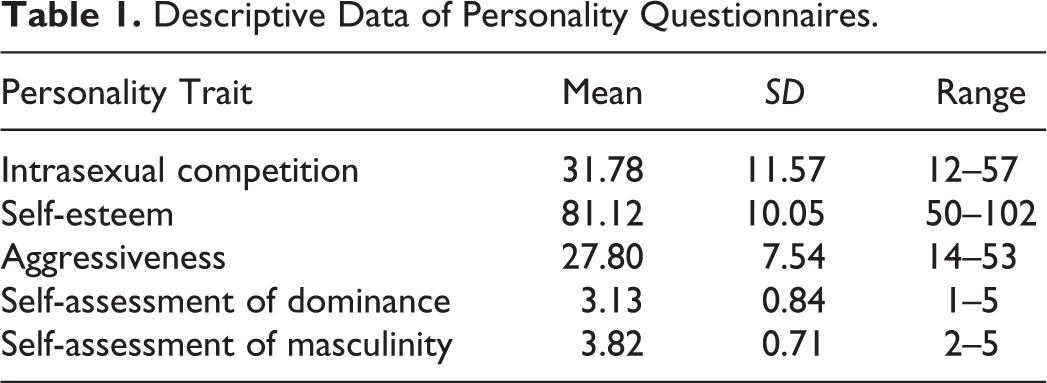
Descriptive data of questionnaires are shown in Table 1. The scores of personality questionnaires had a normal distribution (p > .05 in all cases).
Descriptive Data of Personality Questionnaires.
Choice of a Possible Rival
We proposed that men higher in T levels (pre- and post-test), self-assessment of dominance, self-assessment of masculinity, intrasexual competition, aggressiveness, and self-esteem will choose men with high-dominant masculinity as possible rivals. The number of participants who chose high-dominant masculine men as competitors was n = 48 (40.3%), and the number of participants who chose low-dominant masculine men as competitors was n = 71 (59.7%). The analysis showed that the probability of choosing men with high-dominant masculinity as rivals increased with higher scores of aggressiveness of the participants (B = .037, Wald = 4.245, p = .039; Figure 2). We did not find significant results for pre-test T, post-test T, intrasexual competition, self-esteem, self-assessment of dominance, and self-assessment of masculinity (Table 2).

Mean (± standard error) scores for aggressiveness of men according to their choice of rivals. The probability of choosing a high-dominant masculine man as competitor increases with the scores for aggressiveness of the participants (B = .037, Wald = 4.245, p = .039).
Effects of Testosterone and Personality Traits for the Choice of Rivals.

Note. n = 119.
*p ≤ .05.
According to Batrinos (2012), aggressiveness includes a broad spectrum of manifestations from a tendency to aggressive behavior to physical violence. While violent and aggressive behavior is a natural useful trait to acquire resources or to fight for mates and territory, it has been attenuated in modern humans (Puts, 2010). According to the biosocial model of status, this could explain the nonsignificant relationship between T and aggressiveness in men. However, aggressiveness could be a legacy from our ancestors making men more willing to compete with high-dominant masculine men, even in the absence of apparent T changes or rewards. This behavior may be motivated by an inherent search of high social status.
Study 2
To study whether the decision on choosing a possible rival changes by another when there is a motivation to fight, that is, a date with a woman, we carried out a second study as follows.
Female WHR as Stimuli
We recruited a group of 10 college women (age M ± SD = 21.10 ± 2.05) with the same specification that we used for men in the Study 1. Each woman was photographed from the back in “T” position. They were instructed to wear tight and dark clothes in order to adequately assess their WHR as an indicator of mate value and attractiveness. The photographs were evaluated according to their physical attractiveness by the same group of men and women that rated the photographs of men in Study 1. Ratings were completed using a 7-point Likert-type scale (0 = none at all, 6 = very much). All participants received US$10 for their participation.
As in the previous study, of the total assessed bodies, we used three with the highest rating values of physical attractiveness (coincident with WHR of: M ± SD = 0.713 ± 0.011) and three with the lowest rating values (coincident with WHR of: M ± SD = 0.890 ± 0.010). We employed the highest and lowest values of attractiveness to test whether the possibility to access to a mate with high or low attractiveness has a role in the decisions of men.
Procedure
The same group of men previously used in the Study 1 was used as participants in this second study. Participants were instructed to choose again a possible rival to fight under the same hypothetical situation and following the same instructions given in the Study 1, but this time the task was accompanied by another factor: a motivation to fight. We included after every picture of potential rivals, a picture of a woman with high or low WHR with whom they would have a date if they decided to compete either with the high-dominant masculine or the less dominant masculine man. This second presentation was organized as follows: a photograph of a man with high-dominant masculinity followed by a photograph of a woman with high or low attractiveness and a photograph of a man with low-dominant masculinity followed by a photograph of a female body with high or low attractiveness (see Figure 3 for graphic example). These pairs of pictures were randomly assigned to each volunteer.

Example of photographs randomly presented in the second study. (1) A low-dominant masculine man with a low mate value woman. (2) A high-dominant masculine man with a high mate value woman. (3) A low-dominant masculine man with a high mate value woman. (4) A high-dominant masculine man with a low mate value woman.
Statistical Analysis
To analyze the probability of the participants to choose a rival according to the possible mate, we established a second GEE model by using the multinomial model introducing the choice of possible rivals with a possible mate (four possible options from 1 to 4 in the multinomial model). The other variables were introduced as in the Study 1. The results are graphically represented as means ± SE. All tests were performed using SPSS Version 21 (SPSS Inc., Chicago, IL, USA), and the level of statistical significance was set as p ≤ .05.
Ethical Note
Both studies adhered to the Declaration of Helsinki and were approved by the Bioethics Committee of the University.
Results and Discussion
Choice of Possible Rivals According to the Mate Value of Possible Mates
The number of participants for each possible choice is shown in Figure 4. The analyses indicated that post-test T levels, self-esteem, and aggressiveness were related to the choice of possible rivals according to the mate value of the women (post-test T: B = .937, Wald = 7.134, p = .008; self-esteem: B = .037, Wald = 8.372, p = .004; aggressiveness: B = .041, Wald = 6.163, p = .013; Figure 5a, b, and c, respectively). Nonsignificant results were found for the other variables (Table 3).

Number of participants for each choice (n = 119). Choice 1: Low-dominant masculine men with low mate value women. Choice 2: High-dominant masculine men with high mate value women. Choice 3: Low-dominant masculine men with high mate value women. Choice 4: High-dominant masculine men with low mate value women.

Means (± standard error) for (a) post-test testosterone, (b) self-esteem, and (c) aggressiveness of men according to their choice for rivals and mates (post-test testosterone: B = .937, Wald = 7.134, p = .008; self-esteem: B = .037, Wald = 8.372, p = .004; aggressiveness: B = .041, Wald = 6.163, p = .013). Choice 1: Low-dominant masculine men with low mate value women. Choice 2: High-dominant masculine men with high mate value women. Choice 3: Low-dominant masculine men with high mate value women. Choice 4: High-dominant masculine men with low mate value women.
Effects of Testosterone and Personality Traits for the Choice of Rivals and Mates.
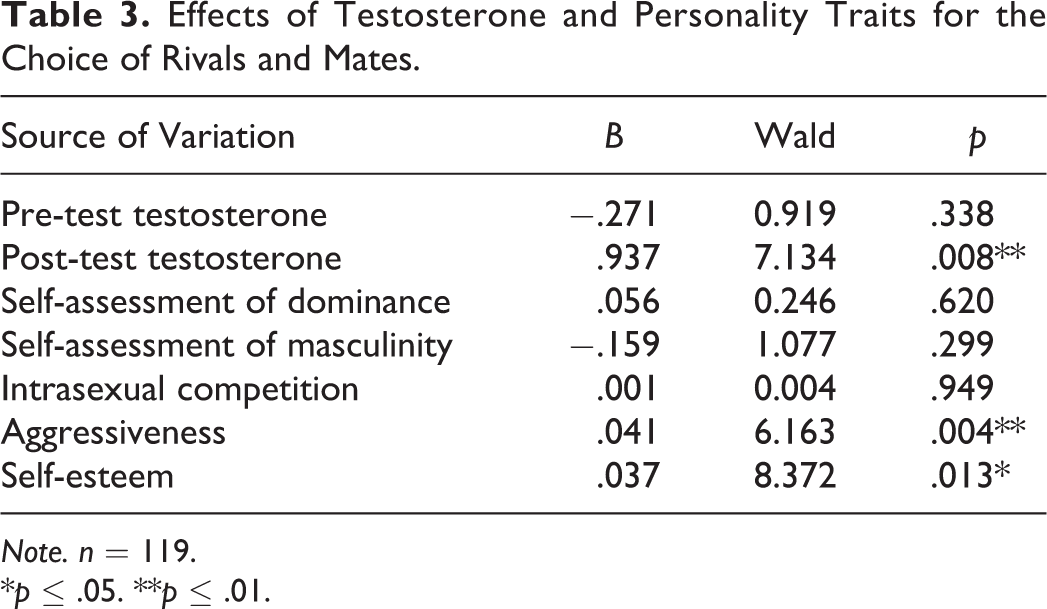
Note. n = 119.
*p ≤ .05. **p ≤ .01.
In this second choice test, there was a high probability of choosing to compete with high-dominant masculine men related to high aggressiveness scores of participants even if the possible mate had a low mate value (Choice 4). However, having average scores of aggressiveness allowed men to decide to compete with less dominant masculine men when the possible mate had a high mate value (Choice 3). Thus, having average scores of aggressiveness allows men to take the best decision that could be related to decreasing costs and at the same time to increasing the achievement of highly valued benefits. It was also observed that in this same choice, self-esteem and post-test T levels may influence the choice of possible competitors according to the mate value of possible mates.
Self-esteem can be defined as an overall view of self (Frost & McKelvie, 2005) or as a global emotional placement of self (Robins, Tracy, Trzesniewski, Potter, & Gosling, 2001). This emotion could be understood as an evolved adaptation that allows individuals to increase their biological fitness in several contexts such as mate choice, intrasexual competition, and maintenance of high social status. In fact, previous literature has shown positive outcomes and benefits related to high self-esteem (e.g., Costea, Palosa, & Munteanua, 2010; Rubinstein, 1977). Our results showed that higher self-esteem scores increased the probability to compete for a date with a woman with high mate value independently of the dominance masculinity of the possible rivals (Choice 2 and 3). According to the previous literature, we suggest that men with higher self-esteem have greater confidence concerning their own mental and physical capabilities. Therefore, they can take greater risks in several social contexts, especially when they have the opportunity to obtain valuable resources such as an attractive mate, high social status, or even some social and sexual benefits independently of the possible costs. Thus, men with higher scores of self-esteem could be more motivated to fight for getting the most valuable resources, in this case, a highly valued mate.
Finally, post-test T had a similar effect as aggressiveness on making the decision to compete with an individual according to the possible mate. It was found that there is a high probability of choosing to compete with high-dominant masculine men when there was a woman with a low mate value (Choice 4). However, having average levels of post-test T allowed men to make an optimal decision (i.e., Choice 3). These observations suggest that endocrine factors are related to mechanisms that promote competitive behaviors according to the mate value of women.
General Discussion
The aim of this study was to evaluate the role of T levels and some personality traits when men choose possible rivals, with and without a motivation to fight. In the first study (men choosing possible rivals), we found that the probability of choosing a high-dominant masculine man as a competitor increased with higher scores of aggressiveness, even though the low-dominant masculine men were the most selected. Whereas in the second study (men choosing possible rivals according to the mate value of women as motivations), we found that self-esteem, aggressiveness, and post-test T regulate the decision to compete with high-dominant masculine or less dominant masculine men according to the mate value of women.
High T levels are positively related to a variety of personality traits and behaviors associated with intrasexual competition (Mehta & Josephs, 2007) such as aggression (Rowe, Maughan, Worthman, Jane Costello, & Angold, 2004), dominance (Mazur & Booth, 1998), and risk-taking behaviors (Stanton, Liening, & Schultheiss, 2011). Our results exhibited the importance of several external factors that could be associated with T levels and personality traits in the analysis of human behavior. Thus, we propose that having average T levels and average aggressiveness as well as high self-esteem in men may increase the probability of making the best decision under an intrasexual competition context in order to obtain highly valued resources such as possible mates with low WHR to increase their biological fitness and their potential reproductive rate (van der Meij et al., 2012).
One of the adaptive problems faced by ancestral human males could have been the assessment of mate value of human females or the degree at which a potential mate could enhance his reproductive success (Singh, 2002). It has been suggested that the preference for traits related to health and mate value has produced psychological mechanisms in men to attend to bodily features to asses mate value and physical attractiveness of a woman (Buss, 1994; Gangestad & Thornhill, 1997). In this regard, the WHR has been proposed as one of the main traits that signals high mate value (Lassek & Gaulin, 2016; Singh, 2002). For example, Singh and Singh (2011) suggested that a low WHR is negatively associated with mortality related to vascular diseases, gall bladder disease, Type 2 diabetes, lung function impairment, carcinomas, anovulatory cycles, and low fertility.
Thus, men could be more motivated to fight for highly valued resources that could increase their biological fitness, and this motivation may vary according to T levels and differences in personality traits. In fact, it is possible to suggest that self-perceptions of intrasexual competition, dominance, and masculinity could be less associated with the motivation for competing with other men than aggressiveness or self-esteem. This idea is supported by the observation that aggressiveness and self-esteem could be interpreted as a legacy from our ancestors making human males more willing to compete for getting highly valued mates or for increasing their social status and their reproductive fitness (see Costea et al., 2010; Puts, 2010). Likewise, it has been proposed that T may be understood as a hormone that has regulated, through the evolutionary history of species, the expression of behavior according to the influence of information that comes from conspecifics and the specific context (Borráz-León et al., 2017).
This study provides important evidence about the plasticity of human behavior, and it supports that the choice of possible rivals is determined and regulated by endocrinal and personality factors such as T levels, self-esteem, aggressiveness, and the physical evaluation of possible mates and possible rivals. We recommend for future studies to implement a real-based contest where men would be able to compete for high valued resources in order to obtain ecological validity and to confirm the hypotheses suggested in this study and to test the premises of the challenge hypothesis in a real-based contest.
Limitations of This Study
A limitation could emerge from this study because direct measurements of strength and muscular attributes were not evaluated. Further studies will have to take them into account to observe whether men with high muscle size or high physical strength choose dominant masculine men as competitors what would represent a challenge providing an opportunity to emphasize their social status and to impress possible mates.
Footnotes
Authors’ Note
This study adheres to the Declaration of Helsinki and the Mexican Official Norm for Research with Human Beings (NOM-012-SSA3-2012.  codigo=5284148&fecha=04/01/2013). It was approved by the Bioethics Committee of the Instituto Nacional de Psiquiatría “Ramón de la Fuente Muñiz”. The research project reported in this article was submitted in partial fulfillment of the requirements for the PhD degree for the first author at Programa de Posgrado en Ciencias Biológicas, Universidad Nacional Autónoma de México and partially supported by a scholarship (270074) from Consejo Nacional de Ciencia y Tecnología to the first author.
Acknowledgments
We acknowledge the support received from the Instituto Nacional de Psiquiatría “Ramón de la Fuente Muñiz” and the volunteers who participated in the study and also acknowledge the Academic Writing Team of the Centro de Estudios de Posgrado, Universidad Nacional Autónoma de México, for their help with this article.
Declaration of Conflicting Interests
The author(s) declared no potential conflicts of interest with respect to the research, authorship, and/or publication of this article.
Funding
The author(s) disclosed receipt of the following financial support for the research, authorship, and/or publication of this article: The authors gratefully acknowledge The National Institute of Psychiatry (RFM) for funding the publication of this article.