




Abstract
Many studies on young adults’ motivations for drinking overlook the symbolic aspects of alcohol use. However, research indicates that young adults’ alcohol consumption is also driven by signaling motivations. Although the interest of a receiver is a necessary prerequisite of a signal, no previous studies have verified whether drinking behavior indeed attracts young adults’ attention. Therefore, we conducted two studies. A two-part eye-tracking study (N1 = 135, N2 = 140) showed that both young men and young women pay special visual attention to male and female drinking behavior. Additionally, a recall experiment (N = 321) confirmed that observed male and female drinking is better remembered than observed nonsignaling, functional behavior. Moreover, alcoholic beverages also receive special attention, as they were recalled better than other functional products, and also nonalcoholic drinks similar in color and shape. In summary, the experiments clearly showed that male and female drinking behavior can be used as a signal, as both behaviors clearly function as an attention-attracting cue. Additionally, as alcoholic beverages draw more attention than nonalcoholic drinks, this attention is clearly linked to the alcohol element of the drinking behavior.
Excessive alcohol consumption is associated with a range of health-related risks. Drinking large amounts of alcohol in a short period of time causes intoxication, thereby impairing the functioning of the brain. Consequently, physical coordination, consciousness, cognition, perception, and behavior are affected (National Institute on Alcohol Abuse and Alcoholism [NIAAA], 2010; World Health Organization [WHO], 2014). Accordingly, the effects of drinking large volumes of alcohol turn from pleasant (e.g., being relaxed and more confident) to harmful, with risk of sickness, coma, and sometimes fatal injuries (NIAAA, 2010). Moreover, because of the toxic effects on organs and body tissues (Rehm, 2011;WHO, 2014), repeated heavy alcohol consumption is linked to more than 200 diseases and health conditions (e.g., cancer, cardiovascular disease, and liver disease). Despite these harmful effects, alcohol consumption is highly prevalent among young adults (Center for Behavioral Health Statistics and Quality [CBHSQ], 2015; Rosiers et al., 2014). Binge drinking behavior, defined as consuming a large amount of alcohol in a limited time, peaks during young adulthood (CBHSQ, 2015; Johnston, O’Malley, Bachman, Schulenberg, & Miech, 2015; Substance Abuse and Mental Health Services Administration, 2014).
Given the negative consequences and high prevalence of heavy drinking during young adulthood, many studies have attempted to shed light on the underlying motives and inducing factors behind the drinking behaviors of young adults. According to the well-known motivational model, young adults often decide to consume alcohol based on the affective change they expect to achieve by drinking (Cooper, 1994; Cox & Klinger, 1988). These affective changes can be the direct chemical effects of alcohol, such as tension reduction and stress relief (coping motivation), or drinking to enhance a positive emotional state (enhancement motivation). On the other hand, the effects can also be indirect, such as fitting in and being liked by peers (conformity motivation) or socializing with peers (social motivation; Cooper, 1994; Emmanuel Kuntsche, Fischer, & Gmel, 2008; Emmanuel Kuntsche, Knibbe, Gmel, & Engels, 2005). Although many studies have linked the four motivations to young adults’ drinking behavior (e.g., Anthenien, Lembo, & Neighbors, 2017; Aurora & Klanecky, 2016; Collins et al., 2016; Hasking, Lyvers, & Carlopio, 2011; Kuntsche, Knibbe, Gmel, & Engels, 2006; Lyvers, Hasking, Hani, Rhodes, & Trew, 2010; Wahesh, Lewis, Wyrick, & Ackerman, 2015; Watkins, Franz, DiLillo, Gratz, & Messman-Moore, 2015), these studies are mainly limited to functional (conformity and social) and hedonic (coping and enhancement) motivations.
However, research suggests that drinking alcohol also has a specific symbolic dimension, in which drinking behavior is used as a signal. Young adults indicate consuming alcohol for self-presentational reasons (e.g., de Visser, Wheeler, Abraham, & Smith, 2013; Martin & Leary, 2001; O’Grady, Harman, Gleason, & Wilson, 2012). Moreover, drinking alcohol brings young adults self-presentational benefits such as enhanced status or attractiveness (Dumas, Graham, Bernards, & Wells, 2014; Van Den Abbeele, Penton-Voak, Attwood, Stephen, & Munafo, 2015). Yet, to function as a signal, drinking behavior must not only be easily perceivable by others (Guilford & Dawkins, 1991) but also be successful in capturing the interest of other young adults (Maynard Smith & Harper, 2003). However, to date, no previous studies have verified whether drinking behavior actually draws the attention of other young adults. Therefore, we set up two studies to explore young adults’ visual attention to and recall of drinking behavior.
Self-Presentational Drinking Behavior
Despite cross-cultural variations in drinking policies and legislation, the drinking cultures in the United States and Northern and Western Europe (Belgium, UK, Germany, etc.) correspond to a certain degree. For instance, all mentioned countries have high alcohol consumption. Moreover, young people in particular are rather tolerant of excessive drinking and intoxication (CBHSQ, 2015; Gordon, Heim, & MacAskill, 2012; Kuntsche, Rehm, & Gmel, 2004; Leifman, 2001; Österberg & Karlsson, 2004; Room, 2001; Room & Mäkelä, 2000; TNS Opinion & Social, 2010; WHO, 2014). Several studies conducted in these countries indicate that drinking behavior is often engaged in by young adults for self-presentational reasons, in which they attempt to control the image they display to others. First of all, young adults’ alcohol consumption is generally highly visible, as they prefer to drink in the company of others (de Visser et al., 2013). Moreover, there also appears to be a strong link between young adults’ level of drinking behavior and displaying this drinking behavior on social networking websites (Moreno, Christakis, Egan, Brockman, & Becker, 2012; Moreno, Cox, Young, & Haaland, 2015; Ridout, Campbell, & Ellis, 2012; Westgate, Neighbors, Heppner, Jahn, & Lindgren, 2014).
Additionally, young adults indicate that they perceive alcohol as a means to create impressions. Of 10 risky behaviors, drinking alcohol was reported most frequently by college-aged students as a typical behavior used to achieve self-presentational goals and social payoffs (Martin & Leary, 2001). Additionally, when motivated to make an attractive impression, both young men and women drink more alcohol in social situations (O’Grady et al., 2012). In other studies, young adults mention that drinking behavior is used to display and strengthen friendships (de Visser et al., 2013; Niland, Lyons, Goodwin, & Hutton, 2013). Research also showed that both mating effort and social competitiveness increase university students’ participation in drinking games, which were considered venues for displays of fortitude and sexual competition (Hone & McCullough, 2015; Hone, Carter, & Mccullough, 2013). College students also indicate engaging in drinking behavior in order to increase their chances of casual sex (Tan, 2012).
Consuming alcohol also seems to bring self-presentational benefits, as drinking alcohol is linked to higher status. Indeed, higher status group members drink more alcohol compared to peers with a lower status (Dumas, Wells, Flynn, Lange, & Graham, 2014). Additionally, young adults perceive men who engage in frequent binge drinking, as well as young women who drink alcohol frequently, as having higher status (Dumas, Graham, et al., 2014). Exceeding peers’ alcohol consumption during occasions of heavy drinking also conveys higher status among both young men and women (Dumas, Graham, et al., 2014). Furthermore, having consumed a moderate amount of alcohol increases young adults’ general attractiveness compared to being completely sober (Van Den Abbeele et al., 2015). Finally, although risky drinking is not considered attractive in a steady, long-term partner (Farthing, 2007; Wilke, Hutchinson, Todd, & Kruger, 2006), frequent drinking does enhance young adults’ desirability as a short-term partner for casual relationships compared to not drinking (Vincke, 2016a, 2016b).
(Costly) Signaling Theory
Given the self-presentational motivations and benefits of alcohol consumption, young adults’ drinking behavior can be studied as a signal. Signals are perceivable behaviors or traits that are intended or evolved to indicate a difficult-to-observe quality about the signaler. Signals are displayed with the conscious or unconscious intention of influencing the receiver’s beliefs or behavior toward the signaler (Donath, 2011; Dunham, 2011; Maynard Smith & Harper, 2003). Signals are designed to take advantage of receiver psychology (Cronk, 2005). Accordingly, the signal must not only carry information about the sender, but this must be information that is of interest to the receiver. Moreover, signals not only need to be easily detectable, they must actually be attention grabbing (Guilford & Dawkins, 1991; Maynard Smith & Harper, 2003). The receiver then uses the signal as a cue to infer the hidden qualities and traits, as a guide to future action (Donath, 2011; Maynard Smith & Harper, 2003).
To explain why young adults would use alcohol as a signal, the theory of costly signaling (Bird & Smith, 2005; Bliege Bird, Smith, & Bird, 2001) and the corresponding handicap principle (Zahavi and Zahavi, 1997; Zahavi, 1975) may be highly relevant. These theories state that individuals signal relevant information about their qualities and resources, by displaying traits or behaviors that are costly in terms of time, resources, energy, or risk. Costly signals evolved because organisms possessing less of the signaled quality or resource could not afford the costs associated with their conspicuous advertisement. Consequently, the costliness of the signal ensures the reliability and effectiveness of the signal (Donath, 2011; Zahavi & Zahavi, 1997). However, for costly signaling to take place, there has to be a strong relationship between the signal and its cost, ensuring that only high-quality individuals engage in this type of signaling behavior. Furthermore, both the signaler and observer should benefit from honest signaling. For the observer, the costly signal should bring reliable information about a relevant trait (e.g., access to resources, courage, health), whereas the costly display must bring advantages to the signaler (e.g., enhanced attractiveness, status). Furthermore, the costly signal needs to be at least easily observable, allowing receivers to correctly interpret the signal. Furthermore, these signals should even be attention grabbing, and therefore stimulate receivers to engage in interpreting these signals (Bird & Smith, 2005; Bliege Bird et al., 2001; Griskevicius et al., 2007; McKeown, 2013; Smith & Bird, 2000; Zahavi, 1975; Zahavi & Zahavi, 1997). As drinking behavior carries negative physical consequences, and given that these negative effects vary between individuals, it is suggested that drinking behavior could be used by young adults as a costly signal that they are genetically equipped to overcome the harmful effects of toxic substances (Sylwester & Pawłowski, 2011).
Current Research
Given its self-presentational motives and benefits, alcohol consumption could function as a signal among young adults, but therefore requires young adults to take an interest in their peers’ drinking behaviors. That is, for young adults, alcohol consumption must not only be observable, but even attention grabbing. However, to date, no previous studies have verified whether this is actually the case.
Given humans’ limited informational capacity, the environment presents more perceptual information than we can process. Therefore, our attentional mechanisms evolved to ensure that we select and process only the most important and relevant information, both externally and internally (Chun, Golomb, & Turk-Browne, 2010; Pashler, Johnston, & Ruthruff, 2001). External attention concerns information about the surrounding environment, perceived through the senses (Chun et al., 2010). Accordingly, our eyes automatically follow what interests us (e.g., Glaholt, Wu, & Reingold, 2010). Internal attention, on the other hand, refers to internally generated information, including representations in our memory. As the number of alternatives that can be considered or remembered at the same time is limited, internal attention also needs to select relevant information represented in the mind (Brigard, 2012; Chun et al., 2010; Kiyonaga & Egner, 2013).
Because of this distinction between external and internal attention, two studies were conducted, focusing on visual attention (i.e., external attention) and recall (i.e., internal attention). In these studies, the attention to drinking behavior is compared to functional behavior that is generally considered to be neutral, that is, without signaling intention (cf. pretest Study 1). Similarly, alcoholic drinks are compared to functional products and nonalcoholic drinks.
As both young men and women engage in self-presentational drinking behavior, and given that both sexes gain signaling benefits, we expect that young adults will pay more visual attention to male and female drinking behavior, compared to other more functional behaviors to which they are exposed (Hypothesis 1). Similarly, observed male and female drinking behavior will be recalled better than observed functional behavior (Hypothesis 2). As alcoholic drinks are inherently part of alcoholic drinking behavior, we also expect alcoholic products to be recalled better than functional products (Hypothesis 3). Finally, for signaling through alcohol consumption, the beverages need to contain alcohol. Therefore, we also believe that young adults will have better recall of alcoholic beverages compared to nonalcoholic drinks (Hypothesis 4).
The two studies were conducted among young adults in Flanders, the Flemish-speaking part of Belgium. Belgium has a liberal drinking culture (Österberg & Karlsson, 2004), as illustrated by a survey showing that 82% of the Belgian population had recently consumed alcohol (Gisle & Demarest, 2014). Additionally, binge drinking behavior is most prevalent among young adults, especially young males (Gisle & Demarest, 2014). Alcohol consumption also peaks among college and university students. For instance, two large-scale Belgian studies showed that more than 90% of young adult students had recently consumed alcohol (Lorant, Nicaise, Soto, & d’Hoore, 2013; Rosiers et al., 2014). Moreover, 60% of those students had engaged in heavy episodic drinking within the last year (Rosiers et al., 2014), 23% of them monthly or even weekly. The second study also confirmed the high frequency of excessive drinking among college students, finding a monthly average of 2.8 excessive drinking sessions (Lorant et al., 2013). Furthermore, the recent Global Drug Survey confirms that alcohol is highly present among young adults, with 96% of the voluntary participants engaging in drinking behavior. In addition, more than one third of young male participants and one fifth of young female participants even indicated engaging in risky drinking patterns (Winstock, Barratt, Ferris, & Maier, 2017). As the legal drinking age is 18 for spirits and 16 for all other alcoholic drinks, young adults are legal consumers of alcohol in Belgium. In Flanders, they prefer to drink beer, wine, as well as distilled spirits (Rosiers et al., 2014).
Study 1: Visual Attention
Design and Participants
To examine whether young adults pay attention to peers who engage in drinking behavior, a two-part eye-tracking study was conducted. These eye-tracking studies verified whether young adults pay more attention to drinking behavior than to functional, nonsignaling behavior. The first part of the eye-tracking study included 135 participants, and the second part included 140. All participants were young adults aged between 18 and 29 (Part 1: M = 20.89, standard deviation [SD] = 1.72; Part 2: M = 20.98, SD = 1.73), with an equal distribution between men and women (Part 1: 51.9% men, 48.1% women; Part 2: 50% men, 50% women). The vast majority of the participants were college or university students (Part 1: 94.8%; Part 2: 92.1%). Additionally, approximately half of the participants indicated that they were in a relationship (Part 1: 51.9%; Part 2: 51.1%), whereas the other half were single. One individual indicated homosexual orientation; all others indicated heterosexual orientation. The participants received no monetary compensation.
Materials and Method
Eye Tracker
Young adults’ eye movements were measured using a Tobii 1750 eye tracker and Tobii Studio software (Version 1.7.3). Calibration gave an accuracy of 0.5°. Stimuli were presented on a 17-in. monitor, with a resolution of 1,280 × 1,024 pixels. Participants were seated approximately 60 cm from the monitor.
Visual Displays
Both parts of the eye-tracking study had a within-subjects design, in which participants viewed a set of 20 visual displays. Each of the 20 displays consisted of three to four images, showing either different objects or one person engaging in different behaviors. Four experimental displays focused on drinking behavior, whereas the other slides functioned as fillers. Each display showed one drinking behavior and two to three functional behaviors (see Table 1) of the same person. In Part 1, the four experimental displays on drinking behavior showed a young male adult (male study), whereas Part 2 showed a young female adult (female study). The four experimental displays showed identical drinking and functional behaviors in Parts 1 and 2.
Experimental Slides Used in Eye Tracking.

All images presented in the visual displays were constructed by means of a professional photo shoot, using a white background. The models in both the male and female study were young adult volunteers aged between 23 and 26 years old and of heterosexual orientation. In all pictures, the model had a neutral expression, showing no emotions. In Slide 1, the model was sitting at a table for all four behaviors, whereas the remaining three slides showed a model standing up. To avoid looking biases (Glaholt et al., 2010; Plassmann, Ramsøy, & Milosavljevic, 2012; Reutskaja, Nagel, Camerer, & Rangel, 2011), the position of the drinking behavior image in the display varied randomly across all four slides. In addition, the presentation order of the 20 slides was randomized, using the randomization option in the eye-tracker software.
Pretest Functional Behavior
To determine functional behaviors without signaling dimension, 40 people were asked to rate a list of functional behaviors according to their perceived communicative or symbolic neutrality. They indicated on a 7-point scale how neutral, common, and everyday they perceived a specific functional behavior to be. The chosen functional behaviors had a neutrality score of 5.75 or higher.
Procedure
The eye-tracking studies took place in a laboratory setting. Upon arrival, participants received a brief explanation of how the eye-tracker functioned, and the calibration process. After providing some basic sociodemographic information, the calibration of the participants’ eyes was conducted. If the calibration quality was sufficient, the actual eye-tracking study was started. Participants were instructed to sit comfortably and to look at the visuals in a spontaneous manner. Each slide was visible for 5 s, after which the screen automatically displayed the following slide.
Results
To process the eye-tracking metrics of the experimental displays, areas of interest (AOI) were created for all images on each experimental display. Defining a separate AOI for each image enables quantification of gaze data, and comparison of gaze data between different images. For each AOI, five variables were selected (Tobii Technology, 2008, pp. 81–85). Time to first fixation gives the time (in milliseconds, ms) from when the stimulus was shown until the start of the first eye fixation within an AOI. Fixation length is the duration of the fixations within an AOI (ms). Fixation count gives the number of fixations within an AOI. Observation length is the total time (ms) that a participant has looked at an AOI, starting with each fixation in the AOI and ending with each fixation outside the AOI. Finally, the observation count gives the number of eye visits to an AOI.
To verify whether both young men and women paid more visual attention to drinking behaviors compared to the functional, neutral behaviors, 10 new variables were created for both the male and female study. For all five eye-tracking variables (e.g., time to first fixation), a mean score was calculated for the four AOIs covering the drinking behavior as well as a mean score for the 10 AOIs covering the functional behaviors. Subsequently, for each eye-tracking variable, mixed analysis of variance (mixed ANOVA) was conducted. The within-subjects factor comprised the mean scores for drinking behavior and functional behavior. The sex of the participants functioned as the between-subjects factor.
For the male behaviors (see Table 2), there was a significant main effect for all five eye-tracking metrics, with no significant interaction effects between the level of attention and the sex of the participants. As can be seen in Table 3, both men and women fixated sooner (time to first fixation), longer (fixation length), and more frequently (fixation count) on male drinking behavior compared to the other, merely functional behaviors. Male drinking behavior was also observed longer (observation length) and more often (observation count) than the functional behaviors.
Significant Effects of Eye-Tracking Metrics and Sex.

Attention to Male and Female Drinking Behavior.
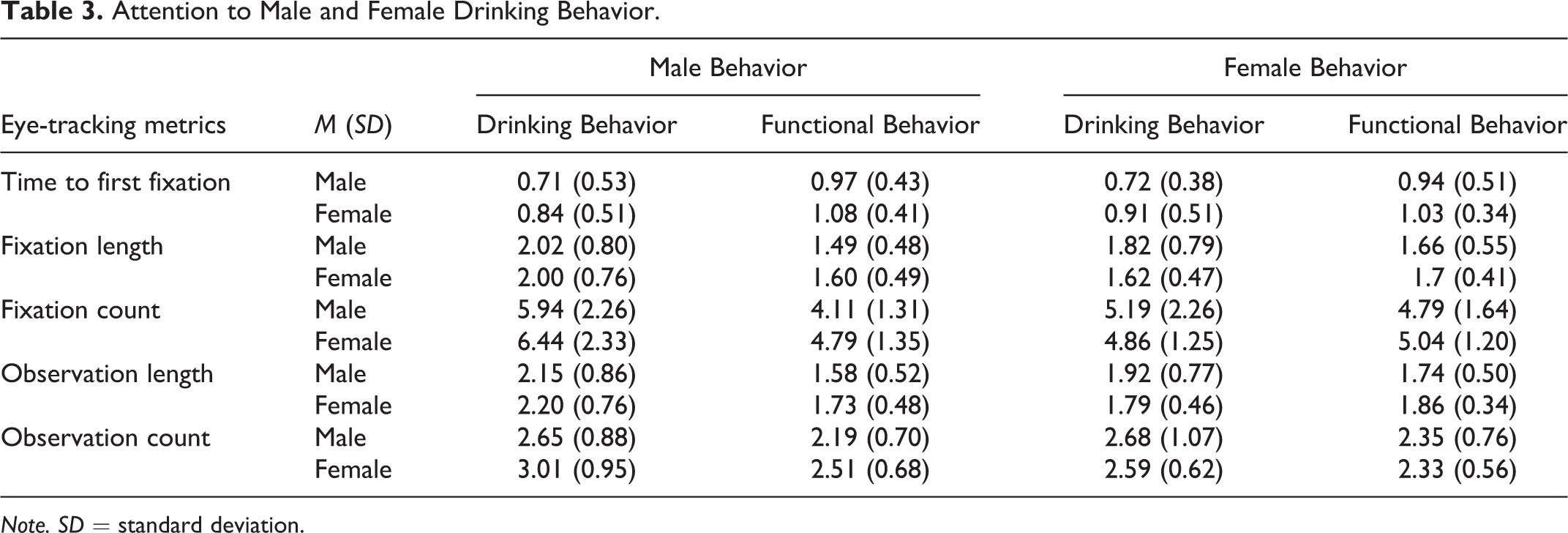
Note. SD = standard deviation.
For the female behaviors (see Table 2), there was a significant main effect for time to first fixation and observation count. Also a significant interaction effect with the participants’ sex was present for fixation length, fixation count, and observation length. As shown in Table 3, both male and female participants fixated sooner on female drinking behavior compared to the other, merely functional behaviors (time to first fixation), and both looked at female drinking behavior more frequently (observation count). However, only the male participants fixated longer (p = .025) and more frequently (p = .028) on female drinking behavior compared to the other, functional behaviors. For women, the fixation length and count did not differ (ps ≥ .221). Similarly, only men observed female drinking behavior longer (p = .032), whereas the observation length among female participants did not differ between drinking and functional behavior (p = .431). In addition, for both the female drinking behavior (ps ≥ .066) and the merely functional behaviors (ps ≥ .122), there were no significant differences between men’s and women’s level of attention.
Discussion
The eye-tracking study clearly showed that drinking behavior draws young adults’ attention. Indeed, they paid attention to drinking behavior sooner than to nonsignaling functional behavior. Drinking behavior was also observed more frequently and was fixated on more, both in length and in count. Remarkably, women were less interested in female drinking behavior than were men, possibly indicating that female drinking behavior is more relevant to men. Male drinking, on the other hand, was of interest to both sexes. However, although this study indicates that drinking behavior attracts young adults’ external visual attention, it remains unclear whether drinking behavior and alcoholic beverages also capture young adults’ internal attention. Therefore, a second study was conducted, focusing on recall.
Study 2: Recall
Design and Participants
To verify whether drinking alcoholic beverages is also better recalled, an online experimental study involving a visual recollection task was conducted with 170 student volunteers from Ghent University. Additionally, these students were requested to forward the link to the online experimental study to two other peers willing to participate in the study. In total, 377 participants started the online experiment. However, only the data of those participants that completed the entire study were retained for statistical analyses. Two participants younger than 18 years, and five participants older than 30 were omitted from the sample. Consequently, the final sample consisted of 321 young adults (141 male, 180 female) aged between 18 and 27 (M = 20.94; SD = 1.85). Similar to Study 1, the sample consisted mainly of college and university students (89.1%). Slightly more than half of the participants (53.6%) indicated being in a relationship. In terms of sexual orientation, 97.5% of participants were heterosexual, with seven individuals identifying as bisexual and one as homosexual. Participants received no monetary compensation for their participation.
The study employed a mixed-subjects experimental design, in which both men and women viewed a series of displays. This visual recollection task is based on previous research on conspicuous consumption and status products (Janssens et al., 2011; Lens, Driesmans, Pandelaere, & Janssens, 2012). In total, participants saw a series of 16 visual displays. The first eight (product) visual displays contained images of six products. The following eight (behavioral) visual displays each showed one person engaging in five different behaviors.
Materials and Method
Product visual displays
Of the eight visual product displays, four focused on beverages; the other four served as fillers. In each display, six products were randomly arranged in a circle. Five products were functional products (knife, key, backpack, lamp, toothbrush, table, etc.), whereas one product was either an alcoholic or a nonalcoholic beverage (a glass of beer/bottle of vodka; a glass of fruit juice/bottle of water). To avoid potential effects of product color on product recall, all products within a specific visual display were of similar colors. Accordingly, the beer and fruit juice displays showed six yellow products, whereas the vodka and water bottle displays contained blue/white products (cf. Online Appendix). Additionally, to avoid looking biases due to the position of the product in the display (Glaholt et al., 2010; Plassmann et al., 2012; Reutskaja et al., 2011), two versions of each display were created using a different arrangement of the products. Participants randomly viewed one of the two versions.
Behavioral visual displays
Four of the behavioral visual displays showed alcoholic drinking behavior, whereas the remaining four served as fillers. All displays showed the same person engaged in five different behaviors, randomly arranged in a circle. Consequently, all visual displays consisted of five pictures, taken by a professional photographer. In all the pictures, the model adopted a behavioral position against a white background, with a neutral facial expression. All models were young adult volunteers aged between 21 and 26 and were of heterosexual orientation. In the experimental displays, four behaviors were functional behaviors (writing, reading, putting on shoes, making a phone call, etc.), while one behavior showed drinking an alcoholic beverage (cf. Online Appendix). More specifically, in the female displays, one display showed a young woman drinking a glass of white wine, whereas the second display showed a young woman drinking from a bottle of gin. In the male displays, one display showed a young man drinking a beer, whereas the second display showed a young man drinking from a bottle of gin. Similarly to the product displays, two versions of each display were created, using a different arrangement of the five behaviors.
Measures
Participants saw each display only for a brief moment. The participants were exposed for only one second to the eight product displays, and slightly longer (2 s) to the eight behavioral displays as these were more difficult to interpret. After each display, participants had 25 s to write down which products or behaviors they had seen. A timer in the upper-right corner of the screen showed participants how much time they had remaining to write down their answers.
Similarly to previous research (Lens et al., 2012), recall probability and recall position were used for testing the hypotheses. For recall probability of the product visual displays, we calculated the proportion of recalled alcoholic beverages (total number of recalled alcoholic beverages divided by two, since we used two displays with alcoholic beverages), the proportion of recalled nonalcoholic beverages (total number of recalled nonalcoholic beverages divided by two) as well as the proportion of recalled functional products of the two alcohol displays (total number of recalled functional products divided by 10, since the two product displays showing alcoholic beverages contained a total of 10 neutral, functional products). For the behavioral visual displays, separate scores were calculated for male and female behavior: The recall probability of alcoholic drinking behavior (total number of recalled alcoholic drinking behaviors divided by two, since there were two displays for both male and female behavior) and the recall probability of functional behaviors (total number of recalled functional behaviors divided by eight, since there were four examples of this type on each slide).
To measure the average recall position of the alcoholic and nonalcoholic beverages, a position score was given to each of the recalled beverages. More specifically, the position score consisted of the reverse ordinal position in which the beverage was recalled, taking into account the number of recalled products. For instance, when five products were recalled, the beverage received a score of five when it was recalled first, and a score of one when it was recalled last. If the beverage was not recalled, it was given a score of 0. Subsequently, for both the alcoholic and nonalcoholic beverages, each of the position scores of the two displays were added and divided by the total number of products recalled in the two displays. The higher the number, the earlier (and therefore stronger) the recall. Objects and behaviors that were wrongly recognized by the participants were omitted from the calculations.
Procedure
Participants willing to take part in the experiment received an e-mail containing a hyperlink to the online experiment. The e-mail explained that the experiment could not be conducted on a smartphone because of the necessity of a large screen, and potential participants were instructed to complete the experiment using a laptop or desktop computer in a nondistracting environment. Upon opening the hyperlink, participants were informed that the study involved recall of products and behaviors. This was followed by some sociodemographic questions. Subsequently, a more detailed explanation of the experiment was given, clarifying that participants would be shown, very briefly, 16 displays of either six products or five forms of behavior, and that after each display they had 25 s to write down all the objects or behaviors they remembered. Next, a test display with six objects was shown, to familiarize the participants with the procedure. This was followed by the 16 displays. Each new display was preceded by a slide, showing the number 1–16, to ensure that the participants were attentive to the upcoming display.
Results
Alcoholic drinking behavior will be recalled better than functional behavior (Hypothesis 2)
For both male and female behavior, a two-way mixed ANOVA was conducted. The proportions of recalled drinking behavior and recalled functional behavior served as variables in the within-subjects factor, with sex as between-subjects factor. The results showed significant main effects for both the male behavior, F(1, 311) = 6.79, p = .010,
Alcoholic beverages will be recalled better than functional products (Hypothesis 3)
A two-way mixed ANOVA was conducted to verify whether alcoholic beverages were remembered better than functional products. The proportions of recalled alcoholic beverages and functional products shown on the two visual displays were used as variables in the within-subjects factor, with the sex of the participants as the between-subjects variable. The results showed a significant main effect of the recalled proportion, F(1, 319) = 14.52, p < .001,
Alcoholic beverages will be recalled better than nonalcoholic beverages (Hypothesis 4)
By means of a two-way mixed ANOVA, we verified whether young adult men and women recalled alcoholic beverages better than nonalcoholic beverages. The proportions of recalled alcoholic and nonalcoholic beverages served as variables in the within-subjects factor, and the sex of the participant was the between-subjects variable. Here also, there was a significant main effect of the proportion of recalled beverages, F(1, 316) = 13.60, p < .001,
Finally, to investigate whether alcoholic beverages are stored more “top-of-mind” in young adults’ memories, and therefore recalled earlier compared to nonalcoholic beverages, a two-way mixed ANOVA was conducted, with average recall position of the alcoholic and nonalcoholic beverages as within-subjects factor, and participant sex as between-subjects factor. The significant main effect, F(1, 316) = 36.09, p < .001,
Discussion
The visual recollection study confirmed that internally, drinking behavior and alcoholic products received a great deal of attention, particularly compared with average functional products. Indeed, both young men and women recalled drinking behavior better than they did functional behaviors that lacked a clear signaling dimension. Moreover, as alcoholic drinks were also remembered better than functional products, and even better than nonalcoholic drinks, the findings demonstrate that even mere cues indicating that a product contains alcohol may lead to increased attention within young adults’ brains.
General Discussion
Research indicates that young adults might use alcohol consumption as a form of signaling behavior to obtain self-presentational benefits. However, no previous studies have verified whether alcoholic beverages and alcohol consumption by other young adults do indeed attract young adults’ attention. As there are two relevant forms of attention, two studies were conducted, with the first focusing on visual attention (external attention) and the second on recall processes (internal attention).
The results indicated that both male and female drinking behavior strongly attracts young adults’ attention. First of all, the eye-tracking study showed that young men and young women fixated sooner, more frequently, and longer on young men drinking alcoholic beverages, compared to these same men being engaged in other, more functional behaviors with no clear signaling dimension; young adults also observed these drinking behaviors longer and more frequently. Young men and young women also fixated sooner on female drinking behavior than on functional behaviors and observed female drinking behavior more frequently. However, only young men fixated on and observed female drinking behavior longer than on functional behaviors. Men also fixated more frequently on female drinking behavior than on functional behavior. As drinking behavior was better recalled than functional behavior, the visual recollection experiment confirmed that also internally young adults pay more attention to drinking behavior than to functional behavior. Indeed, both young men and young women had stronger recollection of male and female drinking behavior than of functional behaviors.
Moreover, the recollection study also showed that young adults’ heightened attention is not limited to actual drinking behavior. Equally, images of alcoholic beverages had higher recollection scores than purely functional consumer products. More specifically, alcoholic drinks were recalled better than other functional products, including nonalcoholic drinks of similar liquid color to the alcoholic drinks. Moreover, alcoholic beverages seemed to be stored more in a “top-of-mind” memory position, as they were recalled faster than their nonalcoholic counterparts. These results suggest that alcoholic beverages serve as cues for young adults without them necessarily even viewing actual drinking behaviors. Moreover, the findings confirm that it is not the drink product “as beverage” that draws the attention, but the fact that it is specifically an alcoholic beverage.
The results of the two experiments suggest that drinking behavior can be studied as a form of signaling behavior, in which perceivable behavior is used to display information about the signaler, with the intention of affecting receivers’ beliefs or behaviors (Donath, 2011; Maynard Smith & Harper, 2003). Studies showing that drinking behavior brings self-presentational benefits to young adults (Dumas, Graham, et al., 2014; Dumas, Wells, et al., 2014; Van Den Abbeele et al., 2015; Vincke, 2016a, 2016b) illustrate that drinking alcohol can indeed affect receivers’ beliefs about drinkers. Furthermore, prototype studies focusing on the social image of heavy drinkers, occasional drinkers, and abstainers indicate that drinking behavior affects young adults’ perception of peers (Gerrard et al., 2002; Spijkerman, Larsen, Gibbons, & Engels, 2010; Spijkerman, van den Eijnden, Vitale, & Engels, 2004; Teunissen et al., 2014; van Lettow, Vermunt, de Vries, Burdorf, & van Empelen, 2013). Additionally, studies focusing on young adults’ signaling motivation when drinking alcohol (de Visser et al., 2013; Hone et al., 2013; Martin & Leary, 2001; O’Grady et al., 2012) show that young adults also have—whether consciously or unconsciously—the intention of displaying information about themselves via alcohol.
Both of the present studies show that young adults’ drinking behavior is easily perceivable and certainly not ignored by other young adults, seemingly corresponding to the theory of costly signaling (Bird & Smith, 2005; Bliege Bird et al., 2001) and its handicap principle (Zahavi & Zahavi, 1997). However, although consuming alcohol can be physically harmful, more research is necessary to confirm whether drinking alcohol is indeed a reliable indicator of specific physical qualities. For smoking —also a known harmful and risky activity—partial confirmation for this assumption was found, as people with low dispositional health suffered more from the harmful effects of smoking compared to persons with high dispositional health (Dewitte, 2011). For alcohol, only one previous study has attempted to verify whether drinking behavior reflects certain physical qualities, by linking this behavior to fluctuating asymmetry as an indicator of overall genetic quality. However, the study did not find confirmation that the use of alcohol functions as an indicator of those specific biological qualities. Nevertheless, the authors indicated that, given the influence of prenatal and other environmental stressors on fluctuating asymmetry, its use as a measure of overall genetic quality is questionable (Borkowska & Pawlowski, 2014). Equally, drinking behavior could also indicate certain mental qualities, such as the propensity to take physical and/or social risks. As drinking behavior also has financial aspects due to the price of alcoholic beverages, drinking behavior could potentially even be used as a costly signal to indicate the drinker’s financial resources to others. However, to date, it remains unclear whether alcohol consumption is used for these signaling purposes.
Future research could also focus on identifying how alcohol is used in different contexts. On the one hand, male alcohol consumption could function as an intersexual courtship signal, as women displayed interest in men’s drinking behavior. However, as men also paid attention to same-sex drinking behavior, alcohol use might also function as a signal for other males, either in intrasexual competitive contexts or in more reciprocal social contexts. As people search for different qualities in romantic partners, sexual partners, coalitional partners, and friends, it would be interesting to know which characteristics and qualities young men attempt to signal in different social situations, through different forms of alcohol consumption.
Similarly, as men also took an interest in women’s drinking behavior, alcohol might also be used by young women as a signal in mating situations. However, the lower attention given by women to other women’s drinking behavior might indicate that consuming alcohol is a less relevant behavior in female intrasexual signaling. Indeed, whereas men engage in risky intrasexual competitive behavior (Chen & Chang, 2015; Daly & Wilson, 2001; Griskevicius et al., 2009; Wilson & Daly, 1985), women prefer engaging in self-promotion in which they attempt to improve their appearance and physical attractiveness (Fisher & Cox, 2011; Fisher, Cox, & Gordon, 2009). This has been attributed to women’s predominant role as the primary caregivers for children, making risky behaviors less appropriate competitive behaviors due to their higher reproductive costs (Campbell, 2004). As drinking behavior, especially in an excessive manner, can also be considered risky and harmful behavior, this could explain why women pay less attention to female peers’ drinking behavior. Nonetheless, as young women mention using alcohol for social bonding and maintaining friendships (de Visser et al., 2013), female peers’ alcohol consumption remains important information.
Together, these results suggest that alcohol consumption might operate as a signaling system in different domains, including intersexual courtship, intrasexual competition, group bonding, and strengthening friendships. However, further research is necessary to unravel the functioning of alcohol as a signal in these different contexts, and to increase the understanding of the meaning of alcohol. Moreover, as sociocultural norms affect young adults’ drinking behavior, future research should take into account both the national and local drinking cultures when studying the meaning of alcohol as a signal. On the one hand, national cultural norms affect both the acceptance and expectation to drink alcohol on specific social occasions as well as the general attitudes toward binge drinking and intoxication (Fjær, Pedersen, von Soest, & Gray, 2016; Grønkjær, Curtis, De Crespigny, & Delmar, 2011; Mäkelä & Maunu, 2016). Accordingly, alcohol will be perceived very differently in abstinent societies or countries with constrained ritual drinking practices, compared to the more liberal European drinking cultures in which nondrinkers are often perceived as unusual (Felson, Savolainen, Bjarnason, Anderson, & Zohra, 2011; Gordon et al., 2012; Room, 2001; Room & Mäkelä, 2000). Additionally, the symbolic meaning of alcohol consumption and excessive drinking also depends on the local community or peer group of which one is a member (Mitchell, Poyrazli, & Broyles, 2016; Savic, Room, Mugavin, Pennay, & Livingston, 2016; Sudhinaraset, Wigglesworth, & Takeuchi, 2016). Furthermore, local alcohol regulations and policies also affect the meaning of alcohol. For example, an 18-year-old drinking alcohol would be perceived differently in Belgium than in the United States, where the legal drinking age is 21.
Finally, there are also some limitations to our studies. Firstly, neither study took into account the actual drinking behavior of the participants. Nonetheless, it is possible that drinking behavior and alcoholic beverages receive more attention from drinkers, compared to nondrinkers. However, as the proportion of alcohol consumers is very high among young adult students in Belgium (Rosiers et al., 2014), we believe that there would have been very few nondrinkers in this study group. Additionally, attention to alcoholic beverages was only measured by means of recall. Future eye-tracking studies should also study the visual attention to alcoholic products. Also, the number of visual displays of alcohol was rather low in both the eye-tracking and recall experiments. As drinking alcohol has physical, mental, and financial aspects, future studies might research young adults’ attention to a larger number of drinking behaviors, presenting a wider variety of alcoholic beverages and levels of drinking, and investigating which specific qualities are signaled by particular drinking patterns. Moreover, the fact that the recall experiment was conducted online rather than in a controlled laboratory environment could be considered a limitation. Consequently, we could not control for potential distractions or Internet connectivity issues that might have affected the recall of the respondents. Finally, attention to drinking behavior was compared to functional behavior, as this behavior carries little signaling intention. Although the neutrality of the functional behaviors was pretested in advance, and although none of the products displayed brand names, we cannot be entirely sure that all of those functional behaviors were free of a signaling dimension for all participants.
The findings of the two studies may be of interest to social marketing professionals and health promotion institutions targeting youth alcohol (ab)use. As both studies indicate that young adults pay attention to peers’ alcohol use, drinking alcohol can and will be used for signaling and impression management purposes. Accordingly, social marketing campaigns might benefit from focusing on this signaling dimension of youth alcohol use, in addition to the more traditional, informative approaches focusing on health-related matters. Also, motivational research, focusing on identifying the motivations and inducing factors for drinking alcohol, might benefit from including signaling motivations within the research and framework.
Supplemental Material
Supplemental material for Does Alcohol Catch the Eye? Investigating Young Adults' Attention to Alcohol Consumption
Supplemental material for Does Alcohol Catch the Eye? Investigating Young Adults' Attention to Alcohol Consumption by Eveline Vincke and Patrick Vyncke in Evolutionary Psychology
Footnotes
Declaration of Conflicting Interests
The author(s) declared no potential conflicts of interest with respect to the research, authorship, and/or publication of this article.
Funding
The author(s) received no financial support for the research, authorship, and/or publication of this article.
Supplemental Material
Supplementary material for this article is available online.
References
Supplementary Material
Please find the following supplemental material available below.
For Open Access articles published under a Creative Commons License, all supplemental material carries the same license as the article it is associated with.
For non-Open Access articles published, all supplemental material carries a non-exclusive license, and permission requests for re-use of supplemental material or any part of supplemental material shall be sent directly to the copyright owner as specified in the copyright notice associated with the article.

