




Abstract
Previous research suggests that binge drinking among young men serves as a “costly signal” to potential mates, such that the binge drinker is capable of bearing the harmful consequences of alcohol consumption. Here, we propose that binge drinking among young adults is conditionally dependent upon the signaler’s willingness to take risks, which is influenced by the local operational sex ratio (OSR). Using archived binge drinking estimates from 2009 to 2012 and Census Bureau records of OSRs, we tested the relationship between OSR and binge drinking rates at the county level across 3,143 U.S. counties against hypotheses drawn from evolutionary theory. Results from our mixed-effects models revealed that a higher overall OSR (i.e., more eligible men compared to women) was associated with higher male binge drinking rates but lower female binge drinking rates. A higher OSR particularly in the 20–29 and 50+ age groups predicted higher male binge drinking rates but lower female binge drinking rates. Our findings generally support predictions derived from evolutionary theory and suggest that binge drinking may function as a costly sexual signal, conditionally regulated by age and the local sex ratio.
Keywords
Binge Drinking in the United States
In the United States, 15.1 million people, or 5.6% of those aged 12 or older, suffer from an alcohol use disorder, making alcohol the most commonly used addictive substance (Substance Abuse and Mental Health Services Administration, 2017). Alcohol misuse is associated with costs related to national productivity, health care, and criminal justice. In 2010, estimated costs related to alcohol use totaled approximately $249.0 billion, with those specifically related to binge drinking accounting for $191.1 billion (76.7%) of this total (Sacks, Gonzales, Bouchery, Tomedi, & Brewer, 2015). In the United States, binge drinking is defined as consuming five or more drinks for men or four or more drinks for women on the same occasion on at least 1 day in the past 30 days (National Institutes on Alcohol Abuse and Alcoholism, 2004; Substance Abuse and Mental Health Services Administration, 2017). In 2016, the National Survey on Drug Use and Health reported that 13.3 million young adults aged 18–25 in the United States engaged in binge drinking at least 1 day in the past month (Substance Abuse and Mental Health Services Administration, 2017).
Alcohol consumption activates reward systems in the brain that respond to fitness-relevant stimuli such as food and social relationships. Alcohol consumption induces opioid release in the nucleus accumbens and orbitofrontal cortex, which are brain areas implicated in reward (Mitchell et al., 2012) and can enhance mood, especially among extraverted drinkers (Fairbairn et al., 2015). However, excessive alcohol consumption is linked with negative outcomes (Corrao, Bagnardi, Zambon, & La Vecchia, 2004; Rehm, Gmel, Sempos, & Trevisan, 2003; World Health Organization, 2014), including high blood pressure (Puddey & Beilin, 2006); heart disease (Pearson, 2016); accident, injury (Cherpitel, 1993); suicide, murder (Pompili et al., 2010); crime, domestic violence (Leonard, 2005); rape (Abbey, Zawacki, Buck, Clinton, & McAuslan, 2001); unsafe sex (Cooper, 2006); unintended pregnancy (Roberts, Wilsnack, Foster, & Delucchi, 2014); fetal alcohol spectrum disorders (Riley, Infante, & Warren, 2011); cancer, memory loss, and learning deterioration (Centers for Disease Control and Prevention, 2017; Corrao et al., 2004). Despite these negative outcomes, alcohol consumption, including excessive and/or binge drinking, appears to be prevalent and socially acceptable in modern times (Guise & Gill, 2007).
Some individuals are more likely to binge drink than others, including those between the ages of 18 and 34 (Centers for Disease Control and Prevention, 2017). Mating competition also tends to be stronger at these younger ages (Kruger & Schlemmer, 2009). One reason why excessive drinking is particularly prevalent among young adults may be that binge drinking is motivated by a suite of evolved human mating strategies that include the proclivity to compete (Hone & McCullough, 2015), and binge drinking may represent a costly signal that communicates one’s underlying qualities (Vincke, 2017). Displaying conspicuous traits or behaviors that are costly in terms of time, energy, and resources can relay underlying qualities of the signaler to the perceiver (Bliege Bird & Smith, 2005). Because the signals are costly, organisms with lower underlying qualities would be less capable of producing and maintaining the signals.
Although costly signals can take many forms, according to several researchers (Boone, 1998; Kantner & Vaughn, 2012; Smith & Bliege Bird, 2003), they must meet the following criteria: (1) individuals vary in some underlying, unobservable attribute that is relevant to others, (2) individuals can convey information about this attribute through a signal, and (3) the cost of sending the signal is correlated with the underlying attribute, and thus signaling tends to honestly advertise signalers’ underlying qualities. Binge drinking appears to meet these criteria: (1) people vary in unobservable attributes of relevance to others, such as income, intrasexual competitive ability, and heritable fitness, (2) binge drinking can convey information about these attributes, and (3) binge drinking is costlier for individuals who are lower in these attributes.
Binge Drinking as a Costly Social and Sexual Signal
Several lines of evidence indicate that binge drinking provides information about characteristics of the drinker that would be useful when evaluating potential as a mate. For instance, binge drinking could communicate information about resources, underlying mate quality, mating competition, and mating strategies. Because alcohol is a luxury good, alcohol consumption may reflect wealth (Aung, 2016). In the United States, reports show that binge drinking is more common among persons with annual household incomes of $75,000 or more (Centers for Disease Control and Prevention, 2017). Data from several other countries, including the United Kingdom (Rao, Schofield, & Ashworth, 2015), Brazil (Wagner, Lebrão, De Oliveira Duarte, & Zanetta, 2014), and Australia (Giskes, Turrell, Bentley, & Kavanagh, 2011), also show that binge drinking is more prevalent among wealthier individuals.
Binge drinking can be considered a type of risk-taking behavior in part due to the negative outcomes associated with binge drinking. Binge drinking can not only result in diminished cognitive and psychomotor abilities (Brumback, Cao, & King, 2007) but can also weaken the immune system (Afshar et al., 2015). A single binge drinking episode (e.g., five shots of vodka) has been shown to weaken the immune system within 20 min (Afshar et al., 2015). The ability to withstand these detrimental effects could signal “vigor” and advertise mate quality. This idea is related to Zahavi’s (1975) handicap principle, where females of many species prefer males that display exaggerated traits that are costly to maintain and develop; hence, these traits serve as “honest” signals. Indeed, occasional drinkers and frequent drinkers were rated as significantly more attractive than nondrinkers, especially in short-term mating contexts (Vincke, 2016). Additionally, a recent review of the evolution of human sex-specific cognitive abilities by Geary (2017) identifies alcohol as a stressor/intoxicant that compromises the building, maintenance, and expression of sexually selected traits. That is, condition-dependent, sexually selected traits that support sexual competition (e.g., visuospatial competencies in men) and are fully developed and function correctly under favorable conditions are compromised by alcohol consumption. Thus, the ability to function despite consuming alcohol (i.e., to “hold your liquor”), especially among men, might signal that the binge drinker is of sufficient quality to cope with the harmful consequences of alcohol.
Marsh and Kibby (1992) reported that young men gathered and drank alcohol primarily to compete for female attention and show off their masculinity to both women and other men. Hone and McCullough (2015) also found that men were more likely to participate in drinking games out of motivation to compete (i.e., participants were either “teased or respected depending on how they played”) and to obtain mating opportunities (i.e., participants like to “play games that loosen people up for fooling around or having sex later”). Furthermore, Hone, Carter, and McCullough (2013) reported that men participated in drinking games more frequently than women and that men’s higher level of sociosexuality (propensity toward casual, uncommitted sex; Simpson & Gangestad, 1991) was positively related to the frequency of drinking game participation. Competition associated with drinking may also take the form of physical altercations. Oftentimes, physical fighting takes place between men or groups of men in bars and clubs where drinking is occurring (Graham & Wells, 2003). Most bar fights begin with young men challenging one another (Graham & Wells, 2001), with the majority victims and attackers being young men aged 18–29 years (Scott & Dedel, 2006). Thus, male–male mating competition is intensified in places such as bars and nightclubs where there are both drinking and access to women in the dating pool (Daly & Wilson, 1988).
Alcohol consumption predicts both short-term mating strategies and reproductive outcomes in both men and women. Among young adults of mating age, the frequency of drinking alcohol positively predicts the frequency of unprotected/unsafe sex (McEwan, McCallum, Bhopal, & Madhok, 1992; O’Leary, Goodhart, Jemmott, & Boccher-Lattimore, 1992). Additionally, drinking alcohol influences one’s decision to have sex and to engage in unprotected (Rehm, Shield, Joharchi, & Shuper, 2012) or risky sex (e.g., having multiple or causal sex partners; Cooper, 2002) and those under the influence are less likely to be assertive when requesting the use of a condom (Maisto et al., 2004). Young adults who engage in binge drinking are more likely to report a higher level of unrestricted sexual behaviors (Vincke, 2017), and teenagers who drink heavily were 63% more likely to become teenage mothers (Dee, 2001). Vincke (2017) also reported that both young men and women who were primed with a short-term mating scenario reported that they would drink a higher maximum number of alcoholic beverages than those who were primed with a long-term mating scenario.
The Influence of Imbalanced Sex Ratio on Mating Behavior
Although binge drinking is generally associated with short-term mating strategies and outcomes, these associations may depend on aspects of the social environment, such as local sex ratios. An imbalanced sex ratio within a population influences behaviors related to both mating strategies and resource acquisition. For example, sex ratios have been linked to divorce rates (South, Trent, & Shen, 2001), marriage rates (Trent & South, 1989), risk-taking behaviors in investment (Ackerman, Maner, & Carpenter, 2016), economic decisions (Griskevicius et al., 2012), frequency of sexually transmitted infections (South & Trent, 2010), teenage pregnancy rates (Barber, 2001), national violent crime rates (Barber, 2000), and violence against women across the United States (Avakame, 1999) and across other nations (South & Messner, 1987). Most of these observed relationships between sex ratios and mating strategies have been considered using a broad theoretical approach grounded in evolutionary theory.
In evolutionary biology, the average ratio of males to females who are ready to mate at a given time and place is referred to as the operational sex ratio (OSR; Emlen & Oring, 1977; Weir, Grant, & Hutchings, 2011). A biased OSR (i.e., lack or abundance of eligible males in relation to eligible females) predicts differences in some human mating behaviors. For example, a higher OSR (i.e., more eligible men relative to eligible women) has been associated with higher marriage rates, decreased promiscuity, fewer out-of-wedlock births, and greater paternal investment (Griskevicius et al., 2012; Lichter, Anderson, & Hayward, 1995; Schacht & Borgerhoff Mulder, 2015).
A higher OSR predicts both women’s and men’s risk-taking and mating behaviors. In women, a higher OSR is associated with increased odds of marrying a high status man (Lichter et al., 1995), decreased tendency to choose a high-risk/high-return financial investment option (Ackerman et al., 2016), and decreased sexual receptivity, as demonstrated by trends of decreased teenage pregnancies (Barber, 2000) and the tendency of women to wear less revealing clothing (Barber, 1999) within those populations. Meta-analyses (Janicke & Morrow, 2018; Weir et al., 2011) found that a higher OSR was associated with increased male intrasexual competition and aggression (cf. Schacht & Borgerhoff Mulder, 2015; Schacht, Kramer, Székely, & Kappeler, 2017). When a population has fewer women, men may be more likely to become aggressive and violent (Barber, 2003, 2006) and spend money for courtship, such as buying more expensive engagement rings (Griskevicius et al., 2012). Furthermore, in environments with a male-biased sex ratio, male mating effort tends to be directed toward courting a single partner rather than multiple partners (Schacht & Borgerhoff Mulder, 2015). Thus, the OSR appears to influence not only the intensity of competition for mates but also the forms that it takes.
Current Study
Previous studies suggested that binge drinking among young adults is associated with short-term mating strategies (Sylwester & Pawłowski, 2011; Vincke, 2017; Vincke & Vyncke, 2017). In this study, we indirectly explored the idea that binge drinking is part of a short-term mating strategy by examining the relationship between sex ratio and binge drinking rates at the population level. Just as other risky behaviors, such as engaging in risky sexual activities, have been linked to sex ratios in the population (Ackerman et al., 2016; Bien, Cai, Emch, Parish, & Tucker, 2013), the consumption of excessive alcohol may also be influenced by the sex ratio. In particular, the association between sex ratio and binge drinking is also expected to occur primarily among young adults. Not only are young adults aged 18–34 the most likely age-group to engage in binge drinking (Centers for Disease Control and Prevention, 2017), but mating competition also tends to be more pronounced at these ages (Kruger & Schlemmer, 2009).
We developed sex-specific predictions regarding the impact of sex ratio on binge drinking. First, we predicted that male binge drinking rates would increase with OSR. Male-biased sex ratios decrease men’s ability to obtain mates (Balshine-Earn, 1996); hence, if binge drinking increases with mating competition, then it should intensify when the population is male biased. Conversely, male binge drinking rates should be lower in lower OSR environments because female-biased sex ratios would facilitate male short-term mating opportunities (Moss & Maner, 2016). In other words, when there are ample opportunities for men to pursue successful short-term mating, men would not need to engage in costly binge drinking or other similar risk-taking behaviors.
By contrast, female binge drinking should decrease with OSR, as such environments would provide more long-term mating opportunities for women and less female mating competition. Conversely, we predicted increased female binge drinking rates in environments with a lower OSR. Lower OSR environments are associated with greater female interest in uncommitted sex (Kenrick, Li, & Butner, 2003; Schmitt, 2005), despite the fact that women tend to be more sexually restricted than men (Buss & Schmitt, 1993; Puts et al., 2015; Schmitt, 2005). Because increased female sexual activity is associated with both lower OSR environments (Barber, 1999; Moss & Maner, 2015) and increased alcohol use (Cooper, 2002), young women may be more likely to engage in binge drinking to attract relatively scarce mates in these environments.
Method
Binge Drinking
Estimates of the prevalence of binge drinking between 2009 and 2012 in all U.S. counties were obtained from the Institute for Health Metrics and Evaluation (Dwyer-Lindgren et al., 2015). Binge drinking was defined as the consumption of more than four alcoholic drinks for women and five drinks for men on a single occasion at least once in the past 30 days (Dwyer-Lindgren et al., 2015).
Sex Ratio
Following previous studies (Griskevicius et al., 2012; Kruger & Schlemmer, 2009), we obtained archival data on the OSR (measured as the ratio of adult unmarried men to unmarried women) across available counties in the United States between 2009 and 2012 from the American Community Survey (U.S. Census Bureau, 2012). Given that some unmarried women can be unavailable to mate due to pregnancy or breastfeeding, this measure comprises a proxy measure of the true OSR. We used the OSR data to compare to rates of binge drinking reported by Dwyer-Lindgren et al. (2015). Although Dwyer-Lindgren et al. (2015) provided binge drinking data for every county in the United States from 2002 to 2012, we used only data from 2009 to 2012 for comparison with available OSR data because OSRs for all counties across the United States were unavailable prior to 2009. We selected all counties reported in the American Community Survey as the target sample for this investigation, yielding data from 3,143 U.S. counties across 50 states, as well as Washington, D.C. The American Community Survey reported total number of unmarried men and women as well as age-specific group categories of unmarried men and women (20–24, 25–29, 30–34, 35–39, 40–44, 45–49, 50–54, 55–59, 60–64, 65–74, 75–84, and ≥85 and over). In order to explore age-specific relationships while limiting the total number of tests and producing bins of more equal size, we combined these OSR data into the following age groups: 20–29, 30–39, 40–49, and 50+, as well as computing the overall OSR. We aimed to use the categorized OSR groups to test the relationships between the OSR of specific age groups and binge drinking rates, given that young adults aged 18–34 are most likely to engage in binge drinking in the United States (Centers for Disease Control and Prevention, 2017).
Data Treatment
To obtain standardized estimates in our multi-level models, we z-scored male and female binge drinking rates, as well as overall OSR, and OSR for the age groups: 20–29, 30–39, 40–49, and 50+. In order to improve the normality of the data in each analysis, we removed outliers across all z-scored measures that were above 3 standard deviations.
Statistical Analyses
R statistical analysis software was used (Version 3.6.1; R Core Team, 2017). We tested whether OSRs influence binge drinking rates using linear mixed-effects modeling, conducted using the “lme4” (Version 1.1-21; Bates, Mächler, Bolker, &Walker, 2015) and “lmerTest” (Version 3.1-0; Kuznetsova, Brockhoff, & Christensen, 2017) in R. Four separate models were conducted for male and female binge drinking rates. In our first two models, male and female binge drinking rates were entered as dependent variables, OSR (i.e., total number of unmarried men to women in the county) was entered as an independent variable, and opposite-sex binge drinking rate (i.e., male binge drinking rate when the dependent variable is female binge drinking rate, and vice versa) and the state to which each county belonged were entered as covariates. The inclusion of years (2009–2012) was random and entered as a random intercept. Allowing OSR and opposite-sex binge drinking rates to vary across each year using random slopes resulted in convergence issues; hence, we included only random intercepts. In our third and fourth models, we ran the same analyses, replacing the OSR variable with OSR for the age groups: 20–29, 30–39, 40–49, and 50+ as independent variables. Full output, model specifications, and scripts can be found in the Supplementary materials.
Results
OSR and Binge Drinking Rates
There was an effect of overall OSR on both male binge drinking rates (β = .04, SE = .01, t = 6.93, p < .001) and female binge drinking rates (β = −.05, SE = .01, t = −9.18, p < .001). In both analyses, opposite-sex binge drinking rate was a significant predictor (male binge drinking rates: β = .63, SE = .01, t = 97.61, p < .001; female binge drinking rates: β = .70, SE = .01, t = 97.62, p < .001). The marginal R 2, the proportion of variance explained by the fixed factors, was 84.8% for male binge drinking and 82.6% for female binge drinking. Using “MuMIn” package (Version 1.43.6; Bartoń, 2018), we calculated the conditional R 2, the proportion of variance explained by both fixed and random factors. The conditional R 2 was 85.2% for male binge drinking and 83.0% for female binge drinking. We used “ggplot2” package (Version 3.2.0; Wickham, 2016) and plotted the overall effect of OSR on male and female binge drinking rates (Figure 1).
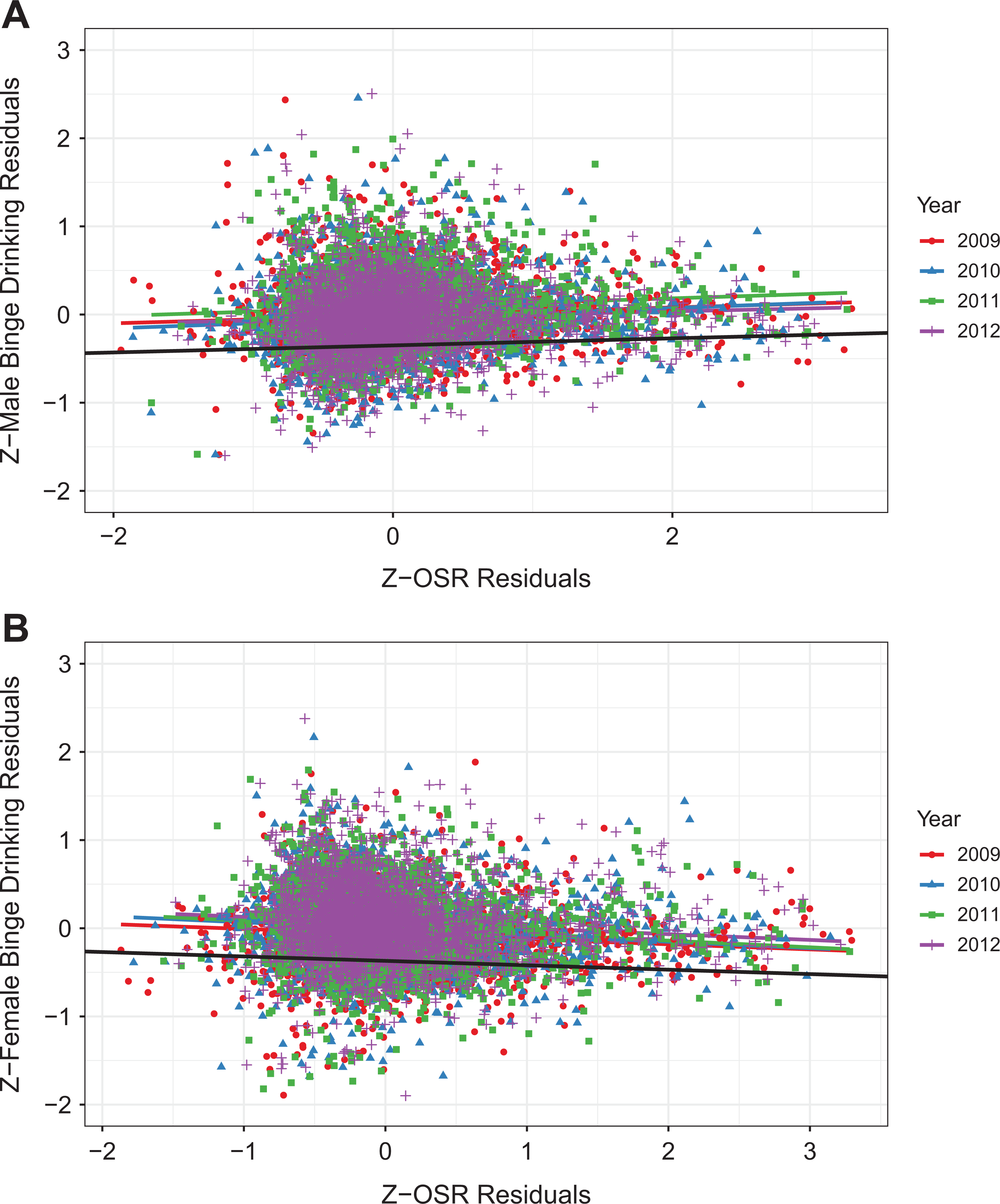
The relationship between overall operational sex ratio (OSR) and binge drinking rates, after controlling for the effect of states and opposite-sex binge drinking rates. Panel (A) represents male binge drinking rate as a function of OSR, with an OSR varying across years. Panel (B) represents female binge drinking rate as a function of OSR, with an OSR varying across years. Colored lines in each panel are the regression lines fitted to the data. The black line in each panel represents the fixed effect estimate of OSR in our random-intercept model.
Age-Specific OSR and Binge Drinking Rates
There was an effect of the age-specific OSR on male binge drinking rates. The OSR of the 20–29 age-group (β = .03, SE = .01, t = 5.13, p < .001), the OSR of 40–49 age group (β = .01, SE = .01, t = 2.44, p = .015), and the OSR of 50+ (β = .06, SE = .01, t = 5.75, p < .001) significantly predicted male binge drinking rates, but the OSR of other groups did not (OSR of the 30–39 age-group: β = −.01, SE = .01, t = −.31, p = .754). The covariate, female binge drinking rate, also significantly predicted male binge drinking rates (β = .63, SE = .01, t = 96.16, p < .001). The marginal R 2 for this model was 85.1%, and the conditional R 2 was 85.5%.
There was also an effect of age-specific OSR on female binge drinking rates. The OSR of the 20–29 age-group (β = −.06, SE = .01, t = −9.13, p < .001) and the OSR of 50+ (β = −.07, SE = .01, t = −5.99, p < .001) significantly predicted female binge drinking rates, but the OSR of the 30–39 age-group (β = −.01, SE = .01, t = −0.29, p = .775) and the OSR of the 40–49 age-group (β = −.01, SE = .01, t = −1.36, p = .175) did not. Here, the covariate, male binge drinking rate, also significantly predicted female binge drinking rates (β = .70, SE = .01, t = 96.17, p < .001). For this model, the marginal R 2 was 83.1% and the conditional R 2 was 83.4%.
Discussion
We were interested in examining whether the varying sex ratios across U.S. counties influenced binge drinking rates, particularly among young adults. Specifically, we predicted higher male binge drinking rates and lower female binge drinking rates in environments with a male-biased OSR. In line with our predictions, our results indicate that a higher overall OSR is associated with higher male binge drinking rates across counties. The opposite relationship was observed with female binge drinking rates. In other words, a greater abundance of unmarried males compared to unmarried females was associated with higher binge drinking rates among men but lower binge drinking rates among women (Figure 1). Second, we found that counties with higher male binge drinking rates also had higher female binge drinking rates, perhaps due to the common influence of unmeasured social variables on both sexes and/or the influence of men and women on each other. For example, a social network analysis study by Lorant and Nicaise (2015) found that being socially tied (friendship, working with, partying with, or roommate) to binge drinkers increases the frequency of one’s binge drinking acts. Third, we found that the OSR of the youngest (20–29) and the oldest (50+) age groups predicted overall binge drinking rates in sex-specific directions.
Age-Specific OSR and Male Binge Drinking Rates
For men, higher OSR for the ages 20–29 (i.e., an abundance of unmarried males compared to unmarried females) predicted higher rates of male binge drinking. Using “sjPlot” package (Lüdecke, 2018), we plotted this relationship in Figure 2. This finding is consistent with other reports of young men’s propensity toward other risk-taking behaviors. For instance, single young men are more likely to commit same-sex, nonrelative homicides (Daly & Wilson, 1990), are 2.5 times more likely than women to die in road accidents (World Health Organization, 2002), and are categorized as the highest demographic risk group for early mortality (Kruger & Neese, 2004). Given that males’ abilities to acquire short-term relationships decline with age, young adults are more likely to be risk prone when the OSR is biased (Kruger & Schlemmer, 2009). A significant positive correlation between overall male binge drinking rates and OSR of the 20–29 age-group suggests that binge drinking might function as a form of mating and signaling effort among young adults.

The relationship between age-specific operational sex ratio (OSR) groups and binge drinking rates. Panel (A) represents estimates of male binge drinking rate in our mixed-effects model, predicted by each age-specific OSR group and female binge drinking rates. Panel (B) represents estimates of female binge drinking rate in our mixed-effects model, predicted by each age-specific OSR group and male binge drinking rates. For each predictor, blue color indicates a positive relationship whereas red indicates a negative relationship. The thick gray line at 0 is the vertical intercept that indicates no effect. *p < .05. **p < .01. ***p < .001.
Although no significant association was observed between male binge drinking rates and OSR of older age groups (30–39), there was a significant positive correlation between male binge drinking rates and OSR in men of ages 40+ (Figure 2). Unmarried men in the 40+ age-group may be more likely to employ a short-term mating strategy that involves binge drinking because it is more likely that they (a) have never been interested in long-term mating (and hence remain unmarried at later ages) and/or (b) are once again interested in short-term mating after divorce and/or raising children to an age of independence. Thus, men in the 40+ age-group may be likelier to employ a mating strategy that involves binge drinking when the age group–specific OSR is biased against them. However, older men binge drink less frequently than younger groups (Centers for Disease Control and Prevention, 2017) and are generally less successful in competition for short-term mating opportunities (Cashdan, 1998; Hill & Hurtado, 1996) and hence are perhaps less likely to employ short-term mating tactics (Kruger & Schlemmer, 2009; Mathes, King, Miller, & Reed, 2002) than younger men. Furthermore, unmarried men who are at least 40 years of age represent only 17.67% of all unmarried men in 2009. Hence, the number of men who are at least 40+ years old, are unmarried, and binge drink is likely to represent a small proportion of all binge drinking men and may therefore make a relatively minor direct contribution to overall binge drinking rates. Instead (or in addition), the OSR of the 40+ age-group may serve as an indicator of environments in which binge drinking is more likely for younger men, perhaps because 40+ unmarried men prefer these environments and have the financial means to reside in them. Nevertheless, these explanations are speculative and should be treated cautiously.
Age-Specific OSR and Female Binge Drinking Rates
For women, we found that the higher the OSR of ages 20–29 (i.e., relatively higher abundance of unmarried males compared to unmarried females), the lower the rates of female binge drinking (Figure 2). In other words, higher binge drinking rates in women were more likely to be observed in female-biased environments. Women who are in their reproductive prime might engage in binge drinking to competitively gain short-term mating opportunities in environments where men are scarce. As such, lower OSR environments are associated with higher rates of female promiscuity (Kenrick et al., 2003; Schmitt, 2005), despite the fact that women tend to be more sexually restricted than men (Buss & Schmitt, 1993; Puts et al., 2015; Schmitt, 2005).
No significant association was observed between female binge drinking rates and OSR of older age groups (30–39 or 40–49). However, there was a significant negative correlation between female binge drinking rates and OSR in women of ages 50+ (Figure 2). It is expected that older married women and women with long-term partners are more likely to invest in both parenting of existing progeny and long-term relationships (Hughes & Aung, 2017), rather than short-term mating opportunities. However, older unmarried women might be more likely to engage in greater mating effort, including risk-taking behaviors such as binge drinking, in order to attain a mate in female-biased environments. In line with this reasoning, older women tend to show less restricted sociosexual behaviors (Meskó, Láng, & Kocsor, 2014) and are less likely to regret engaging in casual sex than younger women (Kennair, Bendixen, & Buss, 2016). As in male binge drinking, unmarried women in the 50+ age-group may be more likely to employ a short-term mating strategy that involves binge drinking because it is more likely that they (a) have never have been interested in long-term mating (and hence remain unmarried at later ages) and/or (b) are once again interested in short-term mating after divorce and/or raising children to an age of independence. In addition, the OSR of the 50+ age-group may serve as an indicator of environments in which binge drinking is more likely for younger women, perhaps because 50+ unmarried women prefer these environments. We emphasize that our age-related explanations are speculative, as we utilized data on binge drinking rates across age groups; to our knowledge, age-specific binge drinking rates at the county level are not available.
Alternative Explanations
Alternatively, binge drinking might be a consequence, rather than a form, of intense mating competition. When mating opportunities are limited in unfavorable OSR environments, it is possible that the reward derived from binge drinking may compensate for the absence of reward derived from mating. This phenomenon has been demonstrated in fruit flies; male fruit flies that were deprived of sexual access to females increased ethanol intake, which increased Neuropeptide F levels associated with the reward system (Shohat-Ophir, Kaun, Azanchi, Mohammed, & Heberlein, 2012). On the other hand, male fruit flies exposed to ample mating opportunities decreased their ethanol intake. In humans, we might also predict that men and women in environments with fewer mating opportunities would pursue other rewarding behaviors such as those associated with drug and alcohol use. However, we found associations between male binge drinking rates and the OSR only in the youngest and oldest age groups. These findings seem more consistent with the hypothesis that binge drinking functions as a form of mating competition than with the notion that binge drinking is compensatory, which would seemingly hold true for men and women in all age groups. Finally, when one demographic group is relatively more prevalent, it may have a greater influence on local patterns of behavior. For example, if young men as a group have a greater proclivity to binge drink, then a higher proportion of young men locally may result in more binge drinking behavior in this and other demographic groups. When there are more young men, there may be more binge drinking in general because younger men are more likely to binge drink. In addition, binge drinking behaviors in young men might influence the binge drinking rates of others (e.g., young women, older men, etc.). The former explanation is less likely since the binge drinking rates obtained from Dwyer Lindgren et al. (2015) are already age adjusted. Although the latter view is possible, it does not explain why we did not observe similar correlations between male binge drinking rates and the OSR across age groups.
Limitations
This study has several limitations. First, our findings are correlational and hence causation cannot be inferred. Second, the reported prevalence rates of binge drinking used in this study comprised rates across all adults rather than age-specific estimates as we had no data on age-specific binge drinking rates across county. This is the major limitation, as we cannot determine the degree to which associations between OSR and binge drinking rates differ when binge drinking rates are specified for each age-group separately. However, we found the relationship between overall OSR and overall male binge drinking rates in a predicted direction. In addition, the sex-specific relationships that we observed between binge drinking and the OSR of 20–29 age-group corroborate other reports that show binge drinking is most commonly associated with adults aged 18–34 (Centers for Disease Control and Prevention, 2017).
Because our analyses were conducted at the population level, interpretation of our findings at the individual level risks committing the ecological fallacy (Pollet, Stoevenbelt, & Kuppens, 2017). However, our predictions were first built upon behavioral expectations at the individual level, and similar patterns were observed at the population level. Future studies should test whether perceived sex ratio within the local mating ecology influences binge drinking behaviors by experimentally manipulating perceptions of the environmental sex ratio (e.g., with priming participants with unbalanced number of male and female photographs or via the sex ratio of live interactions). Previous studies that have employed image primes (e.g., Griskevicius et al., 2012; Moss & Maner, 2016) have successfully manipulated participants’ perception of the OSR and showed that perceived biased sex ratios influence human mating strategies at the individual level.
Conclusion
Our study showed that the overall male and female binge drinking rates are related to the OSR (i.e., proportion of available men relative to women in one’s local environment) in a predicted direction. Additional tests revealed relationships between both male and female binge drinking rates and age-specific OSRs. Our findings highlight that a higher OSR for the ages 20–29 (more available men compared to women) is associated with higher male binge drinking rates and lower female binge drinking rates. Given that the OSR of younger age groups predicts binge drinking patterns in a predicted direction, our results are consistent with the hypothesis that binge drinking comprises part of a short-term mating strategy and serves as a sex-specific costly signal to competitors and/or potential mates. This interpretation nevertheless remains speculative in the absence of data on binge drinking rates for specific age groups. Future studies could test directly whether age-specific OSRs correspond to age-specific binge drinking rates, as these data become available.
Supplemental Material
Supplemental_material - Operational Sex Ratio Predicts Binge Drinking Across U.S. Counties
Supplemental_material for Operational Sex Ratio Predicts Binge Drinking Across U.S. Counties by Toe Aung, Susan M. Hughes, Liana S. E. Hone and David A. Puts in Evolutionary Psychology
Footnotes
Declaration of Conflicting Interests
The author(s) declared no potential conflicts of interest with respect to the research, authorship, and/or publication of this article.
Funding
The author(s) disclosed receipt of the following financial support for the research, authorship, and/or publication of this article: Albright Creative Research Experience (ACRE) program and National Institute on Alcohol Abuse and Alcoholism (F32AA025830).

Supplemental Material
Supplemental material for this article is available online.
References
Supplementary Material
Please find the following supplemental material available below.
For Open Access articles published under a Creative Commons License, all supplemental material carries the same license as the article it is associated with.
For non-Open Access articles published, all supplemental material carries a non-exclusive license, and permission requests for re-use of supplemental material or any part of supplemental material shall be sent directly to the copyright owner as specified in the copyright notice associated with the article.
