



Abstract
Pilot data from eye-tracking research suggest that each male participant has his own gaze pattern, usefully regarded as an individual difference, when viewing female targets whom they are rating for attractiveness. Gaze patterns appear to be consistent within a given male participant across a variety of target models, and these individual differences may override characteristics of the model in determining fixation points, body region focus, and other eye-tracker variables. The goal of the present study was to elucidate these variations of gaze pattern by assessing the extent to which systematic “types” of gaze patterns exist among a group of male participants. Latent class analysis was used to place 60 men into groups based on their gaze pattern. A two-cluster solution produced the most interpretable analysis, and groups formed by this clustering were significantly different from each other on variables of interest. Cross validation of this solution across three additional female models resulted in some support for generalization, though exceptions were noted.
Introduction
Evolutionary psychology offers many predictions about determinants of sexual attractiveness for both men and women. Classically, men attend most to cues associated with fertility, whereas women, to a much greater degree than men, attend to cues associated with resource accrual (Buss, 1994). Much behavioral data exist to provide support for these hypotheses. In a previous study (Melnyk and McCord, 2012) the authors examined hair color as a potential determinant of male judgments of female attractiveness, using eye-tracker technology to assess male gaze patterns. An unexpected finding was that men tended to differ notably from each other with regard to gaze pattern, although each individual male participant tended to utilize the same gaze pattern across different female images. The present study was designed to investigate this serendipitous finding.
Although a full review of the mate attraction literature is beyond the scope of the current paper, key findings are relevant. Thornhill and Grammer (1999) credit Westermarck (1921) with first linking attractiveness determinants to evolutionary functionality. He proposed that judgments of sexual attraction are species typical and evolved by natural selection, as attractiveness gives visual cues to health and reproductive fitness. The same suggestion was proposed by Ellis (1926), focusing on the evolutionary function of the perception of attractiveness. Symons (1979) also stressed the association of health and fertility with cues that we find attractive. Symons documented that, as predicted by sexual selection theory, men pay more attention to physical attractiveness than do women. Buss's (1994) large cross-cultural studies of 37 countries assessing the importance placed on the attractiveness of a partner is a landmark in this literature. In all cases men placed more value on physical appearance in a potential mate than women did.
Two broad features that span much of this literature are youth and beauty. Both function as core aspects of female attractiveness, and both have been clearly linked to numerous biological markers of health, fertility, and reproductive value. Cross-cultural studies show that, to a near-universal degree, men prefer women who are younger than themselves (e.g., Buss, 1994; Symons, 1995). A more precise evolutionary prediction is that men prefer not just younger women, but women closer to the age of maximum fertility, the early to mid-20's. Kenrick, Keefe, Gabrielidis, and Cornelius (1996) explored this concept by gathering data from teenagers. Their data show that adolescent males actually preferred females in their 20s, who in some cases were up to seven years older than the male participant.
With regard to beauty, many variables have been examined, including body size and shape, facial femininity and symmetry, skin tone and clarity, and length and quality of hair. As noted above, a full review of all research in this very active field is beyond the scope of this introduction, but key findings in areas most relevant to the current project will be summarized below.
Devendra Singh has contributed significantly to the evolutionary psychology literature with a series of studies on women's waist-to-hip ratio (WHR) (Singh, 1993; Singh and Randall, 2007; Singh and Young, 1995). Reproductively healthy women have a WHR between .67 and .80 (whereas healthy men have ratio in the range of .85 - .95). Diseases such as diabetes, hypertension, heart-attack, stroke, and gallbladder disorders have been shown to have a link to fat distribution in regards to the WHR, more so than the actual amount of fat, which may help to explain the signal value of this particular index. In addition to indicating possible health problems, WHR has also been empirically linked to fertility factors. In one study, researchers found that women with a low WHR (indicated by a small waist) and relatively large breasts had 26 percent higher levels of estradiol, an ovarian hormone that is a good predictor of fertility (Jasienska, Ziomkiewicz, Ellison, Lipson, and Thune, 2004). In another fascinating study, even blind men were able to demonstrate a preference for lower WHR by feeling mannequins (Karremans, Frankenhuis, and Arons, 2010). Across studies, men rated women with an average WHR of .70 as more attractive than either smaller or larger values.
In recent years researchers have begun to question the specificity of WHR as an indicator of attractiveness. A number of studies suggest Body Mass Index (BMI) may be a greater predictor of attractiveness than WHR. Results have shown that WHR and BMI are positively correlated, as WHR goes up so does BMI; however, when statistically controlling for BMI, WHR was not a significant determinant of attractiveness (Cornelissen, Tovee, and Bateson, 2009). These results suggest WHR is only important because it gives information about BMI. Similar results were found in an eye-tracking study that found gaze patterns fixated on the waist and breasts, but not on hips or pelvis (Cornelissen, Hancock, et al., 2009). Rilling et al. (2009) found that both BMI and WHR were significant predictors of attractiveness; however, waist circumference was an even greater predictor. There is still much research needed to distinguish which of these factors plays the bigger role or what other variables may be relevant.
Skin quality is another important factor as it not only gives an indication towards current health, but also acts as a part time record of previous health. (Sugiyama, 2005). Skin quality has been linked to facial attractiveness (Fink and Neave, 2005). Homogeneous skin is seen as younger and more attractive than splotchy skin (Fink, Grammer, and Matts, 2006; Fink et al., 2008). Clear and unblemished skin shows the absence of parasites, skin damaging diseases, and possibly good genes to heal without infection (Singh and Bronstad, 1997). Faces figure prominently in attractiveness research. A more feminine face is seen as more attractive, defined by features including full lips, relatively larger eyes, thinner jaws, small chin, high cheekbones, and a relatively short distance between mouth and jaw (Gangstead and Scheyd, 2005). Feminine faces are likely to be an attractiveness determinant for two reasons. First, as women age their facial features tend to become less feminine; thus, facial femininity offers cues regarding youth. Second, facial femininity is also linked to higher levels of estrogen, the ovarian hormone linked to fertility (Schaefer et al., 2006). Meta-analysis reveals that facial femininity is one of the most powerful cues to a woman's attractiveness (Rhodes, 2006). Other cues offered by the face involve symmetry, hypothesized as an indicator of developmental stability, a signal of “good genes” and the capacity to withstand environmental challenges. Symmetrical faces have been positively correlated with judgments of attractiveness compared to non-symmetrical faces (Fink, Neave, Manning, and Grammer, 2006).
Not all researchers agree on the importance of facial symmetry. Derek Hodgson (2009) suggests that an attraction to symmetry is not a sexually driven desire, but a perceptual bias. He argues that while symmetrical faces are perceived as attractive, they are not reliable cues to an individual's actual quality of health.
The length and quality of hair is yet another cue that can be read when assessing a woman's attractiveness. A study was conducted interviewing 230 women at various public locations about their age, subjective health, and relationship status. Researchers also collected measures for hair length, and hair quality (Hinsz, Matz, and Patience, 2001). Hair length and quality were strong cues to youth. Younger women tend to have longer hair than older women; furthermore, observers' judgments of the quality of women's hair were also positively correlated with women's subjective judgments of their own health. Fink, Neuser, Deloux, Roeder, and Matts (2013) found that healthy hair was rated as younger, healthier, and more attractive than damaged hair. Hair can also significantly increase or alter female facial attractiveness.
With the increasingly widespread availability of eye-tracker technology, these evolutionary predictions may be tested in more precise ways and at a deeper level. Whereas eye-tracking has existed in some form for more than 100 years, only within the past decade has this technology been applied to evolutionary psychology and the study of determinants of attractiveness.
Recent research has indicated that both men and women have a higher number of fixations and longer viewing times when viewing erotic versus non-erotic stimuli (Lykins, Meana, and Strauss, 2008). Similarly, heterosexual males pay more attention to adult females than to adult males or to children of either sex (Fromberger et al., 2011). Hall, Hogue, and Guo (2011) had male participants view pictures of women ranging in age from birth to 60. Men exhibited more fixations and longer overall gaze time when viewing 20-year-old women as compared to any other age group, consistent with evolutionary predictions regarding peak fertility.
A number of recent studies have used eye-tracking to explore more specific determinants of attractiveness. Hewig, Trippe, Hecht, Straube, and Miltner (2008) reported that both male and female observers gazed primarily at people's faces. After initial scan of the face, men then gazed longer at women's breasts, whereas women gazed at men's legs. Similar results had been reported early by researchers using sexually explicit stimuli (Rupp and Wallen, 2007).
As noted above, female WHR has been associated frequently with attractiveness ratings. Dixson, Grimshaw, Linklater, and Dixson (2011) used eye-tracker technology to explore this common finding. Men viewed frontal view images of the same woman, computer-morphed to vary her WHR (.7 or .9) and breast size (small, medium, large). Both breasts and hips received more first-fixations than any other body region. Men gazed longer at breasts than at any other region, but, consistent with prevailing literature, they rated the .7 WHR as most attractive, independent of breast size. Cornelissen, Hancock et al. (2009) conducted an eye-tracker study to address the distinction between WHR and overall body fat (BMI) in attractiveness judgments. They used three different groups of raters: the first was asked to judge attractiveness, the second to judge WHR, and the third to judge BMI. The fixation patterns for the attractiveness group were very similar to those of the BMI group, and different from the WHR group. This finding adds to a growing literature that suggests BMI, rather than WHR per se, is the key issue in rating female attractiveness. The Cornelissen, Hancock et al. study also serves as a clear example of how eye-tracker technology can help to test competing hypotheses in evolutionary psychology.
In a previous study (Melnyk and McCord, 2012), the current authors explored the hypothesis that blonde hair was a signal of youth, predicting that heterosexual male participants would gaze at hair earlier, and for a higher proportion of total time, with blonde models, compared to brown-haired, black-haired, or red-haired models. However, no differences in predicted eye-tracking variables were found. Observation of participants during the session, confirmed by subsequent data analysis, indicated that a high level of individual variation occurred on each of the eye-tracker metrics. Statistically, then, the within-group variance overshadowed any mean differences between models that might have been found. The present study was designed to follow up on this unexpected finding. Specifically, we re-examined our data with regard to the possibility that “types” of gaze patterns might exist in a group of male participants. Our informal observation was that each participant appeared to exhibit a consistent strategy of gaze across models, regardless of experimental condition. We wondered if there might be systematic patterns shared by clusters of men.
Materials and Methods
Participants
Sixty male participants were recruited for this study from the Department of Psychology human subject pool at a regional comprehensive state university in the rural Southeast. All were of traditional college age (M = 19.03, SD = 2.73, min = 17, max = 36) and 80% indicated their ethnicity as White (11.67% African American, 5% Multiracial, 1.67% Native American, 1.67% Asian). The last item on the brief demographics questionnaire asked if the participant was romantically attracted to women; this was intended as an exclusion criterion, but no participants answered negatively.
Materials and apparatus
The study was conducted using a Tobii TX 300 Eye Tracker to measure various aspects of eye movement (300 Hz gaze capture frequency). The eye-tracking device looks very similar to a large computer display screen, and therefore the eye-tracking hardware is not readily apparent to participants. The device captures eye position remotely with cameras embedded in a module below the display screen, which is used to present experimental stimuli (23 inch diagonal, 1920×1080 resolution widescreen LCD). Viewing distance for the device was 66 cm. We used a velocity-threshold fixation identification algorithm provided with the Tobii Studio software to classify eye gaze points as either belonging to a fixation or a saccade (Komogortsev, Gobert, Jayarathna, Koh, and Gowda, 2010; Salvucci and Goldberg, 2000). In our application of the algorithm, gaze samples were classified as belonging to a fixation if the velocity of the movement to the gaze point was less than or equal to 30 degrees/sec, a value that typically provides good results for psychological research (Olsen and Matos, 2012). The eye-tracking system provides a software reading of the sampling accuracy rate for each participant (i.e., the percent of gaze samples that provide adequate data to identify the position of left and right eye gaze points). We used a threshold of 80% sampling accuracy to retain subject data for further analysis, a standard setting for eye-tracker systems without head restraint (Poynter, Barber, Inman, and Wiggins, 2013).
Procedure
Participants were recruited through the University's research pool. All students in general psychology have the option of participating in experiments within the department or, alternatively, writing a research paper on a psychological topic of their choosing. Since the paper is a viable option that some students do choose, no one was coerced to participate in this study.
Participants arrived for the study in groups and completed a brief demographic questionnaire. They were then tested individually in the eye-tracker lab. Once seated, the eye-tracker was calibrated for the specific participant, who then viewed a series of photographic images of female models (full body, fully dressed). The original study utilized four different females, with hair color systematically varied by computer-morphing across models. The models were rated first for attractiveness and, in a second series of viewing, for estimated age. The present analysis utilized only the attractiveness data, and for only the first model. Participants viewed all four models, each with a varying randomized hair color, since the original study used hair color as a variable. Representation of hair color was also controlled for so at the end of the 60 participants each model had been shown an equal amount of times in each hair color.
Analyses
Our general hypothesis was that male subjects may be meaningfully grouped into categories based on eye-gaze patterns when viewing female models. This hypothesis was tested using latent class analysis (Mplus; Muthen and Muthen, 2010), with key “areas of interest” (AOIs) serving as grouping variables. The eye-tracker device allows the researcher to predefine specific AOIs on which eye-tracking variables are based. In this study, AOIs were: hair, face, breasts, waist, hips, and full picture acting as a total value. Specifically, grouping variables for the latent class analyses were defined as the amount of gaze time spent on each of the first five AOIs expressed as a percentage of total time.
Results
We ran 1-, 2-, and 3-class analyses and tested for best model fit (see Table 1). The statistical indices clearly revealed that a 2-class solution fit the data best. Specifically, the LRT value for the 2-class solution indicated that it was statistically superior to a 1-class solution, and the LRT for the 3-class solution was not significantly better than that for the 2-class solution. The 2-class solution provided an excellent fit to the data with the entropy value being relatively close to 1.00 (entropy = .866) and all mean posterior probabilities being larger than .70 (see Table 2). Approximately 70% of respondents were in class 1 and 30% in class 2. We then had Mplus calculate probable class membership for each participant, forming two groups. A MANOVA was conducted to examine group differences on all five dependent variables as a group, followed by univariate analyses for each AOI. The multivariate test was significant (Wilks' Λ (5, 54) = .266, p = .000, partial eta square = .734), indicating that the five dependent variables differed overall between the two groups. Univariate tests indicated that the groups did not differ significantly with regard to the hair AOI, but they differed significantly on all of the other four dependent variables (see Table 3 for means and mean-difference test results). Class 1 males exhibited a strong orientation toward face, with only minimal gaze time at other AOIs, whereas Class 2 males, while still spending the majority of gaze time on face, distributed time much more evenly among the other AOIs. Figures 1a and 1b provide examples of individual subjects' tracking data for each class.
Model fit for 1-, 2-, and 3-class solutions

Notes: BIC = Bayesian Information Criteria, adjusted for sample size; LRT = Lo-Mendell-Rubin Adjusted LRT Test
Mean posterior probabilities

Mean percent time spent by AOI
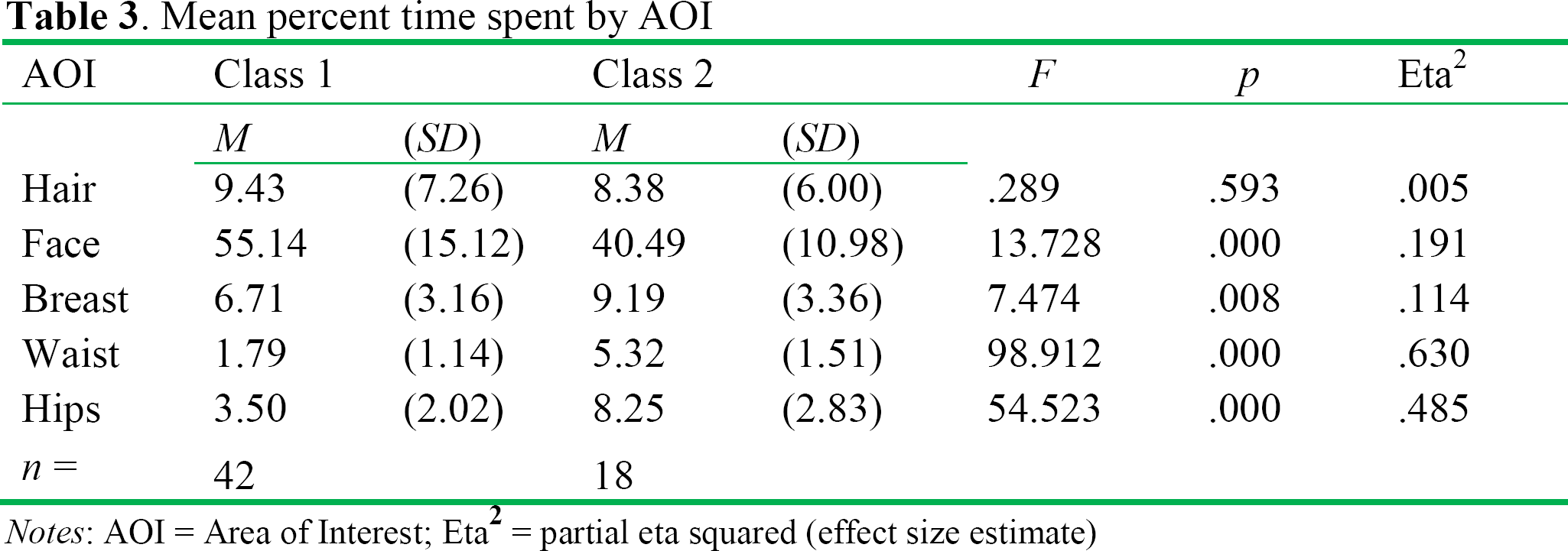
Notes: AOI = Area of Interest; Eta2 = partial eta squared (effect size estimate)

Typical gaze pattern for (a) Class 1: “face only” and (b) Class 2: “face plus”
Discussion
The current study was designed to explore the possibility that “types” of gaze patterns exist among male subjects when viewing female images, and to this extent the study was successful. Latent class analysis revealed that the data were best described by two classes of subjects. Class 1 subjects (“face only”) focused almost exclusively on the facial area when making attractiveness judgments, whereas Class 2 subjects also relied heavily on facial features, but to a lesser extent than Class 1 subjects, including other areas of interest as well. The overall dominance of facial gazing in both groups is consistent with the body of literature on mate attraction (e. g., Rhodes, 2006). Despite the literature on hair length and quality as a predictor of youth and attractiveness, hair was the only area of interest on which the two latent classes did not predict youth and attractiveness. It is possible that tampering with the models' hair colors may have had an effect; however, in debriefing, none of the participants indicated knowledge of tampering with the hair, and most seemed rather surprised by the fact when told.
The systematic gaze pattern differences revealed in this analysis are highly relevant to evolutionary psychological research, and possibly to researchers in other areas who employ eye-tracker technology. This source of individual differences raises the possibility of Type II error, failing to reject the null hypothesis when it is actually false. The systematic variation among subjects is treated statistically as error variance, lowering statistical power. Isolating systematic individual differences in gaze pattern may allow researchers to quantify it, and perhaps use pattern groupings as covariates, in order to increase the statistical power of the design.
Limitations of the current study include the low to modest sample size (60) and the general homogeneity of the sample (all college males taking introductory psychology at a rural state university). Latent class analysis with larger and more diverse samples may well identify more and/or different gaze patterns. Future research should, thus, include larger samples, and perhaps utilize a larger number of AOIs.
A key issue is the nature of the stimulus material. Assuming that our findings do, in fact, generalize meaningfully, to what extent would the identified gaze patterns emerge with different stimuli? Using erotic stimuli, we would certainly expect variations in gaze patterns overall, but would latent classes of gaze pattern emerge? Similarly, using non-sexual stimuli, such as landscapes or other pictures, with tasks totally different from rating attractiveness (or age, etc.), would systematic clusters of individual differences in gaze pattern occur?
The current findings should be seen as preliminary, but researchers working with eye-tracker technology should certainly take note of the differential gaze patterns identified here. These results are especially relevant with regard to evolutionary psychological research.
Footnotes
Acknowledgements
The authors wish to thank Will Poynter for invaluable support with the eye-trackers.