




Abstract
Across different times and cultures, parents play an important role in influencing their children’s mating decisions. When they do so, they aim to forge useful alliances with other parents which raises the question of what parents look for in the latter. The current research aims to address this question. In particular, we employed an online sample of 925 Chinese parents who were asked to rate the desirability of 88 traits in the parents of prospective mates for their children. Principal components analysis classified these traits in eight factors for the mothers and 10 factors of interest for the fathers of their children’s mates. We also found that parents had a well-defined hierarchy of preferences, fathers, and mothers were in agreement in what they looked for in a prospective in-law, but their preferences were contingent to the sex of the in-law.
Introduction
Mating involves six parties, namely, men, women, men’s parents, men’s siblings and other relatives, women’s parents, and women’s siblings and other relatives (Biegler & Kennair, 2016; Blood, 1972; Coonz, 2006; Kennair & Biegler, 2015). Each party has considerable fitness interests in this game that depend on the traits of the other parties. For instance, if prospective mates have poor health, this trait would negatively affect the fitness of mate seekers and their parents. As a consequence, selection pressures are exercised, favoring adaptations that would guide each party to divert its effort in attracting parties with fitness-increasing traits and avoid parties with fitness-decreasing traits. Such adaptations take the form of preferences, with individuals finding fitness-increasing traits desirable and fitness-decreasing traits undesirable (Buss, 1989).
Considerable research has focused on mate preferences (for a review, see Buss, 2017), and we have today a good knowledge of what men and women value in a prospective mate. More recently, there has been an interest in studying what qualities parents value in a prospective daughter- and son-in-law (Apostolou, 2007, 2014a, 2015; Perilloux, Fleischman, & Buss, 2011). Still, the fitness interests of parents are predicted not only by the qualities of their children’s mates but also by the qualities of the parents of their children’s mates. Therefore, parents are expected to have well-defined preferences about the qualities of their children-in-law’s parents. To our knowledge, there has not been any research that has attempted to investigate these preferences which is the goal of the current study.
In-Law Preferences
In the preindustrial context, there are no social protection systems, and people need to rely on others for support in times of need. In addition, individuals can derive substantial benefits in terms of material and nonmaterial resources if they have close ties with other individuals. For instance, an individual who establishes a strong tie with another individual who is wealthy and powerful can receive material gifts, gain social influence and status, and receive support in ascending the social hierarchy. People have evolved to apply preferential treatment to their genetic relatives, as doing so increases their inclusive fitness (Cartwright, 2000). However, an individual may not have many genetic relatives or may have relatives who are not particularly well-off. Accordingly, there are substantial benefits that people can derive by extending their social network to nonrelatives.
One way to do so is to establish nonblood relationships through marriage. Accordingly, anthropological and historical evidence indicates that parents have been approaching the marriage of their children as a way to establish beneficial alliances with other families (Apostolou, 2014b; Coonz, 2006). Such alliances can be of high value for the inclusive fitness of parents, as they can derive substantial benefits for them and their family. The inclusive fitness significance of such alliances exercises considerable selection pressure on parents to evolve mechanisms that would enable them to establish beneficial marital alliances and would prevent them from diverting their resources in establishing alliances which are not beneficial. Such mechanisms or adaptation include in-law preferences. By being predisposed to prefer specific fitness-increasing traits in prospective in-laws, parents are motivated to divert their energy in getting in-laws who have such traits and avoid the ones who do not (Apostolou, 2007).
There are at least three domains of interest when it comes to in-law choice, namely, the qualities of the prospective children-in-law, the qualities of the families of children-in-law, and the qualities of the parents of the children-in-law. Accordingly, selection pressures are expected to have shaped in-law preferences to be sensitive to these three domains. Simply put, when parents strive to establish a marital alliance, they would look to find spouses for their children who have desirable qualities, who come from families with desirable qualities, and who have parents with desirable qualities.
Starting from the former, children-in-law are of considerable fitness importance for parents. They are responsible for giving them grandchildren, providing resources, and treating their children well. Accordingly, parents are expected to have evolved preferences about the qualities which are beneficial for them in prospective children-in-law (Apostolou, 2014b). Quantitative and qualitative studies have found that parents have a well-defined hierarchy of traits they prefer in a prospective daughter- and son-in-law (Apostolou, 2007, 2014a, 2015; Koster, 2011).
Moving on to the family background, one study employed qualitative research methods and identified nine traits that parents find desirable in the family of the their prospective daughters- and sons-in-law (Apostolou, 2014c). Subsequently, it employed quantitative methods and classified these traits in two domains of interest, namely, similar ethnic and religious background and similar socioeconomic and cultural background. Nevertheless, to our knowledge, there has not been any research that has attempted to examine what traits parents prefer in the parents of their prospective children-in-laws.
In-laws
Given the fitness stakes involved in mate choice, we expect that parents have well-defined preferences when it comes to the parents of their prospective children-in-law (unless stated otherwise, we will use the terms in-laws, parents-in-law, mother-in-law, and father-in-law to refer to the parents of children-in-law). That is to say, during the period of human evolution, parents who were predisposed to prefer fitness-increasing traits in a prospective mother- and father-in-law would divert their effort in establishing marital alliances with such individuals. In effect, they would gain a selective advantage over other parents who would not have such dispositions, and so they would allocate their effort similarly in attracting in-laws with and without fitness-increasing traits. On this basis, we hypothesize that parents have well-defined preferences on what they want in prospective parents-in-law.
From this general hypothesis, several additional predictions can be derived. To begin with, when they exercise influence over their children’s mating decisions, parents aim to establish beneficial alliances with other families (Apostolou, 2014b; Coonz, 2006). Personality-related traits such as being kind, tolerant, and cooperative would promote the effectiveness and the longevity of the alliance, and as such they are of high fitness value in prospective in-laws. For instance, an alliance with in-laws who are not cooperative would not be of much benefit for parents, and it would be difficult to work with them toward fitness-increasing goals. Accordingly, we predict that one domain of interest for parents in prospective in-laws would be personality traits which relate to effective cooperation among individuals.
Moreover, the purpose of a marital alliance is for parents to receive benefits including resources and political support (Apostolou, 2014b). Accordingly, traits such as wealth and high social status are of high fitness importance for parents. Wealthy in-laws can provide considerable resources to parents, while high social status in-laws can provide political support and make a positive contribution to the social status of parents. On this basis, we predict that control of resources would be another domain of interest for parents.
If a marital alliance is to be effective and long-lasting, the parties involved need to be committed to it. Prospective in-laws who are family oriented, that is, they are committed in their family and in raising children and grandchildren, will be more likely to be committed marital allies than in-laws who do not share these traits. Family-oriented in-laws would provide to their family, including their extended family. Therefore, we predict that being family oriented would be another domain of interest for parents in prospective parents-in-law.
Overall, we predict that personality traits that relate to effective cooperation, traits that relate to the control of resources, and traits that indicate commitment to the family would be some key domains of interest for parents in a prospective in-law. Given that there is no research in this area, and in-law preferences are complex phenomenon affected by many factors, we expect that in-law preferences would not be confined to these domains. Thus, our research is also explorative—we make specific predictions about the structure of in-law preferences, but as there are many factors at play, we cannot predict the exact structure of these preferences, which needs to be explored further.
Not all traits in prospective in-laws have the same fitness potential for parents. For instance, the resources that prospective in-laws control are of relevance to parents only if the former engage in a functional alliance and they are willing to divert them to the latter. To put it differently, the wealth of prospective in-laws does not matter if the alliance with them is short lived or if they are not willing to share it with their extended family. In this respect, personality traits that predict cooperation and being family oriented in prospective in-laws make a higher contribution to the fitness of parents than traits that indicate control of resources, and so they will be preferred more. On this basis, we predict that in-law preferences would form a hierarchy where those traits which are potentially more fitness-increasing for parents will be preferred more than traits which are potentially less fitness-increasing.
Last but not least, across societies, there is a division of labor, with men and women being ascribed different roles and specializations (Whyte, 1978). For instance, across different cultures and different times, wealth is predominantly controlled by men (Whyte, 1978). Accordingly, such sex difference would translate in this trait being of little fitness importance in a prospective mother-in-law than in a prospective father-in-law. That is to say, parents would benefit much by allocating their resources in attracting wealthy women as women usually do not control wealth, but it would pay for them to divert them in attracting wealthy men, as men control wealth. On this basis, we predict that parents would tend to value several traits differently in a prospective father-in-law than in a prospective mother-in-law.
Method
Participants
The participants of the study completed an online survey. Each participant received a certain payment after completing the survey (i.e., 4.5 ¥, yuán). Overall, 925 Chinese parents took part in this research (479 women, 446 men). Participants were not related to each other, that is, they were not couples. The mean age of mothers was 36.4 (SD = 6.9, range = 30), and the mean age of fathers was 37.8 (SD = 7.4, range = 32). All parents had one child. The male children had a mean age of 11.9 (SD = 5.5, range = 27). The female children had a mean age of 13.1 (SD = 6.2, range = 22). Please note that the data set for this study can be made available by the corresponding author on request.
Moreover, 22.9% of the participants lived in the rural area, 32.8% lived in the small town, and 44.3% lived in an urban area. With respect to education, 12.1% of participants had completed secondary school, 40.3% graduated from a high school, 39.4% had a bachelor degree, and 8.2% had a postgraduate degree. Furthermore, 96.8% of the participants were married and 3.2% were divorced.
Materials
The survey had three parts. In the first part, participants were asked to rate how desirable they considered a set of traits in a prospective mother-in-law, and in the second part, in a prospective father-in-law, using a 4-point Likert-type scale (0 = unimportant, 1 = somehow important, 2 = important, 3 = indispensable). The instrument employed to measure in-law preferences consisted of 88 traits (listed in Table 1) that have been identified by previous research (Apostolou, 2011, 2014a). In order to adapt the instrument to the goals of our study, from the original instrument, we changed the “Few sexual experience before marriage” into “Few extramarital sexual experiences” and the “Wants children” into “Wants grandchildren.” The rest of the items remained unchanged. In the third part, demographic information was collected (sex, age, marital status, number of daughters and sons, and ages of the oldest male child and of the oldest female child). Please note that the order of presentation of the first two parts was counterbalanced across participants.
The Extracted Factors and the Respective Factor Loadings for Mothers- and Fathers-in-Law.

Note. We have also included the Chinese terms that were used in the study.
Results
In order to classify traits in broader preference domains, principal components method for factor extraction and direct oblimin as the rotation method were used. Direct oblimin was chosen because the assumption of noncorrelated preferences was unlikely to hold (Field, 2013). The analysis was performed twice, once for mothers-in-law and once for fathers-in-law. The results suggested an 8-factor solution for prospective mothers-in-law and a 10-factor solution for fathers-in-law (eigenvalue > 1). The KMO statistic was 0.98 for both in-laws, indicating a very good sample adequacy. The factors and the respective loadings are presented in Table 1. The scales produced by this procedure were checked by means of reliability analysis. For mothers-in-law, the internal consistency (Cronbach’s α) ranged from 0.79 to 0.96, with a mean of 0.90. For fathers-in-law, the internal consistency ranged from 0.71 to 0.93, with a mean of 0.87.
In order to construct a preferences hierarchy, we estimated the means and the standard deviations for each extracted factor by summing the traits that composed each factor and dividing them by their number. The results are presented in Table 2. For both mothers- and fathers-in-law, the “Family oriented” and the “Kind, understanding, and cooperative” were found at the top in-law preferences. Similarly, for both in-laws, “Pleasant personality,” “Strong personality,” and “Well-off” were found at the middle of the hierarchy. In addition, “Good looks” and “Similar religious and ethnic background” were found at the bottom of the hierarchy. For mothers-in-law, “Good cook-housekeeper” was found near the top of the hierarchy, while for fathers-in-law near the bottom of the hierarchy. The “Emotionally stable and reliable” and the “Magnanimous and affectionate” were near the top of the hierarchy for a prospective father-in-law.
The Hierarchy of Preferences and Age Effects for Mothers- and Fathers-in-Law.

Note. All age coefficients were negative, indicating that older parents ascribed less value to these traits.
aPlease note that these factors did not emerge for a prospective mother-in-law, so statistical results were not reported.
Contingencies
In order to examine whether mothers and fathers were in agreement over what they looked for in a prospective in-law as well as possible age effects, we run a series of multivariate analysis of covariances on each extracted factor. More specifically, the traits that composed each factor were entered as the dependent variables, and participants’ sex and age were entered as the independent variables. This analysis was performed on each extracted factor for both mothers- and fathers-in-law.
The results indicated that there was no significant effect of sex, suggesting that parents were in agreement over what they wanted in a prospective in-law. As we can see in Table 2, for several factors, age came significant always with a negative coefficient.
We would also like to examine whether parents’ preferences were contingent on the sex of the in-law. Toward this end, we compared the eight factors that were common in a mother- and in a father-in-law. For each factor, we included in our analysis only the traits that loaded for both in-laws. If, for a given factor, a trait loaded only for one in-law (e.g., loaded to the respective factor for a mother-in-law but not for a father-in-law), it was not included in our analysis. Since the sex of the in-law was a within-subjects factor (i.e., participants gave ratings for both in-laws), for the purposes of our analysis, we employed doubly multivariate analysis which is equivalent to the within-subjects MANOVA. In particular, the traits that composed each factor were entered as the dependent variables, and the sex of the in-law was entered as the independent variable.
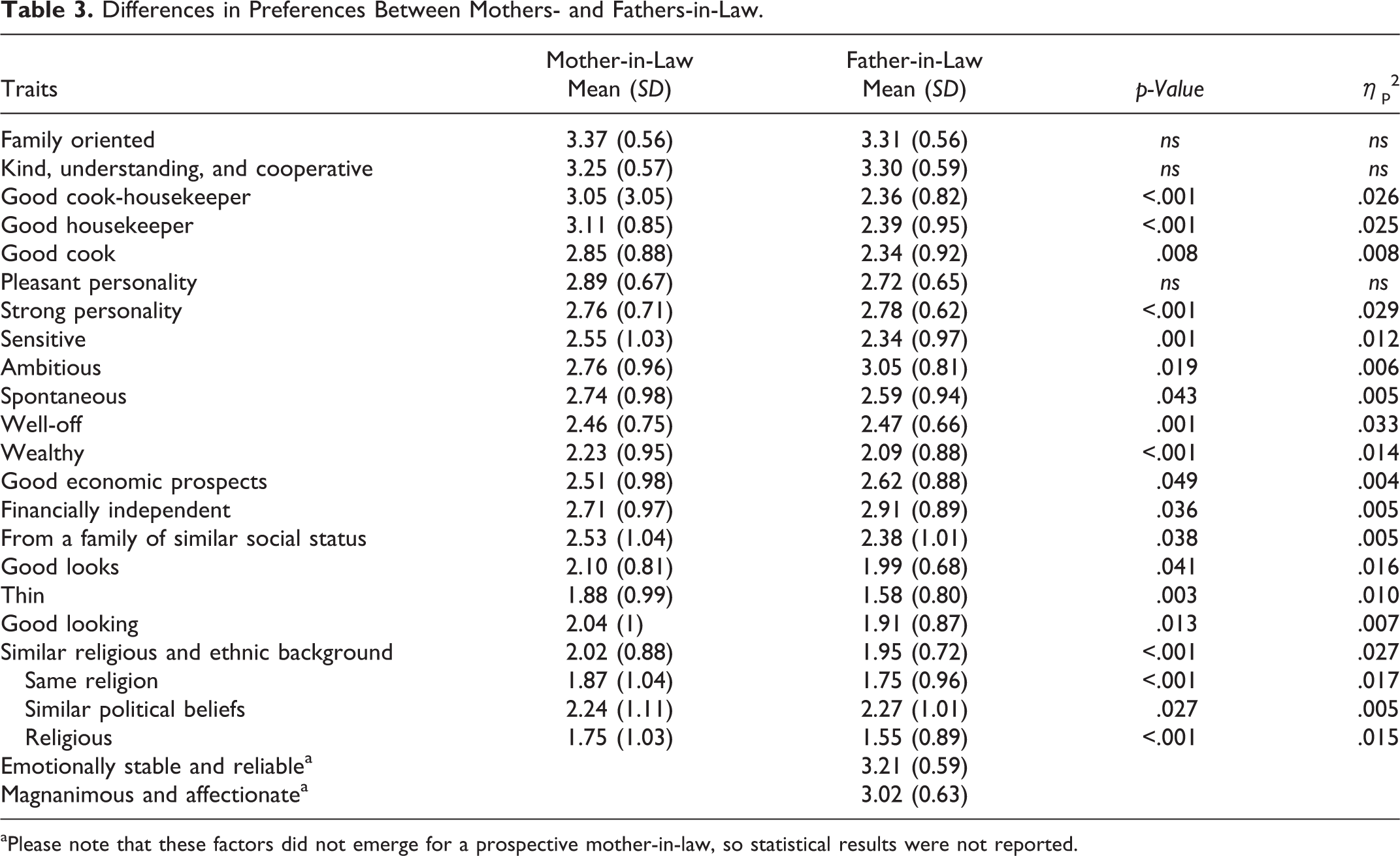
The results were presented in Table 3, where we can see that the sex of the in-law was significant for several factors. To begin with, the “Good cook-housekeeper,” the “Good looks,” and the “Similar religious and ethnic background” were preferred more in a mother- than in a father-in-law. There was also a significant effect of the sex of the in-law for the “Strong personality” and for the “Well-off,” yet the factor means overlapped suggesting that some of the traits that composed these factors were preferred more in mother-in-law while others were preferred more in a father-in-law.
Differences in Preferences Between Mothers- and Fathers-in-Law.
aPlease note that these factors did not emerge for a prospective mother-in-law, so statistical results were not reported.
More specifically, with respect to the “Strong personality,” being “Sensitive” and “Spontaneous” were preferred more in a mother-in-law, while being “Ambitious” was preferred more in a father-in-law. With respect to the “Well-off,” being “Wealthy” and “From a family of similar social status” were preferred more in a mother-in-law, while having “Good economic prospects” and being “Financially independent” were preferred more in a father-in-law.
Discussion
Consistent with our original hypothesis, Chinese parents had a well-defined hierarchy of in-law preferences. As we originally predicted, personality traits that relate to effective cooperation, family oriented, and traits the connote control of resources, emerged as important domains of interest, along with other such domains. In addition, parents ascribed different weights to different traits. Traits such as being family oriented, kind, understanding, and cooperative topped parental preferences, while traits such as good looks and similar religious and ethnic background were located at the bottom of parental preferences. Moreover, parents differentiated their preferences according to the sex of their prospective in-law. Last but not least, fathers and mothers were in agreement in what they looked for in their in-laws.
In our theoretical framework, parents have evolved to employ marriage in order to form useful alliances with other families. As discussed in the Introduction section, one key predictor of the usefulness of a marital alliance is how effectively the parents of the different families can work together toward fitness-increasing goals. In turn, a main predictor of effective cooperation is personality (Buss & Hawley, 2010), so it is no surprise that parents’ preferences were focused predominantly on personality traits. Four of the eight factors in a prospective mother-in-law and 6 of 10 factors in a prospective father-in-law related directly to personality.
People who are family oriented will look after their grandchildren, daughters- and sons-in-law, and their daughters’- and sons’-in-law families and will thus be beneficial for parents. Accordingly, being family oriented topped in-law preferences. Moreover, people who are kind, understanding, and cooperative will treat their genetic and nongenetic relatives kindly. Thus, these traits are important for parents, as they ensure that their in-laws will treat their children and grandchildren well, while they will be there for them in times of need. Furthermore, they ensure effective cooperation toward fitness-increasing goals such as gaining subsistence and raising a family. Consequently, the kind, understanding, and cooperative factor was found at the top of in-law preferences.
Effective cooperation and harmonious coexistence between parents are also predicted by personality traits that make people pleasant to be with. An individual with pleasant personality will be easier to work with and to integrate to one’s family than an individual who does not have this trait. Probably this is the main reason why pleasant personality was found near the top of in-law preferences. Moreover, traits, such as being ambitious, determined, and serious, that compose the strong personality factor, are likely to predict resilience to difficulties and downturns as well as the effective generation of resources. Accordingly, strong personality is fitness-increasing for parents because it ensures that their allies will not be easily taken down by adversities. In Chinese, “Strong personality” is used to describe someone who is determined, special and not easily influenced by others. People say “他(她)很有个性,不愿意随波逐流” that means “He (She) has a strong personality and won’t just copy and follow others.”
Fitness-increasing in-laws are in-laws who can provide resources. As one predictor of resource provision is the amount of resources one controls and the capacity to generate resources, one of the factors that came out in in-law preferences is well-off. Yet, it appears that this factor was a low priority for parents, as it was found near the bottom of their preferences’ hierarchy. One possible reason for this finding is that the willingness of their in-laws to provide them with resources, and being able to cooperate with them effectively toward resource generating activities is more fitness-increasing for parents than the resources they control. Such willingness and capacity for cooperation are predicted by specific personality traits which were strongly preferred by parents.
One primary predictor of cooperation between individuals is similarity (Buss & Hawley, 2010; Gonzaga, Campos, & Bradbury, 2007). Accordingly, it is expected that similarity will be a primary concern for parents when assessing prospective in-laws. The preference for similarity is reflected in the “Similar religious and ethnic background” factor, which was found nevertheless, at the bottom of in-law preferences. Yet, the low scores that parents gave for these dimensions do not indicate that they did not ascribe considerable importance to similarity, but that they did not ascribe considerable importance to similarity over religion and ethnicity. One possible reason is that China is relative homogenous in terms of these dimensions; thus, prospective in-laws are unlikely to vary in religion and ethnicity, so parents did not ascribe much value to this trait.
Parents viewed the qualities of their prospective fathers-in-law differently than the qualities of their prospective mothers-in-law. To begin with, the factor structure of the desirable traits in the former was different than the one in the latter. In particular, the factor structure of father-in-law traits has two additional dimension “Emotionally stable and reliable” and “Magnanimous and affectionate.” These factors were found near the top of the in-law preferences hierarchy, indicating that they were important for parents in a prospective father-in-law. The difference in the factor structure needs to be replicated by future research, which may also attempt to investigate why the structure of preferences differed between prospective in-laws.
With respect to the other factors where sex differences were found, across preindustrial and postindustrial societies, women are more involved in housekeeping and cooking activities (Whyte, 1978), which can potentially account for why parents valued the “Good cook-housekeeper” factor more in a mother- than in a father-in-law. Furthermore, across cultures, men usually control more wealth than women (Nettle & Pollet, 2008), so it is expected that parents would value being well-off more in a prospective father- than in a mother-in-law. Consistent with this prediction, we found that being financially independent was considered more important in the former than in the latter. Nevertheless, being wealthy was found to be more important in a mother- than in a father-in-law, which is contrary to this prediction. One possibility is that in Chinese families, the wife is frequently in charge of the family’s money, so parents may tend to associate being wealthy more with mothers-in-law with than with fathers-in-law.
Last but not least, a significant sex difference was found over “Similar religious and ethnic background.” The difference was predominantly over being religious and having the same religion, which were preferred more in a prospective mother-in-law than in a prospective father-in-law. One possible reason for this sex difference is that religion is more important for women than for men (Beit-Hallahmi & Argyle, 1997; Trzebiatowska & Bruce, 2012), so lack of similarity in this dimension would be more of a problem in a prospective mother- than a father-in-law.
For several factors, we also found a significant effect of age. The coefficient was always negative, suggesting that older parents gave lower scores than younger ones. One possible interpretation of this finding is that older parents have older children who have been married. So, in this case, parents’ problem of marring their children to desirable in-laws has been solved. Thus, older parent may be less concerned about in-law choice, which is reflected in their lower scores.
In our proposed theoretical framework, during human evolutionary time, parents faced recurrently the problem of finding in-laws with beneficial traits to ally with. This problem has translated into a selection pressure for in-law preferences to evolve that would guide parents’ choices. Yet, the fitness value of in-law traits is likely to be contingent on environmental factors. For instance, hunting and gathering, as opposed to agropastoral societies, have limited material wealth, so being wealthy is less important in a prospective in-law in the former than in the latter (Apostolou, 2010). Accordingly, selection forces are expected to have shaped in-law preferences to be sensitive to environmental factors.
More specifically, we expect that parents would be predisposed to value several fitness-increasing traits in prospective in-laws, but how much value they ascribe to each trait would be sensitive to the factors of the environment they find themselves in. That is, the strength of their preferences would depend on how fitness-increasing a trait is in a particular context. For instance, parents would be predisposed to care about the resources their prospective in-laws control, but they would value wealth more in a prospective in-law if they live in a society where much surplus wealth is produced, than in a society where it is not.
Accordingly, we predict that the basic structure of in-law preferences would be shared across parents living in different societies. We can also predict that a basic hierarchy of in-law preferences would be consistent across different societies. In particular, across societies, personality traits that predict effective cooperation would be more strongly preferred than good looks, since a beneficial marital alliance is more strongly predicted by personality than looks, the former would be more fitness-increasing than the latter for parents. Yet, considerable cross-cultural variation is expected.
For example, Chinese culture is relative homogenous in terms of religion and ethnicity. Accordingly, parents in China would not ascribe much value to similarity because their prospective in-laws are unlikely to differ in these dimensions. On the other hand, if we were to replicate this study in the United States, among Chinese American parents, we would expect to find that similarity in these traits would be valued more. The reason is that, prospective in-laws may vary considerably in terms in these dimensions, which are important for effective cooperation between families. Given that this is the first study which has attempted to measure in-law preferences, it remains unknown how these preferences vary across different cultures. Future cross-cultural research is required to study variation in these preferences.
Mating is of high fitness importance which translates in strong selection pressure to favor mechanisms that direct individuals toward making optimal mate and in-law choices (Apostolou, 2014b; Buss, 2017). In this research, we have examined one aspect of in-law preferences, namely, what parents value in the parents of their children’s mates. Many of the extracted factors are similar or identical to the factors extracted in research on what parents look for in a prospective daughter- and son-in-law (e.g., family oriented). In a similar vein, some of these factors are similar or identical to the factors on mate preferences (e.g., good looks).
These similarities raise the question of whether individuals have distinct types of in-law preferences and whether in-law and mate preferences are actually different. That is to say, the current study, as well as other studies in the domain of mating, may have measured a set of core preferences in different scenarios, so the preferences appear to be distinct although they are not. This topic deserves further theoretical and empirical investigation. Our thesis is that individuals have core preferences that have been adjusted by selection forces to guide choice across different scenarios.
In particular, specific personality traits, looks, and ability to generate resources are key in a prospective mate and in-law, which suggests that individuals have evolved specific preferences for these qualities; that is, individuals are sensitive to these qualities in mating candidates, irrespectively of whether they are prospective mates or in-laws. Yet, because the fitness that individuals derive from each trait is contingent on the role of these candidates, selection forces would have acted on these preferences in order to adjust their strength depending on the role of the candidate. To use one example, good looks provide more fitness benefits when they are found in a mate than when they are found in an in-law, so individuals would prefer this trait more in the former than in the latter (Apostolou, 2008), a prediction which is consistent with empirical findings (Apostolou, 2008, 2015; Buunk, Park, & Dubbs, 2008; Lefevre & Saxton, 2017; Perilloux et al., 2011). Accordingly, the same mechanisms, that is, the preference for beauty, have been shaped to work differently when guiding in-law choice and differently when guiding mate choice. In this respect, it is meaningful to talk about evolved in-law and evolved mate preferences, even if we refer to the same mechanism.
Similarly, traits are expected to have a different fitness value when they are found in a child-in-law or in their parents. For instance, good looks are more beneficial in prospective children-in-law than in their parents. One reason is that, looks reflect genetic quality (Gangestad, Thornhill, & Yeo, 1994; Thornhill & Gangestad, 1993) and children-in-law contribute more genes than their parents to an individual’s grandchildren. Thus, selection forces would have shaped in-law preferences to ascribe more value to the good looks of children-in-law than to their parents. In this respect, it is meaningful to talk about two types of in-law preferences. In sum, in this example, individuals have a core preference for good looks, which has been shaped by selection forces to be strong when the target is a mate, weaker when it is a child-in-law, and even weaker when it is the children’s-in-law parents.
This is not the end of the story, however, because not all domains of interest are the same for each candidate. For example, forming family alliances through marriage has been parents’ and not children’s task (Apostolou, 2014b). Accordingly, apart from core preferences, specific preferences may have evolved which are unique to each domain of interest. For instance, the preference for good family background appears to be specific in in-law preferences, and it is not found in mate preferences (Buss, 2017). Overall, we suggest that selection forces have endowed individuals with different preferences according to the context, in which choice takes place.
This study has measured what Chinese parents valued in prospective in-laws at a particular time. Yet, because in-law preferences are not rigid but responsive to the context parents find themselves in, we expect that there would be affected by demographic factors. In particular, China is experiencing a transformation in different domains of life including family. The one-child policy was implemented several years ago in order to control for population growth (Deng, 2000), resulting in most Chinese parents having one child. This policy has been recently relaxed (see CPC the fifth Plenary Session of the 18th CPC Central Committee Bulletin, 2015), which is likely to result in a demographic transition, with parents having more children (see also Mattison, Beheim, Chak, & Buston, 2016). Such family changes may also influence in-law preferences. For instance, raising more children requires more resources, so parent may tend to value wealth more in general, and in prospective in-laws in particular. Future studies that would replicate the current research in China at a future time could identify the effects of the demographic transition on in-law preferences.
This work does not come without limitations. To begin with, the current research was based on a single culture, and its findings may not readily apply to other cultures. Furthermore, this is a self-report study, so there is the possibility that people may behave differently from the way they have indicated here, when the situation in question actually arises. Last but not least, for the purposes of this study, we have employed an instrument that was developed in a different cultural context. Thus, although this instrument is inclusive, there is the possibility that it does not capture preferences for traits which may have only local relevance. That is to say, there may be traits which are important for Chinese parents, but which were not present in our instrument, because it has been developed in a different culture, where they were not important. Future qualitative research that can construct an instrument specific for the Chinese cultural context can address this limitation.
In sum, this research has found that parents look for specific qualities in prospective in-laws. As this is the first study which has attempted to examine this aspect of in-law choice, future studies need to replicate these findings in the Chinese and in other cultural settings, in order to provide a better understanding of in-law preferences.
Footnotes
Acknowledgments
We would like to thank two anonymous reviewers for their constructive feedback which enabled us to improve this work.
Declaration of Conflicting Interests
The author(s) declared no potential conflicts of interest with respect to the research, authorship, and/or publication of this article.
Funding
The author(s) disclosed receipt of the following financial support for the research, authorship, and/or publication of this article: This study was supported by the Social Science Fund of the Faculty of Social Development and Public Policy, Fudan University.