



Abstract
Evolutionary reasoning indicates that certain traits are more beneficial when they are found in a mate than in a son- or a daughter-in-law, while other traits are more beneficial when they are found in a son- or a daughter-in-law than in a mate. This translates into different evolutionary pressures exercised on in-law and mate preferences driving them to diverge. The purpose of this research is to identify the domains over which in-law and mate choice is exercised, and following this, to identify the areas of agreement and disagreement in these domains. In particular, using an extensive sample of parents (N = 1,717), Study 1 identifies 10 domains over which mate and in-law choice is exercised. Study 2 employs a sample of families (N = 541) in order to compare the preferences of parents with the preferences of their children. It is found that in-law and mate preferences diverge over several domains including good looks, personality, and family background.
Introduction
The evolutionary perspective indicates that parents and children value specific traits differently in a prospective in-law and mate, respectively (Apostolou, 2008a; Buunk, Park, & Dubbs, 2008; Schlomer, Del Giudice, & Ellis, 2011; Trivers, 1974). There have been several research attempts to identify the traits over which parents and children have diverging preferences (see Apostolou, 2014b, for a review). The purpose of this work is to advance this research by providing a comprehensive study of the areas of disagreement and agreement. This is accomplished in two stages: First, the domains over which in-law and mate choice is exercised are identified; and second, the preference of parents with the preferences of their children are compared in order to identify the areas of agreement and disagreement in these domains.
Parent–Offspring Conflict Over Mating
Parents and children are genetically related but not genetically identical, which translates into their interests overlapping as well as diverging (Schlomer et al., 2011; Trivers, 1974). One area where this is manifested is mate choice, where the mating decisions of children do not always meet the agreement of their parents (Apostolou, 2008a, 2008b; Buunk et al., 2008; Schlomer et al., 2011; Trivers, 1974; van den Berga, Fawcetta, Buunk, & Weissinga, 2013). In particular, children and parents tend to agree over how important several traits are in a prospective partner for the former, but they tend to disagree about the importance of several other traits.
Genetic quality constitutes a good example of this disagreement. Prospective mates differ in their genetic quality: Some carry more genetic mutations than others, while others have alleles that can better withstand the challenges of the environment. Individuals are 0.50 related to their children and 0.25 related to their grandchildren (note that this refers to common descent, that is, 50% of the genes individuals carry come from one of their parents and 25% from one of their grandparents), which means that it is beneficial to get mates and in-laws, respectively, of good genetic quality, as this will lead to having children and grandchildren with good chances of survival. Nevertheless, this means also that it is more beneficial for individuals to get mates of superior genetic quality rather than in-laws of superior genetic quality. The reason being that individuals have more to lose if, due to poor genetic quality, their children rather than their grandchildren suffer survival penalties, since they are more closely related to the former than to the latter. Consequently, parents and children would agree that good genetic quality is important in a mate, but they would disagree on how important it is, with the latter ascribing more importance than the former (Apostolou, 2008a).
This disagreement can lead to conflict between the two, predominantly due to the compromises mate choice entails. More specifically, children are constrained by their own mate value with regard to the mate value of the individual they can attract. For instance, individuals looking for long-term mates cannot attract mates of much greater value than their own because these mates would not be willing to enter in such a relationship, as it would be optimal for them to seek mates of similar mate value to their own (Apostolou, 2011b; Buss, 2003). Therefore, mate choice inevitably involves compromises. In order to be able to keep a long-term partner, mate seekers may, for example, have to accept less attractive mates than they would desire. Yet, the asymmetrical fitness benefits that certain traits provide result into children making compromises which are not to the best interest of their parents (Apostolou, 2011b).
In particular, as beauty (a proxy of genetic quality; see Gangestad, Thornhill, & Yeo, 1994; Thornhill & Gangestad, 1993) is more beneficial in a mate than in an in-law, children will be willing to compromise on traits such as social status and family background in order to get a more attractive mate. Nevertheless, because beauty is not as beneficial in an in-law, the benefits from good looks will not balance the losses from the compromises in other desirable qualities; thus, from the parents’ point of view, these compromises are not optimal. In different words, children’s mate choices inflict an opportunity cost to parents, which equals to the traits they lose and could get if they were to exercise mate choice for their children.
Consistent with this framework, one study asked children and their parents to allocate a fixed budget of mate points across different traits in a prospective spouse and in-law, respectively (Apostolou, 2011b). It was found that individuals compromised in traits such as good family background in order to get more of other traits, such as beauty. Parents, however, made different allocations, compromising more on traits such as beauty to get more of other traits such as a good family and a similar religious background. These traits may help parents to increase their own social status (Ertem & Kocturk, 2008; Riley, 1994; Shadle, 2003), in order to ensure that their grandchildren are socialized in a culturally appropriate manner and they will receive care in old age (Dubbs, Buunk, & Taniguchi, 2013; Riley, 1994). Overall, beauty in a prospective mate is beneficial to both children and their parents, but it is more beneficial to the former than to the latter. Hence, children are willing to make compromises in other traits to get more of it, compromises that are not to the best interest of parents.
Parent–offspring conflict over mating can also be understood in the context of evolutionary trade-offs. The theory of evolutionary trade-offs suggests that individuals high in genetic quality are likely to be poorer quality parents, as they tend to invest more effort into seeking and obtaining mates than in raising children (Gangestad & Simpson, 2000). Children, in comparison to their parents, benefit more by mating with an individual of high genetic quality because genetic benefits will be delivered to the resulting offspring. If the partner is a poor quality parent, then the children can rely on their parents for extra support in raising any resulting offspring. Nevertheless, if the child opts for a partner with traits indicating high parental investment and lower genetic quality, then the parents would not need to invest extra resources into their child and grandchildren that might then be diverted to other children and grandchildren (Dubbs et al., 2013; Gangestad & Simpson, 2000; Schlomer et al., 2011).
Domains of disagreement
One line of research employed a within-participants design to compare in-law and mate preferences. This design was based on the premise that both types of preferences are active within a sexually mature individual who is also a parent. That is, such an individual can act both as a mate seeker and a parent (Apostolou, 2008a). Accordingly, parents in the United Kingdom were asked to rate several traits in a prospective spouse for themselves and in a prospective spouse for their children. Individuals ascribed more value in the good looks and in the exciting personality of a prospective mate than of a prospective in-law, while they ascribed more value in the good family background and in the similar religious background of a prospective in-law than of a prospective spouse (Apostolou, 2008a, 2008b). This line of research was based on an instrument that was predominantly developed to measure mate preferences. Consequently, several domains of disagreement may have been missed.
In order to identify the domains over which in-law and mate choice takes place, another study employed an open-ended questionnaire and found 86 traits individuals value in a prospective in-law and in a prospective mate (Apostolou, 2011b). On the basis of findings from anthropological studies, a subsequent study added two more traits to reach a list of 88 traits and, by using principal components analysis, classified these into 11 broader domains (Apostolou, 2014a). On this basis, Apostolou et al. (2014) constructed an instrument consisting of 11 items and asked a sample of parents to rate their desirability in a prospective mate and an in-law. It was found that individuals ascribed more value in the exciting personality and in being pleasant and cooperative in a prospective spouse than in an in-law, while they ascribed more value in being family oriented and in coming from a similar religious and ethnic background in a prospective-in-law than in a mate.
In a similar line of research, individuals in the Netherlands were asked to indicate how acceptable they considered a set of traits in a spouse for themselves and how acceptable they thought that their parents would consider the same set of traits in a spouse for their children. It was found that participants considered an unattractive mate who lacks exciting personality as more unacceptable than their parents, while they considered a mate who does not come from a good family background and has a different religious background than their own, as more acceptable than their parents (Buunk et al., 2008; Dubbs & Buunk, 2010). Using a similar method, these findings were replicated in an Uruguayan (Park, Dubbs, & Buunk, 2009), an Argentinean (Buunk & Castro Solano, 2010), and a Japanese sample (Dubbs et al., 2013).
One limitation of the above studies is that they make comparisons within individuals rather than between parents and their actual children. To allow for this limitation, one study asked American individuals to rate a set of 13 traits in a prospective mate and their parents in a prospective son- and daughter-in-law for their children (Perilloux, Fleischman, & Buss, 2011). It was found that individuals ascribed more value in attractiveness and personality than their parents, while their parents ascribed more value in being religious. The main limitation of this research is, however, that it employed an instrument that was originally constructed to measure mate preferences and as such may have failed to identify important areas of disagreement.
Based on a different theoretical framework, another study compared the mate preferences of 63 parent–child dyads of Chinese-Canadian and ChineseAmerican immigrants (Hynie, Lalonde, & Lee, 2006). It examined disagreement over four dimensions, namely, attractiveness, social status, warmth/understanding, and traditional values. It was found that sons placed a greater emphasis on attractiveness than their parents, but the difference between daughters and their parents was marginal. In addition, it was found that parents emphasized traditional values more than their children (see also Lalonde, Hynie, Pannu, & Tatla, 2004). This study is also limited by the fact that it was based on an instrument predominantly developed to investigate mate preferences, and it has only investigated four dimensions of mating interest.
Overall, the current literature on parent–offspring conflict over mating has several limitations, including being based on instruments developed to measure mate preferences, and thus, it may have missed important domains of disagreement. There has been only one study that employed an instrument developed specifically for this purpose, which has only been examined in a within-participants design (i.e., Apostolou et al., 2014). In addition, this instrument has been developed based on principal components analysis, without any attempt to replicate the factor structure in a different sample. Moreover, each factor or domain has several facets, that is, it is composed of several subtraits. Nevertheless, there has not been any attempt to examine disagreement over these traits or over traits that do not load on any factors (i.e., with factor loading below 0.300). Last but not least, to the knowledge of the authors, there has been only one evolutionary informed study that compares the preferences of parents and the preferences of their actual children (i.e., Perilloux et al., 2011).
The present research attempts to address these limitations and to provide a comprehensive account of parent–offspring agreement and disagreement over mate choice. In particular, it aims to (a) identify the main domains, where mate and in-law choice is exercised and (b) examine the agreement and disagreement of parents and their actual children in (1) the broader domains, (2) in the facets of each domain, and (3) in traits which do not load in any domain.
Study 1
The purpose of Study 1 is to identify the primary domains of interest over which mate and in-law choice are exercised.
Method
Participants
Eight research assistants were employed for the purposes of this study. They recruited individuals who volunteered to participate in a research on family relationships (no payment was given). A snowball sampling technique was used, where the research assistants recruited initially several parents and then obtained references for other parents who may be interested in participating in the study. The data collection process lasted approximately 6 months. To qualify for participation, an individual had to have at least one child. This research did not employ couples, that is, fathers and mothers came from different families. The participants were initially asked to sign a consent form and then they were given the survey. Upon completion, the participants put the questionnaire in an unmarked envelop and sealed it.
In this study, 1,717 Greek–Cypriots took part (908 women and 809 men). The mean age of mothers was 45.4 (SD = 8.6, range = 48) and the mean age of fathers was 48.9 (SD = 9.4, range = 45). Participants had a mean of 1.5 (SD = 0.7) male children and a mean of 1.5 (SD = 0.7) female children. The mean age of the oldest female child was 20.4 (SD = 9.1) and the mean age of the oldest male child was 20.6 (SD = 9.2). Moreover, 85.5% of the participants were married, 11.5% were divorced, 1.5% were widowed, 0.9% were single, and 0.6% were in a relationship.
Materials
The survey had two parts. In the first part, participants were asked to rate how desirable they considered a set of traits to be in a prospective spouse for their children using a 4-point Likert-type scale (0 = unimportant, 1 = somehow important, 2 = important, and 3 = indispensable). The instrument employed to measure in-law preferences consisted of 88 traits (e.g., family oriented, selfless, etc.) that have been identified by previous research (Apostolou, 2011a, 2014a). In the second part, demographic information was collected (sex, age, marital status, number of daughters and sons, and ages of the oldest male child and of the oldest female child).
Results
In order to classify traits in broader preference domains, principal components method for factor extraction and direct oblimin as the rotation method were used. Direct oblimin was chosen because the assumption of noncorrelated preferences is unlikely to hold. The results suggested a 10-factor solution (eigenvalue > 1). The Kaiser-Meyer-Olkin (KMO) statistic was .975, indicating an excellent sample adequacy. The factors and the respective loadings are presented in Table 1. The scales produced by this procedure were checked by means of reliability analysis. The internal consistency (Cronbach’s α) ranged from .76 to .91, with a mean of .82.
Factor Structure for the In-Law Preferences.

The factors “good looks,” “good cook-housekeeper,” “well-off family background,” “similar religious and ethnic background,” “family oriented,” “good economic prospects,” and “exciting personality” replicate previous factors (Apostolou, 2014a). The “kind, understanding, and cooperative” is similar to the “kind and understanding” factor, but traits related to cooperativeness also load here. The “reliable and mature” is similar to the “emotionally stable and mature;” however, in this case, items related to emotional stability do not load. The “spontaneous and selfless” is similar to the “pleasant personality and cooperative,” but the item loadings are different.
Finally, the “chastity” factor did not emerge here. One possible reason is that in the Apostolou (2014a) study, the factor structure was derived separately for daughters and for sons, which was not the case for the current study. In addition, in this cultural context, individuals are usually sexually experienced before marriage, which turns chastity not to be an important consideration for parents, which may make it less likely to be detected as a stand-alone factor.
Study 2
Study 2 aims to identify agreement and disagreement between parents and their children in the domains found in Study 1.
Method
Participants
Four research assistants were employed for the purposes of this study. They recruited families who volunteered to participate in research on family relationships (no payment was given). To qualify for participation, a family had to have at least one child who was 16 years of age or older. The research assistants visited families in their homes and administered the survey to each family member who was willing to participate. Participants completed the questionnaire independently, and upon completion, they put it in an unmarked envelop and sealed it.
In this study, 541 Greek–Cypriot families participated, consisting of 979 parents (512 women and 467 men) and 644 children (295 daughters and 349 sons). The mean age of mothers was 47 (SD = 6.8, range = 45) and the mean age for fathers was 50.7 (SD = 7.5, range = 37). Daughters’ mean age was 22.2 (SD = 5.8, range = 35) and sons’ mean age was 21.8 (SD = 5.6, range = 28). With respect to mothers, 84.6% were married, 16.6% were divorced, and 0.5% were widowed. Moreover, 74.5% of fathers were married, 11.5% were divorced, 0.2% were widowed, and 0.2% were single. With respect to daughters, 66.2% were single, 16.8% in a relationship, 4.1% were married, and 0.9% were divorced. Finally, 69.5% of sons were single, 15.5% were in a relationship, 1.7% were married, and 0.3% were divorced.
Materials
The survey was in Greek and it came in two versions, one administered to parents and the other to their children. Each version had two parts. In the first part, participants were asked to rate the desirability of 88 traits employed in Study 1 in a prospective spouse for their daughters and sons using a 4-point Likert-type scale (0 = unimportant, 1 = somehow important, 2 = important, and 3 = indispensable). The order of presentation (daughter and son) was counterbalanced across participants. In the second part of the version administered to parents, demographic information was collected (sex, age, marital status, number of daughters and sons, and age of the oldest male child and the oldest female child).
The survey administered to children had a similar format. In the first part, participants were asked to rate the desirability of the 88 traits in a prospective spouse for themselves using a 4-point Likert-type scale (0 = unimportant, 1 = somehow important, 2 = important, and 3 = indispensable). In the second part, demographic information was collected (sex, age, and marital status).
Results
In order to examine whether parents and children differ in their preferences, doubly multivariate analysis (which is statistically equivalent to repeated measures multivariate analysis of variance) was conducted for each of the 10 preferences. In each comparison, the role (parent–child) entered as the independent variable and the traits that composed each preference entered as the dependent variables. Note that this analysis was appropriate because a within-family design was employed, so children’s and parents’ answers should not be considered independent.
The analysis was performed individually for mothers, daughters and sons, and for fathers, daughters and sons. The results are presented in Tables 2 and 3. Please note that the design of the study did not allow for the sex of the parent to be entered as an independent variable.
Comparisons Between Mothers and Their Children.
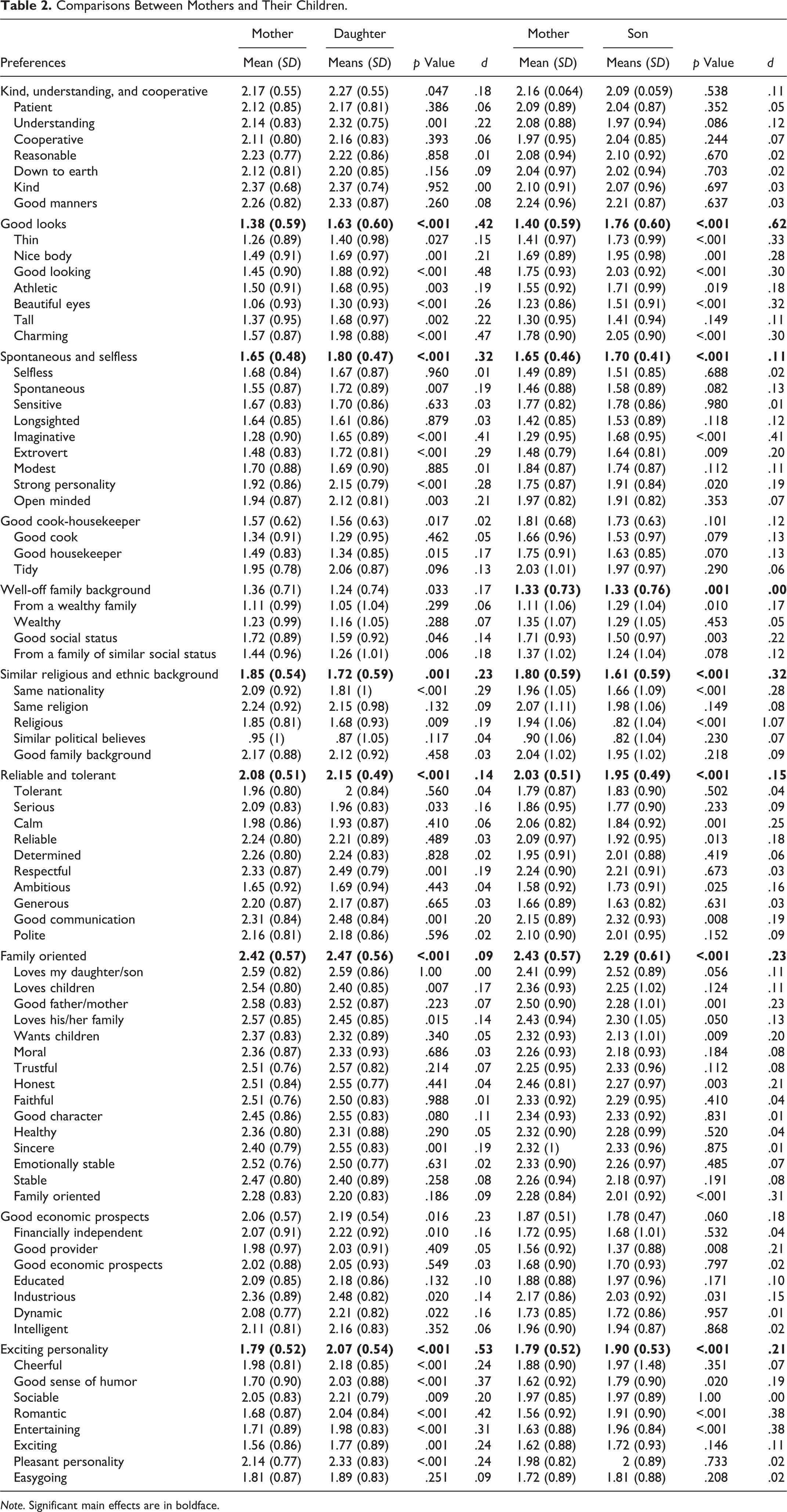
Note. Significant main effects are in boldface.
Comparisons Between Parents and Children for Traits Which Do Not Load in the Extracted Factors.

Note. Significant effects are in boldface.
Not all traits loaded in the extracted factors (i.e., have a factor loading above .300); however, we would like to know if there was agreement and disagreement in these as well. For this purpose, a series of paired-samples t-test was applied between the ratings that mothers and their children, and fathers and their children gave for each trait that did not load in any factor. The results are presented in Table 3.
Finally, in each case (i.e., mother–daughter, mother–son, father–daughter, father–son), 10 different tests (one for each domain) were performed for each comparison which is likely to inflate the α level. Accordingly, Bonferroni correction was applied to reduce α to .005 (.05/10). With respect to the comparisons of individual traits (Table 3), there are 13 comparisons in each case, so the α was reduced to .003 (.05/13 = .003).
Mothers Versus Children
With respect to mothers and daughters, Table 2 indicates that there was divergence in preferences over good looks, spontaneous and selfless, and exciting personality, with these being valued more by daughters in a spouse than by their mothers in a son-in-law. On the other hand, mothers placed more emphasis than their daughters on similar religious and ethnic background. For the “reliable and tolerant” and family oriented, there were differences that are not consistent to one direction. That is, certain constituent traits were preferred more by daughters while others more by their mothers. Also, for most of the constituent traits, significant differences were not found, indicating that there was not much disagreement between mothers and daughters. In addition, for good economic prospects, well-off family background, and good cook-housekeeper, there was agreement between mothers and daughters. Finally, from Table 3 we can see that “positive,” “energetic,” and “optimist” were preferred more by daughters in a husband than by their mothers in a son-in-law.
Similar results were found for mothers and sons. More specifically, good looks, spontaneous and selfless, and exciting personality were valued more by sons in a wife than by their mothers in a daughter-in-law. As in the case of daughters, mothers valued similar religious and ethnic background more in a daughter-in-law than their sons in a wife. In addition, for the “reliable and tolerant,” well-off family background, and family oriented, there were differences that were not consistent to one direction, whereas there was agreement for most traits that compose them. Furthermore, for good economic prospects and good cook-housekeeper, there was agreement between mothers and sons. Finally, from Table 3, we can see that “positive” is valued more by sons in a prospective mate than by their mothers in a daughter-in-law.
Fathers Versus Children
Regarding fathers and daughters, we can see from Table 4 that daughters considered good looks, spontaneous and selfless, kind, understanding and cooperative, exciting personality, “reliable and tolerant,” family oriented, and good economic prospects more important in a husband than their fathers did in a son-in-law. On the other hand, fathers considered more important the well-off family background in a son-in-law than their daughters did in a spouse. In addition, no significant differences were found for the similar religious and ethnic background and the good cook-housekeeper preferences. Finally, from Table 3, we can see that there were several traits such as “positive” and “sweet” which were preferred more by daughters in a spouse than by their fathers in a son-in-law.
Comparisons Between Fathers and Their Children.

Note. Significant main effects are in boldface.
With respect to fathers and sons, good looks and spontaneous and selfless were considered as more important by sons in a wife than by their fathers in a daughter-in-law. Similarly, daughters placed more emphasis in the good economic prospects of a prospective husband than their fathers in a prospective son-in-law. On the other hand, fathers considered well-off family background, good cook-housekeeper, and similar religious and ethnic background more important in a daughter-in-law than their sons did in a wife. Also, for the “reliable and tolerant” preference, there were differences that were not consistent to one direction, whereas there was an overlap for most traits that compose them. Finally, for the kind, understanding and cooperative, spontaneous and selfless, and family oriented, there were no significant differences.
Interaction Effects
We would like to examine whether parents disagree more with their daughters than with their sons or the reverse, that is, whether in-law and mate preferences diverge more between parents and daughter or the other way around. In different words, we would like to investigate whether there is an interaction effect between the role (i.e., parent–child) and the sex of the child. Toward this end, we repeated previous analysis by entering the sex of the child as the independent variable.
More specifically, doubly multivariate analysis was conducted for each of the 10 preferences, where role and sex of the child were entered as the independent variables, and the traits that composed each preference were entered as the dependent variables. The analysis was performed twice, once for mothers and children and once for fathers and children. No significant interaction effects were found for any of the comparisons.
Discussion
The results indicate that parents do not agree with their children over who might their ideal mate be. Disagreement is found in several traits, but it appears that it is centered on three broader domains of interest: good looks, personality, and family background.
To begin with, good looks were rated consistently more important by daughters and sons than by their mothers and fathers. Furthermore, both daughters and sons valued personality traits that make an individual pleasant to be with more than their parents. This is primarily reflected in the spontaneous and selfless and the exciting personality preferences. This appears also in traits such as positive, energetic, and optimistic, which did not load in any of the 10 domains, but they were preferred more by children in a spouse than by their parents in an in-law.
On the other hand, parents placed more emphasis on the family background of a prospective in-law than their children on that of a prospective spouse. Parents were predominantly concerned with their daughters- and sons-in-law coming from families, which have similar characteristics to their own family. Fathers also placed greater emphasis than their children on in-laws coming from well-off families.
The current research confirms previous findings that there is parent–offspring disagreement over good looks, and it identifies that this is the case for most of the traits associated with this domain. It further confirms that exciting personality is another area of disagreement, while it reveals that this disagreement is also found for the related spontaneous and selfless domain. In addition, previous research has identified good family background and similar religious background to be a key area of disagreement (Apostolou, 2008a, 2008b; Buunk et al., 2008; Perilloux et al., 2011). The present research finds that these traits constitute different facets of a preference for similarity over religious and ethnic background, which was preferred more in an in-law than in a spouse.
Finally, this research finds that for certain domains, there is disagreement, but the direction of the disagreement is different for its constituent traits. For instance, for the family oriented, children placed more emphasis on a spouse being sincere and honest than their parents on an in-law, but parents, mainly mothers, placed more emphasis on traits such as “loves his/her family.” This contradicts the finding of Apostolou et al. (2014), where it was found that this trait is valued more in an in-law than in a spouse. The Apostolou et al. study, however, asked parents to rate only the family-oriented trait without examining its constituent traits. This discrepancy in the findings suggests that in order to better understand disagreement, differences in the overall domains as well as in their constituent components must be considered.
The results indicate further that parent–offspring disagreement is not contingent on the sex of the child, that is, the disagreement between parents and their daughters is not stronger or weaker than the disagreement between parent and their sons. There is, however, still the possibility that fathers or mothers disagree more or less with their sons or with their daughters. In other words, there may be a three-way interaction between the role, the sex of the parent, and the sex of the child. The design of this study does not allow testing for this interaction, and future research needs to be pursued to examine if this is the case.
One of the strengths of this study is that it uses a relatively large sample to identify the domains of interest in mate and in-law choice. This, along with the fact that the extracted domains overlap considerably with the domains identified by previous research, provides us with some degree of confidence that these are the main domains of interest. Furthermore, this study examined individually all traits identified as important in a prospective spouse and in an in-law. As a consequence, it is unlikely that there is a major area of disagreement or agreement over in-law and mate choice that has not been identified here. Last but not least, this study is the first one to examine agreement and disagreement in the constituent traits of the extracted domains between parents and their actual children.
This work is not without limitations, one being that it is based on self-report data. Thus, when they have to actually exercise mate or in-law choice, individuals may exhibit different preferences than the ones they indicate here. Another limitation is that the design of Study 2 cannot distinguish between evolved predisposition effects and age and accumulated experience effects. In particular, when we compare parents and children, what changes between them is not only the role (i.e., parent vs. child) but also the age and life experience. For example, the evolutionary perspective predicts that different selection pressures have been exercised on in-law and mate preferences, with these diverging over good looks, a trait that is preferred more in a mate than in an in-law. Accordingly, the differences we observe in this research partially reflect evolved predisposition effects. Yet, as people age, they may have learned through life experience that beauty goes away and that it is not such an important trait in a partner after all. Since parents are older, they have more life experience, than their children, which adds to the observed effect. In other domains, however, the age and experience effect may be to the opposite direction of the evolved predisposition effect, and it can even mask it. This limitation can be addressed by employing a within-participants design, where individuals would rate traits both in a spouse and in an in-law.
The present research is also limited by the fact that it is confined to a single culture. The cultural context is likely to be influential on mate and in-law preferences (Apostolou, 2014b; Buss, 2003), which hints that parent–offspring disagreement is also likely to be affected by the specific cultural setting. Future research needs to replicate the study in different cultures, particularly in preindustrial ones, where mate choice is regulated.
Furthermore, participants in this research were recruited through a snowball sampling technique, which might be susceptible to nonrepresentativeness. For instance, participants were recruited predominantly in cities such as Nicosia. Consequently, traditional rural participants might be underrepresented. Future studies need to account for this limitation by employing a different sampling technique. In addition, the socioeconomic status of both parents and children is likely to have an effect on their in-law and mate preferences, respectively. In this study, socioeconomic variables were not measured, and future research needs to assess their impact on in-law and mate preferences. Last but not least, this study did not take into consideration participants’ sexual orientation. This can introduce a bias, as people with predominantly homosexual orientation may not give valid answers to questions about choosing spouses.
Mate choice is important, one reason being that it introduces a new member in the family unit, who will play a considerable role in its survival and reproduction. Given its importance, we expect that selection forces would have shaped the human mind to pay considerable attention to mate and in-law choice. This means that parent–offspring conflict over mating is not just another area of disagreement between parents and children, but it is a central area of disagreement. Progress in understanding this disagreement is likely to help in developing successful intervention programs that will aim to reduce intrafamily strife. Such interventions may enable, for instance, individuals to understand that their parents may react negatively to their mate choices because they have different preferences to them. It may also enable parents to understand that their children date individuals who do not comply with their preferences not as a reaction against their parents’ wishes, but because they have different preferences.
Overall, the present research has attempted to provide a comprehensive account of the domains and their facets over which there is disagreement between parents and their children with respect to the latter’s mate choices. Future work needs to replicate these findings in different samples and in different cultural settings. Future work needs also to employ these findings in developing interventions, which can improve intrafamily communication and reduce conflict between family members.
Footnotes
Acknowledgments
The author would like to thank Georgia Kapitsaki, Harald Euler, and the three anonymous reviewers for their constructive feedback which contributed to the improvement of this work.
Declaration of Conflicting Interests
The author(s) declared no potential conflicts of interest with respect to the research, authorship, and/or publication of this article.
Funding
The author(s) received no financial support for the research, authorship, and/or publication of this article.