



Abstract
Despite the fact that parents exercise considerable influence over their children's choice of a mate, little is known of their preferences for daughters- and sons-in-law, particularly in a post-industrial context. This research aims to close the gap in our knowledge by making a taxonomic contribution on the qualities desired in an in-law. In particular, parents have rated the desirability of 88 traits in a prospective daughter-in-law and a son-in-law; using principal components analysis, these traits have been classified into 11 broader in-law preferences. On the basis of this classification, four hypotheses were tested: First, parents ascribe different weights to different traits; second, parental preferences are contingent upon the sex of the in-law (i.e., certain traits are valued differently in a son- and in a daughter-in-law); third, parents have a preference for assortative mating (i.e., they want their prospective in-laws and their families to be similar to them); and fourth, in-law preferences are independent of the sex of the parent (i.e., mothers and fathers are in agreement with respect to what qualities they seek in a spouse for their children). The results from two independent studies provide support for the first three hypotheses, but little support for the fourth hypothesis.
Keywords
Introduction
Across human societies, parents exercise considerable influence over their children's mate choices (Blood, 1972; Stephens, 1963). In pre-industrial societies, the most common mode of long-term mating is the arranged marriage, where parents choose spouses for their daughters and sons (Apostolou, 2007b, 2010b). In post-industrial societies, parents have an active interest in influencing their children's mating decisions, and they employ a range of manipulation tactics to achieve this goal (Apostolou, 2011b; Ikels, 1985; Sussman, 1953). The strong parental influence over mating across cultures raises the question of what qualities parents prefer in a prospective son-in-law and daughter-in-law. This paper aims to address this question, and the first step towards doing so is to explore the evolutionary logic of in-law preferences.
The evolution of in-law preferences
Parents and children are genetically related but not genetically identical, which means that their genetic interests overlap, but also diverge (Trivers, 1974). This results in conflict between the two, one example being mate choice (Apostolou, 2007a; Trivers, 1974). The conflict comes about because several traits in a mating candidate give unequal benefits to parents and to their children. A good example of this is genetic quality: Individuals are more closely related to their children than to their grandchildren and consequently they gain (or lose) more if their spouse, rather than their child-in-law, is of good (or poor) genetic quality (Apostolou, 2008; Buunk, Park and Dubbs, 2008). That is, a mate of poor genetic quality will be costly to individuals as the chances of survival and reproduction of their children are compromised, but it will be less costly to their parents whose genetic interests are vested less to their grandchildren. Thus, individuals reap more genetic benefits from a spouse than from an in-law of superior genetic quality (Apostolou, 2008; Buunk et al., 2008; Perilloux, Fleischman and Buss, 2011).
In effect, the ideal spouse for children is not always the ideal in-law for their parents (Apostolou, 2008). Consequently, the former's mate choices induce a cost to the latter in the form of losses in desirable traits in an in-law (Apostolou, 2008; Buunk, et al., 2008). This gives the incentive to parents to control the mate choices of their children and choose sons- and daughters-in-law who best promote their interests. Across human pre-industrial societies parents are successful in doing so, with arranged marriage, where parents choose spouses for their children, being the primary mode of long-term mating (Broude and Green, 1983; Minturn, Grosse and Haider, 1969; Stephens, 1963).
As modern pre-industrial societies resemble ancestral ones, these patterns of mating were most likely present during the greatest part of human evolution (Apostolou, 2010b; Lee and DeVore, 1968), a hypothesis that is supported by phylogenetic (Walker, Hill, Flinn, and Ellsworth, 2011) and historical evidence (Apostolou, 2012). This indicates that throughout human evolution, parents recurrently faced the problem of choosing mates for their children. Therefore, selection pressures have been exercised on parents to evolve preferences to guide this choice.
More specifically, as not all prospective in-laws are the same (e.g., some are hard-working whereas others are lazy), they differ in the benefits they can provide to parents. Thus, parents who have predispositions that enable them to prefer in-laws who are beneficial to them gain a selective advantage over parents who lack such predispositions and choose randomly (they are, for instance, just as likely to choose an industrious in-law as a lazy one). Consequently, the former should have replaced the latter, giving rise to a population of parents with well-defined in-law preferences (Apostolou, 2007a).
A number of studies of pre-industrial societies offer some information about the traits that parents desire in a prospective spouse for their children. In particular, Borgerhoff Mulder (1988) reported that among the pastoral Kipsigies in Kenya, parents prefer as sons-in-law individuals who enjoy high social status, are wealthy, educated, have good character, and are industrious. Yu, Proulx, and Shepard (2007) found that Matsigenka women in Peru prefer men with masculine faces for sons-in-law and interpreted this finding as a preference for good providers, as masculine men are, in general, perceived to be better resource providers. Koster (2011) reported that among the Miskito foragers in Nicaragua, parents desire hunting ability and wealth in a prospective son-in-law. Finally, Apostolou (2007b) found that among foragers, parents prefer sons-in-law who are good hunters and have a good family background, and they prefer daughters-in-law who are industrious and come from good families. These studies, however, aim to study mating patterns in general rather than in-law preferences in particular, so they do not provide a comprehensive exploration of in-law preferences.
A study that was specifically designed to examine in-law preferences coded anthropological evidence from a sample of 67 pre-industrial societies, and identified 13 traits that parents desired in a prospective daughter- and son-in-law (Apostolou, 2010a). The most frequently reported traits were good character, good family background, and industriousness. However, a limitation of this study is that it did not offer a taxonomy of in-law preferences, but rather listed desirable qualities.
Moreover, in-law preferences are contingent upon the subsistence type of a given society (Apostolou, 2010a). This is because prevailing conditions are different in each society type, which is likely to have an impact on in-law preferences. For instance, post-industrial societies are technology based, thus education is something that would be valued in a prospective in-law. However, this is unlikely to be the case, for example, among hunters and gatherers. Accordingly, the findings from pre-industrial societies cannot readily be applied to post-industrial societies.
Thus, in order to examine in-law preferences in a post-industrial context, one study asked a sample of British parents to rate a set of traits in a prospective son- and daughter-in-law (Apostolou, 2007a). It was found that parents have a hierarchy of preferences in which certain traits, such as good character, were considered more important than others. Another study, originally designed to explore parent-offspring conflict over mating, produced similar results in an American sample (Perilloux, Fleischman, and Buss, 2011). To measure in-law preferences, these studies used instruments that were originally designed to measure mate preferences. However, parents may desire qualities in a prospective in-law that their children do not desire in a mate. Therefore, attempting to measure in-law preferences with such instruments is problematic as these may not be able to capture the full range of the qualities desired in an in-law.
To account for this limitation, another study employed an open-ended approach and asked parents to indicate several traits they preferred in prospective spouses for their daughters and sons (Apostolou, 2011a). In this way, parents were not constrained in which preferences to report. Overall, 88 desirable traits were identified, but no attempt was made for these to be classified in broader preference categories. This is necessary, however, because many of these traits (e.g., beautiful eyes, nice body) clearly reflect more fundamental preferences (i.e., a preference for good looks).
In sum, previous studies have identified several traits that parents desire in a daughter- and son-in-law. What is lacking in the literature is for these traits to be classified in more fundamental in-law preference categories. The primary purpose of this research is to undertake this task; that is, to make a taxonomic contribution. Based on the derived taxonomy, this research further aims to test several hypotheses.
Hypotheses on in-law preferences
Prospective sons- or daughters-in-law differ in their qualities, but their qualities also differ with respect to how beneficial they are to parents. Thus, it is hypothesized that parents should assign greater weight to traits that give them more benefits than to traits that give them fewer benefits (Apostolou, 2007a). For instance, a hard-working son- or daughter-in-law is more beneficial to parents than, for example, an in-law who is good at keeping the house clean and tidy. This is because the former constitutes a reliable source of resources that are necessary for survival and reproduction, and are more important than a tidy household. Consequently, industriousness should be considered more important than housekeeping abilities. Overall, parents are predicted to have a well-defined hierarchy of preferences, with certain traits being preferred more than others.
Furthermore, men and women have different evolutionary problems to solve, and so they have evolved to be biologically different (Buss, 2003). For instance, women invest more in their offspring than men and, thus, become a scarce reproductive resource (Trivers, 1972). As a consequence, men strive to gain access to women and tend to monopolize resources that can be used for this purpose (Buss, 2003). Consequently, wealth across cultures is usually controlled by men (Whyte, 1978). On the other hand, women have to bear the costs of pregnancy and nursing their children, so they need to divert their efforts in looking after their family and household. In effect, across cultures, they are primarily responsible for their children and for the household chores (Whyte, 1978).
Accordingly, from an evolutionary perspective, it is not beneficial to prefer housekeeping abilities in a son-in-law, but it is beneficial to prefer them in a daughter-in-law. Similarly, it is beneficial to look for wealth in a son-in-law, but it is not as beneficial in a daughter-in-law (since wealth is predominantly controlled by men). Based on the aforementioned, the second hypothesis to be tested is that if a trait's benefit to parents is contingent on the sex of the in-law, it should be preferred differently in sons- and daughters-in-law.
In addition, in-law traits are, on average, expected to provide equal benefits for mothers and fathers. For instance, as mothers and fathers are equally genetically related with their grandchildren, an in-law of good genetic quality will be equally beneficial to both parents. Therefore, the third hypothesis to be tested is that in-law preferences are independent of the sex of the parent (Apostolou, 2007a).
Finally, several studies have found that people prefer as mates individuals who are similar to them in several dimensions (see McCrae et al., 2008 for a review). One reason for this is that assortative mating promotes a more stable marital union and better communication between parents and their in-laws (Buss, 2003). For similar reasons, a preference for similarity is also expected in in-law choice. For instance, if parents have a son-in-law who is not as religious as they are or who has different political beliefs than they have, this would result in communication difficulties and conflict. Accordingly, the fourth hypothesis to be tested is that parents have a preference for assortative in-law choice, that is, they would prefer in-laws who are similar to them on a number of dimensions.
Study 1
Materials and Methods
Participants. Three research assistants were employed for the purposes of this study. They recruited individuals who volunteered to participate in a study on family relationships (no payment was given). A snowball sampling technique was used, where the research assistants first recruited several parents and then obtained references for other parents who may be interested in participating in the study. The data collection process lasted approximately 2 months. To qualify for participation, an individual had to have at least one child. This study did not employ couples (i.e., fathers and mothers came from different families). The participants were initially asked to sign a consent form, and then they were given the survey. Upon completion, the participants put the questionnaire in an unmarked enveloped and sealed it.
The research assistants initially recruited 197 participants, and overall 621 Greek-Cypriots took part (347 women, 274 men). The mean age of mothers was 43.4 years (SD = 10.7), and the mean age of fathers was 45.7 years (SD = 11.6). Participants had a mean of 1.3 (SD = 0.7) male children and a mean of 1.2 (SD = 0.6) female children. The mean age of the oldest female child was 16.9 years (SD = 11.5) and the mean age of the oldest male child was 18.2 years (SD = 11.8). Moreover, 83.1% of the participants were married, 9.2% were divorced, 3.1% were widowed, 2.6% were single, and 1.8% were in a relationship.
Materials. The survey had two parts. In the first part, demographic information was collected: sex, age, marital status, number of daughters and sons, ages of the oldest male child and the oldest female child. Participants were also asked to indicate the highest level of education that they had completed (primary school, high school, university degree, postgraduate degree), and how wealthy they considered themselves to be using a seven-point Likert scale (1–very poor, 7–very wealthy).
In the second part, participants were asked to rate how desirable they considered a set of traits to be in a son-in-law and in a daughter-in-law using a four-point Likert scale (0-unimportant, 1-somehow important, 2-important, 3-indispensable). The instrument employed to measure in-law preferences consisted of 86 traits (e.g., family oriented, selfless) that have been identified by Apostolou (2011a), and two additional traits that have been identified by ethnographic research (Apostolou, 2010a): “wealthy family background,” and “from a family of similar social status.” The order of presentation (son-in-law, daughter-in-law) was counterbalanced across participants. Finally, the participants were asked to indicate their in-law preferences for both a son- and a daughter in-law, irrespectively of the sex of their children.
Results
In order to classify traits in broader preference categories, principal components analysis for factor extraction and direct oblimin as the rotation method were used. Direct oblimin method was chosen because the assumption of non-correlated preferences is unlikely to hold. Principal components analysis was applied separately to the ratings that participants gave to a daughter-in-law and to a son-in-law. The results suggested an 11-factor solution (eigenvalue > 1) that was robust across the two in-laws. Traits that had a loading of less than .30 to a given factor were dropped, and 48 traits were carried on to subsequent analyses (see Table 1).
In-law preferences structure for sons- and daughters-in-law

The scales produced by this procedure were checked by means of reliability analysis (Cronbach's alpha). For the son-in-law, the internal consistency (Cronbach's alpha) ranged from .74 to .90, with a mean of .81. For the daughter-in-law, the internal consistency (Cronbach's alpha) ranged from .65 to .88, with a mean of .82.
In-law preferences. In order to identify which traits are considered more important, 11 composites were computed for every in-law preference dimension shown in Table 1. More specifically, each composite was estimated by summing up the scores for each constituent trait, and then dividing the total by their number. Following that, means and standard deviations were computed for each of the 11 composites.
The results are presented in Table 2, indicating that it is most important to parents that their prospective in-laws be “family oriented.” That is, they want their in-laws to love children and to want to have a family. Traits that enable a new family unit to be established and maintained also load highly on this preference. In particular, parents want their prospective in-laws to love their daughters and sons, and to be honest and faithful to them.
The hierarchy of daughter-in-law and son-in-law preferences for Study 1
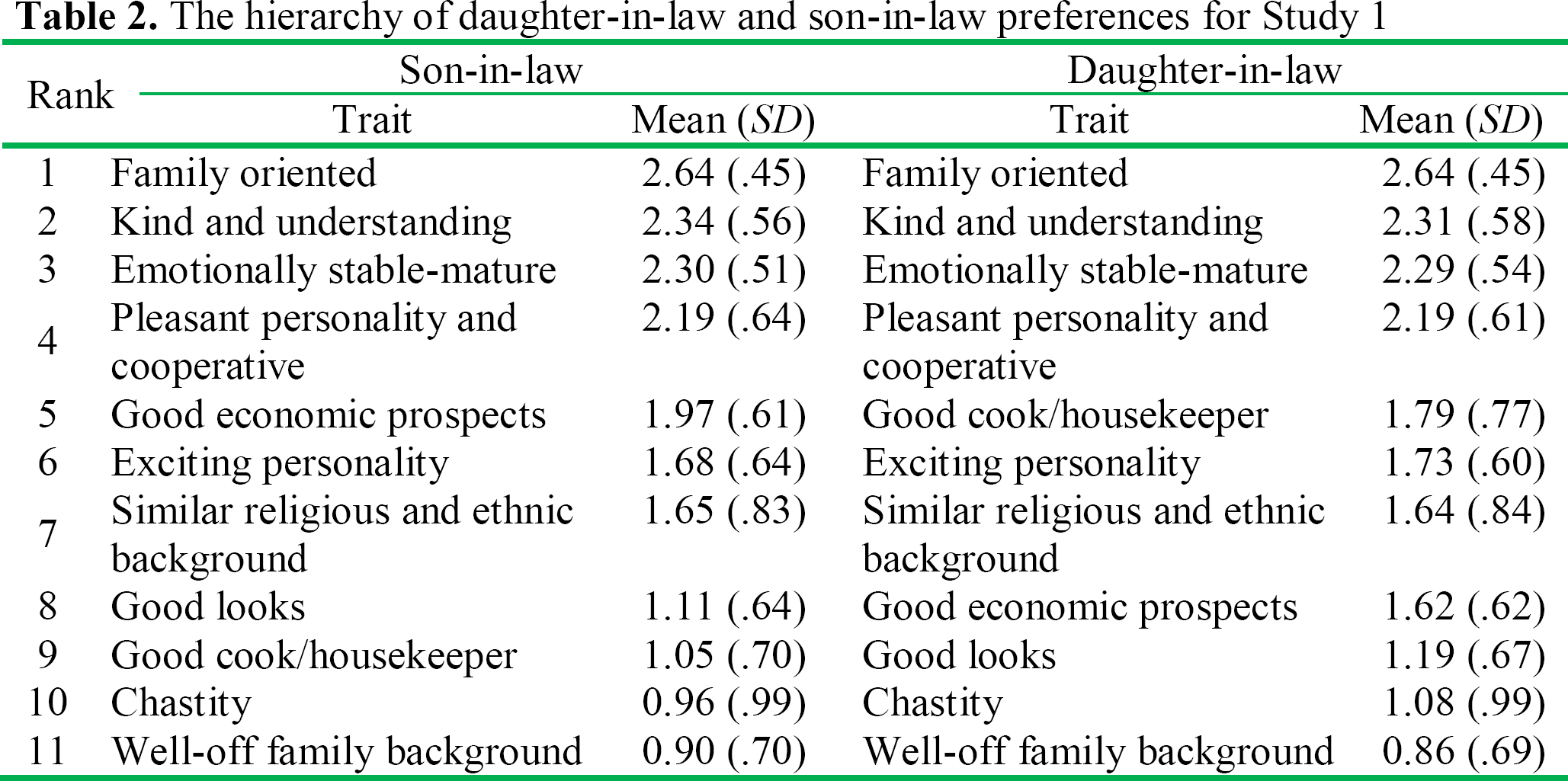
Second most important is being “kind and understanding,” while third most important is emotional stability and maturity, a preference which incorporates being modest, tolerant, and respectful. It is also quite important for parents that their in-laws are “pleasant and cooperative.” Moreover, of considerable importance are “good economic prospects,” especially for a prospective son-in-law. To be a “good housekeeper and a good cook” is also considered important, but only for a prospective daughter-in-law.
Having an “exciting personality,” a preference that includes traits such as being spontaneous, easygoing, sweet and extrovert, is moderately important to parents. Having an in-law of a “similar religious and ethnic background” is moderately important to parents. Note that being religious and coming from a good family background constitute two facets of this preference.
Of lower importance to parents are the “good looks” of their prospective in-laws, a facet of which is being charming. Similarly, parents do not place much emphasis on their in-laws having few sexual experiences before marriage. Last in the parents' hierarchy is a preference for in-laws who come from a “wealthy family background” and are themselves wealthy. This dimension also has an assortative mating component, as it includes a preference for in-laws who come from a family of similar social status and hold similar political beliefs.
Daughter-in-law vs. son-in-law. In order to examine whether preferences are dependent on the sex of the in-law, a doubly multivariate analysis (which is statistically equivalent to repeated measures MANOVA) was conducted for each of the 11 in-law preferences. In each comparison, the sex of the in-law was entered as the independent variable, and the traits that composed each preference as the dependent variables. As there were multiple comparisons involved, Bonferroni correction for alpha inflation was applied and the alpha level was set to .004 (.05/11). The results are presented in Table 3.
Differences in preference between sons- and daughters-in-law

From this table we can see that “good looks” and “good housekeeping” abilities are traits that are considered to be significantly more important in a daughter-in-law than in a son-in-law. On the other hand, parents ascribe more importance to “good economic prospects” for their prospective son-in-law than for their daughter-in-law. Finally, “chastity” is preferred more in a daughter-in-law than in a son-in-law, but this difference does not pass the Bonferroni adjusted significance level (p = .006).
Mothers vs. fathers. To examine whether mothers are in agreement with fathers over what they want in an in-law, a series of MANOVAs was applied with the constituent traits of each preference entered as the dependent variables, and the sex of the parent entered as the independent variable. As before, the alpha level was set to .004. The results are presented in Table 4.
Differences in preference between mothers and fathers

From this table we can see that mothers consider “pleasant and cooperative” and “exciting personality” more important in a son-in-law than fathers, while they consider “family oriented,” “good economic prospects,” “emotionally stable and mature,” and “kind and understanding” to be more important in both a son- and daughter-in-law than fathers.
Wealth and education. In order to examine assortative mating with respect to wealth, participants' perception of their own wealth status was regressed on the wealth trait (part of the well-off family preference). The results indicate that the wealthier the participants perceived themselves to be, the more important they considered it for their prospective son-in-law (p = .02) and daughter-in-law (p = .02) to be wealthy.
With respect to education, a one-way ANOVA was applied with the rating participants gave for education in a prospective in-law as the dependent variable and participants' education as the independent variable. Participants' level of education was not significant for either a son-in-law or a daughter-in-law.
Exploring further contingencies. Although we did not have specific hypotheses, we would like to investigate whether the sex, age, and number of children parents have affect in-law preferences. For this purpose, a series of ANCOVAs was performed, with each of the 11 preference composites for each in-law entered as the dependent variable and the number of children, the age of children group (< 1–9, 10–17, and 18 < years old), and the sex of children (female, both female and male, and male) entered as the independent variables. The parents' age of was entered as a covariate. A backward elimination method was used to reach the final model. Overall, the analysis included 22 comparisons (11 traits for each in-law), so Bonferroni correction for alpha inflation was applied and the alpha level was set to .002 (.05/22).
The results indicate a significant main effect of the age of children on “chastity” for a son-in-law [F(2,580) = 12.50, p < .001, ηp2 = .041], with parents with adult children (18< years) indicating a higher preference than the rest. Also, there was a significant effect of the number of children on the “similar religious and ethnic background” for a daughter-in-law [F(1,591) = 14.04, p < .001, ηp2 = .023], with a positive coefficient (.143) indicating that parents with more children place more emphasis on this trait.
Study 2
Study 2 attempts to replicate the findings of Study 1 using a new instrument that is based on the 11 identified in-law preference dimensions.
Materials and Methods
Participants. Study 2 followed the recruitment procedure of Study 1, and the data collection lasted approximately 3 months. Initially, the research assistants recruited 86 participants, and overall 355 Greek-Cypriots took part (181 women, 174 men). The mean age of mothers was 46.2 years (SD = 7.7), and the mean age of fathers was 48.9 years (SD = 8.6). Participants had a mean of 1.2 (SD = 0.8) male children and a mean of 1.3 (SD = 0.9) female children. The mean age of the oldest female child was 20.1 years (SD = 9.7), and the mean age of the oldest male child was 19.9 years (SD = 9.6). Moreover, 92.4% of the participants were married, 5.4% were divorced, 2% were widowed, and 0.3% were in a relationship.
Materials. The survey had two parts. In the first part, demographic information was collected: sex, age, marital status, number of daughters and sons, and ages of the oldest male child and the oldest female child. Moreover, participants were asked to indicate the highest level of education that they had completed (primary school, high school, university degree, post-graduate degree), and how wealthy they considered themselves to be using a seven-point Likert scale (1–very poor, 7–very wealthy).
In the second part, participants were asked to rate how desirable they considered a set of traits to be in a son-in-law and in a daughter-in-law using a four-point Likert scale (0-unimportant, 1-somehow important, 2-important, 3-indispensable). The instrument employed to measure in-law preferences consisted of the 11 preferences identified in Study 1. The order of presentation (son-in-law, daughter-in-law) was counterbalanced across participants. Finally, the participants were asked to indicate their preferences for a son-in-law, only if they had a daughter and for a daughter-in-law only if they had a son.
Results
In-law preferences. Means and standard deviations for each preference were calculated for a son- and a daughter-in-law, and the results are presented in Table 5. Similar to the results obtained in Study 1, the traits “emotionally stable-mature,” “family oriented,” and “kind and understanding” top parental preferences. Moreover, traits such as “similar religious and ethnic background” and “good economic prospects” are found at the middle of the hierarchy, while traits such as “good looks” and “chastity” are found at the bottom of the hierarchy.
The hierarchy of daughter-in-law and son-in-law preferences for Study 2

Daughter-in-law vs. son-in-law. In order to examine whether preferences are dependent on the sex of the in-law, a series of paired-samples t-tests was conducted between the rating that parents gave for a son- and for a daughter-in-law for each of the 11 in-law preferences. As there were multiple comparisons involved, Bonferroni correction for alpha inflation was applied and the alpha level was set to .004 (.05/11). The results are presented in Table 6.
Differences in preference between sons- and daughters-in-law and between fathers and mothers for Study 2

From this table we can see that good looks and good housekeeping abilities are considered to be more important in a daughter-in-law than in a son-in-law. On the other hand, parents consider good economic prospects and exciting personality to be more important for their prospective son-in-law than for their daughter-in-law.
Mothers vs. fathers. To examine whether mothers are in agreement with fathers over what qualities they seek in an in-law, a series independent-samples t-tests was applied between the ratings that male and female participants gave for each trait. As before, the alpha level was set to .004. The results are presented in Table 6.
From this table we can see that mothers considered “pleasant and cooperative,” “family oriented,” “exciting personality,” “emotionally stable-mature,” and “kind and understanding” to be more important in a son-in-law than fathers. In addition, they considered “pleasant personality and cooperative,” “family oriented,” and “kind and understanding” to be more important in a daughter-in-law than fathers.
Wealth and education. In order to examine assortative mating with respect to wealth, participants' perception of their own wealth status was regressed on the well-off family trait. The results indicate that the wealthier the participants perceived themselves to be, the more important they considered it for their prospective son-in-law (p < .001) and daughter-in-law (p = .02) to be wealthy.
With respect to education, a one-way ANOVA was conducted with the ratings that participants gave for the “good economic prospects” (as being educated loads to this factor, see Study 1) in a prospective in-law as the dependent variable and participants' education as the independent variable. Participants' educational level was not significant for either a son-in-law or a daughter-in-law. We have to be careful interpreting this result though, as some participants may not have education in mind when they rate good economic prospects.
Exploring further contingencies. Although we did not have specific hypotheses, we would like to investigate whether the age and the number of children affect in-law preferences. For this purpose a series of ANCOVAs was performed, with each of the 11 preferences for each in-law entered as the dependent variable and the number of children, the age of children group (< 1–9, 10–17, 18 < years old) entered as independent variables. In addition, the age of parents was entered as a covariate. A backward elimination method was used to reach the final model. Overall, the analysis included 22 comparisons (11 traits for each in-law) thus, Bonferroni correction for alpha inflation was applied and the alpha level was set to .002 (.05/22). The results did not indicate any significant effects.
Discussion
Previous research has identified several traits that parents desire in an in-law (Apostolou, 2011a). On the basis of these traits, the present research has identified 11 fundamental dimensions of in-law preferences. Some of these dimensions are similar to the ones that have been identified in research on mate preferences (e.g., good looks); however, “family oriented,” “pleasant personality,” and “well-off family background” are dimensions which have been identified here for the first time.
The results indicate that the most important dimension for parents is personality, as 5 of the 11 preferences refer to personality traits, namely “family oriented,” “kind and understanding,” “emotionally stable-mature,” “pleasant personality and cooperative,” and “exciting personality,” with the first two topping the hierarchy of parental preferences. This is not surprising given that personality correlates with many aspects of human conduct that are of interest to parents.
More specifically, having an in-law who has traits such as kindness and emotional stability increases the probability that this individual will not harm, abandon, or stop providing for parents, children, and grandchildren, in effect ensuring a more beneficial, harmonious, and long-lasting marriage. Furthermore, such personality traits facilitate cooperation and, thus, the exchange of resources between the parties involved in the marriage. Finally, personality is a strong predictor of career success and, as a result, of the provision of resources, which is highly valued by parents (Apostolou, 2010a).
With regard to the preference for resources provision, this is a key factor for the survival and success of the family unit. It seems, however, that parents are primarily interested in the resource-generating capacity of their in-laws rather than in the resources they currently control. One reason for this is that wealth can be easily spent or lost, but resource-generating abilities constitute a more reliable source of resources (Buss, 2003).
Furthermore, previous research indicates that parents have a strong interest in the good family background of their prospective in-laws (e.g., Apostolou, 2010a). This is also confirmed here, as 2 of the 11 preferences are directly related to a prospective in-law's family background, namely “similar religious and ethnic background” and “well-off family background.”
Good family background is a rather broad term, and this analysis sheds some light on what parents mean by it. In particular, good family background loads in the same factor with items such as “similar religious background” and “similar ethnic background,” indicating that part of what parents see as a good family background is for a family to be similar to them, at least in specific dimensions. A preference for assortative mating for family background is also explicitly reflected in the desire for an in-law who comes from a family of similar social status.
Moreover, the strong preference that parents exhibit for having an in-law who is family oriented indicates that parents follow a long-term reproductive strategy; that is, they look for mates for their children who are likely to make a long-term commitment to the relationship. However, this can conflict with the short-term strategy that children sometimes follow. For instance, children may seek casual sex, paying little attention to whether their mates are family oriented — a choice that will not meet the approval of their parents (see Apostolou and Georgiou, 2011).
As opposed to the original hypothesis, several traits were found to be preferred differently by mothers and by fathers. In particular, where a difference was found, traits were weighted as more important by mothers than by fathers. Previous research did not find such an effect (i.e., Apostolou, 2007a, but see Dubbs and Buunk, 2010), and further replication is needed. Assuming that this effect is real, what can account for it?
One possible explanation has to do with parental uncertainty. More specifically, fathers, as opposed to mothers, are less certain that their daughters and sons are actually their own. Accordingly, mothers may have a stronger interest in the welfare of their children and their grandchildren than fathers who are not as certain that they are their own. Consequently, mothers may be less willing than fathers to make compromises on traits that affect the wellbeing of their children and grandchildren such as “kind and understanding,” “emotionally stable-mature,” and “family oriented.” Therefore, mothers may ascribe more weight to these traits than fathers.
One limitation of this study is that it is based on self-report data, which can potentially introduce a number of biases such as overrating or underrating certain traits. For instance, parents may be more interested in having a wealthy individual from a wealthy family as an in-law than they are willing to admit. Another limitation is that this research is based on a single culture, and given that parental preferences are contingent upon the cultural context (Apostolou, 2010a), we expect differences in in-law preferences to be present across different post-industrial societies.
For instance, Greek-Cypriot people are very religious (Mallinson, 2008); thus, it is not surprising that they consider it important to have an in-law who is religious and who has the same religious beliefs as they have. However, if this study was to be replicated in the UK, where people are less religious (Paxman, 2000), we would expect to get different results. Overall, if it is indeed the case that parents share the same set of fundamental preferences, the weights of which are adjusted to local conditions, the factor structure obtained here will most likely be stable across different post-industrial contexts, but certain differences in the hierarchy of preferences are expected. Future research should attempt to explore the impact of different post-industrial cultural contexts on in-law preferences.
In addition, the samples in both studies were broad in the sense that the only requirement was for participants to be parents (i.e., to have at least one child). This is based on the assumption that once individuals have children, they start thinking as parents. Still, there are limitations as this inevitably involves participants with young children rating traits for prospective in-laws. Future studies may attempt to replicate these findings by employing parents who have only adult daughters and sons.
Last but not least, the nature of the sampling method (i.e., snowball sampling) is unlikely to have resulted in a representative sample. Still, given the size of the sample and that different research assistants were used, the characteristics of participants in the sample are unlikely to be very different for the characteristics of people in the general population; so, most probably this bias did not considerably affect the produced factor structure. Nonetheless, future studies need to replicate these findings in different populations using different sampling techniques.
To summarize, this is the first study that attempts to classify desirable traits into more fundamental in-law preferences. On the basis of these results, it can be argued that the 88 or so different traits that have been identified by previous research constitute different facets of 11 more fundamental in-law preferences.
Footnotes
Acknowledgements
The author would like to thank the editor Harald Euler and three anonymous reviewers for their constructive criticisms and comments that enabled the improvement of this work.
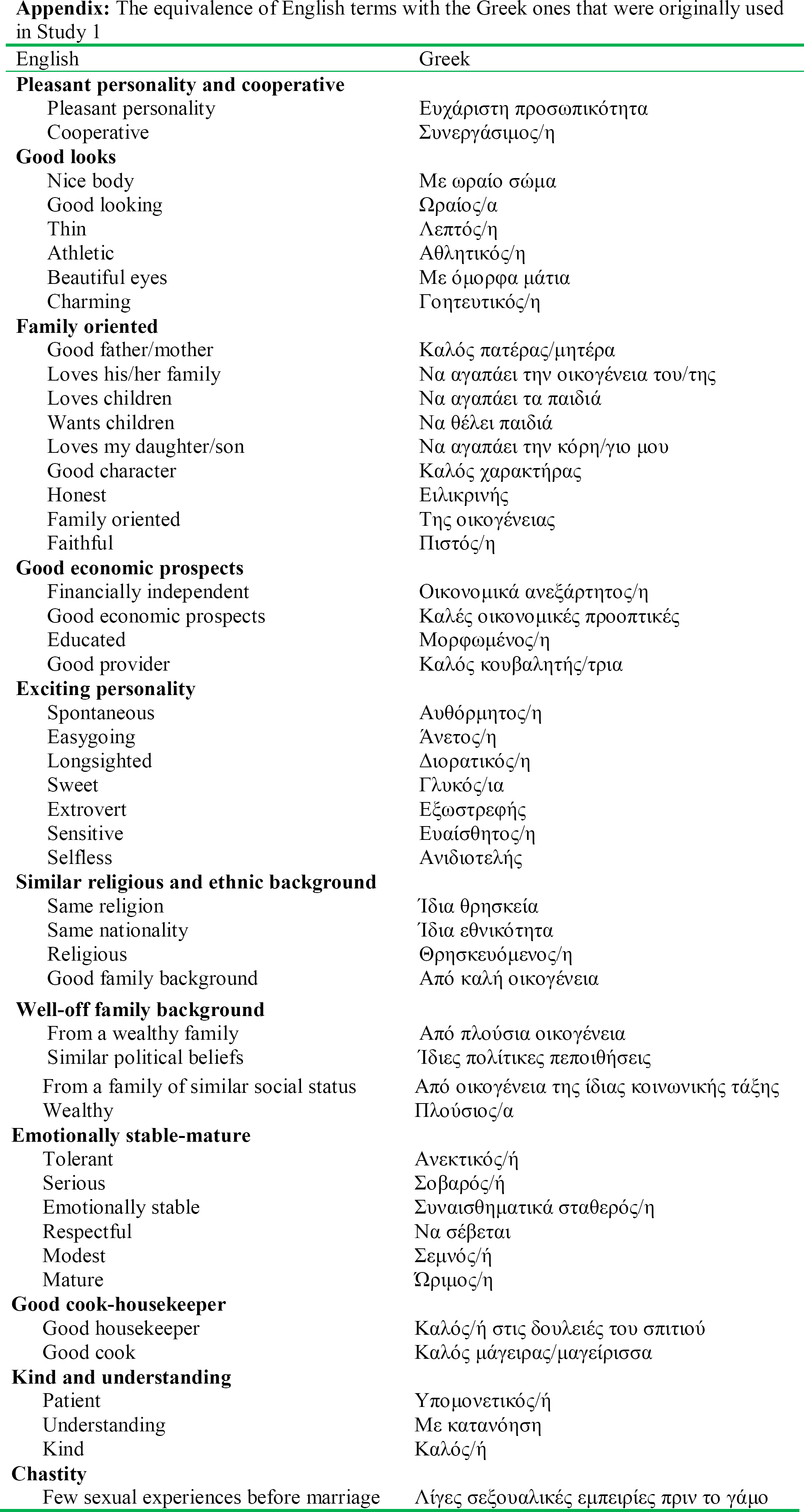
The equivalence of English terms with the Greek ones that were originally used in Study 1
| English | Greek |
|---|---|
|
|
|
| Pleasant personality | Ευχάριστη προσωπικότητα |
| Cooperative | Συνεργάσιμος/η |
|
|
|
| Nice body | Με ωραίο σώμα |
| Good looking | Ωραίος/α |
| Thin | Λεπτός/η |
| Athletic | Αθλητικός/η |
| Beautiful eyes | Με όμορφα μάτια |
| Charming | Γοητευτικός/η |
|
|
|
| Good father/mother | Καλός πατέρας/μητέρα |
| Loves his/her family | Να αγαπάει την οικογένεια του/της |
| Loves children | Να αγαπάει τα παιδιά |
| Wants children | Να θέλει παιδιά |
| Loves my daughter/son | Να αγαπάει την κόρη/γιο μου |
| Good character | Καλός χαρακτήρας |
| Honest | Ειλικρινής |
| Family oriented | Της οικογένειας |
| Faithful | Πιστός/η |
|
|
|
| Financially independent | Οικονομικά ανεξάρτητος/η |
| Good economic prospects | Καλές οικονομικές προοπτικές |
| Educated | Μορφωμένος/η |
| Good provider | Καλός κουβαλητής/τρια |
|
|
|
| Spontaneous | Αυθόρμητος/η |
| Easygoing | Άνετος/η |
| Longsighted | Διορατικός/η |
| Sweet | Γλυκός/ια |
| Extrovert | Εξωστρεφής |
| Sensitive | Ευαίσθητος/η |
| Selfless | Ανιδιοτελής |
|
|
|
| Same religion | Ίδια θρησκεία |
| Same nationality | Ίδια εθνικότητα |
| Religious | Θρησκευόμενος/η |
| Good family background | Από καλή οικογένεια |
|
|
|
| From a wealthy family | Από πλούσια οικογένεια |
| Similar political beliefs | Ίδιες πολίτικες πεποιθήσεις |
| From a family of similar social status | Από οικογένεια της ίδιας κοινωνικής τάξης |
| Wealthy | Πλούσιος/α |
|
|
|
| Tolerant | Ανεκτικός/ή |
| Serious | Σοβαρός/ή |
| Emotionally stable | Συναισθηματικά σταθερός/η |
| Respectful | Να σέβεται |
| Modest | Σεμνός/ή |
| Mature | Ώριμος/η |
|
|
|
| Good housekeeper | Καλός/ή στις δουλειές του σπιτιού |
| Good cook | Καλός μάγειρας/μαγείρισσα |
|
|
|
| Patient | Υπομονετικός/ή |
| Understanding | Με κατανόηση |
| Kind | Καλός/ή |
|
|
|
| Few sexual experiences before marriage | Λίγες σεξουαλικές εμπειρίες πριν το γάμο |