



Abstract
A large number of studies have assessed human mate preferences using lists of characteristics. To date, there is little data regarding mate preferences in Iran. The present study aimed to investigate dimensions in mate preferences among Iranian women and to validate a female-specific instrument in Iranian context. Three studies were designed and conducted. The first study was an interview-based qualitative analysis of women’s mate preferences. The second study provided a psychometrically sound list of 26 characteristics in a potential mate. The third study confirmed the five-factor structure of the instrument. In sum, five dimensions of mate preferences among Iranian women are kindness/dependability, status/resources, attractiveness/sexuality, religiosity/chastity, and education/intelligence, as measured by the newly developed 26-item scale.
Keywords
In past few decades, a large number of empirical studies have investigated the characteristics that humans prefer in a potential mate (Buss, 1998; Candolin, 2003; Eastwick, Luchies, Finkel, & Hunt, 2014; Okami & Shackelford, 2001; Shackelford, Schmitt, & Buss, 2005). There are several differences in long- and short-term relationships (Li & Kenrick, 2006) as well as gender differences. Buss (1985) noted two major gender differences regarding mate preferences, indicating that women are more concerned with a potential partner’s earning ability while men are more interested in physical characteristics, such as potential partner’s attractiveness and cues for fertility. Therefore, it is crucial to consider gender differences in examining human mate preferences (Buss, 1989), which have been confirmed across different cultures and methodologies (Buss et al., 1990; Buss, Shackelford, Kirkpatrick, & Larsen, 2001; Li, Valentine, & Patel, 2011; McGinnis, 1958; Wiederman & Allgeier, 1992). Moreover, there are a number of female-specific variables that can alter mate preferences (cf., Frederick, Reynolds, & Fisher, 2013). For example, it has been shown that mate preferences may vary according to menstrual cycle (Gangestad, Garver-Apgar, & Simpson, 2007; Pillsworth, Haselton, & Buss, 2004). There are also some similarities between genders regarding mate preferences. For instance, both women and men value characteristics such as “good disposition,” “emotional stability,” and “kind and understanding” (Buss, 1989).
Mate preferences among females vary by culture (Buss, 1989). Yet, a number of studies have suggested the most important factors in a potential mate for a female. Furnham (2009) asked young people to rate 14 desirable factors under five broader categories (ability, personality, physical, social, and values). Females rated intelligence, stability, conscientiousness, height, education, social skills, political compatibility, and religious similarity significantly higher than males. A study in India also suggested that characteristics such as healthy, kind and understanding, intelligent, and good earning capacity were among the most important factors in choosing a mate (Kamble, Shackelford, Pham, & Buss, 2014). Moreover, the role of height has attracted a great deal of attention from researchers (Frederick & Jenkins, 2015; Mueller & Mazur, 2001; Salska et al., 2008; Sear, 2006; Stulp, Buunk, & Pollet, 2013; Stulp, Pollet, Verhulst, & Buunk, 2012). More recent studies have also highlighted the role of age, social class, ethnicity (Furnham & McClelland, 2015), and intelligence (Prokosch, Coss, Scheib, & Blozis, 2009) in females’ mate preferences.
Most of the existing literature on human mate preferences relies on questionnaire-based surveys of participants who value a certain characteristic to a certain extent. The number and quality of characteristics vary across different studies (Shackelford et al., 2005). The most widely used mate preference listing includes 18 characteristics, first used in 1930s by Hill (1945). Over the past seven decades, this list has been used in many seminal studies (e.g., Buss, 1989). Other studies have also used different lists of mate preferences with different number of items (Buss & Barnes, 1986; Furnham, 2009; Goodwin & Tang, 1991; Simpson & Gangestad, 1992).
A considerable number of studies that aimed to identify the dimensions of mate preferences are methodologically different regarding the content of items, number of items, size of samples, and demographic details of samples. Yet, a number of dimensions have uniformly been identified in the literature. For example, dimensions of “social status and financial resources” (e.g., Buss & Barnes, 1986; Fletcher, Simpson, Thomas, & Giles, 1999; Furnham & McClelland, 2015; Parmer, 1998; Regan, Levin, Sprecher, Christopher, & Cate, 2000), “kindness and warmth” (e.g., Buss & Barnes, 1986; Fletcher et al., 1999; Goodwin & Tang, 1991; Regan et al., 2000), “attractiveness and health” (e.g., Fletcher et al., 1999; Parmer, 1998; Simpson & Gangestad, 1992), and “religiosity” (e.g., Buss & Barnes, 1986; Furnham, 2009; Shackelford et al., 2005) have been previously identified.
A number of studies have used factor analytic techniques to identify the underlying dimensions of mate preferences. Goodwin and Tang (1991) subjected 15 characteristics to a factor analysis and found three dimensions, that is, kindness/consideration, extroversion, and sensitivity. Another factor analysis on ratings of 15 characteristics identified two dimensions of mate preference, that is, personal/parenting qualities and attractiveness/social visibility (Simpson & Gangestad, 1992). Fletcher, Simpson, Thomas, and Giles (1999) submitted 75 characteristics to factor analyses and reported three major dimensions (warmth-trustworthiness, vitality-attractiveness, and status-resources). Furthermore, Buss and Barnes (1986) found nine dimensions of mate preference (kind-considerate, socially exciting, artistic-intelligent, religious, domestic, professional status, likes children, politically conservative, and easygoing-adaptable). More recently, a factor analytic study reported 12 dimensions of mate selection preferences (kind and understanding, dominant, pleasant, intellectual, wealthy and generous, physically attractive, cultivated, humorous, sociable, creative and domestic, reliable, and similar) using a list of 82 characteristics (Schwarz & Hassebrauck, 2012). Buss and Shackelford (2008) reported four clusters of characteristics in a potential male (good gene indicators, good investment ability indicators, good parenting indicators, and good partner indicators) and argued that more attractive women desire all these indicators in potential mate.
Using a large archival database, Shackelford et al. (2005) submitted 18 previously mentioned characteristics to a principal components analysis and identified four cross-culturally universal dimensions (love vs. status/resources, dependable/stable vs. good looks/health, education/intelligence vs. desire for home/children, and sociability vs. similar religion) that explained 35% of the total variance. Trade-off model (Gangestad & Simpson, 2000) was used to explain the grouping of items into components. These authors also recommended conducting within-culture analyses to identify specific dimensions and constituent preferences that best capture the preference ratings for that particular culture. Of note, data from Iran were excluded from this investigation due to small sample size.
The present research aimed to investigate dimensions of long-term mate preference among Iranian females through three studies. This research would be important considering the following: (a) Iran has been excluded from large-scale cross-cultural studies investigating mate preferences (e.g., Schmitt, 2004a; Shackelford et al., 2005), (b) little data based on empirical investigations is available from Iran, (c) very small sample sizes have been drawn from Iran in large-scale international studies (e.g., Buss et al., 1990), and (d) to date, there is no standardized measure for assessment of Iranian females’ mate preferences.
Study 1
This qualitative study aimed to prepare a preliminary list of characteristics in mate preferences among Iranian women. We used individualized sessions to provide a list to be subjected to quantitative analyses.
Material and Method
Forty-seven heterosexual women aged between 19 and 31 years (M = 24.5, SD = 3.5) were recruited using convenience sampling method. Twenty-one of the participants were selected randomly in a premarriage consulting clinic. These women were about to get married in near future. A total of 19 participants were recruited in university settings. Seven participants were selected in work settings from the population of working women. All participants were asked about their socioeconomic status on a 5-point scale ranging from 1 (very low) to 5 (very high). Eleven women rated 5, 15 participants rated 4, 14 participants rated 3, 6 participants rated 2, and 1 participant rated 1.
Two interviewers were involved: one woman and one man. Characteristics of a potential long-term mate were discussed in 10-min individualized sessions. First, an overview of long-term relationship was presented by the interviewer; then, participants were asked about their preferences in choosing a long-term mate. Each participant reported between 10 and 20 desirable characteristics. Qualitative information were coded and analyzed following a standard procedure (Boyatzis, 1998; Bryman, 2006). First, meaning units were extracted from interviews. Meaning units are constellation of words or statements that relate to the same central meaning (e.g., “I definitely want my future long-term partner to be honest because lying makes me sick”). Then, meaning units were analyzed to form condensed meaning unit (e.g., “wanting an honest partner who doesn’t lie”). Finally, condensed meaning units were coded as single characteristics (e.g., “honest and truthful”).
Results
A total of 205 characteristics were acquired. Fetish-like responses related to specific body parts were excluded. For example, one participant said: “I wouldn’t possibly think about a guy, unless he has a six pack.” Of course, many women are attracted to muscular men (Frederick & Haselton, 2007; Gray & Frederick, 2012), but this item represented an extreme answer. Repeated characteristics (e.g., “kind” was present in 42 interviews) were also excluded and a final pool of 45 characteristics was formed, 37 of which were present in the literature (e.g., Buss & Barnes, 1986; Furnham, 2009; Hill, 1945; Li, Bailey, Kenrick, & Linsenmeier, 2002). Therefore, considering the aforementioned literature, and domestic studies (e.g., Khoei, Ziaei, Salehi, & Farajzadegan, 2013), an item pool of 39 characteristics (see Table 1) was prepared to be used in Study 2.
Mean, Standard Deviation, and Original Source of the 39 Characteristics in Study 2.

aThis adjective was drawn from our qualitative analyses. To our knowledge, there is no precise translation of this word into English. Therefore, we decided to present a definition in parentheses. In meaning, this characteristic may be considered associated with “jealousy,” “honor,” “confrontativeness,” “intrasexual rivalry,” and “protectiveness”; however, neither of these translations conceptually capture the meaning of “Qeirati” in Persian language (This paragraph was reviewed and confirmed by two professionals in translation).
Study 2
This quantitative study aimed to finalize the scale by conducting an exploratory factor analysis (EFA) on previously prepared items. Additionally, we secured evidence for the convergent validity of the scale. The internal consistency coefficients (Cronbach’s α) of the subscales of the measure were also examined.
Material and Method
Participants
Initially, 350 participants completed the survey. Excluding participants with 15% of missing values (n = 34) and married participants (n = 16), a total of 300 participants was used in this study. We recruited convenience samples from various locations (university settings, National Library of Iran, a hospital, a school, a company, and a gym) and systematically recruited groups of single bachelor of arts/bachelor of science (BA/BS) students, single master of arts/master of science (MA/MS) students, single doctor of philosophy/doctor of medicine (PhD/MD) students, and nonstudent working women to ensure a diverse sample of women. The sample size was sufficient for factor analytic purposes (Henson & Roberts, 2006). The data were gathered from Tehran, Iran. Generally, Tehran may be considered the cultural and political center of Iran with over 14 million residents.
Age of participants ranged between 15 and 47 with mean of 25.97 years (SD = 5.34). Forty participants had high school diploma, 16 had associate’s degree, 83 had BS/BA, 113 had MS/MA, 43 had PhD/MD, and 5 participants did not report their educational level. Minimum desired age for marriage was 26.45 (SD = 3.14) and maximum desired age for marriage was 27.48 (SD = 3.39). Moreover, the minimum preferred age difference (with partner) was 4.09 (SD = 2.58) and maximum preferred age difference was 4.92 (SD = 2.66). In the present sample of women, the desired number of children was 1.86 (SD = 1.03).
Measures
Demographics
A set of demographic questions was developed for this study. Demographic details included age, educational background, ideal age difference with partner (minimum and maximum), ideal age of marriage (minimum and maximum), desired number of children, weight, and height. The latter two were used to compute body mass index (BMI).
Item pool
The prepared item pool of 39 characteristics was administered on the sample. In this survey, participants were asked to rate the importance of each item on a 4-point Likert-type scale ranging from 1 (unimportant) to 4 (very important).
Preferences concerning potential mates questionnaire (PPMQ)
This ranking instrument includes 13 characteristics in a potential mate (Buss & Barnes, 1986). Participants were requested to rank each characteristic from 1 to 13. The most desirable characteristic is ranked as 1 while the least desirable is ranked as 13.
Procedure
Participants were administered the questionnaire in public places of universities and National Library of Iran after being informed of the voluntary nature of participation. Participants were not remunerated.
Statistical Analysis
In order to identify the underlying dimensions of mate preference among Iranian females, descriptive statistics for each item were first computed. Then, a preliminary EFA was carried out. Considering descriptive indices, items’ content, and the preliminary EFA, appropriate items were subjected to a principal-axis EFA with varimax rotation. Parallel analysis was performed to determine the number of factors. Moreover, Pearson correlation coefficients were used. All statistical analyses were performed using SPSS 22.
Results
The final 39-item list of long-term mate preferences, their sources, and their descriptive statistics are presented in Table 1. Item 1 (i.e., good cook and housekeeper) had the lowest mean and was considered the least important characteristic in choosing a mate in the present sample. On the other hand, Item 27 (i.e., loyal) was the most important characteristic in a potential mate.
A preliminary EFA was conducted and highly cross-loading items were subsequently identified. Considering the theoretical background of items’ content and exclusion of psychometrically problematic items, a battery of 26 items was selected to be subjected to EFA. Kaiser–Meyer–Olkin (KMO) measure of sampling adequacy was very high (KMO = 0.858). Moreover, Bartlett’s test of sphericity was significant, χ2(325) = 3,201.76, p < .001. These findings suggested that the 26 items had sufficient common variance to be subjected to EFA (Worthington & Whittaker, 2006). Six factors had eigenvalues of 1 or higher. Yet, in order to determine the number of factors, parallel analysis was used. Parallel analysis has proved to be an accurate way of determining the number of factors (Patil, McPherson, & Friesner, 2010) compared to other methods, such as retaining factors with eigenvalues greater than 1 (Guttman, 1954) or the scree plot (Cattell, 1966). Using 1,000 random data sets, parallel analysis suggested extraction of five factors. Therefore, a principal axis factoring with fixed number of five factors and varimax rotation was performed. These five factors explained 58.17% of the total variance (25.58, 13.12, 7.60, 6.58, and 5.29%, respectively). The rotated factor matrix for 26 items of the scale is presented in Table 2.
Rotated Factor Matrix of Five Dimensions of Women’s Mate Preferences.

Note. Corresponding loadings are bolded.
All factors had conceptually consistent items. Factors were, respectively, labeled as “kindness/dependability,” “status/resources,” “attractiveness/sexuality,” “religiosity/chastity,” and “education/intelligence.” The correlation coefficients between the five subscales are presented in Table 3. All subscales were moderately correlated. Except for the correlation coefficient between Factor 2 (status/resources) and Factor 3 (attractiveness/sexuality), all subscales were correlated with an approximate effect size of 0.2 to 0.3. Moreover, all subscales were internally consistent (see Table 3).
Correlations Among Factors of Iranian Women’s Mate Preferences (Study 2).

Note. Italic figures on the diagonal represent Cronbach’s α of subscales.
**Significant at p < .01.
The correlation coefficients between the five factors and demographic details are presented in Table 4. Furthermore, Pearson correlation coefficients were calculated between the five subscales and 13 items of the PPMQ. Since the PPMQ is a ranking instrument, it was hypothesized that related subscales and items would be significantly negatively correlated (see Table 5). The mean rank of each characteristic is also summarized in Table 5. The characteristic “kind and understanding” had the lowest mean rank (i.e., the most important characteristic), and “good housekeeper” was the least important characteristic.
The Correlation Coefficients Between Demographic Details and Five Factors.

Note. K = kindness/dependability; S = status/resources; A = attractiveness/sexuality; R = religiosity/chastity; E = education/intelligence; BMI = body mass index.
*Significant at p < .05.
**Significant at p < .01.
Correlation Coefficients Between Five Factors and 13 Ranked Characteristics.
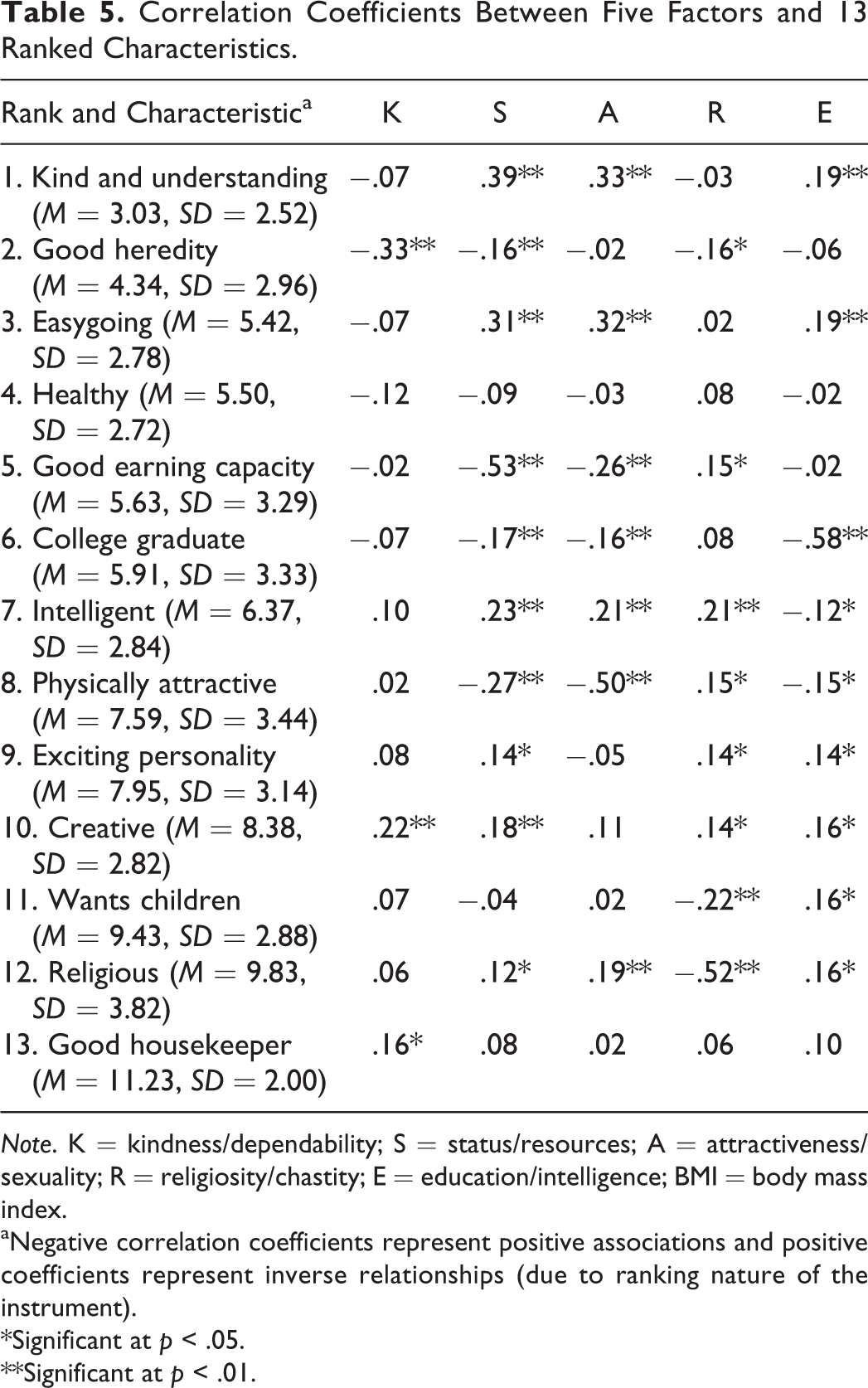
Note. K = kindness/dependability; S = status/resources; A = attractiveness/sexuality; R = religiosity/chastity; E = education/intelligence; BMI = body mass index.
aNegative correlation coefficients represent positive associations and positive coefficients represent inverse relationships (due to ranking nature of the instrument).
*Significant at p < .05.
**Significant at p < .01.
Study 3
In the present study, we used confirmatory factor analysis (CFA) to examine the factor structure of the scale as identified in Study 2. We expected the previous structure (see Table 2) to have acceptable fit indices in a distinct sample.
Material and Method
The final 26-item version of the scale was completed by 100 unmarried female participants aged 18–47 years (M = 27.79, SD = 5.87). The BMI ranged between 17.63 and 33.46. Moreover, the desired number of children was 1.71 (SD = 0.94). The minimum desired age for marriage was 24.47 (SD = 3.55) while the maximum was 31.49 (SD = 5.22). The participants were recruited using snowball sampling. Generally, snowball sampling method is a nonprobability sampling strategy in which one or more individuals are recruited and then they recruit one or more individuals, and so on. It has been shown to be an effective sampling strategy to access hidden groups of participants scattered sparsely in large populations.
In this study, four individuals (three men and one woman) were assigned and instructed to survey 25 women. Fundamentally, CFA is used to determine whether an instrument’s factor structure derived from exploratory factor analytic approaches can hold up with another respondent sample (Mvududu & Sink, 2013). We used CFA to examine the previously identified factor structure of the scale (see Table 2). All factors were permitted to co-vary. As fit indices for the CFA, the χ2 over degree of freedom (χ2/df), the root mean square error of approximation (RMSEA), the root mean square residual (RMR), the Tucker–Lewis Index (TLI), and the comparative fit index (CFI) were analyzed (Hu & Bentler, 1999). Maximum likelihood was used as the estimation method. The analysis was performed using AMOS 19.
Results
The five-factor model fits the data fairly well (χ2/df = 1.41; RMSEA = 0.064, RMR = 0.072, TLI = 0.912, CFI = 0.926). There is no complete agreement regarding interpretation of fit indices (Mvududu & Sink, 2013), but using relatively conservative criteria (four or lower for χ2/df, 0.90 or higher for CFI and TLI; lower than 0.10 for RMR and lower than 0.08 for the RMSEA), all current indices fell within acceptable range. It has been reported that RMSEA may over-reject good models at small sample sizes. As a result, this is less preferable when analyses are performed on small sample sizes; however, the RMSEA was acceptable in the present sample. Of note, in this sample, Cronbach’s α coefficients were .91, .85, .89, .70, and .79 for “Kindness/Dependability,” “Status/Resources,” “Attractiveness/Sexuality,” “Religiosity/Chastity,” and “Education/Intelligence” subscales, respectively. The correlation matrix between subscales also suggested that subscales were relatively independent (r mean = .19).
General Discussion
The aim of the present study was to investigate the dimensions of long-term mate preferences among Iranian women. Following a qualitative study and a comprehensive literature review, an item pool of 39 items was prepared and quantitatively tested. A 26-item scale had the most interpretable factor structure. Finally, a CFA on a different sample of participants provided robust psychometric characteristics for the scale. Since gender differences play a significant role in mate preferences, an all-female sample was used in this study in order to investigate the dimensions of long-term mate preferences among Iranian women. Developing such female-specific lists of characteristics can help intrasexual research on mate preferences in future.
Five dimensions of mate preferences emerged in this study. The first factor, “kindness/dependability,” is conceptually similar to dimensions of “kindness, warmth” and “sociability” as previously identified in previous studies (Buss & Barnes, 1986; Fletcher et al., 1999; Regan et al., 2000; Shackelford et al., 2005). The second factor, “status/resources,” is conceptually similar to dimensions of “status/resources” and “social status, financial resources” (Buss & Barnes, 1986; Kenrick, Sadalla, Groth, & Trost, 1990; Parmer, 1998; Regan et al., 2000; Shackelford et al., 2005). The third factor, “attractiveness/sexuality,” conceptually resembles the dimensions of “good looks” and “attractiveness” identified in previous work (Fletcher et al., 1999; Shackelford et al., 2005; Simpson & Gangestad, 1992). The fourth factor, “religiosity/chastity,” is very similar to “religious” component of mate preference in Buss and Barnes’ study (1986). The fifth factor, “education/intelligence,” is very similar to “education/intelligence” pole in work of Shackelford and colleagues (2005). While the correlation coefficients between these factors were moderate in Study 2; Study 3 suggested that these five factors are relatively independent. Therefore, it may be concluded that these factors are tapping relatively independent robust dimensions of mate preference among Iranian women.
Study 1 revealed a number of culture-related characteristics that were previously underrecognized (i.e., having housing, intellectual, honest, and truthful; having a good financial status, high self-confidence, tall, similar cultural background; and having a high income level and supportive) or unrecognized (i.e., Qeirati). “Having housing” is obviously an indicator of financial resources and a recent qualitative analysis found it to be important in Chinese culture (Zhang, Teng, Chan, & Zhang, 2014). “Intellectual” has also been reported in previous research (Schwarz & Hassebrauck, 2012). “Honesty and truthfulness” and “supportive” are indicators of good personality and are preferred by most women. This preference may be explained by the fact that negative personality characteristics increase the possibility of future infidelity in a potential mate (Buss & Shackelford, 1997; Schmitt, 2004b; Shackelford, Besser, & Goetz, 2008). Interestingly, responses in the qualitative interviews emphasized on “current” financial/social status rather than “potential” status. For example, “having a good financial status,” “having housing,” and “having a good income level” are suggesting the importance of current status (compare with potential). The characteristic “tall” has been recently recognized as a particularly important characteristic for females (Stulp et al., 2013) and this was reflected in our qualitative analyses. “Similar cultural background” also resembles characteristics which measure similarity (e.g., similar political background).
“Qeirati” is a newly discovered important characteristic with cultural value. As mentioned before, to our knowledge, no single adjective in English can completely capture the meaning as perceived in Persian. This adjective is a male-specific characteristic, which implies protecting female members of the family from unwanted sexual attention or any possible danger. Research suggests that, in perceived dangerous environments, women show a preference for protective and physically formidable mates (Snyder et al., 2011). Therefore, the present findings call for research on the relationship between choosing Qeirati mates and other variables such as domestic violence, childhood trauma, social perceptions, and fear of crime.
The relationship between five factors of mate preference and demographic details revealed that age was inversely associated with all factors meaning that older women set lower standards in choosing a mate. This finding may be explained considering that the supply of available mates decreases with age for women (Oppenheimer, 1988) and therefore they expand their preferences in a potential mate (South, 1991). Also, it may be explained by the fact that older women may have a weaker bargaining hand in mating market (Fales et al., 2016). Yet, previous research reported little in the way of age differences (Buunk, Dijkstra, Fetchenhauer, & Kenrick, 2002; Schwarz & Hassebrauck, 2012). Moreover, higher levels of education were associated with stronger expectations for education/intelligence factor and lower importance placed on religiosity/chastity. Attractiveness/Sexuality subscale was also negatively associated with educational level of participants. Ideal age for marriage was inversely correlated with Religiosity/Chastity (i.e., those who want to get married older are less inclined to marry a religious person) and positively correlated with Education/Intelligence subscale (i.e., those females who want to get married older tend to marry a more educated/intelligent person). Ideal age difference was only significantly correlated with status/resources factor. This may be explained by the fact that men with higher resources and social status tend to be older (Kenrick & Keefe, 1992). Findings also revealed that those with inclination toward more religious people desire a higher number of children which is consistent with previous work (Neuman & Ziderman, 1986). BMI was also significantly negatively associated with attractiveness/sexuality factor; that is, those who are more overweight tend to prefer less attractive men. This is consistent with previous correlation between couples’ BMI (Price & Vandenberg, 1980; Silventoinen, Kaprio, Lahelma, Viken, & Rose, 2003).
The correlation coefficients between the five factors and 13 ranking characteristics may be considered as indicators of concurrent validity of the dimensions. Each factor is significantly correlated with the corresponding characteristics in the 13-item ranking instrument (see Table 5). The ranks of these 13 characteristics are also consistent with previous work (Buss & Barnes, 1986).
Study 3 provided fit indices for the factor structure of the 26-item scale that was derived from preceding two studies. All indices of fit fell within acceptable range. Moreover, all five factors of mate preference were internally consistent. Factors were also less strongly correlated suggesting relatively independent dimensions of mate preference. The relative independence of dimensions of mate preference in the current study is consistent with previously reported universal dimensions of mate preference (Shackelford et al., 2005).
Some limitations of this study are worth noting. First, this study was conducted to investigate the dimensions of Iranian mate preference. The 26-item list of characteristics may be used within Iranian culture with acceptable validity and reliability. It is also recommended for future research to cross-culturally validate this scale. Some culture-specific variables may be important in other cultural backgrounds as well. Second, while there is evidence for temporal stability of mate preferences, the current study did not assess test–retest reliability of the 26-item list. Third, the present sample was drawn from Tehran. Due to cultural plurality of Iran, it is recommended to investigate the dimensions of mate preference in other cities and cultures in Iran. Fourth, the sample size in Study 3 is sufficient; however, small for a CFA. It is highly recommended for future research to use confirmatory techniques to confirm the five-factor structure of this newly developed scale.
Conclusion
In sum, the present study investigated a list of mate preferences in Iranian women as an underrecognized population in evolutionary psychological literature. A female-specific mate preference scale was developed and validated in three consecutive studies. The five-factor structure of the newly developed 26-item scale included kindness/dependability, status/resources, attractiveness/sexuality, religiosity/chastity, and education/intelligence. Therefore, this scale may be used as a valid and reliable measure of female mate preferences.
Footnotes
Acknowledgment
We would like to thank Narges Riahi and Hadi Barzin for their support and assistance in data collection.
Declaration of Conflicting Interests
The author(s) declared no potential conflicts of interest with respect to the research, authorship, and/or publication of this article.
Funding
The author(s) received no financial support for the research, authorship, and/or publication of this article.