



Abstract
At least in the United States, there are widespread concerns with advertising that encourages alcohol consumption, and previous research explains those concerns as aiming to protect others from the harm of excessive alcohol use.1 Drawing on sexual strategies theory, we hypothesized that support of censoring pro-alcohol advertising is ultimately self-benefiting regardless of its altruistic effect at a proximate level. Excessive drinking positively correlates with having casual sex, and casual sex threatens monogamy, one of the major means with which people adopting a long-term sexual strategy increase their inclusive fitness. Then, one way for long-term strategists to protect monogamy, and thus their reproductive interest is to support censoring pro-alcohol advertising, thereby preventing others from becoming excessive drinkers (and consequently having casual sex) under media influence. Supporting this hypothesis, three studies consistently showed that restricted sociosexuality positively correlated with support of censoring pro-alcohol advertising before and after various value-, ideological-, and moral-foundation variables were controlled for. Also as predicted, Study 3 revealed a significant indirect effect of sociosexuality on censorship support through perceived media influence on others but not through perceived media influence on self. These findings further supported a self-interest analysis of issue opinions, extended third-person-effect research on support of censoring pro-alcohol advertising, and suggested a novel approach to analyzing media censorship support.
Keywords
Alcohol advertising in the United Sates is strictly regulated. For example, the Distilled Advertising Council (www.discus.org) pledges to comply with the Code of Responsible Practices (2011), and the Beer Institute (www.beerinstitute.org) pledges to comply with the Advertising and Marketing Code (2015). Both codes stipulate that advertising programs must not encourage excessive consumption of alcohol beverage, and the general public are encouraged to file complaints when noticing violations.
However, why would the general public worry about advertising that encourages excessive drinking and bother to have it censored at all? As one possibility, people are caring and motivated to protect others from harm. Excessive drinking leads to various health risks including traffic accidents, unsafe sex, violence, brain damages, and cardiovascular diseases (Alcohol use and your health, 2016). One way to protect others, then, is to censor pro-alcohol advertising, thereby preventing others from becoming excessive drinkers under media influence. Research on the “third-person effect” (Davison, 1983) appears to support this hypothesis. The third-person effect describes the phenomenon where people tend to perceive that others are more susceptible to negative media influence than self, and this differential perception of negative media influence motivates censorship support. In the context of pro-alcohol advertising, research showed that people who perceive pro-alcohol advertising as being more likely to cause others (compared to self) to drink excessively report stronger censorship support (David, Liu, & Myser, 2004; Lambe & McLeod, 2005; Shah, Faber, & Youn, 1999; Shin & Kim, 2011). This finding has since been taken as evidence that media censorship support is motivated by a desire to protect others.
This other-protection hypothesis may be correct at a proximate level (and will be evaluated in this research). However, we argue that, like many behaviors that appear altruistic (e.g., buying environmental-friendly products, Griskevicius, Tybur, & Van den Bergh, 2010), the perception of negative media influence on others and the attitude toward censoring-related media content are in fact self-benefiting at a functional level. In other words, those perception and attitude exist ultimately because they increase perceivers’ inclusive fitness.
This hypothesis of ours draws on an evolutionary analysis of self-interest (Weeden & Kurzban, 2014), and in the context of this research, sexual strategies theory (Buss & Schmitt, 1993; Gangestad & Simpson, 2000) that highlights the impact of reproductive interest on issue opinions (e.g., Kurzban, Dukes, & Weeden, 2010; Pinsof & Haselton, 2016). As elaborated below, the reproductive interest of people who value monogamy (i.e., pursuing a long-term sexual strategy) is undermined when they are surrounded by people (i.e., the “others”) who desire casual sex (in particular extramarital sex; i.e., pursuing a short-term sexual strategy). Thus, to the extent that excessive drinking is perceived to promote (and actually promotes) casual sex, long-term strategists will be concerned with others becoming excessive drinkers and subsequently engaging in casual sex under media influence. That concern is expressed as perceiving negative influence of pro-alcohol advertising on others.
In what follows, we review prior research on attitudes toward pro-alcohol advertising before elaborating the sexual strategies hypothesis. We then test this hypothesis in three studies by examining how sociosexuality, a sexual strategy variable that tracks one’s reproductive interest (Kurzban et al., 2010; Tybur, Inbar, Güler, & Molho, 2015), correlates with perceived influence of pro-alcohol advertising on others, perceived influence on self, and censorship support. As such, this research will extend previous work on media censorship support, sexual strategies and issue opinions, and sexual strategies and alcohol consumption.
Third-Person Effect and Support of Censoring Pro-Alcohol Advertising
Previous research on support of censoring pro-alcohol advertising mostly drew on the third-person-effect hypothesis. According to Davison (1983), people tend to perceive controversial media content (e.g., violent media content) to have stronger negative influence on others (e.g., being more likely to make them violent) than on self. This perception, in turn, motivates censorship support. 2 A meta-analysis support this hypothesis (Feng & Guo, 2012).
Regarding pro-alcohol advertising, research showed that adult respondents tended to perceive pro-alcohol advertising as being more likely to make others (e.g., other Americans) drink excessively (Cho & Han, 2004; David et al., 2004; Lambe & McLeod, 2005). Further supporting the third-person-effect hypothesis, Shah, Faber, and Youn (1999) found that adult respondents reported stronger support of restricting beer advertising and liquor advertising when they perceived such advertising as having more negative influence on others than on themselves. Similarly, Shin and Kim (2011) found that Korean university students reported stronger pro-regulation attitudes when they perceived alcohol product placement in movies as being more likely to encourage other university students than themselves to drink.
In light of these findings, Shah et al. (1999, p. 246) suggested that “attempts to censor communications [such as pro-alcohol advertising] may be motivated by concerns about the effects of communications on others.” Similarly, Shin and Kim (2011, p. 23) believed that their respondents “were concerned about the potentially harmful influence of alcohol product placement…not for their own sake but for the sake of others, so that the need for regulation seems to be motivated to protect not the self but others.” More generally, Davison (1983), who conceived the third-person-effect hypothesis, observed that “it is difficult to find a censor who will admit to having been adversely affected by the information whose dissemination is to be prohibited…It is the general public that must be protected” (p. 14).
Supporting this other-protection hypothesis of media-censorship support, McLeod, Detenber, and Eveland (2001) found that a measure of paternalism (e.g., “Sometimes, it is necessary to protect people from doing harm to themselves”) positively correlated with perceived influence of violent rap lyrics on others and with support of censoring those lyrics. However, Paek, Lambe, and McLeod (2008) were unable to replicate the correlation between paternalism and censorship support with media violence and several other types of controversial media content, including pornography and hate speech. Further, there have not been tests on whether concerns with others’ well-being positively correlate with perceived negative influence of pro-alcohol advertising on others and with support of censoring pro-alcohol advertising.
Media Censorship Support as a Self-Benefiting Device
While the other-protection hypothesis remains to be further tested, a desire to protect others from harm is in fact not needed to explain the correlation between perceived media influence on others and censorship support. We argue that the correlation will occur when the behaviors portrayed in media, once adopted by others, undermine perceivers’ self-interest. Evolutionarily speaking, self-interest is all that (however indirectly) increases one’s inclusive fitness (Weeden & Kurzban, 2014). People should be—and indeed are—concerned with how others behave because others’ behavior often interferes with one’s lifestyle, resulting in conflicts of interest (Weeden & Kurzban, 2014). It thus benefits people to monitor, including to anticipate and project, others’ behavior. This will enable people to side with like-minded others as conflicts arise, mobilizing support to populate behaviors that advance their self-interest and prohibit behaviors that undermine their self-interest (DeScioli & Kurzban, 2013).
Under this account, perceiving negative media influence on others may or may not indicate that one is concerned with others’ well-being at a proximate level. But, functionally, that perception likely gauges the threat of certain media content to perceivers’ personal interest. Stronger the perception, greater the perceived threat to self, and stronger the censorship support. Support of this hypothesis requires that variables that track perceivers’ personal interest reliably correlate with the perception of negative media influence on others and censorship support.
Sexual Strategies and Issue Opinions
We hypothesize that sexual strategies, which track people’s reproductive interest (Kurzban et al., 2010; Pinsof & Haselton, 2016; Tybur et al., 2015), should affect how they perceive the influence of pro-alcohol advertising on others and how much they support censoring such advertising. According to sexual strategies theory (Buss & Schmitt, 1993; Gangestad & Simpson, 2000), to enhance their reproductive success, people choose strategies from a continuum anchored at the two ends by “short term” and “long term,” respectively. A long-term strategy entails having a lifelong partner and investing heavily on the offspring produced with that partner. In contrast, to purse a short-term strategy includes having sex outside a committed relationship and minimizing parental investment (Buss, 2015).
Both strategies can be adaptive, and which one to adopt is calibrated to individual and contextual differences. Men tend to be more short-term oriented than women (Buss & Schmitt, 1993). This is because men have higher potential reproductive rates than women, and, as a result, short-term mating increases offspring quantity more effectively for men than for women (Puts, 2010). At the same time, men who perceive themselves as being more attractive (Al-Shawaf, Lewis, & Buss, 2015), women closer to ovulation (Cantú et al., 2014), and people who have more symmetrical body features (Gangestad & Simpson, 2000) tend to be more short- term oriented. This is because short-term mating enables men and women who have better genes and who are more fertile to maximize offspring quantity and recruit good genes.
Long-term mating has also important benefits. Parental—especially paternal—investment is a key feature of long-term mating, and it reduces infant mortality while enhances offspring’s socioeconomic competence (Geary, 2000). Male provisioning also directly benefits women, especially in critical stages of reproduction (e.g., pregnancy and breastfeeding; Quinlan, 2008). For people who are subjectively (Murray, Jones, & Schaller, 2013; Tybur et al., 2015) and objectively (Schaller & Murray, 2008) susceptible to parasitic threats, long-term mating reduces infection risks by limiting the number of one’s sexual partners and thus sources of infection.
Thus, people adopt a short-term or a long-term sexual strategy for any number of reasons, but regardless of the reason(s), they accrue the associated benefits by having a monogamous or a nonmonogamous relationship, respectively. To advance their reproductive interest, then, people adopting a long-term sexual strategy should be motivated to foster a monogamous environment, including sanctioning casual sex (particularly extramarital sex; Kurzban et al., 2010; Tybur et al., 2015; Weeden, Cohen, & Kenrick, 2008). Casual sex undermines long term–oriented men’s reproductive interest by increasing the risk of them being cuckolded and thus misspending their resources. Casual sex also undermines long term–oriented women’s reproductive interest by diluting their partner’s investment in them and in their offspring.
Conversely, people who pursue a short-term sexual strategy will welcome a sexually liberal environment and oppose rules that enforce monogamy. Monogamy undermines short term–oriented men’s reproductive interest by restricting their offspring quantity. It undermines short term–oriented women’s reproductive interest by preventing them from extracting immediate resources and recruiting good genes from men (Buss & Schmitt, 1993).
Empirical evidence
Supporting sexual strategies theory, Kurzban, Dukes, and Weeden (2010) found that restricted sociosexuality, which indicates a long-term sexual strategy, positively correlated with moral opposition to using recreational drugs (e.g., marijuana, cocaine, and Ecstasy; see also Quintelier, Ishii, Weeden, Kurzban, &, Braeckman, 2013[Quintelier, Ishii, Weeden, & Kurzban, 2013 has been changed to “Quintelier, Ishii, Weeden, Kurzban, &, Braeckman, 2013” to match the reference list. Please approve.]). There is evidence that people who use more recreational drugs (marijuana in particular) are more likely to have casual sex (Whitaker, Miller, & Clark, 2000; Zuckerman & Kuhlman, 2000). However, per our argument, what matters perhaps even more is the perception that using recreational drugs causes having frequent casual sex. In this sense, by prohibiting others from using recreational drugs, long-term strategists are effectively trying to reduce casual sex in society. Indeed, Pinsof and Haselton (2016) found that long-term mating orientation positively correlated with support of sanctioning same-sex marriage, and the correlation was especially strong for respondents who readily associated homosexuality with promiscuity. This is strong evidence that long-term strategists are trying to protect their reproductive interest from perceived threats.
Sexual Strategies and Support of Censoring Pro-Alcohol Advertising
People who consume more alcohol are more likely to have casual sex (e.g., Devos-Comby, Daniel, & Lange, 2013; Grello, Welsh, & Harper, 2006; Justus, Finn, & Steinmetz, 2000; Lindgren, Pantalone, Lewis, & George, 2009; Zuckerman & Kuhlman, 2000), and several studies explicitly link excessive drinking to sexual strategies. Hone, Carter, and McCullough (2013) found that university students who were more sociosexually restricted (i.e., more long-term oriented) were less likely to participate in drinking games, drank less when they participated, and reported less incidences of problematic alcohol use (see also, Hone & McCullough, 2015). Vincke (2016a, 2016b) found that, compared to people described as frequent drinkers, those described as occasional and nondrinkers were perceived to be more sociosexually restricted and less attractive as short-term partners. At the same time, people who were more sociosexually restricted reported to drink less frequently in daily life (Vincke, 2016a, 2016b), and people reported weaker intent to drink under a prime of long-term mating motive than short-term mating motive (Vincke, 2017).
The current hypothesis
Thus, people who are more long-term oriented in sexual strategies generally drink less and are less likely to drink for casual sex. However, theory and research on reproductive self-interest reviewed above further predict that long-term strategists will also desire to prohibit others from drinking excessively. Given that people who drink more excessively are more likely to have casual sex, eliminating factors that promote excessive drinking—such as pro-alcohol advertising—fits long-term strategists’ personal interest.
Pro-alcohol advertising may or may not cause others to drink excessively, but what matters is its perceived effectiveness in doing so. Thus, just as sexual strategies should track support of censoring pro-alcohol advertising, it should also track the perceived negative influence of such advertising on others. That is, people who are more long-term oriented in sexual strategies should perceive pro-alcohol advertising as being more likely to cause others to drink excessively. This is because increases in the prevalence of casual sex in one’s community will be more threatening to people whose reproductive interest relies more strongly on keeping their pair-bonds exclusive and enduring (Kurzban et al., 2010; Pinsof & Haselton, 2016). Those people should thus perceive greater threat from pro-alcohol advertising, resulting in stronger perceptions that pro-alcohol advertising is effective in making others drink excessively.
Comparatively, how perceived influence of pro-alcohol advertising on self correlates with sexual strategies and censorship support is less clear. Davison (1983) noted that censors and their supporters typically perceive themselves as being morally superior and thus perceive the media content in question to have no influence on themselves. Similarly, Kurzban et al. (2010, p. 3501) observed that people want costs to be imposed on behaviors even when they “typically do not consciously perceive—and indeed often expressively deny—that they themselves (or their relatives) are harmed by the behavior in question.”
Those lines of reasoning suggest that sexual strategies do not correlate with perceived influence of pro-alcohol advertising on self. But it is also possible that people who are more long-term oriented in sexual strategies resist more strongly the influence of pro-alcohol advertising. This would result in a negative correlation between sexual strategies and perceived negative media influence on self. The status of the current literature does not allow us to predict which correlation is more likely. At the same time, while the correlation between perceived media influence on self and censorship support is positive on average, it shows larger variation than the correlation between perceived media influence on others and censorship support and can be negative (Chung & Moon, 2016).
In sum, drawing on sexual strategies theory, we predict that people who are more long-term oriented in sexual strategies will be more supportive of censoring pro-alcohol advertising (Hypothesis 1) and will perceive pro-alcohol advertising to be more influential on others (Hypothesis 2). Further, we predict an indirect effect of sexual strategies on censorship support through perceived influence of pro-alcohol advertising on others (Hypothesis 3). We explore how sexual strategies, perceived influence of pro-alcohol advertising on self, and censorship support correlate with each other. These hypotheses and research questions are schematically represented in Figure 1.
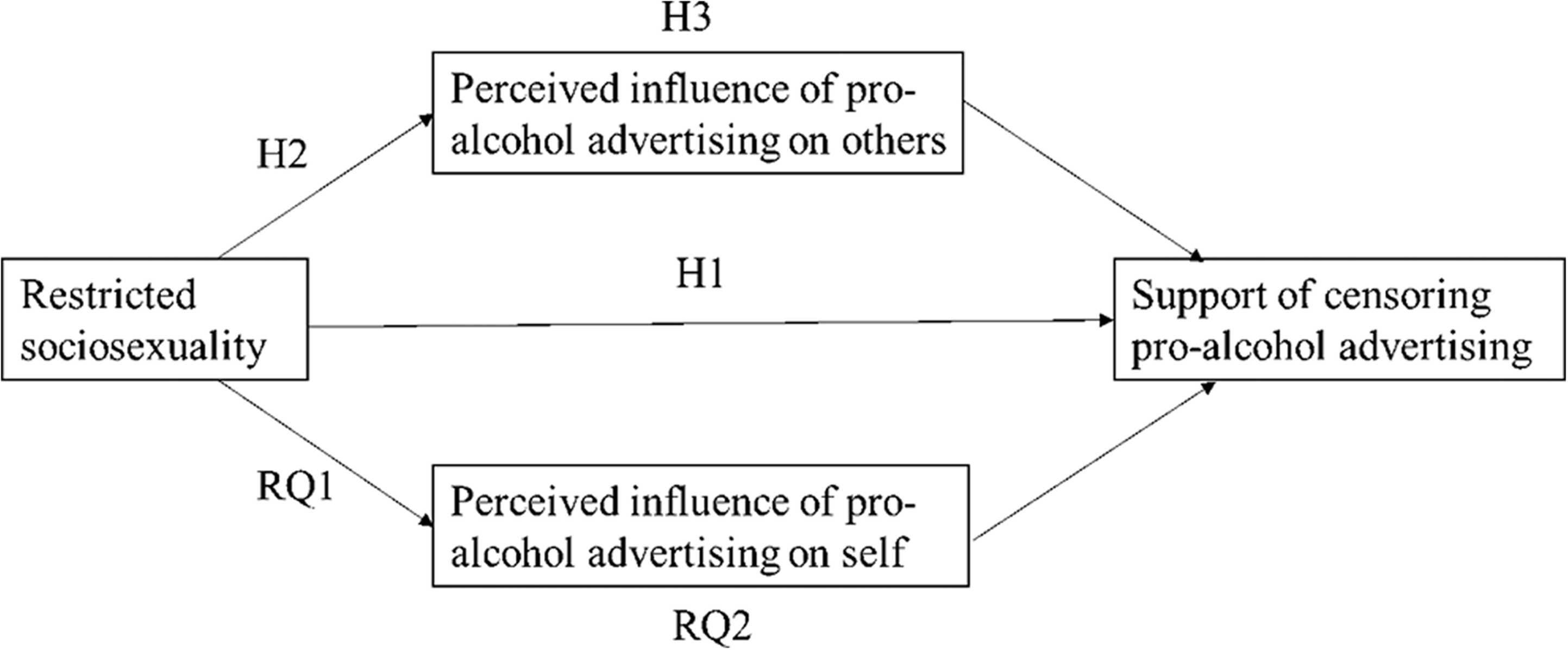
A schematic representation of the hypotheses (“H”) and research questions (“RQ”) of this research. H3 and RQ2 concern the indirect effects of restricted sociosexuality on censorship support through perceived media influence on others and that on self.
We test Hypothesis 1 in all three studies of this research and address the remaining hypotheses and research questions in Study 3.
Covariates
To ascertain the direct effects of sociosexuality on censorship support and on perceived media influence on others, we also control for a series of variables across the three studies. In Study 1, we include pathogen avoidance, political conservatism, and religiosity. Pathogen avoidance is likely an antecedent of sexual strategies (Murray et al., 2013; Tybur et al., 2015), whereas political conservatism and religiosity are likely outcomes of sexual strategies (Tybur et al., 2015; Weeden et al., 2008). In Study 2, we include right-wing authoritarianism (RWA, Altemeyer, 1988) and commitment to democratic ideals (Marcus, Sullivan, Theiss-Morse, & Wood, 1995). Those two variables track people’s desires for freedom and individual rights and predict support of censoring pornography and media violence (e.g., Fisher, Cook, & Shirkey, 1994; Paek, Lambe, & McLeod, 2008).
In Study 3, we include the moral foundations of harm and purity (Graham, Haidt, & Nosek, 2009). The moral foundation of harm tracks one’s care for others’ well-being and positively correlates with opposition to death penalty, likely because people having stronger moral concerns with harm are more likely to imagine others’ suffering (Koleva, Graham, Iyer, Ditto, & Haidt, 2012). Thus, if excessive drinking causes physical sufferings (e.g., illness and death), the moral foundation of harm should positively correlate with perceived influence of pro-alcohol advertising on others and censorship support. 3 This would allow us to test the other-protection hypothesis (Shah et al., 1999; Shin & Kim, 2011), which posits that the desire to protect others from harm motivates media-influence perceptions and censorship support. We did not use McLeod et al.’s (2001) measure of paternalism because the psychometric properties of this measure have not been established.
The moral foundation of purity concerns the extent to which one desires spiritual sanctity (Graham et al., 2009). This moral foundation should positively correlate with support of censoring pro-alcohol advertising because it positively correlates with opposition to casual sex (Koleva et al., 2012). In all three studies, we also control for respondents’ sex given that women are generally more long-term oriented than men (following Tybur et al., 2015). While many of these variables could mediate the effects of sociosexuality on perceived influence of pro-alcohol advertising on others and censorship support, we test a strong version of sexual strategies theory that posits direct effects of sociosexuality.
Research protocol was approved by the University of Hawai’i (UH) Institutional Review Board (IRB), and informed consent was obtained from all respondents.
Study 1
Study 1 aimed to provide a first test of the hypothesized positive correlation between long-term sexual strategy and support of censoring pro-alcohol advertising.
Method
Respondents were 175 American students (female = 97; median age = 20, ranging from 18 to 44) from UH Mānoa. They participated in the study in exchange for course credits.
Measure of censorship attitude
Respondents were asked to indicate how much they supported censoring beer commercials that encourage alcohol consumption on a 7-point scale (1 = not at all, 7 = very much; adapted from Lambe & McLeod, 2005).
Measure of sexual strategies
Next, respondents completed the attitude subscale of the revised Sociosexual Orientation Inventory (SOI-R) (1 = strongly disagree, 9 = strong agree; Penke & Asendorpf, 2008). We only used the attitude subscale (see also, Tybur et al., 2015) because Kurzban et al. (2010) found that the attitude items of SOI-R had the strongest impact on moral opposition to using recreational drugs. After reverse coding, the attitude subscale was reliable (Cronbach’s α = .84), with higher values indicating being more sociosexually restricted (i.e., more long-term oriented in sexual strategies).
Measures of covariates
Following Tybur, Inbar, Güler, and Molho (2015), we measured political ideology with the following items: (1) “I consider myself to be politically conservative,” (2) “I consider myself to be politically liberal,” (3) “I often identify with the policies of the Republican Party,” and (4) “I often identify with policies of the Democratic Party” (1 = strongly disagree, 7 = strong agree). After reverse coding, the 4 items formed a reliable index of political conservatism (α = .72), with higher values indicating being more politically conservative.
We measured pathogen avoidance with the pathogen disgust subscale of the domain-specific Disgust-Sensitivity Scale (Tybur, Griskevicius, & Lieberman, 2009). The reliability of the scale was acceptable (α = .68), with higher values indicating stronger aversion to pathogens. Lastly, we measured religiosity by asking respondents to indicate how often they (1) attended religious services, (2) read a sacred book, and (3) prayed other than participating in obligatory social functions (1 = never, 7 = daily). The 3 items formed a reliable index of religiosity (α = .86), with higher values indicating being more religious.
Results
Data preparation
Descriptive statistics and intercorrelations are presented in Table 1. Because the amount of missing values is very small (i.e., 0.51%), we proceeded without imputation. 4 We used a logarithmic transformation (with base 10) to correct for the skew of censorship support and religiosity (Zs > 3). The transformed variables were used for subsequent analyses, but whether to use the original or transformed variables does not impact statistical conclusions. All variables were Z-transformed prior to analyses.
Descriptive Statistics and Intercorrelations (Study 1).

Note. N = 174–175. Statistics are based on data before transformation. SD = standard deviation.
*p < .05. **p < .01. ***p < .001.
Hypothesis testing
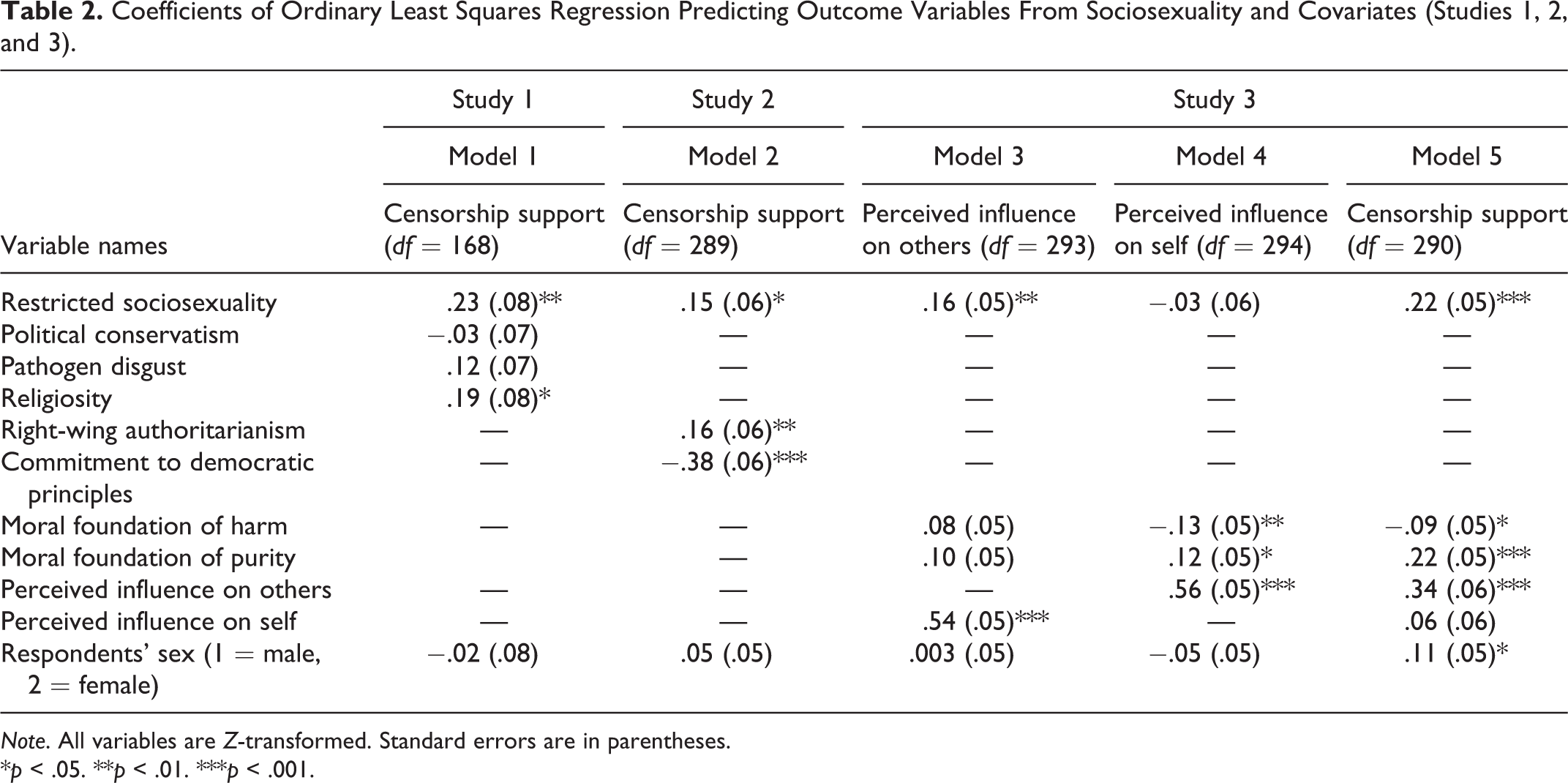
Hypothesis 1 predicts a positive correlation between restricted sociosexuality and support of censoring beer commercials that encourage alcohol consumption. Results from bivariate correlation (Table 1) and ordinary least squares (OLS) regression (Model 1, Table 2) supported Hypothesis 1. As predicted, restricted sociosexuality positively and significantly correlated with support of beer commercials that encourage alcohol consumption before and after political conservatism, pathogen disgust, religiosity, and respondents’ sex were controlled for.
Coefficients of Ordinary Least Squares Regression Predicting Outcome Variables From Sociosexuality and Covariates (Studies 1, 2, and 3).
Note. All variables are Z-transformed. Standard errors are in parentheses.
*p < .05. **p < .01. ***p < .001.
Discussion
Study 1 supported the hypothesis that people who are more long-term oriented in sexual strategies are more supportive of censoring pro-alcohol advertising (Hypothesis 1). The direct effect of sociosexuality on support of censoring beer commercials that encourage alcohol consumption was significant above and beyond the effects of respondents’ political ideology, pathogen disgust, religiosity, and sex. Religiosity also significantly correlated with censorship support, but its effect size was descriptively smaller than that of sociosexuality. Despite these encouraging results, however, the use of a student sample was a limitation, which we addressed in Study 2.
Study 2
In Study 2, we aimed to replicate the positive correlation between sociosexuality and support of censoring beer commercials that encourage alcohol consumption found in Study 1 with a relatively larger sample of nonstudent American adults.
Method
Respondents were 300 adult Americans (female = 133, with one choosing “other” and four choosing “prefer not to answer”; median age = 36, ranging from 18 to 73) recruited from Amazon’s Mechanic Turk (MTurk). Following previous research (e.g., Berinsky, Huber, & Lenz, 2012; Hauser & Schwarz, 2016; Paolacci, Chandler, & Ipeirotis, 2010), we made the study only available to “Turkers” with 95% or higher approval rates. Peer, Vosgerau, and Acquisti (2014) showed that, compared to using Turkers whose approval rates were lower than 95%, using those whose approval rates were 95% or higher produced higher quality data, including higher scale reliability and more truthful responding.
In terms of ethnicity, 92% of all respondents self-identified as non-Hispanics/Latinos. In terms of race, 84% of all respondents self-identified as Whites, 7% as Asian Americans, 5% as Blacks, 1% as American Indian or Alaska natives, and 2% as Other. The median education level of this sample was having a bachelor’s degree.
Measure of censorship attitude
The measure of support of censoring pro-alcohol advertising was the same as in Study 1. Higher values indicate stronger censorship support.
Measure of sexual strategies
As in Study 1, we used the attitude subscale of SOI-R to measure sexual strategies, and the scale was reliable (α = .89). Higher values indicate being more sociosexually restricted (i.e., more long-term oriented in sexual strategies).
Measures of covariates
We measured RWA with Zakrisson’s (2005) short form. From this scale, we excluded items related to sex (e.g., “God’s law about abortion, pornography, and marriage must be strictly followed before it is too late; violations must be punished”), and those related to censorship attitudes (e.g., “It would be best if newspapers were censored so that people would not be able to get hold of destructive and disgusting material”). This left us with 6 items that assessed authoritarian submission (e.g., “Obedience and respect for authority are the most important values children should learn”), authoritarian aggression (e.g., “We should silence the trouble makers spreading bad ideas”), and general conventionalism (e.g., “The ‘old-fashioned ways’ and the ‘old-fashioned values’ still show the best way to live”). All items were measured with 7-point scales (1 = strongly disagree, 7 = strongly agree), and the scale was reliable (α = .89). Higher values indicate stronger RWA.
We measured commitment to democratic principles with 2 items adapted from Paek et al. (2008): (1) “No matter what a person’s political beliefs are, the person is entitled to the same legal rights and protections as anyone else” and (2) “Society should put up with those who have political ideas that are different from the views of majority”; 1 = strongly disagree, 7 = strongly agree; α = .67). Higher values indicate stronger commitment to democratic principles.
Results
Data preparation
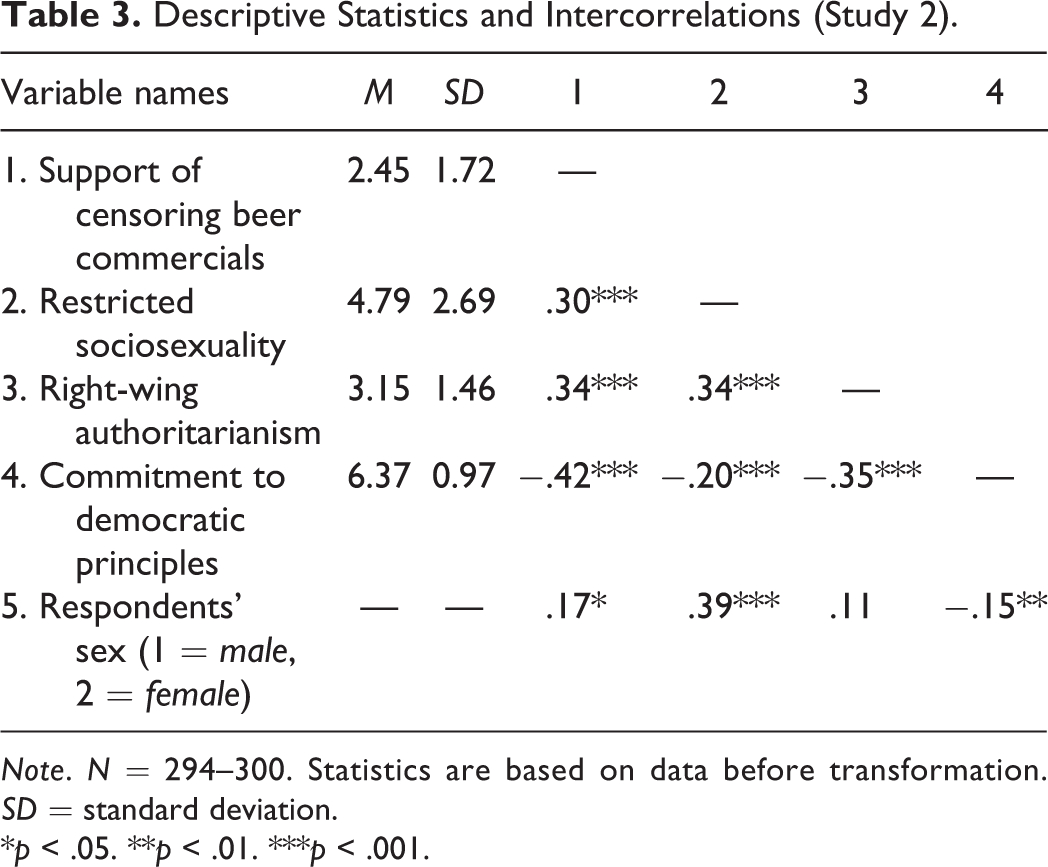
Descriptive statistics and intercorrelations are presented in Table 3. Similar to Study 1, we did not impute the very small amount of missing values (i.e., 0.28%) and proceeded with the original sample. We used a logarithmic transformation to correct for the skew (Z > 3) of censorship support and commitment to democratic principles, before Z-transforming all variables.
Descriptive Statistics and Intercorrelations (Study 2).
Note. N = 294–300. Statistics are based on data before transformation. SD = standard deviation.
*p < .05. **p < .01. ***p < .001.
Hypothesis testing
Results from bivariate correlation (Table 3) and OLS regression (Model 2, Table 2) supported Hypothesis 1. As predicted, restricted sociosexuality positively and significantly correlated with support of censoring beer commercials that encourage alcohol consumption before and after respondents’ RWA, commitment to democratic principles, and sex were controlled for.
Discussion
Study 2 replicated the positive correlation between restricted sociosexuality and support of censoring beer commercials that encourage alcohol consumption with a nonstudent adult sample and after RWA and commitment to democratic principles were controlled for. This finding is noteworthy because neither Kurzban et al. (2010) nor Pinsof and Haselton (2016) controlled for RWA, a variable on desires for tradition and social stability (Jugert & Duckitt, 2009). At the same time, Paek et al. (2008) noted that commitment to democratic principles is “particularly important” (p. 283) in predicting support of censoring controversial media content (e.g., pornography, violent media content). The findings of Study 2 corroborated Paek et al. (2008) but also suggest that support of censoring pro-alcohol advertising is more than devaluing civil rights or desiring social stability. One’s preferred way to achieve reproductive success also plays an important role.
Study 3
The first goal of Study 3 was to provide a third independent test of the hypothesized positive correlation between long-term sexual strategy and support of censoring pro-alcohol advertising (Hypothesis 1). This time, we controlled for respondents’ moral concerns with harm and purity. Second, we tested Hypothesis 2 that long-term sexual strategy will positively correlate with perceived influence of pro-alcohol advertising on others and Hypothesis 3 that long-term sexual strategy will predict censorship support through perceived influence of pro-alcohol advertising on others. Third, we explored how sexual strategies, perceived influence of pro-alcohol advertising on self, and censorship support correlate with each other.
Method
Respondents were 300 U.S. MTurk users (143 females, with one choosing prefer not to answer; median age = 35, ranging from 18 to 71). Similar to Study 2, we restricted the study to MTurkers with 95% or higher approval rates. In terms of ethnicity, about 92% of the respondents self-identified as non-Hispanic/Latino. In terms of race, about 81% of all respondents identified themselves as Whites, 10% as Blacks 5% as Asians, 0.7% as American Indians or Alaska natives, and 0.3% as native Hawaiians or other Pacific Islanders. The median education level of this sample was having a bachelor’s degree.
Measures of perceived media influence
To measure perceived influence of pro-alcohol advertising on self, respondents were asked to indicate how much they agreed that “Over time, viewing beer commercials will make me develop the habit of binge drinking” (1 = strongly disagree, 7 = strongly agree; following Lambe & McLeod, 2005). To measure of perceived influence on others, “me” in the above statement was replaced with “other Americans.”
Measure of censorship attitude
Respondents were then asked to indicate whether beer commercials that encourage alcohol consumption should be censored (1 = should definitely not be, 7 = should definitely be).
Measure of sexual strategies
As Studies 1 and 2, we used the attitude subscale of SOI-R to measure sexual strategies. The scale was reliable (α = .87), with higher values indicating being more sociosexually restricted (i.e., more long-term oriented in sexual strategies).
Measures of moral foundations
To keep the survey economical, we measured the moral foundations of harm and purity using the short form of the moral foundation questionnaire (Graham et al., 2009). Both indices were reliable (αs = .73 and .87), with higher values indicating stronger moral concerns with harm and purity.
Results
Data preparation
Descriptive statistics and zero-order intercorrelations are presented in Table 4. As in Studies 1 and 2, we did not impute the very small amount of missing values (i.e., 0.09%) and proceeded with the original sample. We first applied a logarithmic transformation to correct the skew of censorship support and Harm (Zs > 3). We then Z-transformed all variables for statistical testing.
Descriptive Statistics and Intercorrelations (Study 3).

Note. N = 297–300. Statistics are based on data before transformation. SD = standard deviation.
*p < .05. **p < .01. ***p < .001.
Hypothesis testing
Results from bivariate correlation (Table 4) and OLS regression (Model 5, Table 2) supported Hypothesis 1. Restricted sociosexuality positively and significantly correlated with support of censoring beer commercials that encourage alcohol consumption before and after the two moral foundations and respondents’ sex were controlled for. Results from bivariate correlation (Table 4) and OLS regression (Models 2 and 3) also supported Hypothesis 2. Restricted sociosexuality positively and significantly correlated with perceived influence of beer commercials on others with or without all covariates. A model switching the place of perceived media influence on others and perceived media influence on self revealed a nonsignificant correlation between sociosexuality and perceived media influence on self (Model 4, Table 2).
Hypothesis 3 predicted an indirect effect of restricted sociosexuality on support of censoring beer commercials that encourage alcohol consumption through perceived media influence on others. We performed the indirect-effect analysis using Hayes’ (2013) PROCESS macro, using the 95% bias-corrected confidence intervals (CIs) based on 5,000 bootstrapped samples for statistical inferences. Supporting Hypothesis 3, the indirect effect through perceived media influence on others was significant, with the CI estimated [0.02, 0.11], whereas the indirect effect of through perceived media influence on self was not, with the CI estimated [−0.02, 0.004]. There was no evidence that sociosexuality significantly correlated with perceived influence of beer commercials on self, b = −.04, t(291) = −0.67, p = .50, or perceived influence of beer commercials on self significantly correlated with censorship support, b = .06, t = 1.01, p = .31.
Finally, the other-protection hypothesis predicts that the moral foundation of harm will positively correlate with perceived influence of beer commercials on others and with censorship support. Results from bivariate correlation (Table 4) and OLS regression (Models 3 and 5, Table 2) did not support the hypothesis. Model 5 even revealed a significant negative effect of the moral foundation of harm on censorship support. 5
Discussion
Study 3 replicated the positive correlation between restricted sociosexuality and support of censoring beer commercials that encourage alcohol consumption. This time, the correlation was significant before and after the moral foundations of harm and purity and respondents’ sex were controlled for. We were able to demonstrate for the third time that people who are more long-term oriented in sexual strategies are more supportive of censoring pro-alcohol advertising.
The correlation between the moral foundation of harm and censorship support was not significant in bivariate correlation and was significant but negative in OLS regression. This latter finding suggests that people who were more morally concerned with others’ well-being are less rather than more supportive of censoring pro-alcohol advertising. These results do not support and even contradict the other-protection hypothesis.
The moral foundation of purity positively and significantly correlated with support of censoring beer commercials that encourage alcohol consumption. This finding is expected, given the positive correlation between that moral foundation and opposition to casual sexual (Koleva et al., 2012) and the positive correlation between casual sex and excessive drinking (Hone et al., 2013; Hone & McCullough, 2015; Vicke, 2016a, 2016b, 2017). Importantly, however, restricted sociosexuality significantly correlated with censorship support after the moral foundation of purity was controlled for. This suggests that the effect of long-term sexual strategy on support of censoring pro-alcohol advertising cannot be reduced to a general desire for spiritual sanctity.
Extending Studies 1 and 2, Study 3 showed that restricted sociosexuality positively and significantly correlated with perceived influence of beer commercials on others but not with that on self. In turn, perceived influence of beer commercials on others but not that on self positively correlated with censorship support. This latter finding corroborates Chung and Moon (2016) that perceived media influence on others (but not that on self) reliably correlates with media censorship support. More importantly, the significant indirect effect is further evidence for our sexual strategies hypothesis. That is, people who are more long-term oriented in sexual strategies are more supportive of censoring pro-alcohol advertising due to the concern that others become excessive drinkers under media influence.
More generally, this significant indirect effect supports the hypothesis that people are interested in others’ behavior ultimately for their own benefits (DeScioli & Kurzban, 2013). Kurzban et al. (2010) supported this hypothesis by showing that respondents who were more sociosexually restricted were more likely to judge fictional others using recreational drugs as morally wrong. Extending Kurzban et al., we showed that this “nosiness” of the human species can also manifest as projecting others’ behavior (e.g., to think that others are more, or less, likely to drink excessively under media influence).
At the same time, we found no evidence that sociosexuality correlated with perceived influence of beer commercials on self. This is somewhat counterintuitive because one might expect that people who are more long-term oriented in sexual strategies are more likely to resist the negative influence of pro-alcohol advertising on self. One possibility is that the impact of pro-alcohol advertising on people’s reproductive interest, while existing, is not very strong; this can be seen from the small- to medium-sized effects of sociosexuality in this research. When the impact is stronger and more direct (consider that of pornography), we may find a significant negative correlation between long-term sexual strategy and perceived media influence on self. This remains to be tested in the future research, which will help clarify whether perceived media influence on self has a function (similar to perceived media influence on others) or is merely a by-product of perceived media influence on others.
General Discussion
Drawing on an evolutionary analysis of self-interest (Weeden & Kurzban, 2014) and sexual strategies theory (Buss & Schmitt, 1993; Gangestad & Simpson, 2000), we hypothesized that people who are more long-term oriented in sexual strategies are more supportive of censoring pro-alcohol advertising due to the concern that others become excessive drinkers under media influence. Three studies totaling 775 adult Americans supported this hypothesis. We have discussed several implications of our findings after each study, and we discuss two more here.
Implications for Research on Sexual Strategies and Alcohol Consumption
Previous studies showed that people who are more long-term oriented in sexual strategies generally drink less (Hone et al., 2013; Hone & McCullough, 2015; Vincke, 2016a, 2016b, 2017). Extending those studies, this research showed that people who are more long- term oriented in sexual strategies also have stronger desires to prohibit others from drinking excessively by suppressing factors (e.g., pro-alcohol advertising) that will likely promote that behavior. This is an important extension because self-regulation (reflecting moral conscience) does not necessarily result in the intent to regulate others’ behaviors (reflecting moral condemnation; DeScioli & Kurzban, 2013). In other words, the individual variation in support of censoring pro-alcohol advertising needs an explanation despite the knowledge that long-term strategists generally drink less than short-term strategists.
Is Media Censorship Support for the Good of Others?
Several third-person-effect researchers (Davison, 1983; McLeod, Detenber, & Eveland, 2001; Rojas, Shah, & Faber, 1996; Shah et al., 1999; Shin & Kim, 2011) argued that support of censoring controversial media content (e.g., pornography, violent media content, and pro-alcohol advertising) is mainly to protect others from harm. This argument draws on the reliable positive correlation between perceived negative media influence on others and censorship support (Chung & Moon, 2016) and the occasional positive correlation between paternalism and censorship support (McLeod et al., 2001). However, we argued and demonstrated in this research that other-protection motive, while intuitively appealing, is not needed to explain media censorship support.
Importantly, neither Paek et al. (2008) nor we were able to replicate McLeod et al.’s (2001) finding that concerns with others’ well-being positively correlated with support of censoring controversial media content. These null findings challenge the other-protection hypothesis. It is possible, however, that neither McLeod et al.’s (2001) scale of paternalism nor the moral foundation of harm tapped sufficiently well into the other-protection motive in the context of media censorship support. Another possibility is that there is a small effect of the other-protection motive on media censorship support that Paek et al. (2008) and we were unable to detect due to insufficient statistical power.
Having said that, we would like to note that our hypothesis, which posits that media censorship support ultimately advances one’s self-interest, can accommodate altruistic mechanisms at the proximate level. This is because a self-benefiting psychological program can appear altruistic. An example (as mentioned in Introduction section) is the use of eco-friendly products, which are usually more expensive than similar products without eco-friendly features. Using eco-friendly products appears altruistic because users incur monetary costs on themselves to benefit the community. However, the behavior exists because it ultimately increases users’ inclusive fitness by enhancing their social status (Griskevicius et al., 2010). Similarly, at the proximate level, support of censoring controversial media content can be motivated by the desire to protect others from harm. But ultimately, media censorship support exists because it increases censors’ and censorship supporters’ inclusive fitness.
Several third-person-effect researchers did postulate different ways in which self-interest motivates media censorship support (e.g., Gunther, 1995; McLeod et al., 2001; Lo & Wei, 2002). Most notably, Gunther (1995, p. 29) suggested that support of censoring pornography “may result from an altruistic concern for the welfare of others.” But he quickly added that media censorship support as a reaction to perceived negative media influence on others can be “because of indirect benefits to self,” such as improved personal conditions due to improved social conditions. Gunther’s (1995) indecision between the other-protection and the self-benefiting explanations illustrates the importance of distinguishing proximate explanations from ultimate explanations. Future research on media censorship support should pay attention to making that distinction.
Limitations and Future Directions
The present research only operationalized sexual strategies as sociosexuality. While this renders the results comparable across studies, it also raises the question whether the current findings are specific to one’s sociosexual orientation. We doubt that this is the case but encourage future studies to replicate our findings using different measures of sexual strategies. For example, it would further support the sexual strategies hypothesis by showing that intrapair fertility, a behavioral manifestation of the long-term sexual strategy (Weeden et al., 2008; Weeden & Kurzban, 2014), positively correlates with support of censoring media content that is perceived to promote casual sex.
Despite our best effort in ruling out confounding variables, we could not determine the causality between sexual strategies and support of censoring pro-alcohol advertising. This is an inherent weakness of using cross-sectional data. We call for experiments that examine whether primes of long-term mating motive will make people more supportive of censoring pro-alcohol advertising than primes of short-term mating motive (cf. Vincke, 2017).
This research does not suggest that reproductive interest is the only kind of self-interest that motivates support of censoring pro-alcohol advertising. To the extent that excessive drinking also promotes violence (CDC, 2016), self-interest related to physical safety should also motivate censorship support. Relatedly, while the present research focuses on pro-alcohol advertising, the same logic is applicable to analyzing the variation in support of censoring other controversial media content, including pornography, media violence, and hate speech (to name just a few). For each type of content, the key will be to identify the right kind of self-interest (e.g., reproduction vs. physical safety vs. alliance building). We believe that an evolutionary analysis of self-interest (Weeden & Kurzban, 2014) has the potential of providing an integrative account of media censorship support.
Footnotes
Acknowledgments
The author would like to thank Associate Editor Joshua Tybur and two anonymous reviewers for their suggestions that greatly improved this article.
Declaration of Conflicting Interests
The author(s) declared no potential conflicts of interest with respect to the research, authorship, and/or publication of this article.
Funding
The author(s) received no financial support for the research, authorship, and/or publication of this article.