




Abstract
Mate retention strategies are an important tool in keeping a partner, and their use is determined by the mate value (MV) of the partner one is trying to keep. The type of strategy used is also dependent on one's own MV: mates of lower MV are more prone to exhibiting strategies that are cost-inflicting for their partners, whereas partner-benefiting strategies are used by mates of higher value. The type of strategies used affects relationship satisfaction (RS), and is also affected by the perceived difference in MVs. However, it is unclear how someone's perception of their partner's MV is related to that partner's behavior and their own RS. To this aim, we investigated the relationship between these variables on a sample of 178 couples. Our results showed that benefit-inducing strategies were used more by—and towards—partners of higher MV, and were positively connected with RS. Cost-inflicting strategies were more used by—and towards—partners of lower MV, and were negatively connected with RS. Less MV difference was positively correlated with RS and benefiting strategies, and negatively correlated with cost-inflicting strategies. It seems that good mates use strategies that benefit their partners, which, in turn, make them more valuable and, consequently, their partner more satisfied.
Introduction
Survival and reproduction are basic evolutionary problems, and humans have developed many strategies that maximize both. When reproduction is concerned, men and women differ in their mating strategies, and these differences can be explained by the theory of parental investment originally proposed by Trivers (1972). According to this theory, women tend to evaluate long-term partners on the criteria of resources they have at their disposal and are willing to invest in them, whereas men's choice is more determined by physical signals of a potential partner's health and fertility. These different strategies have developed because of the disparity in the effort invested by women and men in the survival of their offspring, with women making a more substantial physical and time investment. Numerous studies have supported this theory (Buss and Schmitt, 1993; Ellis and Symons, 1990; Haselton and Buss, 2000, 2001; Jackson and Kirkpatrick, 2007; Kenrick, Neuberg, Zierk, and Krones, 1994; Maner, Gailliot, and DeWall, 2007; Schmitt, 2005; Schmitt, Shackelford, Duntley, Tooke, and Buss, 2001; Tadinac and Hromatko, 2006).
In addition to acquiring a mate, it is necessary to retain him/her in order to make all the effort invested in mate attainment reproductively valuable (Buss, Shackelford, and McKibbin, 2008). A man can find himself raising children of other men, and that makes his effort, time, and resources—which he invested in attaining a mate, raising offspring, and maintaining the relationship—reproductively costly. Sexual infidelity causes less concern for females compared to males, because for them it is more important that the male keeps investing his resources in her and her offspring (Daly, Wilson, and Weghorst, 1982). Infidelity can be one step in the direction of being deserted, thus both men and women consider criteria regarding the likelihood of infidelity when choosing a long-term partner (Buss, 1988). Jealousy seems to be a mechanism that aims at minimizing the likelihood of a partner's infidelity through numerous behaviors that prevent cheating and fend off rivals (Buss, 1988, 2000; Buss, Larsen, Westen, and Semmelroth, 1992; Daly et al., 1982).
Tactics used in mate retention should be different for men and women in order to provide the mate with “sex-linked reproductively relevant resources” (Buss, 1988; p. 294) and minimize the likelihood of losing a mate to another individual who can provide these resources. In other words, men will provide economical and material resources, whereas women will provide reproductive opportunities and will spend more time making themselves appear more reproductively valuable. Both sexes will expend more effort on mate guarding; men because of the possibility of cuckoldry, and women because of infidelity being the first step in a mate's resource redistribution or loss (Buss, 1988).
Buss (1988) has found 19 mate retention tactics (e.g., vigilance, resource display, verbal possession signals, and intrasexual threats) that can be grouped into five larger categories: Positive Inducements, Public Signals of Possession, Direct Guarding, Intersexual Negative Inducements, and Intrasexual Negative Inducements. Research has demonstrated that there are predicted sex differences in the type of tactics that are used: women are more likely to use appearance enhancement, whereas men are more likely to use resource provisioning (Buss, 1988; Buss and Shackelford, 1997). In general, more tactics are used by partners who expect to stay in the current relationship, especially vigilance, monopolization of a mate's time, and public signals of commitment. Pham and Shackelford (2013) have shown that in men, positive inducements and public signals of possession, as well as the overall use of mate retention tactics, have been positively related to interest in and providing oral sex, which they propose to be a mate retention tactic. Mate retention behaviors are stable over time (Kaighobadi, Shackelford, and Buss, 2010) and are linked to both men's and their partner's personality traits—e.g., emotional stability, agreeableness, honesty-humility, and the Dark triad of personality of narcissism, Machiavellianism, and psychopathy (de Miguel and Buss, 2011; Goetz et al., 2005; Holden, Zeigler-hill, Pham, and Shackelford, 2014; Jonason, Li, and Buss, 2010; McKibbin, Miner, Shackelford, Ehrke, and Weekes-Shackelford, 2014).
Mate value refers to the extent to which mating with a person and retaining them as a partner would have increased one's reproductive success (Sugiyama, 2005). Since people are unable to directly observe the genetic quality of a potential partner, they estimate someone's genetic quality based on their observable characteristics (Gangestad and Simpson, 2000; Johnston and Franklin, 1993; Miller, 2000; Perusse, 1993; Singh, 1995). Men and women differ in the traits that they find attractive in the opposite sex—e.g., men typically find signs of youth and fertility attractive, whereas women are typically attracted to signs of resource provisioning. However, the desired traits change with regard to whether one is looking for a short-term or a long-term mate (Buss, 2008; Tadinac and Hromatko, 2006). Additionally, the required quality of traits changes depending on the mate value of the person who is seeking a partner, thus women of high mate value will look for mates with good genes, high income, good parenting skills, and who would be good partners (Buss and Shackelford, 2008).
A mate's desirability also has an effect on the use of mate retention tactics: Younger and physically attractive women and ambitious men with good jobs and higher pay have partners that display more mate retention tactics (Buss, 1988; Buss and Shackelford, 1997). Mate value is related to retention tactics used by men: Men of lower mate value use more direct guarding and insult their partners more, whereas women of higher mate value experience less partner insults and more positive mate retention tactics (Miner, Shackelford, and Starratt, 2009; Miner, Starratt, and Shackelford, 2009). The same research has shown that all men use mate retention strategies, but men who use more negative strategies, such as vigilance and monopolization of time (which are costly for their partner as they limit their freedom and time to spend with others), have received lower mate value estimates. On the other hand, men of higher mate value have displayed more public signals of possession.
Mate value has an impact on a relationship from its formation. Women and men who evaluated their partner as having a higher mate value also reported more commitment (Sidelinger and Booth-Butterfield, 2007), relationship satisfaction (Sidelinger and McMullen, 2008), greater will for forgiveness of partner's transgression, and more intense jealousy of a third party (Sidelinger and Booth-Butterfield, 2007). People look for partners who are similar to them (Botwin, Buss, and Shackelford, 1997; Figueredo, Sefcek, and Jones, 2006) and are more likely to be attracted to each other if they are similar (Buss, 1988). They also express greater relationship satisfaction when they perceive themselves as similar (Zentner, 2005).
Relationship satisfaction is a psychological mechanism whose foundation is different mechanisms that monitor the costs and benefits of a relationship. In that sense, when relationship satisfaction is low, it functions as a motivator to make changes in a relationship or to find a new partner (Buss, 1988). Mate guarding can have a negative effect on a partner and has been shown to affect a partner's relationship satisfaction in research done by Shackelford and Buss (2000): Monopolizing a spouse's time, threatening infidelity, punishing or threatening to punish infidelity, and emotional manipulation were negatively correlated with the partner's relationship satisfaction.
The field lacks a theory that can integrate mate retention, mate value, and relationship satisfaction and provide predictions regarding their relations. Based on the aforementioned results, we propose mate value as a predictor of both mate retention strategies and relationships satisfaction, with mate retention strategies acting as a mediator of the relationship between mate value and relationship satisfaction.
Even though mate retention, mate value, and relationship satisfaction have been researched in pairs, there has been no research encompassing all three of these constructs, even though logic and the aforementioned research dictates that they should be connected. The difficulty with making conclusions about their effects is that most of the data gathered consist of a combination of self- and partner-report data, which do not always provide a strong basis for drawing conclusions. There has been little research that compares data gathered within couples, which would enable comparison of self- and partner-report. The age of the subjects has also been quite limited, with older groups being less represented, probably due to younger participants being more easily available. With these gaps in mind, we have decided to gather data on couples in different age-groups and with different relationship lengths and statuses.
The goal of our research was to examine sex differences and the relationship between mate value, relationship satisfaction, and five mate retention strategies.
Hypothesis 1: We do not expect sex differences in the absolute frequency of mate retention tactics used, nor within the categories, as the theory does not predict sex differences in frequency nor has it been found in previous research (Buss, 1988; Buss and Shackelford, 1997).
Hypothesis 2: The same theory and research, as well as the research conducted by Miner, Starratt, et al. (2009) and Miner, Shackelford, et al. (2009) predict a more frequent use of positive tactics by individuals partnered with a more valuable mate, so we expect higher frequencies of positive inducements and public signals of possession displayed by both men and women who have partners of higher mate value. In addition, men of lower mate value have been shown to exhibit more negative retention tactics, so we expect that men of lower mate value will exhibit higher frequencies of direct guarding and intrasexual negative inducements.
Hypothesis 3: Since relationship satisfaction is a motivational force for relationship change or improvement (Buss, 1988) and is sensitive to mate retention tactics (Shackelford and Buss, 2000), we expect a higher relationship satisfaction in men and women whose partners use more positive inducements and public signals of possession, and we expect lower relationship satisfaction in men and women whose partners exhibit more direct guarding and intrasexual negative inducements.
Hypothesis 4: As mate value similarity has a positive relationship with relationship satisfaction (Zentner, 2005), we expect a similar pattern of mate retention strategies and mate value similarity: In couples with a lower difference in mate value, we expect more relationship satisfaction, a higher frequency of positive inducements and public signals of possession, and less direct guarding and intrasexual negative inducements.
Hypothesis 5: Even though theory does not predict the relationship of mate value, mate retention, and relationship satisfaction, based on the previous research that relates mate value to both mate retention strategies and relationship satisfaction, we predict a mediating role of mate retention strategies on the relationship between mate value and relationship satisfaction.
Materials and Methods
Participants
The study consisted of 178 Croatian heterosexual couples with an average age of 37.1 years for women (SD = 10.8; min = 20, max = 60) and 39.3 years for men (SD = 10.8; min = 22, max = 63), and an average relationship length of 14.5 years (SD = 10.6 years; min = 3 months, max = 43 years). The majority of couples (83.2%) lived together, 67% were married, and 57.4% of couples had children.
Sampling procedures
Participants were contacted by the authors' departmental colleagues and students who were rewarded with course credits. The requirement for choosing the participants was that they had to be in a relationship, regardless of its length, and both members had to participate. Data were collected in participants' homes, where both members of the pair were instructed and supervised to fill out the questionnaires at the same time, quietly (to discourage communication), after which they put them in an envelope that was then sealed. In order to make the sample as diverse in its age as possible, we have used a quota sample whose three categories were determined by the age of the participants: ≤ 30 years, 31–45 years, and > 45 years.
Materials
Each participant filled out the self-report of the Quality of Marriage Index (Norton, 1983), the partner-report of both Mate Value Inventory (MVI-7) (Kirsner, Figueredo, and Jacobs, 2003) and Mate Retention Inventory-Short Form (MRI-SF) (Buss, Shackelford, and McKibbin, 2008), as well as demographic variables. The MRI-SF was translated to Croatian and then back-translated to English, whereas the other questionnaires have been previously adapted.
The Quality of Marriage Index (Norton, 1983) has been adapted to different types of relationships, and consists of five questions (e.g., “I really feel like part of a team with my partner”), where participants indicate the strength of an agreement on a 7-point scale (1 = I do not agree at all; 7 = I strongly agree) and answer one question regarding happiness in a relationship (“Considering everything, how happy are you in your current relationship?”) with a 10-point scale (1 = Very unhappy; 10 = Very happy). The final score was a simple linear combination of the responses. Reliability of the inventory form was α = .96 for women and α = .93 for men. The Quality of Marriage Index has been shown to possess adequate psychometric properties and to be a valid measure of relationship quality (Heyman, Sayers, and Bellack, 1994; Nazarinia, Schumm, and White, 2009; Tadinac, Kamenov, Jelić, and Hromatko, 2007).
The MVI-7 (Kirsner et al., 2003) consists of 17 traits that are considered to be important aspects of one's mate value, which are evaluated on a 7-point scale (1 = extremely low on this trait, 7 = extremely high on this trait). These traits are: ambitious, attractive face, attractive body, desires children, enthusiastic about sex, faithful to partner, financially secure, generous, good sense of humor, healthy, independent, intelligent, kind and understanding, loyal, responsible, sociable, and emotionally stable. The final score was a mean value of the responses on all the traits. Reliability of the partner-report inventory was for α = .81 for women (made by men) and for men α = .89 for men (made by women). We have also calculated the absolute difference in partner-reports of mate value. The MVI-7 has been previously used and has shown adequate psychometric properties (Gladden, Sisco, and Figueredo, 2008; Hromatko, Tadinac, and Prizmić, 2006; Kirsner, Figueredo, and Jacobs, 2009; Tadinac and Hromatko, 2007).
The MRI-SF (Buss et al., 2008) consists of 38 behaviors representing 19 mate retention tactics, which can then be grouped into 5 categories: Positive Inducements (e.g., “Complimented me on my appearance”), Public Signals of Possession (e.g., “Held my hand while other women were around”), Direct Guarding (e.g., “Spent all her free time with me so that I could not meet anyone else”), Intersexual Negative Inducements (e.g., “Became angry when I flirted too much”), and Intrasexual Negative Inducements (e.g., “Stared coldly at a woman who was looking at me”). Each behavior is evaluated for being performed within the past year on a 4-point scale (1 = Never performed this act; 4 = Often performed this act), and the results were average replies to questions within each of the categories. The reliabilities of the five categories of behaviors rated by partners were: Positive Inducements for women α = .81 for women and α = .71 for men, Public Signals of Possession α = .74 for women and α = .65 for men, Direct Guarding α = .65 for women and α = .65 for men, Intersexual Negative Inducements α = .78 for women and α = .79 for men, and Intrasexual Negative Inducements α = .73 for women and α= .81 for men. The MRI-SF has been shown to possess adequate psychometric properties and to be a valid measure of mate retention behaviors (Holden et al, 2014; Jonason et al., 2010).
Results
Sex differences in mate retention tactics
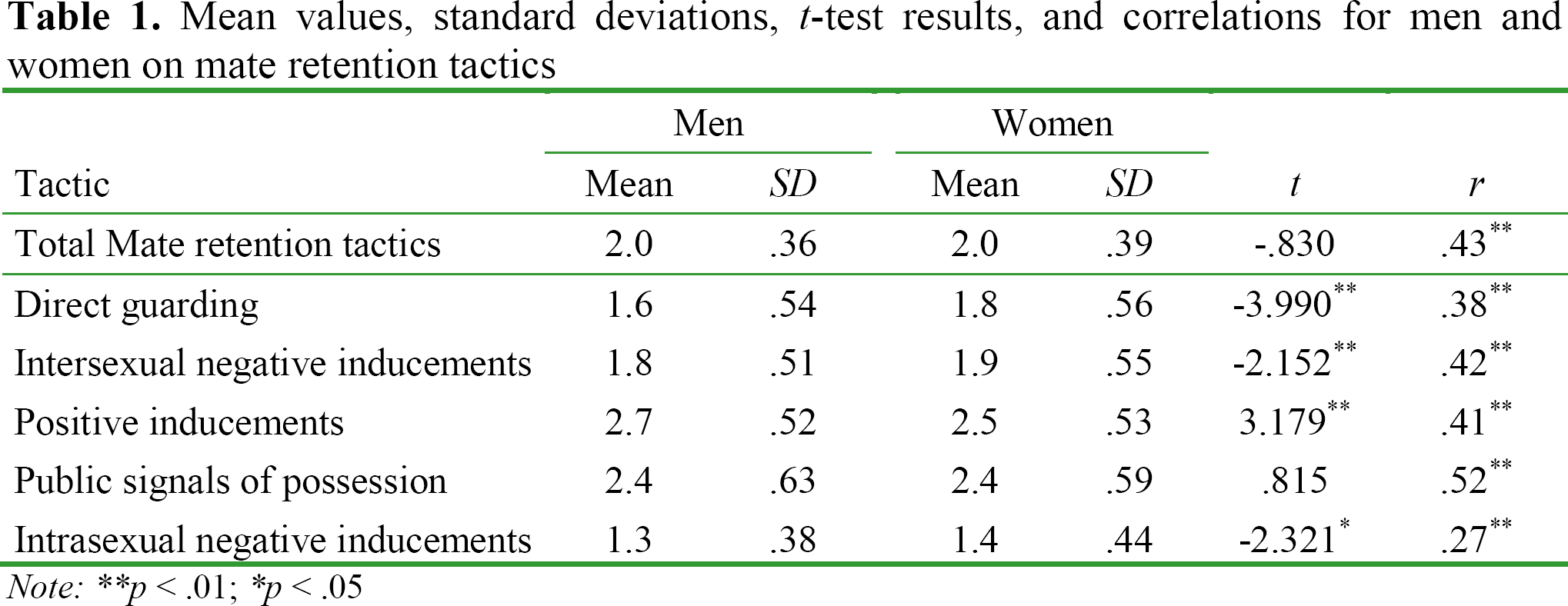
As predicted in Hypothesis 1, there was no statistically significant sex difference in the frequency of the total number of the mate retention tactics, and there were moderate to high correlation coefficients between men and women (see Table 1).
Mean values, standard deviations, t-test results, and correlations for men and women on mate retention tactics
Note: **p < .01;
p < .05
We did not confirm the second part of the prediction; in four of the five larger categories of mate retention, we found statistically significant differences: Men displayed more positive inducements, whereas women displayed more direct guarding, as well as intersexual and intrasexual negative inducements. We found no statistically significant sex difference in public signals of possession (see Table 1).
Correlates of mate retention tactics
The total number of mate retention tactics in women was positively correlated with a higher partner's (men's) mate value and women's relationship satisfaction (see Table 2), whereas in men it was negatively correlated with mate value difference (see Table 3).
Correlations of mate retention strategies displayed by women and mate values, mate value differences, and relationship satisfaction

Note: **p < .01;
p < .05
Correlations of mate retention strategies displayed by men and mate values, mate value differences and relationship satisfaction

Note: **p < .01;
p < .05
As expected by Hypothesis 2, partner's positive inducements and public signals of possession correlated positively with their own mate value both in women and men, with higher correlations for women (see Table 2 and Table 3). Furthermore, direct guarding behavior and intrasexual negative inducements were negatively correlated with men's mate value. We have also found positive correlations between the mate value of both sexes and their use of positive inducements and public signals of possession. In both sexes, their use was more strongly correlated with men's mate value.
Intrasexual negative inducements displayed by women were negatively correlated with their own and their partner's mate value, whereas direct guarding displayed by women was negatively correlated only with their own mate value.
We confirmed Hypothesis 3: One's own relationship satisfaction correlated positively with positive inducements and public signals of possession displayed by the partner (see Table 2 and Table 3). The same is found for one's own behavior and relationship satisfaction, with higher correlations between women's relationship satisfactions and their behavior. Intrasexual negative inducements displayed by women and men correlated negatively with their partner's relationship satisfaction. Additionally, a negative correlation was found between women's display of that behavior and their relationship satisfaction. Direct guarding by partner and relationship satisfaction were negatively correlated in men and women, as well as relationship satisfaction of women and their partner's display of Intersexual negative inducement. Direct guarding in both sexes was negatively correlated with one's relationship satisfaction.
As predicted in Hypothesis 4, mate value difference was negatively correlated with men's and women's display of positive inducements and public signals of possession and relationship satisfaction, whereas intrasexual negative inducements displayed by women was positively correlated with mate value difference (see Table 2 and Table 3). We have also found moderate to high correlations between relationship satisfaction and mate values and mate value difference: Both women and men reported higher relationship satisfaction when partner's and their own mate value were higher, and their mate values more similar (see Table 4).
Correlations among relationship satisfaction, mate values and mate value differences for men and women

Note: **p < .01;
p < .05
In order to examine the relationship between all of the aforementioned variables, we conducted a two-stage hierarchical regression analysis with relationship satisfaction as the dependent variable, for women (see Table 5) and men (see Table 6) separately. The mate values of both partners were entered at stage one, and mate retention strategies were entered at stage two.
Summary of hierarchical regression analysis for variables predicting relationship satisfaction in women

Note: **p < .01;
p < .05
Summary of hierarchical regression analysis for variables predicting relationship satisfaction in men

Note: **p < .01;
p < .05
In women, our first set of predictors explained 63% of the variance, and the introduction of the second set of predictors—mate retention tactics—did not significantly improve the percentage of variance explained by the model (see Table 5). In men, the first step explained 29% of variance, and the additional predictors explained an additional 14% of the variance and significantly improved the model, which explained in total 43% of the variance (see Table 6).
In men and women, self and partner mate values were found to be positive predictors of relationship satisfaction. Men's mate value was a stronger predictor of relationship satisfaction for both sexes. For men, their own mate value is a stronger predictor of relationship satisfaction than their partner's mater value, which is contradictory to the results found in women. Relationship satisfaction in men was also predicted negatively by intrasexual negative inducements and positively by public signals of possession displayed by their partners.
We found no mediating role of mate retention tactics on the relationship between mate value and relationship satisfaction in women. Sobel's test was performed to confirm the mediation effect of public signals of possession and intrasexual negative inducements on the relationship between men's and women's mate value and relationship satisfaction in men. For men's mate value, the mediated effect for public signals of possession was significant, Sobel's z = 3.09, p < .01, and it was also significant for intrasexual negative inducements, Sobel's z = 2.61, p < .01. For women's mate value, the mediated effect for public signals of possession was significant, Sobel's z = 2.51, p < .05, and it was also significant for intrasexual negative inducements, Sobel's z = 3.63, p < .01. We can conclude that public signals of possession and intrasexual negative inducements are mediators of the relationship between men's and women's mate value and men's relationship satisfaction.
Discussion
Even though, in general, both sexes use mate retention tactics with the same frequency, it seems that women use more tactics if they find their mate more valuable and if they are more satisfied with the relationship, which is not surprising as the cost of losing such a good mate is too high. The same findings do not apply to men; their use of mate retention tactics is higher when they are more similar in their “quality,” but they “give up” retention or do not even try when that difference is larger in both directions. It could be that highly valuable men partnered with lower mate value women do not have to try as women do their best to keep them. Our results show that women's use of two benefit-inducing strategies (positive inducements and public signals of possession) is more highly correlated with men's mate value than vice versa. Concerning men of lower mate value, it could be they do not even try to keep their partners because they use less cost-inflicting strategies and are unfamiliar with or less inclined to use benefit inducing strategies, which could possibly be the reason behind their low mate value. Use of mate retention strategies could be necessary in order to be perceived valuable and interested in the relationship and partner we are trying to keep.
Women use more direct guarding and intersexual and intrasexual negative inducements, three categories which can be interpreted as cost-inflicting on their partners (Miner, Starratt, et al., 2009). When people use these strategies, mates are not given an opportunity for a new mate acquisition as their contacts are limited, potential competition is derogated, scared or chased away, commitment is forced and manipulated, and they are presented as less desirable mates. Men use more positive inducements in which they provide financial, sexual, and emotional benefit and support. The reason for such differences could be that women are more prone to using strategies that limit the number of opportunities for men to cheat, but at the same time they try to strengthen the bond by formalizing the relationship and showing a greater commitment. Men, on the other hand, only try to make themselves as good mates as possible, which is consistent with our finding that women have a tendency to retain a good mate and to avoid possible desertion. Both sexes use public signals of possession to a similar extent, in order to mark each other as their own.
Our results suggest that mate retention tactics used in a relationship are related to the mate value of both partners, and also to the relationship satisfaction. Positive inducements and public signals of possession, which have been called benefit-inducing mate retention tactics (Miner, Starratt, et al., 2009), are more displayed by and towards partners with higher mate value, and they provide a positive relationship climate in which partners are satisfied. Such behavior provides the mate with reasons to stay and keep investing in their partner and signals to others that they are no longer available. These strategies, displayed by both sexes, are more correlated with men's mate value, which is consistent with previous research on retention strategies used by men (Miner, Starratt, et al., 2009). It could also be said that men find their partners more valuable if they display more public signals of possession, which show the competition that the woman is taken and unavailable; women, on the other hand, value men that display more positive inducements, those who provide them with material goods, which is consistent with men being more valued as mates if they are providers.
These positive strategies used by men and women are correlated with higher relationship satisfaction of both men and women, so we could say that when more satisfied with a relationship, both use more of these benefit provisioning tactics, which in turn makes their partners more satisfied. It seems these retention strategies serve two functions: Not only do they keep our mate, but they also signal to our mate that we are good partners who benefit them. Mate's behavior that is controlling decreases relationship satisfaction, probably because such behavior signals distrust and could be overbearing. Whereas men's relationship satisfaction does not suffer if a woman manipulates them (intersexual negative inducements), such behavior of men makes women less satisfied with the relationship.
We have found a sex difference in the relationship between mate value, retention strategies, and relationship satisfaction. In women, their partner's mate value has such a strong relationship with their relationship satisfaction that his mate retention behaviors do not impact their relationship satisfaction. For men, public signals of possession and intrasexual negative inducements add explanatory power regarding relationship satisfaction, while it also seems that men's relationship satisfaction is more influenced by his mate value then his partner. A possible explanation is that women's relationship satisfaction is more related to their evaluation of the partner than his behavior toward her, or maybe it is more related to some other behaviors that are not included in the used measure, such as communication, love orientation, and relationship expectations (Meeks, Hendrick, and Hendrick, 1998; Miller and Tedder, 2011). The possible explanation for men's relationship satisfaction being more related to their own mate value is that women's behavior is more influenced by their partner's mate value, and that has a greater impact on men's perception of the relationship. This is confirmed by our mediator analysis: Women's behavior mediates the relationships of men's mate value and their relationship satisfaction.
When all of the aforementioned is taken into account, it is not surprising that our partner's mate value is positively related to our relationship satisfaction. A highly valuable partner makes sure we benefit from that relationship using retention tactics that make him (or her) a better mate, and uses less tactics that cost us time or derogate us. Another factor that makes relationships happier is a similarity in mate value—i.e., similar mate value might make both partners work equally hard to keep each other and in that way they both feel they are equally investing in the relationship. Both men and women of lower mate value use more of the cost inflicting retention tactics, which also has a negative effect on relationship satisfaction.
Our data are based on correlations and that does not allow us to make causal conclusions. Retention tactics, mate value, and relationship satisfaction are correlated, but we cannot guarantee the direction we proposed is correct. Positive mate retention tactics can be used by mates of higher value, but also better mates can earn that appraisal based on their use of positive tactics. People less satisfied in their relationship can use less mate retention tactics or partners who use more benefit-inducing mate retention tactics can be more satisfied in the relationship. Future longitudinal research could clarify the relationship of mate value, retention behaviors, and relationship satisfaction.
Part of our conclusions were based on an analysis of a large number of correlations that could have caused a Type I error and made us wrongly infer the existence of a relationship between variables. The problem of multiple comparisons can be solved by the Bonferroni correction; however, some authors do not recommend the use of this statistical procedure because it can inflate the possibility of a Type II error and cause false acceptance of the null hypothesis (e.g., Nakagawa, 2004; Perneger, 1998).
Our sample is quite novel in this area of research (quasi-stratified quota sampling with data collected in participants' homes and data collected from both members of the pair) and gives us an opportunity to look at previously uninvestigated relations, but it is possible that, although our participants had been asked to fill out the questionnaires by themselves, some couples may have disobeyed and cooperated.
The used Mate Value Inventory is a reliable and often used measure of mate value, but it is not sex-specific and it is possible that some of our participants got higher results because they have characteristics that are not highly desirable for that sex—e.g., a man may have an attractive face, which is a characteristic more desirable in women, whereas a woman could be financially secure, which is a trait more desirable in men. Future research could benefit from the construction of new sex-specific measures of mate value.
Practical implications of our research are particularly valuable for the couples that want to experience higher relationship satisfaction with some very simple behaviors that will also make their partners want to stay with them: Giving compliments, openly showing affection, and being responsive to a partner's wishes are good guidelines to making sure your partner knows you like him/her and will make them more happy in a relationship.
Conclusion
We have confirmed all except two parts of our hypotheses: We have not found sex differences in the absolute frequency of mate retention tactics used, we found a higher frequency of positive inducements and public signals of possession in partners of people of higher mate value, and we found that men of lower mate value exhibit more direct guarding and intrasexual negative inducements. We also found a higher relationship satisfaction and positive inducements and public signals of possession, and a lower relationship satisfaction in men and women whose partners exhibit more direct guarding and intrasexual negative inducements. Relationship satisfaction was higher for men and women in couples with more similar mate value, and they also expressed more positive inducements and public signals of possession and less direct guarding and intrasexual negative inducements. Public signals of possession and intrasexual negative inducements were partial mediators of mate values and relationship satisfaction in men, whereas in women partners and own mate value were the only predictors of relationship satisfaction. Unexpectedly, we found sex differences in four of the five mate retention strategies. These findings emphasize the effect of mate retention tactics on relationship satisfaction as well as its close relationship with mate value: One's behavior towards his/her partner with the intention of benefiting him/her will make the partner more satisfied with the relationship and will make him/her value his/her partner more.