




Abstract
Previous research has demonstrated that men’s lower mate value predicts increased perpetration of mate retention, especially with respect to cost inflicting behaviors. It is less clear if lower mate value women, including those who perceive themselves as being less physically attractive than their intrasexual rivals, also perpetrate more mate retention. Moreover, it is presently unclear whether romantic jealousy, which has been proposed to motivate compensatory behavior in response to evidence that a valued mating relationship is threatened, might mediate this link. The present study addressed this gap in knowledge by examining whether women’s overall self-perceived mate value and upward physical appearance comparisons predicted their cost inflicting and benefit provisioning mate retention, as well as whether jealousy mediated these relationships. In a sample of 167 heterosexual undergraduate women, results found self-perceived mate value predicted greater benefit provisioning mate retention, but not romantic jealousy. In contrast, jealousy mediated the relationship between women’s upward physical appearance comparisons and both their cost-inflicting and benefit-provisioning mate retention, supporting the hypothesis that jealousy in the face of unfavorable social comparisons on important mate value traits can promote action aimed at retaining a mate.
Keywords
Individuals vary from one another in the frequency and intensity of their mate retention behavior. To date, considerable research has focused on men’s mate retention in relation to their own mate value, as well as their partners’ mate value. Findings from these studies generally coalesce to suggest that men who are lower in mate value (e.g., Holden et al., 2014; Miner, Starratt, & Shackelford, 2009) or whose partners are of a relatively higher mate value than they are (Buss & Shackelford, 1997a; Goetz et al., 2005), engage in more mate retention effort; particularly with respect to cost inflicting behaviors. Some research has suggested that men’s own mate value is a better predictor of their scores on the Mate Retention Inventory than their partners’ mate value, as rated by their young adult female partners (Miner, Starratt, & Shackelford, 2009). Moreover, Miner, Shackelford, and Starratt (2009) found in a survey of young women recruited from universities and surrounding communities that men’s own mate value was also more strongly correlated with their partner-directed insults, as an additional index of cost inflicting mate retention, compared to their partners’ mate value. Together, these studies highlight the role of individuals’ own mate value as a key predictor of mate retention effort. Yet to date, little research has examined indices of women’s mate value in relation to their mate retention behavior. Given the particular relevance of physical appearance in determining women’s mate value (Buss, 1989), the present study explored whether women’s mate retention behavior is predicted by self-perception of their overall mate value, their partner mate value, or their frequency of upward physical appearance comparisons, which involves attending to evidence that one is less attractive than other women. A further goal of this research was to determine whether romantic jealousy, as a mechanism for promoting compensatory behavior in response to the threatened loss of a desired partner, mediates these relationships.
Mate Value and Mate Retention
Because mate retention is both costly and potentially risky (especially cost inflicting tactics), it is unlikely to be perpetrated indiscriminately; rather, such actions should be performed most often by those of lower mate value, who are ostensibly at greatest risk of losing a desired partner (Arnocky et al., 2012; Miner, Starratt, & Shackelford, 2009). For women, physical attractiveness may be one important mate value trait implicated in their mate retention effort. Research has shown that newlywed men with less attractive female partners are less satisfied with their relationships, whereas men’s attractiveness bears less meaningfully upon women’s relationship satisfaction (Meltzer et al., 2014). Moreover, women who perceive their partners as being of higher mate value than them report greater perceived odds of their partner cheating on them (Buss & Shackelford, 1997b). Females lower in markers of physical attractiveness, such as being high in body mass index, are significantly less likely to have dating and sexual partners, and are more dissatisfied with their dating status compared to their normal weight peers (see Arnocky, Bird, & Perilloux, 2014, for review).
The relationship between low mate value and mate retention may be particularly relevant to cost inflicting behaviors. Researchers have reasoned that individuals with higher mate value are best able to provide benefits to their partners (e.g., resources, a desirable phenotype) as a mechanism of retaining their mates, whereas those of lower mate value, who cannot confer such benefits to the same degree, must instead resort to cost-inflicting mate retention tactics which are meant to reduce the partner’s self-esteem, deter rivals from mating with their partner, and prevent the partner from seeking alternate mating opportunities (Arnocky et al., 2012; Chaudhary et al., 2018). In support of this, Salkicevic et al. (2014) found in a sample of adult Croatian couples recruited from the community, that men and women of higher mate value engaged in more benefit-provisioning mate retention whereas those lower in mate value engaged in more cost inflicting mate retention.
Attractive females are more often the targets of male mate retention effort (Kaighobadi & Shackelford, 2008), yet little is known about whether less attractive, and hence lower mate value, women are more prone to experiences of romantic jealousy and perpetration of mate retention behavior. Nevertheless, it is well established that physical appearance is fundamentally intertwined with women’s mate retention behavior. Research suggests that effort aimed at augmenting one’s physical appearance might serve as a form of benefit provisioning mate retention for women. Women more than men report more frequent appearance enhancement (benefit provisioning) as well as derogating a rival (cost inflicting) as components of their mate retention repertoires. Moreover, women’s mate retention correlates with other tactics aimed at enhancing their physical appearance. For instance, Atari, Barbaro, Sela, et al. (2017) found that women’s, but not men’s, consideration of cosmetic surgery correlated with benefit provisioning mate retention behavior. Interestingly, consideration of cosmetic surgery and other appearance enhancement effort is also associated with women’s perceived physical attractiveness relative to other women (Arnocky et al., 2016; Arnocky & Piché, 2014).
Indeed, the extent to which individuals engage in more diverse mate retention behaviors also appears to hinge, in part, upon their own attractiveness and mate value (c.f. Chaudhary et al., 2018). Mate value, or the extent to which an individual would enhance their mate’s reproductive success (Sugiyama, 2005), is often measures using self-report instruments such as the Mate Value Scale (Edlund & Sagarin, 2014), containing items assessing individuals’ perceptions of their own desirability to members of the opposite sex. Low mate value individuals have been found to engage in more direct guarding and intrasexual negative inducements and fewer benefit provisioning acts such as public signals of possession (Salkicevic et al., 2014). Specific to physical attractiveness, Oltmanns et al. (2017) found in a sample of American male and female undergraduate couples that individuals’ other-rated attractiveness did not predict their mate retention behavior, yet dissimilarity in the attractiveness between the partners did; those who were less attractive than their partners were more likely to engage in mate retention behavior (see also: Nascimento & Little, 2019). Higher discrepancies between partners in physical attractiveness has also shown to correlate with more experienced jealousy in an American undergraduate sample (Sidelinger & Booth-Butterfield, 2007).
Beyond attractiveness relative to partners, one’s attractiveness relative to intrasexual rivals also appears to play a role in predicting mate retention behavior. More frequent upward physical appearance comparison indicates greater perception that one is less physically attractive than other women (O’Brien et al., 2009). It involves overtly comparing one’s physical appearance to the appearance of same-sex others, including magazine models, at the beach or athletic events, wondering if one’s body is as attractive as others’, and explicitly focusing on how one’s body compares to those perceived as being more attractive. Upward physical appearance comparison relates to lower body satisfaction, lower perceived attractiveness, and higher scores on an eating disorder index (O’Brien et al., 2009).
Arnocky et al. (2012) found that women who made more frequent upward appearance comparisons predicted perpetration of relational aggression toward romantic partners and peers in a large sample of pair-bonded heterosexual female undergraduates. Moreover, the relationship between appearance comparison and aggression was mediated by jealousy, such that upward attractiveness comparisons predicted more romantic jealousy, which in turn predicted more aggression toward one’s partner and peers. The authors reasoned that women who view themselves as low on the important mate value characteristic of physical attractiveness compared to their intrasexual rivals perceive themselves as being at a mating disadvantage, and hence engage in more cost-inflicting intersexual and intrasexual competitive actions. Moreover, the authors reasoned that jealousy serves as an evolved affective mechanism meant to motivate such compensatory actions in the face of unfavorable social information about our mate value.
Jealousy and Mate Retention
Researchers have hypothesized that jealousy evolved to motivate behavior in response to threats to a valued romantic relationship, such as the presence of more desirable intrasexual rivals (e.g., Buss, 2000; Buss & Haselton, 2005). A recent meta-analysis supports the hypothesis that women, more than men, experience jealousy in response to attractive intrasexual rivals (Pollet & Saxton, 2020). Additionally, research has shown that undergraduate men and women low in important mate value characteristics, such as health, exhibit more romantic jealousy (Arnocky et al., 2015) as do individuals who are lower in total mate value relative to their partner (Sidelinger & Booth–Butterfield, 2007). Similarly, Brown and Moore (2003) found in a small sample of undergraduate men and women, that fluctuating asymmetry, as a marker of lower mate value, predicted more romantic jealousy in mating-specific, but not in non-mating, contexts. Evolution-minded researchers have speculated that emotions evolved as psychological mechanisms that become selectively activated in response to threats to survival or reproductive fitness. Activation of these emotions promotes compensatory behavior to deal with the threat or adaptive challenge (see Al-Shawaf et al., 2016, for review). Indeed, previous research has linked jealousy to various mate retention tactics, including aggression toward the mate or toward an interloper (e.g., Arnocky, Ribout, et al., 2014). Jealousy has also been linked to cost inflicting and benefit provisioning mate retention scores (Atari, Barbaro, Shackelford, & Chegeni, 2017). Using this framework, it is anticipated that jealousy should mediate the relationship between upward appearance comparisons (threat) and mate retention behavior (response).
The Present Study
Previous research has linked low mate value to the perpetration of mate retention behavior, primarily in men. The present study extended this research to examine self-perceived relative attractiveness and mate retention. We hypothesized that women’s self-perceived physical attractiveness relative to other women (measured via upward comparison frequency), as well as lower scores on their overall self-perceived mate value, would predict their mate retention effort. Moreover, we anticipated this would be driven largely by a relationship with cost inflicting, but not benefit provisioning, mate retention subscale scores. Further, based upon evolutionary reasoning that jealousy motivates compensatory behavior in the face of threat to a valued romantic relationship, we hypothesized that jealousy would mediate the link between upward appearance comparison, mate value, and mate retention. To test these hypotheses, we sampled heterosexual women who were either currently in a sexual relationship with a man, or had been in one within the past year. Previous research shows that cost inflicting mate retention is linked to greater odds of relationship dissolution (Delecce, 2017). Accordingly, limiting the sample to only those currently in relationships would likely artificially reduce the measured frequency of such behavior. Rather, we controlled for current relationship status in the mediation models.
Method
Participants
A-priori sample size for mediation analyses was determined following guidelines set forth by Fritz and MacKinnon (2007), which revealed a requisite sample of 148 to achieve .8 power with anticipated small-medium effects for both the X-M and M-Y paths (α = 0.26, β = 0.26, bias-corrected confidence intervals). We oversampled to account for missing data; 189 women completed the survey, 21 of whom reported a non-heterosexual orientation and were not included in the analytical data set for this study. Therefore, the final sample comprised of 167 heterosexual undergraduate women aged 17–37 from Nipissing University located in North Bay, Ontario, Canada (Mage = 20, SD = 2.62). Of these, 97 reported currently being in a committed heterosexual romantic relationship. Ninety-one percent of the participants were Caucasian. The Nipissing University Research Ethics Board approved all procedures. Cases with missing values were excluded list wise from the analyses.
Procedure and Measures
Participants completed all procedures in the laboratory in a private testing room. As part of a larger protocol, participants completed a computerized survey assessing basic demographic information as well as the following self-report measures. For each measure, participants were asked to think about their present romantic relationship, or if currently single, their most recent romantic relationship (with the exception of partner mate value).
Upward appearance comparison
Participants completed the Upward Appearance Comparison Scale (UPACS; O’Brien et al., 2009). The measure is comprised of 10 items measuring the extent to which one compares their physical appearance in an upward (i.e., unfavorable) manner to other women using a 5-point scale with response options ranging from 1 = Strongly Disagree to 5 = Strongly Agree. Example items are: “I tend to compare my own physical attractiveness to that of magazine models,” “At the beach or athletic events (sports, gym, etc.) I wonder if my body is as attractive as the people I see there with very attractive bodies,” and “I tend to compare myself to people I think look better than me.” Items were averaged to create a mean score, and the measure showed good internal consistency (α = .89).
Jealousy
Romantic jealousy was measured using the 24-item multidimensional jealousy scale (Pfeiffer & Wong, 1989). The measure captures three facets of romantic jealousy using eight items each: cognitive, emotional, and behavioral using a 7-point scale anchored at Never/Very Pleased to Always/Very Upset. Example items include: “How often do/did you have the following thoughts about X? I suspect that X may be attracted to someone else” (cognitive), “How would you emotionally react to the following situation? X is flirting with someone of the opposite sex” (emotional), and “How often do/did you engage in the following behaviors? I question X about his whereabouts” (behavioral). Given that we had no a-priori hypotheses about any specific facets of jealousy being more or less complicit in mediating links between appearance comparison and mate retention, and consistent with previous use of this measure in the field of mating competition (e.g., Maner et al., 2007), we averaged all items together into a composite romantic jealousy score, which demonstrated good internal consistency (α = .88).
Mate retention
Mate retention was measured using the 38-item Mate Retention Inventory-Short Form (MRI-SF; Buss et al., 2008). Participants indicate how often they have performed the target behavior in the past year along a 4-point Likert-type scale ranging from 0 = Never to 3 = Often. The measure can be broken down into cost inflicting (i.e., direct guarding, intersexual negative inducements, and intrasexual negative inducements) and benefit provisioning factors (i.e., positive inducements, public signals of possession). An example of a cost inflicting item is “Insisted that my partner spend all his free time with me,” whereas an example of a benefit provisioning item is “Bought my partner an expensive gift.” Items were averaged to create mean scores for total mate retention and the two subscales. Both the benefit provisioning (α = .91) and cost inflicting (α = .84) subscales as well as the overall measure showed good internal consistency (α = .92).
Mate value
The Mate Value Scale (Edlund & Sagarin, 2014) is a brief assessment of overall self-perceived mate value. The measure contains the following four items anchored along a 7-point Likert-type scale. Example items are: “Overall, how would you rate your level of desirability as a partner on the following scale?”, “Overall, how would members of the opposite sex rate your level of desirability as a partner on the following scale?”, “Overall, how do you believe you compare to other people in desirability as a partner on the following scale?” and “Overall, how good of a catch are you?” Items were averaged to create a mean score. In the present study, the MVS showed good internal consistency (α = .88). Participants who were currently in a romantic relationship were additionally asked to complete the same items in reference to their current partner (α = .85).
Results
We first examined the bivariate correlations among study variables (Table 1). Results showed that upward appearance comparison correlated positively with jealousy and mate retention, as well as both the cost inflicting and benefit provisioning subscales. Self-perceived mate value correlated positively with total mate retention and both subtypes, but did not correlate with jealousy, precluding jealousy from being considered as a mediator of these links. Conversely, among the subsample of participants (n = 97) currently in a romantic relationship, the perceived mate value of participants’ partners did not correlate with either jealousy or mate retention.
Descriptive Statistics and Bivariate Correlations for All Study Variables.

Note. Indicators of statistical significance are as follows: †p < .10. *p < .05. **p < .01. ***p < .001.
Therefore, models (PROCESS, Model 4; Hayes, 2013) were tested to examine whether jealousy mediated links between unfavorable physical appearance comparisons and mate retention, controlling for direct effects of current romantic relationship status (1 = yes, 2 = no) and self-perceived mate value (n = 150). Upward appearance comparison predicted higher jealousy scores, b = .29, SE = .07, t(146) = 4.07, p < .001, controlling for the effect of relationship status, b = .24, SE = .11, t(146) = 2.16, p = .03, and mate value, b = .12, SE = .06, t(146) = 1.91, p = .06. The initial relationship (total effect) between upward comparison and mate retention was statistically-significant, b = .09, SE = .04, t(146) = 2.34 p = .02. Current relationship status also predicted reported mate retention effort, b = −.36, SE = .05, t(146) = −6.20, p < .001, such that those currently in relationships reported more mate retention effort over the past year. Mate value also predicted women’s mate retention effort, b = .10, SE = .03, t(146) = 2.90, p = .004, whereby women who believed themselves to be of higher mate value engaged in more mate retention behavior. When jealousy was included into the model, the direct effect of upward appearance comparison was reduced to statistical non-significance, b = .01, SE = .04, t(145) = 0.35, p = .73. Jealousy predicted women’s mate retention, b = .27, SE = .04, t(145) = 6.91, p < .001, mediating the link between upward comparison and mate retention, indirect effect b = .08, SE = .02, 95%CI [.03, .12], Sobel z = 3.62, p < .001; Figure 1. Conversely, the effects of both relationship status, b = −.43, SE = .05, t(145) = −8.23, p < .001, and mate value, b = .07, SE = .03, t(145) = 2.22, p = .03, remained significant. The model contributed 29% toward explained variance in women’s mate retention effort (R2 = .29).
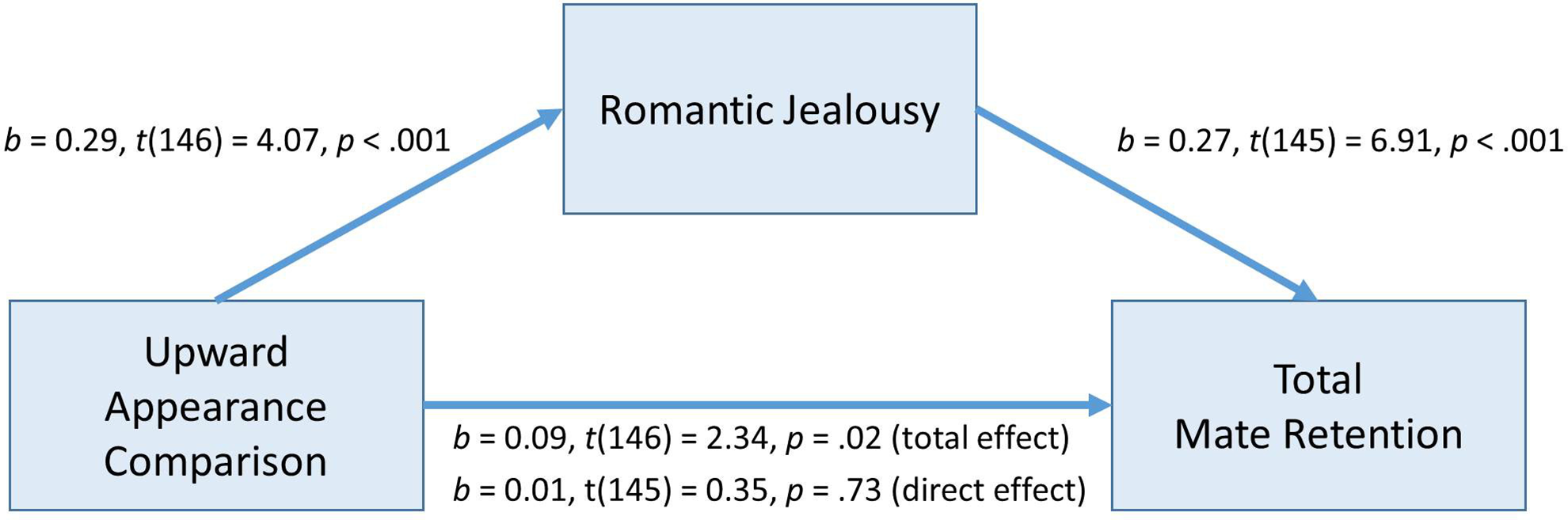
Mediation model depicting the mediating role of jealousy to the relationship between upward physical appearance comparison and total mate retention. Note. Missing cases excluded list wise (n = 150).
Next we explored whether this mediation effect was applicable to both cost inflicting and benefit provisioning mate retention tactics (n = 155). First, upward appearance comparison predicted cost inflicting mate retention, total effect: b = .09, SE = .04, t(151) = 2.49, p = .01, controlling for current relationship status, b = −.20, SE = .06, t(151) = −3.52, p = .006, and mate value, b = .05, SE = .03, t(151) = 1.51, p = .13, the latter of which was unrelated to cost inflicting mate retention. However, when jealousy was included into the model, the direct effect of upward appearance comparison in relation to cost inflicting mate retention was reduced to statistical non-significance, b = .01, SE = .03, t(150) = 0.40, p = .69. Jealousy predicted women’s mate retention, b = .27, SE = .04, t(150) = 7.24, p < .001, mediating link between upward comparison and mate retention, indirect effect b = .08, SE = .02, 95%CI [.04, .12], Sobel z = 3.38, p < .001; Figure 2. The model contributed 13% toward explained variance in women’s cost inflicting mate retention effort R2 = .13. 1
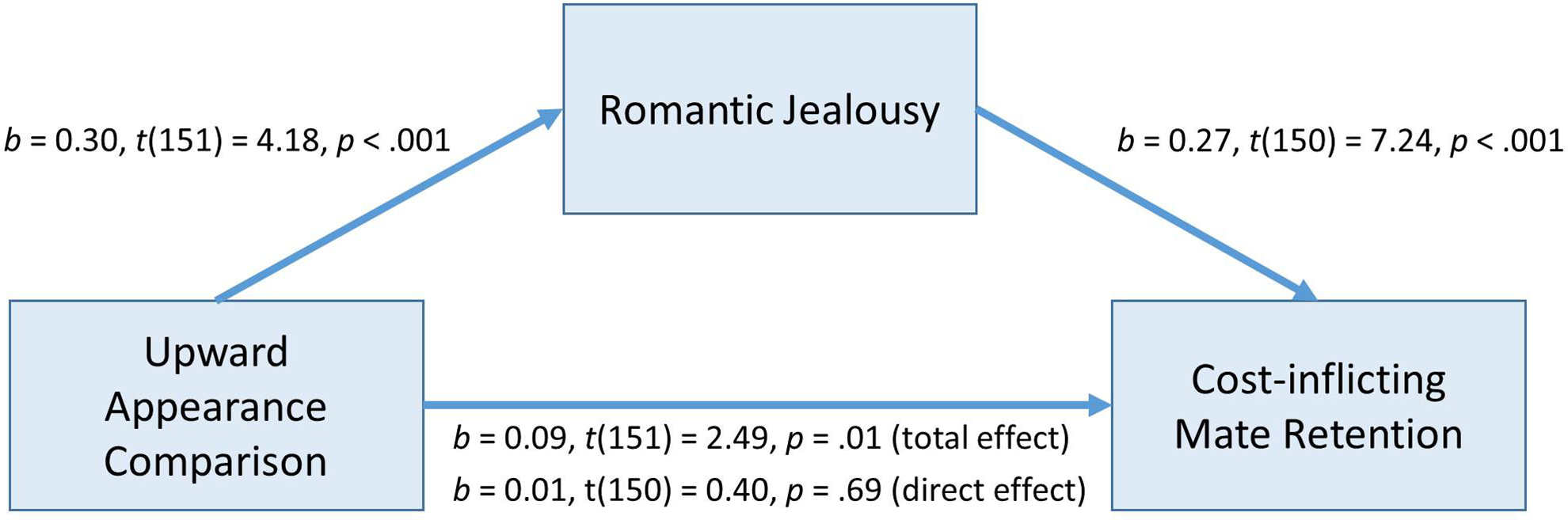
Mediation model depicting the mediating role of jealousy to the relationship between upward physical appearance comparison and cost-inflicting mate retention. Note. Missing cases excluded list wise (n = 155).
Second, upward appearance comparison was modestly related to benefit provisioning mate retention, total effect: b = .08, SE = .05, t(151) = 1.73, p = .08, controlling for the effect of current relationship status, b = −.47, SE = .07, t(151) = −6.94, p < .001, and mate value, b = .13, SE = .04, t(151) = 3.32, p = .001, both of which related significantly to benefit provisioning. When jealousy was included into the model, the direct effect of upward appearance comparison in relation to benefit provisioning mate retention was reduced to statistical non-significance, b = −01, SE = .04, t(150) = −.07, p = .94. Jealousy predicted women’s mate retention, b = .19, SE = .05, t(150) = 3.74, p < .001, mediating link between upward comparison and mate retention, indirect effect b = .08, SE = .02, 95% CI [.04, .13], Sobel z = 3.43, p < .001; Figure 3. Conversely, the effects of both relationship status, b = −.53, SE = .06, t(150) = −8.34, p < .001, and mate value, b = .11, SE = .04, t(150) = 2.97, p = .003, remained significant. The model contributed 14% toward explained variance in women’s benefit provisioning mate retention effort (R2 = .14).
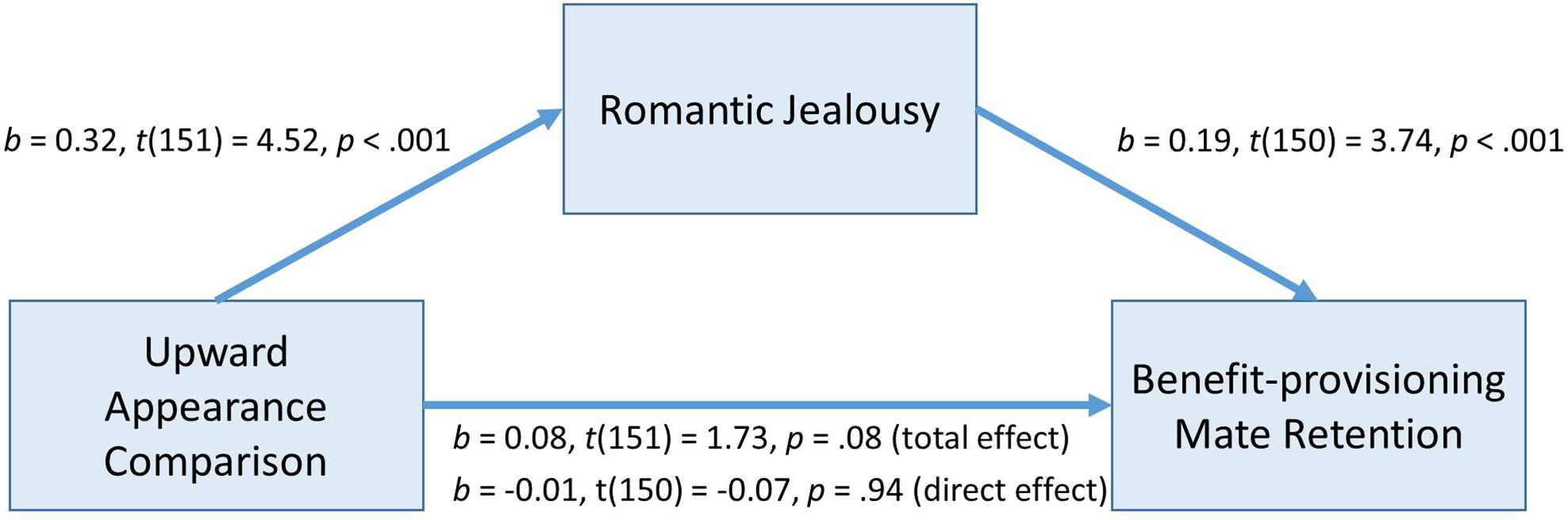
Mediation model depicting the mediating role of jealousy to the relationship between upward physical appearance comparison and benefit-provisioning mate retention. Note. Missing cases excluded list wise (n = 155).
Next, we tested an alternative model whereby upward appearance comparison may mediate links between jealousy and mate retention, again controlling for relationship status and self-perceived mate value. Results did not support this model. Specifically, the predictive role of jealousy in relation to mate retention, b = .27, SE = .04, t(146) = 7.42, p < .001, was not meaningfully reduced upon inclusion of appearance comparison as a mediator, b = .27, SE = .04, t(145) = 6.91, p < .001; indirect effect b = .004, SE = .01, 95%CI [−.02, .02], Sobel z = 0.25, p = .80, which itself was unrelated to mate retention, b = .01, SE = .04, t(145) = 0.35, p = .73. The same pattern emerged when examining cost inflicting and benefit provisioning separately. Jealousy predicted cost inflicting mate retention, b = .27, SE = .04, t(151) = 7.80, p < .001, which was not meaningfully reduced by inclusion of the mediator, b = .27, SE = .04, t(150) = 7.24, p < .001; indirect effect b = .004, SE = .01, 95%CI [−.02, .03], Sobel z = 0.33, p = .74. Appearance comparison was unrelated to cost inflicting mate retention, b = .01, SE = .03, t(150) = 0.40, p = .69. Similarly, for benefit provisioning, Jealousy predicted cost inflicting mate retention, b = .25, SE = .04, t(151) = 5.65, p < .001, which was not meaningfully reduced by inclusion of the mediator, b = .25, SE = .05, t(150) = 5.31, p < .001; indirect effect b = −.001, SE = .02, 95%CI [−.03, .03], Sobel z = 0.01, p = .80. Appearance comparison was unrelated to cost inflicting mate retention, b = −.01, SE = .04, t(150) = −0.07, p = .94. Together these findings suggest that an opposing model, whereby women who are romantically jealousy may be more likely to compare themselves to same-sex rivals in order to determine intrasexual threats would engage in more mate retention, was not supported.
Discussion
Researchers have hypothesized that jealousy evolved as an emotion that promotes mate retention efforts, spanning from cost inflicting to benefit provisioning tactics, in the face of threats to a valued mating relationship (Arnocky et al., 2012; Buss & Haselton, 2005). Although this describes a model whereby the emotion (in this case, jealousy) should mediate the link between the stimulus and the response, little research has tested such models to date. One such threat previously linked to the perpetration of mate retention behavior is low mate value (e.g., Buss & Shackelford, 1997a; Miner, Starrat, & Shackelford, 2009), and more specifically for women, indicators of low physical attractiveness relative to same-sex rivals (Arnocky et al., 2012). Using this framework, it was hypothesized that women who make more frequent upward physical appearance comparisons would engage in more mate retention, both in terms of cost inflicting and benefit provisioning acts, and these relationships would be mediated by romantic jealousy.
Results supported the hypothesis that jealousy mediated the relationship between upward physical appearance comparison and overall mate retention, replicating and extending previously established links (Arnocky et al., 2012). Conversely, a theoretically plausible alternative model, whereby jealous women more often utilize appearance comparisons to ascertain threats to the romantic relationship, and respond in turn with more mate retention effort, was not supported. Although research to date has suggested that low mate value should correspond most strongly with cost inflicting behavior, our results demonstrated that this mediation effect held for both cost inflicting and benefit provisioning mate retention. This could be a function of the studied sample. Young adult university students are likely of higher socioeconomic status backgrounds and youthfulness than average adult members of the broader population at large. It is noteworthy that the initial link between appearance comparison and mate retention was much stronger for cost inflicting versus benefit provisioning behavior. Moreover, one’s overall perception of their own mate value, which was unrelated to jealousy and cost inflicting mate retention, was directly and positively related to benefit provisioning mate retention. Together these findings support previous research suggesting that individuals of higher mate value engage in more benefit provisioning, whereas those who are lower in mate value engage in more cost inflicting mate retention (Salkicevic et al., 2014).
There appears to be a meaningful distinction between the two measures of mate value in this study. Perhaps social comparisons reflect a lowered threshold for detecting intrasexual threats on traits relevant to individuals’ mate value, and it is the threat perception component that drives jealousy and mate retention. In other words, it may be that simply being low on mate value (or an important mate value trait) is not sufficient to motivate jealously and mate retention in and of itself, but rather must be coupled with a perceived threat associated with one’s standing on that trait. Indeed, some researchers have likened unfavorable appearance comparisons to a threat to self (Bergstrom et al., 2009). Moreover, the greater benefit provisioning by women higher in upward appearance comparison appears to be largely driven by jealousy, whereas the relationship between overall mate value and benefit provisioning is not jealousy-driven, given there was no link between MV and jealousy. Thus, high mate value individuals appear to provide benefits to their partners for a different reason, possibly because being of higher mate value allows them to do so more easily than individuals of lower mate value.
Although we did not find links between partner mate value and jealousy or mate retention, it was related to own mate value, suggesting a real (or perceived) occurrence of assortative mating. The lack of a direct link between partner mate value and mate retention aligns with previous work suggesting that one’s own mate value may be more important to the perpetration of mate retention than partner mate value (e.g., Miner, Starratt, & Shackelford, 2009). However, future research would benefit from considering other aspects of how the participant views the relationship, such as relationship satisfaction (Conroy-Beam et al., 2016), in models predicting individual differences in jealousy and mate retention.
This study was comprised of a homogenous sample of primarily young women. Although most of the participants were engaging in pair-bonding relationships, they may not be necessarily expecting to be mated with their partner long-term. For these reasons, broader community-based samples should be examined in order to (1) confirm the replicability of these findings, and (2) determine if upward appearance comparison maps on to jealousy and both cost inflicting and benefit provisioning mate retention in the manner reported herein. Mate retention has been linked to both age of the target (see Albert & Arnocky, 2016, for review) and perpetrator (e.g., Pazhoohi et al., 2016). Although age was unrelated to mate retention in our sample, a broader sample of respondents may show that appearance comparison and mate value matter more in young adulthood, when both focus on physical appearance and mate retention are higher than in later adulthood. Such broad sampling would also help to address potential issues of sample size, which might allow for detection of a smaller effect. For example, Fritz and MacKinnon (2007) suggest a sample size of 462 in order to detect a mediation effect with a small α path and β path.
Some additional limitations common to undergraduate sampling should be noted. Our participants consisted of heterosexual Caucasian young adult females. It is possible that other types of relationships (bisexual, homosexual) would engage in different methods of mate retention behavior and thus this relationship might play out differently. In fact, previous research has shown that homosexual women engage in less mate retention behavior in general, but when they do, it seems to be sex-atypical mate retention behavior (VanderLaan & Vasey, 2008). Future research in this area should also consider the role that relationship length and quality might play, in both homosexual and heterosexual relationships. Although we did control for relationship status, considering how much the individuals actually value the relationship and how it might be affected by length of the relationship would be an interesting avenue to pursue further. For example, VanderLaan and Vasey (2008) controlled for relationship length (in months) and relationship closeness in their analyses involving mate retention, which is a method to quantify the perceived value of the relationship.
In this study the role that upward appearance comparisons play in mate retention have been further elucidated. It would also be interesting to investigate the relationship that downward appearance comparisons might have with these same variables. Perhaps more downward appearance comparisons would have the opposite relationship, whereby women would engage in fewer mate retention behaviors, both cost inflicting and benefit provisioning, or perhaps a general tendency toward comparison with intrasexual rivals, whether upward or downward, might predict greater mate retention effort, which can be considered a constellation of inter- and intra-sexually competitive acts.
Although we found empirical support for the proposed model, directional conclusions should not be made without additional support from experimental priming studies. More importantly, experimental evidence should be pursued in order to test the directional predictions for mate value in jealousy in predicting mate retention. Previous research has primed men with low mate value (Bird et al., 2016), and showed that it increased their intrasexual aggressiveness. Women could be primed with low (versus high) mate value, or with lower/higher mate value relative to their partner. Previous research has also successfully primed upward appearance comparison (e.g., Arnocky et al., 2016). Such primes could be administered followed by a measure of state jealousy and subsequent hypothetical mate retention scenarios (e.g., Arnocky, Ribout, et al., 2014). Previous work has also experimentally induced jealousy (e.g., Massar et al., 2008). Therefore, an alternative model could be explored whereby jealousy priming may lead to an increase in social comparison tendency and subsequent intended mate retention, in order to better ascertain directionality.
Conclusion
Previous research has found that women who make more frequent upward appearance comparisons engage in more relational aggression toward their partners and peers, and that these relationships were mediated by romantic jealousy (Arnocky et al., 2012). The current study extended these results by demonstrating that women who engage in more frequent upward appearance comparisons also perpetrate more mate retention behavior, and that jealousy also mediated this relationship. Together these findings support the hypothesis that women who perceive themselves to be lower than intrasexual rivals on an important mate value characteristic are at a reproductive disadvantage, and thus experience more romantic jealousy, which, in turn, motivated increased effort aimed at preventing the loss of romantic partners.
Footnotes
Declaration of Conflicting Interests
The author(s) declared no potential conflicts of interest with respect to the research, authorship, and/or publication of this article.
Funding
The author(s) disclosed receipt of the following financial support for the research, authorship, and/or publication of this article: Data collection costs supported by a grant from the Natural Sciences and Engineering Research Council of Canada (NSERC) Discovery Grant awarded to S. Arnocky (file # RGPIN-2019-05988).
