



Abstract
We examined relations among Mating Effort, Mate Value, Sex and individuals' self-reported responses to imagined sexual or emotional infidelity. We asked participants to describe the (1) upset or bother (2) aversive emotional reactions (3) punitive impulses, and (4) punitive intentions they experienced in response to imagined sexual or emotional infidelity. The results replicated previously documented sex differences in jealousy. In addition, imagined sexual infidelity upset individuals higher in Mating Effort more than those lower in Mating Effort. Higher Mating Effort also predicted greater temptation, intention, and likelihood to engage in punitive behaviors in response to imagined sexual or emotional infidelity. We discuss these data in light of individual differences in relations between reproductive strategy and romantic jealousy. Additionally, we point to the importance of controlling for co-linearity between reactions to sexual and emotional infidelity, and the need for addressing related methodological problems within jealousy research.
Introduction
The reasons why men and women are differentially upset by sexual as opposed to emotional infidelity are theoretically controversial (see Harris, 2005; Sagarin, 2005). According to an evolutionary perspective men are more upset than women by sexual infidelity due to a risk of cuckoldry (a concern exclusive to men), whereas women are more upset by emotional infidelity due to a risk of lost resources or abandonment (Buss, Larsen, Westen, and Semmelroth, 1992).
Research using forced choice methods has generally supported this account; however, research using Likert scales has yielded equivocal results (Harris, 2003). Thus, when asked to choose which scenario is worse (sexual or emotional infidelity), sex differences emerge in favor of the evolutionary hypothesis, but when asked to rate how upsetting each type of infidelity is separately, the data are contradictory and sometimes inconsistent with the evolutionary hypothesis (Harris, 2005).
Although these findings help to characterize jealousy in populations of men and women, little is known about individual differences in reactions to threats of sexual versus emotional infidelity or how individuals react to infidelity threat on the whole (emotional and sexual infidelity combined). Further, there has been limited attention to potential moderators of these affects. Moreover, the available research examines how upset individuals feel, but pays relatively little attention to either the specific aversive emotional reactions one feels or the behavioral intentions an individual may have in response to threatened sexual infidelity, emotional infidelity, or infidelity as a whole.
In general, men and women become differentially upset over sexual as opposed to emotional infidelity, nevertheless substantial variation exists within each sex (see Harris, 2005; Sagarin, 2005). Furthermore, men and women generally pursue different types of relationships and focus on different aspects these relationships. Research examining relations among types of men and women and individual differences in reaction to threatened sexual or emotional infidelity may help characterize jealousy for a larger spectrum of individuals.
One relatively unexplored factor in the jealously literature is the relationship between reproductive strategies, jealousy, and reactions to threatened sexual and emotional infidelity. Intuitively, the energy one places in obtaining and retaining sexual access to partners may impact reactions to infidelity. Specifically, individuals who allocate their limited resources preferentially to Mating Effort (as opposed to Parental Effort) may focus on the sexual aspects of a relationship, pursue mostly short-term relationships, and hence be less concerned with emotional than sexual infidelity. Moreover, individuals who invest heavily in Mating Effort may behave in ways that benefit them in the short-term (e.g., deter infidelity) independent of the long-term costs (e.g., long-term damage to the relationship).
Jealousy and Reproductive Strategies
Although men and women differ systematically in their reactions to sexual and emotional infidelity (Buss et. al., 1992), we hypothesize that the sex of the individual serves primarily as a proxy for the fact that, overall, the reproductive strategies of men and women differ.
Generally men report more short-term and opportunistic mating strategies than do women (e.g., Buss and Schmitt, 1993; Gangestad and Simpson, 2000; Rowe, Vazsonyi, and Figueredo, 1997; Figueredo, et. al. 2005). In addition, Mathes (2003) demonstrated that sexual infidelity is more threatening than emotional infidelity to individuals involved in short-term relationships, regardless of the sex of the respondent and that those reporting more sexual partners (a short-term relationship focus) also tend to report that sexual rather than emotional infidelity is a greater threat, again regardless of sex (Mathes, 2003).
Hence, sexual strategies influence the form of infidelity an individual considers most threatening (See Harris 2005; Sagarin, 2005). Given that, we examine the hypothesis that those pursuing short-term reproductive strategies (Higher-Mating-Effort, Lower-Parental-Effort individuals) have relatively little concern over emotional infidelity or the risk of losing a partner because their relationships involve little investment and are shortlived. In contrast, those pursuing long-term reproductive strategies (Lower-Mating-Effort, Higher-Parental Effort individuals) will have great concern over emotional infidelity or the risk of losing a partner because of the large investment in the relationship. Thus, in addition to sex-specific triggers of jealousy, we suggest that evolutionary pressures shaped specific reactions to sexual and emotional infidelity appropriate to the reproductive strategies (or style) pursued by different individuals.
Specific Strategic Considerations
Mating Effort
One way to estimate differences in reproductive strategies is to measure Mating Effort (ME): The energy and resources one invests in obtaining and retaining access to sexual partners (Bjorklund and Shackelford, 1999; Rowe, et. al., 1997). Higher-ME individuals report pursuing multiple short-term relationships, avoiding long-term investments, and placing great importance on gaining sexual access to partners. Hence, higher levels of ME may produce costs in other areas of life because limited energy and resources (e.g., time, food, and wealth) are spent gaining and retaining sexual access to partners. Higher-ME individuals often report more sexual partners and more sexual promiscuity than individuals who are lower in ME (Rowe, et. al., 1997). Higher-ME individuals also report competing with individuals of the same sex and resorting to aggressive, coercive, and antisocial behavior to obtain or guard sexual access to a mate more often than Lower-ME individuals (Egan et al., 2005; Lalumiere and Quinsey, 1996).
The effort expended in obtaining or guarding a mate that results from Higher-ME is not the same as increasing one's investment in a long-term committed relationship. According to evolutionary theory, Higher-ME individuals guard their mates inconsistently – generally during their more fertile and hence more sexually active times (Rowe et. al., 1997). Thus, Higher-ME individuals restrict a competitor's access to other potential partners even though such behavior might lead to relationship dissolution in the future. Based on data such as these, we test the hypothesis that sexual infidelity threatens Higher-ME individuals more than emotional infidelity because of the relative importance of sexual activity in a short-term relationship and a lack of concern with partners eventual departure. In addition, Higher-ME individuals are likely to react punitively to potentially unfaithful partners because punitive behavior will (at least in the short-term) deter infidelity. Thus, jealousy in such individuals is likely to be driven toward the goal of restricting their partner's sexual behavior (Shackelford, Goetz, Buss, Euler, and Hoier, 2005; Shackelford, Goetz, and Buss, 2005).
In contrast, although sexual infidelity due to the risk of cuckoldry and loss of resources invested in a single partner may threaten Lower-ME individuals, such individuals should also be concerned with losing that partner in the long-term because such a loss would result in poor reproductive outcomes. Hence, we predict that Lower-ME individuals are less likely than Higher-ME individuals to react to infidelity in punitive or destructive ways because such individuals are more likely to frame their reproductive behavior in the long run and are therefore not likely to risk losing the investments they have made in the relationship.
Mate Value
Sexual and romantic attractiveness or Mate Value (MV) is related to infidelity (Buss and Shackelford, 1997; Brown and Moore, 2003). Little attention has been paid to relationships between MV, jealousy over sexual as opposed to emotional infidelity, or infidelity as a whole (sexual and emotional infidelity combined). We measure MV by asking an individual to rank him/herself on different traits desirable to a romantic partner (Kirsner, Figueredo, and Jacobs, 2003). These are traits attractive to both long-term and short-term sexual or romantic partners.
Individuals with higher levels of Fluctuating Asymmetry (FA; a variable inversely correlated with MV) report experiencing higher levels of chronic jealousy (Brown and Moore, 2003). This suggests that relations between MV and reactions to sexual and emotional infidelity differ, at least partially, because Lower-MV individuals chronically anticipate infidelity.
Short-term Mate Guarding is an effective deterrent to sexual infidelity. Lower-MV individuals may use such strategies as a stop-gap, deterring infidelity (even in the face of long-term costs) to temporarily retain the relationship. As a result, such individuals may focus on short-term aspects of the relationship, be more emotionally upset about sexual infidelity, and react more punitively to infidelity.
Conversely, Higher-MV individuals are less likely to be chronically concerned over infidelity at least partially because they are more valued as romantic partners and have greater access to relationship opportunities (Brown and Moore, 2003). Hence, Higher-MV individuals should be more upset over infidelity in general because it is an unexpected outcome and indicates poor mate choice. As a result, in a Higher-MV individual, being more upset over the infidelity should motivate dissolution of the relationship, rather than an exhibition of punitive behaviors, because they can more easily find another high-quality partner.
Aversive Emotional Reactions
Sexual and emotional infidelity is associated with distinct emotional reactions (e.g., sexual infidelity is often associated with anger, emotional infidelity is often associated with sadness or depression; Becker et al., 2004). It appears that men experience greater levels of anger than do women with respect to infidelity of any type (Sabini and Green, 2004). With this in mind, we asked participants to report specific emotions that occur with sexual or emotional infidelity. This permitted us to examine the specific emotions and intentions participants report in response to imagined emotional or sexual infidelity.
Punitive Behavioral Intentions
Although most researchers on jealousy ask participants to report attitudes and feelings towards sexual and emotional infidelity, they seldom inquire about behavior. Unfortunately, attitudes and feelings do not adequately predict behavior (e.g., Fazio and Zanna, 1978). Natural selection operates on behavior, not attitudes or feelings, over evolutionary time (Harris, 2005). Hence, it is important for evolutionary psychologists to investigate behavior – what people will do – as directly as possible.
Research in social psychology demonstrates that a good way to predict specific behavior is to inquire of an individual's intentions (Ajzen, 1985). Given that evolutionary theory guides the present research, we measured participants' intentions to act following imagined sexual or emotional infidelity. We also probed the presumably antecedent impulses towards specific punitive actions by assessing the temptations that may or may not be acted upon (Figueredo et al., 2006).
We measured intention to use punitive responses designed to stop infidelity in the short-term, regardless of long-term costs to a relationship. We focused on unequivocally punitive behaviors to avoid any ambiguity over the hostile intention behind the action. For example, an individual could “ignore” infidelity, however this action could be born out of an inability to cope with the overwhelming hurt of the infidelity, or this action could represent little concern over the infidelity. Thus, behaviors were selected which clearly demonstrated a negative behavioral response towards the infidelity.
General Methodological Considerations
We have used multiple regression analyses to examine the hypotheses driving this study. Experts in statistical methodology suggest assigning hierarchical priority in multiple regression analyses to causally preceding variables when multiple predictors are correlated (or mutually confounded) (Cohen and Cohen, 1983). In the case of cross-sectional and non-experimental research, causal priority can be established by the application of causal theory, not by any purely statistical method.
For example, ME correlates with Sex of respondent because men generally invest more in ME than do women (e.g., Gangestad and Simpson, 2000). We hypothesize that “sex differences” in jealousy are attributable to reproductive strategy rather than Sex per se. Therefore, we give ME hierarchical priority over Sex in our multiple regressions. Similarly, because self-reported MV might be biased by ME (e.g., Rowe et al., 1997), we give ME hierarchical priority over MV in our multiple regressions. Hence, for all hierarchical regression techniques reported herein, the theoretically based order of causal priority is ME, then MV, then Sex, then ME*Sex. By giving the variables theoretically determined priority, we control for ME before assessing MV, for ME and MV before assessing Sex, and the ME, MV, and Sex before assessing the ME*Sex interaction. We estimate the interaction last as per the standard recommended statistical techniques (Cohen and Cohen, 1983).
A methodological flaw in much jealousy and infidelity research involves the collinearity of reactions to different forms of infidelity. Originally, jealousy research examined sex differences and two types of infidelity scenarios, sexual and emotional using a 2 (Sex: Female vs. Male) X 2 (Infidelity: Sexual vs. Emotional Infidelity) chi-square (e.g., Buss et. al., 1992). As other researchers examined sexual and emotional infidelities using Likert scales, alternative hypotheses, and different measures, they continued to examine each outcome or criterion variable using orthogonal statistical procedures (see Sagarin, 2005, for review). Unfortunately, reactions to sexual and emotional infidelity are highly correlated because sexual and emotional infidelities co-occur more often than not (see Harris, 2003 for a review). Thus, much in the same way that we cannot examine the effect of two highly correlated independent variables on some outcome using separate statistical tests, we cannot examine reactions to sexual or emotional infidelity without accounting for the co-linearity between them.
Theoretically, the order of causal priority between sexual and emotional infidelity is difficult to establish. In some cases, individuals are solely interested in having sex outside a relationship without emotional involvement, or emotional involvement may develop long after sexual relations began. In other cases, an infatuation or romantic interest may develop gradually, leading to emotional infidelity, which may or may not lead to sexual contact.
Because it is theoretically difficult to determine the causal direction between the two forms of infidelity, we treat the two co-linear predictors as converging indicators of a single common factor (Gorsuch, 1983). Thus, all applicable analyses first examine relations between the hypothesized predictor variables and the overall reactions (aversive emotions, punitive impulses, or punitive intentions) as measured by a single common factor. We operationalize that factor as the average of the separately measured reactions to sexual and emotional infidelity, which we call the “General Infidelity” factor. Then, we control the influence of the common factor variance by entering it as the first predictor variable when we conduct separate analyses of the unique variance associated with sexual or emotional infidelity. This allows us to examine the direct effect any predictor variable may have specifically on sexual or emotional infidelity by controlling for the overlap between the two.
Although this procedure is commonly used for common factors consisting of three or more component indicators, in the present study we only have two indicators of the factor (sexual and emotional infidelity). When estimated in this fashion, any unique effects upon sexual and emotional infidelity will be the exact inverse of each other. To avoid statistical redundancy, we report all results for sexual infidelity after controlling for general infidelity, and omit the inverse results for emotional infidelity (when controlled for general infidelity) both in the text and tables. This procedure does not favor the effects of sexual over emotional infidelity, but instead accepts their complementary (additive) contributions to the general infidelity factor. We chose sexual infidelity as the unique variance of interest to be consistent with the direction of our hypotheses.
Finally, we encountered the related problem of co-linearity among measures of the aversive emotions, the punitive impulses, and the punitive intentions produced by jealousy. To address this problem, we constructed a “cascade” (Demetriou, Christou, Spanoudis, and Platsidou, 2002; Figueredo and Gorsuch, in press; Mouyi, 2006) of multiple regressions in which the multiple criterion variables are analyzed sequentially according to the hypothesized causal order, with each hierarchically prior criterion variable entered as the first predictor for the next. Each successive dependent variable is predicted from the initial set of ordered predictor variables, each time entering the immediately preceding criterion variable hierarchically as the first predictor, to statistically control for any indirect effects that might be transmitted through them, then entering all the ordered predictors from the previous regression equation. Within this analytical scheme, the estimated effect of each predictor is limited to its direct relationships with the successive dependent variables. To establish a theoretical causal order, we hypothesized that aversive emotions causally precede punitive impulses, and that punitive impulses causally precede punitive intentions.
Summary
Our purpose is to examine relations among self-reported reproductive strategy, sexual attractiveness and affective, impulsive, and intended reactions to imagined sexual or emotional infidelity. Additionally, we examine how differences in self-reported reproductive strategy may account for, augment, or interact with the sex of the participant to create different reactions towards sexual and emotional infidelity.
We examined relations among these variables and traditional measures of jealousy (see Buss et. al., 1992) by gathering self reports of how upset participants were towards imagined sexual and emotional infidelity, and which form of infidelity they considered most upsetting. We also accounted for a methodological shortcoming of previous research by accounting for the collinearity between sexual and emotional infidelity when using Likert scales. We then examined relations among these individual differences and specific aversive emotions, impulses to act punitively towards a partner, and intentions to act punitively towards a partner in response to sexual and emotional infidelity.
We predicted that Higher-ME individuals (those who generally pursue short-term reproductive strategies) would report being more upset by sexual infidelity than by emotional infidelity, report greater tendencies to behave punitively in response to either form of infidelity, report greater rates of jealousy overall than Lower-ME individuals, and report greater temptation and likelihood to behave in punitive ways in response to sexual or emotional infidelity. In addition, we predicted that Lower-ME individuals would report being more upset over and react more punitively to sexual than to emotional infidelity. We also predicted that previously reported sex differences will emerge from traditional measures of jealousy using both forced choice and Likert scale items, even after the effects of reproductive strategy was accounted for within the model. Finally, we predicted that interactions between sex and reproductive strategy will help explain why some studies have failed to replicate previous jealousy results, and why levels of high variation exist within men and women (see Harris, 2003).
Study 1
Study 1 examined relations among the hypothesized predictors (ME, MV, Sex, and ME*Sex) and the form of infidelity (sexual or emotional) considered most threatening by different individuals. We also measured the degree to which imagined sexual and emotional infidelity upset or threatened participants using Likert-scale measures.
Materials and Methods
Participants
Two hundred ninety-eight individuals participated in a study on “Relationships and Person Differences.” Data from twenty-seven were omitted from the analyses due to incomplete data. The final sample contained 271 participants (185 women, 86 men) enrolled in an introductory psychology or human sexuality course who volunteered to participate in exchange for course credit or extra credit for their course.
Procedures and Measures
Participants were tested in groups of 5–12 (with one group of 70) within a classroom setting. The questionnaires were presented in a large study packet. Participants were assured their answers would be anonymous, were asked to answer with the first response that came to mind, and to complete the questionnaires in the order they were given.
Mating Effort. We first assessed ME by asking participants complete the Mating Effort Scale (MES), which assesses the effort people allocate towards short- and long-term relationships and how hard they try to gain and retain access to sexual partners (Rowe et. al., 1997). The scale asks participants to indicate how much they agree (−2 = strongly disagree, to +2 = strongly agree) with each of 10 statements in the scale, such as: “I would rather date several boys (girls) at once rather than just one boy (girl).” The items were averaged to form a single score. The MES demonstrated acceptable inter-item reliability (α=.73).
Mate Value. Participants then completed the Mate Value Inventory (MVI) which assesses their own perception of how attractive they are to potential mates (Kirsner et. al., 2003). The MVI is a 17–item (with five distracter items) self-assessment scale that asks participants to rate themselves on a set of characteristics empirically shown to be desirable in a mate. Examples of traits used on the MVI are: Attractive Face, Good Sense of Humor, and Intelligent. The traits were averaged to form a single scale: The scale also demonstrated acceptable inter-item reliability (α=.78).
Jealousy Manipulation. Participants then read the following:
Please think of a serious committed romantic relationship that you have had in the past, or that you currently have. Imagine that you discover that the person with whom you've been seriously involved became interested in someone else. How much would each of the following distress or upset you?
Two two-choice pairs taken from previous research (Buss et al., 1992) followed this description:
Imagining your partner forming a deep emotional attachment to that person,
Imagining your partner enjoying passionate sexual intercourse with that other person.
Imagining your partner trying different sexual positions with that other person,
Imagining your partner falling in love with that other person.
Likert Scale Items. Participants were asked to react to each item on a Likert scale of: −3 = the most upset you have ever been, to +3 = extremely happy. The Likert scale items were first averaged separately for Sexual and for Emotional Infidelity, creating one two-item scale for Sexual Infidelity and one two-item scale for Emotional Infidelity, measuring how upset a participant reported being in response to the two Sexual and two Emotional Infidelity scenarios respectively. This, however, resulted in a high correlation between the two-item reaction to Sexual Infidelity scale and the two-item reaction to Emotional Infidelity scale (r=.58, p=<.0001). Therefore we created a common General Infidelity Factor (α=.79), reflecting the overall reaction to either form of infidelity, by averaging the two-item Sexual Infidelity and the two-item Emotional Infidelity scales (see above).
Forced Choice Items. Participants then selected the most threatening form of infidelity by circling either the A or B choice located immediately below the item. To avoid the use of such dichotomous criterion variables in the analyses, however, we added the two forced choice items together (1 = Sexual Infidelity was chosen as worse, 0 = Emotional Infidelity was chosen as worse) to create a single three-point scale for the forced choice items ranging from 0 to 2.
Results
We first examined relations among the hypothesized predictors (ME, MV, Sex, and ME*Sex), the form of infidelity (Sexual or Emotional), and the reported degree of threat under the forced choice conditions.
The overall model predicting the most threatening form of infidelity was statistically significant: R2=.10, F(4,267)=7.52, p<.01. ME predicted threat from Sexual Infidelity (F=8.21, p<.01, β=.02). Additionally, men were more threatened by Sexual Infidelity than were women (F(4,267)=18.12, p<.01, β=.53). MV was not related to the form of infidelity seen as most threatening (F<1). There was a non-significant ME*Sex interaction, with the direction of the effect suggesting that Higher-ME men report more upset from Sexual than Emotional Infidelity (F(4,267)=3.47, p=.06, β=.30).
We then analyzed the average of how upset participants reported being over General Infidelity on the Likert scales. There were no main effects for Sex or ME (F's<2.25), however, there was a main effect for MV (F(4,268)=4.84, p=.03, β=−.16), such that Higher-MV individuals reported being more upset about General Infidelity than Lower-MV individuals. In addition, there was also a significant ME*Sex interaction (F(4,267)=3.78, p=.05, β=−.33); Higher-ME men were the most jealous overall.
We then analyzed how upset participants reported being about Sexual or Emotional Infidelity, using the average of the two Sexual Infidelity items and the average of the two Emotional Infidelity items, respectively. We statistically controlled for General Infidelity in the first step in each equation to obtain the unique variance associated with each form of Infidelity being analyzed (see rationale above). Men reported greater upset over Sexual than Emotional Infidelity (F(4, 267)=11.15, p<.01, β=−.21), using the average of the two Sexual Infidelity items in Likert form. The analysis detected no other differences.
Discussion
The results of Study 1 confirm that Higher-ME individuals report greater threat to Sexual Infidelity than do Lower-ME individuals. Higher-ME individuals focus primarily on short-term sexual access to partners rather than long-term commitment to partners; hence, Sexual Infidelity is most upsetting to them. Conversely, Lower-ME individuals focus on long-term commitments rather than short-term sexual access to partners; hence, Emotional Infidelity is most upsetting to them. This pattern of data replicates familiar findings with respect to sex differences: Men are more threatened by Sexual Infidelity than Emotional Infidelity whereas women are more threatened by Emotional Infidelity than Sexual Infidelity as determined by forced choice and Likert measures.
Some evidence supported the prediction that ME interacts with Sex to account for within-sex variance. Higher-ME men report greater upset by Sexual than Emotional Infidelity. These men place great importance on sexual activity and are likely to guard mates tightly against possible interlopers, at least in the short-term.
Higher-MV individuals report more threat over General Infidelity than do Lower-MV individuals. This supports the hypothesis that infidelity upsets Higher-MV individuals more than Lower-MV individual because (1) they do not expect infidelity, (2) infidelity indicates indicate poor mate choice, and (3) better options were lost (opportunity cost).
The Likert-scale items offer some support for the idea that Higher-ME individuals are, overall, more jealous than are Lower-ME individuals. It may be that Higher-ME individuals are simply more impulsive and sensitive to infidelity, and are more easily upset in general.
Study 2
Study 2 examined relations among our hypothesized predictors (ME, MV, Sex, and ME*Sex) and specific aversive emotional reactions produced by Sexual or Emotional infidelity scenarios, as well as specific intentions to behave punitively toward an unfaithful partner.
Materials and Methods
Participants
One hundred and thirty-two students participated in a study on, “Relationships and Person Differences” in exchange for course credit. The data from five participants were omitted from the analysis because of missing data, leaving a total of 127 (88 women, 42 men). The procedures were identical to those used in Study 1.
Procedures and Measures
Mating Effort and Mate Value. We used ME, MV, Sex, and ME*Sex to predict the aversive emotional and punitive reactions participants report in response to Sexual or Emotional Infidelity. The MES (α=.70) and MVI (α=.77) demonstrated good internal consistency reliability.
Jealousy Manipulation. Participants read two scenarios (order counterbalanced) of Sexual and Emotional Infidelity (see below):
Sexual Infidelity:
Please think of a serious committed romantic relationship that you have had in the past, or that you currently have. Imagine that you discover that the person with whom you've been seriously involved became interested in someone else…you also discover that your partner is enjoying passionate sexual intercourse with that other person but has no romantic feelings for this person. Please answer the following questions with respect to how you would feel and react.
Emotional Infidelity:
Please think of a serious committed romantic relationship that you have had in the past, or that you currently have. Imagine that you discover that the person with whom you've been seriously involved became interested in someone else…you also discover that your partner has fallen in love with that other person but isn't having any sexual contact with them. Please answer the following questions with respect to how you would feel and react.
Participants then completed a questionnaire assessing aversive emotions and punitive reactions to each scenario.
Aversive Emotional Reactions. The questionnaire assessing aversive emotions asked participants how much they agreed with the following: I would feel Enraged, Disgusted, Insecure, Inadequate, Frightened or Scared, Disappointed, Lonely, Sad, or Depressed. The questionnaire assessing aversive emotional reactions demonstrated good internal reliability for both the Sexual Infidelity (α=.78) and Emotional Infidelity (α=.80).
Punitive Intentions. Participants were then asked how likely they would be to perform a series of punitive behaviors towards their partner such as: I would scream at them, I would slap them, I would break up with them, I would start seeing someone else. All items were rated on a scale of −3 = strongly disagree to +3 = strongly agree. The questionnaire assessing punitive intentions demonstrated good internal reliability for both the Sexual Infidelity (α=.85) and Emotional Infidelity (α=.83) scenarios.
General Infidelity Factors. Due to the high positive correlation between the data obtained from the questionnaires assessing aversive emotional reactions to Sexual and Emotional Infidelity (r=.62, p<.01), we averaged the two sets of data in an attempt to measure aversive emotional reactions to General Infidelity (α=.76) (see above). Because a similarly high correlation existed between the data obtained from the two questionnaires assessing intended punitive reactions to both infidelity scenarios (r=.72, p<.01), we averaged those data to measure punitive intentions to General Infidelity (α=.83).
Hierarchical Analyses. Aversive emotional reactions and punitive intentions for both Sexual and Emotional Infidelity were correlated with each other. We therefore suggest that aversive emotional reactions causally preceded punitive intentions. Aversive emotional reactions were estimated directly from the hypothesized predictors (i.e., ME, MV, Sex, ME*Sex); punitive intentions were estimated first from the corresponding aversive emotional reactions (both General and specific to Sexual Infidelity scenarios) and then from the hypothesized predictors (i.e., ME, MV, Sex, ME*Sex).
Results
We first tested the relations among our hypothesized predictors (ME, MV, Sex, and ME*Sex) and participants' aversive emotional reactions to General Infidelity; we found no statistically significant effects (R2=.03, F(4,123)=1.05, ns). We then tested the individual relations among the predictor variables and aversive emotional reactions specific to Sexual Infidelity, statistically controlling for aversive emotional reactions to General Infidelity. Although the model predicted reactions to Sexual Infidelity (R2=.80, F(4,123)=97.96, p<.01), only aversive emotional reactions to General Infidelity predicted aversive emotional reactions to Sexual Infidelity (see Table 1 for all F values, p values, and β weights). Hence, none of the model predictors uniquely relate to aversive emotional reactions to Sexual Infidelity.
Predictors of Aversive Emotional Reactions to General Infidelity and Sexual Infidelity.

Note: Significant findings are in bold. EMOG=Aversive Emotional Reactions to General Infidelity.
We then examined the relations among the predictor variables and intended punitive reactions to Sexual Infidelity, controlling for aversive emotional reactions to General Infidelity, since emotions logically precede intentions. The overall model was significant (R2=.35, F(4,123)=13.03, p<.0001). Aversive emotional reactions to General Infidelity predicted intended punitive reactions to General Infidelity. In addition, ME significantly and positively predicted intended punitive reactions to General Infidelity (see Table 2 for all F values, p values, and β weights). Thus, individuals who report greater aversive emotional reactions to General Infidelity are more likely to report punitive intentions in response to General Infidelity.
Predictors of how likely participants reported being to engage in Punitive Behaviors in response to General Infidelity and Sexual Infidelity.

Note: Significant findings are in bold. EMOG=Aversive Emotional Reactions to General Infidelity, EMOS=Aversive Emotional Reactions to Sexual Infidelity, INTG=Punitive Intentions for General Infidelity.
After controlling for aversive emotional reactions to General Infidelity, however, we found that Higher-ME individuals also report a high likelihood of engaging in punitive behaviors in response to General Infidelity. In addition, a significant main effect for sex indicated that women were more likely report an intention to administer punitive behaviors in response to General Infidelity.
We then tested the individual effects of the predictor variables on behavioral reactions specific to Sexual Infidelity, statistically controlling for aversive emotional reactions to General Infidelity, aversive emotional reactions to Sexual Infidelity, and punitive reactions to General Infidelity. The model examining punitive reactions to Sexual Infidelity was statistically significant (R2=.90 F(4,123)=146.61, p<.01). Aversive emotional reactions both to General Infidelity and specifically to Sexual Infidelity, along with punitive reactions to General Infidelity, significantly predicted punitive reactions to Sexual Infidelity. In addition, after statistically controlling for these variables, a significant main effect for MV emerged: Higher-MV individuals reported being less likely to behave in punitive ways in response to Sexual Infidelity.
Discussion
Study 2 lent further support to the hypothesis that ME predicts an individual's reaction to Infidelity. Overall, Higher-ME individuals reported a greater likelihood of responding to General Infidelity with punitive behaviors toward their partner than did Lower-ME individuals. Hence, ME relates not only to attitudes towards infidelity, but also to an individual's reaction to General Infidelity.
These data do not support the hypothesis that men and women differ in specific aversive emotional reactions towards infidelity or in their reactions to Sexual Infidelity. As predicted, Higher-MV individuals reported a lesser likelihood of responding to Sexual Infidelity with punitive behaviors than did Lower-MV individuals. This result is consistent with the idea that Higher-MV individuals react less to Sexual Infidelity than do Lower-MV individuals. One explanation for this finding relies on the notion that Higher-MV individuals have greater access to partners than do Lower-MV individuals. Lower-MV individuals may be more motivated to guard their mates against Sexual Infidelity to deter infidelity in the short term, even if it comes at a cost to the relationship in the long-term.
Study 3
Study 3 used the same set of hypothesized predictors (ME, MV, Sex, and ME*Sex) to examine relations among reports of (1) how tempted participants are to respond to infidelity punitively and (2) how likely participants are to respond to infidelity punitively. We also asked participants to rate how strongly they would feel specific emotions in response to infidelity, with an aversive emotion on one side and a near opposite emotion on the other side of a graded continuum.
Materials and Methods
Participants
One hundred, thirty-two individuals participated in a study on “Relationships and Person Differences” in exchange for course credit. Data from eight participants were excluded from the analysis due to missing data, leaving a total of 124 participants (92 women, 32 men). The procedures were the same as Studies 1 and 2.
Design and measures
Mating Effort and Mate Value. The MES (α=.73) and MVI (α=.75) demonstrated good internal consistency reliability.
Jealousy Manipulation. After filling out the MES and MVI, participants read the scenarios used in Study 2 (counterbalanced).
Aversive Emotional Reactions. After reading each scenario, participants rated how they reacted to each form of infidelity using a scale that permitted a report on a continuum of −4 (completely feeling the emotion to the left) or +4 (completely feeling the emotion to the right). For example, for the first item, the scale was as follows: −4 = completely jealous, +4 = completely fine. The items were: Jealous/fine, upset/relaxed, distress/calm, rage/calm, sadness or depression/happy, disgust/turned on, insecure/secure, fear/relieved, disappointed/impressed, inadequate/adequate, and concerned/carefree. The ratings of the items were averaged for each infidelity scenario to create an aversive emotions scale reacting to both Sexual Infidelity (α=.85) and Emotional Infidelity (α=.83). Both demonstrated good internal consistency reliability.
Punitive Impulses. Participants were then given a questionnaire asking how tempted they would be to perform a series of punitive behaviors (−4 = not at all, +4 = completely) (e.g., I would scream at them, I would slap them, I would break up with them, I would start seeing someone else). Participants completed this questionnaire in response to both Sexual Infidelity (α=.90) and Emotional Infidelity scenarios (α=.87). Both scales demonstrated good internal consistency reliabilities.
Punitive Intentions. Directly beneath the how tempted items, participants were asked how likely they would be to perform that same punitive behavior (−4 = not at all, +4 = completely). Participants completed this questionnaire in response to both Sexual Infidelity (α=.85) and Emotional Infidelity scenarios (α=.82). Both scales demonstrated good internal consistency reliabilities.
General Infidelity Factors. Because the two aversive emotional reaction scales were highly correlated (r=.68, p<.0001), we created an overall scale of aversive emotions in response to General Infidelity. To do this, the aversive emotions scales for both Sexual and Emotional Infidelity were averaged. The resultant scale demonstrated good internal consistency reliability (α=.81). In addition, the scales assessing how tempted participants would be to engage in punitive behaviors in response to Sexual or Emotional Infidelity were highly correlated (r=.67, p<.0001), as were the scales assessing how likely participants would be to engage in punitive behaviors in response to Sexual or Emotional Infidelity (r=.74, p<.0001). Thus, the scales responding to how tempted and how likely they would be to engage in punitive behaviors in response to both Sexual and Emotional Infidelity were averaged to create overall scales of how tempted and how likely participants reported they would be to engage in the list of punitive behaviors in response to General Infidelity (α=.80 for how tempted; α=.87 for how likely).
The Hierarchical Cascade. Finally, aversive emotional reactions, punitive impulses, and punitive intentions correlated with one another. We therefore assumed that aversive emotional reactions causally preceded punitive impulses and that punitive impulses causally preceded punitive intentions. We estimated aversive emotional reactions directly from the hypothesized predictors (i.e., ME, MV, Sex, ME*Sex). We estimated punitive impulses first from the corresponding aversive emotional reactions (both General and unique to Sexual Infidelity scenarios) and then from the hypothesized predictors (i.e., ME, MV, Sex, ME*Sex). We estimated punitive intentions first from the corresponding punitive impulses (both General and unique to Sexual Infidelity scenarios), then from the corresponding aversive emotional reactions (both General and unique to Sexual Infidelity scenarios), and finally from the hypothesized predictors (i.e., ME, MV, Sex, ME*Sex).
Results
We first tested the relations among our hypothesized predictors (ME, MV, Sex, and ME*Sex) and participants' reported aversive emotional reactions to General Infidelity. The model was significant (R2=.08, F(4,123)=2.59, p=.04). Sex was a significant predictor of aversive emotional reactions to General Infidelity; women reported more aversive emotions than men (see Table 3 for all F values, p values, and β weights). We then tested the individual predictor variables on emotional reactions specific to Sexual Infidelity, statistically controlling for aversive emotional reactions to General Infidelity. The model was significant (R2=.80, F(4,123)= 127.89, p<.01), As in Study 2, however, only aversive emotional reactions to General Infidelity predicted aversive emotional reactions to Sexual Infidelity (see Table 3 for all F values, p values, and β weights). No other predictors were statistically significant.
Predictors of Aversive Emotional Reactions to General Infidelity and Sexual Infidelity.
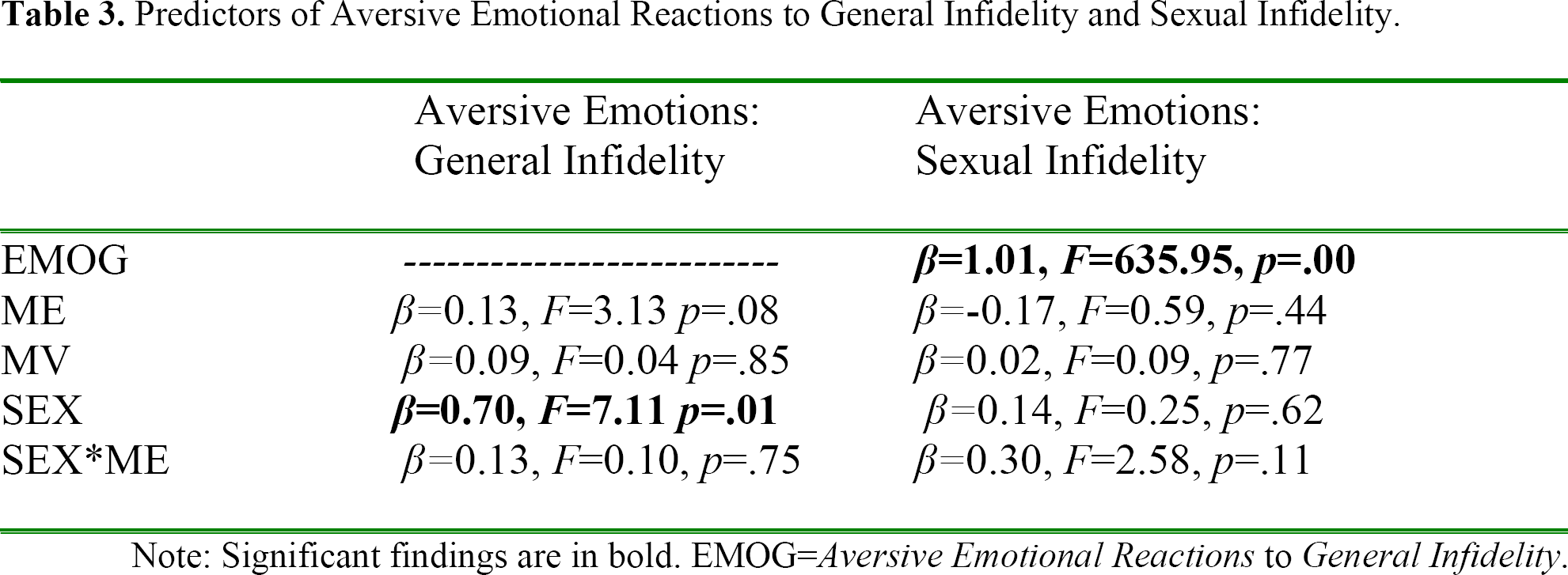
Note: Significant findings are in bold. EMOG=Aversive Emotional Reactions to General Infidelity.
We then tested the individual relations among the predictor variables and how tempted to engage in punitive behaviors participants reported being in response to General Infidelity and specifically to Sexual Infidelity. In both cases, we statistically controlled for aversive emotional reactions to General Infidelity. When examining impulses to engage in punitive behaviors specifically in response to Sexual Infidelity, we also controlled for aversive emotional reactions specifically to Sexual Infidelity.
The model predicting impulses to engage in punitive behaviors in response to General Infidelity was significant (R2=.29, F(4,123)=9.66, p<.01; see table 4 for all F values, p values, and β weights). Regarding aversive emotional reactions and punitive impulses in response to General Infidelity, aversive emotions predicted impulses to engage in punitive behaviors, such that individuals who reported more aversive emotions reported a greater impulse to engage in punitive behaviors. After controlling for aversive emotional reactions to General Infidelity, a significant main effect emerged for ME indicating that Higher-ME individuals reported more impulses to engage in punitive behaviors in response to General Infidelity than did Lower-ME individuals. In addition, significant main effects for Sex and MV emerged. Women reported a greater impulse to engage in punitive behaviors in response to General Infidelity than did men. Higher-MV individuals reported lesser impulse to engage in punitive behaviors in response to General Infidelity than did Lower-MV individuals.
Predictors of how tempted participants reported being to engage in Punitive Behaviors in response to General Infidelity and Sexual Infidelity.

Note: Significant findings are in bold. EMOG=Aversive Emotional Reactions to General Infidelity, EMOS=Aversive Emotional Reactions to Sexual Infidelity, IMPG=Impulses to engage in Punitive Behaviors in response to General Infidelity.
The model examining impulses to engage in punitive behaviors in response to Sexual Infidelity was also significant (R2=.90 F(4,123)=146.61, p<.01). Aversive emotions in response to General Infidelity and to Sexual Infidelity and impulses to engage in punitive reactions to General Infidelity significantly predicted impulses to engage in punitive reactions in response to Sexual Infidelity. No other relations were significant.
Thus, aversive emotional reactions specific to Sexual Infidelity predicted impulses to engage in punitive reactions in response to that infidelity. This effect accounted for variance above and beyond aversive emotional reactions to General Infidelity, which suggests that although emotions experienced during Emotional Infidelity and Sexual Infidelity are highly correlated, specific infidelity may elicit specific emotions which motivate an individual to act in certain ways in response to that infidelity.
We then tested the individual relations among the predictor variables on how likely participants reported they would be to engage in punitive behaviors in response to General Infidelity and specifically to Sexual Infidelity. In both cases, we statistically controlled for aversive emotions in response to General Infidelity as well as for impulses to engage in punitive behaviors in response to General Infidelity. When dealing with punitive intentions related to Sexual Infidelity, we also controlled for aversive emotions as well as for the impulses to engage in punitive behaviors in response to Sexual Infidelity.
The model predicting how likely participants reported they would engage in punitive behaviors in response to General Infidelity was significant (R2=.62, F(4,123)=31.67, p<.01; see table 5 for all F values, p values, and β weights). Aversive emotions in response to General Infidelity, and impulses to engage in punitive behaviors in response to General Infidelity both significantly predicted the report of how likely a participant would be to engage in punitive behaviors in response to General Infidelity. After controlling for these variables, only a significant effect for ME emerged: Higher-ME individuals reported they would be more likely to engage in punitive behaviors in response to General Infidelity.
Predictors of how likely participants reported being to engage in Punitive Behaviors in response to General Infidelity and Sexual Infidelity.

Note: Significant findings are in bold. EMOG=Aversive Emotional Reactions to General Infidelity, EMOS=Aversive Emotional Reactions to Sexual Infidelity, IMPG=Impulses to engage in Punitive Behaviors in response to General Infidelity, IMPS=Impulses to engage in Punitive Behaviors in response to Sexual Infidelity, INTG=Intentions of engaging in Punitive Behaviors in response to General Infidelity.
The model predicting how likely participants reported they would be to engage in punitive behaviors in response to Sexual Infidelity was also significant (R2=.92, F(4,123)=148.80, p<.01; see Table 5 for all F values, p values, and β weights). Aversive emotions in response to General Infidelity and specifically to Sexual Infidelity, and impulses to engage in punitive behaviors in response to General Infidelity and specifically to Sexual Infidelity, significantly predicted the report of how likely participants would be to engage in punitive behaviors in response to Sexual Infidelity. No other predictors were statistically significant.
Discussion
Results of Study 3 indicate that Higher-ME individuals report being both more tempted and more likely to engage in punitive behaviors in response to General Infidelity. Women reported being more tempted to respond to infidelity more punitively overall, but did not indicate they would be more likely to engage in such behaviors. The results also suggested that how likely participants reported they would be to engage in punitive reactions in response to General Infidelity and specifically to Sexual Infidelity were predicted first by aversive emotions in reaction to General Infidelity and specifically to Sexual Infidelity and then by impulses to behave in punitive ways to General Infidelity and specifically to Sexual Infidelity. This suggests that emotions and impulses to behave in certain ways in response to infidelity scenarios may mediate an individual's final behavioral intentions in response to infidelity. Furthermore, the data support the prediction that Higher-ME individuals are both more tempted and more likely to engage in punitive behaviors in response to General Infidelity than are Lower-ME individuals. This supports the notion that Higher-ME individuals are more motivated (by experiencing higher levels of temptation), and more likely to act in ways that will deter infidelity of a partner, even if such actions are punitive and may pose long-term costs.
The aversive emotions participants report in response to infidelity appear to influence impulses to engage in punitive behaviors in response to General or Sexual Infidelity. This suggests that emotions mediate a path to impulses to behave in certain ways in response to infidelity. In addition, women, and individuals with lower MV also significantly reported increased impulse to engage in punitive behaviors in response to General Infidelity.
Earlier, we predicted that Lower-MV individuals would report more impulse to engage in punitive behaviors in response to General Infidelity because they may be unlikely to keep their romantic partner in the long-term. Moreover, these individuals may benefit from motivations to engage in behaviors that deter infidelity, even if such behaviors pose long-term costs to the relationship (Figueredo and McCloskey, 1993). We did not, however, predict the tendency for women to report higher levels of impulse to engage in punitive behaviors in response to General Infidelity. Women were more likely to report aversive emotional responses to General Infidelity. We should interpret this finding with caution, however, considering a lack of similar significant findings in Study 2.
As in Study 2, aversive emotional responses to General Infidelity predicted aversive emotional responses to Sexual Infidelity. These findings are similar to those predicting temptation and likelihood of engaging in punitive behaviors in response to General Infidelity and to those predicting temptation and likelihood of engaging in punitive behaviors in response to Sexual Infidelity. Thus, emotions, impulses, and intentions specific to either emotional or Sexual Infidelity seem to be similar regardless of the type of infidelity in question. Interestingly, however, emotions and impulses specific to a type of infidelity contribute unique variance to predicting reports of likelihood of engaging in punitive behaviors. Thus, although aversive emotions and punitive impulses cluster and are similar, it seems as if there are some notable differences in how aversive emotions lead to specific impulses, and in which impulses ultimately lead to specific punitive intentions.
General Discussion
Reproductive strategy appears to be a crucial determinant of both affective and behavioral reactions to infidelity. As predicted, Higher-ME individuals are not only more likely to be threatened by Sexual Infidelity, they also report a higher likelihood of responding to General Infidelity with punitive behaviors.
Men and individuals higher in ME reported being more upset by Sexual Infidelity than women or individuals lower in ME. When examined using proper statistical procedures, these findings were consistent for both forced choice and Likert items. Thus, it appears that because of the focus Higher-ME individuals place on the short-term aspects of relationships, they are differentially upset by thoughts of Sexual Infidelity. Further, Higher-ME individuals are also more likely to respond in punitive ways to General Infidelity. This also reflects the predicted notion that Higher-ME individuals are more likely to think in terms of stopping the infidelity immediately with little to no regard of the future consequences on the relationship.
ME influences the self-reported temptation to and the likelihood of behaving in punitive ways in response to General Infidelity. This indicates that Higher-ME individuals report greater motivation to act in ways that support short-term infidelity deterrence, and also report being more likely to act upon that motivation. The present results, however, did not support the hypotheses that Higher-ME individuals are more likely to engage in punitive behaviors in response to Sexual as opposed to Emotional Infidelity. Sexual and Emotional infidelities were highly correlated in all studies. Hence, we statistically controlled for and examined a common jealousy factor before we examined the specific relations among the predictor variables and either Sexual or Emotional Infidelity. The behavioral response patterns reported by Higher-ME individuals appear to be a reaction to General Infidelity, not a reaction to a specific type of infidelity. A reasonable account of this is that, because Sexual and Emotional infidelities often occur in combination, individuals interested in defending short-term interests would have historically based tendencies to react in a way that immediately deters any type of infidelity.
The present results replicated more familiar sex differences in response to Sexual or Emotional Infidelity. Men were more upset by Sexual Infidelity than by Emotional Infidelity using both the sum of the forced choice items and Likert scale items assessing jealousy. Sexual Infidelity threatened Higher-ME individuals more than Lower-ME individuals, regardless of sex. An individual's ME is a factor which influences the reproductive strategy they follow. Such strategies have been used throughout evolutionary time to solve specific adaptive problems in one's socio-ecological environment. Such strategies may have solved problems of how to deal with an unfaithful partner effectively and how to keep a partner faithful, regardless of the long-term cost to the relationship. It is likely to have been a strategy that was successful for Higher-ME individuals.
Because both men and women vary in their levels of ME, however, it is unlikely that we can honestly attribute these findings to differences in how cultures treat men and women, or to what men and women learn with respect to relationships or infidelity. For example, certain cultures may teach that it is unacceptable for women to be sexually unfaithful, and thus create greater sexual jealousy in men. However, cultural explanations cannot explain why such differences would exist between Higher-ME and Lower-ME individuals. Furthermore, although men are generally higher in ME than women, men still reported being more threatened by Sexual Infidelity, even after we controlled for differences in ME.
We predicted that Lower-MV individuals would report a greater likelihood of punitive behaviors in response to infidelity because Lower-MV individuals need to deter infidelity by resorting to behaviors that are more drastic (and costly). Hence, it may be more beneficial for them to delay infidelity (even if dissolution of the relationship is imminent) rather than be a victim of infidelity. Self-described MV, however, did not consistently relate to self-reported jealousy.
Nevertheless, Higher-MV individuals were less likely to engage in punitive behaviors in response to Sexual Infidelity, and thus more likely to report punitive behaviors in response to Emotional Infidelity than Lower-MV individuals. We suggest that this is because Higher-MV individuals have less trouble finding a new sexual partner to “even the score” by being unfaithful themselves (Symons, 1979), or by finding someone else with whom to start a sexual relationship. Higher-MV individuals may, however, be upset at the prospect of losing a valuable partner. Another interpretation is that Higher-MV individuals do not have to be as vigilant against Sexual Infidelity because they are very desirable.
One reason for the inconsistent findings may relate to the MV differential between one's partner and one's self. An individual with a lower MV may have the same MV as their partner and thus may feel secure in the relationship. Another individual of the same MV might have a partner who exceeds her or him in MV – setting the stage for insecurity, hypersensitivity to infidelity, and the use of more drastic mate-retention tactics.
No particular variable predicted aversive emotional reactions to infidelity. There was some indication that women reported more aversive emotions in response to General Infidelity, but this did not occur consistently. Aversive emotional reactions did, however, strongly predict self-reported likelihood of specific forms of behavior. Individuals who reported more distress about General Infidelity also reported a greater likelihood of behaving punitively in response to General Infidelity. Thus, emotional reactions and ME were independent but strong predictors of behavioral intentions in response to infidelity. Further, emotions elicited by a specific infidelity uniquely predicted the specific punitive behaviors an individual may perform in response to that infidelity. Thus, individuals who reported stronger aversive emotions with respect to Sexual Infidelity (after controlling for emotions in response to General Infidelity) were more likely report punitive behaviors in response to Sexual Infidelity specifically.
We selected the behaviors we asked about because these actions appear to reduce the cost of infidelity or discourage infidelity in the short term, but also appear likely to strain or harm the relationship in the long term. Contingency traps (generally, decisions between short-term loss for long-term benefit, or long-term loss for short-term gain) such as these may be useful in defining an individual's reproductive strategy, because in some environments one may maximize reproductive potential in the short-term by using these strategies (Figueredo and McCloskey, 1993). These findings are consistent with what we know about ME in general. Higher-ME individuals tend to behave more coercively and act in ways that benefit them in the short-term, with little regard for long-term costs (Rowe et al., 1997).
The statistical analysis of the data partially supports our hypothesis that ME accounts for the sex-specific variation seen in the threat produced by Sexual or Emotional Infidelity. Although there was evidence that reproductive strategy interacts with sex to produce increasing levels of concern over General Infidelity, the two variables had additive main effects on jealousy. After controlling for ME, the effects of respondent sex (being a woman or a man) increased in magnitude. Thus, within-sex variation with respect to ME or reproductive strategy may cloud the sex effects that jealousy researchers describe.
As importantly, because Sexual and Emotional Infidelity often co-occur and are therefore highly correlated, one must control for General Infidelity (defined as the average of Sexual and Emotional Infidelity), before assessing how a specific variable uniquely relates to one form of infidelity or another. In short, one must estimate how the predictor variables affect the General Infidelity factor, created by combining Sexual and Emotional Infidelity, before examining any unique effects upon either Sexual or Emotional Infidelity alone.
We now offer four cautionary notes. First, because the jealousy manipulations were hypothetical, the ecological validity of these results remains unknown. Although self-described intentions provide an estimate of how a person will react to infidelity, these intentions remain distance from real-world behaviors enacted in response to infidelity. The external validity of these results remains to be established.
Second, all the items in the present scales were punitive and pitted short-term benefit against long-term cost. Theory predicts Higher-ME Individuals to have impulses and intentions with respect to these costs and benefits; a different set of costs and benefits, however, may elicit different responses. Hence, it may be informative to examine the generality of these findings including behaviors directed towards different goals such as frightening a partner into not cheating, dissolving a relationship, retaining a mate (e.g., pulling them away from the interloper, back into the relationship), or working things out. It may be that Higher-ME individuals are less likely to work things out than others because they think within short-term time frames; it may be that Lower-ME individuals are less likely than others to dissolve a relationship because of their use of long-term time frames and the resultant greater levels of commitment to the relationship (Figueredo et al., 2006).
Third, a full predictive model makes it necessary to examine the MV of a participant's partner relative to the MV of the participant because, theoretically, MV in relation to that of the partner will predict degree of vigilance to infidelity. Lower-MV in relation to one's partner places a premium on efforts to protect against Emotional as opposed to Sexual Infidelity because investment in a relatively Higher-MV partner may be worth the risk of extra partner affairs, as long as several offspring are produced with the higher quality partner. In contrast, being with a relatively Lower-MV partner increases vigilance over Sexual Infidelity because the individual may be sacrificing other desirable qualities in a mate for the knowledge that all the offspring one invests in are one's own.
Fourth, given current methods, measuring real-world responses to infidelity is impractical and unethical. Thus, measuring intentions to imagined scenarios is as close as we could come to measuring responses to infidelity. Responses to infidelity may be equivocal in their consequences; some may perform the same behavior with different desired outcomes for the relationship. We selected the behavioral intentions used in this study because of their clear purpose of deterring infidelity and being punitive in nature.
Given these caveats, the results reported here support the notion that reproductive strategies and reactions to infidelity relate strongly. Higher-ME individuals report greater upset to Sexual Infidelity, and a greater likelihood of behaving punitively towards their partner or their relationship in response to infidelity than do Lower-ME individuals. The results are robust and replicated consistently.
Finally, the fine-grained distinctions among aversive emotional reactions, punitive impulses, and punitive intentions that are the sequelae of infidelity provide grounds to suggest that different causal forces are at work at different levels of this hierarchical cascade of consequences. How threatening Sexual or Emotional Infidelity is to someone depends on an individual's sex and ME; the degree of threat also depends on the person's ME, aversive emotional responses, and punitive impulses. Taken together these factors (and perhaps more, yet unidentified factors) are collectively responsible for punitive behavioral intentions towards a potentially unfaithful partner.
In summary, these studies document five major findings. First, using traditional forced-choice methods, we replicated the well-established sex difference in reaction to Sexual and Emotional Infidelity. Using graded Likert-scales we also replicated the previously reported disappearances of such sex differences. Second, because these sex differences have been interpreted by previous researchers to be little more than proxies for differing sexual strategies, we also obtained additional results of theoretical interest using two strategically-relevant predictors, ME and MV, and several different outcomes measures of our own devising. Neither ME nor MV significantly predicted aversive emotional reactions, however. We interpret this result as an indication that the previously self-reported “upset” attitudes are insufficiently discriminative of different sexual strategies. Nevertheless, with aversive emotional reactions controlled, individuals higher in ME and lower in MV were generally more likely to report punitive impulses towards an unfaithful partner, regardless of the type of infidelity. Furthermore, with aversive emotional reactions and punitive impulses controlled, individuals higher in ME were generally more likely to report punitive intentions towards an unfaithful partner, regardless of the type of infidelity.
Third, the high collinearity between Sexual and Emotional Infidelity should be considered when assessing specific effects. Because a single General Infidelity Factor can be constructed to capture the common variance, effects upon specific Sexual or Emotional Infidelity Factors should be statistically controlled for effects upon the General Factor when testing more specialized hypotheses. Fourth, most statistically significant effects of ME, MV, and Sex were directly upon the General Infidelity Factor and only indirectly on Sexual (or Emotional) Infidelity. Finally and also importantly, it appears that aversive emotional reactions lead to punitive impulses, punitive impulses lead to punitive intentions, and it is punitive intentions that presumably lead to real-world punitive behaviors. More research will be required to document this last conclusion.