




Abstract
Life-history theory (LHT) has drawn upon the concept of “time preference” as a psychological mechanism for the development of fast and slow strategies. However, the conceptual and empirical nature of this mechanism is ill-defined. This study compared four traits commonly used as measures of “time preference” (impulsivity, sensation seeking, future orientation and delay discounting) and evaluated their relationship to variables associated with life-history strategies (aggressive behavior and mating attitudes, biological sex, pubertal timing, victimization, and exposure to aggression in the environment). Results indicated that only sensation seeking consistently showed all the predicted associations, although impulsivity, future orientation, and delay discounting showed some significant associations. A unidimensional higher-order factor of “time preference” did not adequately fit the data and lacked structural invariance across age and sex, suggesting that personality traits associated with LHT do not represent a global trait. We discuss the use of personality traits as measures in LHT and suggest that greater caution and clarity is required when conceptualizing this construct in future work.
Keywords
Introduction
Life-history theory
Life-history theory (LHT) is an evolutionary framework addressing phenotypic variation (see Ellis, Figueredo, Brumbach, and Schlomer, 2009; Stearns, 1992). Phenotypic variation is not infinite and is constrained by trading-off limited resources between traits (Roff, 1992). As fitness is measured via successful reproduction, a principal life-history decision is the age of reproductive onset. Organisms can terminate investment in growth and reproduce early, expanding reproductive windows at the expense of lower accumulated capital for parenting. Alternatively, delaying reproduction allows somatic growth and resource accumulation but shortens the reproductive window. Age-specific mortality rates affect trade-offs (Ellis et al., 2009; Promislow and Harvey, 1990) because reproduction first requires survival. An organism's development thus balances reproductive optima with avoiding fitness cliffs. Mortality rates differ across ages and environments, making reproductive timing decisions sensitive to risks of premature death.
LHT principles have been applied to explaining variation among humans (e.g., Belsky, Steinberg, and Draper, 1991; Chisholm, 1999; Ellis et al., 2009). It has been proposed that individuals detect cues to mortality either directly from the local environment (Wilson and Daly, 1997) or via familial stress manifested through weak attachments (Belsky et al., 1991; Chisholm, 1999), predisposing the adoption of a “faster” developmental trajectory. This is achieved by earlier pubertal onset, coitus, and willingness to engage in risky behaviors such as aggression and short-term couplings (Chisholm, 1999; Ellis et al., 2009). According to Chisholm (1999), fast strategists (those who have suffered greater environmental and familial stress) express a “time preference” that prioritizes short-term consumption over long-term investment, leading to riskier, but evolutionarily functional behaviors. The nature of “time preference” forms the core of this paper.
Time preference
Chisholm's (1999) “time preference” is an economic term synonymous with “intertemporal choice [between alternatives with varying costs or benefits over time], impatience, impulsiveness, self-control and the inability to defer gratification” (p. 135). The concept is often used interchangeably with “time perspective” and “time horizon” (Wilson and Herrnstein, 1985) and is proposed to be the psychological mechanism supporting strategic decision-making during development (Chisholm, 1999). Those with shorter time preferences consume resources in the present. Present consumption protects against possible future fitness cliffs. In environments where mortality risks are high, early reproduction and willingness to take risks may be functional, because capitalizing on resources and opportunities in the present can ensure fitness returns (Chisholm, 1999; Ellis et al., 2009). Deferring investment may bring no return at all through premature death. From a fitness perspective, individuals living under high mortality conditions have the least to lose and the most to gain from increased aggression and mating effort in the present, optimizing fitness in response to beliefs about reproductively uncertain 1 futures (Chisholm, 1999).
Schechter and Francis (2010) found that measures of future orientation were positively related to longer life expectancy and negatively related to childhood attachment problems and risk-taking attitudes. Kruger, Reischl, and Zimmerman (2008) demonstrated that time preference mediated relationships between measures of developmental environments and measures of aggression and criminality (corroborated by Hill, Jenkins, and Farmer, 2008). Self-assessed life expectancy has shown predicted correlations with life-history behaviors; shorter life expectancies were associated with more aggression, risky behavior, and earlier reproductive behavior (Chisholm, 1999; Copping, Campbell, and Muncer, 2013a; Wilson and Daly, 1997; Wilson and Herrnstein, 1985).
Chisholm (1999) conceptualized time preference with reference to several psychological traits, most of which fall under the umbrella concept of “impulsivity.” “Impulsivity” constitutes a “heterogeneous cluster of lower-order traits” (Depue and Collins, 1999; p. 495). Others have also stressed the multi-faceted nature of the construct (Evenden, 1999; Cross, Copping, and Campbell, 2011). Based on weak correlations between different measures, Frederick, Loewenstein, and O'Donoghue (2002) concluded that “time preference” is likely multidimensional—a proposition supported by others (Smith and Hantula, 2008; Teuscher and Mitchell, 2011). Loewenstein, Weber, Flory, Manuck, and Muldoon (2001) claimed that the construct consists of three facets: impulsivity (spontaneous/unplanned activities), inhibition (restricting impulses), and compulsivity (planning). Frederick et al. (2002) argued that intertemporal choice (between immediate smaller rewards and delayed larger rewards) results from multiple, competing processes and motives; a single discounting rate applicable to all choices is unlikely. Wilson and Daly (2006) concluded that a unitary construct reflecting time horizon is “not a psychological reality” (p. 993) based on results comparing offenders and non-offenders that were inconsistent with predictions.
The use of the constructs “time preference” and “impulsivity” has been historically inconsistent. For instance, Hill et al. (2008) invoke sensation seeking (as a measure of heritable temperament) as indirectly causing weaker future orientation, which in turn increases risky behavior and impulsivity. All these traits are conceptually subsumed under “time preference,” yet in this one study, these facets variously represent biological vulnerability, a mediating mechanism, and a behavioral outcome. The role of “impulsivity” is similarly unclear in psychometric LHT measures (Figueredo et al., 2005), with some but not all facets of this construct acting as correlates (but not causes) of fast/slow strategies.
Empirical findings based on the measurement of traits constituting “time preference” (such as delay discounting and time perspective) have sometimes contradicted LHT predictions, particularly in aggression research where violent or juvenile offenders are no more present-orientated than non-violent offenders or community samples (Brennan, Moore, and Shepherd, 2010; Nagin and Pogarsky, 2004; Wilson and Daly, 2006; but see Brezina, Tekin, and Topalli, 2009). Chisholm (1999) claimed that “time preference” should be sensitive to age and sex, with younger individuals and males demonstrating the highest rates of future discounting. However, this has not always been supported by research findings. Sex differences rarely emerge (Cross et al., 2011), and elderly rather than young individuals often discount more heavily (Read and Read, 2004; Trostel and Taylor, 2001). In a review of the animal literature, Fawcett, McNamara, and Houston (2012) proposed that discounting is not exponential and is instead context-dependent and contingent on the availability and consistency of reward.
Whilst lower-order traits constituting “time preference” and “impulsivity” are implicated in LHT, conceptual confusion and empirical overlap of these umbrella terms create difficulties in identifying psychological mechanisms. This exploratory study aimed to conceptually untangle components of “time preference” and investigate their association with life-history variables.
Identifying psychological mechanisms
According to Chisholm, “time preference” is the mediator between environmental stress and behavior. Psychological mechanism(s) that represent it should demonstrate the following associations (although these are not necessarily criteria for evaluating all potential life history variables, they should apply to aggression and mating behaviors based on Chisholm's hypothesis):
Associations with life-history behaviors such as aggression and mating attitudes. As “time preference” is the hypothesized mediating mechanism underpinning behavioral expression, candidate traits failing to demonstrate such associations may be rejected.
Associations with reproductive onset. If a shorter “time preference” results from earlier puberty (or the converse), pubertal age would be expected to show significant associations with a candidate “time preference” trait(s).
Associations with environmental stressors. Chisholm (1999) claimed local mortality rates impact upon family instability and disrupt attachment bonds, conveying levels of environmental stress indirectly to developing children. If “time preference” is a response to environmental stress, it should demonstrate associations with indicators of stressful environments.
Sex differences. Evolutionary principles emphasize a role of biological sex in attachment processes, personality, and behavioral expressions of life-history variables, particularly aggression and sexual activity (Archer 2009; Copping, Campbell, and Muncer, 2013b; Del Giudice, 2009). Differing reproductive variances between the sexes form the basis of these differences, with reproductive outcomes being more variable for males than females (Bateman, 1948; Trivers, 1972) encouraging greater male risk-taking and impulsivity to secure reproductive fitness (Wilson and Daly, 1985)—the opposite being true for females (Campbell, 1999). Indeed, Chisholm (1999) claimed that sex would be a key factor in “time preference.”
Several traits have been associated with a faster life-history tempo. A review of these traits in relation to the above four criteria follows.
Sensation Seeking
Sensation Seeking (SS) is defined as “the need for varied, novel and complex sensations and experiences and the willingness to take social risks for the sake of such experience (Zuckerman, 1979; p. 10).” It is often regarded as synonymous with impulsivity and risk taking, despite evidence to the contrary (Copping et al., 2013b; Cross et al., 2011). Aggression and antisocial behaviors correlate positively with levels of SS (Wilson and Scarpa, 2010), as do risky sexual behaviors and mating strategies (Donohew et al., 2000; Seto, Lalumiere, and Quinsey, 1995). Sex differences in SS are evident (Cross et al., 2011). Higher rates of SS have been associated with indices of environmental stress (Gatzke-Kopp, Raine, Loeber, Stouthamer-Loeber, and Steinhauer, 2002). SS is also negatively correlated with pubertal onset (particularly in males: Khurana et al., 2012; Steinberg et al., 2008).
Impulsivity
Impulsivity represents a lack of deliberation. Typical questionnaire items include “I often get into trouble because I don't think before I act” and “I will often say what comes into my head without thinking first.” Impulsivity is negatively correlated with age of first sex (McAlister, Pachana, and Jackson, 2005) and positively related to physical and verbal aggression (Vigil-Colet and Codorniu-Raga, 2004). Sex differences are evident but weak (d = .12; Cross et al., 2011). Stressful environments may contribute to impulsivity via interaction with genetic variants associated with impulsivity (Reif et al., 2011). Measures of impulsivity show expected relationships with pubertal onset (Khurana et al., 2012).
Future Orientation
Future Orientation (FO) describes several related cognitive, attitudinal, and motivational processes (see Steinberg et al., 2009), representing the ability to comprehend, predict, and plan for the future. Although “future orientation” is invoked as a mediator in LHT, studies often use proxies such as life expectancy (Chisholm, Quinlivan, Peterson, and Coall, 2005; Wilson and Daly, 1997) or hopelessness (Bolland, 2003). FO is correlated with aggression and sexual activity (Bolland, 2003; Cabrera, Auslander, and Polgar, 2009; Wilson and Daly, 1997). Women are more future orientated than men (Kruger et al., 2008; Schechter and Francis, 2010; Steinberg et al., 2009), and economically disadvantaged individuals show weaker future orientations (Nurmi, 1987, 1992). Life expectancy has shown expected relationships with female pubertal onset (Chisholm et al., 2005).
Delay Discounting
Delay Discounting (DD) describes a preference for short-term over long-term gains where subjective reward value decreases with increases in receipt delay (Mazur, 1987). Respondents are presented with choices between small, immediate rewards and larger, delayed rewards and indicate reward preferences given varied delay periods. Rewards can be hypothetical or real. DD is related to risky behaviors, including aggression and sexual risk-taking, (Reimers, Maylor, Stewart, and Chater, 2009). Sex differences have been found in measures of DD, but their magnitude varies considerably (Cross et al., 2011). Discounting is also influenced by resource scarcity (Griskevicius, Delton, Robertson, and Tybur, 2011; Griskevicius, Tybur, Delton, and Robertson, 2011). Measures of discounting also show expected correlations with pubertal onset (Khurana et al., 2012).
Current study
The current exploratory study aims to evaluate Chisholm's conceptualization of “time preference” to determine if one latent construct encompassing all four suggested traits exists. Traits were also examined individually to determine which trait best meets the criteria for a mediating psychological mechanism.
Materials and Methods
Participants
Seven hundred and forty one individuals (306 males and 435 females) recruited from schools, colleges, and universities participated in an online questionnaire. Their mean age was 16.87 (SD = 5.59). Participants had to be age 13 or above and to have reached puberty in order to participate (for ethical reasons). No exclusion criteria or incentives were used.
Measures
Measures are described below. Confirmatory factor analysis (CFA) was conducted on all measurement indicators where a latent factor was assumed. Models were evaluated by the following criteria: X 2 values should be non-significant, RMSEA (measuring model complexity) should be .05 or below (Browne and Cudeck, 1993), and CFI values should be greater than .95 (Hu and Bentler, 1999). Method of estimation was weighted least squares with means and variance corrections (WLSMV). This procedure is appropriate for categorical/ordinal level data (Brown, 2006). Reliability was examined using ordinal alpha (Zumbo, Gadermann, and Zeisser, 2007), which more accurately estimates reliability than Cronbach's alpha on ordinal measures.
Potential mediators of LH strategy
Sensation Seeking (SS). The SS scale includes 11 binary items measuring thrill and excitement seeking. These were taken from the 19-item Impulsive-Sensation Seeking Scale (Imp-SS; Zuckerman, Kuhlman, Joireman, Teta, and Kraft, 1993), which reliably splits into distinct impulsivity and sensation seeking subscales (Copping et al., 2013b; Zuckerman and Kuhlman, 1993). The scale is summed, with higher scores representing higher levels of sensation seeking. SS items include “I like to have new and exciting experiences and sensations even if they are a little frightening” and “I like doing things just for the thrill of it.” CFA was used to validate the scale. The 11-item scale did not fit adequately. Removing five items created an adequate measure (X 2(9) = 13.30, p > .05, RMSEA = .03, 95% CI [0.00, 0.06], CFI = .99), which was used in further analyses (α = .79). Factor loadings ranged from .29 to .64.
Impulsivity (DI)
The Dysfunctional Impulsivity scale (DI; Dickman, 1990) is composed of 12 binary items measuring deliberative failure. The inventory is summed, with higher scores representing greater impulsivity. Items include “I will often say whatever comes into my head without thinking first” and “I often get into trouble because I don't think before I act.” CFA was used to validate the scale. The 12-item scale did not fit adequately. Removing four items created an adequate measure (X 2(20) = 32.69, p > .01, RMSEA = .03, 95% CI [0.00, 0.05], CFI = .99), which was used in further analyses (α = .77). Factor loadings ranged from .09 to .70.
Future Orientation (FO)
Future Orientation was measured using the 15-item Future Orientation Scale (Steinberg et al, 2009). However, two of the three subscales (Anticipation of Future Consequences and Planning Ahead) contained items that were conceptually similar to DI; these scales were moderately correlated with DI (.60 and .57 respectively). For this reason, we analyzed items on the Time Perspective subscale only (α = .54) to maintain a clear distinction between constructs. According to Steinberg et al. (2009), the low alpha value of the subscale is attributable to the small number of items. CFA indicated a good fit to the data (X 2(5) = 6.30, p >.05, RMSEA = .02, 95% CI [0.00, 0.06], CFI = .99). Factor loadings ranged from .06 to .71. This 5-item measure presented two opposing statements separated by the word BUT on a 4-point Likert scale, requiring participants to indicate which statement best described them (i.e., statement A is really true for me, statement A is sort of true for me, statement B is sort of true for me, statement B is really true for me). For example, A) Some people spend very little time thinking about how things might be in the future, BUT B) Other people spend a lot of time thinking about how things might be in the future. Higher scores represent a greater orientation towards the future.
Delay Discounting (DD). DD
was measured using the One-Shot Delay Discounting Measure (Reimers et al., 2009). On this binary item, participants indicated which they would prefer: £45 in three days' time or £70 in three months' time. Reimer's et al. claimed this measure to be as effective as a full behavioral DD battery. A higher score signifies preference for larger, delayed rewards.
Life-history variables
Aggression
Levels of physically aggressive behavior were recorded using the Richardson Conflict Response Questionnaire (RCRQ; Richardson and Green, 2003). Items reference various acts of physical aggression and respondents indicate how often they have performed each in the last year using a 5-point Likert scale labelled “rarely” to “often” (e.g., “How many times in the last year have you kicked someone?”). The six items were loaded onto one factor using CFA. Two items were dropped to produce an adequate fit (X 2(2) = .43, p > .05, RMSEA = .00, 95% CI [0.00, 0.05], CFI = 1.00). Factor loadings ranged from .73 to .85. Internal consistency was high (α = .91). Higher scores index greater aggression.
Attitudes to Short-Term Relationships (STR)
This was measured with an 11-item questionnaire presenting opposing statements regarding sexual and relationship behaviors. Participants indicated their response on a 4-point Likert scale in the same manner as the FO scale. This was a new measure developed for this study (see Appendix 1 for items). The 11 items were loaded onto one factor using CFA. Seven items were dropped to produce an adequate fit (X 2(2) = 4.43, p > .05, RMSEA = .04, 95% CI [0.00, 0.09], CFI = .99). Factor loadings ranged from .60 to .87. Internal consistency was high (α = .81). Higher scores represent a proclivity for STR.
Puberty
Participants indicated the age at which they reached puberty from 11 options, ranging from “younger than 10” to “older than 18.”
Environment
Environmental stress
Environmental stress was examined by using perceptions of neighborhood aggression on the assumption that higher levels of perceived violence and victimization are indicative of greater environmental stress (mortality risk). Levels of victimization (Vict) and environmental aggression (EA) were measured by using modified versions of the RCRQ, which asked participants to record how often they had witnessed acts of physical aggression (e.g., “How many times in the last year have you seen someone being kicked?”) and how often these acts had happened to them (e.g., “How many times in the last year have you been kicked?”). The six victimization items were loaded onto one factor using CFA. Two items were dropped to produce an adequate fit (X 2(2) = .34, p > .05, RMSEA = .00, 95% CI [0.00, 0.04], CFI = 1.00). Factor loadings ranged from .75 to .83. Internal consistency was high (α = .89). Higher scores indicate more frequent victimization. The same procedure was conducted on the witnessed aggression scale. Two items were dropped to produce an adequate fit (X 2(2) = 2.93, p > .05, RMSEA = .3, 95% CI [0.00, 0.08], CFI = .99). Factor loadings ranged from .81 to .85. Internal consistency was high (α = .89). Higher scores indicate more frequent witnessing of aggression.
Analysis
Multi-group analysis was used to examine invariance on all of the above measures as a function of sex and heterogeneity of participant age (categorized as age 13–17 (N = 584) and 18+ (N = 1572). All measures demonstrated invariance across age and sex (model statistics available on request). Analyses were conducted using IBM SPSS 20 and R 3.1.
Results
The following analyses are exploratory and do not permit conclusions about causal relationships between personality variables and LH variables. Descriptive statistics are presented in Table 1. Correlations are presented in Table 2.
Descriptive statistics for all study variables

Table of correlations

Note. p < .05
p < .01
“Time preference” as a unitary construct
Table 2 shows that all four potential traits are related to each other, albeit weakly. This may, therefore, support the contention that “time preference” is a global trait. CFA was used to examine whether such a higher-order structure fit the data. All four indicators were loaded onto a single, higher-order latent factor (representing “time preference”). WLSMV was used to calculate the fit to the data set. This procedure yielded a model that did not adequately fit the data (X2 (167) = 321.75, p < .001, RMSEA = .04, 95% CI [0.03, 0.04], CFI = .94), with a significant X2 and a CFI less than .95. Testing for structural invariance between sex and age groups showed that the higher-order structure also varied between groups. Fitting the model to men and women separately yielded a X2 difference of 92.76 (p < .001). The female model did not adequately fit the data (X2 (167) = 285.46, p < .001, RMSEA = .04, 95% CI [0.03, 0.05], CFI = .93). The male model was a closer fit to the data, although X2 was still significant (X2 (167) = 192.70, p < .01, RMSEA = .02, 95% CI [0.00, 0.04], CFI = .97). The same procedure was repeated across the two age categories, yielding similar—albeit less variant—figures, with a X2 difference of 53.21 (p < .001) and a less adequate model for older participants (X2 (167) = 202.34, p < .001, RMSEA = .04, 95% CI [0.01, 0.05], CFI = .93) than for younger participants (X2 (167) = 255.55, p < .001, RMSEA = .03, 95% CI [0.02, 0.04], CFI = .94). The construct of “time preference” appears to be neither a viable higher-order construct nor invariant across sex and age. Appendix 2 shows the factor loadings across each group.
Criterion evaluation
Table 2 presents correlations between study variables. All candidate variables were associated with the life-history variables in expected directions (Criterion 1). Aggression and orientation to short-term relationships increased with higher levels of DI and SS, weaker FO, and a preference for immediate rewards. All correlations were significant (p < .05) albeit weak to modest in strength (ranging from r = -.11 to .37). DI and SS had the strongest associations with life-history variables
Criterion 2 was that candidate variables should correlate with pubertal onset. SS and DI were the more strongly associated (r = -.15 and -.10, p < .01), whereas DD and FO showed weaker correlations (r =.09 and .08, p < .05). Higher scores on SS and DI were associated with lower age at puberty. Pubertal onset was later for those with a stronger FO and the propensity to discount short-term rewards.
Criterion 3 proposed that candidate traits should be associated with levels of environmental stress, indexed by exposure to and witnessing of violence. Table 2 shows that all four variables were associated with victimization and witnessing aggression (p < .05).
Criterion 4 focused on sex differences in candidate variables. Independent samples t-tests were conducted on each personality trait (chi-square was conducted on DD due to its binary nature). Table 3 presents the results. Significant differences were found in all variables in the expected directions (p < .05). Men scored higher on DI and SS, were less future orientated and less likely to defer rewards. Men were also more aggressive and more orientated towards short-term sexual relationships (p < .05 in both cases).
Significance tests for sex differences (df = 739)

Note. p < .05
p < .01; π reported as a Chi Square with a df of 2
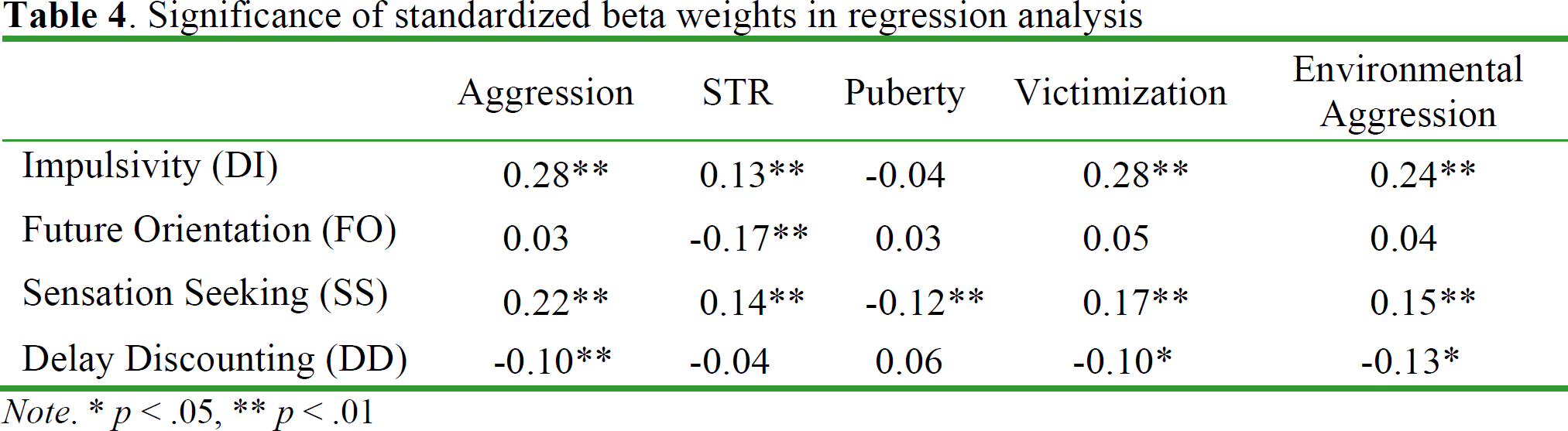
To assess relative relationship strengths, regression analysis was used to examine the variance contributed by each trait to each LH variable (see Table 4). Using forced entry method, regression allows us to examine the unique variance associated with each predictor. Based on these analyses, SS was the only variable to show consistently significant relationships across all variables (p < .01 in all cases). DI was significant with all variables except Puberty and showed stronger links to aggression (exposure to and use of) than SS. FO and DD showed the least consistent patterns of relationships across LH variables.
Significance of standardized beta weights in regression analysis
Note. p < .05
p < .01
Discussion
The aims of this study were twofold: to evaluate the global construct of “time preference” and to evaluate potential candidate mechanisms in terms of their suitability as mediating mechanisms in life-history models.
The results indicated that a higher-order global construct of time preference did not fit the data. Supporting previous work (Frederick et al., 2002; Wilson and Daly, 2006), lack of statistical parsimony on the full sample and lack of structural invariance across sex and age, as well as weak correlations between components cast doubt over its feasibility. As all latent measurement structures (see Method) used in this analysis demonstrated invariance across age and sex, the fact that a combined structure did not demonstrate invariance suggests that these traits do not work in the same way together across different sex and age groups. Whilst there was clearly shared variance between the four personality traits, it was not sufficient to support the notion of “time preference” (or indeed “impulsivity”) as coherent umbrella constructs in their own right. This is congruent with a growing body of work into the multidimensional nature of superficially similar personality traits (Depue and Collins, 1999; Teuscher and Mitchell, 2011; Wilson and Daly, 2006). However it should be noted however that sample sizes between the age and sex groups differed in the present data and this could have potentially inflated X2 values (Brown, 2006). More balanced samples may have yielded a more invariant higher-order construct; Further research is required to examine this possibility.
Regarding the second objective, correlation analysis suggests all of the potential psychological mediating mechanisms in this study demonstrated; 1) relationships with aggression and mating attitudes in expected directions; 2) significant sex differences consistent with evolutionary theory; 3) significant associations with environmental stress (victimization and witnessing aggression) and; 4) significant associations with pubertal onset. Impulsivity and sensation seeking appeared to be the most successful traits with regards to these four criteria, with future orientation and delay discounting being less strongly related.
Regression analyses confirmed this pattern of results, with impulsivity and sensation seeking yielding the highest beta weights for the prediction of pubertal onset, aggression, mating orientation, and levels of environmental aggression and victimization. Sensation seeking, however, was the only variable to be significant in all cases. It therefore seems likely that sensation seeking is the best of the current candidates to represent the mediating mechanism between environmental stress and life-history strategy. However, it should be noted that impulsivity, while not related to puberty, appeared to be more strongly associated with aggression and environmental aggression. Delay discounting and future orientation were the weaker predictors, and this analysis suggested that they are more peripherally related to life-history variables.
Specifically why sensation seeking and impulsivity appear to be more closely related to life history variables than future orientation and delay discounting is beyond the scope of this study. Future orientation and delay discounting may involve more situational and reflective cognitive abilities, whereas sensation seeking and impulsivity may capture more enduring affective and temperamental traits (MacDonald, 2008). Future work, however, is needed to fully explain these results fully.
Limitations, future work and conclusions
In any study, conclusions are specific to the measurement instruments used. Our measures of stress do not readily encapsulate the complexity of (and interactions between) harshness and unpredictability in environments (Ellis et al., 2009). Furthermore, our focus was explicitly on external sources of stress as hypothesized by Chisholm (1999). Recent theoretical work by Nettle, Frankenhuis, and Rickard (2013) has suggested a potential role for internal sources of mortality (e.g., pathogenesis, somatic damage) as a driver of strategy behavior. Such factors were not measured here but should not be ignored in future work. Future work should also consider if low or absent correlations are a result of potential suppressor variable(s) that may impact upon life history strategy.
Our index of mating orientation was designed specifically for this study, whereas measures of environmental stress (witnessed aggression and victimization) were modifications of an existing self-report measure of aggression (the RCRQ – Richardson and Green, 2003). Although appearing to represent the intended constructs, these require further testing for the purposes of establishing reliability and validity.
Measures were selected for brevity and simplicity for the purposes of this school-based research. Although this aids recruitment and prevents loss of attention, other longer, validated measures should also be implemented, such as the SSS-V (Zuckerman, 1994), the Barrett Impulsivity Scale (Patton, Stanford, and Barratt, 1995), a full delay discounting task, and the Zimbardo Time Perspective Inventory (Zimbardo and Boyd, 1999). The one-shot delay discounting measure, while quick and easy to administer, is known to produce only small, negative correlations with age of first sex and income in large samples (Reimers et al., 2009). Furthermore, single item measures of discounting have been shown to have stronger associations with personality traits—such as impulsivity and sensation seeking—than with a full delay discounting battery (Mishra and Lalumière, 2011). These differential associations may have implications for tests of global “time preference” measures. Future studies should employ alternative indices in order to determine the replicability of the present findings.
Future work needs to establish how potential candidate mechanisms—sensation seeking and impulsivity in particular, given the present results—develop during childhood, as well as the environmental inputs to which they are sensitive and the life-history variables that they affect. Longitudinal data and multivariate modeling are required to properly examine personality mediators of strategy development as part of a longitudinal trajectory. Previous studies have attempted to show how time preference may work in a life-history context (Hill et al., 2008), but the conceptually inconsistent use of “impulsivity” still makes it difficult to ascertain the precise mechanisms involved in strategy development. Longitudinal designs eliminate the need for less reliable retrospective measures of development, particularly self-reported assessments of pubertal timing where the signs are less memorable and distinct for men than for women. Future studies need a more accurate way of gauging pubertal onset given its theoretical importance as a developmental switching point.
The results of this study did not contradict the fundamental premise of Chisholm's (1999) proposal. Our aim was to clarify the conceptual basis of the “time preference” that he invokes. In our exploratory analysis, although the four potential candidates were weakly correlated, a unitary “time preference” structure did not emerge. We suggest that measures of sensation seeking and impulsivity appear to be better candidates for time preference than constructs such as discounting or future orientation. We hope that these findings stimulate further work in this field.
Footnotes
Appendix 1. Mating Inventory
This section examines your attitudes and your environment. Each question has two statements. Read statements A and B and choose one of the four responses you feel is most true of you.
Appendix 2. Factor Loadings for Time Preference Across Groups

| Latent Factor | Variable | Full Model | Male | Female | Young | Old |
|---|---|---|---|---|---|---|
| Time Preference | DI | .77 | .77 | .75 | .72 | .66 |
| SS | .50 | .50 | .69 | .53 | .77 | |
| FO | −.50 | −.50 | −.79 | −.57 | −.78 | |
| DD | −.35 | −.35 | −.29 | −.34 | −.13 | |
|
|
||||||
| DI | DI1 | .22 | .22 | .20 | .21 | .22 |
| DI2 | .26 | .26 | .32 | .29 | .24 | |
| DI3 | .25 | .25 | .35 | .29 | .31 | |
| DI4 | .33 | .33 | .27 | .31 | .19 | |
| DI5 | .21 | .21 | .24 | .22 | .19 | |
| DI6 | .07 | .07 | .13 | .06 | .18 | |
| DI7 | .18 | .18 | .17 | .16 | .15 | |
| DI8 | .35 | .35 | .37 | .34 | .30 | |
|
|
||||||
| SS | SS1 | .17 | .17 | .26 | .20 | .31 |
| SS2 | .25 | .25 | .31 | .30 | .32 | |
| SS3 | .17 | .17 | .16 | .12 | .29 | |
| SS4 | .16 | .16 | .23 | .16 | .29 | |
| SS5 | .30 | .29 | .29 | .22 | .27 | |
| SS6 | .25 | .25 | .26 | .25 | .19 | |
|
|
||||||
| FO | FO1 | .36 | .36 | .42 | .42 | .42 |
| FO2 | .39 | .39 | .32 | .34 | .51 | |
| FO3 | .30 | .30 | .52 | .30 | .52 | |
| FO4 | .25 | .25 | .11 | .23 | .33 | |
| FO5 | .57 | .57 | .41 | .61 | .45 | |
|
|
||||||
| DD | DD | .49 | .50 | .49 | .50 | .46 |
1
Recent theoretical and experimental works now conceptualize Chisholm's concept of environmental uncertainty as separate dimensions of harshness and unpredictability (Ellis et al., 2009), but these dimensions are difficult to disentangle at the measurement level. For clarity, this study maintains Chisholm's terminology of “uncertainty” or “stress” throughout unless explicitly stated otherwise.
2
Only two categories were used due to low n for age groups higher than age 21. Low samples would make CFA analyses impossible.