



Abstract
The purpose of the study was to explore the influence of mate value and fertility status on women's implicit and explicit preferences for male traits associated with genetic quality. It was hypothesized that a woman low in mate value would experience greater fluctuation across her menstrual cycle in her preferences for characteristics associated with genetic quality than a woman high in mate value. Specifically, a low mate value woman during the non-fertile part of the cycle would experience a reduction in a desire for traits associated with health and reproductive success. To test the hypothesis, the college age female participants completed two measures of mate value and a self-report measure designed to gauge fertility status. Then the participants performed an Implicit Associations Test (IAT) designed to measure implicit associations with a male trait related to genetic quality and a questionnaire designed to measure their explicit responses to the same trait. As predicted, mate value moderated the relationship between fertility status and implicit preferences.
Introduction
A substantial body of literature indicates that women's mate preferences fluctuate during the menstrual cycle. The phenotypic traits that women are attracted to when they are in the most fertile part of the cycle tend to differ from the traits they are attracted to when less fertile. For example, during the fertile phase, women are more attracted to masculine faces (Penton-Voak and Perrett, 2000: Penton-Voak et al., 1999), masculine bodies (Little, Jones, and Burris, 2007), masculine voices (Feinberg et al., 2006; Puts, 2005, 2006), dominance behaviors (Gangestad, Garver-Apgar, Simpson, and Cousins, 2007), and the scent of symmetrical men (Havlicek, Roberts, and Flegr, 2005; Thornhill et al., 2003). Taken as a whole, the evidence suggests that when women are in the fertile part of their cycle they are more attracted to phenotypic characteristics associated with masculine traits indicating long-term health (Rhodes, Chan, Zebrowitz, and Simmons, 2003) and greater reproductive success (Mueller and Mazur, 1998; Pawlowski, Dunbar, and Lipowicz, 2000).
Gangestad and his colleagues have proposed that the fluctuation in preferences across the menstrual cycle may promote the use of a mixed mating strategy in which a woman pursues both a long-term relationship and, on occasion, short-term extra pair relationships (Gangestad and Thornhill, 1998; Gangestad, Thornhill and Garver-Apgara, 2010). When employing a mixed mating strategy, women place more emphasis on cues associated with genetic quality with short-term mate than with the long-term mate because the short-term mate has the opportunity to contribute genetic material but limited time to contribute resources. Although the mixed mating strategy provides many women with access to high quality genetic material (than she might have been able to obtain in a long-term relationship), the strategy is also associated with costs such as aggression and abandonment from the long-term mate (e.g., Cousins and Gangestad, 2007). Consequently, women employing a mixed strategy should pursue high genetic value short-term mates when they are fertile to accrue genetic benefits and eschew short-term mating when they are less fertile to avoid the costs (Gangestad, Garver-Apgar, Simpson, and Cousins, 2007).
The effect of the fluctuations in mate preferences across the menstrual cycle may motivate women to mate with men who have higher quality genes than her partners when she is fertile. That is, the phenotypic markers of genetic quality become more attractive when she is in the fertile phase of her cycle and most likely to benefit from the high quality genes. The reduced interest in phenotypic markers of genetic quality during the infertile phase would reduce the likelihood of infidelity during the time when the potential costs out weight the benefits. Taken together, these hormonally induced changes in preferences would allow a woman to obtain high quality genes while maintaining the benefits of a long-term relationship (Penton-Voak et al., 1999). Consistent with this reasoning, a number of studies have already found that women demonstrate more interest in extra pair partners when they are fertile (Bellis and Baker, 1990; Gangestad, Thornhill, and Garver, 2002; Haselton and Gangestad, 2006).
Mate Value and Cyclic Preferences
Inherent in Gangestad and his colleague's reasoning about cyclic changes in mate preferences is the proposition that the mixed mating strategy would be most adaptive for women who are unable to obtain mates that are high in both genetic quality and resources. Women who can attract both high genetic quality and resource rich males for long-term relationship have less need to acquire high quality genetic material through short-term mating. For this type of woman, the costs incurred from infidelity are less likely to outweigh the genetic benefits. An individual difference that is likely to play a pivotal role in woman's ability to attract high quality mates is mate value (Fisher, Cox, Bennett, and Garvik, 2008). Although there are a variety of different definitions of mate value, most conceptualizations suggest that mate value is determined by observable characteristics that indicate the persons quality as a sexual partner (Kirsner, Figueredo, and Jacobs, 2003) and ability to increase the reproductive success of mates (Sugiyama, 2005; Waynforth, 2001). Not surprisingly, research has already demonstrated that a woman's mate value influences many male behaviors and emotions, e.g., mate retention behaviors (Jones, Figueredo, Dickey, and Jacobs, 2007; Miner, Starratt, and Shackelford, 2009) and jealousy (Phillips, 2010). Further, numerous studies have found a woman's perceived attractiveness influences her mate preferences (e.g., Feinberg et al., 2012; Little and Mannion, 2006; Penton-Voak et al., 2003; Vokovic et al., 2008).
It seems very probable that women who are low in mate value will have more difficulty in attracting long-term mates that possess both genetic quality and resources than women high in mate value. Hence, for low mate value females it may be adaptive to pursue a mixed strategy forming long-term relationships with lower genetic quality males and pursuing high genetic quality males for extra pair couplings. For these women, this is the best way to obtain the benefits of a long-term relationship and obtain high quality genetic material. Alternatively, females high in mate value who are more able to obtain long-term mates with both genetic quality and resources would benefit less from a employing a mixed mating strategy. Consistent with this reasoning physically attractive women express higher standards for both indicators of genetic quality and indicators of investment than less attractive women (Buss, 2008b).
If cycle changes in mate preference at least partially motivate a mixed mating strategy then the strength of the fluctuations in mate preferences across the menstrual cycle may vary depending on mate value. Females low in mate value who benefit from pursuing a mixed mating strategy may experience stronger fluctuation than females high in mate value who benefit less from pursuing a mixed strategy. With a low mate value woman, an increase in attraction to cues of genetic quality when fertile would motivate her to pursue her best mating strategy. In other words, she would be motivated to mate with men who have higher quality genetic material than her partners when she can obtain the benefit of the high quality genes. On the other hand, high mate value women who have the ability to obtain long-term mates that possess both cues of genetic quality and resources may have less fluctuation in their mate preferences. Consistent with this reasoning, Feinberg et al. (2006) has already found that women indicate a stronger preference for masculine voices during the fertile part of the cycle and that this shift is weaker for feminine women (women with above average concentrations of E3G hormone) than for less feminine women (below average concentrations of E3G hormone).
Current Research
The purpose of this study was to explore the moderating influence of mate value and fertility status on women's preferences for male traits associated with genetic quality. Based on past findings, the researcher expected that women in the fertile part of their cycle would indicate a stronger preference for traits associated with genetic quality than during the non-fertile part of their cycle. In addition, the researcher hypothesized that the woman's mate value would moderate this relationship. Specifically, the cycle changes in preferences for characteristics associated with high quality genetic material would be stronger for women low in mate value. That is, a low mate value woman during the non-fertile part of her cycle would experience an actual reduction in desire for traits associated with genetic quality. To test these predictions, college age female participants completed two measures of mate value and a self-report measure designed to assess fertility status. Following this, the experimenter measured the participants' responses to a male trait related to genetic quality (muscles). Muscularity was chosen because it acts as a genetic quality cue. Muscularity is associated with high levels of testosterone (Storer et al., 2003; Wang et al., 2000; for a review, see Bhasin, 2003) that may signal a more robust immune system. In addition, muscularity indicates that the male can afford a costly trait, i.e., muscularity requires high-energy demands in terms of calories (Frederick and Haselton, 2007). Further, numerous studies have indicated that muscularity is a partially inherited trait with heritability estimates ranging from 40 to 80 percent (Prior et al., 2007, Thomis et al., 1997, Thomis et al., 1998).
Methodological strategy
Most of the research examining female mate preferences has focused on explicit ratings of the attractiveness of stimuli (notable exceptions to are Rosen and Lopez's [2009] work on attentional bias and Johnston, Miles, and MacRae's [2008] work on facial perception). Typically, researchers have varied characteristics of a potential mate (e.g. voices, faces) and then collected overt ratings or behavioral measures of attraction. Yet for the most part, the complex evolved psychological mechanisms that direct mate preferences are believed to operate automatically and wield their influence without consciousness awareness (Buss, 2005; Cosmides and Tooby, 1995). Given the hidden nature of many of these mechanisms, persons may have difficulty providing accurate information and their explicit ratings may be particularly susceptible to a variety of self-report biases produced by the woman's social environment (Sprecher and Regan, 2002). For example, in the current study, it is possible that overt ratings of the male characteristic made by the participants simply represent strategic shifts in self-reports. Women low in mate value compared to women high in mate value may consciously lower their expectations about potential mates because they realize that they will be unable to obtain mates with certain high value traits. To overcome this type of self-report bias and to tap into the hidden psychological mechanisms governing mate preferences, the present research employed an implicit association measure of desirability in addition to the traditional self-report measure. Implicit responses were measured because they occur without conscious control or conscious cognitive effort (Greenwald and Banaji, 1995; Rudman, 2004; Wilson, Lindsey, and Schooler, 2000) and, therefore, factors in the social environment are much less likely to influence implicit responses (Greenwald, Poehlman, Uhlmann, and Banaji, 2009). If women in the study were accurately stating their preferences for the male trait then the hypothesized pattern of preferences should occur with both the explicit and implicit measures.
Materials and Methods
Participants
Participants were 147 women recruited from a large urban university in the southwestern United States. The study employed an electronic signup procedure operated by the psychology department to recruit participants who reported that they were normally ovulating (e.g., not using oral contraceptives). The study offered no monetary compensation to the participants but did give the participants the opportunity to earn class credit. The average age of the participants was 20 and the range of ages was 18 years to 32 years of age. Sixty-two percent of the participants were of European descent, 20% were of Hispanic descent, 16% were of Asian descent, and 2% were from other groups. The experimenter dropped six participants from the study because they were unable to provide accurate information about their menstrual cycles.
Stimulus Material
In order to present a trait related to male physical strength, a large pool of photographs depicting a male's flexed arm and shoulder against a neutral background were collected from open sources on the Internet. The stimulus pictures were all of arms from males of European descent. The experimenter excluded photographs depicting male arms that were extremely developed or underdeveloped. In a pilot study, ten female participants rated each of the arms depicted in the photographs on three scales with endpoints of 1 (weak) and 7(strong), 1 (poorly built) and 7 (well built), and 1 (puny) and 7 (muscular). Eight photographs that depicted arms that were judged as strong (M = 6.41), well built (M = 6.51), and muscular (M = 6.71) and eight photographs that depicted arms judged as weak (M = 2.41), poorly built (M = 2.61), and puny (M = 2.33) were used in the study.
Procedure
When the participant arrived at the experimental room, the experimenter informed her that the purpose of the study was to measure impressions about a number of different physical characteristics. In the study, the participants would be required to perform a reaction time task that focused on a specific physical characteristic and then make a number of ratings of the physical characteristic. The experimenter reassured the participant that her responses would be completely confidential and asked her to sit at a computer that presented the experimental materials. The computer sequentially presented the participant with all of the experimental materials.
Implicit measure
Following the introduction, participants completed an implicit measure designed to assess their positive associations with muscular male arms. The current study employed the most commonly used implicit measure, the Implicit Association Test, developed by Greenwald and his colleagues (Greenwald, McGhee, and Schwartz, 1998). The Implicit Associations Test rests upon the assumption that it is easier to make the same behavioral response (a key press) to concepts that are strongly associated in memory than to concepts weakly associated in memory. Typically, the implicit associations test presents positive and negative words (pictures) and representations of the object. If a person responds quicker when positive words and the object require the same behavioral response, then the test assumes that he/she implicitly associates positive affect with the object. There is considerable evidence that supports the validity of the Implicit Associations Test (see Greenwald, Poehlman, Uhlmann, and Banaji, 2009 for a review).
During each trial, the Implicit Associations Test presented a single image or word at the center of a computer screen. The word presented at the center of the screen was either a positive word (e.g., splendid, noble, worthy), a negative word (e.g., awful, vile, rotten), or one of 16 photographs depicting either a muscular or non-muscular male arm. Each time a word or image appeared the participant was required to press a computer key to classify the word or image. The Implicit Associations Test had two phases. In the first phase, participants completed 40 trials in which they had to press the z key if the word was positive (e.g., splendid) or if there was a picture depicting a muscular male arm. Alternatively, if the word at the center of the screen was negative (e.g. awful) or there was a non-muscular male arm, they were instructed to press the 2 key on the keyboard's number pad. Prior to the first phase, participants completed three practice blocks. Participants completed twenty practice trials to learn the concept dimension (muscular/non-muscular), categorizing the photographs, by pressing either the z or 2 keys, 20 trials to learn the attribute dimension (positive/negative), and 20 trials to practice categorizing both the words and photographs.
In the second phase, the Implicit Associations Test reverses the keys used to classify positive and negative words. In this phase, the participants completed 40 trials in which they had to press the z key if the word was negative or if there was a photograph of a muscular male arm and to press the 2 key if the word was positive or a picture of non-muscular male arm. Prior to the second phase, participants completed two practice blocks. Participants completed 20 practice trials to learn to switch the concept dimension (muscular/non-muscular) and 20 trials to practice categorizing both words and photographs. The order of key positions was counterbalanced for each phase. The Implicit Associations Test determines the strength of the positive or negative associations with the photographs by examining the difference in latencies between the two phases. That is, were participants quicker when pressing the same key for positive words/muscular arms and negative words/non-muscular arms or were they quicker when this was reversed (negative words/muscular arms and positive words/non-muscular arms)?
Menstrual cycle survey
Following the implicit measure, the study used a procedure developed by Lukaszewski and Roney (2009) to obtain menstrual cycle information. This procedure asked each participant to answer three questions: (a) the first day of her last menstrual bleeding, (b) to estimate the number of days until her expected next episode of bleeding, and (c) estimate duration of her typical cycle. If the participant's information is accurate, the reported cycle day should be equal to the typical cycle length minus the number of days until the next anticipated cycle. If the participant's cycle day estimate was more than five days from what the formula would predict it was assumed that the participant was providing inaccurate information and she was dropped from further consideration in the study.
Participants were considered in the high fertility part of the cycle during the five days prior to ovulation and the day of ovulation because these are the days in which conception is most likely to occur (Wilcox, Weinberg, and Baird, 1998; Wilcox, Duncan, Weinberg, Trussell, and Baird, 2001). To estimate the day of ovulation, a backward counting method was used in which ovulation was determined by counting back 14 days from the onset of the next menstrual cycle. Counting backward from the beginning of the next menstrual cycle provides estimates that are more accurate because the luteal phase is less variable than the follicular phase (Baird et al., 1995; Fehring Schneider, and Raviele, 2006). For example, this method defines days 9–14 as the high fertility part of the cycle in a 28-day menstrual cycle. The method adds or subtracts days for women with longer or shorter cycles. For example, a woman with a 30-day cycle would be defined as fertile in days 10–15. Days outside of the six-day fertility window are defined as the low fertility part of the cycle (see Röder, Brewer, and Fink [2009] and Schwarz and Hassebrauck [2008] for similar procedures). In the current study, 31 women were identified as being in the fertile part of their cycle.
Measurement of mate value
Participants completed two measures of mate value. The first measure was the multi-dimensional measure of mate value inventory (MVI) developed by Kirsner, Figueredo, and Jacobs (2003). The Mate Value Inventory requires the participant to indicate the extent to which 17 attributes apply to herself on seven point scales with end points of 1 (extremely low on this trait) and 7 (extremely high on this trait). Each of the attributes presented in the scale relate to a characteristic that would be of interest to a romantic partner, e.g., intelligent, healthy, attractive face, and faithfulness. The scale has been used extensively to measure mate value (e.g., Jones et al., 2007) and has demonstrated acceptable inter-item reliability in past research (• = .78, Jones et al., 2007 and • = .83, Fisher, Cox, Bennett, and Garvik, 2008). In the current study the inter-item reliability was .79. The second measure was the Self-Perceived Mating Success Scale (SPMS) was developed by Landolt, Lalumiére, and Quinsey (1995). The Self-Perceived Mating Success Scale requires the participant to indicate the extent to which she agrees with eight statements about herself on seven point scales with end-points of 1 (disagree) and 7 (agree). Each of the statements describes how members of the opposite sex react to her (e.g., members of the opposite sex notice me, I receive sexual invitations from members of the opposite sex, and members of the opposite sex are attracted to me). This scale has also been widely used to measure mate value (e.g., Penke, and Denissen, 2008; Massar, Buunk and Dechesne, 2009) and has demonstrated adequate inter-item reliability (• = 0.83, Landolt, Lalumiére, and Quinsey, 1995). In the current study the inter-item reliability was .81.
Measuring female mate value can potentially be difficult because mate value may vary across the menstrual cycle. For example, Beaulieu (2007) found that women during the high fertile phase might place more emphasis on physical appearance in mate value assessments. To minimize this problem the two mate-value measures were administered when the woman was in the non-fertile part of her cycle. To accomplish this, women who were in the fertile part of the cycle during the experimental session were re-contacted when they were in the non-fertile part of their cycles and asked to fill out the mate value measures. In addition, they were asked to indicate their day in their monthly cycle and when their most recent menstruation had occurred. This information was used to verify the accuracy of their original estimates.
Explicit measures
After completing the menstrual cycle and mate value questionnaires, the participants were asked to give explicit self-reports about the arms depicted in the photographs. Each of the 16 photographs was presented to the participants in random order and they were asked to rate the attractiveness of each of the arms on three scales with endpoints of 1 (undesirable) and 7 (desirable), 1 (unattractive) and 7 (attractive), and 1 (ugly) and 7 (beautiful). In addition the participants were asked to rate the strength of each of the arms presented in the photographs on three scales with endpoints of 1 (weak) and 7 (strong), 1 (poorly built) and 7 (well built), and 1 (puny) and 7 (muscular). Then the participants were asked to indicate their relationship status, age, ethnic origin, and if they had any children. Finally, the experimenter questioned the participant about her understanding of the experimental hypotheses and then fully debriefed the participant.
Results
Control analyses
In order to confirm that the participants perceived the muscular arms as stronger than the non-muscular arms the three ratings of arm strength were averaged to form a single index (Cronbach's • = .84). This index was analyzed in a one factor (muscular vs. non-muscular picture) repeated measures analysis of variance (ANOVA). Consistent with the results of the pretest, participants rated the photographs of the muscular arms as significantly stronger (M = 5.26, SD = 1.05) than the photographs of the non-muscular arms (M = 3.22, SD = 1.34), F(1, 139) = 195.97, p = .0004. 1 In addition, a couple of one factor analyses of variance indicated that were no significant differences between the fertile women and less fertile women in terms of their age (p = .54) and the number of children (p = .46).
D-scores
The data from the Implicit Associations Test was scored using the D-score algorithm. The procedure discards the trials longer than 10,000 ms and participants who completed more than ten percent of trials in less than 300 ms. After these corrections, each participant's average response time from phase one (same key press for positive words and muscular arms) was subtracted from phase two (same key press for negative words and muscular arms). This difference was divided by the standard deviations of the responses in both phases (see Greenwald, Nosek, and Banaji (2003) for a more detailed description of this procedure). Accordingly, a larger D-score indicates a more positive evaluation associated with the arms (remember that shorter reaction times indicate a stronger association).
Implicit associations
The main hypothesis stated that a woman's mate value would moderate the relationship between fertility and preferences for characteristics associated with high quality genetic material (muscular arms). To examine this hypothesis, the d-scores from the Implicit Associations Test were analyzed in a three-step hierarchical regression analysis. In this analysis, three regressions were performed in which Mate Value Inventory scores, fertility status, and the interaction term (mate value × fertility status) were added into the equations used to predict Implicit Associations Test d-scores. The interaction term was created by multiplying the participant's Mate Value Inventory score by her fertility status (see Aiken and West [1991] for a description of this procedure). Consistent with past research, the addition of fertility status to the model containing the Mate Value Inventory produced a significant increase in prediction (ΔR2 = .08, p < .01). Women in the fertile part of their cycle associated more positivity with muscular arms than when they were in the less fertile part of their cycle. Further, as hypothesized, the addition of the interaction term (mate value × fertility status) produced a significant increase in prediction over the main effects model (ΔR2 = .07, p < .001), and the interaction term in the final model was a significant predictor, b = −.01, t = −3.90, p < .01, (see Table 1).
Summary of hierarchical regression analysis examining the relationship of the mate value (Mate Value Inventory), fertility status, and the interaction of mate value X fertility status to positive implicit associations with muscular arms.
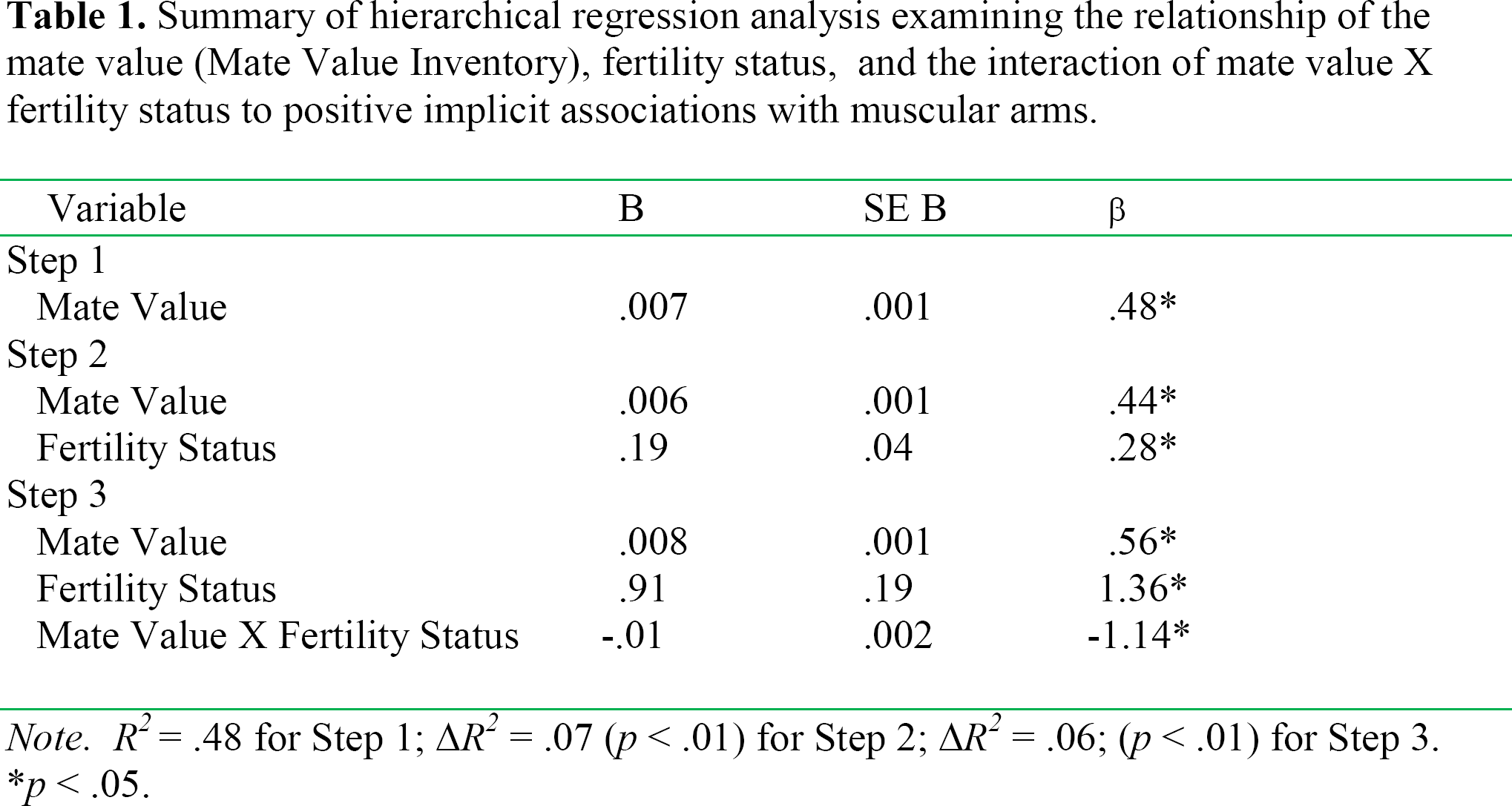
Note. R2 = .48 for Step 1; ΔR2 = .07 (p < .01) for Step 2; ΔR2 = .06; (p < .01) for Step 3.
p < .05.
To explore the nature of the interaction between mate-value and fertility status, values were plotted for participants who were high and low in fertility and were at one SD above and one SD below the mean mate value rating. For women low in mate-value (−1 SD), there was a significant difference between the high and low fertility predicted values, b = .43, t = 5.58, p < .01 (see Aiken and West [1991] for a description of this procedure). That is, low mate value women had significantly less positive implicit responses to the muscular arms when they were low in fertility than when they were high in fertility. For women high in mate value (+1 SD) there was no significant difference between the high and low fertility values, b = .03, t = .47, p >.05. That is, high mate-value women did not have less positive implicit responses when they were low in fertility (see Figure 1).

The relationship of fertility and positive associations with muscular arms at low mate-value (Mate Value Inventory 1 SD below mean) and high mate value (Mate Value Inventory 1 SD above mean). Larger D-Scores indicate more preference for muscularity.
The same set of analyses was conducted using the Self-Perceived Mate Value scale. These analyses produced findings that were similar to the set of findings produce by the Mate Value Inventory. The addition of fertility status to the model containing Self-Perceived Mate Value produced a significant increase in prediction (ΔR2 = .15, p < .01) and the addition of the interaction term (mate value X fertility status) produced a significant increase in prediction over the main effects model, ΔR2 = .06, p < .01 (see Table 2).
For a woman low in mate-value (−1 SD) there was a significant difference between the high and low fertility predicted values, b = .40, t = 6.49, p < .01, and for women high in mate value this difference disappeared, b = .08, t = 1.15, p > .05 (see Figure 2).

The association of fertility status and positive associations with muscular arms at low mate-value (Self-Perceived Mate Scale one SD below the mean) and high mate value (SPMS one SD above the mean). Larger D-Scores indicate more implicit preference for muscularity.
Explicit ratings
Each participant's responses to the three questions about the attractiveness (desirability, attractiveness, and beauty) of each of the 16 photographs depicting muscular and non-muscular arms were summed to form a single index with a range of 3 to 21 (Cronbach's • = .89). Then, for each participant, this index was used to calculate a mean rating of the eight muscular arms as well as a mean rating of eight non-muscular arms and a difference score was created for each participant by subtracting her mean rating of non-muscular arms from her mean rating of the muscular arms. Larger difference scores indicate a more positive evaluation. There was only a modest correlation between the explicit difference score measure and the implicit difference score measure (r = .37). This finding replicates the general pattern of divergent validity for implicit responses found in the extant literature (e.g., McConnell, Rydell, Strain, and Mackie, 2008). These difference scores were analyzed with the same three-step hierarchical regression analyses that were used with the implicit measure.
Consistent with past research, the addition of fertility status to the model containing mate value (Mate Value Inventory) produced a significant increase in prediction (ΔR2 = .40, p < .001). Women rated muscular arms as more attractive when they were in the fertile part of their cycle (M = 12.31) than when they were in the less fertile part of their cycle (M = 5.33). However, the addition of the interaction term (mate value X fertility status) failed to produce a significant increase in prediction over the main effects model (p = .75). For women in the fertile part of their cycle there were no differences in the predicted value (12.43) for low mate value women (−1 SD) and the predicted value (12.22) for high mate value women (+ 1 SD). Similarly, for women in the less fertile part of their cycle there were no differences in the predicted value (5.33) for low mate value women (−1 SD) women and the predictive value (5.56) for high mate value women (+ 1 SD). The same pattern of results was obtained when the Self-Perceive Mate Value measure of mate value was used in these analyses. The addition of fertility status to the model containing Self-Perceive Mate Value increased the predictive power of the model (ΔR2 = .38, p < .001) and the addition of the interaction term did not increase prediction (p = .97). For women in the fertile part of their cycle there were no differences in the predicted value (12.01) for low mate value women (−1 SD) and the predictive value (13.00) for high mate value women (+ 1 SD). Similarly, for women in the less fertile part of their cycle there were no differences between low mate value (−1 SD) predicted values (5.13) and high mate value (+ 1 SD) predictive values (5.71).
Discussion
The study replicated the influence of the menstrual cycle on women's mate preferences found in the extant literature. With both the implicit and explicit measures, women during the fertile part of their cycles associated more positivity with characteristics linked to quality genetic material. Further, the findings provide partial support for the main hypotheses that low mate value women would have more pronounced changes in preferences across the menstrual cycle. When the implicit measure was examined, women low in mate value had weaker positive implicit associations with characteristics associated with high quality genetic material when they were in the less fertile part of their cycle and, alternatively, with women higher in mate value this reduction in positive associations during the less fertile part of their cycle did not occur. These results are congruent with the proposition that a mixed mating strategy (pursuing short-term relationships with high genetic quality males while maintaining long-term relationships with a lower genetic quality male) would be most adaptive for low mate value women who are unable to obtain mates that are high in both genetic quality and resources. That is, for low mate-value women, increased attraction to characteristics associated with high quality genetic material during the more fertile part of her cycle would facilitate this strategy. Contrary to the expectations, the study did not find the moderating effect of mate value when explicit responses were measured. Both high and low mate-value women expressed an explicit preference for muscular arms.
Why did mate value act as a moderator with implicit preferences but not with explicit preferences? One possibility is that the processes involved were operating without conscious awareness, limiting the participants' ability to explicitly state preferences. Remember that an explicit preference is a positive or negative evaluation that is retrievable from memory and directs behavior. Whereas an implicit attitude is the product of positive or negative associations with an object (muscles) that can no longer actively be retrieved from memory. This explanation is consistent with the notion that many evolved processes operate passively without deliberate thought (Cosmides and Tooby, 1995; Tooby and Cosmides, 1989). Yet it is puzzling why participants would be able to explicitly state preferences influenced by the menstrual cycle but not by mate value. Another possibility for the divergence between implicit and explicit responses is that the participants' were giving socially desirable explicit responses. The women may have believed that expressing positive attitudes towards the muscles was the expected or correct response, i.e., normal women should like muscles. Consequently, both the low and high mate value women gave positive explicit ratings of the muscular arms. On the other hand, the Implicit Association Test used to measure the women's implicit preferences was able to detect the moderating role of mate value because the Implicit Association Test is less susceptible to this type of social desirability distortion (see Cvencek, Greenwald, Brown, Snowden, and Gray [2010] and Steffens [2004] for a discussion of Implicit Association Test's resistance to response distortion).
Although this research produced a number of significant findings that are consistent with the hypotheses, issues remain. First, it was difficult to adequately measure mate value because the construct is not fully explicated in the literature. In the literature, mate value has been conceptualized and measured in a variety of ways; in some research, mate-value is operationalized as just a single characteristic (e.g., Beaulieu, 2007) or small set of characteristics (Graham-Kevan and Archer, 2009), and, in other research, as a multidimensional construct (e.g., Figueredo, Sefcek, and Jones, 2006). In an effort to overcome this problem and capture the construct, the current study employed two different measures of mate value (Mate Value Inventory and the Self-Perceive Mate Value Scale). However, both of the measures used in the current study focused only on self-perceived mate value. Is self-perceived mate value accurate and consistent with actual mate value, i.e., how others perceived her mate value? Though many researchers have proposed that persons have evolved psychological mechanisms to assess their mate value (e.g., Buss and Schmitt, 1993; Penke, Todd, Lenton, and Fasolo, 2007) and that these mechanisms need to be accurate in order to be useful (Kirkpatrick and Ellis, 2001), there is little empirical evidence demonstrating the relationship. Future research should address this relationship.
Another limitation of the current study is that fertility status was measured through self-reports. The backward counting procedure employed in the current study has been used successfully in a number of studies (e.g., Lukaszewski and Roney, 2009) and has a built in accuracy check. In an effort to verify the accuracy of the participants' recall, the fertile participants were re-contacted and queried about their place in their cycle and their most recent menstruation. The cycle estimates generated from the second session were compared to estimates generated from the initial session. This procedure did not lead to the reclassification of any participants as fertile or non-fertile. Yet, it is still possible that there were some reporting errors and a few women were miss-classified into the fertility and low fertility conditions. However, it is unlikely that the current findings are the result of miss-classifications because this type of random error would tend to obscure effects. Despite this, an actual hormonal measure has the potential to provide a more accurate classification and allow for the exploration of the putative proximal causes of menstrual cycle changes in mate preferences.
Finally, it is important to remember that there may be variables that correlate with mate value that have the potential to influence changes in female mate preferences across the menstrual cycle. For example, it is possible that there is a correlation between the size of the hormonal shifts across the menstrual cycle and mate value, i.e., low mate value women may have larger shifts than high mate value women. Thus, it is possible that the size of the hormonal shift is responsible for the differences in mate preferences. Similarly, the menstrual cycle is associated with many changes (e.g., self-perceived attractiveness, mood, and facial attractiveness). The influence of these other changes on mate preferences is not fully understood. For example, it is possible that changes in self-perceived attractiveness across the cycle influences the woman's judgment about her ability to obtain highly desirable mates.
Conclusions
The program of research inspired by evolutionary psychology has focused almost exclusively on species typical behavior and has ignored individual differences, with the exception of gender differences, despite the vast corpus of evidence demonstrating their profound importance (Buss, 2008a). Recently, in an effort to rectify this omission, evolutionary theorists have offered a variety of explanations for the evolution of individual differences, e.g., cost signaling (Miller, 2007), balancing selection (Penke, Denissen, and Miller, 2007), and life history theory (Kaplan and Gangestad, 2005). The next step for evolutionary psychologists will be to identify evolutionarily important individual differences and specify how these differences moderate the relationship between ecological inputs and manifest behaviors. The present research, by examining the moderating effects of mate value on mate preferences, is part of this quest.
One participant failed to complete the rating of the muscularity of the arms in the photographs and was not included in this analysis.