




Abstract
What do evolutionary psychologists study, which are their most highly cited articles, and which variables predict high citation counts? These are important questions for any emerging science. To help answer these questions, we present new empirical research on publication trends in evolutionary psychology's flagship journal, Evolution and Human Behavior (and its predecessor, Ethology and Sociobiology), from its inception in 1979 to 2008. First, analyses of 8,631 title words published in these journals between 1979 and 2008 (808 articles) show an increasing interest in researching sex, sex differences, faces, and attractiveness. For example, during the Ethology and Sociobiology era (1979–1996), the most frequent title words were “evolutionary,” “human,” “behavior,” “reproductive,” “evolution,” “selection,” and “altruism,” whereas during the Evolution and Human Behavior era (1997–2008), they were “sex,” “attractiveness,” “differences,” “sexual,” “human,” “male,” and “facial.” Second, we reveal the 20 most-cited articles in these journals, which show the importance of research teams. Third, citation analyses for these journals between 1979 and 2002 (562 articles) suggest articles that cite more references are in turn cited more themselves (r = .44, R2 = .19). Lastly, we summarize recent research that suggests evolutionary psychology is not only surviving, but also thriving, as a new interdisciplinary science.
Keywords
Introduction
What do evolutionary psychologists study? Which articles in evolutionary psychology's flagship journal, Evolution and Human Behavior, have been the most influential? Which variables — if any — are associated with citation counts in evolutionary psychology articles? These are fundamental questions for any emerging interdisciplinary science. The purpose of the present investigation is to answer these questions using empirical quantitative methods.
First, evolutionary psychology is an emerging scientific field that bridges disciplines as diverse as anthropology, biology, economics, and psychology. In part because of its interdisciplinary nature, it may be somewhat difficult to answer the question, “What do evolutionary psychologists typically study?” In addition, evolutionary psychology is a relatively new science, which suggests that its boundaries remain largely uncharted; what is and is not considered to be evolutionary psychology is still being defined. Thus, understanding what, exactly, evolutionary psychologists typically study is a fundamental question. One way to answer this question is to examine word frequencies in the titles of journal articles in evolutionary psychology's flagship journal over time. This also allows for an understanding of how topics of interest to evolutionary psychologists have waxed and waned over time. Because this is a purely descriptive exercise, we make no a priori predictions as to what the hot topics are in evolutionary psychology or how they have changed over time.
Second, another way to understand the nature of an emerging scientific field is to find and examine its most influential works. To this end, the present research will identify and describe the 20 most highly cited articles in Evolution and Human Behavior. In addition, citation counts in academic science — often used as a measure of prestige—typically follow Pareto's 80/20 Rule (Barabási, 2003; Taleb, 2007), where roughly 80% of the work (publications, citations, etc.) is done by roughly 20% of the people (research scientists). In other words, scientific publication citation counts almost invariably produce extremely positively skewed frequency distributions, where, for example 80% of the citations might come from 20% of the articles in a given scientific journal. We predict that evolutionary psychology will be no different, such that it will approximately follow the 80/20 Rule.
Third, given the variability in citation counts, are there any variables we can identify that are associated with — and perhaps even use to predict — how frequently an article is cited? We propose that the number of references that articles include will predict how many citations they will later receive. We make this prediction for three reasons. First, review articles (e.g., theoretical reviews, meta-analyses) tend to have more citations than and are cited more frequently than typical empirical articles. Second, scientists are humans, and humans crave recognition for their work and often participate in reciprocal altruism (Trivers, 1971). Thus, the tit-for-tat nature of “I cite you, you cite me,” may be at work: The more people you cite in your paper, the more people are likely to cite your paper (the paper they were cited in) in the future. Third, the Matthew effect — the idea that “the rich get richer,” that publications that are initially highly cited tend to have the advantage of being cited even more in the future — may also occur (Barabási, 2003; Gladwell, 2008; Merton, 1968).
To address these questions, we chose an archival methodology that allowed us to (a) track topic trends over time in title words, (b) identify the 20 most highly cited works published in evolutionary psychology's leading journal, and (c) examine the extent to
which an article's reference count predicts its citation count.
Method
All data were obtained via the Institute for Scientific Information's (ISI) Web of Knowledge online academic database provided by Thomson Scientific. This database contained the necessary information to examine the questions at hand including the authors, titles, and the citation and reference counts for every article published in Evolution and Human Behavior (and its predecessor, Ethology and Sociobiology) since its inaugural issue in late 1979. Why examine titles? Keyword descriptors were not given in the data until late 1990; alternatively, title words provide a fairly reliable indicator of an article's main subject matter that extend back to the journal's inception in 1979.
The sample consisted of 8,631 title words from 808 publications in Ethology and Sociobiology (1979–1996; 400 publications) and Evolution and Human Behavior (1997–2008; 408 publications). According to the Web of Knowledge's classification system, the published works in our sample consisted of 736 general articles (91%), 24 review articles (3%), 17 conference/proceedings papers (2%), 16 letters (2%), and 15 notes (2%); we chose to exclude works classified as editorial material or book reviews.
Title word frequency was visualized using Wordle (http://www.wordle.net), which makes “word clouds” from inputted text. The font sizes of the words appearing in a word cloud are proportional to the number of times the words appear in the inputted text. For example, if the inputted text was “evolutionary, evolutionary, evolutionary, human, human, behavior,” then “evolutionary” would appear in a font size 1.5 times larger than “human,” and “human” would appear in a font size 2.0 times larger than “behavior.” Word clouds combine descriptive and quantitative information in an ingenious way that allows viewers to extract word frequency information in a fun, efficient, and empirically grounded way that blends art with science. For example, Webster and Nichols (2009) used word clouds to examine change over time in poster titles from a social-personality psychology conference.
Because articles appearing in Evolution and Human Behavior over the last few years have not had enough time to accumulate a stable number of citations, citation and reference counts were analyzed from 1979 to 2002, yielding a subsample of 562 publications (70% of the original sample).
Results
Title Words
Table 1 shows the 25 most frequent title words for each of 5 six-year time windows for evolutionary psychology's flagship journal from 1979 to 2008. In cases where fewer than 25 of the most frequent title words are listed, ties occurred that would have exceeded the top-25 cut-off criterion. Percentages reflect the frequency of a given word divided by the total number of title words for a given time window, multiplied by 100. As can be inferred from the frequency data across years, topics relating to sex, sex differences, faces, and attractiveness have become increasingly popular over the life of the journal. In contrast, such title words as “ethological” and “sociobiological” that were well represented during the early years of the journal were subsequently replaced by other words and topics. Title words such as “kin” and “culture” were relatively common during the early years of the journal, disappeared from the top 25 during the middle years, and have enjoyed a modest resurgence during the last six years. Some topics in evolutionary psychology appear to have enjoyed relatively brief but intense popularity. For example, the appearance of the word “ratio,” might be attributed to studies of women's waist-to-hip ratios (e.g., Singh and Young, 1995) and the sexual and individual differences in 2nd-digit-to-4th-digit (2D:4D) ratios as markers of in-utero androgen exposure (see Putz, Gaulin, Sporter, and McBurney, 2004, for a review). Similarly, “(a)symmetry” may be related to examining fluctuating asymmetry as a marker of good genes and developmental stability (e.g., Gangestad, Thornhill, and Yeo, 1994; Jones, et al., 2001).
Most frequently used words in titles of 808 articles in two journals, 1979–2008 (8,631 title words)

Note. % = (word count for category or time period / total word count for category or time period) * 100.
Table 2 shows the same data broken down into different comparisons. The first column shows the title word data for all 808 publications. Table 2's second and third columns show the breakdown by journal title — that is, Ethology and Sociobiology versus Evolution and Human Behavior, respectively. Ironically — and perhaps presciently — the three most frequent title words during Ethology and Sociobiology's publication history (i.e., “Evolutionary,” “Human,” and “Behavior”) became enshrined in the name of its successor, Evolution and Human Behavior. Comparing these two columns further highlights the evolution of topics in the direction of sex, mating, and attraction (Figure 1). Last, Table 2's fourth and fifth columns show the most recent trends in title words by examining 2 three-year time windows (2002–2004 and 2005–2008). This breakdown suggests that attraction has maintained stable popularity as a “hot topic” among evolutionary psychologists over the last six years; however, it appears that 2002–2004 was a more “sexy” time than 2005–2008, which suggests that more social and kinship-related topics may be regaining popularity (e.g., “Social,” “Kin,” “Children,” “Cultural”).
Most frequently used words in titles of 808 articles in two journals, 1979–2008 (8,631 title words): Comparisons

Note. % = (word count for category or time period / total word count for category or time period) * 100.

Title word frequency clouds (via Wordle.net) for all articles published in Ethology and Sociobiology (top; 1979–1996) and Evolution and Human Behavior (bottom; 1997–2008); 100-word limit.
Citations and References
The 20 most-cited articles published in Ethology and Sociobiology and Evolution and Human Behavior are shown in Table 3. Remarkably, each article has been cited in excess of 100 times (as of March 2009). Interestingly, the second work ever to be published in the journal, Sarah Hrdy's (University of California, Davis) review article on animal infanticide, is currently the most cited publication, despite the lack of an overall relationship between publication year and citation count (r = .05, details below). The most cited authors overall appear to be the team of Leda Cosmides and John Tooby (University of California, Santa Barbara), whose coauthored works appear a remarkable three times in the top eight rankings. Other multiple appearances by authors include the teams of Martin Daly and Margo Wilson (McMaster University), with two papers in the top 5, and Steve Gangestad and Randy Thornhill (University of New Mexico), with 2 and 3 works in the top 18, respectively. Because of the lag time for articles to accumulate citations, no articles published since 2002 currently rank in the top 20.
The 20 Most-Cited Articles in Ethology and Sociobiology and Evolution and Human Behavior, 1979–2008 (as of March 2009).

Recall that in several scientific fields, it is not uncommon for roughly 80% of the research output to be produced by only roughly 20% of all researchers. Instead of comparing authors to citations, we have chosen to compare publications to citations. Nevertheless, we expected citation counts to roughly follow the Pareto 80/20 rule. Here is what we found: The top 1% of the most frequently cited articles (which happened to be those having 150 or more citations), were responsible for 11% of all citations. Similarly, the top 5% were responsible for 28%, and the top 20% were responsible for 61%. The point at which the two percentages summed to 100% was such that the top 28.5% of the most frequently cited articles were responsible for 71.5% of all citations. Thus, citation frequencies for evolutionary psychology's premier journal appear to be showing nearly the same distribution that is found in other sciences (Barabási, 2003; Taleb, 2007).
Does the number of references an article contains predict its citation count? Preliminary analyses of 562 articles revealed that citation counts ranged from 0 to 471 (Mode = 0, Mdn = 14, M = 25.34, SD = 37.69), whereas reference counts ranged from 0 to 719 (Mode = 21, Mdn = 35, M = 45.28, SD = 47.99). Log transformations (i.e., log10[x+1]), which are commonly used for count data (see Judd, McClelland, and Ryan, 2008), successfully corrected the positive skew of the frequency distributions for both citations (Mdn = 1.18, M = 1.14, SD =0.52) and references (Mdn = 1.56, M = 1.52, SD = 0.37). Publication year (1979–2002) was linearly related to neither log citations (r560 = .05, ns) nor log references (r560 = .07, ns). As predicted, log citations and log references were positively related (r560 = .44, p < .05; Figure 2). In other words, reference counts explained 19% of the variance in citation counts.
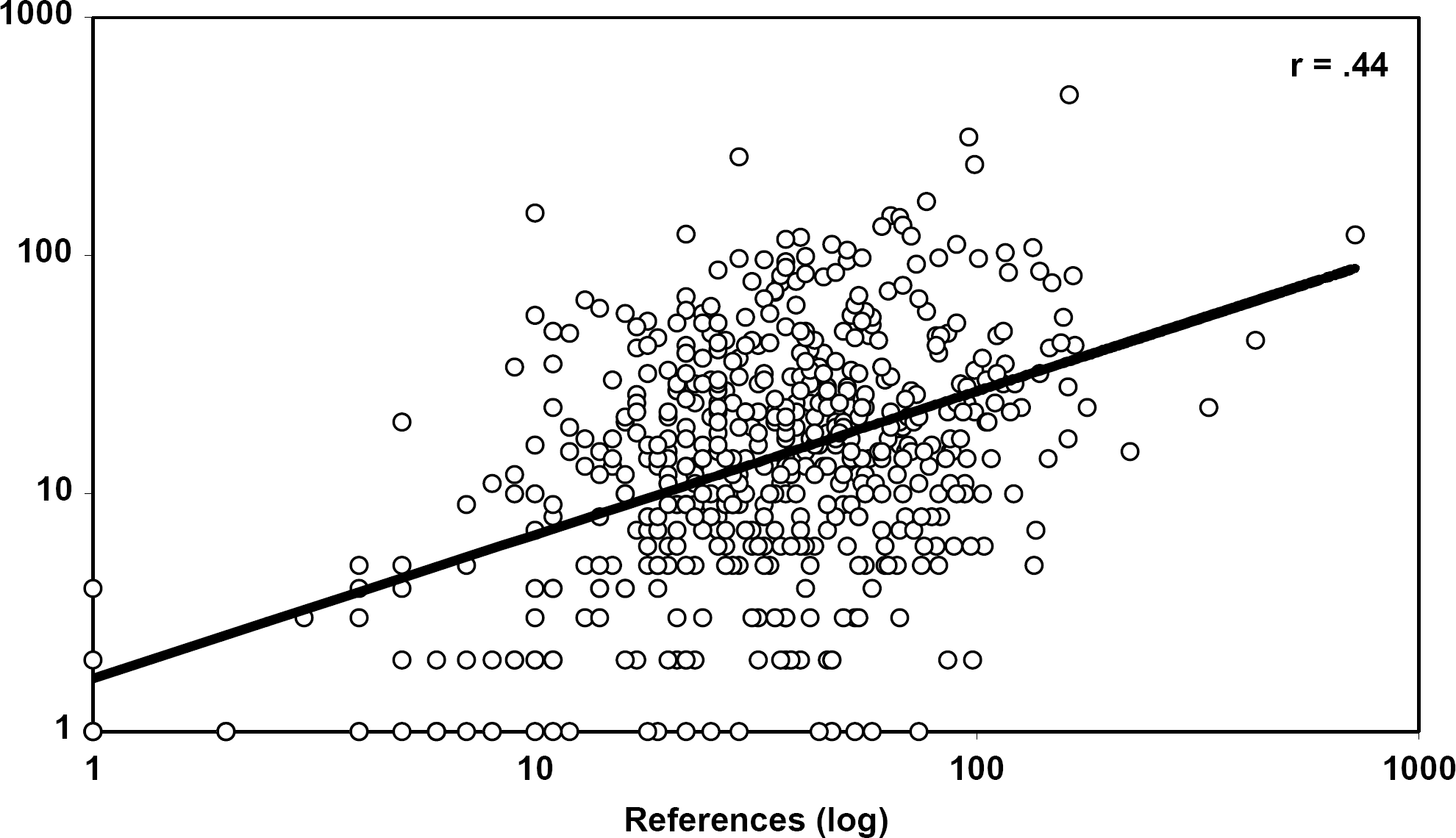
Log10-Log10 Correlation between References and Citations in Articles Published in Evolution and Human Behavior, 1979–2002.
We also examined trends in words per title over time. Across the five time windows, the number of words per title increased significantly (r3 = .96, p < .05). For example, from 1979 to 1984, the mean number of words per title was 9.45, whereas from 2003 to 2008 it was 11.25, corresponding to an increase of 19%. Increases in words per article title over time have also been observed in related disciplines such as personality and social psychology (Reis and Stiller, 1992; Webster, Bryan, Haerle, and O'Gara, 2005).
Discussion
What do evolutionary psychologists typically study? A brief answer would be that evolutionary psychologist typically study humans, behavior, evolution, kin, and altruism; and especially recently, sex, faces, mating, and attractiveness. Perhaps a more detailed answer would be that, given the interdisciplinary nature of the adaptationist paradigm (e.g., Mayr, 1983), evolutionary psychologists study a staggering array of behavior that transcends traditional boundaries among biology, psychology, economics, and anthropology. Despite its topical diversity, evolutionary psychology has managed to focus on a core group of topics ranging from human social and sexual behavior to (facial) attractiveness and from kinship to altruism.
Which articles and authors in evolutionary psychology's leading journal have been cited the most? Articles relating to infanticide, emotional adaptations, punishment and cooperation, male sexual jealousy, the young male syndrome, human food-sharing, the generation of culture, and male facial attractiveness rounded out the top 10. Interestingly, among the most highly cited authors were three pairs of frequent collaborators: Cosmides and Tooby, Daly and Wilson, and Gangestad and Thornhill. Frequently collaborating dyads or teams of researchers may provide some advantages in the publication game. For example, publications by teams of researchers are more frequently cited than those written by solo researchers on average, and this differences has increased over time and is present in nearly all scientific disciplines (Wuchty, Jones, and Uzzi, 2007). We tested this possibility by creating a variable for the number of authors per article (Mdn = 2.0, M = 1.89, SD 1.17), log transforming it (Mdn = 0.48, M = 0.43, SD = 0.14), and correlating it with log citation counts, which showed a significant positive relation (r560 = .20, p < .05; Figure 3) that remained even after excluding a possible outlier (r559 = .19, p < .05). In all, between 1979 and 2002, the percentages of articles published by one, two, three, four, five, six, or seven or more authors were 46%, 34%, 12%, 5%, 2%, 1%, and < 1%, respectively.
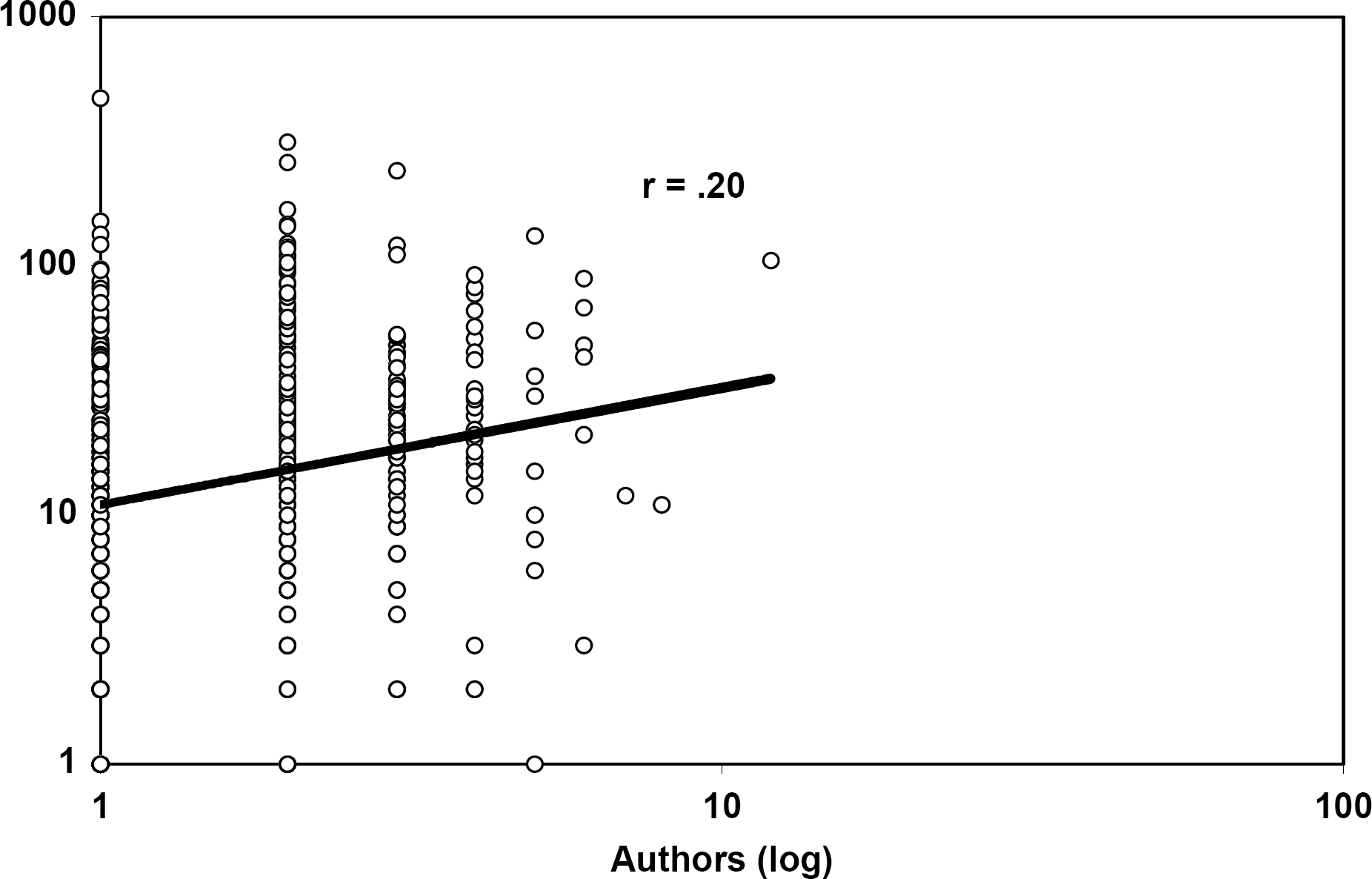
Log10 Correlation between Authors and Citations in Articles Published in Evolution and Human Behavior, 1979–2002.
Was the number of references included in an article related to — or even predictive of — an article's future citation count? Yes. Reference and citation counts were significantly positively correlated, with the former explaining nearly one-fifth of the variance in the latter. But is this relationship necessarily predictive? Maybe. The fact that publications have a set number references before they begin to accumulate citations allows one to establish temporal precedence; if a causal relationship is present, one can feel fairly confident about the directionality. Nevertheless, it is possible that the observed relationship is a spurious one that can be explained by an unknown or unmeasured “third variable” that affects both references and citations (e.g., individual differences in how extroverted or well-networked various authors are). Thus, without a randomized experiment, one cannot reliably exhaust all “third variable” possibilities.
One possible explanation for the reference-citation association is reciprocal altruism (Trivers, 1971), where groups of authors cite each other's works over time. For example, if we cited your work in this paper and you notice it, you might be more likely to cite our work in one or more of your papers in the future, provided it is on a related topic. Thus, the more references an author includes, the greater the likelihood that more authors will in turn cite his or her work. This can create a “runaway” positive feedback loop of referencing and citing among groups of collaborators or affiliated researchers that accumulates over time (typically years). In science, this phenomenon is sometimes known as the “Mathew effect” or “the rich get richer effect,” where articles that are initially highly cited in their first few years tend to be the same ones that continue to have a high citation rate in subsequent years (Gladwell, 2008; Merton, 1968).
Another possible explanation for the reference-citation association is that it is driven largely by broad theoretical articles, review articles, and meta-analyses. These types of articles often include more references than most other types of articles and often have higher citation counts in part because they represent summaries of knowledge that incorporate multiple individual works and perspectives. Table 3, however, reveals little consistent support for this possibility, because 17 (85%) of the top 20 most frequently cited papers in Evolution and Human Behavior are classified as general empirical articles and only one is categorized as a review article (5%), which are similar rates compared to the overall sample (91% and 3%, respectively). We should caution, however, that including a high number of references will not necessarily translate into increased citations for all articles. Indeed, psychology has experienced an “explosion” of (often redundant) referencing and citing that has contributed increasingly protracted articles over time (Adair and Vohra, 2003), and although it appears this trend has recently diminished (Webster, 2007d), we doubt evolutionary psychology has been immune to these general trends. Thus, it is possible that reciprocal altruism, the Matthew effect, and expectations about review articles could each be driving the observed reference-citation relationship to some extent.
Limitations and Implications
Although we were generally able to answer the question we set out to address, the present research is not without its limitations. First, title words are not a perfect reflection of the topic(s) of scientific articles. Although we could have used keyword descriptors instead of title words, recall that keywords were not used or indexed regularly in evolutionary psychology's premier journal until late 1990, which would have resulted in a loss of data and an inability to examine important long-term trends. Nevertheless, we are confident that most titles portray a fairly accurate representation of their respective article's content. Second, the time spans we chose to examine (i.e., 5 six-year windows) were somewhat arbitrary, and are not optimal for capturing year-to-year fluctuations in topic interests. Nevertheless, by pooling multiple years, we were able to reduce the likelihood that any particular title word would have had an undue influence on the observed trends. Thus, in light of this trade-off, we believe our choice of design is justified.
Third, regarding the top 20 most frequently cited articles, we cannot rule out the possibility of chance alone being a contributing factor. Some articles are simply “lucky” enough to be published at a time when interest in the topic they address is high. Other articles maybe lucky in that they cite the “right” group of influential, well-networked researchers. Still other articles may benefit from a substantial Matthew effect, where if the article generates a groundswell of interest early on, more researchers are likely to join the bandwagon of other researchers who initially cited it. Nevertheless, it is noteworthy that many of the most-cited researchers in evolutionary psychology frequently publish as teams.
Fourth, regarding the reference-citation relationship, we reiterate that causation cannot be reliably established given the limitations of our correlational design. Nevertheless, we have fulfilled two of the three necessary criteria for establishing causality: correlation and temporal precedence (Kenny, 2004). The only remaining limitation is that we cannot rule out a spurious correlation based on unknown and untested “third” variables. In addition, the moderately strong effect size of the reference-citation relationship suggests that it may warrant further study.
The implications of these findings might be best interpreted in the broader context of publication and citation trends in evolutionary psychology. First, establishing a dedicated journal in an emerging field can provide an immediate boost in visibility and citations (Webster, 2008), and this was likely the case for evolutionary psychology when the first issue of Ethology and Sociobiology rolled off the presses in 1979. Since then, the numbers of authors, section headings, studies, participants, and empirical research articles (vs. theoretical or review articles) have increased significantly (Webster, 2007c). Moreover, the term “evolutionary psychology” appears to be outpacing — and perhaps replacing — the term “sociobiology” in the scientific literature (Webster, 2007e). In addition, evolutionary theory's influence on related scientific fields such as cognitive neuroscience (Webster, 2007a) and social-personality psychology (Webster, 2007b) has been increasing substantially in recent years. Furthermore, evolutionary psychology is now covered more in introductory psychology textbooks than it was three decades ago (Cornwell, Palmer, Guinther, and Davis, 2005). Even the impact factor (a measure of how frequently the average article in a journal is cited within its first two years of publication) for Evolution and Human Behavior significantly increased between 1997 and 2005 (Webster, 2007c).
More recent research has revealed that Evolution and Human Behavior may be even more influential than its respectable impact factor might suggest. Using SCImago Research Group's (http://SCImagoJR.com) SCImago Journal Rank (SJR), which takes the citation reputations of journals that cite a given journal's articles into account (a sort of “second-order” impact factor weighting that is akin to accounting for differences in strength of schedule when ranking teams via winning percentages in sports), Evolution and Human Behavior's SJR ranking is at the 96th percentile for psychology journals and at the 92nd percentile for science journals in general (Gangestad, 2008a). In other words, evolutionary psychology's interdisciplinary nature allows it to be cited by authors who publish in other highly cited journal across a broad array of scientific fields (e.g., biology, neuroscience, medicine, psychology, anthropology, multidisciplinary science, and of course, evolutionary science), and this indeed appears to be occurring for Evolution and Human Behavior (Gangestad, 2008b). Thus, evolutionary psychology's broad appeal may translate into high SJRs, and in turn, greater prestige in the scientific community.
Coda
What have we learned about evolutionary psychology? First, we now know that evolutionary psychologists typically study a diverse array of scientific topics, ranging from altruism to attractiveness and from kinship to sexual behavior. Additionally, there appears to be a shift toward topics relating to the study of sex, sex differences, faces, and attraction over the last decade or so. Second, we see that the most frequently cited articles in evolutionary psychology tend to be a blend of theoretical articles, review articles, and general empirical articles that vary widely in their subject matter. We do know, however, that highly cited articles tend to be written by teams of researchers that have published together several times (Table 3). Third, we find that having more references in an article correlates positively with having more citations to that article in the future. Although the causal process remains elusive, we were able to generate at list of three possible contributory explanations that are neither exclusive nor exhaustive: reciprocal altruism, the Matthew effect, and the high citation rates of “summary” articles (e.g., integrative reviews, theoretical papers, meta-analyses). Regardless, we are encouraged by prior research that shows evolutionary psychology is surviving and thriving as a new interdisciplinary science.
Footnotes
Acknowledgments
This research was presented as a poster at the 21st annual meeting of the Human Behavior and Evolution Society (HBES) in Fullerton, California, in May 2009.