



Abstract
In order to explain helping strangers in need in terms of reciprocal altruism, it is necessary to ensure that the help is reciprocated and that the costs of helping are thus compensated. Competence and willingness to make sacrifices for the benefactor of the person being helped are important cues for ensuring a return on help because reciprocity would not be possible if the person being helped had neither the competence nor the inclination to give back in the future. In this study, we used vignettes and manipulated the cause of suffering strangers’ difficulties and prosociality to investigate participants’ compassion for and willingness to help the stranger. In Study 1, we measured willingness to help by using hypothetical helping behaviors that were designed to vary in cost. In Study 2, we measured willingness to help by using the checkbox method in which participants were asked to sequentially check 10 × 10 checkboxes on a webpage, which asked the participants to pay a small but real cost. In both studies, the controllability of the cause and the prosociality were found to independently affect compassion. These two factors also independently affected willingness to help, as measured by both the hypothetical questions and the checkbox method. We consequently discussed the reasons for the independent processing of the competence and behavioral tendency cues.
People often help others in need at a large cost. Behavior, akin to morphological traits, represents a phenotype that undergoes natural selection. If the benefits (i.e., increase in fitness) resulting from a behavior outweigh the costs (i.e., decrease in fitness), that behavior will evolve. The issue is altruistic behavior. Altruistic behavior is defined as behavior in which an individual pays a cost to enhance the benefit of another. Thus, it appears improbable, at the individual level, for this behavior to persist under natural selection. For a gene to increase in frequency within a population, the fitness of individuals carrying the gene must, on average, exhibit higher fitness than those lacking it. If an individual lowers its own fitness through altruistic behavior and the fitness of other individuals with the same gene increases as a result, the average fitness of the gene will rise, thereby increasing its frequency in the population. The Price equation modeled the conditions facilitating a gene's frequency increase in a population (Price, 1970), from which “positive assortment” arises as a condition under which genes involved in altruistic behavior can increase their frequency (Pepper & Smuts, 2002). In essence, within a population segmented into various groups, if the variance within a group is smaller than the variance between groups, genes associated with altruistic behavior will increase in frequency within the population. In other words, not only genes and individuals, but also groups can be regarded as units of selection (multi-level selection). The inclusive fitness theory of Hamilton (1964a, 1964b) can be deduced from the Price equation because kin groups can be viewed as groups with strong positive assortment (Hamilton, 1975).
Traditionally, explanations regarding the evolution of altruistic behavior in humans can be divided into two main categories: kin selection and reciprocal altruism that explains altruistic behavior among non-kin (Trivers, 1971). However, with the consideration of multi-level selection, kinship merely represents one of the circumstances ensuring positive assortment. If individuals possessing genes associated with altruistic behavior engage in more frequent interactions with each other than the overall frequency of the population, altruism will evolve according to that degree. Additionally, since many kin tend to reside in close spatial proximity, spatial proximity facilitates positive assortment; nevertheless, it serves as a sufficient condition, not a necessary one. Even if individuals are not spatially close to each other, when those with genes associated with altruistic behavior form a network and exclusively interact among themselves, there exists potential for multi-level selection to operate. For reciprocal altruism to function effectively, the cost of altruism must be compensated for later, either directly or indirectly. In essence, if we can eliminate “free-riders” and engage socially solely with those who are likely to reciprocate (individuals who share “reciprocal genes,” so to speak), reciprocal altruism operates under the same model as multi-level selection.
The fundamental concept of evolutionary psychology posits that the proximate factor (i.e., the structure of the mind) is influenced by the ultimate factor (i.e., selection pressure). While this does not account for all the structures of the mind, some can be hypothesized and tested from an evolutionary standpoint. Indeed, research has shown that humans possess various cognitive functions adapted for positive assortment, such as the detection of cheaters and altruists (e.g., Cosmides,1989; Cosmides & Tooby, 1992; Oda et al., 2009; Oda et al., 2021), as well as memory biases enabling people to more accurately recall the face of a cheater compared to a non-cheater (e.g., Oda & Nakajima, 2010). Many of our emotions might also have evolved as adaptations to the positive assortment (Trivers, 1971). Compassion, for instance, serves as a motivator for helping behavior. If the person in need can be expected to give back in the future, that is, if they have the tendency and ability to reciprocate, then it would be worth the cost to help them. The compassion and the willingness to help that motivates it would vary in strength depending on the balance between the expected return from the person in need and the cost that the helper would incur.
When we help a person in need, the competence of the person is an important cue for ensuring a return on help because reciprocity would not be possible if we helped a person who did not have the competence to give back in the future. A cue of competence is the controllability of the cause of the difficulties. If the sufferer has got into trouble even though the cause is controllable, this suggests that the individual lacks the competence to reciprocate. Indeed, there are many studies indicating that the controllability of the cause of difficulties affects the willingness to help (e.g., Barnes et al., 1979; Goetz & Halgren, 2020; Meyer & Mulherin, 1980; Weiner, 1980).
Another possible cue is the willingness to sacrifice for the benefactor. Even if the sufferer had the competence to reciprocate, they would not do so if they were not willing. Stellar et al. (2014) asked participants to interact with egoistic, cooperative, and control targets who disclosed a time of suffering and measured physiological responses as well as compassion. They reported that suffering egoists evoked less compassion in others than non-egoists. Sznycer et al. (2019) experimentally investigated whether factors such as how needy the stranger was and how much they would sacrifice for the benefactor would influence the degree of compassion and help toward the stranger. They showed that compassion mediated the stranger's degree of neediness and the participants’ welfare tradeoff rations for the stranger (Experiment 1). However, when information about the stranger's degree of willingness to sacrifice was obtained, compassion measured initially did not correlate with the degree of tradeoff ratio after the information was provided (Experiment 2). In addition, when compassion was measured after information was obtained only from the high-need stranger, the participants’ sacrifice was not correlated with degree of compassion (Experiment 3). These results suggest that compassion is an index of a stranger's level of need, not their value as a cooperative partner.
In this study, we used vignettes and fixed the needs of the suffering stranger while manipulating cues about the stranger's probability of reciprocating. In Sznycer et al. (2019), the stranger's willingness to sacrifice was presented as a value. However, in a real situation, how much a stranger is willing to sacrifice is uncertain and can only be inferred from indirect cues such as personality and past behavior. If compassion motivates helping behavior, it might increase or decrease according to expectations of future returns rather than clear current cost-benefits. As a cue to the probability of reciprocation, we manipulated the cause of the strangers’ difficulties because getting into trouble through one's own fault indicates a lack of competence, and one cannot expect more in return. Another cue could be the character of the stranger. A prosocial person can be expected to reciprocate more than a less prosocial person, and such a person would be more likely to be pitied. However, in the case of self-responsibility, reciprocity is not expected even if a person is prosocial, whereas it is expected if a person is not responsible to the cause. On the other hand, if a person is low in prosociality, little return is expected whether or not they are responsible for themselves. As a result, an interaction between prosociality and cause of difficulty is expected.
In Study 1, we measured compassion for and willingness to help the people in the vignettes. Our hypotheses were: Participants would answer that they felt more compassion for those who were in trouble through no fault of their own than for those who were not and that they felt more compassion for those with prosocial tendencies than for those without. There would thus be a significant interaction between cause of difficulty and prosocial tendency. The same would apply to willingness to help, and as the cost of helping increases, the willingness to help would decrease significantly. In addition to compassion, several emotions thought to be associated with helping behavior were simultaneously measured for manipulation checks.
In Study 2, we measured willingness to help in a different way. Goetz et al. (2010) defined compassion as the feeling that arises from witnessing the suffering of others and that motivates a subsequent desire to help, and Goetz and Halgren (2020) showed that compassion mediates the effects of controllability on willingness to help others. They measured compassion and willingness to help others using the Likert scale. For example, they created six helping behaviors that varied in cost and asked participants how willing they would be to provide the six types of help. When we measure attitudes such as compassion and willingness to help using a Likert scale, we may not be sure whether the response reflects the true attitude because the respondent simply chooses one of the options presented. Various factors, such as social desirability and the presence of others, can affect the choice. Therefore, we measured willingness to help using a method that asked participants to pay low but actual costs.
We employed the checkbox method developed by Oda and Hiraishi (2021), in which participants were asked to sequentially check 10 × 10 checkboxes on a webpage by pointing the cursor at each box and clicking (or by tapping in the case of touch panels). Each box is numbered from 1 to 100, from left to right, and it is only possible to check them in order, starting with the smallest number. For example, to answer 7, the participant must click seven times in the correct order. Compared to simply selecting a number or moving a slider to a desired position, checking the boxes one by one is more tedious and time-consuming because participants have to keep clicking until they get to the number they want to answer (see Figure 1 in Oda & Hiraishi, 2021). As it does not require a material cost such as money, the checkbox method is a convenient method of measuring willingness to incur a cost. Indeed, in their replication of Ohtsubo and Yagi (2015), which showed that people were more likely to make a costly apology to valuable partners than to less valuable ones, Oda and Hiraishi (2021) reported that among the factors expected to affect the number of boxes checked, the most important was the instrumentality of the friend. Moreover, the cost of the apology was greater in the “stained book scenario” than in the “no-show scenario,” which demonstrated the validity of the “costly apology model.”
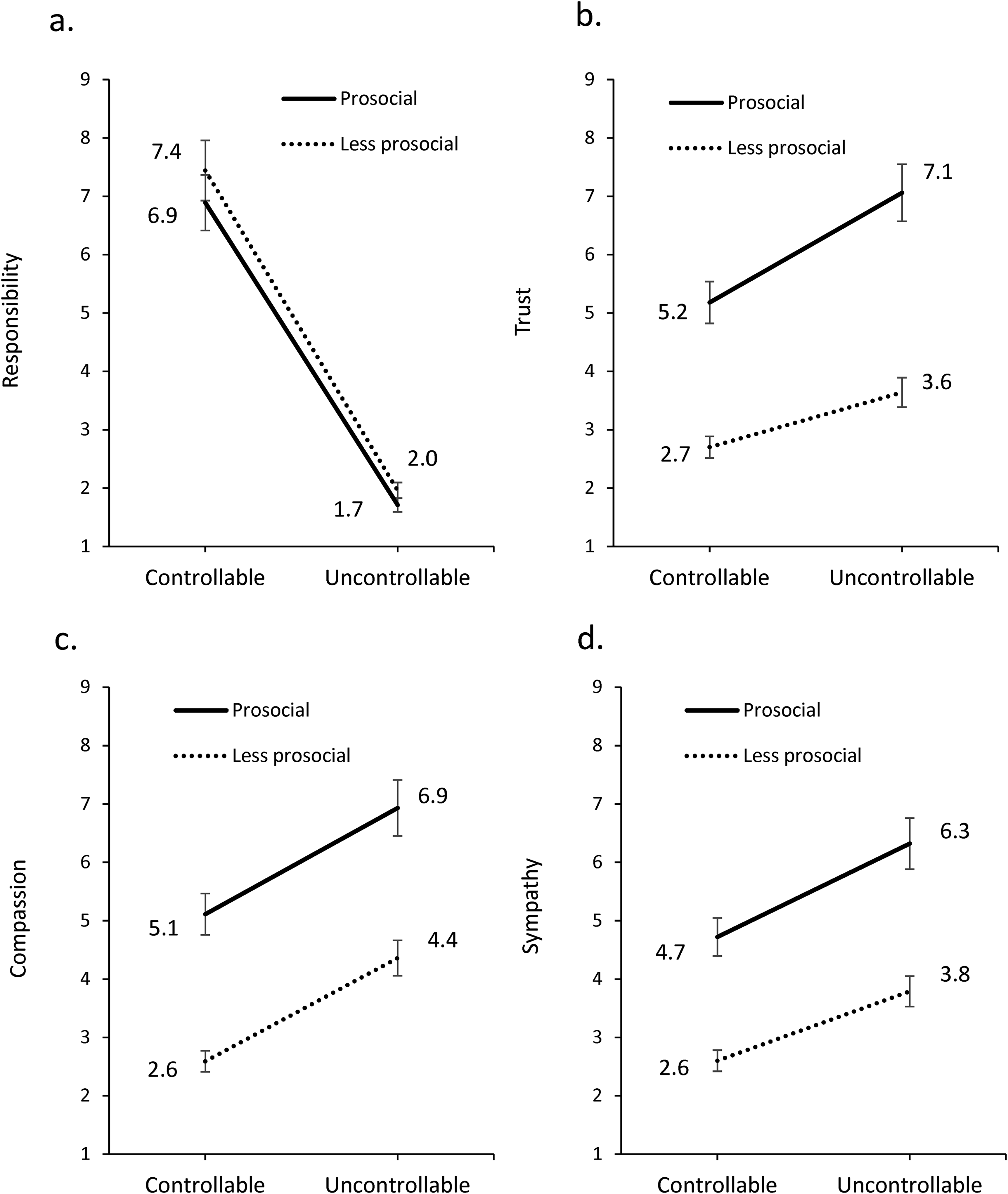
Mean and SE of (a) responsibility, (b) trust, (c) compassion, and (d) sympathy felt by participants in the combinations of character and cause.
Another improvement in Study 2 was that we used different scenarios from those in Study 1, in which the individuals in the scenarios were given a more extreme characterization: prosocial and antisocial. Moreover, in addition to the participants’ compassion and trust as measured in Study 1, we measured participants’ admiration, familiarity, contempt, and dislike toward the individuals in the scenarios. If the characterization of the person is appropriate, participants would answer that they felt significantly more trust, admiration, and familiarity toward those with prosocial tendencies and significantly more contempt and dislike toward those with cheating tendencies. As regards compassion and the number of boxes checked, the results of Study 1 would be replicated.
Study 1
Method
Procedure
Four fictional scenarios involving four people were prepared (see Appendix). These scenarios concerned fictional persons who have lost their jobs, and the word counts were kept nearly identical. By the description of their personality, job, and leisure time, we characterized two of the individuals as prosocial (diligent care worker and sincere person enjoying volunteer activities) and the other two as less prosocial (unreliable office worker and lazy person enjoying games and watching YouTube). The cause of unemployment was set to self-responsibility (controllable: late due to oversleeping) and a cause beyond the individual's control (uncontrollable: employer bankruptcy due to fire). Participants read all the four scenarios that combined the character and the cause of unemployment. The combination was counterbalanced. That is, one of the two prosocial individuals was paired with the controllable and the other with the uncontrollable, and each of the two less prosocial individuals was also combined with one of the two controllability. This resulted in four different combination patterns (see Appendix). Participants were assigned to one of the patterns, and the order of presentation of the scenario was randomized within each pattern.
After reading each scenario, participants answered the questions for a comprehension check of the scenario, and they reported how much responsibility they thought the people in the scenario bore for their unemployment, and their feelings of trust, compassion, and sympathy toward the people in the scenario, on a nine-point Likert scale (from 1 “I do not feel this at all” to 9 as “I feel this strongly”). The order in which the questions were presented was fixed. Participants then indicated their willingness to help the individuals in the scenario. The willingness was measured using four helping behaviors that were created to vary in costliness, in reference to Goetz and Halgren (2020). These included helping that is likely to have little or no impact on the fitness of the helper or recipient (giving words of encouragement), relatively low-cost instrumental helping such as sharing resources for a short period of time (help with a job search, loaning money), and more costly instrumental helping (giving money). Participants responded to each item on a nine-point Likert scale (from 1 “I am not willing to do this at all” to 9 as “I am extremely willing to do this”), and the order in which these items were presented was fixed. This study design was approved by the Institute's Ethics Committee.
Participants
Participants were recruited through Cross Marketing, Inc. (Tokyo, Japan), a research agency that maintains a panel of more than 2 million individuals who have consented to participate in web-based online surveys. After excluding those who did not answer the comprehension check correctly, data from 209 Japanese adults (100 females and 109 males, median age: 53 years, range: 16–88 years) were analyzed.
Statistical Analyses
Two-way analyses of variances were conducted, with magnitude of each of the four feelings (responsibility, trust, compassion, and sympathy) as the dependent variable and the character of the person (prosocial/less prosocial) and the cause of unemployment (controllable/uncontrollable) in the scenarios as the within-subject independent variables. As we tested on four ratings independently, we set the alpha to .01 (<.05/4; Bonferroni correction) to control for family-wise type I error. A power analysis using G*Power 3.1.9.2 showed that a sample of 146 participants was required for an effect size of 0.25 (medium), power of .95, and an alpha of .01. Our sample size is sufficient for the analyses performed. Three-way analysis of variances was conducted, with the magnitude of willingness to help as the dependent variable and the character of the person (prosocial/less prosocial), the cause of unemployment (controllable/uncontrollable), and the cost of helping (four kinds) as the within-subject independent variables. A power analysis using G*Power 3.1.9.2 showed that a sample of 72 participants was required for an effect size of 0.25 (medium), power of .95, and an alpha of .05.
Results and Discussion
The main effects of character and cause on responsibility was significant (character: F(1, 208) = 19.56, p < .001, η2p = .086; cause: F(1, 208) = 1231.05, p < .001, η2p = .855), while the interaction between them was not significant (F(1, 208) = 4.20, p = .042, η2p = .020). Participants were likely to think that individuals in distress due to a controllable cause (M = 7.2) were more responsible than those in distress due to an uncontrollable cause (M = 2.0). Although participants were also likely to think that less prosocial individuals (M = 4.7) were more responsible than prosocial individuals (M = 4.3), the effect size was considerably smaller than that of the cause (Figure 1(a)). The main effects of character and cause on trust were significant (character: F(1, 208) = 533.07, p < .001, η2p = .719; cause: F(1, 208) = 246.89, p < .001, η2p = .543), as was the interaction between them (F(1, 208) = 44.72, p < .001, η2p = .177). Participants were more likely to trust prosocial (M = 6.1) than less prosocial individuals (M = 3.2), and individuals in distress due to an uncontrollable cause (M = 5.3) than those in distress due to a controllable cause (M = 3.9). The effects of these two factors were not independent (Figure 1(b)). The main effects of character and cause on compassion were significant (character: F(1, 208) = 398.29, p < .001, η2p = .657; cause: F(1, 208) = 248.01, p < .001, η2p = .544), while the interaction between them was not significant (F(1, 208) = 0.06, p = .814, η2p = .000; Figure 1(c)). Participants felt more compassion for prosocial (M = 6.0) than less prosocial (M = 3.5) individuals, and for individuals in distress due to an uncontrollable cause (M = 5.6) than those in distress due to a controllable cause (M = 3.9). The same tendency could be seen on sympathy (character: F(1, 208) = 328.07, p < .001, η2p = .612; cause: F(1, 208) = 198.66, p < .001, η2p = .489; interaction: F(1, 208) = 6.41, p = .012, η2p = .030; Figure 1(d)). Participants felt more sympathy for prosocial (M = 5.5) than less prosocial (M = 3.2) individuals, and for individuals in distress due to an uncontrollable cause (M = 5.1) than those in distress due to a controllable cause (M = 3.7).
The main effects of character, cause, and cost of helping on willingness to help were significant (Table 1). The interactions between character and cost as well as cause and cost were also significant. The assumption of sphericity was violated for the cost of helping, and we employed Greenhouse–Geisser corrected degrees of freedom for the results. Participants were more likely to help prosocial individuals than less prosocial individuals, and those in distress due to an uncontrollable cause than those in distress due to a controllable cause. As the cost of helping increased, the willingness to help decreased (Figure 2). The simple effects of character and cause were significant for all the costs of helping (Table 2). Multiple comparisons revealed that the effects of character and cause diminished as the cost of helping increased (Table 3).
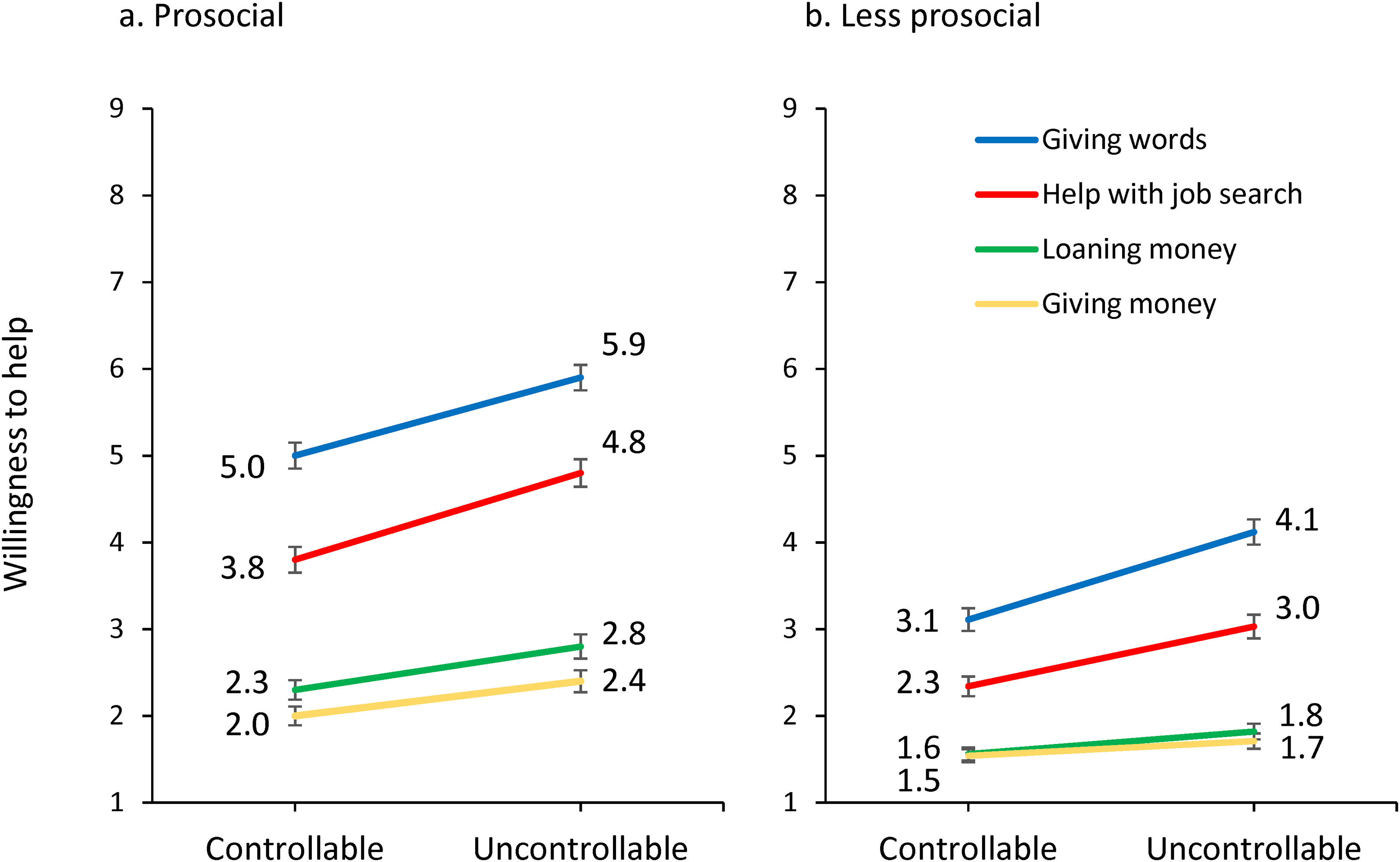
Mean and SE of willingness to provide help in the combinations of character, cause, and cost of helping.
Result of Three-Way ANOVA on the Willingness to Help.

Simple Effects of Character and Cause on Each Helping Behavior.

df = 1, 832.
Multiple Comparison of Willingness to Help in Each Helping Behavior.

df = 208.
The results show that participants felt more positive emotions, including compassion, for prosocial individuals than for less prosocial individuals, and for individuals in distress due to an uncontrollable cause than for those in distress due to a controllable cause, which could lead to helping behavior. Indeed, participants answered that they were more willing to help prosocial individuals than less prosocial individuals, and those in distress due to an uncontrollable cause than those in distress due to a controllable cause. However, these two factors, which influence the likelihood of being returned, were found to independently affect willingness to help. Moreover, the effects of the two factors diminished as the cost of helping increased, especially for helping through loaning and giving money. Since the character of the distressed person and the cause of the distress are merely cues to what potential helpers expect to receive in return in the future, they might not be useful in determining when the cost of helping (i.e., the amount of investment) is high.
Study 2
The results of Study 1 showed that, contrary to the prediction, the character of the person in need and the cause of the difficulty independently affected willingness to help. However, the declarations of willingness were only fictitious, and it was not certain that participants would actually pay the costs. Therefore, in Study 2, we measured willingness to help by imposing actual costs on participants using the checkbox method. If the results of Study 1 are correct, character and cause should independently affect the number of boxes checked.
Method
Procedure
As with Study 1, four fictional scenarios concerning four people were prepared (see Appendix). These scenarios were about fictional persons whose businesses went bankrupt, and the word counts were kept nearly identical. Two of the individuals were prosocial (actively participated in local neighborhood associations/contributed to the welfare of children in the community), and the other two were antisocial (refused to pay neighborhood association dues/served alcohol to local high school students). The cause of bankruptcy was set to self-responsibility (controllable: failure to expand business) and a cause beyond the individual's control (uncontrollable: the COVID-19 pandemic). Participants read all the four scenarios that combined the character and the cause of bankruptcy. The combination was counterbalanced. That is, one of the two prosocial individuals was paired with the controllable and the other with the uncontrollable, and each of the two antisocial individuals was also combined with one of the two controllability. This resulted in four different combination patterns. Participants were assigned to one of the patterns, and the order of presentation of the scenario was randomized within each pattern.
After reading each scenario, participants answered questions for a comprehension check and reported their feelings of compassion, trust, admiration, familiarity, contempt, and dislike toward the people in the scenarios on a nine-point Likert scale (from 1, “I do not feel this at all” to 9, “I feel this strongly”). The order of presentation of the questions was randomized within each scenario.
In order to measure the degree to which they would like to help the person in the scenarios, participants were then asked to indicate their willingness to help by clicking the checkboxes; there were 100 of these, with 10 per row. Each box was numbered from 1 to 100, from left to right, and it was only possible to check them in order, starting with the smallest number (from 0, “I don’t want to help at all,” to 100, “I want to help the person very much”). This study design was approved by the Institute's Ethics Committee.
Participants
Participants were recruited through Cross Marketing, Inc. (Tokyo, Japan). After excluding those who did not answer the comprehension check correctly, data from 160 Japanese adults (80 females and 80 males, median age: 55 years, range: 19–92 years) were analyzed. Forty participants (20 females, 20 males) were assigned to each of the four conditions by combination of the manipulated variables.
Statistical Analyses
Two-way analyses of variances were conducted, with magnitude of six feelings (compassion, trust, admiration, familiarity, contempt, and dislike) as the dependent variable and the character of the person (prosocial/antisocial) and the cause of bankruptcy (controllable/uncontrollable) in the scenarios as the within-subject independent variables. As we tested on six ratings independently, we set the alpha to .008 (<.05/6; Bonferroni correction) to control for family-wise type I error. A power analysis using G*Power 3.1.9.2 showed that a sample of 152 participants was required for an effect size of 0.25 (medium), power of .95, and an alpha of .008. Our sample size is sufficient for the analyses performed.
The number of boxes checked can be considered as count data; therefore, the dependent variable was modeled using the Poisson distribution. A general linear mixed model (GLMM) was run with the character of the person and the cause of bankruptcy as fixed effects and the participants as random effects. The function glmer in the R 4.2.2 package lme4 was used.
Results and Discussion
The main effects of character and cause on compassion were significant (character: F(1, 159) = 159.46, p < .001, η2p = .501; cause: F(1, 159) = 38.38, p < .001, η2p = .194), while the interaction between them was not significant (F(1, 159) = 0.60, p = .441, η2p = .004; Figure 3(a)). Participants felt more compassion for prosocial (M = 5.6) than antisocial (M = 3.6) individuals and for individuals in distress due to an uncontrollable cause (M = 5.0) than those in distress due to a controllable cause (M = 4.2). The main effects of character and cause on trust were significant (character: F(1, 159) = 178.75, p < .001, η2p = .529; cause: F(1, 159) = 27.55, p < .001, η2p = .148), while the interaction between them was not significant (F(1, 159) = 3.19, p = .076, η2p = .020; Figure 3(b)). Participants felt more trust toward the prosocial (M = 5.4) than the antisocial (M = 3.3) individuals and toward the people in distress due to an uncontrollable cause (M = 4.6) than those in distress due to a controllable cause (M = 4.1). The same tendency could be seen on admiration (character: F(1, 159) = 202.64, p < .001, η2p = .560; cause: F(1, 159) = 18.53, p < .001, η2p = .104; interaction: F(1, 159) = 1.36, p = .245, η2p = .009) and familiarity (character: F(1, 159) = 197.77, p < .001, η2p = .554; cause: F(1, 159) = 18.70, p < .001, η2p = .105; interaction: F(1, 159) = 0.36, p = .551, η2p = .002; Figure 3(c) and (d)). Participants felt more admiration for prosocial (M = 5.2) than antisocial (M = 3.2) individuals, and for individuals in distress due to an uncontrollable cause (M = 4.4) than those in distress due to a controllable cause (M = 4.0). The same was seen for familiarity (M = 5.1 for prosocial and M = 3.0 for antisocial; M = 4.2 for controllable and M = 3.9 for uncontrollable).
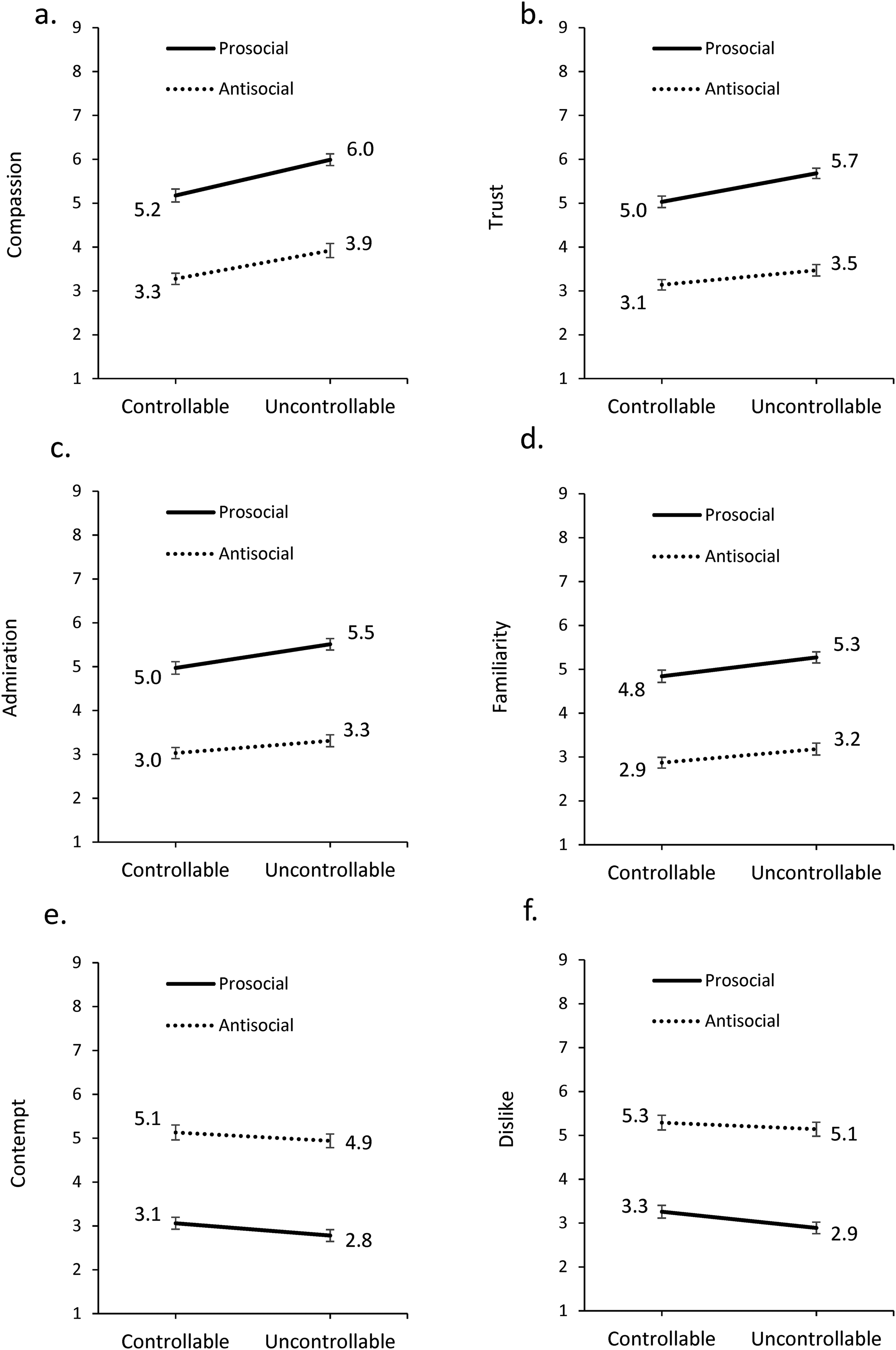
Mean and SE of (a) compassion, (b) trust, (c) admiration, (d) familiarity, (e) contempt, and (f) dislike felt by participants in the combinations of character and cause.
Regarding contempt and dislike, only the main effect of the character was significant (character: F(1, 159) = 159.89 and 168.56, p < .001, η2p = .501 and .515, respectively), while the main effect of the cause and the interaction were not significant (cause: F(1, 159) = 3.84 and 6.53, p = .052 and .012, η2p = .024 and .039, respectively; interaction: F(1, 159) = 0.17 and 0.99, p = .681 and .322, η2p = .001 and .006, respectively; Figure 3(e) and (f)). Participants felt more contempt for antisocial (M = 5.0) than prosocial (M = 2.9) individuals. The same was seen for dislike (M = 5.2 for antisocial and M = 3.7 for prosocial).
The results indicating that participants felt more admiration and familiarity and less contempt and dislike toward the prosocial than the antisocial individuals mean that our manipulation of the character of the individuals in the scenarios was successful. Both the prosociality and the controllability of the cause affected compassion for the individuals, while there was no interaction between them, which replicated the results of Study 1. Contrary to Study 1, however, the interaction between character and cause on the degree of trust was not significant. It is possible that differences in the content of the vignettes affected the degree of trust.
Figure 4 shows the detailed distribution of the number of boxes checked in each condition. First, we compared several GLMM models. Random effects of individual differences are considered as random intercept and random slope. The AIC of the model that included the random intercept and the interaction between the character and the cause as a fixed effect was 6287.9. In the model in which the random slope was added, the AIC was 4667.5. On the other hand, the AIC of the model that included both of the random intercept and the random slope, but excluded the interaction, was 4655.2. Therefore, the model that did not include the interaction was a better fit.

Distributions of the number of boxes checked in the combinations of character and cause.
The model revealed significant fixed effects of character (b = 1.32, SE = 0.15, z = 8.88, p < .001) and cause (b = 0.33, SE = 0.06, z = 5.11, p < .001). The variance and SD of the random intercept were 0.86 ± 0.93. The variance and SD of the random slope of character and cause were 1.18 ± 1.08 and 0.36 ± 0.60, respectively. As with compassion, participants were more likely to help prosocial than antisocial individuals, and individuals in distress due to an uncontrollable cause than those in distress due to a controllable cause. Even when the participants paid a real cost in effort and time to respond, both prosociality and controllability of the cause affected their willingness to help, while their interaction did not improve the fit of the model.
General Discussion
In both Study 1 and Study 2, prosociality and controllability of the cause were found to affect compassion independently. As with compassion, the willingness to help measured in Study 1 was independently affected by prosociality and controllability of the cause. Furthermore, in Study 2, in which participants answered at a small but real cost, the interaction between prosociality and controllability of the cause for the willingness to help did not improve the fit of the model. These findings support the conclusion that prosociality and controllability of the cause independently affect helping behavior, as does compassion as measured by Likert scales.
Possible reasons for the lack of interaction could be ceiling or floor effects. However, Study 1 showed that the mean plus 1SD of the degree of compassion in the prosocial/uncontrollable condition was 8.7, and the mean minus 1SD of the degree of compassion in the less prosocial/controllable condition was 1.1. Study 2 showed that the mean plus 1SD of the degree of compassion in the prosocial/uncontrollable condition was 7.7, and the mean minus 1SD of the degree of compassion in the antisocial/controllable condition was 1.7. Furthermore, in Study 1, the mean plus 1SD of the willingness to help by “giving words of encouragement” in the prosocial/uncontrollable condition was 8.0. The possibility of ceiling or floor effects was unlikely for these findings. However, in Study 1, the mean minus 1SD of the willingness to help by “lending money” and “giving money” in the prosocial/controllable condition was 0.7 and 0.5, respectively, and in the less prosocial/controllable condition was 0.5 in both cases. There might have been a weak floor effect on these values; that is, without the floor effect, the effects of prosociality and controllability on high-cost helping would have been stronger.
Our hypothesis that behavioral tendencies and competence that increase the likelihood of reciprocity would have a synergistic effect on compassion and willingness to help was not supported. Why, then, do people process the cue of behavioral tendencies and competence independently? Social perceptions of others’ behavioral tendencies and competence have been studied as cues for social partner choice. Since helping others in need provides an opportunity to establish a subsequent reciprocal relationship with the subject, studies of social partner choice can be informative. Previous studies have shown that “warmth (which related to friendliness, helpfulness, sincerity, trustworthiness, and morality)” and “competence (which related to intelligence, skill, creativity, and efficacy)” are the reliably universal dimensions on which people choose social partners, and that people place greater weight on warmth (Fiske et al., 2007). Eisenbruch and Krasnow (2022) proposed that warmth is a better predictor of the long-term benefits of a relationship. When traits such as warmth and competence differ between individuals, the trait that (a) varies more between individuals and (b) varies less between situations is the more informative cue for partner choice decisions (Eisenbruch & Krasnow, 2022). Eisenbruch and Krasnow argued that, in the social world in which humans have evolved, it is likely that warmth outweighs competence in these two dimensions. That is, behavioral tendencies and competence might be processed differently in partner choice because they differ in variability and change over time. This could be the case for helping strangers as an opportunity to establish partnership with them. Furthermore, Dhaliwal et al. (2022) argued that choosing willing over able partners has a signaling function, with reputational and partner choice benefits. Considering that signaling plays an important role in indirect reciprocity, the competence of the sufferer might be perceived by helpers as a cue of direct reciprocity, while helping prosocial sufferers might be related to indirect reciprocity.
In the realm of social psychology, the concept of helping behavior has been scrutinized through the lens of attribution theory, with scholars proposing an intricate attribution model (e.g., Tscharaktschiew & Rudolph, 2015). However, this model merely elucidates the mechanism without addressing the underlying reasons behind it. Our study demonstrates the efficacy of an evolutionary psychological perspective, employing reverse engineering methodology to unveil the emotions and intentions driving helping behavior. A limitation of this study is that vignettes were used to manipulate the prosociality and competence of the sufferers. Although they were able to provide realistic everyday situations and the checkbox method allowed for a small but real cost for the answer, it is difficult to quantitatively manipulate the prosociality and competence of the sufferers in vignettes compared to experimental studies such as Sznycer et al. (2019). By preparing scenarios for various situations, it might be possible to evaluate the effects of different factors to some extent.
Footnotes
Declaration of Conflicting Interests
The authors declared no potential conflicts of interest with respect to the research, authorship, and/or publication of this article.
Funding
The authors disclosed receipt of the following financial support for the research, authorship, and/or publication of this article: This work was supported by the Japan Society for the Promotion of Science, (KAKENHI Grant Number 20H01755).
