




Abstract
Children at age 6 years differentially treat kin, friends, and strangers in resource allocation games by being more altruistic toward kin. However, it is unknown how previous allocation experience as a recipient influences the potential kinship effect in subsequent resource allocations. The present study investigated how 4- to 6-year-old children allocated resources between themselves and a sibling, a friend, or a stranger in three allocation tasks after the recipient had previously shared or nonshared with the participant. Results showed that, when a share would induce cost on the self, 6-year-old children were likely to share with a sibling whether the sibling had previously shared or not, but they would share only with friends or strangers who had previously shared. When a share would induce no cost, participants across ages were likely to share with a recipient who had previously shared. When the decision option was between sharing equally and sharing altruistically, participants would allow the recipient to have more only when the recipient was a sibling or friend who had previously allocated altruistically. These findings suggest that kin altruism in resource allocation emerges at around 6 years of age and that reciprocity partly overrides and partly reinforces kin altruism.
A compelling explanation of altruism adopts kin selection or inclusive fitness theory (Hamilton, 1964), which has been supported extensively by evidence from adult populations (Bowles & Posel, 2005; Chuang & Wu, 2017; Madsen et al., 2007; Vollan, 2011). However, less is known about the development of kin altruism and its interaction with reciprocal altruism as another altruistic mechanism (Axelrod & Hamilton, 1981; Trivers, 1971). A recent study showed that 6-year-old children reacted more favorably toward kin in a resource allocation game than they did toward friends and strangers (Lu & Chang, 2016); however, the researchers did not consider reciprocity or the extent to which a giver’s allocation was based on his or her recipient’s previous allocation (Gummerum, Takezawa, & Keller, 2009). Although reciprocity is generally adopted to explain cooperation among unrelated individuals, it also accounts for sharing among relatives (Allen-Arave, Gurven, & Hill, 2008). Although older preschoolers are likely to altruistically allocate resources to their kin, their experiences as recipients of previous allocations from kin may also affect their subsequent allocation decisions. Previous altruistic allocations from kin may induce reciprocal altruism depending on whether the child recipients take generosity from kin for granted. By contrast, previous selfish allocations from kin may induce similar degrees of selfishness due to “tit-for-tat” reciprocity or altruism due to underlying genetic connections and inclusive fitness. Therefore, on the basis of a resource allocation game involving the kin, friends, and strangers, the present study examined the potential effects of kin altruism and reciprocal altruism among 6-year-old children.
Kin Altruism in Resource Allocation
According to kin selection and inclusive fitness theory (Hamilton, 1964), helping individuals who share common genes constitutes indirectly helping oneself because the reproductive success or fitness of one’s relatives can be considered as one’s own fitness based on the degree of genetic relatedness between the two parties in question. Such help is adaptive and worthwhile only when the genetically weighted appropriation of benefit for the help receiver is more than the cost for the helper. Hamilton’s theory partially explains why many resource-sharing behaviors occur between kin in both humans and inhuman animals. In daily life, migrant workers remit money to their families more often than to nonkin (Bowles & Posel, 2005) and leave higher proportions of estate to kin than to nonkin (Smith, Kish, & Crawford, 1987). In hunting societies, more food sharing occurs between genetically related families than between nongenetically related families (Ziker & Schnegg, 2005). In economic games enabling players to share profits from joint investments contributed by all players, participants trusted family members more than nonfamily members (Vollan, 2011) and preferred partnerships with kin-like individuals (Krupp, Debruine, & Barclay, 2008) to the extent of providing larger initial investments for kin-based partnerships. In addition, nonhuman primates demonstrated kin altruism in experimental contexts by choosing between giving zero or one piece of food to a recipient. When the recipient was kin (de Waal, Leimgruber, & Greenberg, 2008) or a kin-like individual who had cohabited with the giver (Chang, Winecoff, & Platt, 2011), the giver preferred to give one piece of food.
Although resource sharing with kin more than nonkin has been widely observed in human and nonhuman adults, few studies have investigated when and how kin altruism in resource allocation develops in children. Studies regarding the developmental trajectory of altruistic sharing have shown that 5-year-old children are more likely to share candy or stickers with peers than are 3-year-old children (Gummerum, Hanoch, Keller, Parsons, & Hummel, 2010; Rochat et al., 2009) and that among children aged 3–8 years, the older children tended to select the generous option of equal sharing (1/1; i.e., one toy or item of food each for oneself and a recipient) over the selfish option of not sharing (2/0; i.e., two toys or items of food for oneself and none for the recipient; Fehr, Bernhard, & Rockenbach, 2008; House, Henrich, Brosnan, & Silk, 2012). Studies not involving kin have shown that selective sharing increased in children aged from 4 to 8 years. Children of 8 years old preferred to share with those who had fewer toys or who needed emotional comfort (Malti et al., 2016), whereas 5-year-old children made sharing decisions based mainly on common interests and personal relationships (Sparks, Schinkel, & Moore, 2017). Other resource allocation studies also suggest that, by 5 years of age, children appear to begin treating friends and people they like more generously than strangers or people they dislike (Kumaki, Moriguchi, & Myowa-Yamakoshi, 2018; Moore, 2009; Paulus et al., 2015). In three studies which are the only ones that involved kin as the target of sharing, children aged 3.5 years shared with kin and friends in similar proportions (Olson & Spelke, 2008; Spokes & Spelke, 2016), whereas children aged 5.5 years preferentially shared their possessions with kin over friends (Spokes & Spelke, 2016) and children aged 6 years are more likely to select 1/1 over 2/0 for siblings or cousins than for friends (Lu & Chang, 2016). However, the studies involving kin have employed single-round games without reciprocal interactions between the giver and the recipient.
Reciprocity
Reciprocity refers to the provision of a benefit equivalent to that received by a previous recipient to a previous giver (Montada, 2003). Reciprocity is crucial in social cooperation, where cooperators generally reciprocate the previous behaviors of others and expect similar returns (Gummerum et al., 2009). Contingent reciprocity, also called immediate reciprocity, where favors are exchanged over repeated interactions between a giver and a recipient, is a powerful strategy for stabilizing cooperation (Warneken & Tomasello, 2013) because both parties can enjoy long-term benefits if they alternate in assuming the roles of benefit giver and beneficiary (Axelrod & Hamilton, 1981; Trivers, 1971).
People in hunter–gatherer societies were found to offer more food to families from whom they had previously received food than those from whom they had not (Gurven, 2006). In economic games, participants who receive money from partners as initial investments are more willing to return their earned profits to their partners (Fehr & Gächter, 2000). Chimpanzees have demonstrated partial reciprocal abilities. In field observations, chimpanzees were more likely to groom (Gomes, Mundry, & Boesch, 2009), share food with (de Waal, 1997), or offer support during fights to (Koyama, Caws, & Aureli, 2006) conspecifics who had previously provided grooming than those who had not. However, weaker or no reciprocity was observed in experimental settings. Chimpanzees did not provide food to partners that had previously provided food for them (i.e., they opted for 1/0 over 1/1; Brosnan et al., 2009), nor did they offer more food to previously helpful partners than previously unhelpful partners (Melis, Hare, & Tomasello, 2008); however, they acted more helpfully than usual toward helpful partners (Melis et al., 2008). Because phylogenetic development elucidates ontological development, similar to chimpanzees, human children should be able to reciprocate altruism that incurs no cost but may be unable to share food or other tangible possessions.
In one study, children reciprocated help and cooperation with individuals who had previously acted prosocially (Fishbein & Kaminski, 1985). In this study, the participants aged 6–11 years helped partners to advance toward their goals in a competitive game if the partners in question had previously voluntarily helped the participants in the same manner. In another study, each child aged approximately 10 years loaned the only crayon in his or her possession to another child who had previously shared candy with the loaner (Staub & Sherk, 1970). The number of times crayons were lent out was positively correlated with the number of candies previously shared (Staub & Sherk, 1970). More recent studies have shown similar findings. For example, Fujisawa, Kutsukake, and Hasegawa (2008) reported that, in natural classroom observations, 3- to 4-year-old children tended to provide help to peers who acted prosocially toward them. In another experiment, 3-year-old children shared toys with previously helpful recipients more generously (Vaish, Hepach, & Tomasello, 2018). Similarly, 3-year-old children chose to help those who did not harm over those who had previously harmed others (Vaish, Carpenter, & Tomasello, 2010). Even children aged approximately 2 years showed preference in helping behavior by helping those who took turns when playing toys with others (Barragan & Dweck, 2014; Dahl, Schuck, & Campos, 2013) and those who shared toys with others (Dunfield & Kuhlmeier, 2010).
In resource allocation games where children can choose between two options that lead to different payoffs for themselves and recipients, 6- to 8-year-old children conditioned their choices on the basis of each recipient’s previous behavior, whereas the 3- to 5-year-old children did not (Dahlman, Ljungqvist, & Johannessonm, 2007). More specifically, child participants and recipients of similar ages took turns to play three allocation games termed “costly sharing game” (the two options were 2/0 and 1/1), “prosocial game” (the two options were 1/0 and 1/1), and “envy game” (the two options were 0/0 and 0/1) by Fehr, Bernhard, and Rockenbach (2008), and only in the prosocial game did 6- to 8-year-old children differ from the younger ones in terms of reciprocity (Dahlman et al., 2007). Similarly, adopting the prosocial game only, House et al. (2013) tested pairs of children of the same age from a group of 3- to 8-year-olds and found that children older than 5.5 years were able to reciprocate their partners’ previous prosocial actions. Furthermore, children of 5 years old shared on the basis of future reciprocation. They shared with recipients who were expected to reciprocate more frequently than those who were described as unlikely future reciprocators (Kumaki et al., 2018; Sebastián-Enesco & Warneken, 2015; Xiong, Shi, Wu, & Zhang, 2016). By contrast, Sebastián-Enesco, Hernández-Lloreda, and Colmenares (2013) reported that 2.5-year-old children were unable to reciprocate previous prosocial actions.
Several studies have shown that neither adults nor children exhibit indiscriminate reciprocity toward different targets. In daily life, although adults may not immediately reciprocate their friends’ actions because immediate reciprocity is an indicator of short-term interaction and an unstable friendship (House et al., 2013), they rely on relationship quality to make reciprocity-related decisions (Kuhlmeier, Dunfield, & O’Neill, 2014). Households in hunter–gatherer societies exchange food and reciprocate food transfers with genetically related households more often than with unrelated households (Allen-Arave et al., 2008). College students more frequently reciprocate help through emotional support, labor, or financial assistance during crises involving kin than those involving acquaintances (Stewart-Williams, 2007). In the trust game, where an investor transfers a certain amount of money that is later doubled to a recipient who can decide how much money to return to the investor, adults and Grade 6 children returned more money to in-group investors than out-group investors (Gummerum et al., 2009). In natural observations, 3- to 4-year-old children reciprocated toy offerings more frequently to friends than to nonfriends (Fujisawa, Kutsukake, & Hasegawa, 2008). The findings of these studies suggest that reciprocity is affected by the relationship between the giver and the recipient. However, no systematic comparisons of reciprocity have been drawn among kin, friends, and strangers. In addition, how reciprocity toward different targets develops in children is unknown.
Present Study
To investigate reciprocity, resource allocation games, which involve costly sharing (2/0 vs. 1/1), prosocial (1/0 vs. 1/1), and envy (1/1 vs. 1/2) games (Fehr et al., 2008; House et al., 2013; Moore, 2009), were adopted in the present study. These games constitute simple tasks for young children because they must choose from one of only two options. Participants in the resource allocation games in this study initially assumed the role of a recipient before subsequently assuming the role of an allocator. While playing as the recipient, each participant received one toy or nothing from the giver, who retained two toys when giving nothing. In other words, each participant interacted with a generous or selfish partner. We hypothesized that the participants would be more likely to select the generous option (the second of each option pair) when their partners were generous. Children aged 4–6 years were tested because previous studies have demonstrated that children aged 5–6 years reacted differently toward kin, friends, and strangers in resource allocation games, whereas their younger counterparts did not (Lu & Chang, 2016); children older than 5.5 years reciprocated their partners in the prosocial game (House et al., 2013); and children aged 4 years reciprocated friends and nonfriends differently in real-life contexts (Fujisawa et al., 2008). We hypothesized that reciprocity would increase with age and occur more frequently toward kin than friends and toward friends than strangers.
Study 1
Method
Participants
A total of 113 Chinese children (54 boys and 59 girls) with siblings were recruited from two kindergartens in Hong Kong. The participants consisted of 31 children aged 4 years (M = 52.9, standard deviation (SD) = 5.3 months; 15 males), 42 children aged 5 years (M = 64.2, SD = 2.5 months; 21 males), and 40 children aged 6 years (M = 72.5, SD = 1.1 months; 23 males). The children completed all the tasks individually. They received stickers as rewards for participation. This study was approved by the institutional ethical review board.
Design
The following three independent variables were defined: allocation target (siblings vs. friends vs. strangers), allocation game (costly sharing, prosocial, and envy games), and previous allocation from a target (shared vs. not shared). The participants could choose 2/0 or 1/1 in the costly sharing game, 1/0 or 1/1 in the prosocial game, and 1/1 or 1/2 in the envy game. Immediately before each participant’s allocation was made, the participant was told that the corresponding target was given two small toys, of which to share one or zero with the participant. Each participant completed 18 trials, 3 (target) × 3 (game) × 2 (target’s prosocial behavior), over 3 days. Every day, each participant completed six trials with the same target. Sequences of different targets on different days and those of previously shared and not shared trials were counterbalanced. Sequences of the three allocation games under previously shared and not shared conditions were random.
Procedure
On the day with sibling targets, each participant was led to a quiet room by an experimenter. After building rapport with the participant, the experimenter asked whether the participant’s sibling was a sister or a brother and presented a puppet to the participant and asked him or her to pretend that the puppet was the sibling in question. Previous studies have demonstrated the validity of employing puppets to investigate children’s responses in sharing games (Lu & Chang, 2016; Olson & Spelke, 2008; Paulus, 2014). In the present study, the experimenter started to tell a story to the participant with visual assistance from a picture book. In addition, puppets, small toys, and packed biscuits were used to present trials. The story involved the participant going outside with the target. Six similar scenarios occurred and one trial was embedded in one scenario; for example, if a participant’s sibling was a sister, in the sequence where previously shared trials were presented first, the story was told as follows: One day, you and your sister come to a forest. The two of you are wandering in the forest and see a house. You go into the house and enter a room. You meet the host of that room. As a welcome for your arrival, the room host gives your sister two small toys.
On the day with friend targets, the experimenter asked each participant to name a friend with whom he or she liked to play and pretend that a puppet was that friend. The remainder of the procedure was identical to that on the day with the sibling target, except that the individual going outside with the participant was his or her friend. On the day with stranger targets, the experimenter used a puppet to represent a child of the same age as each participant. In the story, the child stranger went to the forest with the participant.
Results and Discussion
In the costly sharing game, the option 1/1 represents an altruistic option, whereas the option 2/0 represents a selfish option. In the prosocial game, the options 1/1 and 1/0, respectively, represent the altruistic and selfish options, and in the envy game, 1/2 for the altruistic option and 1/1 for the selfish option.
In the costly sharing game, Table 1 shows the frequencies of the altruistic and selfish options being chosen under various conditions. When the recipients were friends or strangers, the 6-year-old children shared on the basis of the recipients’ previous allocations (Figure 1). Under the friend condition, if the recipients had not previously shared, most 6-year-old children selected the selfish option (n = 20) over the altruistic one (n = 17). By contrast, if the recipients had previously shared, the numbers of participants who selected the selfish option and altruistic option were 11 and 26, respectively, χ2(1) = 4.50, p < .05. Similar results were observed under the stranger condition, where the numbers of those who chose the selfish and altruistic options were, respectively, 23 and 14 if the stranger had not previously shared and 12 and 25 if the stranger had previously shared, χ2(1) = 6.56, p < .05. However, when the recipients were siblings, the 6-year-old children shared regardless of the recipient’s previous allocation. The respective numbers of those who chose the selfish and altruistic options were 16 and 24 for previously not sharing and 14 and 26 for previously sharing, χ2(1) = .21, p = .64. Across all the target conditions, the 4- and 5-year-old children were more likely to select the selfish option than the altruistic one. Among the 4-year-old children, 47 and 38, respectively, chose the selfish and altruistic options under the not sharing condition, and the corresponding numbers were 44 and 41 under the sharing condition, χ2(1) = .21, p = .65; among the 5-year-old children, the corresponding numbers were 64 and 52 under the not sharing condition and 57 and 59 under the sharing condition, χ2(1) = .85, p = .36. By contrast, among the 6-year-old children, the corresponding numbers were 59 and 55 under the not sharing condition and 37 and 77 under the sharing condition, χ2(1) = 8.71, p < .01. These results suggest that the 6-year-old participants were able to choose whether to share with friends or strangers on the basis of the recipient’s previous allocation and to share with siblings regardless of whether the siblings had previously shared with them in the costly sharing game.
Frequencies of Altruistic or Selfish Options Under Different Conditions in the Costly Sharing Game in Study 1.
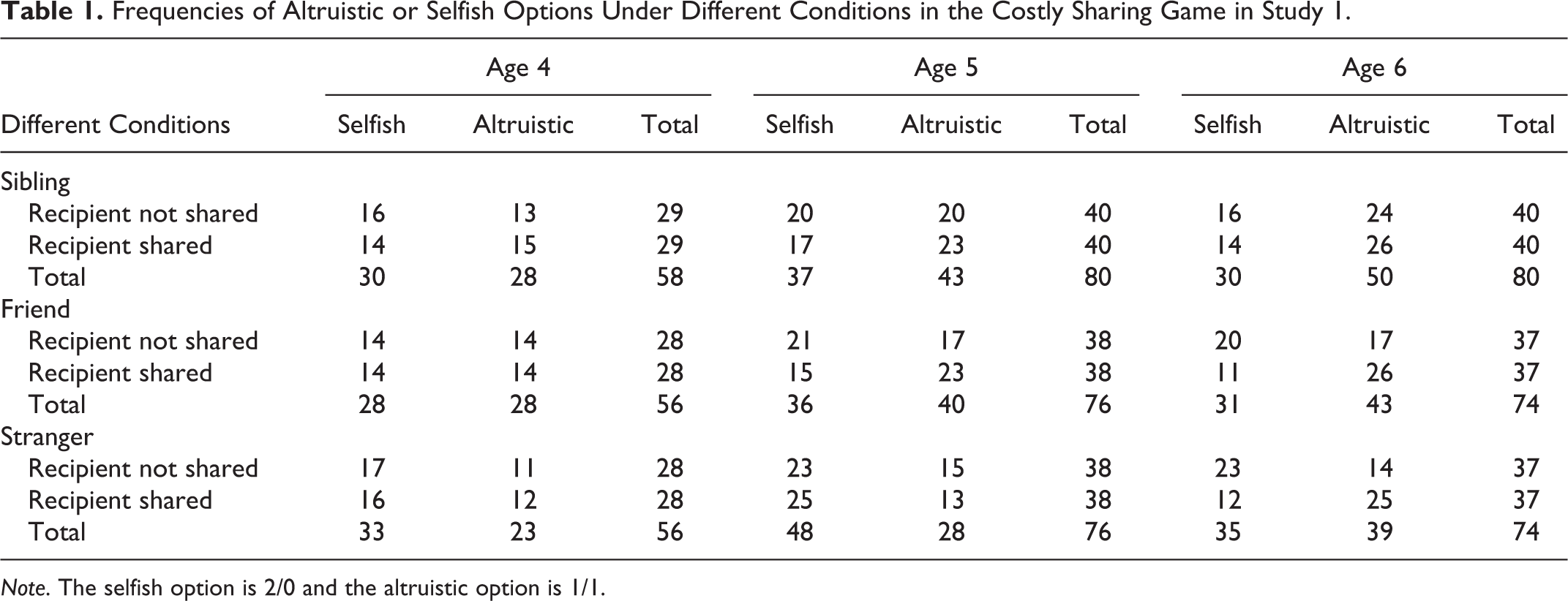
Note. The selfish option is 2/0 and the altruistic option is 1/1.

Percentage of altruistic and selfish options under different conditions in the costly sharing game in Study 1.
In the prosocial game, the results of frequency (Table 2) showed that across targets, children aged 6 years selected the altruistic options considerably more often than the selfish option (86 vs. 28) if the recipient had previously shared; however, less discrepancy between the altruistic and selfish options was observed if the recipient had not shared previously (71 vs. 43), χ2(1) = 4.60, p < .05. By contrast, children aged 4 and 5 years did not exhibit such a pronounced reciprocity effect (Figure 2). Children aged 4 years selected the altruistic options more than the selfish options under both conditions (55 vs. 40 if the recipient had previously shared and 49 vs. 36 if the recipient had not), χ2(1) = .89, p = .35, and similar results were observed in children aged 5 years (68 vs. 48 for previously sharing and 78 vs. 38 for previously not sharing), χ2(1) = 1.85, p = .17. Across all ages, the children consistently chose altruistic options over selfish options for siblings (65 vs. 44), friends (65 vs. 38), and strangers (58 vs. 45) when the recipient had not previously shared and chose altruistic options considerably more frequently than selfish options for siblings (78 vs. 31), friends (72 vs. 31), and strangers (69 vs. 34) when the recipient had previously shared, χ2(1) = 6.67, p < .05 (Figure 3). These results suggest that the participants were likely to select option 1/1 over 1/0 for the recipients regardless of target type and the recipients’ previous allocations. Moreover, only children aged 6 years considered the recipients’ previous allocations when making choices in the prosocial game.
Frequencies of Altruistic or Selfish Options Under Different Conditions in the Prosocial Game in Study 1.
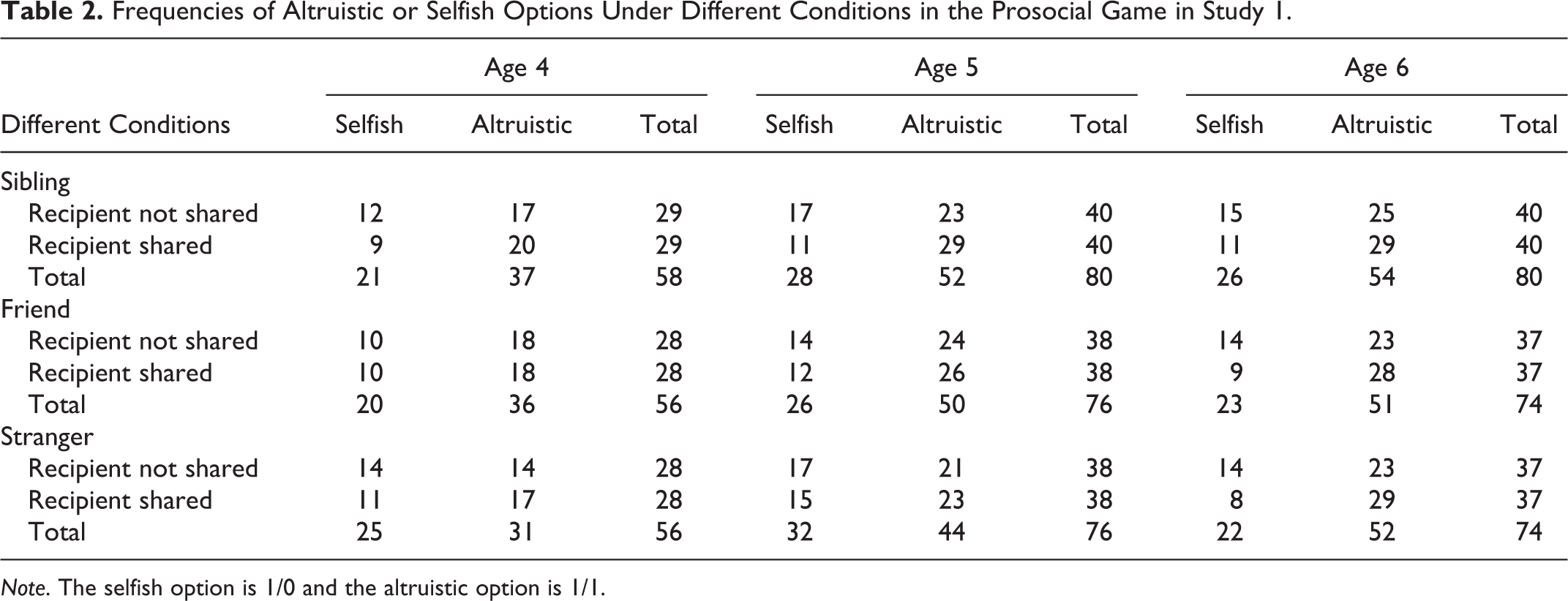
Note. The selfish option is 1/0 and the altruistic option is 1/1.

Percentage of altruistic and selfish options after the recipient had previously shared or not shared in children aged 4–6 years in the prosocial game in Study 1.

Percentage of altruistic and selfish options toward sibling, friend, and stranger after the recipient had previously shared or not shared in the prosocial game in Study 1.
In the envy game, Table 3 shows the frequencies of altruistic or selfish options under different conditions in the envy game. Only an age effect was observed. Children aged 4 years were more likely to select 1/2 (n = 94) than 1/1 (n = 76). Among children aged 5 years, similar numbers selected both options (n = 121 and n = 111 for 1/2 and 1/1, respectively) and children aged 6 years were less likely to select 1/2 (n = 98) than 1/1 (n = 130), χ2(2) = 6.80, p < .05 (Figure 4). Neither a target effect, χ2(2) = 2.89, p = .24, nor previous allocation effect of the recipients, χ2(1) = 1.84, p = .18, was observed.
Frequencies of Altruistic or Selfish Options Under Different Conditions in the Envy Game in Study 1.

Note. The selfish option is 1/1 and the altruistic option is 1/2.

Percentage of altruistic and selfish options in children aged 4–6 years in the envy game in Study 1.
In summary, most participants chose the altruistic option on the basis of whether the recipient had previously shared in the costly sharing and prosocial games. Compared with previous decisions to not share (2/0), those to share (1/1) were more likely to induce choosing the altruistic option (1/1) over the selfish option (2/0) in the costly sharing game or the selfish option (1/0) in the prosocial game. However, in the envy game where participants chose between 1/1 and 1/2, previous sharing did not induce choosing the more generous 1/2 more than did previously not sharing. Although a previous share showed the generosity of the recipient, the 1/1 allocation may have induced the selection of 1/1 only but not that of 1/2, where the recipient receives more than the giver. To induce the participants to choose 1/2, the recipients may have had to previously let the participants have more than they had. This was tested in Study 2, where the recipient had previously received two toys and gave both to a participant who subsequently assumed the role of allocator in the envy game. The results under the condition of previous altruism (0/2) were analyzed with those under the condition of previous sharing (1/1) in Study 1 for the envy game.
Study 2
Method
Participants
The participants were the same as those in Study 1.
Design and Procedure
The design and procedure were the same as those in Study 1, except that only the envy game was conducted and the previous allocation of the recipient was 0/2 rather than 2/0 or 1/1. In other words, when a recipient received two toys from the room host as welcome gifts, he or she demonstrated altruism by giving both toys to the participant, thereby retaining none.
Results and Discussion
Table 4 shows the frequency of the altruistic or selfish options being chosen under various conditions. Across all ages, children were more likely to select 1/2 (n = 67) than 1/1 (n = 42) when sharing with a sibling who had previously demonstrated altruism (i.e., giving two toys to the participant, thereby retaining none) and less likely to select 1/2 (n = 50) than option 1/1 (n = 59) if the sibling had previously shared with them (i.e., sharing one toy with the participant and retaining one toy), χ2(1) = 5.33, p < .05. Similar results were observed under the friend condition. The respective numbers of participants who chose 1/2 and 1/1 if the friend had demonstrated altruism were 58 and 45, and the corresponding numbers were 43 and 60 if the friend had previously shared, χ2(2) = 4.37, p < .05. However, when the recipients were strangers, the participants’ selections of 1/2 and 1/1 were similar (55 vs. 48 for previous altruism and 55 vs. 48 for previous sharing; Figure 5), χ2(1) = 0, p = 1.00. The results suggest that the participants are likely to select the option to the recipient’s advantage (i.e., 1/2) if the recipient had had previously gave them two toys while retaining none to the self, but only when the recipient is a siblings or a friend.
Frequencies of Altruistic or Selfish Options Under Different Conditions in the Envy Game in Study 2.

Note. The selfish option is 1/1 and the altruistic option is 1/2.
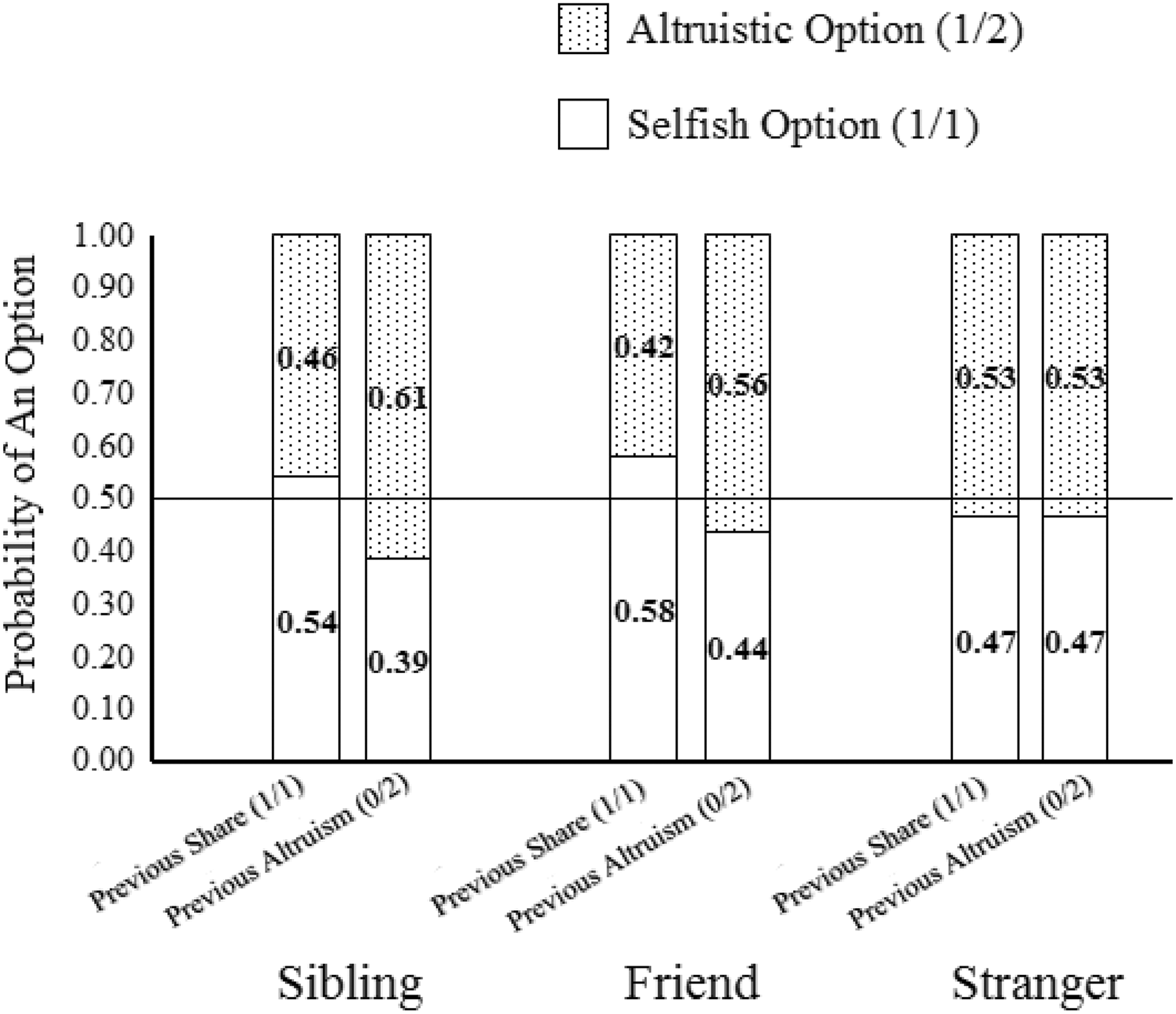
Percentage of altruistic and selfish options toward sibling, friend, and stranger after the recipient had previously shared or been altruistic in the envy game in Study 2.
General Discussion
This study investigated the developmental time lines of kin altruism in humans in the context of three resource allocation games that manipulated reciprocity. In the costly sharing game where the participants chose between 1/1 and 2/0, the 6-year-old children were likely to share with kin regardless of whether the kin had previously shared with them, but they based decisions on whether to share with friends or strangers and on whether the recipients had previously shared. By contrast, the 4- and 5-year-old children were likely to select the selfish option (2/0) regardless of reciprocity or recipient type. These results reveal how kin altruism interacts with reciprocity and suggest that the 6-year-old children were better able to respond to reciprocity than were their 4- and 5-year-old counterparts; however, the 6-year-old children favorably responded to kin independently of reciprocity. These results are consistent with those of previous studies that investigated the development of reciprocity (Dahlman et al., 2007; House et al., 2013) and kin altruism (Lu & Chang, 2016) separately. These studies showed that, around 6 years old, children were able to share resources on the basis of the recipient’s past sharing and shared with kin more often than with friends or strangers in costly sharing. The age of 6 years may be a crucial age at which children learn how to differentially respond to kin and other social targets (Lu & Chang, 2016). Age 6 nears the end of early childhood when children have well-developed abilities of inhibition and delayed gratification (Imuta, Hayne, & Scarf, 2014). These abilities play key roles in reciprocal strategies where children have to inhibit impulses for immediate reward either to reciprocate previous favors or to anticipate future reciprocal exchanges (Leimgruber, 2018). The inhibitory abilities facilitate reciprocation involving friends and kin among 6-year-old children who demonstrate kin altruism in costly sharing (Lu & Chang, 2016). By contrast, 4- and 5-year-old children were unable to reciprocate at personal cost, possibly because they lacked inhibitory abilities. Although 6-year-old children are not necessarily aware of genetic connections and inclusive fitness, they may have special affiliations with kin just as adults do (Kruger, 2003; Lu & Chang, 2009). The benefit of inclusive fitness can offset the cost of sharing resources with kin (Hamilton, 1964). Thus, reciprocity is not a necessary condition for sharing with kin but is necessary for sharing with friends or strangers (Axelrod & Hamilton, 1981; Trivers, 1971). In summary, regarding the costly sharing game, the age of 6 years appears to be a crucial age at which children develop an understanding of kin altruism as well as reciprocity.
In the prosocial game where the participants selected between 1/1 and 1/0, the results showed that only the 6-year-olds intended to reciprocate, whereas the 4- and 5-year-olds were more likely to select the prosocial option (1/1), regardless of whether the recipient had previously shared. No target effect was observed in this game. Previous studies that have not investigated target effects have obtained similar results, showing that only by age 6 years could children respond appropriately to recipients’ previous behaviors (House et al., 2013; Moore, 2009). It seems that incurring personal cost is essential when examining target effects, whereas the target effects were not observed in the prosocial game in which participants incurred no personal costs in and they can always have one reward item, regardless of whether they give one to the recipient. In the envy game where the participants chose between 1/1 and 1/2, participants of all ages preferred 1/2 toward kin and friends if the target had previously demonstrated altruism by giving the participant two toys while retaining none. Reciprocal altruism was associated with kin and friends when sharing was not costly but placed the giver in a disadvantaged position (i.e., the giver had only one toy, whereas the recipient had two). The participants endured such a disadvantage only when the recipients were kin or friends who had previously placed themselves in disadvantaged positions but not when the recipients were strangers who lacked frequent interactions and intimate relationships with the givers (Kruger, 2003; Laursen & Hartup, 2002).
Although reciprocal altruism is derived from friendship and long-term interactions (Axelrod & Hamilton, 1981, Trivers, 1971), whereas kin altruism mainly explains altruistic behaviors among relatives (Hamilton, 1964), the present study showed that the principle of reciprocity can be applied among kin because reciprocity is fundamentally based on the high probability or expectation of future interaction inherent in kin relationships (Allen-Arave et al., 2008; Leimgruber, 2018). In the envy game, participants applied reciprocity involving both kin and friends, whereas in the costly sharing game, participants favored kin and applied reciprocity to friends only. The difference may be caused by emotion of envy. The personal costs of favoring and sharing with siblings even when the sibling has previously not shared can be offset by inclusive fitness gains due to genetic relatedness (Hamilton, 1964). However, participants could not endure the feeling of envy and the disadvantage of having less than their siblings if the sibling has not previously endured the same disadvantage position. These results suggest that in terms of emotional feelings, kin and friends may be alike; children applied reciprocal strategies for both kin and friends and may revenge for emotional harm on kin. These results also help explain daily observations that emotional conflicts and tit-for-tat interactions are frequent among kin even though people still provide financial support at personal costs to kin when they are in need.
This study had several limitations. First, we examined only how children reciprocated previous favors and not how they initiated sharing in anticipation of reciprocity from various targets. Future studies could explore how children allocate resources while anticipating future interactions with kin, friends, and strangers. Second, although this study adopted three established allocation games as tests of sharing for simple implementation and structural comparison (Fehr et al., 2008), the allocation games cannot represent other sharing tasks such as sharing from specific amounts of endowed resources (Sebastián-Enesco & Warneken, 2015) and resource distribution among various targets (Olson & Spelke, 2008). Moreover, sharing behaviors cannot represent other forms of altruism such as offering help, providing financial support, or donating organs. Other sharing tasks and other altruistic behaviors could be applied in future studies to investigate discriminative reciprocity toward different targets. Third, puppets were used to represent various recipient types. Although employing puppets to investigate children’s sharing behaviors is common (McCrink, Bloom, & Santos, 2010; Olson & Spelke, 2008; Paulus, 2014), future studies could employ real people as recipients in the sharing games to improve the ecological validity of the findings and to examine dynamic interactions between givers and receivers.
Footnotes
Acknowledgment
We thank the editor and two anonymous reviewers for their valuable comments on an earlier version of this article. We thank Yan Wing Kong, Zero Kwong, Hoi Lam Tam, and Anne Tsang for their assistance in data collection of this study.
Declaration of Conflicting Interests
The author(s) declared no potential conflicts of interest with respect to the research, authorship, and/or publication of this article.
Funding
The author(s) disclosed receipt of the following financial support for the research, authorship, and/or publication of this article: This research was supported by a General Research Fund (project number: 15608415) from the Research Grants Council of Hong Kong and a Chair Professor Grant (CPG2016-00025-FSS) from the University of Macau.
