



Abstract
We investigated whether men's faces contain embedded cues that signal differences in individual fitness. Data on shoulder-to-hip ratios (SHR), grip strength, sexual history, and facial photographs were collected from male college students. Female college students rated the photographs for attractiveness We found a striking relationship between ratings of facial attractiveness and body morphology. Males with attractive faces had significantly more masculine, wedge-shaped SHRs. Ratings of facial attractiveness accounted for over 25% of the variance in this sexually dimorphic dimension of male body configuration. Male students with attractive faces also had higher grip strength scores, and more sexual partners. These findings are consistent with a growing body of evidence showing that facial features contain important cues to fitness and hormonal status.
Introduction
Adaptations to life in the arboreal habitat during primate evolution helped shape a heavy reliance on the sense of vision (see Gallup and Cameron, 1992). The importance of visual cues is illustrated by the preoccupation that humans have with faces and the specialized neural mechanisms dedicated to facial recognition. Faces are featured prominently when it comes to interpersonal attraction and mate choice, and ratings of facial attractiveness are consistent across different cultures (Cunningham, Roberts, Barbee, Druen, and Wu, 1995). Even neonates spend significantly more time looking at faces rated by adults as being more attractive (Langlois et al., 1987; Langlois, Ritter, Roggman, and Vaughn, 1991). These findings suggest that selection has operated to influence our perception of faces because they contain embedded cues to individual fitness.
Consistent with this position, it has been shown that people with lower fluctuating asymmetry (i.e., higher bilateral symmetry) have faces that are rated as more attractive (Thornhill and Gangestad, 1993) and deviations from bilateral symmetry are inversely proportional to genetic, physical, and mental health (Thornhill and Moller, 1997). Indeed, more symmetrical faces are found to be more attractive in their own right (Grammer and Thornhill, 1994; Hume and Montgomerie, 2001) and attractive faces predict body symmetry even when facial symmetry is masked by only presenting half of the face (Scheib, Gangestad, and Thornhill, 1999).
People with attractive faces also live longer (Henderson and Anglin, 2003), providing more opportunity for offspring and grandchildren investment. Ratings of facial attractiveness have been shown to predict sperm count, sperm motility, and sperm morphology in males (Soler et al., 2003) and estrogen levels in females (Law Smith et al., 2006). Ratings of facial attractiveness peak in females when they are in the ovulatory phase of the menstrual cycle (Roberts et al., 2004). Men who are heterozygotic at the Major Histocompatibility Complex, and are therefore more disease resistant, are also judged by women as being more attractive (Roberts et al., 2005).
Little has been done, however, to examine how well faces reflect other sexually dimorphic traits, such as strength and body configuration. Body configuration also signals underlying fitness. Singh (1993) has shown that males prefer females with low waist-to-hip ratios (WHR), a signal of increased fertility. Hughes and Gallup (2003) extended this analysis by suggesting that low WHR also signals 1) the absence of pregnancy and 2) pelvic skeletal morphology conducive to easy childbirth. More recently, Lassek and Gaulin (2006) gathered evidence for a neurodevelopmental effect of differences in the distribution of body fat as measured by WHR. Fat stores in the hips and thighs are comprised of long chain polyunsaturated fatty acids essential for brain growth and development. Mobilization of these fatty acids is conserved for gestation and lactation, times of primary brain growth in offspring. Consistent with this idea, women with low WHR (more lower-body fat), and their offspring, have higher cognitive ability scores (Lassek and Gaulin, 2008).
When it comes to short term sex partners females tend to prefer testosterone driven traits in males, such as broad shoulders and narrow hips indexed by high shoulder-to-hip ratios (SHR) (Evans, 1972; Franzoi and Herzog, 1987). The importance of these gender specific body types is highlighted by the finding that individuals with ideal body proportions evoke more intrasexual jealousy (Dijkstra and Buunk, 2001). Furthermore, a recent eye-tracking study has shown that WHR is the primary morphological cue used to determine the gender of figures in motion (Johnson and Tassinary, 2005).
Males with wedge-shaped torsos (high SHR) have sex at earlier ages, more sexual partners, and more extra-pair copulations (Hughes, Dispenza, and Gallup, 2004). High SHR males are also more prone to high school aggression and show enhanced handgrip strength (Gallup, White, and Gallup, 2007). Handgrip strength is a ubiquitous measure of human health and vitality that is associated with postoperative recovery (Klidjian, Foster, Kammerling, Cooper, and Karran, 1980) and longevity (Rantanen et al., 1999). In males, grip strength is positively correlated with number of sexual partners and negatively correlated with age of first sexual intercourse (Gallup et al., 2007). Although handgrip strength is influenced by environmental (Geliebter et al., 1997) and developmental (Hunt, Rowlands, and Johnston, 1985) factors, 65% of the individual differences in grip strength are due to underlying differences in genes (Reed, Fabsitz, Selby, and Carmelli, 1991), making it a prime candidate for fitness research. The relationship between handgrip strength, promiscuity, and body morphology (SHR) among males recently reported by Gallup et al. (2007) casts a new light on handgrip as a mate choice characteristic.
The current study was designed to determine if female ratings of facial attractiveness in males predict independent measures of strength, body configuration, and sexual behavior.
Materials and Methods
Stimuli
All subjects were undergraduate college students fulfilling course research requirements. Thirty-eight males (mean age = 19.1, SD = 2.1) agreed to provide morphological data including shoulder and hip circumferences, and hand grip strength measurements. Subjects were asked to squeeze a hand held dynamometer (Lafayette Instruments Model 78010) as hard as they could. Grip strength (in kilograms) was defined as the maximum of three dynamometer readings for each hand. Shoulder and hip circumference measurements were obtained following the method of Hughes and Gallup (2003). A digital photograph was taken of each male's face from the neck up. Facial photographs were taken against a white background under the same lighting conditions from a distance of approximately one meter. Males were asked to remove their hats, glasses, and other accessories that would be visible in the photograph. Subjects also completed an anonymous questionnaire to determine their age, number of sexual partners, and age of first sexual intercourse. All participants reported being heterosexual.
Raters
Sixteen female college students viewed a PowerPoint slideshow of a series of male faces. At a designated computer, females were free to spend as much time as necessary to view and rate each photograph for attractiveness. All ratings were recorded on a five point Likert-type scale. To minimize fatigue effects, half of the photographs were presented in random order to half of the female raters and the other half of the photos were rated by the remaining females. This resulted in two groups of eight females each rating 19 facial photographs. Females in both groups were instructed not to rate photographs of individuals they recognized. Menstrual cycle phase and use of birth control among the raters were treated as random variables. Cronbach's alpha inter-rater reliability of male facial attractiveness was.88 for both groups of females.
Results
Descriptive statistics for the different measures and ratings are presented in Table 1. Morphological measurements and survey data were initially analyzed using two-tailed Pearson correlations.
Descriptive statistics for each variable of interest in males (n=38).

Morphology and behavior
Grip strength scores varied as a function of body morphology. Males with more accentuated wedge shaped torsos (high SHRs) had significantly higher grip strength scores. Figure 1 depicts the relationship between grip strength and SHR (r =.381, p <.02). Grip strength was also correlated with number of sexual partners (r =.317, p <.05).

Grip strength in males as a function of shoulder-to-hip ratio (SHR).
Morphology and ratings
Males with higher grip strength scores were independently rated by the females as having more attractive faces (r =.323, p <.05) (see Table 2 and Figure 2). As shown in Figure 3, males with broad shoulders and narrow hips (high SHR) were also rated by females as having more attractive faces (r =.512, p <.01). Females also rated males who reported more sexual partners as having more attractive faces (r =.360, p <.03).
Pearson correlations between female ratings of facial attractiveness, number of sexual partners, age of first sex, shoulder-to-hip ratio (SHR), maximum grip strength, and 2D/4D in males.

p<.05
p<.01

Grip strength in males as a function of ratings of facial attractiveness.

Shoulder-to-hip ratio (SHR) in males as a function of ratings of facial attractiveness.
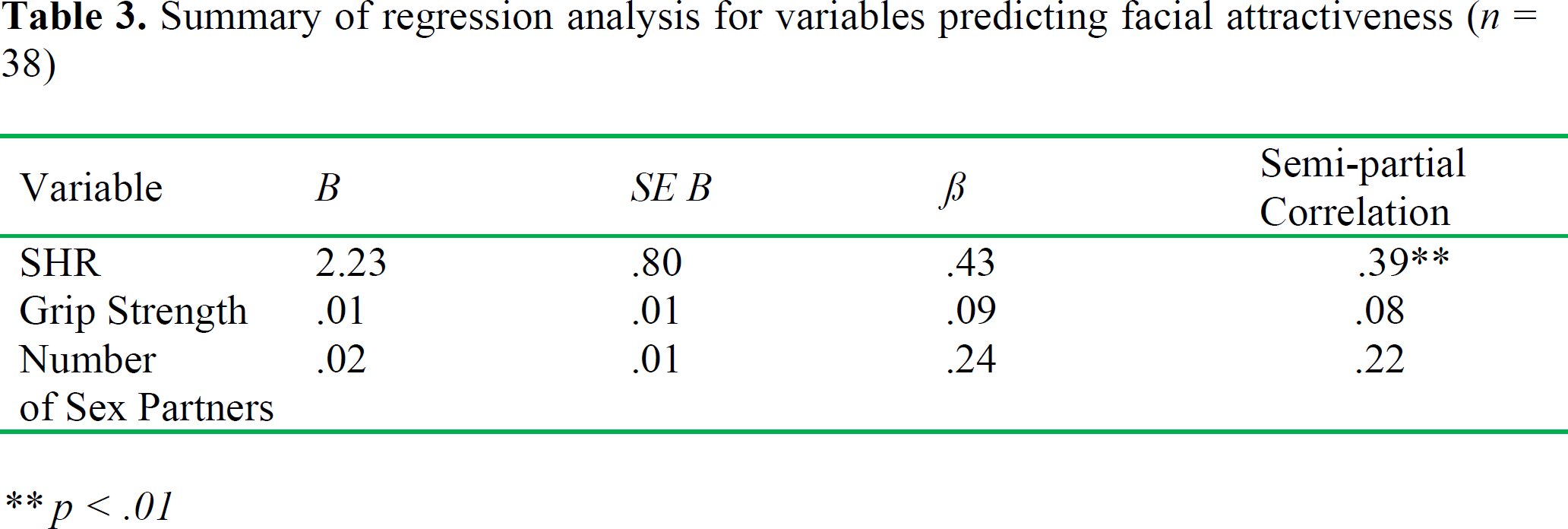
A multiple regression was employed to determine the unique contributions of each variable while controlling for all others. Semi-partial correlations between facial attractiveness and SHR, grip strength, and number of sex partners are shown in Table 3. When controlling for all other variables, the correlations remain in the predicted direction and SHR correlates significantly with facial attractiveness.
Summary of regression analysis for variables predicting facial attractiveness (n = 38)
p < .01
Discussion
These results show that the way women rate men's faces accounts for a substantial proportion of the variance in body morphology, grip strength, and sexual behavior among male college students. Ratings of facial attractiveness accounted for 26% of the variance in body configuration (SHR) and 10% of the variance in grip strength. Fink, Neave, and Seydel (2007) also found a relationship between grip strength and ratings of male facial attractiveness.
It is important to note that our facial photographs were taken from the neck up and did not include the participants' shoulders or any other body features, suggesting that hormonal and genetic factors that shape morphological indicators of fitness also influence facial features. Thornhill and Grammer (1999) found that ratings of female faces were positively correlated with ratings of their bodies, suggesting that faces signal body features in both sexes. Both the neck and hair were included in the photographs we used to maintain realistic depictions of the subjects. Whereas it may be possible that the inclusion of the neck could have affected the results, subjects were given explicit instructions to rate the face. Future work will be needed to determine whether and to what extent (if any) the neck may contribute to such ratings.
Consistent with findings reported by Rhodes, Simmons, and Peters (2005), our results also show that female ratings of male facial attractiveness accounted for a significant proportion (13%) of the variance in male promiscuity (i.e., number of sexual partners). Rhodes et al. measured both short-term and long-term sexual partners, body attractiveness (height and symmetry in males), and facial attractiveness to show that attractive males have more short-term mating partners. Although not significant, age of first sex among the males in our sample was related to handgrip strength and SHR in the predicted negative direction (see Table 2). Because the mean age was only 19.1 (SD = 2.1), the magnitude of these correlations may have been affected by the truncated range of values for self-reported age of first sex (range = 7 years). We also found a negative (but again non-significant) correlation between number of sexual partners and the age of first sex (r =−.18).
Our findings parallel those reported by Hughes et al. (2004) for voice attractiveness. Both men and women with voices rated as more attractive by members of the opposite sex reported more sexual partners, more extra-pair copulation partners, and an earlier age of first sexual intercourse. In addition, having an attractive voice predicted a more masculine (high) SHR in males, a more feminine (low) WHR in females, as well as lower fluctuating asymmetry in both sexes (see Hughes, Harrison, and Gallup, 2002). Considered in conjunction with our results, it would appear that the interplay between hormones and genes plays a substantial role in molding a ‘package’ of characteristics that signal differences in fitness. This package includes body morphology (as in SHR and WHR), physical strength, bilateral symmetry, vocal characteristics, and facial attractiveness.
Do these effects generalize to women? Contrary to Thornhill and Grammer (1999) who failed to find a relationship between WHR and ratings of facial attractiveness in females, Brewer, Archer and Manning (2007) recently found that male ratings of women's facial attractiveness were negatively correlated with WHR. Robust negative correlations between WHR and ratings of voice attractiveness in females have also been obtained (Hughes and Gallup, 2003; Hughes et al., 2004).
According to our results and those of Gallup et al. (2007), handgrip strength fits comfortably into this package. Our findings replicate theirs, showing that handgrip strength predicts SHR as well as number of sexual partners among men. We also found that males with a stronger grip had faces that were consistently rated as being more attractive. This is particularly interesting in light of evidence showing that handgrip strength is correlated with serum testosterone levels (Page et al., 2005). It is well established that females in the fertile phase of their menstrual cycle find masculine male faces more attractive (Johnston, Hagel, Franklin, Fink, and Grammer, 2001; Penton-Voak et al., 1999) and that masculine male facial features are largely testosterone driven (Penton-Voak and Chen, 2004). These results suggest that handgrip strength is a reliable proxy for circulating testosterone levels in men. It is important to note that although environmental factors do affect grip strength, both handgrip strength and testosterone levels are highly heritable (65% and 56%, respectively) (Reed et al. 1991, Kuijper et al., 2007) making them prime candidates for screening during mate selection.
Given the historical and cross-cultural prominence of handshake greetings between men, handgrip strength could also function as a means of assessing intrasexual competition. Archer and Thanzami (2007) report that males with high grip strength, score higher on physical aggression and direct aggression scales. They discuss their findings in terms of the Resource Holding Power theory (Parker, 1974), in which males assess their rival's abilities prior to making decisions regarding competition strategies. If handshakes enable males to assess the health, strength, and vitality of newly encountered individuals then grip strength would be positively selected in males. Unlike males, Gallup et al. (2007) found no correlations between female grip strength and measures of reproductive fitness, including WHR, number of sexual partners, and age of first sexual intercourse. They also found that the distribution of grip strength scores between males and females were virtually non-overlapping.
In conclusion, our results add to a growing amount of evidence for important connections between appearance and underlying dimensions of fitness. In addition to replicating several relationships between morphology, behavior, and attractiveness, we report a novel relationship between facial attractiveness and SHR, suggesting that these characteristics should be interpreted as a package that, collectively and individually, signal fitness. Therefore in a very real sense what you see is what you get when it comes to faces and bodies, and what you hear is what you get when in comes to voices.