




Abstract
Several studies conducted from an evolutionary perspective have documented differential investment in grandchildren by lineage. The majority of these studies have used retrospective ratings by grandchildren, but only a fraction of these studies have examined actual grandparental behavior. Here we focus on the interaction between distance and lineage on face-to-face contact with a (random) grandchild in a large scale sample. Our main prediction is that maternal grandparents are significantly more willing to travel in order to see their grandchild. While controlling for initiative of contact, urbanization, sex and age of the grandchild, educational attainment, marital status and age we found a significant interaction between distance and grandparent type on frequency of contact with a grandchild. Maternal grandmothers were significantly more inclined than paternal grandfathers and grandmothers to maintain frequent face-to-face contact, as distance between grandparent and grandchild increased. The results are discussed with reference to evolutionary theories of grandparental investment.
Keywords
Introduction
Consistent with predictions based on paternity uncertainty, differences in solicitude between maternal and paternal grandparents have been found in historical (Voland and Beise, 2002) and modern societies (Euler and Weitzel, 1996; Euler, Hoier, and Rohde, 2001; Michalski and Shackelford, 2005; Pollet, Nettle, and Nelissen, 2006). Typically, maternal grandmothers invest most in their grandchildren, followed by maternal grandfathers, and paternal grandmothers, with paternal grandfathers investing least (Eisenberg, 1988; Hoffman, 1979–1980, Kahana and Kahana, 1970; Rossi and Rossi, 1990). Even though paternity uncertainty in contemporary societies is assumed to be relatively low (Anderson, 2006), consistent differences in solicitude have been found between maternal and paternal grandparents. Such differences have also been documented for uncles and aunts (Gaulin, McBurney, and Brakeman-Wartell, 1997; McBurney, Simon, Gaulin, and Geliebter, 2002; Pashos, 2007). In general, individuals thus appear to invest more in their matriline than in their patriline (but see Pashos, 2000).
Evolutionary studies of grandparental investment in modern societies have mainly focussed on retrospective ratings by grandchildren, rather than grandparental behavior (Chrastil, Getz, Euler, and Stark, 2006; Euler and Weitzel, 1996; Euler, et al., 2001; Laham, Gonsalkorale and von Hippel, 2005; Pashos, 2000; but see Michalski and Shackelford, 2005). The main argument for using this method has been that grandparents would give socially desirable answers and would claim to treat all grandchildren equally (Euler and Weitzel, 1996; Hoffman, 1979–1980). However, research from a family studies perspective has analysed the grandparent-grandchild dyad from the grandparent's point of view, and has found consistent differences in grandparent-grandchild contact frequencies by lineage (Uhlenberg and Hamill, 1998). Michalski and Shackelford (2005), however, have argued that contact frequencies are a poor measure for investment, mainly because they do not take into account who initiates contact. Yet, social network research commonly uses contact frequency measures and these measures relate to emotional and financial support, regardless of whom initiates contact (see House, Umberson and Landis, 1988). It is thus reasonable to examine contact frequency data from a grandparent perspective for evidence of lineage-based differences, as we did in a previous paper (Pollet et al., 2006).
Here we extend our analysis and test for a lineage x distance interaction effect on contact frequency as a measure of grandparental investment by using a large dataset. We use a multivariate design that allows us to control for initiative of contact and a large number of other factors affecting the grandparent-grandchild tie. Following paternity uncertainty, the main prediction is that, when other factors are controlled for, there will be consistent differences in how much individuals are willing to travel in order to see their grandchild as a function of lineage. Namely, maternal grandmothers/grandfathers, rather than paternal grandmothers/grandfathers, will be more inclined to have very frequent contact with their grandchild, even when that grandchild lives far away. So we predict a grandparent type x distance interaction effect on contact frequency with a grandchild. Such an interaction is evidence for stronger investment by matrilineal grandparents than patrilineal grandparents. This would indicate differential investment as travel is evidently costly in terms of time and money.
However, paternity uncertainty does not necessarily lead to predict that maternal grandfathers will invest more than paternal grandmothers, as is commonly found. This finding has been attributed to co-residence of grandparents (see Gaulin et al., 1997; McBurney et al., 2002 but see Euler and Weitzel, 1996) or sex-specific investment in matrilines (Euler and Weitzel, 1996; Euler and Michalski, 2007). Laham and colleagues (2005) explained higher investment by maternal grandfathers than paternal grandmothers in terms of the availability of more certain “outlets”. If alternative investment options (e.g. cousins via a sister) are available to paternal grandmothers, they should invest less in grandchildren than maternal grandfathers do. Differences between maternal grandmothers and paternal grandparents and between maternal grandfathers and paternal grandfathers in investment would thus suggest that psychological mechanisms attuned to paternity uncertainty are operating. Differences between maternal grandfathers and paternal grandmothers, on the other hand, can be explained by co-residence of grandparents, sex-specific investment strategies or available investment outlets.
Materials and Methods
Sample and assessment procedures
The Netherlands Kinship Panel Study (NKPS) dataset was obtained through the Netherlands Interdisciplinary Demographic Institute (NIDI). The NKPS is a large scale study (n= 8,161), designed to investigate family and kin relations in the Netherlands (Dykstra et al., 2004). The main study aimed to reach 8,500 non-institutionalized individuals between 18 and 79 years old (Dykstra et al., 2004: 23-ff.). These individuals were randomly drawn from a large Dutch address register. The study yielded a final sample with data for 8,161 persons (M age= 46.43; SD = 15.13; Dykstra et al., 2004). The sample was unbalanced in terms of gender, with more female than male respondents (nmen= 3,420; nwomen= 4,741).
Individuals were interviewed face-to-face by trained researchers between October 2002 and October 2004 about various aspects of their family life (Dykstra et al., 2004). The average interview lasted 74 minutes during which data was collected for a wide variety of family-related variables, e.g. relationships with and characteristics of family members (mainly for fathers, mothers, siblings, husband/spouse, children, grandparents, grandchildren, but also for close friends). Respondents also provided detailed information on a wide range of socio-demographic variables (e.g., educational attainment, marital status, employment history). The sampling procedure, representativeness, the survey method and other aspects of the study are described in much more detail by Dykstra and colleagues (2004).
From this dataset we selected all individuals who had a grandchild between zero and fifteen years old at the time of the interview (M = 6.45 years; SD = 4.23 years). Limiting the analyses to grandchildren between zero and fifteen years old, allows for controlling of initiation of contact on their behalf, rather than by the grandparent (see Michalski and Shackelford, 2005). It is reasonable to assume that contact frequency represents initiative and investment on behalf of the grandparent rather than the grandchild, for young grandchildren. There is no data available on the genetic relatedness between the parent and grandchild but only on genetic relatedness between grandparent and parent. Five cases where the grandparent was never married were excluded from analysis, as this category is problematic for obtaining estimates in the multinomial logistic regression. Only cases where the grandchild was living with the child of the respondent were used and “missings” on variables were treated list wise for the multinomial logistic regression (Final sample: n = 831). The variables used are described in Dykstra and colleagues (2004), with the exception of constructed or recoded variables (age of grandchild, education, geographical distance, marital status grandparent). Initiative of contact, whether it was by the grandparent or by the parent of the grandchild, was surveyed as: When you're in touch with {name, description}, do you usually get in touch at your initiative, at the other's initiative, or is it more or less equal? (Dykstra et al., 2004). The dependent variable, frequency of contact, was surveyed as: How often have you seen {name, description} over the past 12 months. This variable was recoded from seven to five categories, by merging the first two in order to avoid categories with too few cases (Table 1). The variables used, their associated predictions and descriptives are summarized in Table 1. Multinomial logistic regression (MLR) was used to investigate the independent effects of the variables from Table 1 on contact frequency (Hosmer and Lemeshow, 1989; Menard, 1995; Pampel, 2000). Multinomial logistic regression as statistical technique is relatively free of assumptions and statistically robust. It allows the examination of relationships between independent variables and a dependent variable that consists of multiple categories. Unlike ordinary least square regression, parameters are estimated by maximum likelihood. Here we will report the likelihood ratio tests for variables (pllr) in the model and the parameter estimates for the model (see Peng, Lee, and Ingersoll, 2002). As we use many independent variables, we will not discuss all effects in detail (see Pollet et al., 2006). Our main focus is the interaction between grandparental type and distance on frequency of face-to-face contact.
Descriptive statistics and concomitant predictions (prediction number in brackets)

We also performed an additional event history analysis by Cox regression which allows examining the likelihood of an event as time, or in this case, distance progresses (Allison, 1984; Cox, 1972). We will present the final model using the same independent variables as for the multinomial logistic regression, but will use the log (distance) transformation for the graphical display. As event we selected maintaining frequent contact (a few times a week or daily) with a grandchild, with increasing distance.
Results
The descriptive statistics and predictions are summarized in Table 1. There were no significant differences between grandparents in distance to their grandchild (ANOVA: F(1, 827) = 1.03; p = 0.38; all contrasts p > .17).
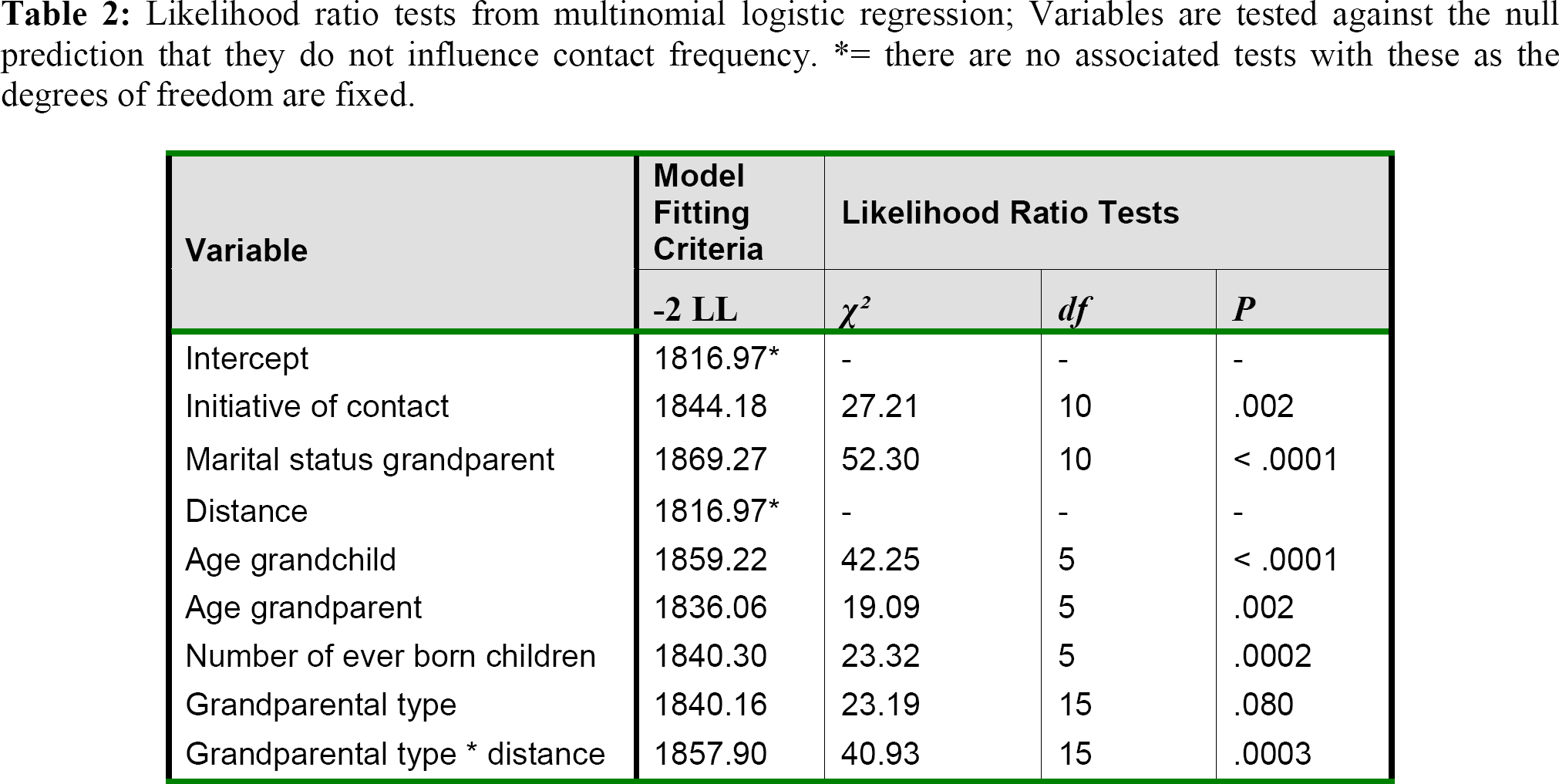
Using multinomial logistic regression, we found the predicted interaction effect between grandparent type and distance on frequency of face-to-face contact (Likelihood Ratio test; χ2 = 42.1; p = .0003; Table 2). The final model had a Nagelkerke R2 of 0.621 (model fit −2LL = 1816.97; χ2 = 746.85; df = 70; p < .0001). The overall model thus performed very well. Urbanisation, marital status of the child, educational attainment, relatedness to the child, sex of the grandchild did not predict face-to-face contact between grandparent and grandchild (all likelihood ratio tests; p > .05). The effects for the variables were in the predicted direction of Table 1, however (Table 2, see Pollet et al., 2006). The effect of relatedness between grandparent and parent, while not significant, was in line with the predicted direction, with respondents having a tendency to have more contact with a related grandchild than an unrelated grandchild (χ2 = 9.35; df = 5; pllr = .096). As distance increased, grandparents had significantly less contact with their grandchild (Table 2). Grandparent type also influenced contact frequency (see Pollet et al., 2006). However, the presence of a significant interaction effect indicates that the effect of grandparent type is contingent upon how far the grandparent lives away from the grandchild (Table 2). Therefore, we focus on the odds ratios for this interaction effect.
Likelihood ratio tests from multinomial logistic regression; Variables are tested against the null prediction that they do not influence contact frequency. *= there are no associated tests with these as the degrees of freedom are fixed.
By examining odds ratios, we found that if a respondent was a maternal grandmother, instead of a paternal grandmother the odds (of having contact a few times a week versus not at all or once) became 1.22 times larger for each kilometre she lives further away. By substituting reference categories we are able to calculate estimates for each comparison (Table 3).
Odds ratios for comparisons (grandparent x distance). * = p < .05; ∞ = pos. estimate with .05 < p < .1 (these estimates are not presented as they are extremely large). For example: 1.89 (top right corner) means that if a respondent was a maternal grandmother, instead of a maternal grandfather the odds (of having contact daily versus not at all or once) become 1.89 times larger for each kilometre the respondent lives further away.

There are consistent differences between maternal grandmothers and paternal grandmothers in how distance affects contact frequency (Table 3). Comparisons with paternal grandfathers were not definitively positive but the trend was positive. This is due to the lack of paternal grandfathers who had contact on a daily basis with their grandchild (n = 4). However, the findings appear largely limited to comparisons between having contact daily or a few times a week versus other categories.
Subsequent analysis by use of Cox Regression, did however show consistent differences between paternal grandfathers and other categories in the likelihood of still having contact daily or a few times a week as distance increased (Wald tests; p < .05; Figure 1).

Cumulative likelihood of still having contact a few times a week or daily with a grandchild by log(distance). * = p< .05; **p < .01; ***p < .001 indicating significant differences in likelihood (Wald tests).
Grandparent type was a significant predictor in the Cox regression. Figure 1 clearly shows that maternal grandparents continue to have frequent contact with their grandchildren as distance increases. It shows a clear and significant separation between maternal grandparents and paternal grandparents.
Beside grandparent type, type of child, number of ever born children, urbanisation, educational attainment, marital status and age of the respondent were predictors of still having contact a few times a week or daily, as distance increases (Wald tests; p < .05). These effects were in the predicted direction as described in Table 1. Age and sex of the grandchild as well as initiative of contact and marital status of the child, were not significant predictors of frequent contact as a function of distance (Wald tests; p > .25). The effect of type of child was reverse to the prediction. As distance increased the respondent was more likely to have contact with children that were not related (adopted or of the partner) to him or her. The effect is due however to a few outlying cases (Unrelated child but contact of a few times a week or daily: n = 4). In addition, the loss of χ2 is not significant if this variable is dropped from the model (p = .076).
Discussion
Grandparent categories did not differ in how far they lived from a grandchild. This difference might be because of the high degree of urbanization in and the size of the Netherlands, compared to the USA, for example. There was a significant interaction effect between distance and grandparent type on face-to-face contact with a grandchild. This indicates that maternal grandparents, especially maternal grandmothers, are more inclined to maintain frequent contact with their grandchild as distance increases. The parameter estimates showed that the effects were however limited to comparisons of a few times a week or daily, compared to a different category. Further analysis by Cox regression showed that as distance between grandparent and grandchild increased, maternal grandparents were significantly more likely than paternal grandparents to maintain frequent contact with their grandchild. As in our previous paper (Pollet et al., 2006), we find support for the majority of predictions listed in Table 1, both in the logistic and Cox regression analysis (MLR: support for predictions: 2,5,6,8,9,11,12; Cox regression: support for predictions: 1,2,4,5,9,11). Relatedness proved marginally significant in the logistic regression, with unrelated individuals having less contact than related individuals. In the Cox regression, by contrast, relatedness influenced contact frequency in the opposite direction. The lack of any conclusive findings or opposite findings for relatedness can be attributed to the very small number of cases where the grandparent was unrelated to the child.
In line with other studies (e.g., Euler and Weitzel, 1996; Michalski and Shackelford, 2005) we thus find consistent differences between matrilines and patrilines in investment. Yet, the differences between paternal grandmothers and paternal grandfathers and between maternal grandmothers and maternal grandfathers were not significant and appear inconsistent with the paternity uncertainty hypothesis. However, the lack of differences can be explained by co-residence and marriage of grandparents. When a grandchild visits his or her grandparent, he or she usually meets the partner of the married grandparent as well (Gaulin et al., 1997; McBurney et al., 2002, but see Euler and Weitzel, 1996). There was no conclusive evidence for more contact with maternal grandfathers than with paternal grandmothers. Our data do not support or allow distinguishing between explanations based on alternative outlets (Laham et al., 2005), sex-specific investment (Euler and Weitzel, 1996; Euler and Michalski, in press) or co-residence. Unlike Michalski and Shackelford (2005), we found consistent differences not only between maternal grandmothers and paternal grandfathers, but also between maternal grandmothers and paternal grandmothers, and between maternal grandfathers and paternal grandfathers in investment, measured here as maintaining frequent contact with increasing distance.
In conclusion, we show consistent differences between matrilines and patrilines in how distance affects face-to-face contact with a grandchild. These findings appear robust and in line with the paternity uncertainty hypothesis. The findings cannot be attributed to a wide variety of factors listed in Table 1. If the necessary conditions are met, namely measures against social desirability and adequate control variables, the study of contact frequencies between grandparents and grandchild allows testing evolutionary hypotheses, such as the paternity certainty hypothesis. In the future we hope to address whether or not these differentials in contact frequency according to lineage are maintained over the life span. The Netherlands Kinship Panel Study is a longitudinal study and the future waves should allow addressing this question. Further research can also investigate whether and how these differences between grandparents in contact frequency benefit grandchildren. In addition, further research is necessary to show how contact frequencies relate to measures of financial investment.
Footnotes
Acknowledgements
We wish to thank Harald Euler and Alexander Pashos for helpful comments. We are also very grateful to the Netherlands Interdisciplinary Demographic Institute (NIDI) for access to the NKPS data.
Appendix
The Netherlands Kinship Panel Study is funded by grant 480-10-009 from the Major Investments Fund of the Netherlands Organization for Scientific Research (NWO), and by the Netherlands Interdisciplinary Demographic Institute (NIDI), Utrecht University, the University of Amsterdam and Tilburg University.