




Abstract
Asymmetric grandparental caregiving is usually explained by the paternity certainty hypothesis. Accordingly, the lower investment by grandfathers (GFs) and paternal grandparents, as compared to grandmothers (GMs) and maternal grandparents, is based on differential kinship certainty to grandchildren. Hence, differential caregiving by grandparents is equated with their on-average different genetic relatedness to a grandchild. But what about nonbiological grandparents? All else being equal, step-grandparents should not invest highly in step-grandchildren and their investment should not be asymmetric because no differences in kinship certainty exist. However, coresidence with a biological grandparent might enhance step-grandparents' investment. From a total of 508 respondents from Germany and the USA, 108 were step-grandchildren who reported kin caregiving from 151 step-grandparents. Further, we analyzed data of 45 stepparents, 1,005 biological parents, and 1,585 biological grandparents. We identified different types of step-grandparents. Subjects reported step-grandparents who were spouses of biological grandparents (Type I) much more often than step-grandparents who were parents of stepparents (Type II). Investment and emotional closeness ratings for step-grandparents were relatively high, however, on average somewhat lower than that of biological grandparents. Step-GFs provided more caregiving than step-GMs for step-grandchildren. More detailed analyses, however, revealed that this applied only for later partners of biological GMs (Type Ib) who were not already stepparents of the parents (Type Ia). Type Ib step-grandparents generally invested less in step-grandchildren than Type Ia; however, Type Ib maternal step-GFs, by contrast, invested more. Similar to step-GFs, stepfathers also invested more than stepmothers. However, this could be explained by the stepfathers' household connection with their stepchildren. We conclude that mating effort best describes the differential step-GFs' step-grandchild investment.
Keywords
Introduction
Every human has exactly four biological grandparents, regardless of whether one has ever known them or not. Due to remarriage of parents and grandparents, however, people often have additional grandparents who are not biologically related to them. These are known as step-grandparents. Because step-grandparents are not genetically related to step grandchildren, it is interesting to know from an evolutionary point of view whether their kinship behavior is structurally different from that of consanguine grandparents.
Grandchild care by the four biological grandparents is asymmetric, that is, their caregiving (as well as their investment of resources, solicitude, involvement, looking-after grandchildren, contact frequency, etc.) regularly differs depending on the grandparent’s sex and the laterality of the relationship to the grandchild (patrilateral or matrilateral kin). Matrilateral kin and females typically provide more caregiving compared to patrilateral kin and males (Danielsbacka & Tanskanen, 2012; Danielsbacka, Tanskanen, Jokela, & Rotkirch, 2011; Euler & Weitzel, 1996; Huber & Breedlove, 2007; Laham, Gonsalkorale, & von Hippel, 2005). On average, maternal grandmothers (GMs) provide the most care and paternal grandfathers (GFs) provide the least care for grandchildren. This is paralleled by ratings of closeness by the grandchildren: Grandchildren feel most close to maternal GMs and least close to paternal GFs (Eisenberg, 1988; Hoffman, 1980; Michalski & Shackelford, 2005; Pashos & McBurney, 2008).
In evolutionary science, the most popular interpretation for these grandchild-care asymmetries is kin selection in combination with the paternity certainty hypothesis (Russell & Wells, 1987; Smith, 1981, 1988). Biological grandparents share, on average, 25% of their genes with their grandchildren. According to kin selection theory, they should thus invest, on average, equally in their grandchildren. However, due to the paternity uncertainty of fathers and sons, the average genetic relationship in the male line decreases. Less patrilineal investment and more matrilineal investment may thus be expected, and this has been shown in many empirical studies (for an overview, see Euler, 2011; Euler & Michalski, 2007).
However, there are also considerable doubts about the paternity certainty hypothesis as a theoretical explanation for the asymmetric kin investment. In modern urban societies, matrilineally biased grandparental kin investment has proven to be nearly universal. However, in traditional rural societies, patrilateral grandparent investment has also been found. In rural Greece, for instance, paternal grandparents, especially paternal GMs, were found to provide more caregiving than maternal grandparents (Pashos, 2000). The tendency for paternal grandparents to take on the “duties of caregiving” has also been documented for rural Iowa farmers in the United States (King & Elder, 1995; King, Silverstein, Elder, Bengtson, & Conger, 2003), for rural China (Kaptijn, Thomese, Liefbroer, & Silverstein, 2013), and for two Kiptchak Turkic populations from Kirghizstan and Bashkortostan (Pashos, In Press; Pashos, Kinjabaeva, Ismailbekova, Absalyamova, & Niemitz, 2014). Another recent study found that Italian paternal grandparents shared more activities with grandchildren than maternal grandparents (Smorti, Tschiesner, & Farneti, 2012). These results show that grandparental caregiving is culturally variable and that, in a patrilocal settings, the caregiving by paternal grandparents is often greater than by maternal grandparents.
Another critique on the paternity certainty explanation is the theoretical embedding of asymmetric aunt and uncle caregiving in evolutionary theories. Biased caregiving by aunts and uncles shows a similar asymmetric pattern to that of grandparents. Complementary to grandparents, aunts invest more in nieces and nephews than do uncles, and maternal aunts and uncles invest more than paternal aunts and uncles (Gaulin, McBurney, & Brakeman-Wartell, 1997; Hoier, Euler, & Hänze, 2001; McBurney, Simon, Gaulin, & Geliebter, 2002; Pashos & McBurney, 2008). However, because there is no difference in kin certainty of an aunt and an uncle—brothers and sisters of the parents have the same certainty of relatedness with their siblings’ children—no sex bias should exist caused by genetic relatedness but only a laterality bias of maternal and paternal relationship (Pashos & McBurney, 2008).
Similar to the results from societies with greater patrilateral grandparental caregiving, actual paternity certainty in a society does not appear to play a proximate role for aunt and uncle care. Among American Orthodox Jews, who are assumed to have a high level of paternity certainty, the matrilateral investment of aunts and uncles was not found to be less than for other Americans (McBurney et al., 2002). A very high certainty of paternity, however, should diminish the asymmetric differences. Asymmetric caregiving should hence neither be matrilateral nor patrilateral but should disappear. McBurney et al. (2002) proposed adaptation to paternity certainty in the Environment of Evolutionary Adaptedness, and not present paternity certainty, as an explanation for today’s kin investment asymmetries found. However, one might also generally question the paternity certainty explanation for biased kin caregiving.
In fact, the empirical results from the asymmetric kin caregiving studies actually do not fit the paternity certainty hypothesis as well as initially assumed, causing some evolutionary researchers to modify (e.g., Euler & Weitzel, 1996; McBurney et al., 2002) or reject (Pashos, 2000; Steinbach & Henke, 1998) the paternity certainty explanation. These researchers have theoretically distinguished between two combined effects in biased kin investment, the sex effect, and the laterality effect (Gaulin et al., 1997; McBurney et al., 2002; Pashos, 2000). One major argument against the paternity certainty hypothesis is that asymmetric kin investment can also be explained to a great extent by the relationship of the caregiver to the parent of the caregiving recipient (Danielsbacka, Tanskanen, & Rotkirch, 2015; Matthews & Sprey, 1985; Pashos, 2000; Pashos & McBurney, 2008; Steinbach & Henke, 1998). Hence, family relationship networks appear to play a major role in kin caregiving (Cherlin & Furstenberg, 1994; Lussier, Deater-Deckard, Dunn, & Davies, 2002; Monserud, 2008). The paternity certainty hypothesis seems to fit rather accidentally to the asymmetric pattern of grandparental investment.
Still, the proximate mechanisms of biased kin relationships are not fully understood. Understanding these mechanisms is, however, necessary for the interpretation of kin selection on an ultimate level. An interesting approach to solving the puzzle of asymmetric kin caregiving is to investigate the investment by nonbiological kin. Are there kin asymmetries among step-grandparents? Because step-grandparents are not genetically related to their step-grandchildren, paternity uncertainty can be ruled out as an explanation for differential investment in step-grandchildren.
Different Predictions on Step-Grandparental Investment
From an evolutionary perspective, biological children and grandchildren should be favored over step-related offspring, and, in fact, this has been repeatedly documented (Christensen & Smith, 2002; Coall, Hilbrand, & Hertwig, 2014; Sanders & Trygstad, 1989; Silverstein, 2007). Such a comparison, however, is often methodologically biased. Many step-relationships are temporary, and they are usually also voluntary in nature (Cherlin & Furstenberg, 1994; Christensen & Smith, 2002). Moreover, the paternity certainty hypothesis implies that costly altruistic investment in genetically unrelated offspring should be avoided, in that there is no genetic interest to invest in step-grandchildren. Thus, under similar social framework conditions, the investment in genetically unrelated grandchildren should be substantially lower than the investment in biological grandchildren, and step-grandchild investment should not be asymmetric.
From the viewpoint of the social sciences, kin asymmetries have been known since the late 1970s (e.g., Hoffman, 1980), and explanations have been sought in the social parameters of interpersonal relationships. If kinship relations are stronger for matrilineal relatives, it is because women are socialized as kinkeepers in the intergenerational family network (e.g., Hagestad, 1986; Monserud, 2008; Rossi & Rossi, 1990). Genetic relationship is not usually seen as cause for differential caregiving and kin relationship quality. Some social scientists have argued against the evolutionary explanation (Friedman, Hechter, & Kreager, 2008), although others at least have taken the evolutionary view into account (Dubas, 2001; Silverstein, 2007, pp. 141–142). One theoretical possibility would be that step-grandparents have their own social roles that lead to a caregiving pattern that is different from biological grandparents. Another possibility is that there are, universally, similar social conditions for all kinds of grandparents. If the same asymmetric pattern of grandchild care would also be found for step-grandparents, this would strongly argue in favor of the assumption that there are universal nongenetic, social factors, such as stronger social female family links, that explain the asymmetric caregiving.
However, other asymmetries are also conceivable. The empirical research on kin investment and kinship relationships shows that different mechanisms might play a role in asymmetric kin caregiving. Sex and laterality effects might have different causes or might be influenced to a different degree by the same mechanisms. A general sex effect of women caring for offspring more than men might be generally found (see Geary, 2000) and hence also found for step-grandparents. There are other general-influence factors that have been discussed for biological grandparents that might also affect step-grandparents’ caregiving behavior. For example, Gaulin et al. (1997) assumed that GFs’ investment in grandchildren might be positively biased by their coresidence with the GMs. Therefore, they focused their work on aunt and uncle investment, where no coresidence problem exists. Also, Knudsen (2012) found that living with a partner could positively affect grandchild care. Coresidence might also influence the caregiving of step-grandparents, with their investment in step-grandchildren being influenced by their spouses, the biological grandparents. New spouses of biological grandparents might therefore invest more in step-grandchildren than biological parents of stepparents.
Hypotheses
When it comes to examining the investment of step-grandparents, one has to determine what or who a step-grandparent is. In general, two types can be differentiated: stepparents of parents (what we will call Type I) and parents of stepparents (what we will call Type II). In recent articles, these very different links for being step related were often not distinguished (e.g., Dench & Ogg, 2002, however, mostly interpreted as Type I step-grandparents), or only one type was defined as step-grandparents and researched (Lussier et al., 2002; Tanskanen, Danielsbacka, & Rotkirch, 2014; both articles investigated only Type II step-grandparents).
In the following, we derive five partially competing hypotheses with regard to step-grandparental investment:
Material and Method
Definition of Different Kinds of Step-Grandparents
We identified three basic types of step-grandparents: stepparent of parent (Type I), parent of stepparent (Type II), and stepparent of stepparent (Type III). However, because only one person in our sample was classified as Type III, we limited our sample to Types I and II step-grandparents only.
A deeper analysis of step-grandparenting suggests a subdivision of Type I into two subtypes. If a grandparent remarried when the Subject’s parent was still a child, the step-grandparent Type I usually is viewed as the stepparent of the parent. However, if the Subject’s parent was already an adult, he or she wouldn’t perceive the new parent’s partner as a stepparent but merely as the parent’s new spouse. However, from a grandchild’s perspective, both might always have been present since childhood and thus both might be perceived as step-grandparents. Thus, we will call the parent’s stepparent as Type Ia and the new or later partner of a grandparent as Type Ib (see Figure 1).
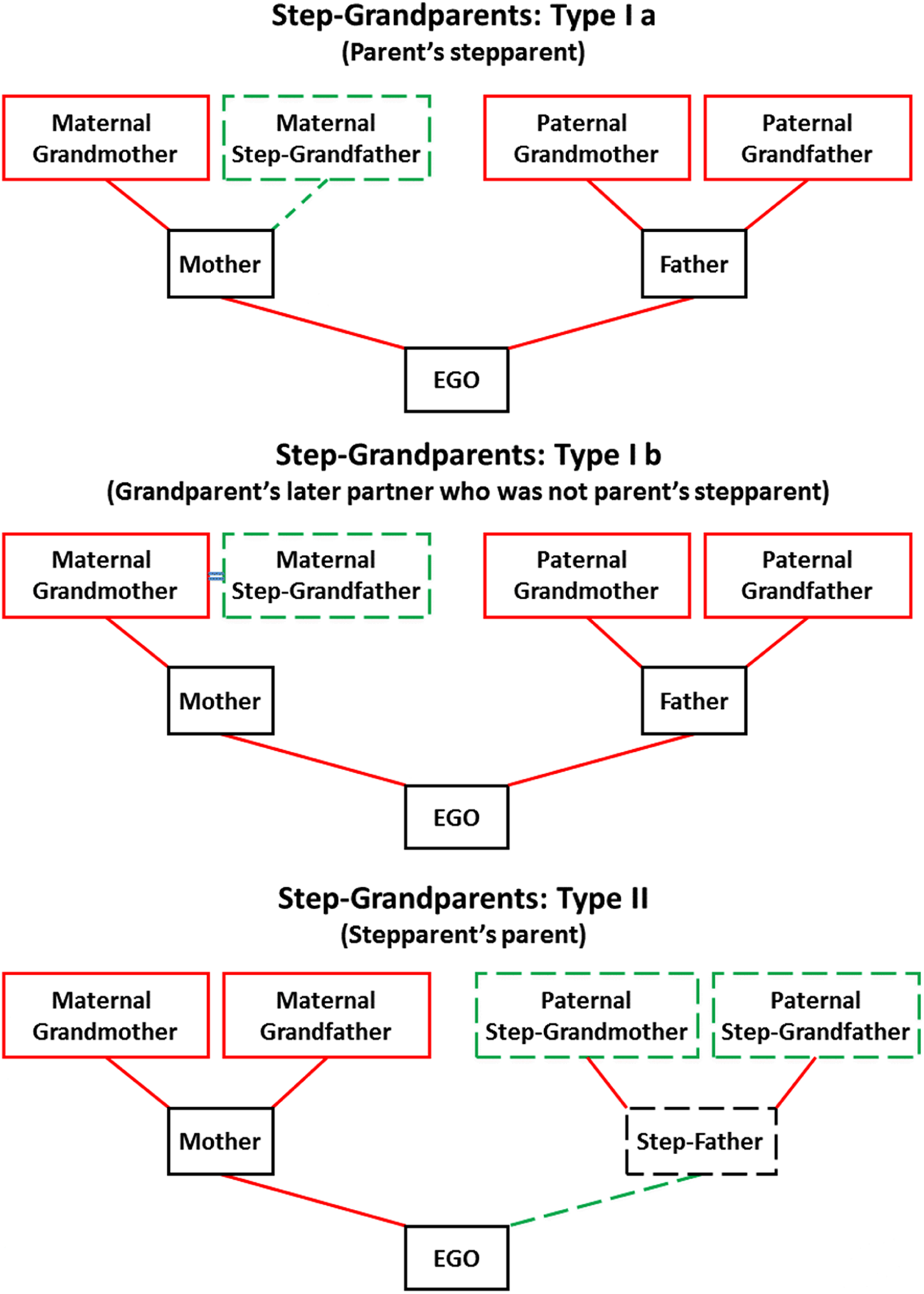
Overview of kinship links to step-grandparents for the most frequent Types Ia, Ib, and II. For each type(/subtype), one example is given. Solid lines and frames stand for blood related and dashed lines and frames for step related (the small equal sign stands for a later marriage).
Additional types of step-grandparents are possible that result from more complex family configurations. For example, during data collection, we found a fourth type, which we did not expect at the beginning of the survey, and thus did not measure in the questionnaire. Although this single case we found was also not included to our sample, we identified and defined it as Type IV, step-grandparent through half/step-sibling: If a Subject has an older half-sibling from an earlier relationship of the mother to another husband, the parents of this earlier husband are the biological paternal grandparents of the older half-sibling. If they visit their biological grandchild (the Subject’s half-sibling), they hence also get in touch with the Subject himself or herself. So they can become the Subject’s step-grandparents without being directly related to one of the Subject’s parents.
Measurements
The respondents provided information on their relationships to step-grandparents during their childhood and defined the kind of the step-relationships for each of the four categories: maternal and paternal step-GF and step-GM. In addition, we collected information on biological grandparents (including adoptive relationships), parents, and stepparents. The respondents must have had a household connection with a stepparent (i.e., lived or lived partly, e.g., on weekends, together with him or her) in order to avoid rating biases that are caused by functional and spatial distance to a stepparent. A parent’s earlier marriage partner, for example, might not be perceived as a stepparent by most respondents. However, this might not be clear to every Subject. Furthermore, if a divorced or separated parent left home or never lived with the children, the parent’s new partner may not have often had a chance to take on any caregiving roles.
The respondents were asked to rate their (step-)grandparents and (step)parents in the questionnaire along three main measurements, which were used in an earlier study (Pashos & McBurney, 2008).
Investment, defined as caregiving resources received by step-grandparents during childhood, compared to the resources the caregiver was able to give (this included gifts, money but also time, help, and protection),
Emotional closeness to step-grandparents, and
Perceived physical and psychological resemblance with the step-grandparents.
“Investment” or “caregiving” (see Appendix for exact wording) is a typical measurement for evolutionary studies, and previous studies have used similar questionnaire items, namely, “concern about welfare” (Gaulin et al., 1997; McBurney et al., 2002) and “caregiving, solicitude” (in German: “sich kümmern,” Euler & Weitzel, 1996; in Greek: “ϕροντíζω,” Pashos, 2000). The “emotional closeness” measurement has been used in various social science surveys (e.g., Hoffman, 1980) and hence allows a reliable comparison of the results. “Resemblance” plays an important role in evolutionary interpretations for kin recognition.
Answers were given on a 7-point scale from (1) not at all to (7) very much, as used in earlier studies (e.g., Euler & Weitzel, 1996; Pashos & McBurney, 2008). Both investment and emotional closeness rating scales proved to be good indicators for measuring asymmetric kin caregiving, as has been shown in earlier studies (see, e.g., Euler & Michalski, 2007). Both measurements are highly correlated with each other (Michalski & Shackelford, 2005; Pashos & McBurney, 2008).
Finally, we assessed and analyzed the marriage status of the biological grandparents (relevant for Type I step-grandparents who have a relationship with a biological grandparent). We also collected additional information such as (a) marriage status of the step-grandparent (married during the Subject’s entire childhood, became divorced/separated again, and became widowed), (b) sex of step-grandchild, (c) socioeconomic status of (step-)grandparent, (d) time in life when a step-grandparent became a step-grandparent (since birth, early childhood, and later childhood), and (e) if the step-grandparent also had biological grandchildren, and if so (f) from which relationship they derived. However, our restricted sample size did not allow for further detailed analyses.
Sample
Within the framework of a larger survey on kin investment, 319 Subjects, mainly students from different German cities (Berlin, Hamburg, Wuppertal, and Heidelberg), were given a questionnaire referring to step-grandparents. Because not every Subject had a step-grandparent, this overall number was not particularly high. Therefore, we also added a sample of 189 Subjects (mainly college students) from Pittsburgh, PA, from an earlier study (Pashos & McBurney, 2008), using the same or very similar 7-point scales. The questionnaire items from Pittsburgh relating to the determination of the step-grandparent–step-grandchild relationship were not as detailed as in the German sample; however, Type I and Type II step-grandparents were distinguished from each other, although Type III was not measured in the U.S. sample and no distinctions were made between Type Ia and Ib step-grandparents.
In total, we had a sample of 508 participants (after excluding seven cases with missing questionnaires), with 108 having at least one step-grandparent in their childhood. Among respondents who had step-grandparents, the percentage of females was somewhat higher (82% vs. 74%), while the average age was about the same among respondents with (M = 23.8 years, SD = 7.7) and without (M = 23.6 years, SD = 8.5) step-grandparents. In all, kin investment information was available for 151 step-grandparents, excluding one Type III step-grandparent. We also excluded 14 adoptive-related grandparents (related due to either adopted grandchildren or adopted parents) from our sample because the number was too small for further analyses. The main caregiving measurements were missing for 8 of the 151 step-grandparents. Although the relatively small sample size limits the power of some analyses, nonetheless, significant effects and strong tendencies were found that were clear enough for a substantial interpretation. Furthermore, the results from Germany and Pittsburgh were highly similar and were therefore collapsed in all analyses.
For reasons of comparison, we additionally analyzed the caregiving of the biological grandparents, parents, and stepparents. In all, we had data on 1,585 biological grandparents in the merged sample (1,553 with valid investment or closeness ratings, independent of resemblance rating), given by 499 respondents (498 with valid investment or closeness ratings) who had become acquainted with at least one biological grandparent during childhood. For the analysis of the interlink between children and (step)parents, we collected caregiving data on 498 fathers (and one additional case with only resemblance rating), 506 mothers, 31 stepfathers, and 14 stepmothers (we did not include four adoptive parents).
Results I and Discussion: Frequencies of Nonbiological Grandparents
Table 1 presents the distribution of Type I and II step-grandparents in this study. Inspection of the table reveals that respondents named spouses of biological grandparents (Type I, N = 109) more often than parents’ stepparents (Type II, N = 42). In addition, among the Type II step-grandparents (stepparents’ parents), very few maternal step-grandparents were named. The difference in the distribution of Type I and Type II step-grandparents as a function of step-grandparent category (i.e., maternal step-GM, maternal step-GF, paternal step-GM, and paternal step-GF) was confirmed by a significant χ2 test, χ2(3) = 14.46, p = .002, reflecting fewer Type II maternal step-grandparents being listed than paternal step-grandparents, relative to the Type I frequencies. After divorce, children usually stay with the mother. Thus, divorced fathers and their new wives, the stepmothers, seldom live in one household together with the children. Hence, stepmothers and her parents, the maternal step-grandparents Type II, might be more emotionally distant and very often not perceived as step-related family members.
Frequency of Step-Grandparent Type I (Spouse of Biological Grandparent) and Type II (Stepparent’s Parent). 151 Step-Grandparents named by 108 of Overall 508 Respondents.
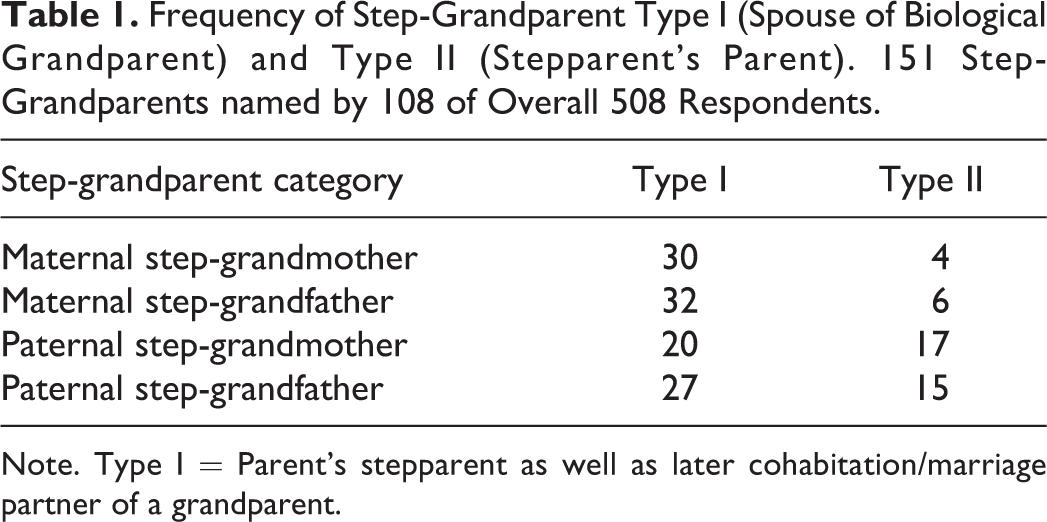
Note. Type I = Parent’s stepparent as well as later cohabitation/marriage partner of a grandparent.
Results II: Caregiving
Caregiving of Type I and Type II Step-Grandparents
Table 2 presents the mean ratings for investment, emotional closeness, and resemblance for Type I and Type II step-grandparents as well as for our sample of biological grandparents. When comparing the investment and emotional closeness of step-grandparents, the first result to note is that the overall ratings for step-grandparents were generally lower than for biological grandparents, yet clearly above floor levels that would be expected following the assumption that nonblood-related kin should have no genetic interest to invest in the nonconsanguine children (cf. Hypothesis a). The perceived physical and psychological resemblance to step-grandparents, however, was indeed very low, as one might predict.
Investments, Emotional Closeness, and Resemblance With Grandparents and Step-Grandparents: Differences Between Biological As Well As Type I and Type II Step-Grandparents.
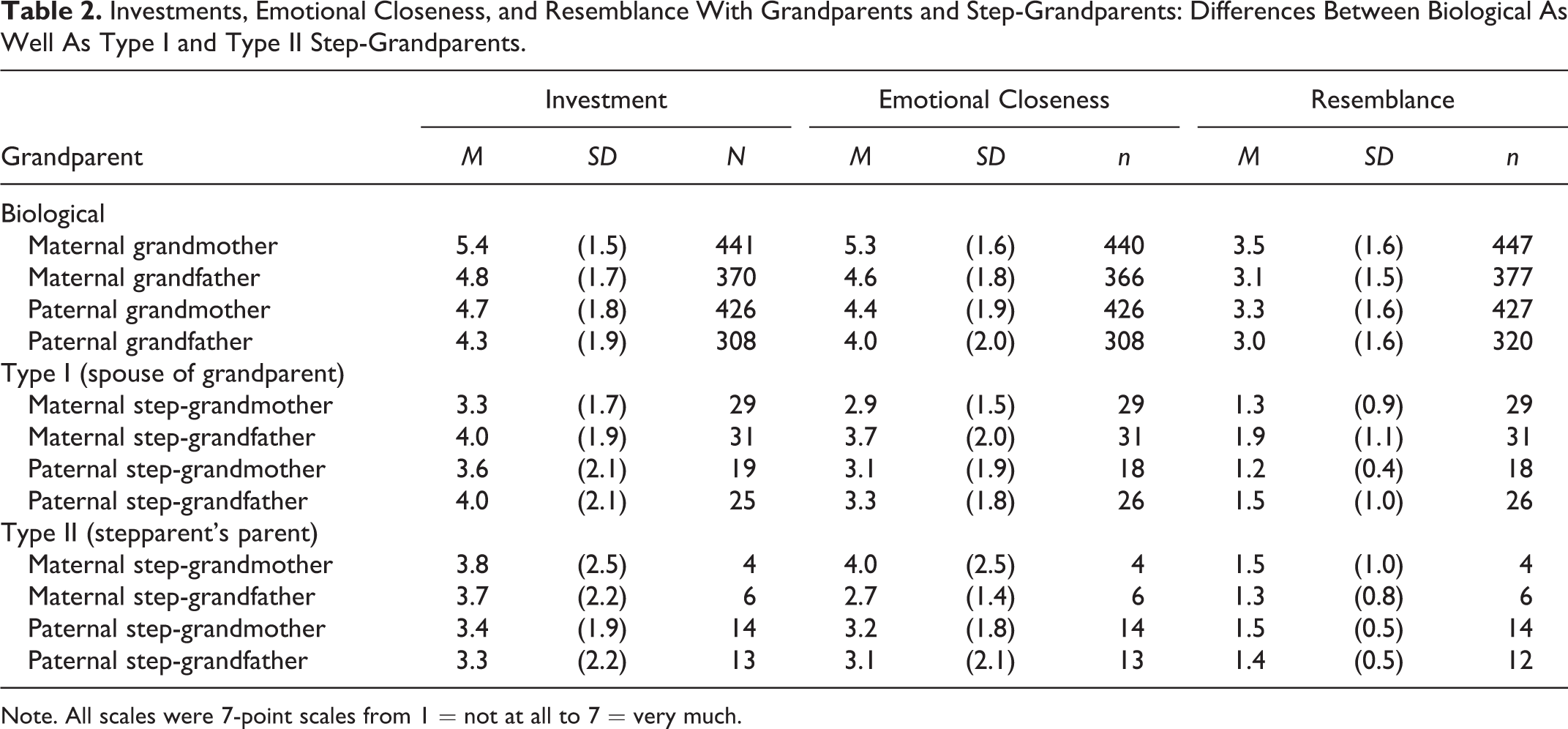
Note. All scales were 7-point scales from 1 = not at all to 7 = very much.
When analyzing the results for the different step-grandparent types in greater detail, the known pattern of asymmetric grandparental caregiving did not appear (cf. Hypothesis b). For the step-GF/step-GM sex difference (cf. Hypothesis c), the opposite was true: Step-GFs invested more in their step-grandchildren (M = 3.8) than step-GMs (M = 3.5), and step-grandchildren were emotionally closer to step-GFs (M = 3.4) than to step-GMs (M = 3.1). Although the number of cases is small, for emotional closeness, the sex difference among Type I maternal step-grandparents reached significance, t(58) = 2.0, p = .05. However, this tendency was found only for Type I step-grandparents: There were no discernable differences among the Type II step-grandparents for any dependent measure, and the direction—if any—was in favor of the step-GMs as is typical for biological grandparents (see Table 2).
The higher rating of emotional closeness for Type I step-GFs relative to Type I step-GMs was only significant for maternal step-grandparents. Following from this is the further question of whether a laterality effect exists in step-grandparents. Because of the relatively small sample size, a clear statement cannot be made. However, for Type II step-grandparents, there was a trend toward matrilateral investment.
When comparing the two step-grandparent types (cf. Hypothesis e), the overall ratings for Type I step-grandparents were not significantly higher than for Type II step-grandparents. The trend of greater investment by Type I step-grandparents (Type I = 3.74 vs. Type II = 3.43) was due exclusively to the high investment ratings for Type I step-GFs (Type I = 3.98 vs. Type II = 3.42).
Caregiving of Stepfathers and Stepmothers
A helpful procedure for investigating the causes of the higher kin investment of Type I step-GFs might be an analysis of the stepparental caregiving. When we compared the investment and emotional closeness of stepparents, we found the same tendency for a sex difference in favor of the stepfathers as among Type I step-grandparents. Again, participants reported greater levels of investment and emotional closeness for stepfathers compared to the levels of investment and emotional closeness for stepmothers (see Table 3).
Investments, Emotional Closeness, and Resemblance With Parents and Stepparents.

Note. All scales were 7-point scales from 1 = not at all to 7 = very much.
For biological parents, however, who received altogether much higher ratings than stepparents, the expected sex difference in favor of the mother was confirmed. Participants reported larger investment from and emotional closeness to biological mothers compared to the investments from and the emotional closeness to biological fathers (see Table 3).
However, one has to bear in mind that the respondents were asked to name only stepparents to whom they had a household connection in order to avoid a bias by divorced parents (namely, fathers) who moved away from the household. (In Western countries, the mother usually stays with the children after divorce.) Those divorced fathers’ spouses would not have an equal chance to build a relationship with their stepchildren compared to stepparents living together in a household with the stepchildren. This is probably the reason why we had fewer stepmothers than stepfathers. A missing household connection might also indirectly explain the very low number of maternal Type II step-grandparents.
Therefore, we raised the question of whether the greater spatial household distance of stepmothers compared to stepfathers was responsible for their lower investment and emotional closeness ratings by step-grandchildren. We compared stepmothers and stepfathers living in the same household with the respondent with those stepparents not living in the same household with the respondent, although there was only one stepfather of 29 who was not living in the same household with the respondent (and this stepfather received a very low rating). We found a clear tendency in the predicted direction for stepmothers. Although the numbers are small and can only provide a descriptive overview, stepmothers who were living in the same household as their stepchild did not receive lower ratings than stepfathers (stepmother in household: n = 4, investment: M = 5.0 and SD = 2.8, closeness: M = 4.5 and SD = 2.6; stepmother not in household: n = 9/8, investment: M = 3.4 and SD = 1.8, closeness: M = 3.3 and SD = 2.0; stepfather in household: n = 28, investment: M = 4.6 and SD = 1.9, closeness: M = 4.4 and SD = 2.0).
The same effect was found for the biological father. When he did not live with his child or children together in one household, he invested significantly less in the children and was rated as less close to them (investment: M = 6.1, SD = 1.3, n = 427 vs. M = 4.0, SD = 1.8, n = 59; t(484) = 8.7, p < .001; closeness: M = 5.9, SD = 1.4, n = 427 vs. M = 4.2, SD = 2.1, n = 61; t(486) = 6.3, p < .001). For mothers living apart from their children’s household, the same tendency was found, however, much smaller and not significant (investment: M = 6.6, SD = 0.9, n = 497 vs. M = 6.0, SD = 1.7, n = 7, ns; closeness: M = 6.5, SD = 1.0, n = 497 vs. M = 5.8, SD = 1.9, n = 8, ns). The number of mothers who did not live together with their child (i.e., the Subject) during childhood was, however, small (n = 8).
Comparison of step-grandparent and stepparent results
These data suggest that household connection plays an important role in assessments of investment and emotional closeness and may explain the higher family involvement of stepfathers compared to stepmothers. The results for stepfathers’ and step-GFs’ kin investment display parallels. However, among step-grandparents, spatial household connection is not an actual issue because in neolocal Western societies, biological grandparents and step-grandparents do not share, as a rule, the same household with the grandchildren as parents do. If there is any influence of spatial household connection, then it is related to the parent’s childhood. This means that for Type II step-grandparents (stepparents’ parents), a sex difference is not expected. Rather, one should expect lower maternal step-grandparent investment because this investment emanates from the stepmother’s parents. For Type Ib step-grandparents (grandparents’ later partners), spatial household connection cannot explain the sex difference at all because there was no cohabitation with the parent during the parent’s childhood.
Step-Grandparents as Coresident Spouses (Type I)
Grandparent/step-grandparent couples
If coresidence with biological grandparents explains the kin investment of step-grandparents (cf. Hypothesis d), a biological grandparent’s investment should be generally greater than that of his or her step-grandparental spouse (who is the step-grandparent of his or her biological grandchildren). Assuming that step-grandparents simply mirror the grandchild investment of their spouses, the biological grandparents, there should not be many cases where the step-grandparent spouse was higher rated than the biological grandparent.
Using sign tests, we compared the grandchild investment as well as the emotional closeness and resemblance to the grandchild, for the biological grandparent/step-grandparent couples. Results are presented in Table 4. As expected, in all four categories of biological grandparent/step-grandparent relationships, the respondents rated the biological grandparent as physically and psychologically more similar to themselves than the step-grandparent. For investment and emotional closeness, in five of the eight grandparent/step-grandparent couple categories, the biological grandparent received significantly (ps
Sign Tests. Biological Grandparents Versus Step-Grandparent Spouses (Type I). Comparison of Investment in, and Emotional Closeness and Resemblance to (Step)Grandchildren Between (a) Step-Grandparents Type I and (b) Biological Grandparents Who Were Spouses.
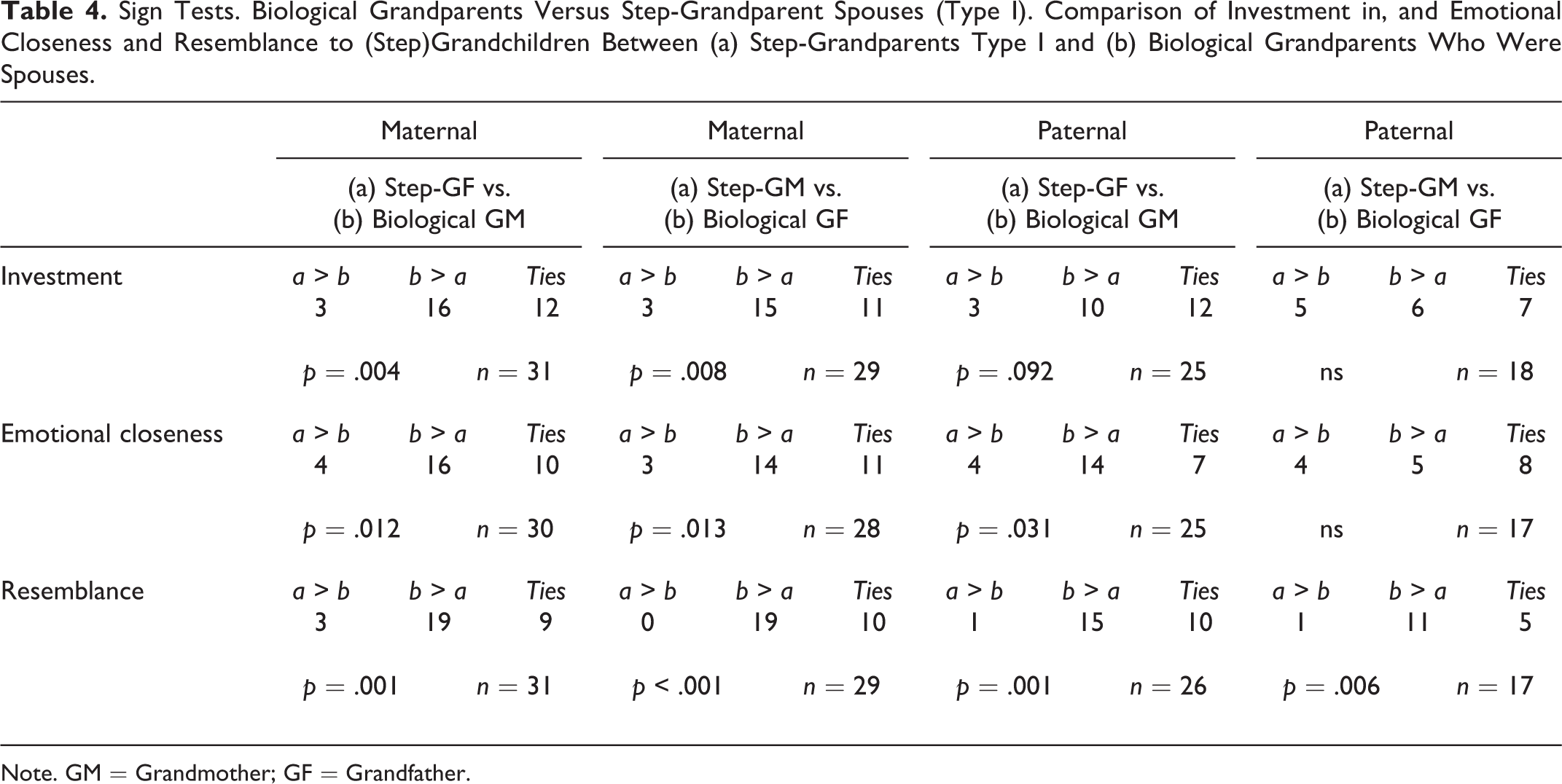
Note. GM = Grandmother; GF = Grandfather.
Type Ia versus Ib step-grandparents (parents’ stepparents vs. grandparents’ later partners)
The Type I step-grandparents comprise two subtypes, Type Ia, a parent’s stepparent, and Type Ib, a new partner of a grandparent who was not stepparent of the parent because the new remarriage took place when the parent was already an adult. A more detailed view on the different kinds of step-grandparenthood might help to explain the sex-biased investment of Type I step-grandparents.
We chose emotional closeness to a step-grandparent as the dependent variable for a General linear model (GLM) analysis because the step-grandparent sex difference was highest for emotional closeness. The Type I subtypes were only distinguished in the newer German sample and not in the Pittsburgh sample, which was not included in the following analysis. Table 5 shows the results of the GLM, the influence factors, and their directions as shown by the descriptive statistics. Step-grandparent category (maternal, paternal, male, and female) had no significant influence on emotional closeness. The differentiation between Type Ia and Type Ib, however, was significant. In general, parents’ stepparents (Type Ia) were emotionally closer to the respondents (M = 3.6, SD = 1.9) than the later partners of the grandparents (Type Ib; M = 2.8, SD = 1.8, n = 68). However, there was also a significant interaction. Means for both paternal step-grandparents and for the maternal step-GM followed the above pattern, with parents’ stepparents, i.e., Type Ia step-grandparents, receiving higher emotional closeness scores than later partners of grandparents, i.e. Type Ib step-grandparents (Type Ia, M = 3.9, SD = 1.7 vs. Type Ib, M = 2.4, SD = 1.3, n = 45). In contrast, for Type I maternal step-GFs, this effect was reversed. Here, the mothers’ mothers’ new husbands were emotionally closer than the mothers’ stepfathers (Type Ia, M = 3.1, SD = 2.2 vs. Type Ib, M = 4.4, SD = 1.9, n = 23).
General linear model (GLM). Influence of Type Ia and Type Ib Step-Grandparents on Emotional Closeness. Perceived Emotional Closeness to a Type I Step-Grandparent, Dependent on Step-Grandparent Category, and Subtype Ia (Stepparent of Parent) and Ib (Later Partner of Grandparent).

Note. German subsample n = 68. GF = grandfather; GM = grandmother.
We performed a similar analysis using investment as dependent variable. Although the general Ia versus Ib comparison did not reach significance, the same interaction effect approached significance (p = .055, η2 = .12; n = 69), with a pattern very similar to that found for emotional closeness (maternal step-GF: Type Ia, M = 3.1, SD = 1.6 vs. Type Ib, M = 5.1, SD = 1.9, n = 23; the other three step-grandparents: Type Ia, M = 4.1, SD = 2.0 vs. Type Ib, M = 3.3, SD = 2.1, n = 46).
We further compared the investment and emotional closeness of step-GMs and step-GFs for the Type Ia and Ib groups and found a significant sex difference for the Type Ib only (see Table 6). Later husbands of the biological GMs who were not already the parents’ step-grandparents received higher ratings for both investment and emotional closeness than later wives of the biological GFs. Differences between step-GMs and step-GFs for parents’ stepparents (Type Ia) were not significant.
Sex Difference for Type Ia and Type Ib Step-Grandparents. Investment of, and Emotional Closeness and Resemblance With Step-Grandmothers and Step-Grandfathers, Subdivided for Parents’ Stepparents (Ia), Grandparents’ Later Partners (Ib), and the Not Distinguishable Pittsburgh Sample.

Note. All scales were 7-point scales from 1 = not at all to 7 = very much.
In conclusion, step-grandparents who were already stepparents of the parents (Type Ia) generally had a closer relationship with their step-grandchildren than step-grandparents who were later partners of the biological grandparents (Type Ib). They apparently had developed stronger ties to their new family. However, for the husband of the maternal GM (the maternal GM is the grandparent who provides on average the greatest caregiving), this was not true. Mother’s mother’s later partner appeared to maintain a better relationship to his step-grandchildren than mother’s stepfather. One has the keep in mind, however, that the differentiation between a maternal and a paternal step-GF is not an absolute distinction but a relative one. In other words, it is the same person, but on the one hand, his relationship is to his spouse’s daughters’ children and on the other hand to his spouse’s sons’ children. This means that the later husband of the maternal GM discriminated strongly in favor of his wife’s daughters’ children, much as his wife did. In contrast, the mother’s stepfather did not behave like his wife, the maternal GM. Rather, he tended to act solicitously toward his wife’s sons’ children.
Widowed or divorced grandparents
When distinguishing widowed or divorced grandparents who are in a new relationship with a step-grandparent, we found results that were complementary to the Type Ia and Type Ib step-grandparent results. Again, the result for the maternal step-GF/maternal GM couple was reversed.
As a general trend, step-grandparents who were married with a widowed grandparent invested more in step-grandchildren and were closer to them than step-grandparents who were married with divorced grandparents. However, this seems to be only a reflection of the results for the biological grandparents. As a general trend, widowed and remarried grandparents invested more and were emotionally closer to their grandchildren than divorced and remarried grandparents. However, the result was quite the opposite for the maternal GM (remarried maternal GM: investment: divorced, M = 6.1 vs. widowed, M = 4.5, n = 25; closeness: divorced, M = 5.7 vs. widowed, M = 4.1, n = 25. The three other grandparent groups together: investment: divorced, M = 3.1 vs. widowed, M = 4.6, n = 72; closeness: divorced, M = 2.8 vs. widowed, M = 4.3, n = 71). Divorced and remarried maternal GMs invested significantly more and were rated as closer by their grandchildren than were their widowed and remarried counterparts (maternal GM, divorced, and in another relationship vs. widowed and in another relationship: investment: Mean Difference = 1.59, t(23) = 2.5, p = .021; closeness: Mean Difference = 1.66, t(23) = 2.3, p = .028). The same was true for their husbands, the maternal step-GFs. If they were married with a divorced wife, they tended to invest more in their wives’ daughters’ children than their married-with-a-widowed-wife counterparts, in contrast to the general trend that is reversed (maternal step-GF, married to a divorced GM vs. married to a widowed GM: investment: Mean Difference = 1.58, t(18) = 2.1, p = .054; closeness: ns).
Discussion
The present analysis shows that step-grandparental investment in step-grandchildren and step-grandchildren’s closeness to step-grandparents, although on average less than that provided by biological grandparents, were substantially higher than would be predicted based on genetic similarity alone. The Hypothesis (a) that grandparental caregiving and its differences are predominantly a reflection of average genetic relatedness was not supported. However, the alternative Hypothesis (b) that the kin caregiving asymmetries among grandparents and step-grandparents might be similar because they reflect a general social structure that is not limited to biological relatives cannot be confirmed either. The step-grandparents’ kin investment and emotional closeness estimates did not show an asymmetric kin investment pattern, such as exists among biological grandparents. For Type Ib step-grandparents (later partner of the grandparent), however, an unexpected sex bias appeared. The later husbands of biological GMs were more involved in step-grandchild care than the later wives of biological GFs. This speaks against Hypothesis (c) that there is a general rule that female kin caregivers are always closer and more investing than male kin caregivers.
Spousal coresidence (Hypothesis d) with a biological kin caregiver appeared to play a role for the step-grandparental investment in and step-grandchildren’s closeness to step-grandparents. Accordingly, Type I step-grandparents’ caregiving was frequently less than that of their spouses, the biological grandparents. However, this was not true for the paternal step-GM Type I. Her caregiving was not merely a weaker version of that of her husband’s (i.e., the paternal GF). She did not care less than her husband; and indirectly this also means that Type I step-GMs did not discriminate much in favor of their husband’s daughters’ children, such as her husband did. This illustrates that step-grandparents (Type I) are also independent actors, whose kin investment decisions can follow their own motivations and do not simply mirror those of their spouses, the genetically related grandparents.
In contrast to step-grandparents, sex difference among stepparents was better explained by coresidence. Stepfathers provided more caregiving for stepchildren than stepmothers, likely because they more often lived in the same household as their children. In contrast to step-grandparents, stepparents also share the same household with the recipients of caregiving.
Nonetheless, the coresidence hypothesis as an explanation for sex-biased grandparental behavior assumes mainly an influence that biological GMs exert on their husbands (Gaulin et al., 1997). The present results would not necessarily argue against this assumption, in that the counterexample for the spousal coresidence effect is the paternal GF/step-GM couple, a GF and wife constellation.
Given the relatively small sample size, the present study cannot confirm that Type II grandparents (stepparents’ parents), because of their weaker kinship link, generally provided less caregiving than Type I step-grandparents (Hypothesis e). However, the Type Ib step-GFs (GMs’ later husbands) had an especially strong connection with their wives’ maternal grandchildren (i.e., daughters’ children). This illustrates a kind of direct kinship link effect, as postulated in Hypothesis (e). An important factor for kin investment appears to be the affinity to the new family. Affinity is related to coresidence with the biological caregiver; however, affinity also embraces the psychological attachment resulting particularly from the kinship link to the family. In the present study, step-grandparents who were already stepparents of their spouses’ children (Type Ia) mostly appeared to have developed a stronger affinity to their new family, in that they invested more in step-grandchildren than step-grandparents who were not stepparents of their spouses’ children because they married into the family later in life (Type Ib). However, as an exception, the behavior of the later husband of the maternal GM mirrored the behavior of his wife, investing more in his wife’s daughters’ children. If he was, however, a Type Ia step-GF (already a stepparent of the parent), then his kin investment was less discriminating and he showed relative favoritism to his wife’s sons’ children. Possibly in his earlier times as stepfather of the child’s parent, he developed his own preferred family relationships, which did not simply mirror his wife’s kin-caregiving preferences. It could be that the Type Ia step-GFs (parents’ stepfathers) also try to balance the discrimination of their spouses, the biological grandparents, and thus pay particular attention to the son’s children. However, the present sample size was not large enough to confirm this tendency.
Corresponding kinship-link results were found by Dench and Ogg (2002) in a survey with an even smaller sample size. They also found higher involvement by step-GFs, although Dench and Ogg did not make the necessary differentiation between Type I and Type II step-grandparents (nor between Type Ia and Ib). In contrast to step-GMs, who appeared to have stronger links to their own biological children’s families, step-GFs took on their caregiver role in a new family and saw themselves fully integrated in grandchild rearing; however, they had little say from the viewpoint of the step-grandchildren’s parents (pp. 135-136).
In the present study, a kinship affinity effect was also illustrated by the grandparents’ marriage status. Widowed grandparents and their step-grandparental spouses generally exhibited a greater kin investment than divorced grandparents and their spouses, again with the exception of the maternal GM/step-GF couple, where the pattern was reversed. A divorced grandparent might value his or her own mating interest higher than the duties of grandparenting (and this could include the willingness to split the existing relationship with one’s own children’s other parent). A widow or widower did not intentionally break off the former marriage. A new partner might also in particular be selected after his or her capacity to take on the role as a kin caregiver. Therefore, widowed grandparents and their new partners might show higher kin investment than divorced grandparents. Also, the exception of the top-caregiver, the maternal GM, and her new husband would make sense in this connection. She shows a clear preference for her daughters’ children. When she was divorced, however, her matrilateral kin investment was even more discriminative in favor of her daughter’s offspring, and her new husband mirrored this behavior as well. Thus, in case of the maternal GM, pursuing her own mating interest did not lower, but rather increased, the preference for investing in her daughters’ children.
The exception of the maternal GM in the case of divorce might also be the result of chance, given the relatively small sample. However, in the classic study by Euler and Weitzel (1996), divorced maternal GMs were an exceptional case as well. For grandparents who were living separately from their spouse, the grandchild care was less than for grandparents not separated, with the exception of separated maternal GMs (cf. Euler & Weitzel, 1996, table 3, p. 49).
The fact that most Type I step-grandparents did not significantly mirror their spouses’ (the biological grandparents’) discrimination between sons’ and daughters’ children would also be in accordance with the paternity certainty hypothesis. This does not apply, however, to the later husband, the Type Ib step-GF. He strongly mirrored the caregiving behavior of the maternal GM, his wife, in preferring daughters’ children. The main problem for this interpretation is that given the sample size, neither matri- or patrilaterality nor lack of biased laterality can be definitely confirmed for either Type I or Type II step-grandparents. The fact that no large differences were found does not exclude the possibility that differences might reach significance with a larger sample. The significantly higher ratings for the Type Ib step-GFs, however, are not in accordance with the paternity certainty hypothesis as the only explanation. If paternity uncertainty explains the reluctance of GFs for grandchild investment, why do Type Ib step-GFs invest more than step-GMs?
In conclusion, the best post hoc explanation for the results presented here is mating effort. Mating effort can explain the general step-grandparental caregiving interest as well as the present finding of a sex bias of greater step-GFs’ (Type Ib) investment and the different findings of affinity effects of Type Ia/Ib and divorced/widowed step-grandparents. In practice, this means that child-loving and caring step-GFs had been more attractive to GMs as new marriage partners. And maternal GMs who remarried in a later stage of life or after divorce had new husbands who supported their own imbalanced matrilateral grandparenting. Mating effort in the form of step-grandchild care, hence, appears to be an explanation for the step-grandparents’ investment in nonbiologically related grandchildren.
Tifferet, Jorev, and Nasanovitz (2010) came to a similar conclusion for stepparent investment, finding that young Israelis with divorced parents received more financial support for their Great Journey (travel for a certain period of time after military service) if they were raised by stepfathers than by stepmothers. One might criticize, however, that mating effort might not play a role in postreproductive relationships as for later step-grandpaternal Type Ib caregivers because there might be almost no possibility of siring new offspring. However, in humans, mating must not necessarily lead to actual reproductive outcomes. Long-term relationships without children exist, including postreproductive relationships. Hence, in humans, mating effort is a kind of relationship effort (Anderson, Kaplan, Lam, & Lancaster, 1999; Anderson, Kaplan, & Lancaster, 1999).
Recent work identified another motivation for grandparental helping behavior. Grandparents could preferentially invest toward grandchildren or their parents most in need of help (Hank & Buber, 2009; Thomese & Liefbroer, 2013). These studies are, however, based on measurements that usually describe instrumental support for the grandchildren’s parents, such as regular childcare/babysitting or household help and financial support for the parents (Snopkowski & Sear, 2015). The results are therefore often different from the present study or earlier studies (e.g., Euler & Weitzel, 1996), which measure discriminative caregiving and solicitude embracing emotional preferences, independently of duties and necessities. In cases of father absence, however, there might be the need that other men take on the father role. As Oyserman, Radin, and Benn’s (1993) study shows, this can also be a GF. Regarding stepfathers and step-GFs, we should not presume that in modern societies, remarriage is necessarily an indicator for disadvantaged families with particular social needs. Nor should we assume that the present results for step-relatives are universal (we only researched two Western cultures). Further cross-cultural research is needed to investigate how being divorced or widowed differentially shapes stepparental and step-grandparental caregiving in non-Western societies.
The present study shows that important family caregivers must not necessarily be blood related. However, on average, the biological grandparents show a greater interest in grandchild investment than the step-grandparents. From an evolutionary point of view, the biological grandparents’ investment interests appear to be mainly driven by parenting effort and not by mating effort. Future research should especially focus on the role of emotional affinity or, for example, on attachment (Bowlby, 1969) and familiarity (Bischof, 2008, pp. 407-408) as proximate factors for family help by blood- and nonblood-related relatives. Future research might also include the affinal relatives into the discussion (e.g., Burton-Chellew & Dunbar, 2011).
Footnotes
Appendix: Main Questionnaire Items
Acknowledgments
We would like to especially thank Donald H. McBurney for his active contribution to the Pittsburgh data collection.
Declaration of Conflicting Interests
The author(s) declared no potential conflicts of interest with respect to the research, authorship, and/or publication of this article.
Funding
The author(s) disclosed receipt of the following financial support for the research, authorship, and/or publication of this article: The research project was funded by the German Research Foundation (DFG). The Pittsburgh data collection was supported by a fellowship of the German Academic Exchange Service (DAAD).