



Abstract
Two studies were conducted to explore the effect of parental sex on well-being due to parenthood. Study 1 analyzed the sixth wave of the World Values Survey data. The results indicated that parents were happier than their respective childless peers. However, the effect of motherhood was significantly higher than that of fatherhood. Furthermore, Study 2 analyzed the data from 354 single-child parents in China. The results showed that perceived parent–child facial resemblance moderated the sex difference in well-being. Specifically, in the high parent–child facial resemblance group, both fathers and mothers showed high levels of well-being; however, in the low parent–child facial resemblance group, the well-being level of mothers was higher than fathers. These results supported the renovated pyramid of needs and the hypothesis of paternal uncertainty.
The Effect of Parenthood on Parents’ Well-Being
Well-being has been conceptualized and measured from various perspectives by different researchers (Steel, Schmidt, & Shultz, 2008). For example, Pavot, Diener, Colvin, and Sandvik (1991) defined well-being as a cognitive evaluation of one’s life. In addition, Averill and More (1993) considered well-being as individuals’ long-lasting emotional experiences. Anderson, Hildreth, and Howland (2015) integrated those views and noted that well-being included three dimensions: life satisfaction, positive affect, and negative affect. Life satisfaction is the overall cognitive component of well-being, and the positive affect and negative affect are the affective components of the well-being. The affective component of well-being depends on external circumstances (Carver & Scheier, 1990; Kim-Prieto, Diener, Tamir, Scollon, & Diener, 2005). In comparison, the cognitive component of well-being is more stable (Diener, Ng, Harter, & Arora, 2010). For most events, the effects of life events (e.g., marriage, child birth) on cognitive well-being are stronger and more consistent than on affective well-being (Fujita & Diener, 2005; Luhmann, Hofmann, Eid, & Lucas, 2012). Thus, this study would focus on the effect of parenthood on the cognitive component of well-being (life satisfaction).
There has been a long-standing debate regarding whether parenthood promotes parent’s well-being or not. Some parents think that parenting increases the economic burden, disturbs rhythms, blocks social interaction, and reduces marriage quality (Claxton & Perry-Jenkins, 2008). Thus, in their opinions, parenthood may lead to low well-being. However, other parents focus on positive outcomes of parenthood. As noted by Inglehart and colleagues, “one minute when your child comes running to greet you with a smile and a hug may be worth a hundred minutes of cleaning up after them” (Inglehart, Foa, Peterson, & Welzel, 2008). The literature supports both perspectives, with some researchers demonstrating that parents perceive higher well-being than their childless peers (Aassve, Goisis, & Sironi, 2012; Nelson, Kushlev, English, Dunn, & Lyubomirsky, 2013) and others showing the opposite (Evenson & Simon, 2005; Nomaguchi & Milkie, 2003). A number of longitudinal studies demonstrated that both parents experienced a significant increase in well-being during the period of pregnancy. However, the parents’ well-being would suddenly decline in the year after childbirth and continuingly decrease for the following 2–5 years (Bleidorn et al., 2016; Dyrdal & Lucas, 2013; Luhmann et al., 2012; Myrskyla & Margolis, 2014).
The aforementioned conflicting results might in part be explained by moderating variables such as parental sex, parent age, number of children, marital status, and so on (Myrskyla & Margolis, 2014; Nelson, Kushlev, & Lyubomirsky, 2014; Pollmann-Schult, 2014). Among these moderators, parental sex is an important factor that has been frequently examined by researchers, with some research showing higher well-being among mothers and others among fathers (Keizer, Dykstra, & Poortman, 2010; Larson, Richards, & Perry-Jenkins, 1994; Myrskyla & Margolis, 2014; Nelson et al., 2013). Social role theory may account for why fathers report higher well-being. This theory argues that mothers tend to undertake most tasks for childcare and housework (Milkie, Bianchi, Mattingly, & Robinson, 2002; Nomaguchi & Milkie, 2003), and, therefore, lose their choice of jobs due to parenthood (Budig & England, 2001). Relative to fathers, mothers report more time strain (Nomaguchi, Milkie, & Bianchi, 2005) and distress (Bird, 1997). Moreover, fathers’ time spent with children typically consists of playing games and leisure activities, which are related to positive emotions. Thus, fathers should be expected to report higher well-being than mothers (Nelson et al., 2013).
Evolutionary Psychology Perspective on Parenting
In contrast to social role theory, evolutionary perspectives suggest that mothers would derive higher well-being from parenthood than fathers. Modern evolutionary psychologists have revised Maslow’s hierarchy of fundamental human motives, comprising of immediate physiological needs, self-protection, affiliation, status/esteem, mate acquisition, mate retention, and parenting (Kenrick, Griskevicius, Neuberg, & Schaller, 2010). When one fulfills each type of need, he or she should perceive high well-being (Nelson et al., 2014; Schaller, Neuberg, Griskevicius, & Kenrick, 2010). For example, when food (Desmet & Schifferstein, 2008; Macht & Dettmer, 2006) and self-esteem needs (Knowles & Gardner, 2008) are met, people experience mental reward and pleasure. In this revised framework, parenting needs is at the top of the pyramid. Thus, parents should experience higher levels of well-being than their peers (Lyubomirsky & Boehm, 2010; Schaller et al., 2010). According to this theory, parenting not only includes childbirth but also child growth, success, marriage, and having grandchildren. Thus, well-being due to parenthood may derive from long-term effort and commitment (Schaller et al., 2010).
Because of inner fertilization, when mothers take care of their children by themselves, they are 100% “sure” of their genetic contribution to offspring (Gaulin & Schlegel, 1980). In contrast, due to the limited number of eggs, males face fierce competition in mating (Trivers, 1972), and their partners might mate with other men (Burch & Gallup, 2000). In this way, men are faced with paternal uncertainty (Buss, 2014; Bussing et al., 2009). Because of this uncertainty, parenthood offers mothers more fulfillments than fathers. Therefore, we hypothesize that parental sex would moderate the relationship between parenthood and well-being (Hypothesis 1).
The Cues of Paternal Uncertainty
Studies have shown that men can use some cues to assess paternity. These cues include “indirect cues” (e.g., the perception of spouse’s fidelity; Apicella & Marlowe, 2004; Flinn, 1988) and “direct cues” (e.g., body odor resemblance between father and child and facial resemblance between father and child; Alvergne, Faurie, & Raymond, 2010; Bressan, Bertamini, Nalli, & Zanutto, 2009). Among these cues, parent–child facial resemblance provides a reliable index to assess the genetic resemblance between parent and child (Maloney & Dal Martello, 2006). Biological studies have demonstrated that craniofacial characteristics (e.g., the anterior and posterior face heights and the cranial base dimensions) are highly heritable (Johannsdottir, Thorarinsson, Thordarson, & Magnusson, 2005). Further, previous studies have shown that the more similar the facial characteristics between fathers and children, the more resources men would invest in their offspring (Alvergne, Faurie, & Raymond, 2009; Yu et al., 2017; Yu, Zhang, et al., 2019), the lower would be the rate of domestic violence (Burch & Gallup, 2000), and the physically healthier would be among the father (Yu, Guo, et al., 2019; Yu et al., 2016). Since there is no corresponding maternal uncertainty for women, mother–child facial resemblance has no effect on the emotional and material resource investment in their children. Furthermore, because of maternal certainty, maternal investment is far more than paternal investment (Geary, 2000; Sear & Mace, 2008).
Thus, we hypothesized that if perceived high parent–child facial resemblance, the fathers might experience low threat from paternity and therefore report the same level of well-being as mothers. Conversely, if perceived low parent–child facial resemblance, the fathers might experience lower well-being than mothers. As shown in Figure 1, the parent–child facial resemblance would further moderate the sex difference in parental well-being (Hypothesis 2).

The comprehensive hypothesis model in the present study: the moderating effect of parental sex and moderated moderating effect of parent-child facial resemblance between parenthood and well-being.
The Current Studies
To examine the moderating effect of parental sex on the relationship between parenthood and well-being (Hypothesis 1), Study 1 analyzed data from the sixth wave of World Values Survey Association (2014). As suggested by prior research, well-being was influenced by socioeconomic status (SES; Johnson & Krueger, 2006; Pinquart & Sorensen, 2000), parent age (Nakazato & Shimonaka, 1989), marital status (Umberson, Pudrovska, & Reczek, 2010), and heath condition (Kok & Fredrickson, 2010; Thayer, Hansen, Saus-Rose, & Johnsen, 2009). Study 1 used those variables as control variables. In Study 2, parents from one kindergarten and one primary school in Beijing were recruited to test the moderating effect of parent–child facial resemblance on the sex difference in parental well-being (Hypothesis 2). As in Study 1, parent age, health condition, and family SES served as control variables. We submitted our research to the local ethics committee for review, and the committee had approved this study.
Study 1
Method
Participants
The data were from the sixth wave of the World Values Survey database (World Values Survey Association, 2014), comprising of 86,272 participants from 187 countries. When people get old and retire from work, their support system would be reconstructed. Family supports, especially from children, would be more prominent (Beggs, Haines, & Hurlbert, 1996; Chou & Chi, 2004). Thus, to eliminate the effect of age, we selected participants aged no more than 60. The sample consisted of 72,668 adults, including 35,593 men, 37,028 women, and 47 respondents whose sex information was missing or were not answered. There were 24,573 respondents with no children, 46,975 respondents rearing one or more children, and 1,120 respondents considered as null in this item.
Measures
Demographic measure
Participants’ demographic information was gathered, including sex, age, highest education level attained, subjective health (a 4-point Likert-type scale, ranging from 1 [very good] to 4 [poor]), household income scale (respondents rated an income scale card, ranging from 1 = the lowest income group to 10 = the highest income group in their country), and marital status (including married, live together as married, divorced, separated, widowed, and single).
Well-being measure
Well-being was measured as 1 item assessing life satisfaction (“All things considered, how satisfied are you with your life these days?”), ranging from 1 = completely dissatisfied to 10 = completely satisfied. Previous studies have demonstrated that the single-item measure of well-being has satisfactory reliability and validity (Dyrdal & Lucas, 2013; Veenhoven, 2000).
Parenthood
Parenthood was measured by an item, “how many children you have.” The answer “0” indicated without children and the answer “≥1” indicated with children.
Results
According to suggestions by Kraus, Piff, and Keltner (2009), the average of standardized family income and the years of maternal and paternal education was used as a composite measure of participants’ SES. As shown in Table 1, the correlations between well-being and health status, between well-being and family SES were positively significant, and the correlation between well-being and age was negatively significant.
Descriptive Statistics and Correlations Among Variables in Study 1.

Note. N = 354. SES = socioeconomic status; SD = standard deviation.
*p < .05. **p < .01. ***p < .10.
With parental sex and child status as independent variables, well-being as a dependent variable, and age, subjective health, marital staus, and SES as control variables, a multiple analysis of variance indicated that the effects of age, F(1, 68,606) = 89.67, p < .001, partial η2 = .001; subjective health, F(1, 68,606) = 4,807.43, p < .001, partial η2 = .095; SES, F(1, 68,606) = 2,996.48, p < .001, partial η2 = .042; and marital status, F(1, 68,606) = 87.44, p < .001, partial η2 = .006, on well-being were all significant. The main effects of parental sex, F(1, 68,606) = 82.29, p < .001, partial η2 = .001, and parenthood, F(1, 68,606) = 34.89, p < .001, partial η2 = .001, were significant. The interaction between sex and child status was also significant, F(1, 68,606) = 12.44, p < .001, partial η2 < .001.
To further analyze the effects of marital status on the well-being, a post hoc test was conducted. As shown in Table 2, the well-being of people who lived together as married was significantly higher than all the other marital status groups (ps < .001). The well-being of people who were divorced was significantly lower than those who were married, lived together as married, separated, and single (ps < .001). However, there were no differences between the divorced group and the widowed group (p > .05) and between the separated group and the single group (p = .63).
Descriptive Statistics of Well-Being in Different Marital Status Groups.

A simple effect analysis was conducted while controlling for age, subjective health, SES, and marital status. As shown in Figure 2, regardless of parental sex, the well-being of adults with children was higher than childless adults, MD male = −.10, SE = .03, F(1, 68,606) = 9.22, p = .002, partial η2 < .001; MD female = −.22, SE = .03, F(1, 68,606) = 48.49, p < .001, partial η2 = .001. Furthermore, there was significant sex difference in well-being among the childless group, MD = −.10, SE = .03, F(1, 68,606) = 11.65, p = .001, partial η2 < .001; specifically, women’s well-being was significantly higher than men’s in adults with children, MD = .22, SE = .02, F(1, 68,606) = 116.17, p < .001, partial η2 = .002.

The effect of parenthood on well-being: The moderating effect of parental sex. The figure decipts the moderting effect of parental gender on the relationship between parenthood and well-being.
Discussion
Consistent with the results of a longitudinal study by Dyrdal and Lucas (2013), when controlling for age, subjective health, and SES, the results in Study 1 showed that adults with children perceived more happiness than childless adults. Furthermore, there was a sex difference in the effect of parenthood on well-being. Specifically, female adults with offspring were happier than their male counterparts. These results are in line with the hypothesis of paternal uncertainty. Men are faced with the risk that their putative children may not be their biological offspring. Thus, to men, the effect of parenthood on well-being could be lower when they perceive low paternity than when they perceive high paternity. Conversely, women are 100% sure of their genetic contribution to offspring because of inner fertilization. For women, the effect of parenthood on well-being should be consistently high.
To further assess this hypothesis, parents from a kindergarten participated in Study 2 to explore how parent–child facial resemblance moderated the sex difference in well-being related to parenthood.
Study 2
Method
Participants
A total of 480 parents were initially recruited from a kindergarten and a primary school in Beijing. To eliminate the possible effect of confounding variables, we removed 126 participants (111 from non-single-child families, 15 from remarried families) and used 354 parents (163 fathers and 191 mothers) from 354 independent single-child families as participants in the present study. All the participants were in their first marriage, and all children came from biological families. Three hundred forty-six participants were ethnic Han, and eight participants were ethnic minorities. The average age of participants was 36.09 years (SD = 4.20), ranging from 27 to 59.
Measures
Demographic measure
Participants’ demographic information was gathered, including sex, age, the health status of participants and their spouses (a 4-point Likert-type scale, ranging from 1 [very good] to 4 [poor]), and the educational attainment. Participants also reported the number of children they had and their annual household income.
Well-being measure
The Satisfaction with Life Scale (Diener, Emmons, Larsen, & Griffin, 1985) was used to measure the parents’ well-being. The scale included 5 items, such as “In most ways, my life is close to my ideal,” “The conditions of my life are excellent,” and so on. The measure was completed on a 7-point Likert-type scale, ranging from 1 (strongly disagree) to 7 (strongly agree). The scale has high reliability and validity (Diener et al., 1985). In this study, the Cronbach α coefficient of the scale was .83 and the split-half reliability was .80.
Perceived parent–child facial resemblance measure
Perceived Parent–Child Facial Resemblance Scale (Yu et al., 2016) was used to measure facial resemblance between parents and child. There were 2 items in this scale: “In your opinion, how much does the youngest child look like you?” and “In your friends’ or family members’ views, how much does the youngest child look like you?” The scale was rated on a 10-point Likert-type scale, ranging from 1 (not at all) to 10 (completely). The average score of 2 items served as the index of parent–child facial resemblance. The correlation coefficient between these 2 items was .85 in Yu et al. (2016), and the correlation coefficient was .84 in the present study.
Results
As in Study 1, the average of the standardized family income and years of maternal and paternal education was used as a composite measure of participants’ SES (Kraus, Piff, & Keltner, 2009). To facilitate the subsequent regression analysis, sex of parents and children was coded (assigning female as “1” and male as “0”).
As shown in Table 3, the correlations between well-being and health status, family SES were significant, and the correlation between well-being and perceived parent–child facial resemblance was marginally significant.
Descriptive Statistics and Correlations Among Variables.
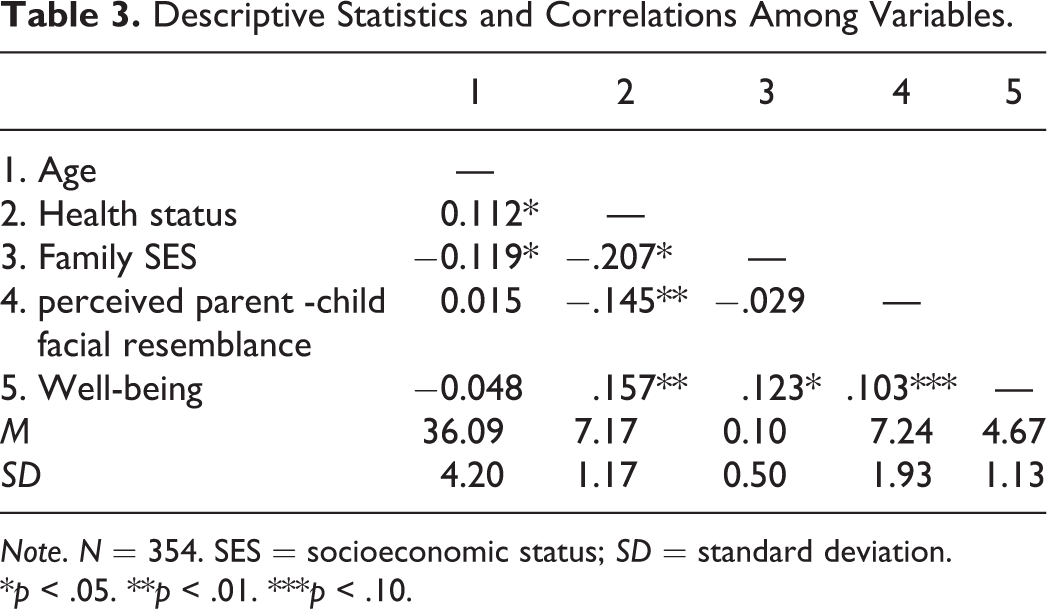
Note. N = 354. SES = socioeconomic status; SD = standard deviation.
*p < .05. **p < .01. ***p < .10.
We conducted a stepwise regression analysis to explore the moderating effect of perceived parent–child facial resemblance on sex difference in parents’ well-being. In the first step, the controlling variables, including parent age, health condition, and SES, were entered. Parental sex and the perceived parent–child facial resemblance were included in the second step, and the interaction between sex and perceived parent–child facial resemblance was entered in the final step. As shown in Table 4, the effects of parents’ age on well-being were not significant, and SES and health condition significantly predicted parents’ well-being. In support of Hypothesis 2, the interaction between parental sex and perceived parent–child facial resemblance was significant.
The Effect of Perceived Parent–Child Facial Resemblance on Parents’ Well-Being.

Note. SES = socioeconomic status; SE = standard error.
*p < .05. **p < .01. ***p < .001.
In order to further investigate the moderating effect of perceived parent–child facial resemblance on the relationship between parental sex and well-being, according to Aiken, West, and Reno (1991) recommendations, a simple slope effect test was conducted. As shown in Figure 3, in the high perceived parent–child facial resemblance group, there was no sex difference effect in well-being, B = −.02, SEB = .08, CI [−.168, .133], t(347) = −0.26, p = .79; however, in the low perceived parent–child facial resemblance group, fathers’ well-being was significantly lower than mothers (B =.51, SEB = .09, CI [.266, .675], t(347) = 5.38, p < .001, η2 = .08.
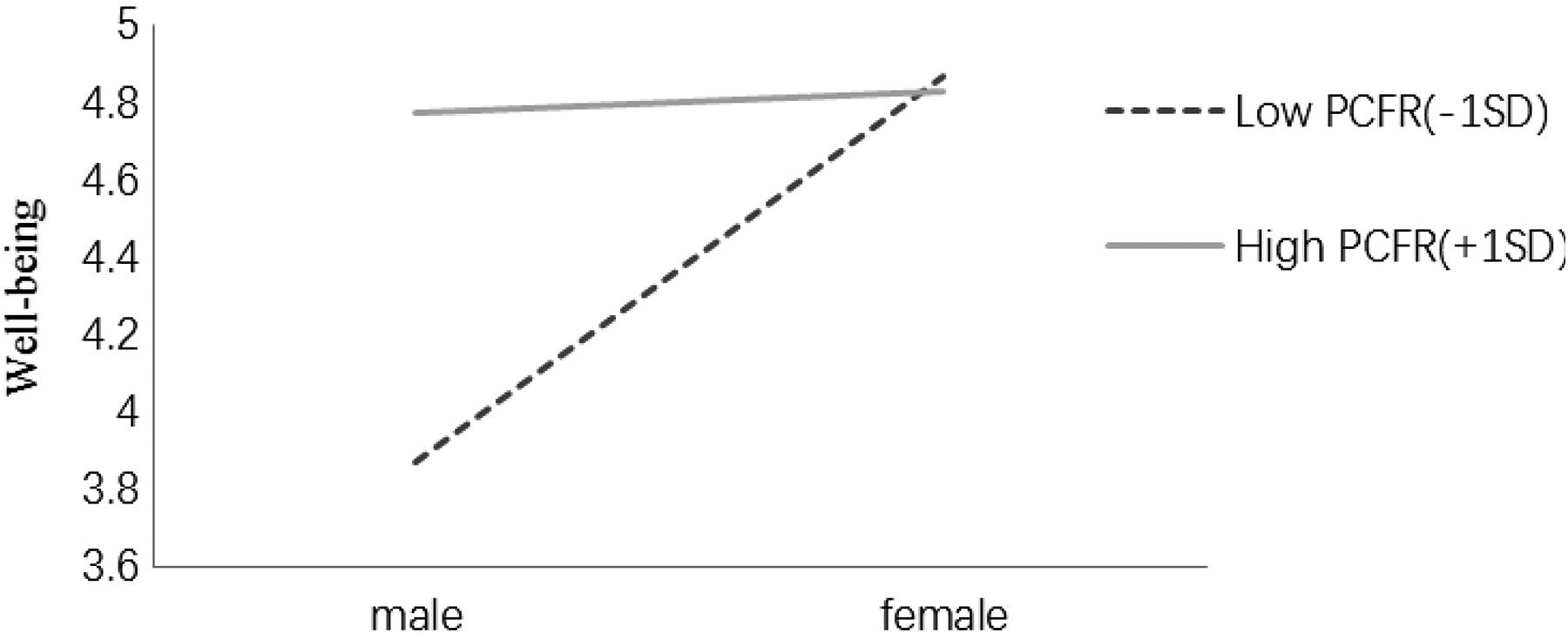
Sex difference in life satisfaction of parenthood. This figure depicts the life satisfaction score corresponding to −1SD and +1SD of perceived parent–child facial resemblance (PCFR) for both genders. The slope was significant for low PCFR but not high PCFR.
Discussion
In Study 2, the results further supported our hypothesis that fathers derive lower well-being than mothers from parenthood, which was in part influenced by the uncertainty of paternity. When perceiving higher levels of facial similarity with children, fathers experienced the same level of well-being as mothers. But when perceiving lower paternity likelihood, fathers would report much lower levels of well-being. These findings support the hypothesis of paternal uncertainty.
General Discussion
By analyzing the data from the sixth wave of the World Values Survey, we found that parents were happier than nonparents, and this effect was moderated by parental sex. Study 2 further explored how perceived parent–child facial resemblance moderated the relationship between parent sex and well-being. These results support the hypotheses of the revised pyramid of human needs and paternal uncertainty.
The Effect of Parenthood on Well-Being
There is no doubt that the process of parenting will be a mixture of joy and sadness and happiness and pain. The literature supports both increased and decreased well-being among parents compared to childless peers. On the one hand, because of the economic burden and the disturbance to normal life, parents can experience increased sadness and pain (Clark, Diener, Georgellis, & Lucas, 2008; Nomaguchi & Milkie, 2003). Longitudinal studies have demonstrated that parents’ well-being declines dramatically as early as several months after a new baby’s birth (Luhmann et al., 2012). However, when parents witness the things that children begin to prattle, become toddlers, and other developments and growth, they would derive high levels of well-being from parenthood (Nelson et al., 2014). As hypothesized by evolutionary psychology, parenting is at the top of the motivational pyramid. When this need is satisfied, the parents’ well-being increases (Kenrick et al., 2010; Lyubomirsky & Boehm, 2010). This notion was supported by the results of Nelson, Kushlev, English, Dunn, and Lyubomirsky’s (2013) study showing that parents experienced higher well-being than did nonparents.
Previous studies demonstrated that the well-being of motherhood did not differ from that of fatherhood, with some research even noting that mothers might derive lower well-being from parenthood than do fathers (Keizer et al., 2010; Nelson et al., 2013). However, the findings in the present study found the opposite. Children’s age may contribute to this discrepancy (Clark et al., 2008; Nelson et al., 2014; Twenge, Campbell, & Foster, 2003). According to the social role theory, when children are young and in need of care, mothers tend to undertake more care responsibilities and their jobs, and overall well-being may be therefore negatively affected (Budig & England, 2001). On the contrary, when fathers are taking care of the children, their responsibilities mainly focus on playing with their children in leisure time, and their jobs and overall well-being are hardly affected (Yeung, Sandberg, Davis-Kean, & Hofferth, 2001). Thus, compared with mothers, fathers may report more happiness and joy during parenthood (Nelson et al., 2013). However, once children are grown up and independent from the original family, mothers will be released from the burden of parenting, and their well-being could be increased accordingly (Umberson et al., 2010).
In addition, some longitudinal studies found that both parents’ well-being declined in 2–5 years after childbirth, which was attributed to the parents’ gradual adaption to the birth of a child (Dyrdal & Lucas, 2013; Luhmann et al., 2012). However, the past research on life course studies showed that parents, compared with childless adults, tended to derive more positive affect from parenthood when their children grow up (Umberson et al., 2010). It is possible that the childbirth may disturb their normal life rhythm and then reduce their social interaction and marriage quality, masking the effect of parenthood on well-being.
Due to inner fertilization and cohabitation, mothers are 100% sure of their genetic contribution to offspring (Gaulin & Schlegel, 1980). In contrast, men are faced with paternal uncertainty (Buss, 2014; Larsen & Buss, 2008). Thus, men would consciously and unconsciously seek various cues (e.g., perceived spouse fidelity, perceived father–child facial resemblance, and perceived father–child body odor resemblance) that suggest a genetic resemblance between father and child to enhance paternal certainty. Therefore, fathers should derive as high levels of well-being from parenthood as mothers when they perceive high paternal certainty. In contrast, when fathers perceive low paternal certainty, they would derive low levels of well-being from parenthood. Nevertheless, thanks to the high confidence of maternity, mothers would consistently derive a high level of well-being from motherhood (except for the early stage when their children are young).
These effect sizes were small in Study 1, and this limitation may relate to the heterogeneity of the respondents. Human behaviors were influenced not only by evolutionary mechanisms but also by social and cultural factors (Bertamini & Lyons, 2015; Shan et al., 2012; Yu et al., 2017). The difference in cultural or religious beliefs from different countries in the current sample from the World Values Survey database could, to some extent, account for the small effect size of the results.
The Measure of Parent–Child Facial Resemblance
In Study 2, we adaopted the self-reported method to measure parent–child facial resemblance. Previous studies have domentstrated that self-report measure has a relatively higher ecological validity (Apicella & Marlowe, 2004; Burch & Gallup, 2000). A father’s subjective perception rather than the objective fact that the child is similar or dissimilar to him actually influences his investment in the child-rearing and his attitude toward the family; forgiven that it can be influenced by social approval and social norms, the internal validity of self-rating may be not high (Alvergne et al., 2010). In addition, there were another two methods to assess parent–child facial resemblance: morphological method and third-party rating (Alvergne et al., 2009). Comparatively speaking, Morph synthesis has higher internal validity, which may manipulate the facial resemblance between the object and the participant to explore the causal link between the facial resemblance and the corresponding psychological and behavioral expressions. However, the facial stimulus is fictitious, and therefore the application of the results to real families and in society is limited (Alvergne et al., 2010; Platek, Burch, Panyavin, Wasserman, & Gallup, 2002; Platek et al., 2003, 2004). As a result, the ecological validity of Morph software synthesis is not high. Compared to the previous two measures, the third-party measure is moderate both in internal validity and ecological validity (Yu, Guo, et al., 2019; Yu et al., 2016). Therefore, further study might adopt empirical manipulation to enhance the internal validity when examining the psychological and behavioral mechanisms of parent–child facial resemblance.
The Controlling Variables
The results of Studies 1 2 indicated that SES and health status were important factors influencing well-being, which was consistent with the results of previous studies (Johnson & Krueger, 2006; Kok & Fredrickson, 2010; Pinquart & Sorensen, 2000; Thayer et al., 2009). However, the effects of age on parental well-being varied between Studies 1 and 2. In Study 1, parent age significantly predicted parents’ well-being, which was consistent with the results of previous studies (Nakazato & Shimonaka, 1989). However, the effect of parent age on well-being was not significant in Study 2. In order to explore the reason for this discrepancy, we analyzed a subdata of the World Values from China and found that the correlation between age and well-being was not significant (r = −.03, N = 1,314, p = .27). This result was consistent with the result of Study 2. We reasoned accordingly that the relationship between age and well-being might vary from culture to culture and was not significant in China. Additionally, the different measurements in these two studies might contribute to the inconsistency.
Limitations and Further Research
Although the results of the present studies supported our hypotheses, there were still some limitations. First, Study 1 simply defined the “nonparent” as adults without children. It is not clear whether the nonparents actively chose this lifestyle or passively accepted the lifestyle due to some objective reasons. If there are objective reasons behind their childless status, nonparents would be likely to report lower levels of well-being. Thus, further research on well-being related to parenthood could compare different nonparent types (actively vs. passively). Secondly, parenthood includes the birth of new babies, the growth and success of children, the marriage of offspring, and even the birth of grandchildren. Thus, it still awaits further exploration regarding the specific aspect of parenthood that contributes to the well-being of parents. Thirdly, the perceived parent–child facial resemblance is one of the many cues for assessing paternity. The spouse’s fidelity and the body odor resemblance between parents and offspring are two of the other cues. Further studies can verify and explore the findings in the present research with the other two cues of paternity. Fourthly, there are some other varibles that may moderate the sex difference in the effect of parenthood on parental well-being, for example, employment status and work hours of both parents (Nelson et al., 2014). Due to the fact that more fathers are full-time employed and typically spend less time with their children, they are on average less involved with their children, resulting in a lesser effect of parenthood on well-being. Thus, further study should control these variables while exploring the sex difference in the relationship between parenthood and well-being. Lastly, the present research employed a static correlational research paradigm, which could not establish a causal relationship. Therefore, future studies can adopt longitudinal methods or manipulated experiments to further explore the effects.
Conclusion
From the perspective of evolutionary psychology, the present research explored the sex difference in well-being due to parenthood. We found that adults with children were happier than those without. Furthermore, the effect of parenthood on well-being in the mother group was stronger than the father group. Further exploration found that the perceived parent–child facial resemblance moderates the relationship between parental sex and the well-being of parents derived from parenthood. These results supported the hypotheses of the hierarchical theory of needs, which notes that parenting is at the top of the motivational pyramid. Further, these results provided evidence for the hypothesis of paternal uncertainty.
Footnotes
Declaration of Conflicting Interests
The author(s) declared no potential conflicts of interest with respect to the research, authorship, and/or publication of this article.
Funding
The author(s) disclosed receipt of the following financial support for the research, authorship, and/or publication of this article: This research was supported by a grant from the National Social Science Youth Project of China (15CSHO55), a grant from the National Social Science General Project of China (16BSH098), a grant from Fundamental Research Funds for the Central Universities (CCNU18XJ045), a grant from the Research Program Funds of the Collaborative Innovation Center of Assessment toward Basic Education Quality (2019-04-020BZPK01), a grand from the Research Program Funds of the Collaborative Innovation Center of Assessment toward Basic Education Quality (2018-04-013-BZPK01) and a grant from the self-determined research funds of CCNU from the colleges’ basic research and operation of MOE (CCNU19TD018).
