



Abstract
Sex differences in reaction to a romantic partner's infidelity are well documented and are hypothesized to be attributable to sex-specific jealousy mechanisms which are utilized to solve adaptive problems associated with risk of extra-pair copulation. Males, because of the risk of cuckoldry become more upset by sexual infidelity, while females, because of loss of resources and biparental investment tend to become more distressed by emotional infidelity. However, the degree to which these sex-specific reactions to jealousy interact with cues to kin are completely unknown. Here we investigated the interaction of facial resemblance with decisions about sex-specific jealousy scenarios. Fifty nine volunteers were asked to imagine that two different people (represented by facial composites) informed them about their romantic partner's sexual or emotional infidelity. Consistent with previous research, males ranked sexual infidelity scenarios as most upsetting and females ranked emotional infidelity scenarios most upsetting. However, when information about the infidelity was provided by a face that resembled the subject, sex-specific reactions to jealousy were exaggerated. This finding highlights the use of facial resemblance as a putative self-referent phenotypic matching cue that impacts trusting behavior in sexual contexts.
Introduction
Sex-specific reactions to jealousy are well-understood (Buss, Larsen. Westen, and Semmelroth, 1992; Buss and Shackelford, 1997; Shackelford, LeBlanc, and Drass, 2000; Teisman, 1975; Shettel-Neuber, Bryson and Young, 1978) and hypothesized to have evolved as a consequence of sex-specific optimal mating strategies and to deal with risks of extra-pair mating (Platek and Shackelford, 2006). That is, because of extra-pair paternity, which is estimated at between 2–30% in modern human populations (Anderson, 2006; Baker and Bellis, 1995; Bellis et al., 2006; Cerda-Flores, Barton, Marty-Gonzales, Rivas and Chakbroty, 1999; Neale, Neale, and Sullivan, 2002; Sasse, Muller, Chakbroty, and Ott 1994; Sykes and Irven, 2000; see also American Association of Blood Banks Report, 1999), males are hypothesized to have developed cognitive-emotional vigilance mechanisms that take the form of sexual jealousy and motivate such behaviors as mate guarding, violence, and monitoring/stalking. Jealousy is a leading cause of female-directed intimate partner abuse, rape, and homicide (Daly and Wilson, 1988; Shackelford and Goetz, 2006). Approximately 1.5 million women are raped or physically assaulted by an intimate partner each year in the United States and 8% of women report having been stalked by an intimate partner at some point in their lives (Tjaden and Thoennes, 1998a; 1998b).
On the other hand, females have greater need for biparental effort in order to adaptively raise highly altricial human offspring and are therefore hypothesized to have developed psychological mechanisms to deal with loss of partner attachment expressed as emotional jealousy. Townsend (1995) revealed that females place a higher importance on emotional investment in relationships than men and that indiscriminate sexual activity created more anxiety and distress in women, regardless of their self-reported liberal views on uncommitted sexual activity.
Parallels to this sex difference can be seen in non-human organisms as well. For example, male baboons tend to invest more in offspring that they presumably have more confidence that they sired (Buchan et al., 2003). Females of species that typically employ biparental care, abandon offspring in the absence of a male partner (Beissinger 1990; Kelly and Kennedy 1993; Szekely, Webb, Houston and McNamara, 1996). Similar examples of social, but not sexual, monogamy are found in species of fish (Whiteman and Cote, 2004), birds (Barash and Lipton, 2001; Reichard, 2002, 2003), and other mammals (Barash and Lipton, 2001; Reichard, 2002, 2003).
The autonomic (Buss et al., 1992) and central nervous system (Rilling et al., 2004; Takahashi et al., 2006) correlates of jealousy suggest that the sex difference is derived from sex-specific selection on substrates which are still unknown. A complete understanding of sex differences in jealousy at the cognitive/psychological (Schützwohl, 2004; Schützwohl and Koch, 2004; Schützwohl, 2005; Schützwohl, 2006; Thomson et al., unpublished data), psychophysiological (Buss et al., 1992), and neural (Takahashi et al., 2006; Thomson et al., unpublished data) levels will lend to a better understanding of many behavioral phenomena (e.g., sperm competition and prudent sperm allocation, intimate partner violence, etc.).
Jealousy evoking information can be learned in two ways: 1) observation/discovery (e.g., confirmation of suspicion) of an act of infidelity that creates jealousy or 2) communication about infidelity via a social group member. When observation/discovery occurs the resulting behavior is largely predictable (e.g., aggression, abandonment; e.g., Gage, 2005), however, communication via a social group member is likely and the source of the information can determine level of trust in that information (Barr 2004; Debruine 2002), thus moderating the likelihood of subsequent behavioral outcomes (e.g., aggression, stalking, etc.). Here we investigated the role of facial resemblance, as a putative cue to kinship (Debruine, 2002; Platek et al., 2002, 2003, 2004, 2005; Volk and Quinsey, 2007), in communication about a romantic partner's infidelity.
Methods
Subjects
Fifty-nine undergraduates (M age = 19.8, SD = 2.5; 21 males) from a Northeastern US University volunteered and received course extra credit for participation.
Face Stimuli
Participants' pictures were taken (prior to the entire session) using a four megapixel digital camera (Canon) and were morphed with one other face (Ulead Morph Editor, V. 1) with a randomly selected, age and sex matched facial image from the CAL/PAL Face Database (Minear and Park, 2004). They were told that their picture may or may not appear in the session. For the non-self-resemblance trials morphed composites of faces from the database were used. Participants were debriefed about the morphing procedure at the completion of their participation.
Procedure
In order to investigate the role of kin-based information source reactions to jealousy-provoking scenarios we created computerized facial composites (see e.g., Platek et al., 2005) of research participants and asked them to rank order two jealousy evoking scenarios when each was presented by a self-resembling face and a non-self-resembling face. Total number of trials was four: self-resembling and sexual infidelity, self-resembling and emotional infidelity, non-self-resembling and sexual infidelity, and non-self-resembling and emotional infidelity. Each face plus infidelity scenario was presented individually and randomly for purposes of visualization. In other words, participants were informed by a face that either resembled or did not about a putative infidelity on the part of their romantic partner. After seeing each of the four conditions the subjects were shown the four conditions at once and asked to make their rankings (see Fig. 1).
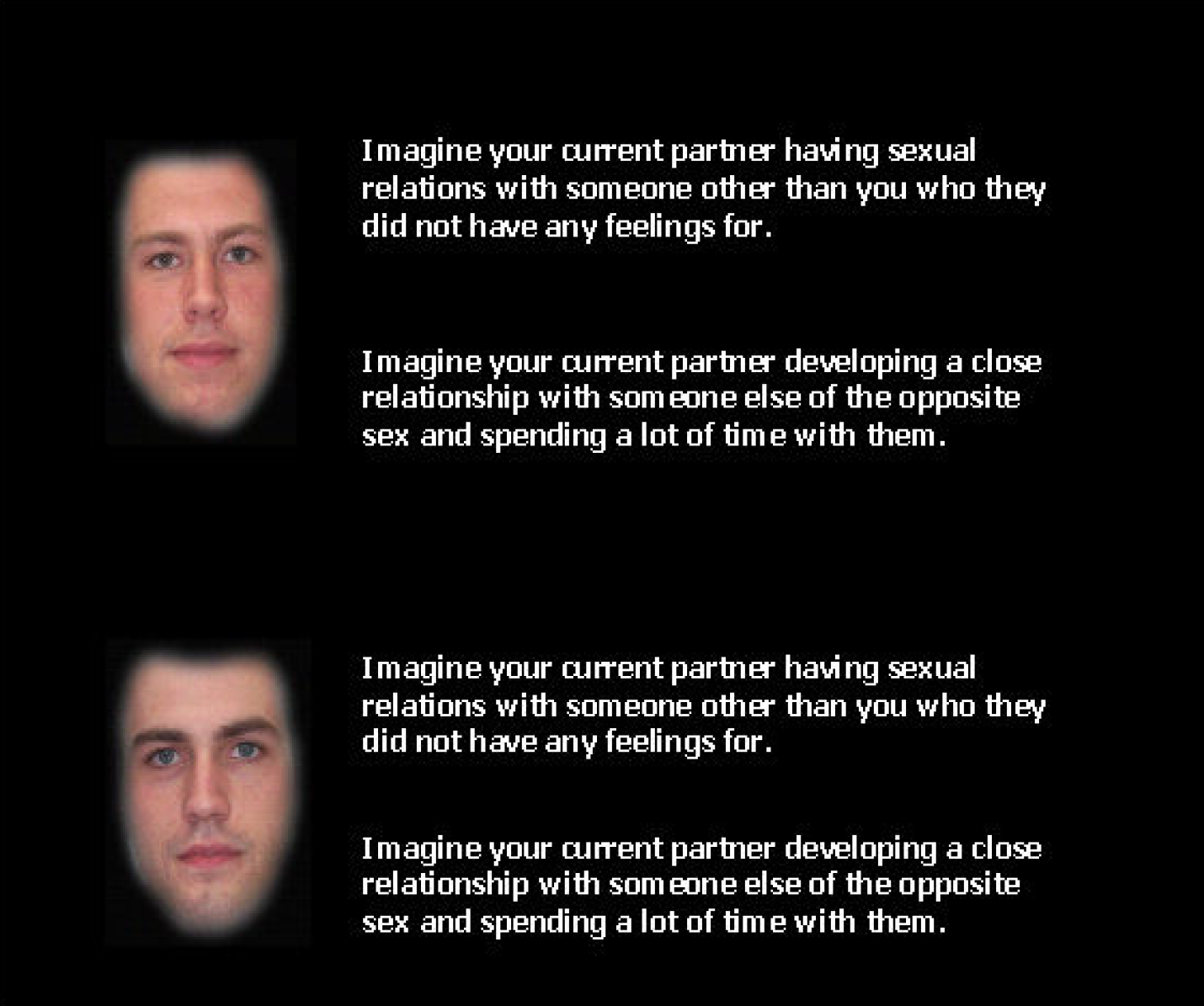
Participants were asked to rank order the four conditions (self-resembling sexual infidelity, self-resembling emotional infidelity, non-self-resembling sexual infidelity, and non-self-resembling emotional infidelity) on the basis of which would be most upsetting. Subjects were instructed to imagine that the face presented provided them with the infidelity information and then were asked to rank order each scenario from most to least distressing. Each condition was presented individually for visualization. Participations took approximately five minutes.
Results
Consistent with previous research, males ranked scenarios dealing with sexual infidelity as more upsetting than scenarios dealing with emotional infidelity and females showed an opposite pattern. Interestingly, facial resemblance exaggerated participants' degree of upset to sex-specific jealousy invoking scenarios. Males (p < .05, Fisher's exact probabilities test), but not females (p = .128, Fisher's exact probabilities test) ranked sexual infidelity scenario presented by a self-resembling face highest in level of distress more often then would be expected by chance. The opposite pattern was observed for females who ranked the emotional infidelity scenario presented by a self-resembling face as most distressing (p <.01, Fisher's exact probabilities test; males p = .367). In fact, no males ranked the sexual infidelity presented by self-resembling face last (p < .01, binomial test) and only two females ranked the emotional infidelity presented by self-resembling face last (p <.01; see Figure 2 and Table 1).

Percent (+/− 95% CI) of participants (by sex) that selected each category of face by jealousy information as a function of rank position.
Rank order statistics by condition. Yellow boxes indicate highest ranking. Blue boxes indicate lowest ranking.

There was also a sex difference in ranking the face x infidelity conditions. Males ranked sexual infidelity presented by self-resembling face as more upsetting than females (Mann-Whitney U = 284.5, p < .05) and females ranked emotional infidelity presented by a non-self-resembling face as more upsetting than males (Mann-Whitney U = 268.5, p <.05). When contrasts were computed within sex using a Friedman's non-parametric statistic effects were only found for males. Males ranked sexual infidelity presented by a self-resembling face and presented by a non-self-resembling face as first or second more often (p <.001), whereas females revealed no within sex ranking preference. A comparison of specific conditions revealed that males ranked sexual infidelity with and without self-resemblance as the source more upsetting than emotional infidelity overall. In other words, males were most upset when someone who resembled them told them about their partner's infidelity.
Discussion
These are the first findings to demonstrate an interaction between two proposed evolved cognitive adaptations – jealousy as a response to intimate partner extra-pair mating and utilization of facial resemblance as a cue to kin. Perception of facial resemblance, even at unperceivable levels, activates medial prefrontal cortical substrates and anterior cingulate cortex (Platek et al., 2004, 2005) and so too does attentional processing (Passingham, 2000). Previous work from our group (Thomson et al, unpublished data) showed that males' attentional resource load (i.e. the capacity to attend to an item(s)) was hijacked (i.e. overtaken) by cueing to sexual infidelity. These findings suggest that infidelity-based attentional resource hijacking might interact neurally with perceptions of kin to enable cognitive mechanisms dedicated to making trust/don't trust discriminations as a function of kin selection (Debruine 2002). There are several unanswered questions from this research. For example, does familiarity and reputation impact sex-specific jealousy-based decision-making? Also, to what extent does kin rivalry and recognition interact with respect to these effects? Is there a matrilineal/patrilineal bias? Is information provided by particular kin weighted more/less heavily? Does this vary with social and sexual context? These are all interesting, but yet unanswered questions that are currently under investigation in our laboratories.
In conclusion, the findings reported here suggest that kin recognition increases trust in information about an intimate partner's putative infidelity, particularly in males when attending to sexual infidelity cues.
Footnotes
Acknowledgements:
The authors thank Todd Shackelford, Shilpa Patel, and Sarah Levin for helpful comments on this work.