



Abstract
We have studied gift giving at Christmas among 50 graduate students in Norway. The students invested more the closer the coefficient of relatedness. However, partners ranked highest, which is natural for people at the start of their reproductive career. All students gave to their parents, siblings, and children, most gave to their grandparents, and only a third gave to some, but not all, of their genetic aunts/uncles. Twenty percent gave to first cousins, and none to second or third cousins. Similar patterns for gifts received were found. There were also sex differences (e.g. women had larger exchange networks than men), and birth order effects. Firstborns spent more on relatives than laterborns. However, middleborns gave more to their male friends than both firstborns and lastborns. We conclude that the results are consistent with theories of kin selection, reciprocity, sex differences and birth order effects.
Introduction
Gift giving is a central aspect of human behavior and culture (Carrier, 1995; Cheal, 1988; Davis, 1992, Essock-Vitale and McGuire, 1980; Lévi-Strauss, 1969; Mauss, 1950/1990) and may be classified as a human universal (Brown, 1991; Fox, 1980; Murdock, 1945). The human tendency to reciprocate a gift may be classified as a “human instinct” (Ridley, 1996, p. 121). The importance of a gift is usually not the transfer of an object in itself, but the social aspect, especially in terms of obligations, namely to give, to receive, and to reciprocate (Mauss, 1950/1990).
In the old Norwegian Gulating law and other old Germanic law it was actually stated that a gift should be valued with an equal gift in return (Hamre, 1960). In the old Scandinavian civilization, as well as in a number of others, exchanges and contracts take place in the form of presents which are voluntary in theory, but are given and reciprocated obligatory in reality (Mauss, 1950/1990). The notion of reciprocity seems to be a central aspect of gift giving among humans in all cultures (e.g. Cheal, 1986; Davis, 1972; Hamre, 1960; Lévi-Strauss, 1969; Mauss, 1950/1990; Sahlins, 1965, cited by Alexander 1975). Reciprocal giving of gifts is also a marked feature of the Christmas festivities in England (Lowes et al., 1971), the United States (Caplow, 1984) and Canada (Cheal, 1986).
Although some repayment is expected for any gift, it is crucial that it be deferred. To reciprocate at once indicates a desire to end the relationship, whereas delayed payment makes the strings between giver and receiver longer and stronger (Mauss, 1950/1990). Note that Christmas gifts represent an exception in this regard because the gifts given and received are expected to be exchanged simultaneously (Cheal, 1988; Davis, 1992). In addition, it is typical that Christmas gifts are distributed at gatherings where every person gives and receives gifts (Caplow, 1984).
Alexander (1975) analyzed Sahlins' (1965, cited by Alexander 1975) review of the anthropological social-exchange literature and noted that the review supported general expectations of the theories of kin selection (Hamilton, 1964) and reciprocal altruism (reciprocity) (Trivers, 1971). Essock-Vitale and McGuire (1980) reviewed the anthropological exchange literature in light of these two evolutionary theories. Five predictions were all supported in most studies reviewed. 1. Kin will be given more unreciprocated help than non-kin, with close kin receiving the most unreciprocated help. 2. Kin will be given more help than non-kin, with close kin receiving the most help. 3. Friendships will be reciprocal. 4. Large gifts and long-term loans are most likely to come from kin. 5. Individuals requiring unreciprocated help over long periods of time will gradually be abandoned by their former helpers. Even though Essock-Vitale and McGuire (1980) discussed the broader aspect of helping behavior, gift-giving behavior was a central part of their focus. But most of the data they reviewed was qualitative rather than quantitative. We wanted to extend the quantitative part of the data base on gift-giving behavior and focus on the first four of their five predictions.
A partner is the prerequisite for successful reproduction. We therefore tested if partners were given the most expensive gifts. We also asked if having a partner would affect the gift-giving behavior relative to single individuals. We also studied if there were any sex differences in gift-giving behavior. Because women are the most investing sex in the offspring with larger need for all kinds of support and protection for themselves and their offspring (Judge, 1995; Judge and Hrdy, 1992), they may have a larger network of persons they exchange gifts with than men.
Finally, we asked if there were any birth-order effects (Davis, 1997; Hertwig, Davis, and Sulloway, 2002; Paulhus, Trapnell and Chen, 1999; Rohde et.al., 2003; Salmon, 1998, 1999; Salmon and Daly, 1998; Sulloway, 1996, 2001) in gift giving. Sulloway (1996) documented substantive birth-order effects for several personality traits, and we wanted to test if functional firstborns (hereafter firstborns) differed from functional laterborns (hereafter laterborns) when concerning investment in their relatives. Since for example firstborns identify more strongly with parents and with authority, we expected that they might invest more in their close relatives than laterborns. Several studies have found that middleborns are distinct from first- and lastborns (Kennedy, 1989; Kidwell, 1982; Rohde et al., 2003; Salmon, 1998; Salmon and Daly, 1998; Sulloway, 1996), for example middleborns were less likely to indicate having a close relationship with their parents (Kennedy, 1989). We wanted to test if middleborns invested less in their close relatives than first- and lastborns or in other ways had different gift-giving behavior at Christmas.
Methods
Fifty graduate students out of a possible 338 at Department of Biology, University of Oslo in Norway were interviewed during January 7–20 1998 about their gift behavior before and at Christmas 1997. The inclusion criteria was 1) Christian background, and 2) not entered paid work. The interviews were conducted by two of us (IM and TD), 25 each. Twenty-five males and 25 females were interviewed in private for 30–60 minutes, depending on how many people each of them had given gifts to. We did not inform about the theoretical background for the study but stressed that all answers were confidential.
We first asked about age, birth order (including number of brothers and sisters, number of year between them as firstborn and the next brother or sister or as later born and the elder brother or sister next to them), address, civil status (married/co-inhabitant, with or without girl/boyfriend), how long they had been together with their partner, if their parents were married or divorced, and if divorced, when that happened, and if their parents had new partners. We also asked why they give presents at Christmas. We then asked about each person they had given a gift to: sex, age, the student's relation to them, birth-order parameters (see above), address, occupation and if they were working, how often he/she talked and met them, if they subjectively felt that the person in question lived far away, how much time it usually took to visit them, when they bought/made the gift, what was given, the price of it, if they bought/made the gift themselves, how many people shared the expenses on the gift, what was received, price of what was received, and how many people gave the received gift. Then we noted possible relatives (aunts, uncles, first cousins, nieces, nephews aso.) they did not give anything to, and why nothing was given. We also asked if they had received anything from persons they did not return a gift to and noted the student's relation to them and what was given. We asked if they had any relatives they did not get anything from. Finally we asked what kind of “gift philosophy” they used among six alternatives, or if they used other principles. The least relevant data are omitted from this paper.
The students were generally positive to and interested in the project. It was our impression that they answered honestly and in most cases remembered well who they had given to, what they had given and the price of it, and what they had received. They had more difficulty with the price of what they had received. In many instances they had no idea about it, which is as expected with a norm of not asking about the price of a gift received.
Characteristics of the study population
The students' age lay between 23 and 31 years with a mean age of 26.0 years (SD = 1.8); 26.0 years (SD = 2.1) for women and 26.1 years (SD = 1.6) for men. There were 28 firstborns and 22 laterborns in the sample (12 firstborn men, 16 firstborn women, 13 laterborn men, and 9 laterborn women). Mean age of these four categories was 26.0 (SD = .9), 25.8 (SD = 1.9), 26.2 (SD = 2.1) and 26.0 (SD = 2.6), respectively. The laterborns consisted of 9 middleborns and 13 lastborns (5 middleborn men, 4 middleborn women, 8 lastborn men, 5 lastborn women), with mean ages 26.8 (SD = 2.2), 27.8 (SD = 3.0), 25.9 (SD = 2.1), and 25.2 (SD = 1.3), respectively. Thus, for both sexes, first- and laterborns, and first-, middle-, and laterborns, the ages were similar and the group pretty homogenous. Age of student was positively correlated with father's age (p = .01), but not with mother's age (p = .34). Firstborns had younger mothers, but not younger fathers, than laterborns (p < .001 and p = .12, respectively). Firstborns and laterborns did not differ in how old their grandparents were (p = .19). There was no association between the grandparents' age and the students' age (p = .22).
Forty-two of the students had parents who were still married, five had divorced parents, and the parents of three students were widows/widowers. Forty-eight had genetic uncles and/or aunts, and 38 had grandparents alive. Five students were married, 16 were living together without being married, 12 had a girl/boyfriend, 16 had no girl/boyfriend at the moment and one was in the “other” category (no longer cohabiting, child from prior cohabitation). The latter was excluded from the variable civil status in the statistical analyses. If one focuses on the period of time the students had been married, been living together or had a girl/boyfriend, the mean duration was 4.3 years (SD = 2.1; n = 25 available for analysis). The students gave to a mean of 2.2 friends (SD = 2.7).
Coding of data and statistical analyses
When coding for functional birth order sensu Sulloway (1996) and Salmon and Daly (1998), one laterborn twin was coded as lastborn (the pair of twins was lastborn with one older sibling) and only children (two men, one woman) were coded as firstborn. To test for linear effects, firstborns were coded as 1, middleborns as 2, and lastborns as 3, and to test for quadratic effects, these three birth orders were coded as -1, 2, and −1, respectively.
The statistical analyses were done by means of the program S-PLUS version 4.5, using standard tests such as paired t-test, ANOVA and Pearson regression analysis. For all regressions and ANOVAs, the assumptions of the models were checked (homogeneity of variance by means of residual plots, normality of the data by means of QQ-plots) and logtransformation (ln) of the variables performed if necessary. For imbalanced data sets, adjusted means are presented (instead of means). For the logistic regression analyses, the validity of the conclusions was checked by looking at the residual deviance, testing for overdispersion and using dispersion test. To save space, we mostly report only the p-values (alpha significance level of 0.5).
Results
All students gave and received gifts. They gave gifts to a total of 550 persons (M: 11.1, SE = .8), what we have termed “gift-giving relations”, and received gifts from a total of 537 persons (mean: 10.7, SE = .8), what we have termed “gift-receiving relations”. These numbers did not differ (p = .42). The students gave a total of 719 gifts (mean: 14.4, SD = 1.1) and received 616 gifts (mean: 12.3, SE = 1.0), and so they gave more than they received (p < .01). The total number of gifts given by a student was highly correlated with the total number of gifts received (p < .001). The average student spent NOK 1501 (SE = 112) (approximately $190) in total for Christmas gifts (self-made gifts excluded). Excluding self-made gifts, and cases where we did not know the price, the average student spent NOK 173 (SE = 11) per gift-giving relation.
Relatives and partners
All students of both sexes gave gifts to their closest family (to all mothers, fathers, brothers, sisters and children). They also received gifts from at least one parent and own children above a certain age. Thirty-two of 38 gave to their grandparents (Table 1), and 32 also received gifts from at least one of them. Forty-five of 46 received gifts from at least one of their siblings.
Number of men, women and all students who gave gifts to their grandparents out of number who could have given. The upper part shows how many of the students who gave to grandparents on mother's and father's side,1 the middle part sees the grandparents together while the lower part shows how many gave to all or 50% of their grandparents.
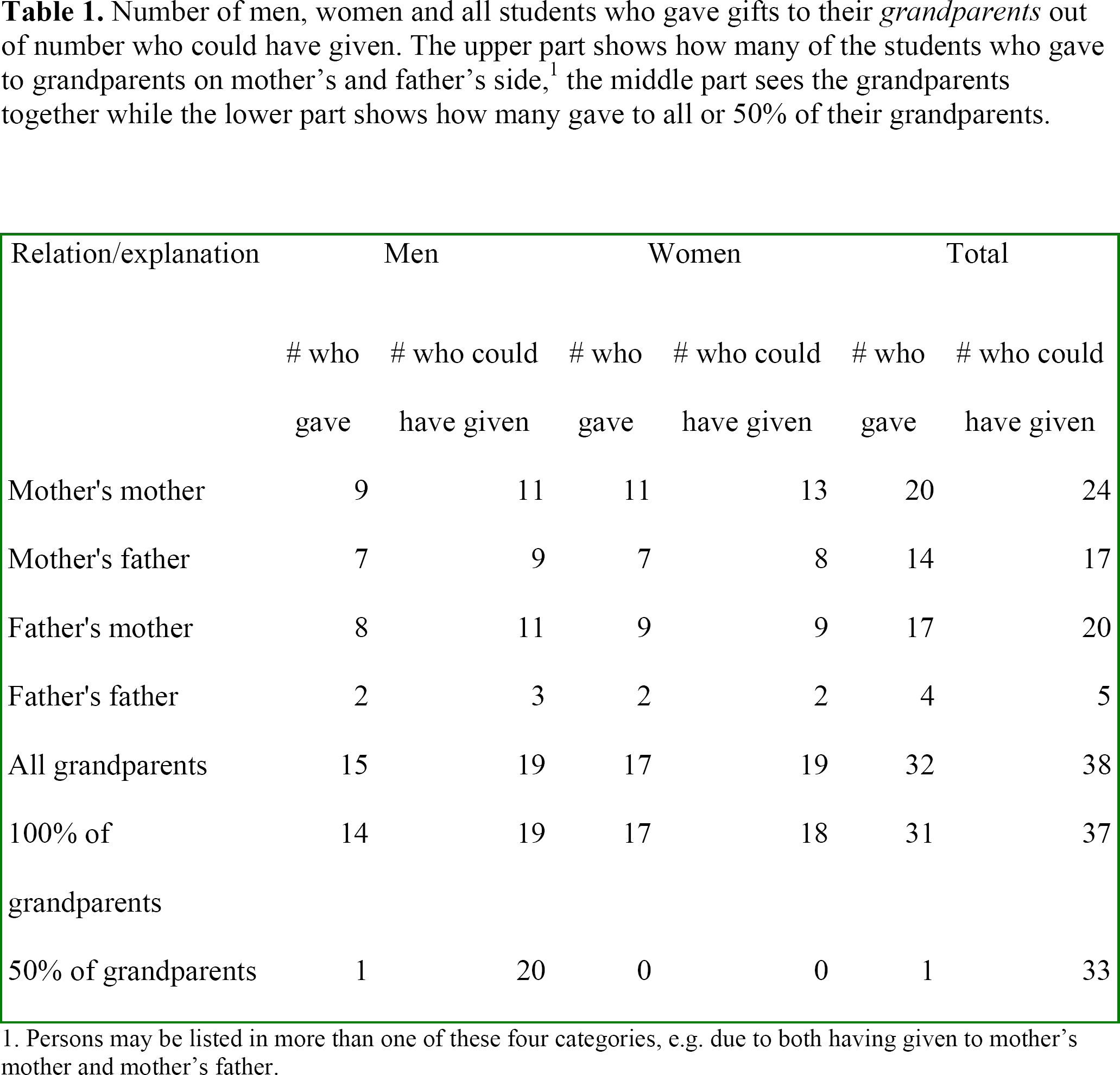
Persons may be listed in more than one of these four categories, e.g. due to both having given to mother's mother and mother's father.
Twenty-one of the students gave gifts to at least one of their uncles and/or aunts, while 22 received gifts from at least one. Out of 48 who had first cousins, only 10 students gave to one or more of them, and nine received gifts from one or more.
Of 27 students who received one or more gifts (mean 2.4), with a value above NOK 544 (mean value for all), 22 got it from their parents, four from their siblings, and five from their grandparents. Of non-kin, partners were on top with eight students receiving such gifts. Note that a student may be counted in more than one category.
In terms of money spent, the students gave significantly more to partners than to each of the other categories (all p < .01), relatively equally to their parents and siblings, and an equal, but less, amount to people in each of the other categories (Figure 1). They tended to give slightly more to parents than siblings (p = .08), and more to parents than to grandparents, genetic uncles/aunts, first cousins, friends, other family and “others” (all p < .02). The students also gave more to siblings than to grandparents, genetic uncles/aunts, friends, other family and “others” (p < .007). They also spent more money on friends than on people in category “others” (p = .005).

Mean (+SE) amount of money spent on gifts to people in the relation categories. Sample sizes are indicated above bars.
No correlation existed between the mean value of money spent on gifts to parents, siblings, grandparents, genetic uncles/aunts, first cousins, and nephews/nieces, and their respective coefficients of relatedness with these relatives (p = .69). However, organizing the data with all data points for giving to each of these six categories as one response variable, a regression with coefficient of relatedness as predictor was highly significant (p < .001; log-transformed response variable): the larger coefficient of relatedness (r), the more money was spent on gifts. To see if each person invested in each of these same six categories in proportion to degree of relatedness, we added number of persons the students could have given to when estimating mean values (which only affected gifts to grandparents, genetic uncles/aunts, and first cousins) (Figure 2). Roughly, students invested twice as much in parents and siblings (r = .5) as in grandparents and nephews/nieces (r = .25), but much less in genetic uncles/aunts. In first cousins (r = .125), they invested equally little as in genetic uncles/aunts. The correlation between the means for each category and the coefficient of relatedness was fairly high (p < .02).

Mean (+SE) amount of money spent on gifts to people in the relation categories when number of persons each could have given to, but did not give to, is included. Sample sizes are indicated above bars.
More money was spent on gifts to mothers the closer she lived (p = .01), and the more often a student talked with her (p < .05), although the latter relationship was no longer significant when controlling for distance (p = .14). If we combine birth order, civil status, how often a student talked to the mother, and distance to where she lived in the same model, there was no significant interaction between the four factors. Using type III Sum of Squares, distance to where mother lived did not add to the model. Removing this variable, there were significant effects of birth order (p = .01), civil status (p < .01), and frequency of talking (p < .01). We found no association between mean amount of money given to mothers and fathers and the mean age of the mothers and fathers (p = .69 and p = .43, respectively, log-transformed response variables). Likewise, money spent on grandparents was unrelated to the mean age of grandparents (p = .87; log-transformed response variable). When controlling for number of brothers, the students' age could explain a significant proportion of the variance on how much was spent on gifts to brothers (p < .03): the older the student, the less was given to brothers.
Many students did not give gifts to “half near” family (i.e. grandparents, aunts and uncles or first cousins), and we asked them why. Twenty-two of the 50 students answered that it was due to sparse contact, 18 answered that it was due to tradition or convention in the family of not doing so, and nine replied that they could not afford it or that it would be too many to give to. Only two gave to all first cousins, aunts, uncles and so forth. Note that most of the persons the students referred to as “half near” family were first cousins, and that the students were allowed to give more than one score.
The more often the students talked with their female friends, the more was spent on gifts to them (p = .02). This was also nearly significant when controlling for number of female friends given to (p = .06).
Civil status
There was a significant correlation between number of gift-giving relations and civil status (p = .002): married/cohabiting students had more gift-giving relations than unmarried ones without partner, and the latter had fewer gift-giving relations than unmarried ones with partner. This held also true when excluding friends from the analysis (p < .001). Focusing on number of friends given to, there was no effect of civil status. There was no interaction between sex of giver and civil status on number of gift-giving relations, but significant main effects for both (sex: p < .001; civil status: p < .01; type III sum of squares). Similarly, there was a significant correlation between (log-transformed) number of gift-receiving relations and civil status (p < .001): married/cohabiting and unmarried with partner both had more gift-receiving relations than unmarried ones without partner (adjusted means of 12.8, 11.7, and 6.6, respectively). There was no interaction between sex of giver and civil status, but there were significant main effects for both (sex: p < .001; civil status: p < .001; type III sum of squares).
Married/cohabitant gave more gifts than unmarried with and without partner (adjusted means of 17.8, 13.7, and 9.3, respectively; p = .001). Similar results were found for gifts received (adjusted means of 14.6, 12.6, and 8.1, respectively; p = .002). Similarly, married/cohabitant spent more money than unmarried with partner, who again spent more than unmarried without partner (adjusted means of NOK 1729, 1608, and 1073, respectively; p < .02). However, when controlling for number of gift-giving relations the effect of civil status was no longer significant (p = .33).
Married/cohabitant gave gifts worth more to their partner than unmarried with partner (adjusted means of NOK 742 and 461, respectively; p = .01). However, married/cohabitant students spent less money on gifs to their mothers than both unmarried with and without partner (adjusted means of NOK 183, 225, and 293, respectively; p = .01).
Sex differences
Women had more gift-giving relations than men (modal numbers of 13 and 8, respectively; p < .001). When excluding friends from the analysis, no statistical association with sex of giver was found. Women gave to many more friends than men (mean number of 3.9 and 0.6, respectively; p < .001). There was no correlation between how many non-friends the students gave to (mainly own and partner's family) and number of friends they gave to (p = .39)
Women had also more gift-receiving relations than men (modal numbers of 13 and 8, respectively; p < .001). When excluding friends from the analysis, a tendency for women to receive gifts from more persons than men still existed (mean values of 9.1 and 6.8, respectively; p < .06). Men hardly ever received gifts from friends (mean value of 0.3 for men and 3.2 for women; p < .001). Similarly, women gave more gifts than men (mean values of 18.5 and 10.2, respectively; p < .001), and received more gifts (mean values of 16.5 and 8.1, respectively; p < .001).
Women spent more on gifts than men (mean values of NOK 1859 and 1143, respectively; p < .001). Number of gift-giving relations (excluding relations which only were given a self-made gift or where the price was unknown) was correlated with money spent in total (p < .001). Controlling for this factor revealed that the sex link was still present (p = .05). Sex of giver could not explain the variation in any of the relation categories, with the exception of partners: there was a tendency for women to give more than men to partners (adjusted means of NOK 707 and 515, respectively; p = .09), which was significant if an outlier was removed (p < .05).
Controlling for number of sisters, the only factors that explained how much was spent on gifts to sisters were sex of giver, age and their interaction (number of sisters: p = .44; sex: p = .04; age: p < .01; and sex*age: p = .03; log-transformed response variable, type III Sum of Squares). The older the student, the less was spent on gifts to sisters, but below age 25, men spent more than women, while above this age, women spent more than men. Women both talked to and met their sisters more often than did men (p < .01 and p < .001, respectively), even when controlling for age (p < .01 for both).
We classified a response variable for students who bought/made all gifts themselves (n = 20) versus students who had someone else buy/make at least one of the gifts (n = 30). One-way logistic regressions revealed no influence of sex or age of giver. Logistic regression of the giftmakers (8) and non-giftmakers (42) showed that sex of giver, but not age or birth order (linear and quadratic), could explain this habit (p < .001). All eight giftmakers were women. Five of them gave at least one such gift to a friend.
Birth order
Firstborns spent more than laterborns per gift-giving relation (adjusted means of NOK 188 and 154, respectively; p = .05). In general, firstborns gave more to their parents and grandparents than laterborns (Figure 3; p < .01 for both). The statistical tests were done on log-transformed response variables, but Figure 3 shows the untransformed ones. Firstborns gave much more to their mothers than laterborns (adjusted means of NOK 267 and 177, respectively; p = .03), and also more to fathers (adjusted means of NOK 269 and 153, respectively; p = .005). Money spent on fathers correlated with distance to where the father was living (p = .04). However, combining distance and birth order in the same model, there was no interaction and distance to father's home added little (distance: p < .10, birth order: p = .01; type III Sum of Squares).

Adjusted mean amount (+SE) of money spent on gifts to parents and grandparents by birth order. Sample sizes are indicated above the bars.
We tested if birth order influenced how often the students talked to and met their closest relatives. Almost significant quadratic effects for how often they met mothers (p < .06) and fathers (p = .08; log-transformed response variables) were found. Firstborns had more such contact with their fathers than lastborns (adjusted means of 3.05 and 2.71, respectively), but lastborns had more contact with their mothers than firstborns (adjusted means of 3.42 and 3.05, respectively). Middleborns met their mothers and fathers least often (adjusted means of 2.36 and 2.33, respectively). We therefore tested if the linear birth-order effects found for how much was spent on gifts to mothers and fathers were still present when controlling for how often the students met their parents. The effects were still present (p = .01 for both tests).
Linear effects of how often the students talked with their sisters were found (p < .01; log-transformed response variable): laterborns talked more often with their sisters than firstborns, even when controlling for number of sisters (p = .01). For how much was given to siblings, only near-significant quadratic birth-order effects were found (p = .06). However, the more siblings the students had, the less money was spent on gifts to each of them (p < .01), and when controlling for number of siblings, quadratic birth-order effects disappeared (p = .64). Controlling for number of brothers, firstborns gave more to brothers than laterborns (p = .02). There was also a quadratic birth-order effect (p < .05), but it was not quite significant when controlling for number of brothers (p = .08). Combining birth order (linear) and age in the same model, there was no interaction, and age was most important for money spent on gifts to brothers (age: p < .04; birth order: p < .07; type III Sum of Squares). Firstborns received gifts of higher value from their brothers than did lastborns, who in turn received more than middleborns (adjusted means of 5.65, 5.23, and 4.73, respectively; p = .04; log-transformed response variable). With exception of this finding, we found no significant birth order effects on how much was received from the various groups of relatives.
In logistic regressions, we considered people who had aunts and a yes-no to if they gave to at least one of them, as response variable. We then performed one-way analyses with several predictor variables. Only birth order was significant; more firstborns than laterborns gave to aunts (p < .01). No such relationship held for uncles. When controlling for number of male friends given to, middleborns gave for more to each of their male friends than both firstborns (adjusted means of 5.52 and 4.21, respectively) and lastborns (adjusted mean of 4.18; p = .03).
A lower proportion of middleborns (0 of 9) than firstborns (13 of 28) and lastborns (7 of 13) procured all gifts by themselves, which means that a higher proportion of middleborns had someone else procure at least one of their gifts (logistic regression, p = .001).
DISCUSSION
All students gave and received gifts, consistent with other findings that gift giving at Christmas is very common in Western societies (Borch, 1994, 1998; Caplow, 1982; Cheal, 1988; Lowes et al., 1971). They gave to an average of 11.1 persons and received gifts from 10.7 persons, and they gave a mean of 14.5 gifts and received 12.3. The gift-giving networks of our students are thus in accordance with what has been found in other studies which include a greater diversity of people than students only (Borch, 1994; Dunbar and Spoors, 1995; Milardo, 1988; Otnes, Lowrey and Kim, 1993). The number of gifts exchanged were also within the ranges found elsewhere (Borch, 1994; Caplow, 1982; Caron and Ward, 1975).
The students spent on average NOK 1501 ($190) on gifts, which is 2.4% of what an ordinary student got in loan and stipend from the state in 1997. This is similar to what people elsewhere spend on Christmas gifts relative to income (Caplow, 1982). The giving of gifts at Christmas may affirm the continued importance of social ties (Caplow, 1982), and the giving of small presents seems to be a common means by which relationships may be maintained (Bourdieu, 1976, cited by Cheal, 1987).
Kin
With exception of gifts to the student's partner, we found that the most valuable gifts were given to kin, as has been found elsewhere for gift giving in general (Befu, 1966; Caplow, 1982; Cheal, 1986; Essock-Vitale and McGuire, 1980; Saad and Gill, 2003). All students gave to their parents, siblings, and children, most to their grandparents, and only a third to at least some of their genetic aunts/uncles. A similar pattern was found for who in the family gifts were received from, although some more students received gifts from aunts/uncles than they gave to. Out of those students who could have given gifts to first cousins, slightly above 20% gave, and none gave to second or third cousins (similarly for received gifts), which is in accordance with what has been found elsewhere for cousins (Caplow, 1982; Knutsen, 1987).
The closer the kin, the more often a gift was given. Together with some earlier findings (Belk, 1979, cited by Fischer and Arnold 1990; Borch, 1994; Caplow, 1982; Saad and Gill, 2003), it therefore seems that people of Western protestant cultures give to the closest family (r = .5), most people give to grandparents (r = .25), fewer to genetic aunts/uncles (r = .25), even fewer to first cousins (r = .125) and nobody to family with r < .125. Our main result about gift-giving in relation to kinship is therefore in accordance with what has been hypothesized from theory to be a universal feature (Daly et al., 1997, p. 282; Essock-Vitale and McGuire, 1985; see also Buss, 1999, pp. 222–249; Cunningham, 1985; Rossi and Rossi, 1990).
The students seemed to give as much to each of friends as to grandparents, genetic uncles/aunts, and the remaining category “others”. One here has to keep in mind that all “made” gifts are excluded from this analysis and that a lot of these gifts were to friends. Number of friends the students gave to seemed to be relatively independent of how large their extended family was (similar results by Dunbar and Spoors, 1995). The network of friends may be maintained at the same time as economic expenditures are kept down by exchanging small, relatively cheap or self-made gifts. Thus, friendship may not primarily be maintained by gift giving but by other forms of mutual assistance, like help in daily life (Essock-Vitale and McGuire, 1985).
Students with a partner spent less on gifts to mothers than those who had no partner. When controlling for number of non-friends given to (mainly own and partner's family), the association became weaker. Thus it seems that less money is spent on one's own mother when their family in a wide sense increases. This may be to keep the total expenses down, but also because less time is available per relation, and because the need for help from one's mother may be reduced. Similar arguments may explain why older students tended to spend less on gifts to brothers and sisters than younger students, namely to keep expenses down, and because of reduced contact with siblings, and reduced need for family assistance.
Geographical distance
The closer the parents lived relative to the student, the more was spent on gifts to them. Moreover, students talking often with their mother, spent more on gifts for her. Distance was less important than other variables in explaining money spent on gifts to mothers and fathers, and it was not significant for money spent on gifts to grandparents, brothers and sisters. However, our findings fit with Cunningham's (1985) hypothesis that humans have a tendency to become attached to those with whom they encounter most frequently (see also Bowlby, 1969, 1973; Caplow, 1982; Rossi and Rossi, 1990). However, gifts may also repair and reinforce the kinship ties when weakened by distance (Caplow, 1982; but see also Rossi and Rossi, 1990).
Gifts to partner and importance of civil status
We found that partners were the most likely of non-kin to give large gifts, which is in accordance with earlier findings (Borch, 1994; Bussey, Banks, Darrington, Driscoll, Goulding, Lowes, Phillips and Turner, 1967, cited by Carrier 1995; Caplow, 1982; Cheal, 1986; Essock-Vitale and McGuire, 1985). Gift giving can be an elaborate courtship ritual in humans (Saad and Gill, 2003) and a way to avoid splitting up an important non-kin relationship (Caplow, 1982).
We found that students with a partner had both more gift-giving and gift-receiving relations than those without a partner, which is trivial (and also found by Borch, 1994) because the former had more people (partner's family) to give to and to receive from. Having a partner may diminish the generosity toward friends compared to being single (Komter and Vollebergh, 1997). However, we found no effect of civil status on the number of gift-giving relations to friends, as also found by Borch (1994).
Sex differences
We found that women gave to more people at Christmas than men, which was also found in a Canadian study (Fischer and Arnold, 1990). On average, the women in our study gave to 13.6 persons, to their 12.5 persons, the men in ours study to 8.4 persons, their to 8.0 persons, which are very similar results. We also found that women spent more money on gifts than men, even when controlling for number of gift-giving relations. To compare, Borch (1998) found that women in her random Norwegian sample planned to spend less money than men. However, Borch (1998) did not control for how many people in total they planned to give to. In their study of assumed gift consumption among Canadian students, Saad and Gill (2003) did not find any sex differences in total amount of money spent. However, the study was about gifts in general, and it did not measure actual behavior, and number of persons to which the students assumed to give, was not controlled for.
The extra gift-giving relations of women as compared to men were friends, which is consistent with earlier findings (Argyle and Henderson, 1984; Borch, 1994; Essock-Vitale and McGuire, 1985). Our results are consistent with the finding that women tend to maintain a more complex network of intimate social relationships than men (Geary, 1998; Golombok and Fivush, 1994, cited by Geary 1998; Turner, 1982). On average, women are more motivated to develop and maintain a reciprocal and socially stable system of interpersonal relationships with a relatively equal distribution of resources, whereas men are more concerned with the establishment and maintenance of social dominance (Geary, 1998, p. 242). Women tend to maintain stronger emotional ties with their contacts than do men (Booth, 1972), and feel more normative obligations to give gifts (Rossi and Rossi, 1990).
Male students in our sample did not seem to use gifts as a mean to gain social dominance, which might have happened (competitive gift giving or giving to a large network as a signal of wealth) according to Veblen's (1899) “conspicuous consumption” hypothesis (see also Boone, 1998). However, this could hardly be expected in a relatively poor student population. Moreover, in modern societies there exists a variety of means of domination in which gifts may play little part (Cheal, 1988). We did not examine the sizes of the social networks of men and women, so it might be argued that women gave to more persons because they had a larger social network. This is probably not the case because Dunbar and Spoors (1995) found that the modal network size was very similar for the two sexes in a British sample. In addition, Hartup and Stevens (1997) concluded in their review that sex differences in network size among adults were not consistent across the relevant studies (see also Booth, 1972; Buys and Larson, 1979).
Why did our female students give to a larger network than male students? Geary (1998, p. 248) argued that any such sex differences must be based on a consideration of the social groups within which our female and male ancestors likely lived. Men, unlike other male primates, tend to stay in their birth group and women tend to reside in the birth group of their mate. Under such conditions, most men will have a social network of kin, whereas most women will not. Because stable social relationships and social support are important for the health and well-being of these women and their children, selection pressures may have favored women who were skilled at developing and maintaining such relationships. And because these relationships would be developed with non-kin, they would require greater reciprocity and equity (Geary, 1998, p. 296). Relationships with friends probably cannot be maintained without reciprocity and equity (Hartup and Stevens, 1997), and may even require higher levels of exchange than relationships with kin (Essock-Vitale and McGuire, 1985; Hartup and Stevens, 1997; Trivers, 1971). A larger network of gift relations for women than men may also exist because of the larger female investment in the offspring, causing a greater need for all kinds of support and protection for themselves and their offspring, including protection against men (Smuts, 1995). In humans, as in chimpanzees, gorillas, and orangutans, female-female coalitions are relatively weak compared with those formed in many female-bonded primates. This tends to be the case even when women do not disperse from their natal groups (Rodseth, Smuts, Harrigan and Wrangham, 1991; Rodseth, Wrangham, Harrigan, and Smuts, 1991).
Rucker et. al., (1991) found that males placed greater emphasis on price while females were more concerned with how much both partners liked their gifts; when gift exchange was between males and females, partners were less likely to report that the exchange was equitable. In our study, women tended to give more to their partners than men did, which is consistent with some other studies (Rucker et al., 1991; Saad and Gill, 2003). However, the result is contrary to the prediction from evolutionary theory that men are expected to give more than women (Buss, 1994), and also contrary to some empirical findings (Borch, 1994; Caplow, 1982; Cheal, 1986; Janicki, 1999). Our results may reflect a generally greater female involvement in gift giving (Cheal, 1988), and/or that women invest more as a relationship stabilizes, while men invests most in the beginning as part of their courtship strategy (Saad and Gill, 2003). Concerning the interaction effect for gifts to sisters, it was interesting to note that with age, the investment curve for sisters leveled off faster for men than for women. One explanation may be due to the finding that women both talked to and met their sisters more than men did, even when controlling for age.
Because women invest more in a network of friends than men, it makes sense that it was the female students who made gifts themselves in our study. This might be cheaper than buying but also represents a more personal present. Apparently, the important thing is to give a gift, not what is given or the expense of it, although some gifts may be judged as inappropriate among friends, for example money (Burgoyne and Routh, 1991; Cheal, 1987, 1988; Lea et al., 1987; Solnick and Hemenway, 1996; Webley et al., 1983; Webley and Wilson, 1989). We should also keep in mind that making of gifts is the old custom, which in our modern society has been almost abandoned by adults (Bø, 1984, p. 172). Some decades ago, most Norwegian women worked hard with finishing making of new clothes for Christmas, whereas today it is the group with least purchasing power (children and adolescents up to high school) who make the most gifts (Bø, 1984), as has also been found elsewhere (Caplow, 1982). University students are a prolonged fork of this purchasing weak group, and female students may follow the tradition from older female relatives more than men.
Reciprocity
The primary distinction between the nature of social relationships among kin and that among friends is reciprocity (Geary, 1998, p. 182). Relationships with kin, especially parent-offspring relationships, are not always reciprocal, whereas long-term friendships are defined by reciprocity (Hartup and Stevens, 1997; Trivers, 1974). Humans seem well prepared to keep track of who reciprocates and who does not in various kinds of social exchanges (e.g. Cosmides, 1989; Cosmides and Tooby, 1989, 1992; Gigerenzer and Hug, 1992).
In our study, the students gave gifts to equally as many as they received from, but the persons given to and received from were not always the same, because 48% gave to one or more people without getting anything in return, and 42% received gifts from one or more people without reciprocating. This would make the students inferior in this context, particularly if the gifts were accepted with no thought of returning (Mauss, 1950/1990, p. 65). Gift exchanges at Christmas time is not expected to be delayed on part of either giver or receiver, but to be performed simultaneously (Cheal, 1988, p. 22; Davis, 1992, p. 42). However, if we consider which kind of people these non-reciprocal relationships were about, it fits nicely with one of Essock-Vitale and McGuire's (1980) predictions that kin will be given more unreciprocated help than non-kin. Most of the persons who did not return gifts to the students were kin (genetic aunts/uncles, grandparents and first cousins), and most of these transactions were from the older to the younger generation (i.e. the students got presents from older people). Similarly, several students gave to children, who they did not get anything in return from.
Only four students did not reciprocate with giving gifts to friends they received from, and three to the family of cohabiting boy-/girlfriend. This fits nicely with Sahlins' (1965, cited by Alexander 1975) review of the anthropological literature, that the closer the kinship between the person giving the gift and the person receiving it, the less necessary it was that the gift be balanced by a commensurate gift in return. Our results are also in accordance with Essock-Vitale and McGuire's (1985) study of helping behavior in white, non-Hispanic, middle-class, American women. They found higher degree of reciprocity balance among both the women and their friends and among the women and their husbands/husbands' kin than among the women and their own kin. Contrary to this, most of the persons the students gave to without getting anything in return from, were friends.
The finding that the students gave to several persons who did not reciprocate and that they gave more gifts than they received, fits recent research by Janicki (1998). She tested if humans may have perceptual biases that function to take advantage of others (individual selfishness) or that function to maximize a person's benefits and minimize costs within reciprocal relationships (cooperative selfishness), and found convincing support for the latter. Janicki (1998) argued that in order to maintain valuable reciprocal relationships in a cooperative selfishness situation, individuals could be motivated to maintain their share of reciprocating and to feel guilty if they do not. Reciprocating others seemed to be more important than not being reciprocated and not reciprocating more upsetting than not being reciprocated. One reasonable explanation is that not reciprocating can damage a relationship, leading to the cessation of future benefits (Janicki, 1998). Another reasonable explanation is that not reciprocating can damage one's reputation as an exchange partner (Alexander, 1987; Janicki, 1998). Reciprocating others may also help avoiding indebtedness (Janicki, 1998). The importance of giving more than one receives, thus acquiring a reputation of generosity, has also been recognized by anthropologists (Carrier, 1987; Chiaramonte, 1970), and it does not seem that people gain materially in the future in these exchanges.
Birth order
We found clear effects of birth order for several response variables, and birth order was one of the most important predictor variables. Our results therefore support the general thesis of Sulloway (1996), and research inspired by him (Davis, 1997; Hertwig et al., 2002; Paulhus et al., 1999; Rohde et al., 2003; Salmon, 1998, 1999; Salmon and Daly, 1998), that birth order seems to be an important parameter for determining personality. Firstborn students spent more on average on each gift-giving relation than laterborn students, and firstborns gave more to their parents, brothers (but not sisters) and grandparents than laterborns. This fits Sulloway's (1996) thesis that firstborns identify more strongly with parents and with authority (including grandparents). This identification shapes their personalities in formative early years, which seems to be reflected in their gift investments later in life. In addition, firstborns were found to have more contact with their fathers than laterborns, but lastborns had more contact with mothers than both first- and middleborns. When controlling for how often the students met their mothers and fathers, firstborns still gave more than laterborns.
Firstborns gave more even to brothers, which may at first seem conflicting, but it can be due to firstborns being more family-centered (Salmon and Daly, 1998) and influenced by kin ties (Salmon, 1998) than laterborns, especially middleborns. Note that consistent with this middleborns actually met their parents least often. We also found that firstborns received more from their brothers than laterborns, and can therefore not decide if they give more because they receive more or vice versa (but these findings did not come from paired tests). We have no good explanation as to why firstborns gave more to brothers, but not to sisters (actually firstborns got more from sisters, but again, we could not use paired tests). Perhaps it is due to our small sample size. A higher proportion of firstborns gave to relatives outside the nuclear family and grandparents (namely to aunts), which might also be due to firstborns being more family-centered and influenced by kin ties than laterborns (Salmon 1998; Salmon and Daly 1998). When controlling for number of male friends given to, it was found that middleborns gave for more to each of their male friends than both firstborns and lastborns. This fits with previous research (Salmon and Daly, 1998) where middleborns' reduced closeness to parents (Kennedy, 1989) was made up by greater expressed closeness to both unrelated friends and siblings. However, we did not find any birth-order effects for gifts to female friends.
A higher proportion of middleborns preferred to let someone else buy/make at least one of their gifts. Also in this respect, middleborns seem different (cf. Kennedy, 1989; Rohde et al., 2003; Salmon and Daly, 1998; Sulloway, 1996). This might result because middleborns are less family-centered (Salmon and Daly, 1998) or less influenced by kin ties (Salmon, 1998) than both firstborns and lastborns, with less likelihood of indicating having a close relationship with their parents (Kennedy, 1989): Christmas is a celebration with the close family at its center, and middleborns may be less motivated to take part in the celebration than first- and lastborns.
Footnotes
Acknowledgements
IM has been supported with a stipend from the Research Council of Norway, area “Environment and Development”, section “Environmentally determined quality of life”. We thank Frank Sulloway for technical advice and encouragement. Earlier versions of this paper benefited from comments from Maria G. Janicki, Debra S. Judge, Craig T. Palmer, Frank Sulloway and two anonymous reviewers. Portions of it were presented at the 10th Annual Meeting of the Human Behavior and Evolution Society, Davis, CA, 1998.