



Abstract
Past research implicates adaptations in women to assess men's willingness to invest in offspring (La Cerra, 1995). In two new studies, women's evaluations of an opposite-sex target as a long-term partner and short-term sex partner were negatively impacted by viewing that target ignore a baby in distress; this effect occurred for men in Study 1 only. Men's short-term sexual attraction to a female target was not affected by context. In Study 2, women responded similarly to a man vacuuming and to a man interacting with a happy baby. Neither sociosexual orientation nor sex-role beliefs moderated participants' sensitivity to targets' behavior. Women more than men appear to display a general sensitivity to an opposite-sex target's good character.
Introduction
Research on hunter-gatherer societies and on non-human species with mating systems that parallel those of humans suggests that over human ancestral history, paternal care was critical for offspring survival to reproductive age (Hurtado and Hill, 1992; Marlowe, 2003). Although men regularly provide substantial care to offspring (Geary, 2000), men's lower level of obligatory investment in offspring relative to women's (Trivers, 1972) and greater uncertainty of genetic relatedness to offspring (Symons, 1979) imply that men, on average, should be less likely than women to invest in offspring. Thus, evolutionary psychologists have proposed that women have evolved a preference for men who show signs of not just an ability to invest in offspring, but also a willingness to invest in offspring (Buss, 1989; La Cerra, 1995). Various investigations have provided support for this proposal. For example, Kenrick, Sadalla, Groth, and Trost (1990) found a sex difference in mate preferences concerning family orientation (wants children, is kind and understanding) at increasingly committed levels of relationship involvement.
In her dissertation, La Cerra (1995) used photographs of the opposite sex in various contexts to test the proposition that women have an evolved preference for men who show signs of a willingness to invest in offspring. Using within-subjects, Latin-square designs, La Cerra exposed men and women to pictures of same-sex and opposite-sex models in a variety of conditions. She found support for a domain-specific capacity in women to assess and respond positively to indicators of a man's willingness to invest in offspring. First, La Cerra demonstrated that women responded more positively to a man interacting with a happy baby than to a man standing alone, and more negatively to a man ignoring an unhappy baby than to a man standing alone. Further, La Cerra demonstrated that (1) the effects were unique to women's ratings of men (they did not replicate with men's ratings of women); (2) the effects were specific to the mating domain (they did not appear when evaluating an opposite-sex person as a friend or neighbor, nor did they appear in evaluations of same-sex individuals as a friend or neighbor); (3) the positive effect of seeing a man interact with a baby was not a product of a general preference for “domesticity” (women rated a man vacuuming as even less attractive than a man standing alone); and (4) the positive effect of seeing a man interact with a baby was not a product of a more general sensitivity to demonstrations of compassion (women rated a man interacting with the baby as more attractive than they rated a man engaged in caretaking of an elderly person).
La Cerra's (1995) findings were never published in a peer-reviewed outlet; thus, although well-known among evolutionary researchers, her findings on the domain-specific nature of evaluations of parental investment cues beg replication and extension. In fact, in two recent studies, Brase (2006) found substantially less support than she did for a domain-specific capacity in women to assess men's willingness to invest. Although women in Brase's studies responded positively to pictures of men interacting with a baby, their positive reaction was not limited to the mating context (it occurred when they evaluated men as potential friends and neighbors, as well); moreover, the women responded just as positively to pictures of men showing compassion to an elderly person as they did to pictures of men interacting with a happy baby. Brase's findings did document some differential sensitivity of women in assessing behavioral cues, with the result that there are now contrasting findings in the literature.
The current studies were undertaken to test further the proposition that females have a domain-specific capacity to assess men's willingness to invest in offspring. We extended previous research by (1) using pre-rated models of varied attractiveness levels and (2) utilizing a more conservative, between-subjects design. In addition, in our second study, we (3) designed new dependent measures and (4) tested the moderating effects of individuals' sociosexuality and beliefs about sex-role equality on ratings of models' attractiveness in the varied contexts.
Study 1
Method
Participants
A total of 46 male and 57 female undergraduates at a regional public institution participated in Study 1. The students ranged from 18 to 47 years of age, with only one participant over 31. The mean age was 20.01 years (male M = 19.64, SD = 1.92; female M = 20.30, SD = 3.97). Some students participated in partial fulfillment of course credit.
Materials and Procedure
Half-body (torso and up) shots of the adults used as targets in Study 1 were pre-rated by 20 opposite sex judges as similarly, slightly attractive (male M = 1.81, female M = 1.93; scale ranged from 1 to 5, and neither target received a rating of 4 or 5). As displayed in Figure 1, targets were photographed in each of two contexts: interacting with a happy baby and ignoring a baby in distress.
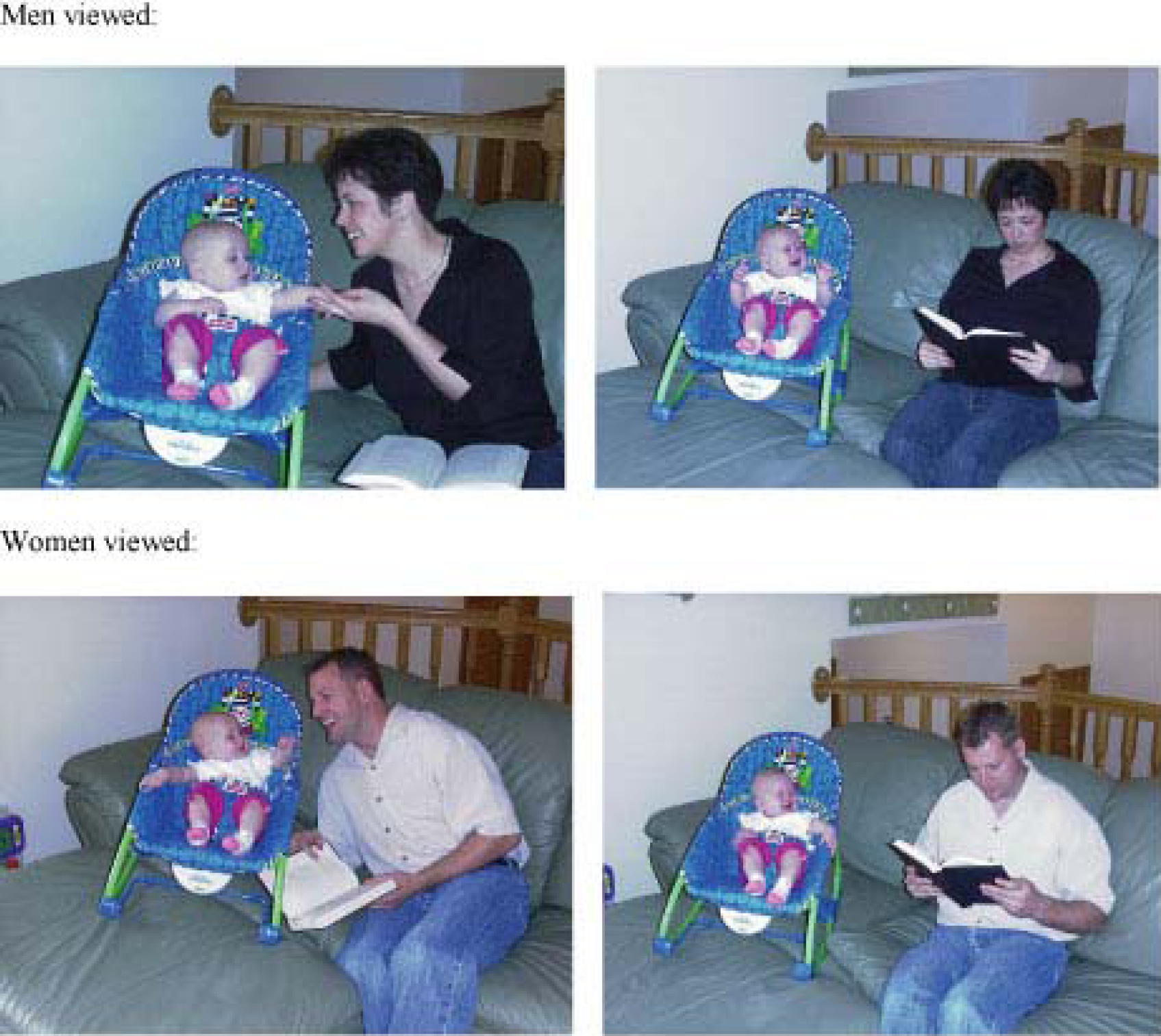
Study 1 stimuli.
Study 1 was a 2 × 2 between-subjects design with baby context (interacting or ignoring) as the independent variable and sex of participant (male or female) as the subject variable. Participants were randomly assigned to condition, and viewed a color picture of the opposite sex in one of the two baby contexts. Upon receiving the questionnaire, participants viewed the picture of the target. Then, similar to that done by La Cerra (1995), participants turned to the next page and used a 7-point scale to rate how physically and sexually attractive they found the person in the photograph to be as a neighbor, friend, short-term sex partner, long-term relationship partner, and marriage partner (1 = Very Unattractive, to 7 = Very Attractive). Next, participants used a 5-point scale to rate their perceptions of how honest, kind, loyal, agreeable, and loving the target was (1 = Not At All, to 5 = Extremely). Participants were debriefed in writing upon their completion of the questionnaire. The entire procedure took approximately five minutes.
Results
Because participants' evaluations of the target as a long-term dating partner and marriage partner were largely overlapping (Cronbach's α = .95), these evaluations were averaged into one long-term partner score. Participants' evaluations of the target's personality traits were also highly reliable (! = .93) and thus averaged into one personality score. A significance level of .05 was adopted for all tests reported below.
Participant age was not related to attractiveness ratings (all ps > .36). Overall, across evaluation contexts (long-term romantic partner, short-term sex partner, friend, neighbor) and baby contexts (interacting, ignoring), men and women gave similar ratings of the target's attractiveness, t(103) = 1.19, p = .24 (male M = 4.00, SD = 1.03; α = .92; female M = 3.72, SD = 1.45; α = .96). Across evaluation contexts and participant sex, participants who viewed the target interacting with a happy baby gave higher attractiveness ratings than did those who viewed the target ignoring an upset baby, t(104) = 6.20, p < .001, Cohen's d = 1.22 (interacting M = 4.47, SD = 1.05; ignoring M = 3.13, SD = 1.17).
Effects of Sex and Context on Ratings of Target's Attractiveness
Figure 2 displays the effects of picture context on men's and women's ratings of the target's attractiveness as a long-term romantic partner (top left panel), short-term sex partner (top right), friend (bottom left), and neighbor (bottom right).
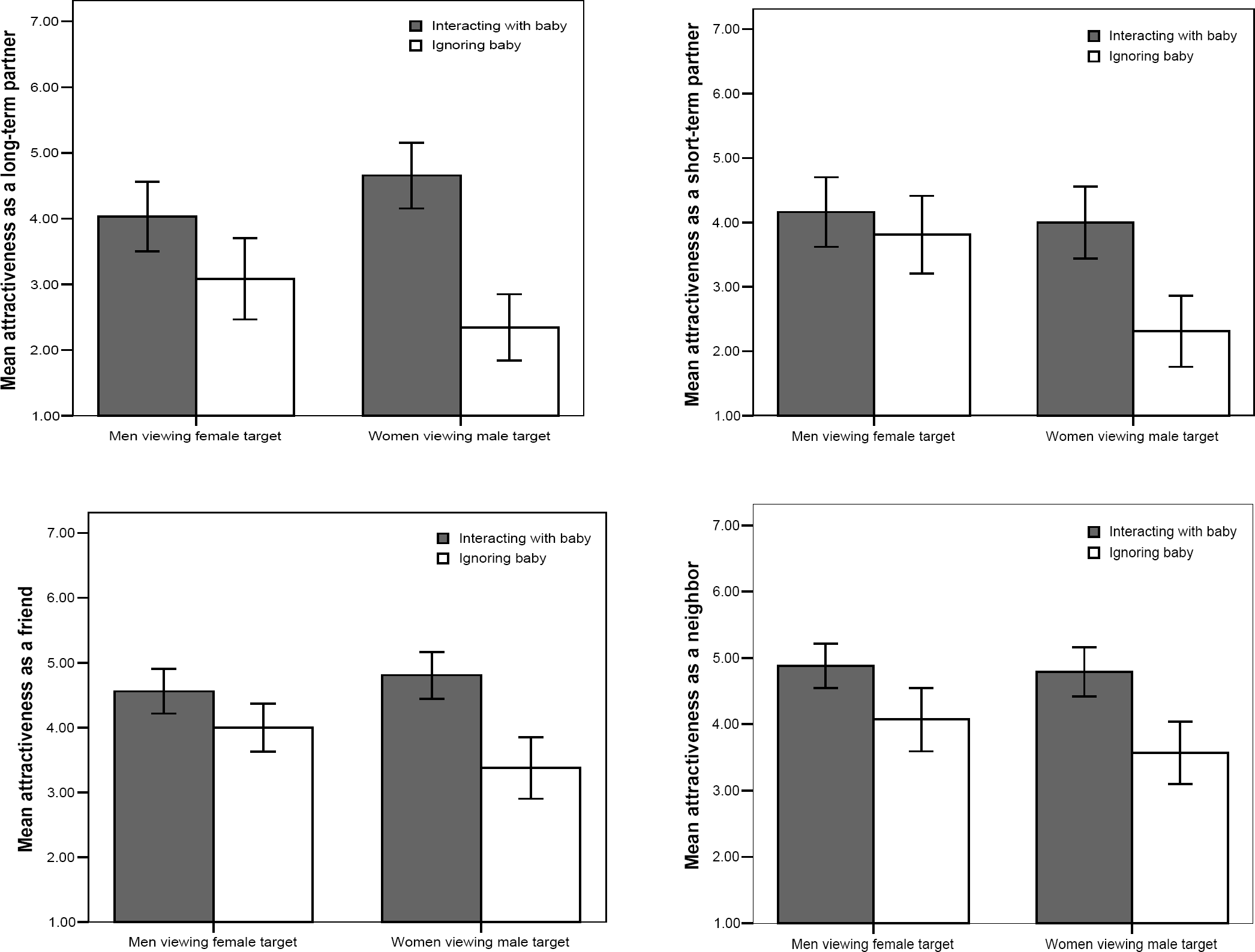
Study 1: Effects of context on men's and women's ratings of target's attractiveness as a long-term partner (top left), short-term sex partner (top right), friend (bottom left), and neighbor (bottom right). Bars represent group means, and error bars represent standard errors of the mean.
Attractiveness as a long-term romantic partner
First, two-way analyses of variance revealed a strong main effect of picture condition: Participants who viewed the target ignoring the baby rated the target as less attractive than did participants who viewed the target interacting with the baby, F(1, 102) = 38.56, partial η2 = .27, p < .001. Second, across context, men's and women's ratings of the target as a long-term partner did not differ, F(1, 102) = .05, p = .83. Third, participant sex and baby context interacted to affect ratings, F(1, 102) = 6.75, partial η2 = .06, p < .05. The pattern of this interaction is displayed in the top left panel of Figure 2: Men who viewed the woman ignoring the baby rated her as less attractive than did men who viewed her interacting with the baby, t(44) = 2.43, p < .05, d =.73; but the effect of context on women's ratings of the male target was very strong, t(58) = 6.63, p < .001, d = 1.74. Within each baby context, men's and women's ratings did not differ, ps > .05.
Attractiveness as a short-term sex partner
First, two-way analyses of variance revealed a strong main effect of picture condition: The target who was ignoring the baby was rated as less attractive than was the target who was interacting with the baby, F(1, 102) = 13.36, partial η2 = .12, p < .001.). Second, across picture conditions, men's ratings of the target's attractiveness as a short-term sex partner were higher than women's ratings were, F(1, 102) = 8.84, partial η2 = .08, p < .01. Third, participant sex and baby context interacted to affect ratings, F(1, 102) = 5.76, partial η2 = .05, p < .05. The pattern of this interaction is displayed in the top right panel of Figure 2: Picture context did not affect men's ratings of the target's short-term attractiveness, t(44) = .90, p = .74, but it did affect women's ratings. Women who viewed the man ignoring the baby rated him as less attractive than did women who viewed him interacting with the baby, t(58) = 4.38, p < .001, d = 1.15. Men and women responded similarly to the target who was interacting with the baby, t(54) = .41, p = .68, whereas men rated the ignoring baby target as more attractive than women did, t(48) = 3.73, p < .01, d = 1.08.
Attractiveness as a friend
First, two-way analyses of variance revealed a strong main effect of picture condition: Participants who viewed the target ignoring the baby rated the target as less attractive than did participants who viewed the target interacting with the baby, F(1, 102) = 26.63, partial η2 = .20, p < .001. Second, across context, men's and women's ratings of the target as a long-term partner did not differ, F(1, 102) = .91, p = .34. Third, participant sex and baby context interacted to affect ratings, F(1, 102) = 4.88, partial η2 = .05, p < .05. The pattern of this interaction is displayed in the bottom left panel of Figure 2: Men who viewed the woman ignoring the baby rated her as less attractive than did men who viewed her interacting with the baby, t(44) = 2.30, p < .05, d =.69; but the effect of context on women's ratings of the male target was larger, t(58) = 4.95, p < .001, d = 1.30. Men and women responded similarly to the target who was interacting with the baby, t(54) = −1.00, p = .32, whereas men rated the ignoring baby target as more attractive than women did, t(47) = 2.14, p < .05, d = .62.
Attractiveness as a neighbor
First, two-way analyses of variance revealed a strong main effect of picture condition: Participants who viewed the target ignoring the baby rated the target as less attractive than did participants who viewed the target interacting with the baby, F(1, 102) = 24.52, partial η2 = .19, p < .001. Second, across context, men's and women's ratings of the target as a long-term partner did not differ, F(1, 102) = 2.09, p = .15. Third, participant sex and baby context did not interact to affect ratings, F(1, 102) = 1.01, p = .32. As displayed in the bottom right panel of Figure 2, the negative effect of ignoring a baby was similar in magnitude for the two sexes.
Effects of Sex and Context on Ratings of Target's Personality
The pattern for participants' ratings of the target's personality was similar to that found for ratings of the target's attractiveness. First, a two-way analysis of variance revealed a significant main effect of the manipulation on ratings of the target's personality, F(1, 99) = 67.05, p < .001, partial η2 = .40: The target who ignored the baby was perceived less positively overall than was the target who interacted with the baby. Second, across picture conditions, men's and women's ratings of the target's personality did not differ, F(1, 99) = 2.98, p = .09. Third, participant sex and baby context interacted to affect ratings, F(1, 99) = 7.63, partial η2 = .07, p < .01. Men who viewed the target ignoring the baby rated the target less positively (M = 2.89, SD = .81) than did men who viewed the target interacting with the baby (M = 3.68, SD = .62), t(39) = 3.69, p < .01, d = 1.20; and this negative effect of context was very strong for women, t(55) = 8.04, p < .001, d = 2.17 (ignoring M = 2.24, SD = .79; interacting M = 3.83, SD = .71). Men and women responded similarly to the target who was interacting with the baby, t(51) = −.82 p = .42, whereas men rated the ignoring baby target more positively than women did, t(48) = 2.86, p < .01, d = .83.
Discussion
Consistent with the hypothesis that women have an evolved sensitivity to cues of a man's willingness to invest in offspring, women's judgments of a man's attractiveness as a long-term partner were negatively affected by seeing him ignore a baby in distress. However, our findings suggest less domain-specificity in women's sensitivity than reported previously (La Cerra, 1995). Women's attractiveness ratings were affected not only in the long-term mating evaluation, but also in the short-term mating and non-mating (i.e., friend and neighbor) evaluation domains. Given the logic of parental investment theory, it is not surprising that women's ratings of a man's long-term attractiveness were negatively affected by seeing him ignore a baby in distress. Perhaps somewhat surprising is that their ratings of a man's short-term sexual attractiveness were also negatively affected. After all, men chosen as short-term partners are not expected to invest on a prolonged basis, particularly in offspring. However, some research suggests that engaging in short-term mating often functions as a strategy for acquiring a long-term mate (Greiling and Buss, 2000); thus, the two mating domains are likely not independent of each other in the female mind.
In further contrast to La Cerra's findings, men's ratings of the target's long-term attractiveness also were significantly affected by picture condition. On one hand, because women have parental certainty, they might invest reliably in offspring and, as such, one might not expect there to have been selection pressure for men to have evolved to be sensitive to behavioral cues regarding women's willingness to parentally invest. On the other hand, women's degree of nurturance and devotion to their offspring varies tremendously, and if such variation historically was related to differential child outcomes, then men may have evolved to be sensitive to behavioral cues regarding women's willingness to care for children. Although our effect sizes suggest that men were not as strongly affected as women were by viewing a target ignore a baby in distress, the finding warrants discussion and attempted replication.
Importantly, men's ratings of a woman's short-term sexual attractiveness were not at all affected by context in the evaluation of the target's attractiveness as a short-term sex partner. This non-finding accords with past research showing that men's standards for various characteristics such as kindness and intelligence drop in the selection of a sex partner (Kenrick, Groth, Trost, and Sadalla, 1993).
Study 2
Introduction
In Study 1, extended previous research by using a conservative, between-subjects design. However, we lacked a direct test of the possibility that women may respond positively to the male interacting with the baby because women have a general preference for men who are “domestic” or helpful around the house. In Study 2, we tested this possibility by creating a third condition in which the participant was pictured alone vacuuming.
Study 1 also lacked a measure of individual differences in sexual strategy, or sociosexual orientation. We hypothesized that within each sex, a more restricted sexual strategy (being oriented toward long-term, committed mateships) would be associated with a greater sensitivity to the effect of interacting vs. ignoring a baby, and that a more unrestricted sexual strategy would be associated with a lower sensitivity. In Study 2, then, we included the Sociosexual Orientation Inventory (SOI; Simpson and Gangestad, 1991) as a measure of sociosexuality.
One might suggest that women's strong negative reaction to a man ignoring a baby is the product of traditional sex-role socialization processes that instruct women to find a man who will be a good father. This explanation, however, needs to be unpacked in order to be tested. First, we assume that being a ‘good father’ means more than just providing resources; it also means being willing to contribute time and energy directly to the care and instruction of one's children. Under this assumption, it is just as likely that men are socialized to find a woman who will be a good mother as it is that women are socialized to find a man who will be a good father. Second, individuals who hold traditional views about sex roles tend to agree with statements that emphasize the importance of the wife rather than the husband handling the children and housework. Thus, one might predict that holding traditional views about the sexes is associated with less sensitivity to males' behavior with a baby. Individuals with sex-egalitarian views, on the other hand, tend to agree with statements that characterize both female and male as caregivers; one could argue that women's sensitivity to cues of a man's willingness to invest is the result of being socialized according to modern sex-egalitarian ideals. If that is the case, then women who score higher in sex-role egalitarianism (i.e., lower in traditional sex-role identification) should be more susceptible to the negative effect of images of a male ignoring a baby. In Study 2, we included a measure of sex-role beliefs to determine whether they were related in any way to the negative effect of ignoring a baby on people's perceptions of the target.
Method
Participants
A total of 70 male and 115 female undergraduates from two regional public institutions participated. The participants ranged from 18 to 49 years of age, with only one participant over 30. The mean age was 19.56 years (male M = 19.76 years, female M = 19.44 years). Some students participated in partial fulfillment of course credit.
Materials and Procedure
The method of creating stimuli and collecting data for Study 2 was the same as for Study 1. The adult targets used in Study 2 were both pre-rated by 15 opposite sex judges as moderately attractive (male M = 6.46, female M = 5.60; scale ranged from 1 to 9, and neither target received a score below 4), although the male was pre-rated as more attractive than was the female, t(34) = −2.61, p < .05. In addition, the male and female targets were pre-rated as similar in age (male M = 22.60 yrs, female M = 22.90 yrs). As displayed in Figure 3, male and female targets were photographed while interacting with a happy baby and ignoring a baby in distress. Targets were also photographed in a third context, vacuuming alone (the “domestic” condition).
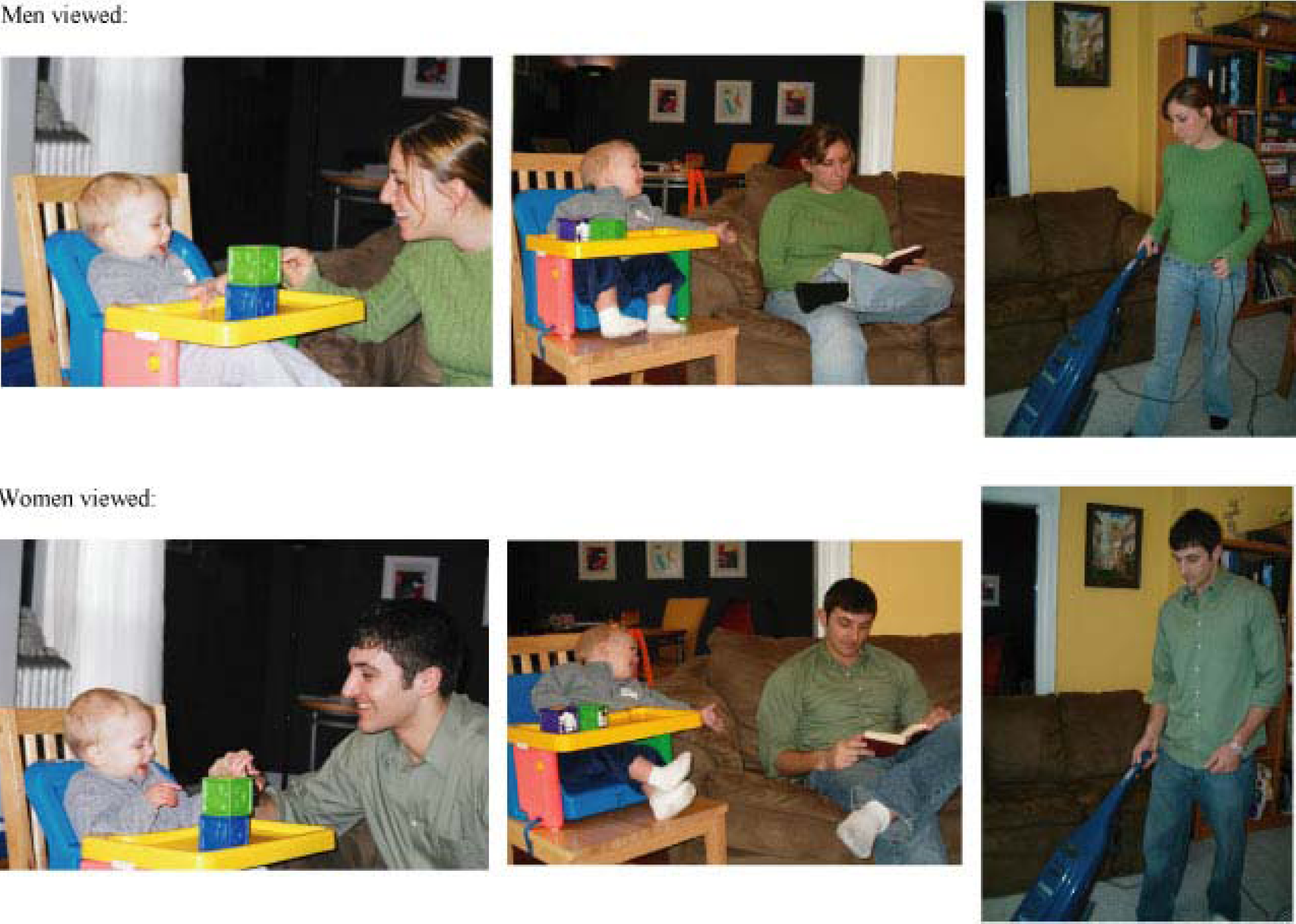
Study 2 stimuli.
Study 2 was a 3 × 2 between-subjects design with picture context (interacting, ignoring, or being domestic) as the independent variable and sex of the participant as the subject variable. Each participant was randomly assigned to one of the three picture conditions. First, participants viewed a color picture of the opposite sex target in one of the three conditions. Then, participants turned to the next page and used a 7-point scale (1 = Disagree Strongly, to 7 = Agree Strongly) to indicate their agreement with five statements about their attraction to the person in the photograph as a sex partner (e.g., “This man[woman] is sexually attractive,” “I am sexually attracted to this man [woman],” “I would be willing to have sex with this man [woman]; α = .93), and three statements about their attraction to the person as a long-term relationship partner (e.g., “This man [woman] would be a desirable marriage partner,” “I would be willing to develop a long-term romantic relationship with this man [woman];” α = .89). We generated these items in an attempt to more closely parallel the thoughts someone might entertain when viewing a member of the opposite sex. Rating the target's sexual attractiveness as a potential neighbor, for example, as conducted in Study 1 and in previous research, seemed awkward. Scores on the sexual attraction and long-term relationship composite variables were moderately correlated (p < .001).
Next, participants used a 5-point scale to rate their perceptions of how honest, kind, loyal, agreeable, loving, and motherly/fatherly the target was (! = .92; 1 = Not At All, to 5 = Extremely). Finally, participants completed the Sociosexual Orientation Inventory (SOI; Simpson and Gangestad, 1991) and the Larsen and Long Sex Role Egalitarianism Scale (Larsen and Long, 1988; α = .80). Participants were debriefed in writing upon their completion of the questionnaire. The entire procedure took approximately 15 minutes.
Results
Participant age was not related to sociosexual orientation (p = .18), nor to attractiveness ratings (all ps > .20). Overall, across evaluation contexts (long-term relationship attraction, sexual attraction) and baby contexts (interacting, domestic, and ignoring), men reported more attraction to the target than did women, t(178) = 3.43, p < .01, d = .51 (male M = 4.35, SD = 1.20; female M = 3.69, SD = 1.28). Across evaluation contexts and sex, participants who viewed the target ignoring the baby reported lower levels of attraction to the target (M = 3.41, SD = 1.34) than did either those who viewed the target interacting with the baby (M = 4.35, SD = 1.30, p < .001) or those who viewed the target being domestic (M = 4.09, SD = 1.03, p < .01); the latter two groups did not differ from each other.
Effects of Sex and Context on Attraction to Target
Figure 4 displays the effects of picture context on men's and women's ratings of long-term relationship attraction (left panel) and sexual attraction (right panel) to target. For ratings of long-term relationship attraction, a two-way analysis of variance revealed a strong main effect of picture condition, F(2, 178) = 8.78, p < .001, partial η2 = .09. Participants who viewed the target ignoring the baby reported less long-term relationship attraction (M = 3.11, SD = 1.33) than did either those who viewed the target interacting with the baby (M = 4.20, SD = 1.44, p < .001) or those who viewed the target being domestic (M = 4.01, SD = 1.08, p < .001); the latter two groups did not differ from each other. The analysis also revealed a significant interaction between sex and picture condition, F(2, 178) = 4.11, p < .05, partial η2 = .04. As displayed in Figure 4, no pair-wise mean comparisons for men were significant; however, women who viewed the target ignoring the baby reported lower levels of long-term relationship attraction than did either those who viewed the target interacting with the baby (p < .001) or those who viewed the target being domestic (p < .001). Women who viewed the man interacting with the baby did not report more long-term attraction relative to those who viewed him vacuuming.
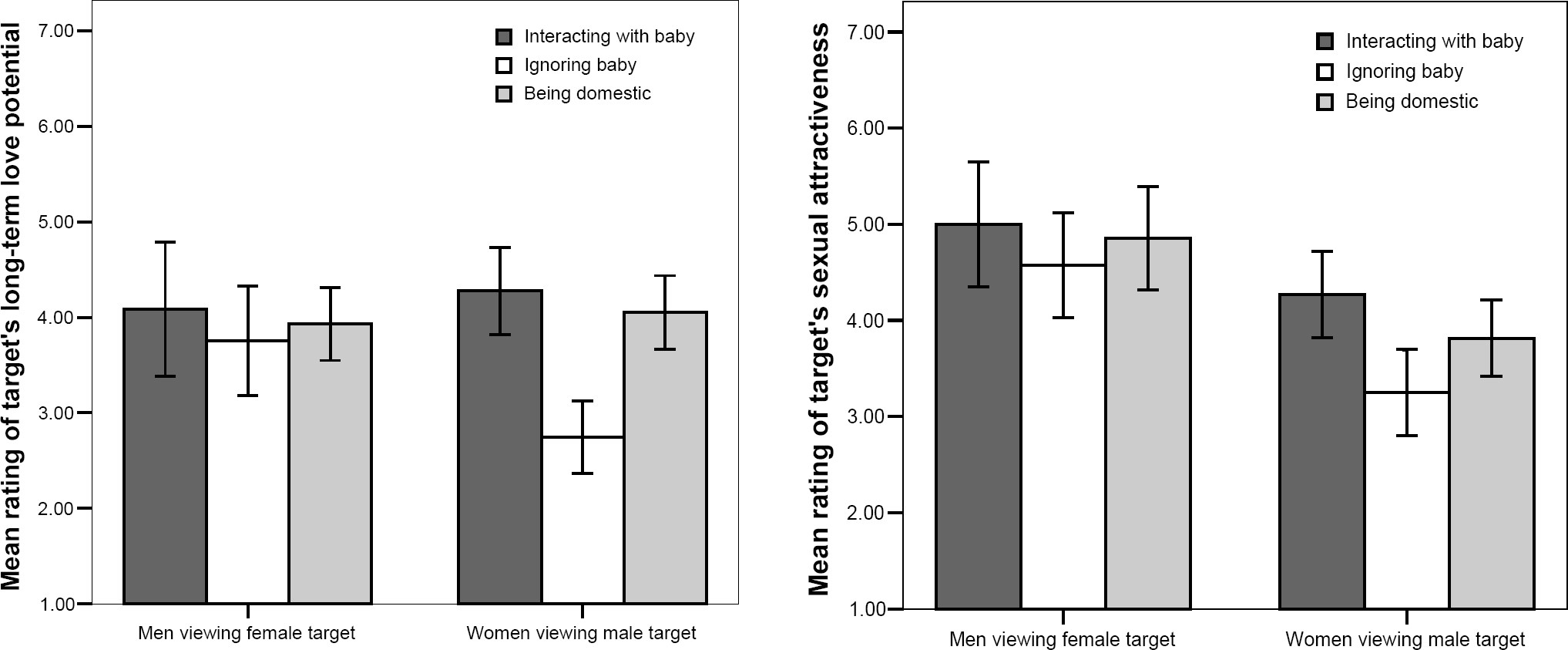
Study 2: Effects of context on men's and women's ratings of target's long-term love potential (left) and sexual attractiveness (right). Bars represent group means, and error bars represent standard errors of the mean.
For ratings of sexual attraction, a two-way analysis of variance revealed a strong main effect of sex, F(1, 174) = 26.04, p < .001, partial η2 = .13. Across picture conditions, men (M = 4.81, SD = 1.32) reported more sexual attraction to the target than did women (M = 3.75, SD = 1.36). The analysis also revealed a main effect of picture condition, F(2, 174) = 4.31, p < .05, partial η2 = .05. That is, participants who viewed the target ignoring the baby reported lower levels of sexual attraction (M = 3.73, SD = 1.48) than did those who viewed the target interacting with the baby (M = 4.56, SD = 1.39, p < .01); no other comparisons were significant. We conducted one-way analyses of variance with follow-up comparisons to look at the effects of picture condition for each sex separately. As displayed in Figure 4, no pair-wise mean comparisons for men were significant. However, women who viewed the target ignoring the baby reported less sexual attraction than did women who viewed the target interacting with the baby, p < .01. No other comparisons were significant; again, women who viewed the man interacting with the baby did not report any more attraction relative to those who viewed him being domestic.
Effects of Sex and Context on Ratings of Target's Personality
For perceptions of the target's personality, a two-way analysis of variance first revealed a small main effect of sex, F(1, 178) = 4.46, p < .05, partial η2 = .02. Across picture conditions, men (M = 3.28, SD = .80) perceived the target more positively than did women (M = 3.00, SD = 1.00). Second, the analysis revealed a large main effect of picture condition, F(2, 178) = 40.64, p < .001, partial η2 = .31, with all pair-wise comparisons significant. That is, participants who viewed the target ignoring the baby perceived the target's personality more negatively (M = 2.86, SD = .76) than did either those who viewed the target interacting with the baby (M = 3.72, SD = .73, p < .001) or those who viewed the target being domestic (M = 3.25, SD = .71, p < .001). Further, those who viewed the target interacting with the baby rated the target more positively than did those who viewed the target being domestic (p < .01). Third, the analysis of variance revealed that the pattern of the effect of the manipulation was different for women than for men, interaction F(2, 178) = 5.81, p < .01, partial η2 = .06. Analyses of the effect of the manipulation for each sex separately showed that among men, those who viewed the target ignoring the baby rated the target less positively (M = 2.89, SD = .76) than did those who viewed the target interacting with the baby (M = 3.86, SD = .59), p < .001; and those who viewed the target being domestic also rated the target less positively (M = 3.11, SD = .69) than did those who viewed the target interacting, p < .01. Men's personality ratings of the female target did not differ for the ignoring and domestic conditions. Among women, those who viewed the target ignoring the baby rated the target less positively (M = 2.15, SD = .80) than did either those who viewed the target interacting with the baby (M = 3.62, SD = .81, p < .001), or those who viewed the target being domestic (M = 3.34, SD = .71, p < .001). Women's personality ratings of the target male did not differ for the interacting and domestic conditions.
Sociosexuality and Ratings of Target
As has been documented in prior research (e.g., Simpson and Gangestad, 1991), male participants were less restricted on average, and more variable overall (M = 63.43, SD = 42.01), in sexual strategy compared to the female participants (M = 42.29, SD = 28.41), t(183) = −6.02, p < .001, d = −.89. We first investigated links between sociosexuality and susceptibility to the manipulation by including SOI score as a covariate in the analyses of variance reported above. No significant effects were found for sociosexuality, either as a main effect or in interaction with sex and picture condition. Second, by sex, within each picture condition, we conducted bivariate correlational analyses between SOI score and rating of target. In no case was sociosexuality related to attraction to target or perceptions of target's personality, all ps > .05.
Sex-Role Beliefs and Ratings of Target
Although both sexes held more egalitarian than traditional views about the sexes, female participants held more egalitarian views (M = 1.99, SD = .72) than did male participants (M = 1.31, SD = .76), t(179) = 4.04, d = .60. Beliefs about sex-role equality were analyzed in the same way as were SOI scores, and the findings were similar. No significant effects were found for sex-role beliefs, either as a main effect or in interaction with sex and picture condition. Within sex and picture condition, in no case were sex-role beliefs related to attraction to target or perceptions of target's personality, all ps > .05.
Discussion
In this study, we replicated the finding from Study 1 that women's, but not men's, sexual attraction to an opposite-sex model is negatively impacted by seeing that model ignore a baby in distress. We also found that women's, but not men's, long-term romantic attraction to an opposite-sex model is negatively impacted by seeing that model ignore a baby in distress. Given women's parental certainty and overall likelihood of investing in offspring relative to men's, it is likely that men have not evolved to be as sensitive as women to the opposite sex's willingness to invest in offspring. And in line with this logic of parental investment, in Study 2 men's level of long-term attraction to the female model was not impacted by seeing her ignore a baby. The discrepant results—that context did impact men's long-term evaluations of attractiveness in Study 1, but did not in Study 2—beg explanation. In Study 2, we used a female model of above-average (rather than slight) attractiveness. It is possible that, at least in momentary reflections such as in this study, surrounding contexts become essentially irrelevant to the average man evaluating a female who exceeds some minimum threshold of attractiveness. Perhaps, beyond some minimum threshold yet to be defined, a man will ignore or discount other potentially valuable traits in a mate. Future research might vary model attractiveness systematically to more clearly determine whether the attractiveness level of a female target moderates the influence of contexts.
In this study, we also documented that women who viewed a male interacting with a baby did not respond significantly more positively to him than did women who viewed him vacuuming (although the means were consistently in that direction). These findings corroborate Brase's (2006) conclusion that women's positive evaluations of men interacting with a baby may be less domain-specific than suggested by previous research (La Cerra, 1995). However, as one reviewer of this paper noted, it also is possible that demonstrated willingness to vacuum, itself, serves as a cue of willingness to help with children.
Finally, Study 2 documented that the effects of sex and picture condition are not moderated by either individual differences in sociosexual orientation or beliefs about sex-role equality. Restricted men were no more negatively affected by the female target ignoring a baby than were unrestricted men; and unrestricted women were no less affected by it than were restricted women. Brase (2006) also found no moderating effects of sociosexual orientation. The overall pattern of findings raises the possibility that men's and women's responses to the different stimuli may also be robust to individual differences in primary personality traits.
There are, however, other potential moderators of the effects documented in the current studies. Because men are unreliable parental investors, women's perception of a man's attractiveness as a long-term mate should be sensitive to variables (besides behavior with a baby) that are reliably associated with differences in parental investment. For example, highly attractive men — those having symmetrical and masculine features — have been shown to invest relatively little in offspring compared to other men. Perhaps when the male target is highly symmetrical and masculine, women will be less negatively impacted by seeing him ignore a baby in distress because (1) he is not “expected” to invest, and (2) his lack of investment might be outweighed by his higher likelihood of carrying “good genes.” Future research might investigate the negative effect of ignoring a baby using male targets of varying degrees of symmetry and masculinity.
Women's menstrual cycle phase when viewing a male target also might moderate the impact of context on women's ratings of men's attractiveness. Given that women find masculine and symmetrical (“good genes”) features especially attractive when they are ovulating (Gangestad and Thornhill, 1998; Penton-Voak and Perrett, 2000), women may be somewhat less sensitive to baby context—particularly if the target male is highly sexually attractive—when they are in the high fertility phase of their cycle.
General Discussion
In two different studies, using a between-subjects design and two independent sets of stimulus materials, we documented that women's evaluations of a man as a long-term and short-term sex partner are negatively impacted by viewing that man ignore a baby in distress. In these same studies we documented that men's evaluations of a woman as a potential sex partner are not affected by viewing her ignore a baby in distress. In one of the two studies, men's evaluations of the woman as a long-term partner were not affected, either. Overall, our pattern of findings suggests that women may be sensitive to cues of a man's willingness to invest in offspring, and this sensitivity is not moderated by sex-role beliefs or sexual permissiveness. Because women did not respond differently to men interacting with a baby and men vacuuming, women's positive evaluations of the man interacting with the baby may be a product of a more general sensitivity in women to good character—signs of kindness and compassion in all relationship partners (e.g., friends and neighbors in addition to mates); however, it could also be that helping with domestic chores is a reliable indicator of willingness to help with children. The finding that women did not respond differently to the man smiling at a baby and the man vacuuming with a neutral facial expression does rule out the possibility that smiling drove the high ratings given to the interacting with baby target.
Our findings should be interpreted with caution due to our limited subject populations of young college students. That said, the participants varied widely in their sociosexual orientation, and the targets they viewed, particularly in Study 2, were just a little older than themselves (about the same age of any romantic partners they themselves would likely be pursuing). Moreover, Brase (2006) utilized an internet sample of people of varying ages and documented findings similar to ours. The current series of studies supports the general conclusion that women more than men display sensitivity (and men more than women indifference) to an opposite-sex target's behavior toward a baby.
Footnotes
Acknowledgements
The authors thank Gary Brase, Kelsey Fasteland, Gregory Madden, and Philip Rechek for comments on a previous draft of this manuscript, and Andrew Rohloff for help with data collection.