



Abstract
Parental investment theory and sexual strategies theory predict that women and men should differ on many of the criteria by which they choose mates. These theories posit a gender selectivity effect, such that women should be more selective than men in their mating choices. The theories also posit an age differential effect, such that women should seek older mates, and men should seek younger mates. These two hypotheses have been supported by self-report surveys, speed-dating studies, analysis of on-line and newspaper personal ads, and laboratory analog studies. However, each of these data sources has limitations. Therefore, a new source of data may provide a valuable additional test of the robustness of these effects. The current study examined two independent sources of data involving blind dates arranged and paid for by newspapers. Consistent with the first hypothesis, we found women to be more selective than men. We also found that matchmakers tended to pair older men with younger women, consistent with the second hypothesis. However, contrary to the second hypothesis, we found no evidence that the age differential between members of a couple influenced their ratings of the date. The implications of these findings are discussed.
Keywords
Introduction
Parental investment theory (Trivers, 1972) and sexual strategies theory (Buss and Schmitt, 1993) posit that men and women's mating preferences and strategies should differ in ways that reflect the different adaptive problems the two genders faced over the long span of evolutionary history. These theories predict a gender selectivity effect, such that women should be more selective than men in their mating choices because they bear a greater cost associated with pregnancy and child-rearing. The theories also posit an age differential effect, such that men will seek mates younger than themselves because younger women are more likely to be fertile; whereas women will seek mates older than themselves because older men typically have greater economic resources and higher social standing, both of which provide greater security for offspring.
The gender selectivity hypothesis has substantial empirical support. Several studies using speed-dating procedures have demonstrated that women are less likely than men to agree to additional contact after a speed-dating event (Fisman, Iyengar, Kamenica, and Simonson, 2006; Kurzban and Weeden, 2005; Todd, Penke, Fasolo, and Lenton, 2007). In addition, Townsend and Wasserman (1998) found that after viewing an attractive opposite-sex photograph, men were significantly more likely than women to report willingness to go on a date or have sex with the person shown in the photograph. Similarly, Clark and Hatfield (1989) showed that when participants were approached by research confederates of the opposite sex and asked to go over to the confederate's apartment, 69% of men agreed, but only 6% of women agreed; and if asked to have sex that evening, 75% of the men agreed, whereas none of the women agreed. These findings have been replicated several times (e.g., Clark, 1990; Guéguen, 2011; Voracek, Hofhansl, and Fisher, 2005). In a study of on-line dating behavior involving nearly 6,000 participants, when individuals viewed an opposite-sex profile, men were one and a half times more likely than women to send an introductory email (Hitsch, Hortacsu, and Ariely, 2010).
There is also substantial empirical support for the age differential hypothesis. Buss (1989) surveyed 37 cultures across 6 continents and found that in every culture studied, men prefer to marry younger women (mean difference = −2.66 years) and women prefer to marry older men (mean difference = 3.42 years). In addition, Buss collected actual age differences at marriage for 27 of the 37 cultures, and in every case, men, on average, married women who were younger than themselves. Buunk and colleagues (2001) queried Dutch men and women between the ages of 20 and 60 about their age preferences for various types of intimate relationship, ranging from sexual fantasies to marriage. They found that men consistently preferred younger partners than did women. Using a nationally representative sample of single Americans younger than 35, Sprecher, Sullivan, and Hatfield (1994) found that women were significantly more willing than men to marry someone who was older by five years; and men were significantly more willing than women to marry someone who was younger by five years. In an analysis of over 1,000 personal ads, Wiederman (1993) found that women generally sought men older than themselves; and men generally sought women younger than themselves.
The goal of the present study is to test the gender selectivity and age differential hypotheses using a new source of data – blind dates arranged and paid for by newspaper matchmaking columns. Given the fact that blind dates are relatively common in modern life, this source of data has good external validity. In addition, since these are found data, experimenter bias is minimized. Although, as noted above, there are many empirical studies supporting these two hypotheses, this new source of data has the potential to add incrementally to our confidence in the robustness of the effects.
Materials and Methods
We collected all available ratings of blind dates that were published in two American newspaper columns from the inception of each column until November 20, 2011. The two newspaper columns were: “Dinner with Cupid” from The Boston Globe and “Date Lab” from The Washington Post. Given our hypotheses, we only collected ratings from heterosexual couples. We also collected the ages of the participants. Both newspaper columns advertise for singles who are willing to provide a narrative report of a blind date along with a quantitative rating in exchange for a free dinner at a local restaurant. For the quantitative rating, The Boston Globe used letter grades, which we converted to a numerical scale (F=0 to A+=12); and The Washington Post used a 1–5 scale, with higher scores indicating more favorable ratings. The newspapers attempt to match up compatible individuals based on information that the applicants provide in response to an on-line questionnaire (54 items for The Washington Post and 36 items for The Boston Globe). The questionnaires gather information on applicants' age, height, occupation, marital status, sexual orientation, and race/ethnicity. In addition, applicants respond to open-ended items such as dating history, interests, hobbies, activities, and partner preferences. Other items ask participants such questions as when they are the happiest, what makes them a good catch, and what is the first thing others notice when they walk into the applicants' homes. Applicants must also upload three recent photos. The newspaper columns do not specify the method by which they combine this information in order to determine which individuals might be compatible.
Results
The Washington Post sample included 224 blind dates from April 22, 2007 to November 17, 2011. The Boston Globe sample included 123 blind dates from February 1, 2009 to November 20, 2011. Descriptive statistics for the two samples are shown in
Descriptive statistics.

The ratings of couples were strongly correlated for The Washington Post, r(222) = .48, p > .001, and moderately correlated for The Boston Globe, r(119) = .28, p = .002. We used paired t-tests to examine the hypothesis that women are more selective than men in their dating choices. The effects were statistically significant for both The Washington Post, t(223) = 3.59, p > .001, d = .25, and The Boston Globe, t(120) = 2.45, p = .02, d = .27. The effects are illustrated in Figure 1.
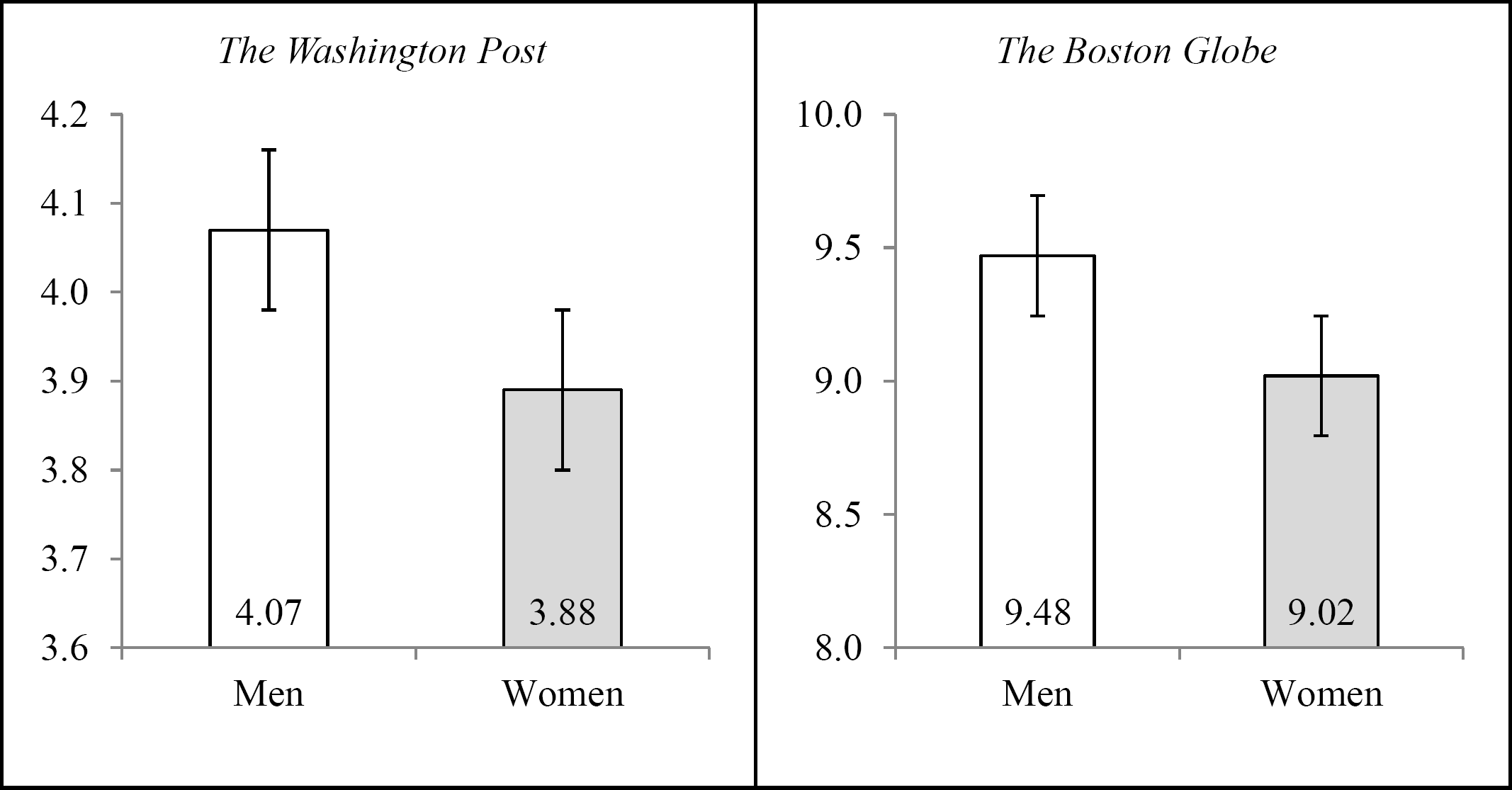
Ratings of participants in blind dates.
The ages of couples were highly correlated for both The Washington Post, r(220) = .97, p > .001, and The Boston Globe, r(121) = .95, p > .001. We used paired t-tests to test the hypothesis that the newspapers would tend to match older men with younger women. The effects were statistically significant for both The Washington Post, t(221) = 6.99, p > .001, d = .12, and The Boston Globe, t(122) = 4.68, p > .001, d = .14. These effects are illustrated in Figure 2.

Ages (in years) of participants in blind dates.
We used independent samples t-tests to determine whether the age disparity between members of a pair was associated with their ratings of the dates. We compared the ratings when the man was older than the woman with the ratings when the woman was older than the man. Couples who were the same age were excluded from this analysis. For The Washington Post sample, there were significantly more pairs in which the man was older (n = 133) as opposed to the woman being older (n = 56), χ2(1, n = 189) = 31.4, p > .001. Although not statistically significant, the observed values were opposite to the predicted direction. Male ratings were lower when the man was older than the woman (4.01 vs. 4.17, t(187) = 1.37, p = .17, d = .23). Female ratings were also lower when the man was older than the woman (3.82 vs. 4.05, t(187) = 1.76, p = .08, d = .30). For The Boston Globe sample, there were also significantly more pairs in which the man was older (n = 72) as opposed to the woman being older (n = 27), χ2(1, n = 99) = 20.5, p > .001. Although not statistically significant, the observed values were in the predicted direction. Male ratings were higher when the man was older than the woman (9.53 vs. 8.98, t(97) = 1.38, p = .17, d = .32). Female ratings were also higher when the man was older than the woman (9.18 vs. 8.80, t(97) = .97, p = .33, d = .21).
We obtained similar results when we analyzed the age difference as a continuous variable. For each couple, we subtracted the woman' age from the man's age, yielding a variable that was positive if the man was older, negative if the woman was older, and zero if there was no age difference. Descriptive statistics for the new variable were as follows: for The Washington Post, M = 1.05, SD = 2.23, range: −4 to 9; for The Boston Globe, M = 1.11, SD = 2.64, range: −7 to 10. The continuous age difference variable was not significantly correlated with ratings of the dates. The observed correlations for The Washington Post were negative: r(219) = −.03, p = .68 for men and r(219) = −.04, p = .57 for women; whereas the observed correlations for The Boston Globe were positive: r(118) = .03, p = .75 for men and r(118) = .16, p = .08 for women.
Discussion
We used two independent sources of data from blind dates arranged and paid for by newspaper matchmaking columns to investigate two hypotheses about human mating behavior derived from parental investment theory and sexual strategies theory. The first hypothesis is the gender selectivity effect, which posits that women should be more selective than men in their mating choices. The second hypothesis is the age differential effect; which posits that men should prefer younger women, and women should prefer older men. Our findings strongly support the first hypothesis. Women were more selective than men in both blind-dating samples (i.e., women gave lower ratings of the dates). Our findings were more equivocal regarding the second hypothesis. The match-makers at both newspapers clearly used the age differential as an important factor, tending to pair older men with younger women. However, the participants' ratings of the dates did not conform to the hypothesis, and there were no statistically significant effects of the age differential on either male or female ratings of their blind dates.
The current study has good ecological validity. Aside from the requirement that participants provide a narrative report and quantitative rating (an important caveat, as we note below), the dates proceeded as they would in ordinary life. We would argue that the ecological validity of the current study is better than laboratory-based research, such as the use of confederates, or asking participants to rate how likely they would be to seek a date based on a photograph or a hypothetical situation. Our study has similar ecological validity to speed-dating studies in that both use relatively common, real-world dating options that involve face-to-face encounters with potential partners. As contrasted with speed-dating studies, the duration of blind dates is up to the couple, and daters are free to spend as much (or little) time as they would like with one another. In addition, blind dates involve only the two participants, as opposed to the pressure of being surrounded by other daters and the personnel running speed-dating events. Although speed-dating studies can be considered similar to what a person might encounter at a bar or party, the many artificial constraints (e.g., every woman must speak with every man and vice versa; each encounter is short and of the same duration) reduce their ecological validity.
This study has a number of limitations. First, given that the ratings were to be published in a newspaper, participants might have been motivated to provide favorable ratings to avoid hurting the feelings of their dating partners or to avoid appearing overly harsh in their public judgment of others. This limitation could be mitigated in future studies of blind dates by collecting confidential ratings of the date.
Second, members of a couple might have discussed their ratings, perhaps even colluding to provide similar ratings. These first two limitations, however, are unlikely to explain our findings. For these factors to explain our findings, men would have to have been differentially influenced by social pressures to provide more favorable ratings. We are unaware of any theory that would predict such an effect; whereas a gender selectivity effect is predicted by parental investment theory and sexual strategies theory.
Third, the pool of participants in our samples was self-selecting, and it is possible that the women and men who volunteered differed systematically in their attractiveness. If the women in both our samples were more attractive than the men, then our findings could be attributable to sampling bias.
Fourth, the ecological validity of our samples could be questioned (i.e., to what degree is blind dating representative of typical human mating behavior?) However, we would argue that blind dates are a common occurrence in modern dating (“Oh, I know someone who would be just perfect for you!”). Moreover, other sources of data on these questions (e.g., speed-dating, analysis of personal ads, laboratory studies) have their own limitations regarding ecological validity. Our study can be thought of as adding to the previous literature by way of triangulation. That is, no method has perfect ecological validity, but to the degree that findings converge across different methods, one can be more confident of the results.
Fifth, one could argue that blind dates have limited ancestral relevance. Although blind dates are relatively common in modern human life, in the small-scale societies that existed during most of human evolution, it is probable that potential mates would have already known one another. We note, however, that many modern dating contexts, including speed-dating, internet matchmaking services, newspaper personal ads, singles bars, and college mixers are no more ancestrally relevant than blind dates. Moreover, a fundamental assumption of evolutionary psychology is that the psychological characteristics that arise in response to evolutionary pressures continue to influence human behavior in the current day despite substantial differences between modern life and the conditions faced by humans during most of human evolution.
Sixth, the ratings provided by participants indicated their satisfaction with the blind date itself and do not necessarily reflect whether they would agree to a second date. We do think it reasonable to expect that these two variables should be positively correlated (i.e., higher satisfaction with the blind date indicates a greater likelihood of agreeing to a second date). Nevertheless, our study would be improved if participants were asked specifically if they wanted to go on a second date. We note that the newspaper matchmaking columns used for this study did report on participants' interest in a second date, but the manner in which this information was collected was subjective and inconsistent, which prevented us from systematically analyzing the data.
In summary, using two independent samples, we found that women tend to provide lower ratings than men after a blind date. In addition, we found that matchmakers tend to pair younger women with older men. These findings are consistent with two predictions derived from parental investment theory and sexual strategies theory: (1) women should be more selective than men in their mating decisions; and (2) women should prefer older men, and men should prefer younger women.
However, contrary to the second prediction, we found no evidence of an association between age differential and ratings of blind dates. This finding suggests that age differential preferences may loom large in the abstract (all things being equal, men would prefer younger women, and women would prefer older men), but in practice, when a couple actually goes on a date, the age differential might not carry as much weight as other factors such as physical attractiveness and personality traits.
On the other hand, the lack of an age differential effect in our two samples could be due to other factors. First, unless the daters revealed their ages to one another during the course of the date, they may not have been aware of the age differential. Second, even if the age differential was perceived by the daters, it is possible that the effect of age differences only becomes salient later in the relationship, after the couple has been on several dates. Third, it is possible that the variance in age differentials in this study was too small to generate a significant effect.
Presuming that our findings can be replicated, they suggest that the actual age differential that exists in dating and married couples could be a function of a general bias on the part of matchmakers and potential daters that results in many more dating opportunities in which the man is older than the woman. Thus, even though couples might be equally happy in relationships in which the woman is older than the man (as our data suggest), the matchmaker preference for age disparity documented in this study may result in fewer opportunities for such relationships to blossom, thus reducing their frequency in the population.
Future research on blind dates should seek to replicate these effects and explore this hypothesis further. If possible, these studies should collect confidential ratings of the date, as well as willingness to go on a second date. In addition, the matchmakers should be provided only with age ranges (e.g., 30–40) and be required to match up individuals who are in the same age bracket. In this way, the dates would include roughly equal numbers of pairs in which either the man is older or the woman is older. Prior to going on the dates, participants should be provided with a brief description of their date that includes their partner's age to ensure that the age differential is known to the participants. The initial questionnaire that is filled out by the potential daters should include a question assessing participants' preferences regarding a date's age. It would be fascinating if participants' preferences in the abstract are in line with previous research on the age differential effect, but their ratings of the specific date and their willingness to go on a second date show no such age differential effect.