




Abstract
How do we make lives in the wake of the detachments that make us? What attachments do we desire amid detachments from place and others that extend beyond our lives? In this collection of fragments I perform a response to these questions via a story of a brass bell and the tangle of attachments and detachments that make my relations to a place, the North-East (England), and a person, my great-Grandad Thomas Anderson, who was born and grew up there. In the telling, the story becomes one of distances from long-gone worlds, the impossibility of attachments we may desire, and intimacies that fold time and space.
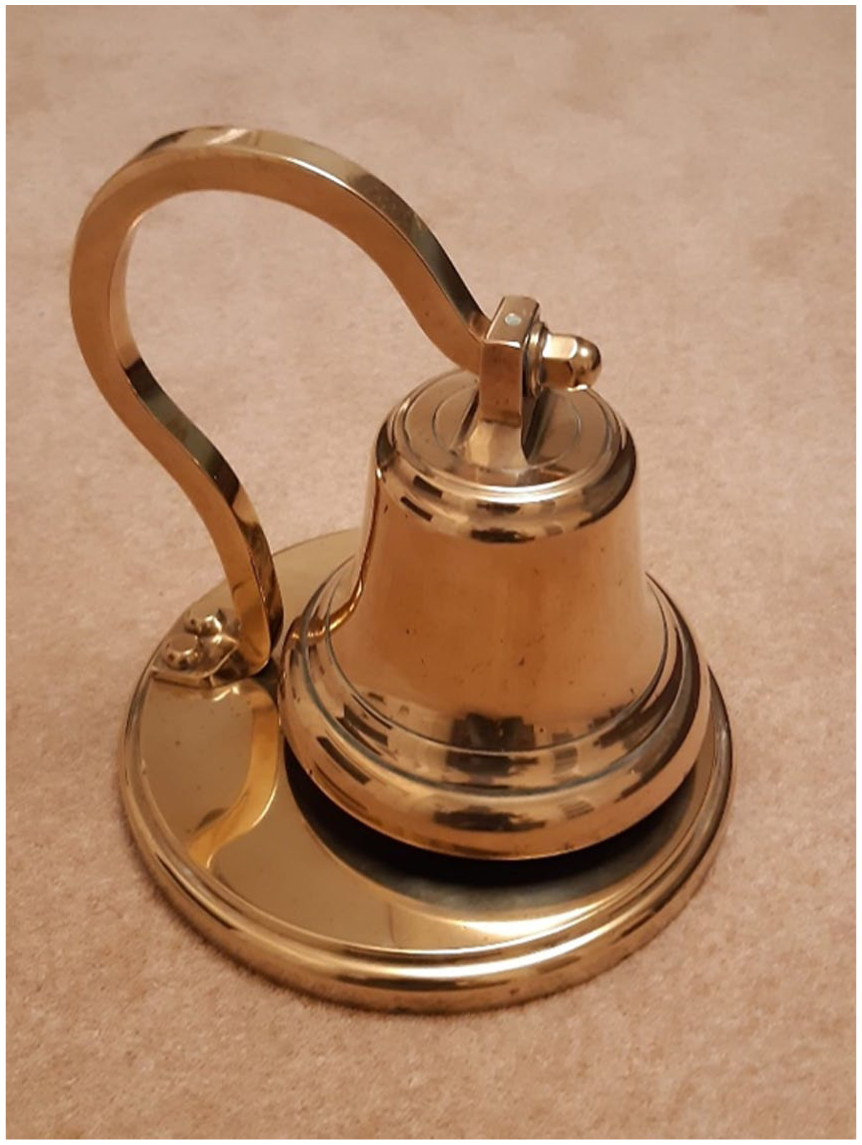
A brass ship’s bell sat in the corner of our living room for most of my childhood growing up in a village in north-Nottinghamshire. We gave it little thought, especially after discovering at some point in our childhood it didn’t properly sound. Mum polished it once a week or so, before Dad took over the work that everyone acknowledged was tedious. It now sits next to the mantlepiece where my parents live. I had to check it still does. I’ve barely noticed it whenever we’ve visited, the house normally full of the noise of my children and nieces and nephews and my siblings and their partners when we visit. I’d forgotten about it until my sister showed a 25-year-old photo of her wearing Goth make up, and there it was. A friend asked what it was (Figure 1).
A brass bell.
Detachments are everywhere. Felt and unfelt, unknown and unknown, named and unnamed, desired and forced, they make our lives and their intricate, changing geographies. Some detachments might feel like the inattention and uninterest with which I distanced myself from the promise of an object I grew up with. Other detachments distance us from worlds we never knew. 1
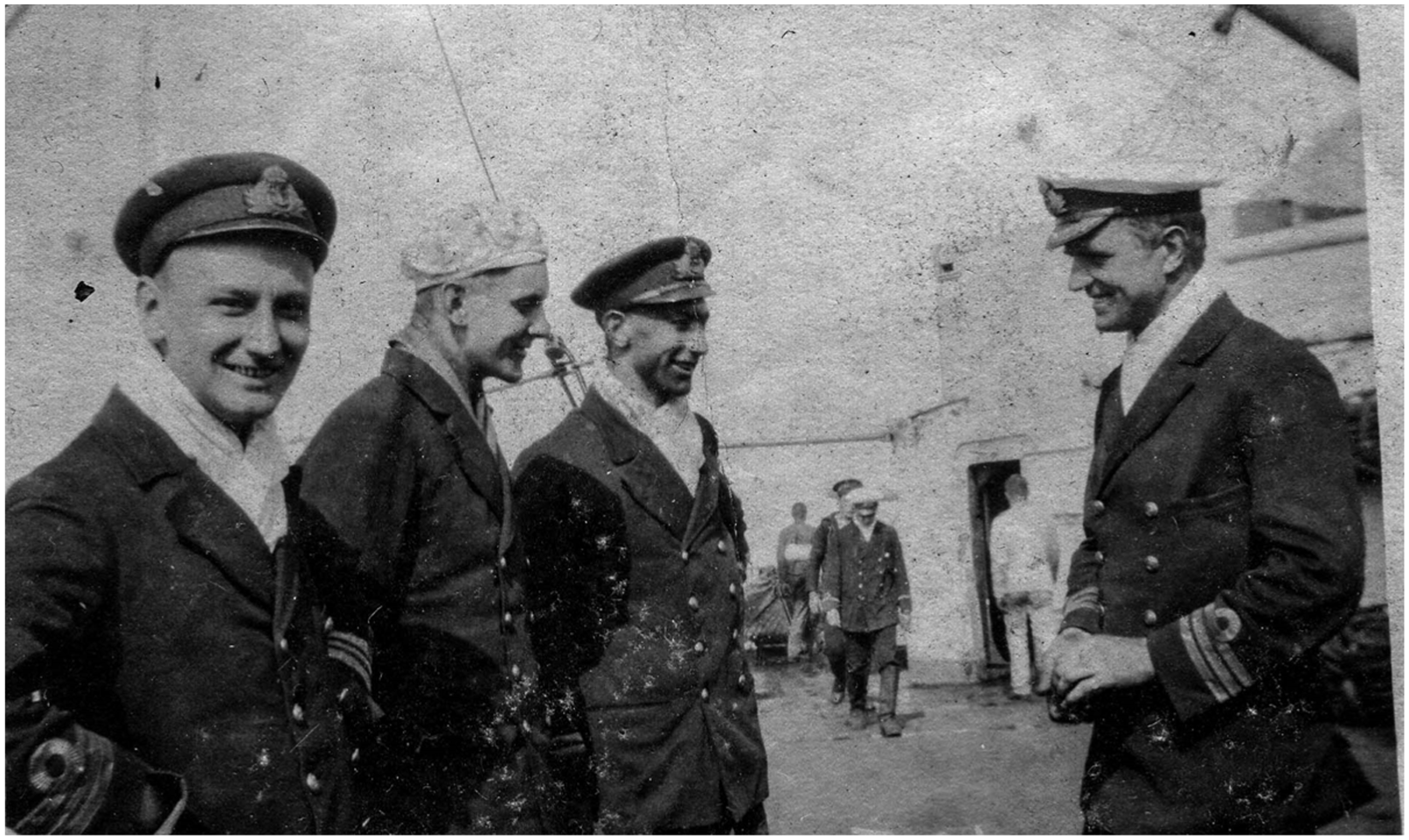
My Great-Grandad – Thomas Anderson (born 5 March 1882) – was in the British navy in the First World War, serving in the battle of Jutland. Before that he was listed in the 1901 census as ‘Steam engine maker, fitter apprentice’. He later joined the merchant navy, before working in the shipping industry in the North-East. But paid work was hard to come by, and he found the work he came by hard to hold down (Figure 2). His wife, my Great-Granny, Rosie, came from Ireland, as so many did in the early twentieth century. After trying to make a life in the north-east, they moved to Yorkshire in 1936. Thomas died on the 6th April 1950. He’s buried in a small village in Yorkshire.
Thomas Anderson on ship.
No one knows where the Bell came from. Perhaps it was from a decommissioned ship when Thomas worked in the north-east shipyards? At some point, it passed from Thomas and his wife, Rosie, to their son Bob, and then to my Dad. And after quietly residing where we grew up, 90 or so years after it was forged, the bell now rests next to a mantlepiece in a house near York.
What attachments do we desire?
Despite living in the North-East for 20 years, I hadn’t known Thomas was from the region I now feel is home, and my children were born and are growing up in. I hadn’t known of Thomas, never having even thought to have asked my Grandad about a man who died before my Dad was born. I noticed his place of birth when flicking through a book celebrating my Granny’s 90th birthday, trying to remain connected to her life and my past a year or so after her death weeks after her 100th birthday party. A single surprising word designating a birthplace – Newcastle - held out a promise of a new attachment to a place I love but, as someone who arrived in the north-east at 28, can never quite shake the feeling that I’ll never be fully part of (even though I’m unsure what being ‘fully part of’ a place would feel like, and whether I really want whatever that feeling might be). 2
Places are detached and we are detached from them. Forces beyond us, the abstractions we give names like ‘deindustrialisation’ to or geopolitical events such as the First World War, ceaselessly sever and disconnect. We make lives in the wake of detachments we are not aware of. We carry those detachments we haven’t exited, some loosely, some weigh us down.
Biggs Main Village, the place in Newcastle Thomas was born and grew up in, doesn’t exist anymore. Built in the second half of the 18th century to house workers of Bigges Main Colliery, most of the population was relocated to Wetsmorland Estate (Newcastle) in 1936, with the village then demolished. The Colliery closed long before, in 1857 due to flooding. There’s now no trace of the village, beyond street names in Westmorland Estate (including Biggs Gardens).
‘One of the nicest people you could meet, before the drink’ a family member remembers someone once saying of Thomas. Family lore suggests he was left at a distant port due to drunkenness whilst in the merchant navy in the early 1930s. No one knows for sure where, but think it was Vladivostok. He found his way back to the North-East. No one knows how. What resourcefulness would be necessary to travel far distances in the early twentieth century? No one knows what he saw in the First World War, what he and so many now mostly forgotten young men endured amid the fire, drowning and death of the battle of Jutland.
I went to where Biggs Main village had been. I wanted to feel something, perhaps a new kind of attachment to the North-East, perhaps a sense of Thomas’ world. I desired to be haunted, to feel ancestors and inheritances I’d until recently been unaware of. Perhaps I desired a coherent, simple, story of belonging to place. A fragile story that is unavailable to so many and detached from by many others, including for a long time by me as I’ve distanced myself from the Nottinghamshire village I grew up in and exited as soon as I was able. But the site is now the Centurian Park golf course, currently closed for redevelopment, and I found it hard to feel much of anything looking over an empty golf course on a cold November day.
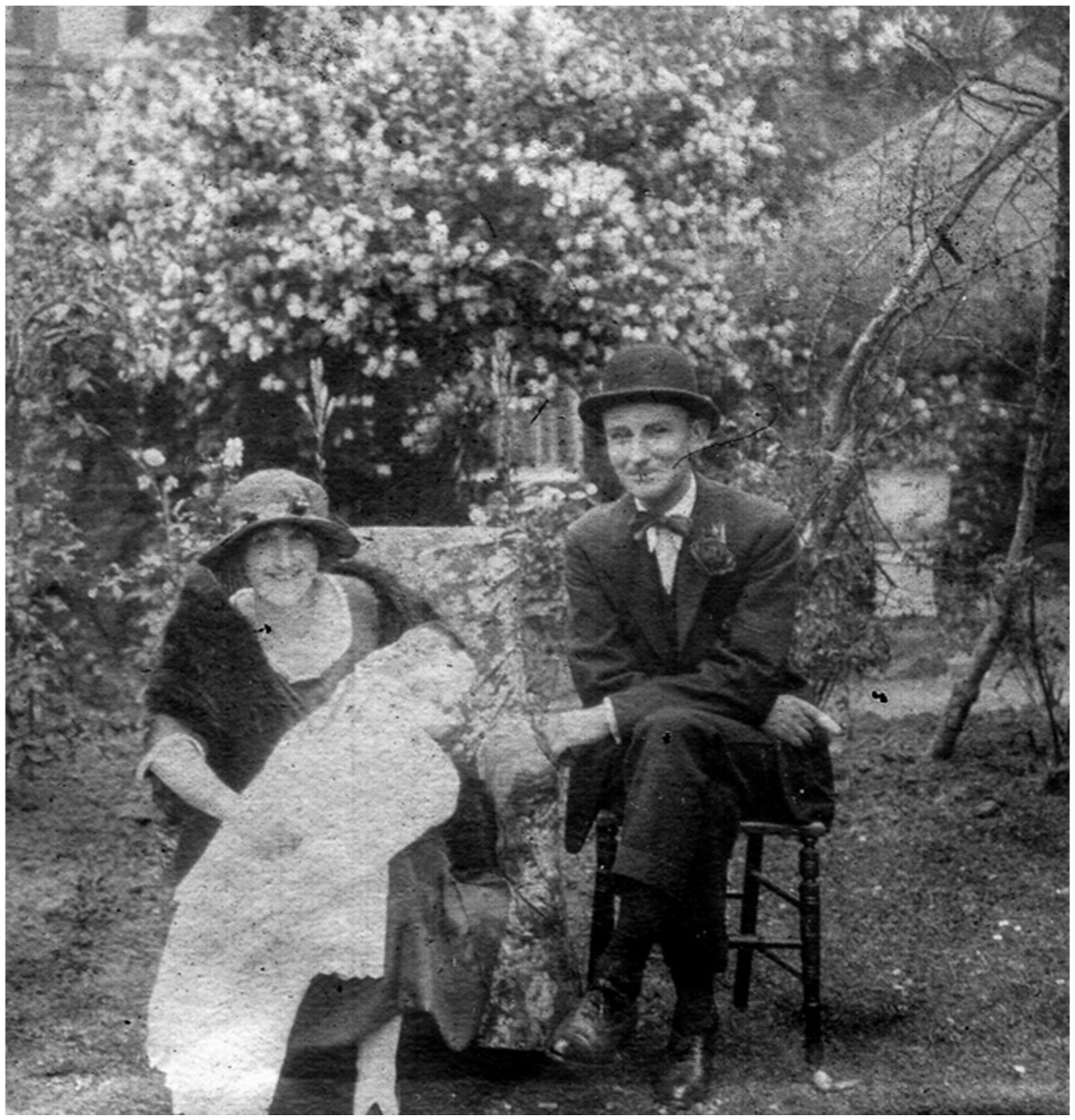
There’s a photo from the early 1920s of Rosie and Thomas. Thomas is sat cross legged on a chair, looking at the camera (Figure 3). Rosie smiles, my Grandad’s brother who was to die in the Second World War then a baby on her knee. To me, Thomas’ expression conveys a kindness. Perhaps I feel that from the photo because his posture and smile remind me of Dad. Somehow, Dad sits in a similar way, and often carries the same wry, kind expression that I feel from Thomas’ face. I’ve always loved Barthes description of how the punctum of a photograph ‘pricks’ or ‘bruises’ a viewer, how it folds pasts and presents. 3 I keep returning to a long-gone scene and wonder how a posture and way of smiling passed between Grandad and Grandson and their worlds, if it did: two men who would never meet each other.
Rosie and Thomas Anderson.
Some stories are barely available to us, no matter how much we desire to attach to them. Some attachments to place will always be too shadowed by the detachments that made us, and we’ve long carried without knowing. That’s the way it is for me and the North-East. Thomas’ North-East, a world of the mass killing of young men in war, of a place that no longer exists built for a Colliery that no longer exists, of shipyards now quiet and nearly vanished, is too distant from mine. His life is only barely imaginable, in just remembered fragments, a few images, a gesture and a smile that echoes one I know well. But a bell that accompanied my childhood and remains in a house that I visit is now something different, almost but not quite securing a fragile desire for a different relation with place and its pasts.
What might have been different if I had attached to a story the bell carried before now? What promises and threats do our detachments hold out to us? What losses might they bring, what might they offer? What of Thomas’ world remains?
Footnotes
Acknowledgements
In remembrance of Thomas and Rosie Anderson, in loving memory of Robert and Lorna Anderson, and with love to Adrian and Rosemary Anderson. Thanks to Adrian and Rosemary for family history research, to friends and loved ones for their generous responses to this story, and to Caleb Johnson for his attentive editorial feedback on a previous draft.
Ethics statement
Consent secured from all living participants named in the paper.
Funding
The author received no financial support for the research, authorship, and/or publication of this article.
