




Abstract
The social and material landscapes of post-industrialisation in the North East of England are replete with the ghosts of past. It is important to consider and examine the area’s demolished buildings, buried identities, people lost and ideas forgotten because they are important in contextualising contemporary issues of social inequality, economic disparity with the rest of the UK and lack of infrastructure that persists in the region. Transformed uses of colliery spaces, visually serve to re-ruralise the spaces between colliery towns, however, the spectral legacy of industrial heritage remains in economic, historical and ideological imaginings of place. This short essay offers a literary walk through Elemore Park and Herrington Country Park, sites Former colliery sites situated in the Coalfields area of the City of Sunderland. I walk through the present landscape, but imagine, in italicised interpolations, the ‘ghosts’ of people, ideas, ideologies, actions that still haunt the contemporary endeavour to renovate. I address the unease that remains in re-ruralised post-industrial spaces in a literary style that seeks to perform that spectrality.
It’s soon that pit nee mair Ah’ll see Ee aye Ah cud hew But Ah’ll carry it round inside of me Now me hewin’ days are throo
Ed Pickford’s acapella paean to the travails of colliery life articulates the conflicting feelings towards an industrial heritage that casts an often traumatic pall over the physical and social landscapes of the North-East of England. The song describes both a pride in remembrance and an inability to forget that is physical and psychological (coaldust and memories are both carried equally by the protagonist). A dual desire to remember and inability to forget has shaped a landscape where physical sites of industry have been reshaped in uneasy accord with rural surroundings. This is perhaps especially evident in the reclaimed colliery sites that form a constellation across the Coalfields which comprise an archipelago of towns and villages on the border of Sunderland and Country Durham. This is a land shaped by the industry of coal mining, the demise of which is still a livid, ubiquitous concern. Converted into country parks, many of these former collieries are now curated green spaces. But there is something uncanny, something spectral, something haunted (haunting) in their curation. Hills are often too rounded, lakes are too neat at the edges, pathways are cut too purposefully through their landscape. These spaces are surrounded by ghosts – hauntings of the past. By ghosts, I invoke and conjure identities and communities formed around colliery life, industrial innovations, as well as the lived traumas of industrial work, and of having that work removed, of poverty and deprivation. Ghosts are spectral memories that are recalled and ‘carried around’ and etched into landscape. They linger or ‘haunt’.
These ghosts imbue the landscape, in the memories of places and ruined buildings; they are part of what makes sense of the region’s heritage. These sites are palimpsests – or maybe even more strikingly – they exist as concurrent spaces. The present ‘park’ is read alongside the past ‘colliery’. The present is written atop the past, but it does not erase it. Indeed, the present maintains the past, albeit as a spectral apparition often seen in fleeting glimpses. This writing attempts to recognise ghosts in the landscape and illustrate a ‘colliery-and-derelict-and-park’ simultaneity – the trauma of disappearance and deindustrialisation is the spectral presence that connects the past with present.
This brief writing offers a literary walk through two sites in Sunderland’s post-industrial heritage. We visit Elemore, a colliery-turned-golf-course-turned-derelict-site-turned-country-park, and Herrington Park, another converted colliery site. Inspired by Lisa Hill’s essay, 2 this work offers something of a séance in the scenery, calling upon ghosts that collide with one another, etching themselves into the meaning of the reclaimed rolling hills. Hill’s own literary walk through the Royal Forest of Dean looks ‘beyond the presence of. . . places to focus upon absence, loss and haunting’ to offer a ‘spectral’ reading of the landscape where ‘the spectral is not a ghostly spirit hovering over a concrete world of real objects and living bodies, but is integral to our experience of the world, as the enduring and unsettling capacity of place to haunt’. 3 I follow Hill’s assertion that the ‘spectral unsettles any linear understanding of time’ 3 by writing of walks through country parks, interpolated by italicised spectres of places, people and events not present. These passages incorporate memories (collective and personal), people, places and events which all exist in a non-linear landscape to illustrate that these ghosts are integral to understandings of post-industrial place.
Elemore colliery/park
A spring afternoon that promises rain, my son and I, armed with bin bags and litter picking claws, are walking through Elemore Park. It is our valiant effort rid the landscape of litter. We start at a bridleway gate that leads back, past burn and bramble, to Hetton le Hole. We fill a bag with an etiolated cache of cans and crisp bags, bottled and vapes, all faded into spectres by sun and rain and abandon. We walk past greens fading back into re-curated wilderness, past sand traps being gradually encroached by sycamore saplings. From the top of a hill, the view leads out onto a lake that is metamorphosising in real time, its sides soothed, waterfowl returned, weeds and reeds are clambering at the edges. Reborn as a park, the landscape has been re-ruralised, returned, through myriad iterations, to its ‘original’ guise. It leaves the ghost of something uncanny. Reminders, remnants, uncomfortable compromises. Maybe these too will fade? The presence of the golf course seems to have elided, written over, the traces of the colliery. Maybe the ghost of the coal is so ubiquitous in a space like Easington Lane that it needn’t be so explicitly called forth?
In my mind, I walk from the rolling greens of Elemore Park to Easington Lane Community Access Point, a towering brick and sandstone edifice on the Brick Garth. A heart, a home. I walk through the doors, past the charity shop, past the vegetables grown in gardens out the back and made available for anyone, past food parcels and children’s play centre, up the grand stairs. I’m met with a wood-panelled room, shrouded and replete with ghosts, with memories, collected and collective. Faces, stern and sepia stare out from the terraced rows of photographs. They stand at shop fronts, arms folded. They collect at workplace gates. They call out. They are familiar – literally to the residents who donated them to the collection, who recognise friends and relations gathered here. But they are familiar in their everydayness, in their gathering by the buildings and monuments that linger still, that connect them to the present from the past, that make their past our present.
We walk down a pathway lined with lithe saplings. I am reminded of something a friend had observed as a virtue of this reclaimed landscape. It allows, he said, for the eye to flex its focus muscles, to zoom in and out, to look out to the horizon, then focus on the immediacy of the foliage in front, to examine detail then contemplate context. I wonder if the same is true for past and present. Does a space like this offer a chance for the memory to zoom in and out? Do past and pasts, present and presents, maybe even future and futures, become horizons and details for us to shift between?
My eye zooms out to Copt Hill, to the sentinel Seven Sisters, beech trees that stand atop the hill. On this elevated site between land and sky, a huddled clan of Mesolithic mackems mourn the loss of their chieftain and inter the bones among the stony earth, reversing the process of extracting minerals from the ground. On the same hillside, standing shoulder to shoulder, separated by millennia, George Stephenson, frock coat fluttering, stands buffeted and undeterred by the crags and undulations of this tempestuous valley. Stephenson’s eyes zoom out to his future, our past, his horizon, our detail, and he imagines lines of iron and sleeping slabs of timber stretching to the Wear. He imagines a relentless iron horse galloping over hills, breathing fire and plumes of smoke. He imagines something that does not exist, that cannot exist, but inevitably has to. The ghosts linger long after Stephenson’s imagined future has rusted and eroded into convenient leafy walkways, green traces that connect green spaces, mapped by leaflets and websites,
4
leaving a ghostly green ribbon, a tracing of a scar or an artery that brought the earth to the water, to the rest of the world. The smoke and steam still stain the air, still arrest the senses. Burning coal to deliver coal.
My son and I continue our walk. We lose ourselves in the landscape, forget our mission and the way back home. We skip down dells where colliers hued, trudge back up hills where golfers strolled. At the bottom of one hill, we are stopped by a brilliant blue shard of plastic, shorn and split, a sledge sliced in two by the stones below the snow, an apparition of a snowier day hurled with frustration at fun curtailed into the trees. We radge it down, bringing bark and branches with it, and add it to our bin bags. We listen to the hum of insects in the humid afternoon. The clubhouse-turned-café reappears over the crest of another rolling hill, and we find ourselves back in the carpark (Figures 1–3).
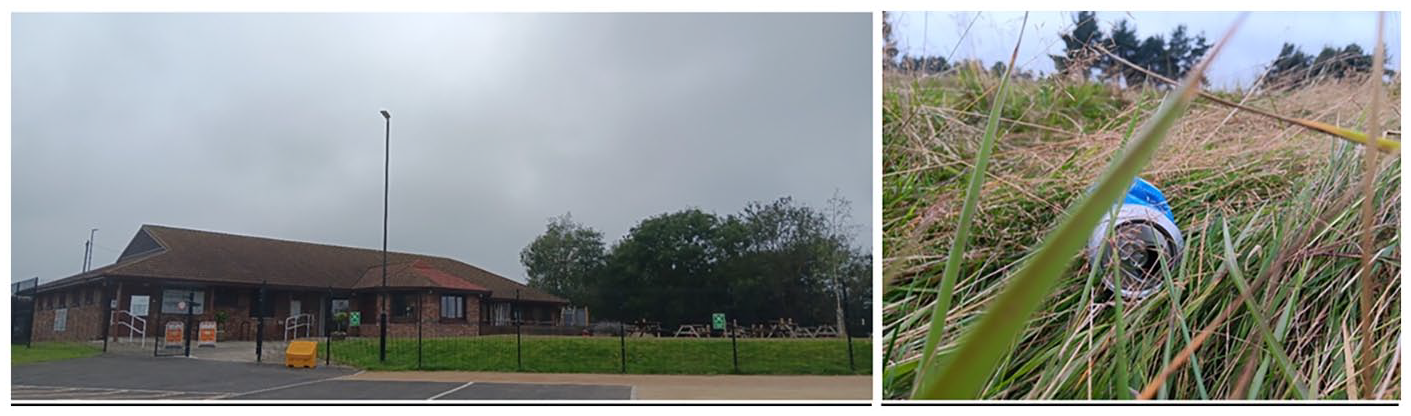
The entrance and litter at Elemore Park.
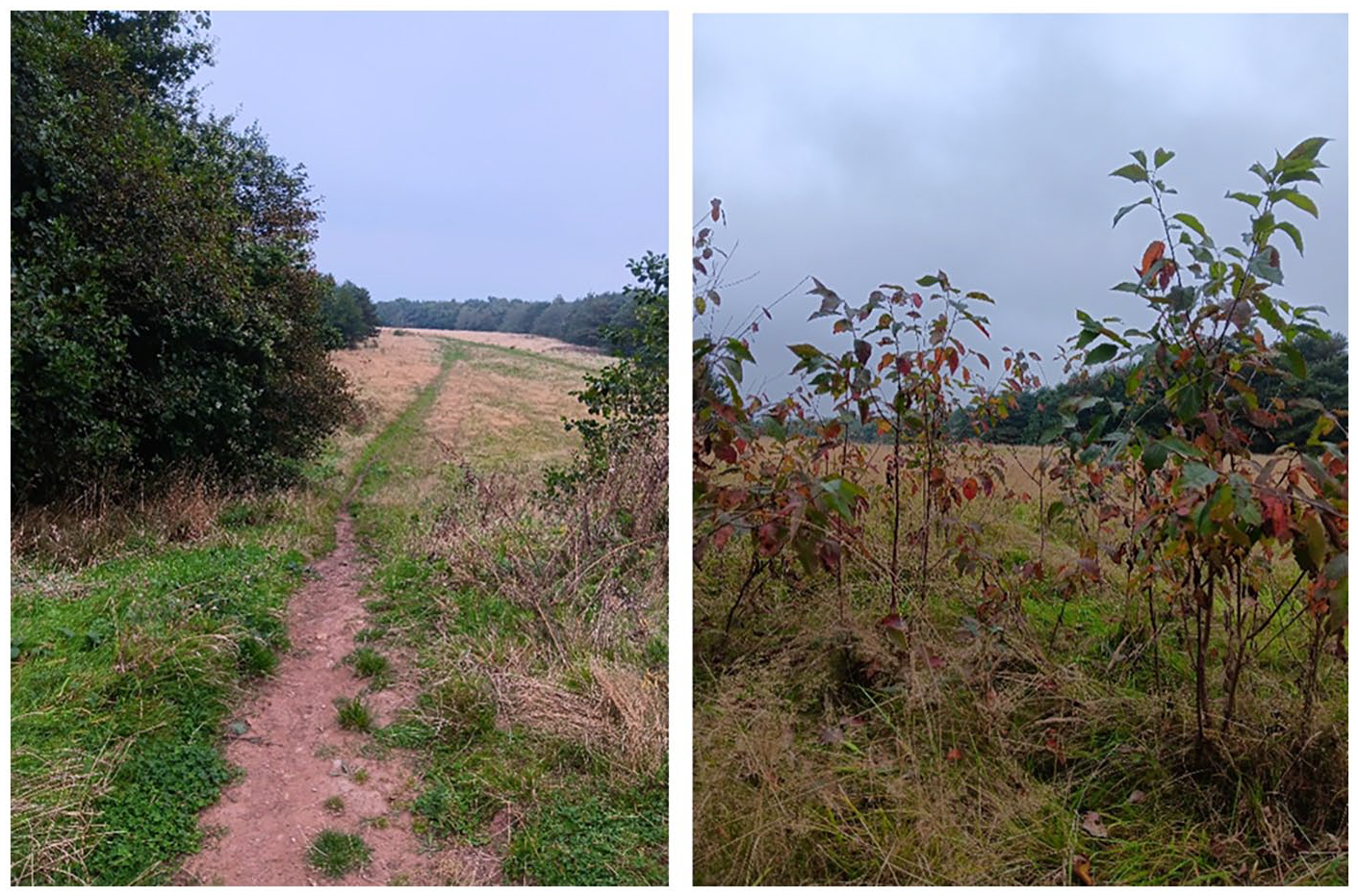
Pathways and saplings, Elemore Park.
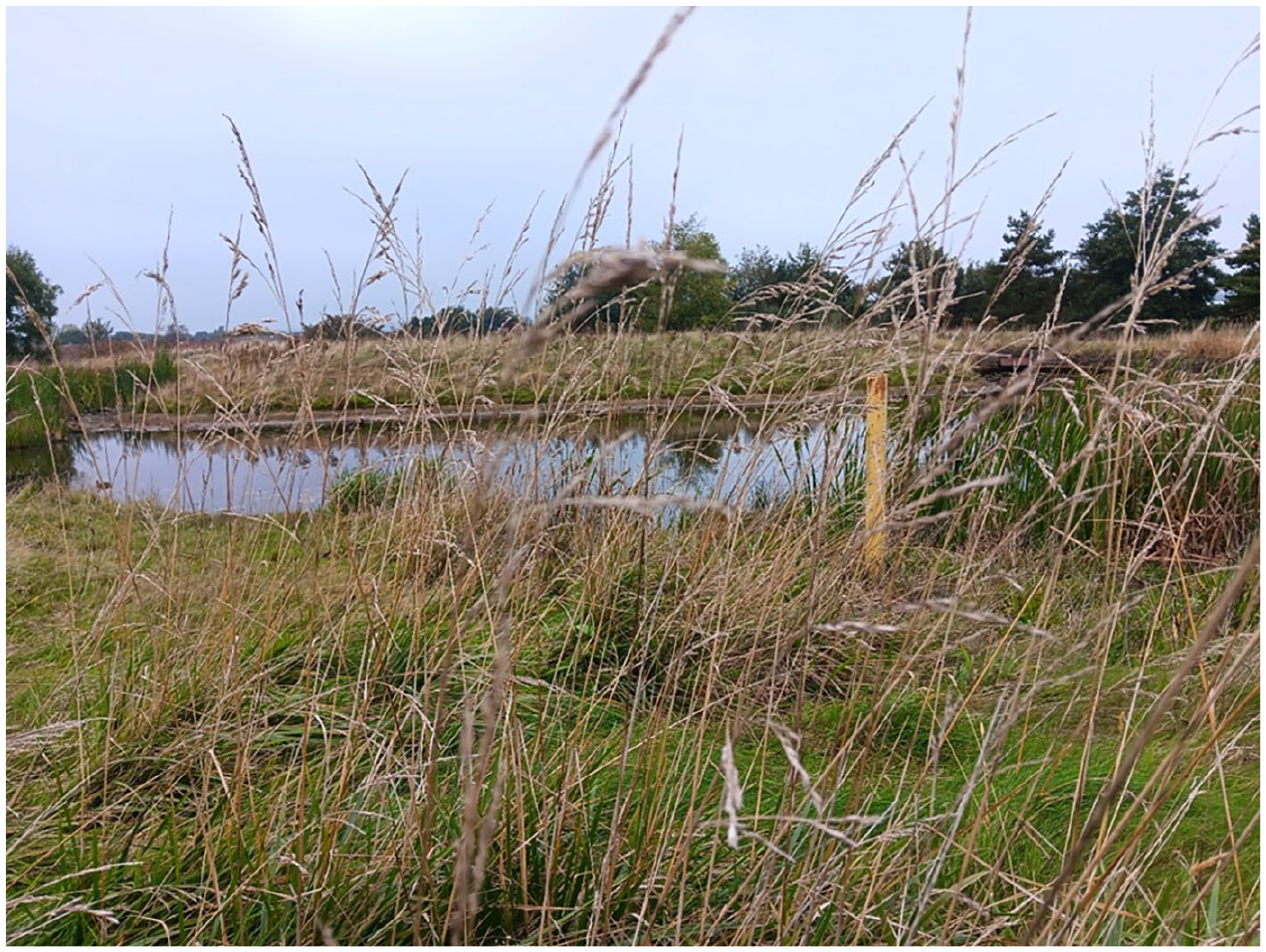
The lake at Elemore Park.
Herrington country park
On another day, the coal dark sky closes around me as I walk along the meandering pathways in Herrington Park. The park is sprawling green and rippling with lakes where waterfowl are replete. This is Herrington Colliery. The park sits serene and unassuming in the landscape. It has a feel of always having been there. And yet, it sits strange. The pathways are not drawn direct, with desire or destination. They meander. Some of them lead nowhere, others seem to lead to everywhere at once, a ribbon of water expands and contracts from meagre rivulet to engorged pond along the windswept expanse. An amphitheatre, a skate park, a statue, a mound. It’s hard to make sense of. Too many pathways, too many options. I walk up a spiral pathway around the circumference of a hill too round and smooth, shorn dark green grass. At the summit, a sculpture
5
made of sandstone miniature monoliths stand out against the darkening clouds. It simultaneously evokes the spirits of a stone circle and a quarry. Hovering between the stones are metallic figures, black against the darkening sky, drizzle soaking each surface, puddles among the stones. Desire lines cut in the grass by countless feet marching up the hill determined to reach the summit or furrowed by walkers chasing escaping dogs back down. In the darkening of the winter afternoon, the views stretch across the fields falling to the horizons in each direction. I peer through one of the sighting boxes of the sculpture and see the smooth lines of hills, the rounded grey ripple of the lake, the slick deep green of the park. Here and there, a solitary figure walks a dog through the rain. Another gap in the stones offers a view of the unending patchwork of fields, the stretching pockmarked pastoral County Durham and the vague black smudges of towns in the valleys: Herrington, Newbottle Great Lumley.
From these coal towns I see the ghosts streaming desire lines into the soil, walking to Herrington Colliery from these satellite terraces. They walk in silence from these rows to the mouth of the colliery. They are swallowed by the earth, they swallow the earth, one lungful at a time. They reemerge and float their way onto the photos in myriad ‘Memory’ books. They float into the imagination of what it meant to be a man, they stalk unemployment figures, hover over violence and desperation. What it meant. What it took. What it would take. When men were swallowed by the earth. I walk down to Shiney Advice and Resource Project in Shiney Row a community financial agency that serves as a community hub. I walk into the library, comprised of books remaining when the public library closed, and look at the New Herrington Miner’s Lodge banner, of which ShARP are proud custodians – august golds and reds, oil painted faces of the ‘Men of the People’.
I look through another sightline and I see the hill, dappled grey and brown, denuded trees and yellowing grass, soot-blackened sandstone in columns on top of the hill: Penshaw Monument, a displaced Parthenon weathering the wind and rain. The perennial black dot on every horizon, visible from everywhere, peering out across the coalfields from above. A pathway cuts across the lapping lumps of the hill leads up to the monument, always already anachronistic.
I see at the summit the faux-ceremonial Masonic blessing of the faux-Greek stones, ghosts upon ghosts, tracings of tracings. I see the amassed crowd of faces watching the austere incantations under the drizzle that always falls, part in mirth, part in alleviation of the everyday. Below the blackened stones, more ghosts wait. The aaful Lambton Worm laps its tail, constricting the landscape, waiting for the night to fall and the feast to begin. There’s the ghost of brave and bold Sir John, sailing back from tempestuous climes to cleave the terror. There’s the ghosts of the bairns swallowed alive. Swallowed again by the soil. And then the ghost of my grandfather is standing next to me on the hill, singing unending verses of the folk song. Whisht, lads. Haad yer gobs.
I walk back down the manmade hill and through the park, feet tripping through puddles. I get in my car and drive home (Figures 4–6).
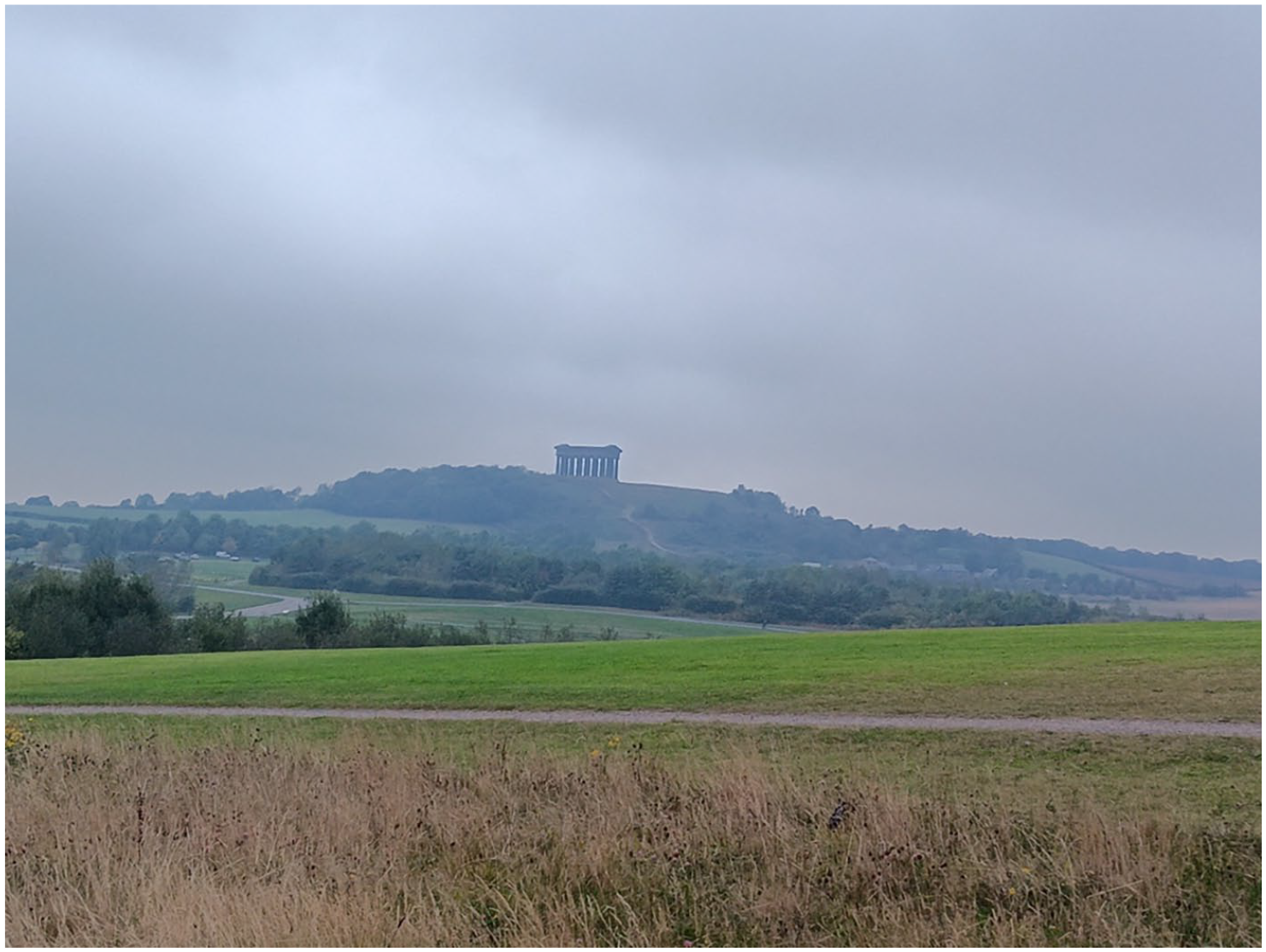
Penshaw monument, as seen from Herrington Country Park.
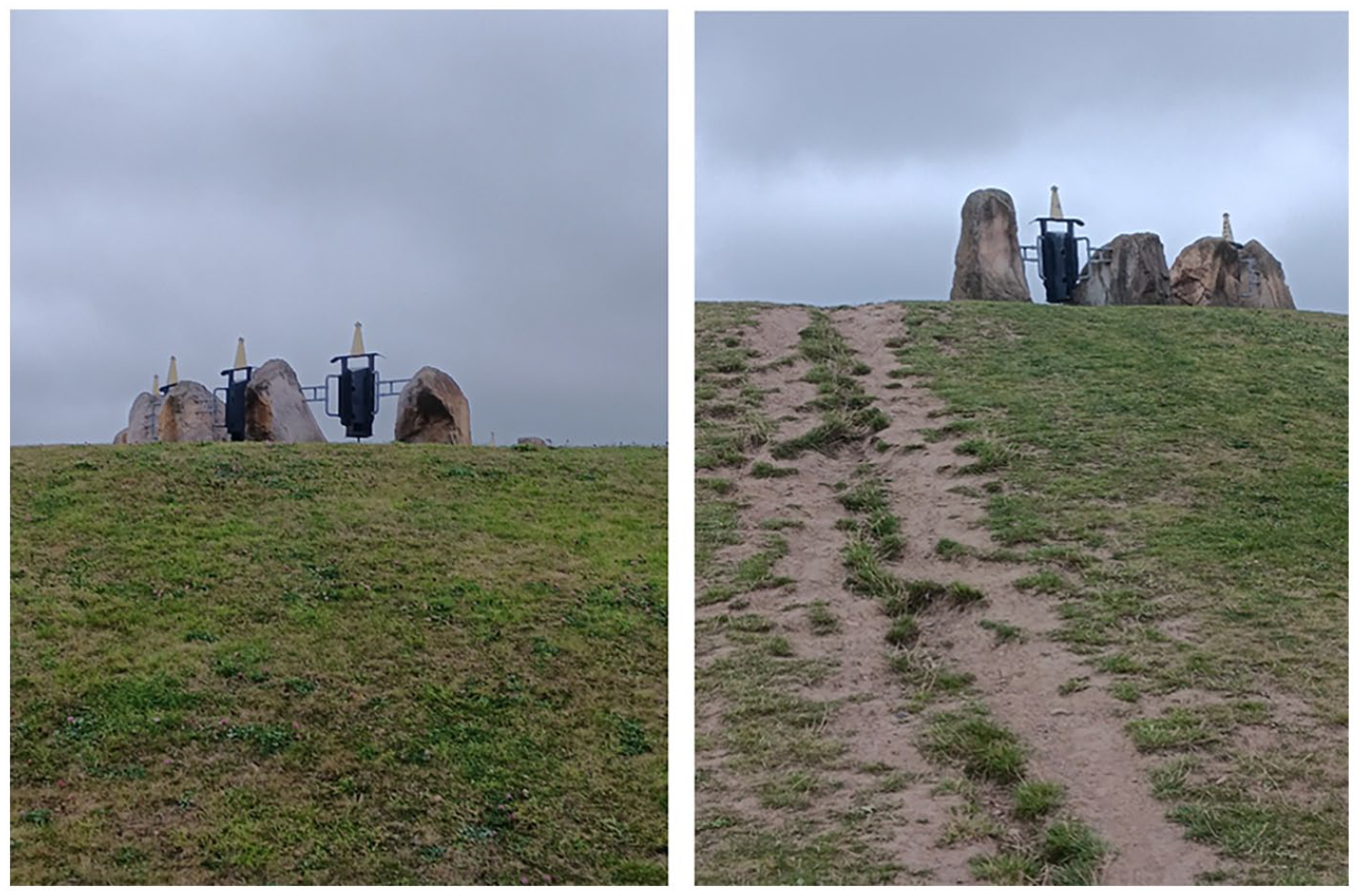
‘Site lines’ by David Paton, Herrington Country Park.
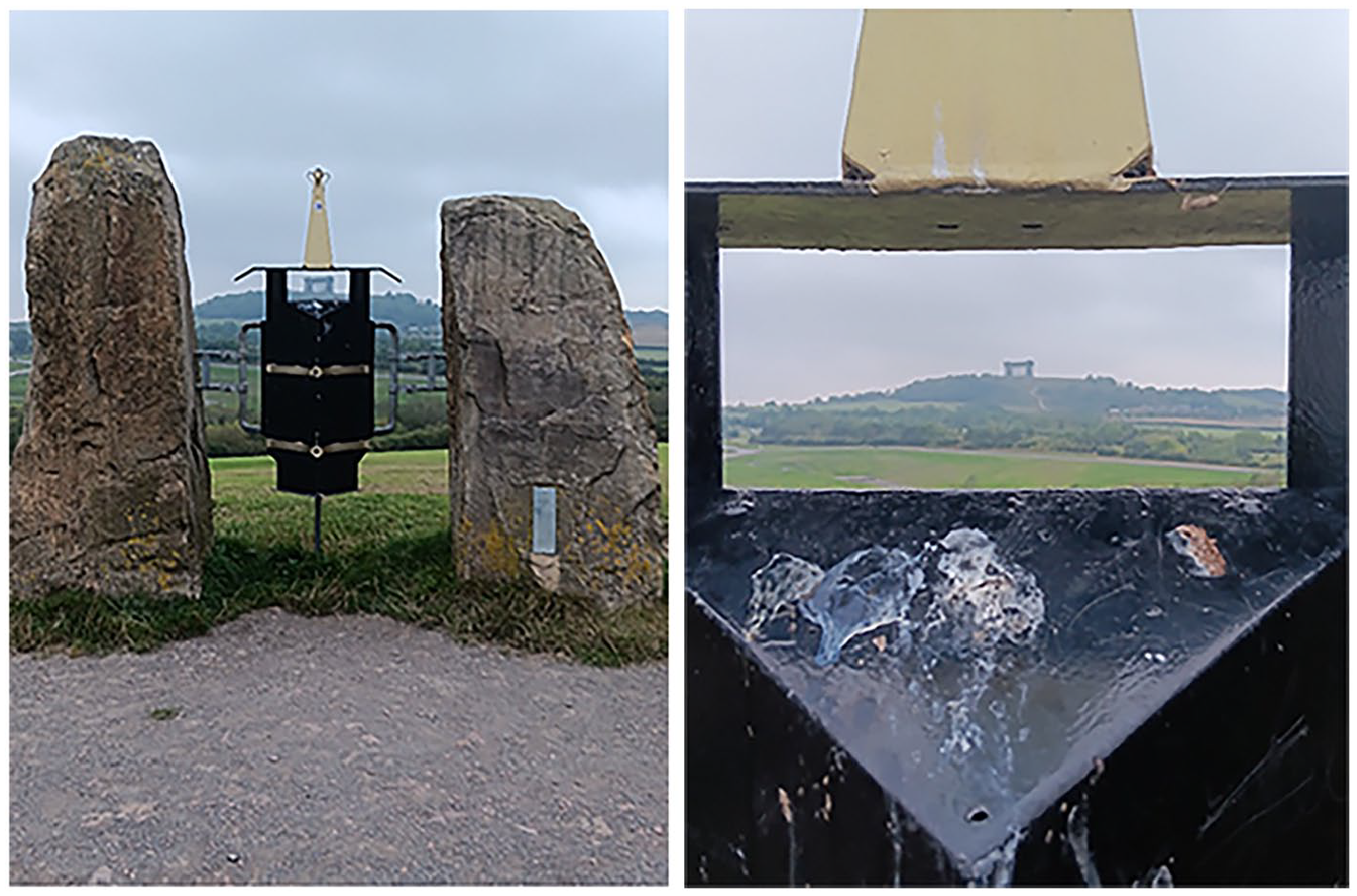
Penshaw monument, as seen through ‘site lines’.
But the ghosts remain.
Footnotes
Acknowledgements
My thanks to Dr. Elisa Villalobos for taking the photos that accompany the text of this essay. I am also grateful to the community centres mentioned in this essay: Easington Lane Community Access Point and Shiney Advice and Resource Project. Though this essay does not include any of the data, interviews or work undertaken there, I would like to acknowledge Sunderland City Council, where I worked as a community engagement worker. I am grateful for the opportunity to visit a large number of community centres across the region and to talk to residents about their lived experiences.
Funding
The author received no financial support for the research, authorship and/or publication of this article.
Ethical approval
This study relied exclusively on publicly available archival materials. No human subjects were involved in the research process. All sources have been properly cited in accordance with academic standards.
