




Abstract
This article examines how environmental trauma develops and is passed across four generations of women living beside a dammed river in Northern Finland. Through their connected life stories, it traces the emotional, cultural and psychological impacts of hydropower-driven environmental change. Once central to identity and livelihood, the free-flowing river has become a regulated, quiet presence and its silence echoes the community’s muted grief and disrupted memory. Drawing on cultural trauma, ecological grief and land-based violence, the study views unwanted environmental change as an ontological rupture that unsettles place attachment, historical continuity and intergenerational storytelling. Trauma emerges not only through spoken accounts but also through silence, embodied practices and emotional atmospheres. The river’s silence becomes both literal – an altered soundscape – and metaphorical: a gap in memory and an unvoiced legacy of loss. By tracing how this trauma is remembered, repressed and reactivated across generations, the article challenges individual, medicalised views of distress and argues for a collective, place-based understanding of environmental suffering. It ultimately calls for ecological restoration that addresses not only damaged landscapes but also broken narratives and disrupted relationships with place.
Keywords
Introduction
Through the interwoven life narratives of a grandmother, her daughter, granddaughter and the echoes of a great-grandmother, this article investigates the emotional and cultural impacts of drastic environmental change caused by hydropower development. In this article we understand sudden, unwanted changes in the environment as traumatic experiences, and look at trauma and ecological grief through a cultural lens. 1 With our research case we focus on the concept of environmental trauma 2 and examine its manifestation and transmission through four generations of a family living local to the river, and a part of the land along with the river.
Hydropower development in northern Finland began in the 1930s and accelerated after the Second World War, when electricity production became a national priority for reconstruction and industrial growth. The Kemijoki River was transformed into one of Europe’s largest hydropower systems: construction started in 1948 and eventually included 17 power plants and 2 reservoirs. On the neighbouring Iijoki River, five power stations were built between 1959 and 1971.
Damming reshaped the physical and cultural landscape. Migratory salmon disappeared entirely, as no fishways were built, and centuries-old salmon fishing traditions collapsed. Homes, farmland and reindeer pastures were submerged or replaced by dams, reservoirs and new roads. Many residents lost both livelihood and property. While hydropower brought employment and infrastructure, local concerns received little attention, and those affected had no power to oppose the projects in the political climate of the time.
The damming led to sweeping environmental transformations, affecting not only the physical landscape but also the socioecological and cultural fabric of local communities. The priorities of the time lay in engineering achievement and economic progress; environmental and cultural concerns received little attention, and the voices of local people went unheard.
Klaus Eder 3 has argued that maintaining a modern world requires the exploitation of nature, but at the same time it causes anxiety for people. In addition to the exploitation of natural resources, unwanted changes in the environment can be caused by natural disasters or human-made ecocides, such as wars. A body of research suggests that physical environments have many positive effects on people’s social, physical and mental wellbeing. 4 Unwanted and sudden environmental changes can cause negative health effects or even trauma that spreads both vertically across generations and horizontally through communities, persisting and re-emerging over time. 5
While Eder makes a distinction between modern world and nature, this article challenges the usefulness of the nature–culture binary that has structured much Western environmental thought. The dammed river is not a passive backdrop against which human suffering unfolds, but an active presence that shapes memory, routine, belonging and safety. The notion of trauma itself becomes relational: people grieve not only for a damaged environment, but also for harmed people and companion species. Following scholars of more-than-human geography and relational ontology, 6 we argue that environmental trauma cannot be understood if nature is treated as external to social life. The experiences of the four generations demonstrate that the river and the community are co-constituted; when the river is altered, the cultural and emotional life of the place is altered as well. Abandoning the nature–culture divide therefore allows a more accurate, situated account of how trauma emerges and persists within damaged landscapes.
Recent research has recognised the importance of exploring the social dimensions of environmental change as well as its social consequences. 7 There is a need for new conceptual frameworks to better analyse the lived connections between human and environment, their social consequences and impacts on health and wellbeing. Understanding stories of different generations within a family can enrich and inform discourses that critique the philosophy of how we centre our sense of self and experience our surrounding world.
Our starting point is the psychological trauma caused by a shocking event that causes severe stress. Loss, grief and suffering are closely related to trauma. However, when we engage with trauma, the common discourse pivots around its corporeal expression – bound within the body and interpreted through the clinical gaze. However, these are partly contested issues. Psychological trauma, so often confined to the constructs of post-traumatic stress disorder (PTSD) or other medical diagnoses, is reduced to measurable symptoms, to be catalogued, often pathologised and treated. This reductionism, while useful in its intentions to heal, can neglect the deeper, more insidious wounds that extend beyond the body. These can be argued to be wounds born of land violence – a concept that demands an unmooring from medicalisation. 8 This understanding has a strong base in our previous work and data at hand. 9
This article argues that environmental trauma is not only a psychological or cultural condition but a spatial and intergenerational process that unfolds through silence, embodiment and a damaged landscape. Land violence is not merely about physical displacement, but an ontological rupture. It fragments the self at the level of identity, culture, history and memory. The earth, here, is not just a ground to stand upon but an archive of belonging, inscribed with ancestral connections, spiritual inheritances and community bonds. At the same time, land is not only meaningful because humans have inscribed it with memory. More-than-human scholarship reminds us that earth is also a living, agentic presence with its own rhythms, forces and temporalities that exceed human representation. 10 Land does not simply hold memory; it participates in making and unmaking it. Violence against land is thus both a social rupture and a material interruption of more-than-human worlds. It is, whether through forced displacements, colonisation or environmental degradation, thus an assault on this fundamental archive – an erasure of memory, a tearing of the self from the collective psyche.
We ask how environmental trauma manifests among people that have experienced dramatic changes in their environment, and how trauma may pass on to younger generations. How are changes in the environment talked about and negotiated in the families between generations, and can these acts of negotiations reveal transfer mechanisms of intergenerational trauma?
Theoretical frame
Trauma was originally examined as a medical condition, but the concept has since gained attention across disciplines. Scholars have increasingly recognised the need to understand traumatic experiences and their transmission within social and cultural contexts. Early studies focused on trauma and post-traumatic stress reactions caused by the First World War, 11 while more recent research has addressed the impacts of the Second World War, the Holocaust and the Vietnam War. 12 Pioneers in social-science trauma research include Jeff Alexander and Ron Eyerman, whose work on cultural trauma is widely used. 13 We draw on their theories as well as the concepts of environmental trauma and land-based violence. 14 Environmental trauma refers to suffering caused by unwanted environmental change, while land-based violence highlights communities’ deep, embodied connection to land through ancestral knowledge, cultural practices and place-rooted stories. Relevant here are solastalgia and ecological grief. Solastalgia describes emotional distress when a familiar environment deteriorates, creating feelings of loss, displacement and powerlessness without physical relocation. Glenn Albrecht introduced the term to describe psychological effects of landscape loss on individuals, but it has since been developed as a socially constructed collective phenomenon, as suggested by Brown. 15 Ecological grief refers to emotional responses to ecological losses such as declining species, ecosystems or meaningful landscapes. 16
Environmental trauma is a long-term condition tied to harmful environmental change and the loss of everyday practices that connect people to their homeland. Although it begins with a material event that alters the physical environment, its effects reach into cultural, emotional and social life. Trauma-related disconnections occur when continuous practices – such as fishing, gathering, seasonal movement, storytelling or simply being on the land – are disrupted, weakening identity, belonging and ancestral memory. Delays describe how trauma may remain latent for years or generations, ‘hibernating’ until triggered by memory, threat or further change. Silencing refers both to the absence of public recognition and to individuals’ suppression of grief, whether due to institutional narratives of progress or a sense that suffering should not be voiced. Like other traumas, environmental trauma can be intergenerational, transmitted through silence, story fragments, emotional atmospheres, embodied practices and landscapes that continuously signal loss. At its most severe, environmental trauma threatens place-based foundations of life, including livelihoods, emotional ties to the environment and family and community histories. 17
We argue that negative environmental change threatens both place attachment and a sense of belonging. Scannell and Gifford 18 conceptualise place attachment as a multidimensional, tripartite model consisting of (1) the person dimension, (2) psychological processes and (3) place. The person dimension refers to who is attached – both individuals and groups – and includes personal identity, memories, biography and group identities rooted in a particular landscape. The psychological process dimension explains how attachment forms, through emotion, cognition and behaviour: feeling at home, remembering, longing, grieving, caring, returning, protecting or resisting. The place dimension concerns the physical and social qualities of the environment itself. Importantly, this dimension is not passive: places shape cultural practices, social relationships, sensory experience and environmental knowledge, and are therefore co-constitutive of identity and memory rather than merely symbolic backdrops.
When environments are radically altered – such as through damming – each dimension is disrupted. Physical transformation undermines daily practices and sensory familiarity; community narratives and histories lose their anchoring and emotional bonds become strained or ambiguous. Environmental trauma therefore destabilises not only the material landscape but the relational processes that sustain belonging across generations. 19
Belonging refers to an emotional attachment that creates a sense of being at home. According to Yuval-Davis, 20 belonging is constructed at three levels: through social locations (such as gender, class or age), through emotional and identificational ties to communities and ways of life and through the political and ethical values that determine who is seen as belonging. Lähdesmäki et al. 21 emphasise that belonging is always spatial, shaped by the places where everyday life unfolds.
In our research area’s riverine contexts, these spaces are inseparable from the wider environment. Belonging is produced through sensory familiarity, seasonal rhythms and daily relationships with land and water. The environment is therefore a condition of feeling at home. When the river is altered, the foundations of belonging shift: routines change, memories lose their anchor and familiar places become strange. Environmental change thus unsettles belonging across both emotional and spatial dimensions.
Recent more-than-human and decolonial scholarship encourages viewing environments not as passive settings but as active participants with their own agencies and rhythms. 22 From this perspective, the river is not merely a backdrop to trauma but a continuing actor in human lives. Its altered currents, muted soundscape, unpredictable ice, stagnant waters and missing salmon reshape routines, sensory experience and environmental knowledge. Indigenous and decolonial thinkers similarly emphasise land and water as relational beings with whom communities live and remember. 23 Trauma here is thus not only the loss of a river, but the break in a reciprocal relationship with a once-living, sustaining entity. The river’s continuing presence – its silence, danger and refusal to behave as before – keeps the trauma active. Environmental trauma becomes co-produced: people grieve the river, and the river shapes how grief, memory and belonging circulate. Recognising the river’s agency therefore shifts the analysis towards a relational understanding in which trauma exists between people and place.
Materials and methods
The data consists of qualitative interviews of three women, the grandmother, her daughter and granddaughter, all talking about their home environment and its changes. The informants have lived in the same place and have witnessed different phases of the river – a free river, a dammed one with dry riverbeds and a partially restored, heavily regulated one.
The first author, Autti, who conducted the fieldwork, also comes from a region shaped by dammed rivers, thereby intertwining her research with personal and communal experience. Initially, she approached the topic scientifically and at a distance, using research to process her community’s losses. Over time, she realised she was part of the very story she was studying: her own family had faced the same environmental changes as her interviewees, shaping the sensitivity of her questions. The research process uncovered both her inherited grief and the community’s collective trauma, including disrupted traditions and a weakened connection to the environment. Her role thus shifted from external observer to participant, becoming one of the voices through which the river’s loss is expressed. She reflects openly on how her position and emotions shape the work, turning her positionality into an active, reflexive engagement with her background, community and subject.
The starting point for this article was a research interview with Anna, born in 1937. Autti interviewed her in 2009 for her PhD research on local people’s experiences of hydropower production in Northern Finland. In summer 2022, Anna’s granddaughter Ella contacted Autti after reading her article and identifying that her grandmother was one of the informants. Grandmother Anna had died in the meantime. As Autti had made progress in her research on environmental trauma and was interested in its intergenerational aspects, she asked Ella for permission to interview her. The permission was granted and the researcher was presented with an opportunity to empirically examine the intergenerational nature of place-related grief and environmental trauma. The study setting became even more complete when Ella’s mother Laura also agreed to discuss her own relationship with place – how it had developed and the factors that had influenced it.
The interviews were carried out in full compliance with the ethical guidelines for research involving human participants issued by the Finnish National Board on Research Integrity (TENK). All interviewees were given pseudonyms, as well as the places they mentioned, such as the river in question. The interviews were qualitative research interviews; their form had features of both thematic interview and an open interview. All interviews were accompanied by a specific interest in personal narratives, local environment and its change. 24 The duration of the interviews varied between 1 hour and 2 hours. The interviews were recorded on audiotape and transcribed. The method of analysis was qualitative content analysis that included several thematic readings of the data. 25 The research questions guided the analysis to find the relevant themes to be analysed further, and the chosen key concepts structured the data further.
Because environmental trauma often appears in subtle or muted ways, the analysis focused not only on explicit narratives but also on indirect expressions: silences, embodied practices, emotional tones in family memories and references to the altered landscape as a constant reminder of loss. This follows cultural trauma scholars who note that trauma is often carried through non-verbal channels, as well as postmemory research showing that later generations inherit trauma through affective traces and gaps in family stories. 26 Studies of slow and spatial violence likewise emphasise how damaged environments act as enduring archives of harm. 27 Together, these perspectives support the idea that trauma can persist through silence, embodiment, atmosphere and landscape, even when verbal accounts are limited.
The qualitative, narrative approach enabled participants to describe how environmental change was felt in daily life – through memories, silences, emotions and bodily practices. Interviewing three generations from the same family allowed tracing how trauma and place attachment unfold over time, and how the river shaped identity, routines and belonging. As long-term residents with deep ties to the river, their accounts offer valuable insight into lived experiences of slow environmental change and its intergenerational impacts.
Findings
Anna – Grandmother who mourns for the Fate of the River
The interview was conducted at Anna’s home, Riverbend (pseudonym), where the river could be seen from the windows. The view showed the dammed river whose water level had been raised by construction of bottom dams. The family had lived there since 1771, and the house was now home to the tenth generation. The house was Anna’s birthplace and was now divided into two parts, one of which was occupied by Anna’s daughter and her family. ‘That’s the way it is, I belong here’, Anna said.
For Anna, the long family history, memories and sense of roots were important. Equally important to her was family and its continuity through her children and grandchildren. These factors reinforced Anna’s mental and emotional sense of belonging. This sense of belonging was sustained and strengthened by a variety of activities, as well as the aesthetics of the environment. Ann described how multi-sensory the experience of the environment is:
I like to be outside, I dig and sow and harvest, I have my own grapes and currants and strawberries. We have a smoke sauna. Last Saturday I sat up late in the dark after the sauna until the heat evened out, so it’s quite a princely feeling, just sitting and looking at the stars.
The aesthetics of water was important to Anna: ‘I do all my work so that I look at the river all the time, even in the kitchen, haha. It’s incredibly important’.
By Anna’s home, there had been powerful rapids in the river, always roaring. But when the nearest hydropower plant was built in the 1960s and the water was diverted through a new channel, the old riverbed remained dry for about 10 km. The dry riverbed soon began to grow dense willow – see Figure 1. Only decades later the water level was raised by the construction of a series of bottom dams. Today, the river near the house resembles a stagnant pool rather than a free-flowing river.
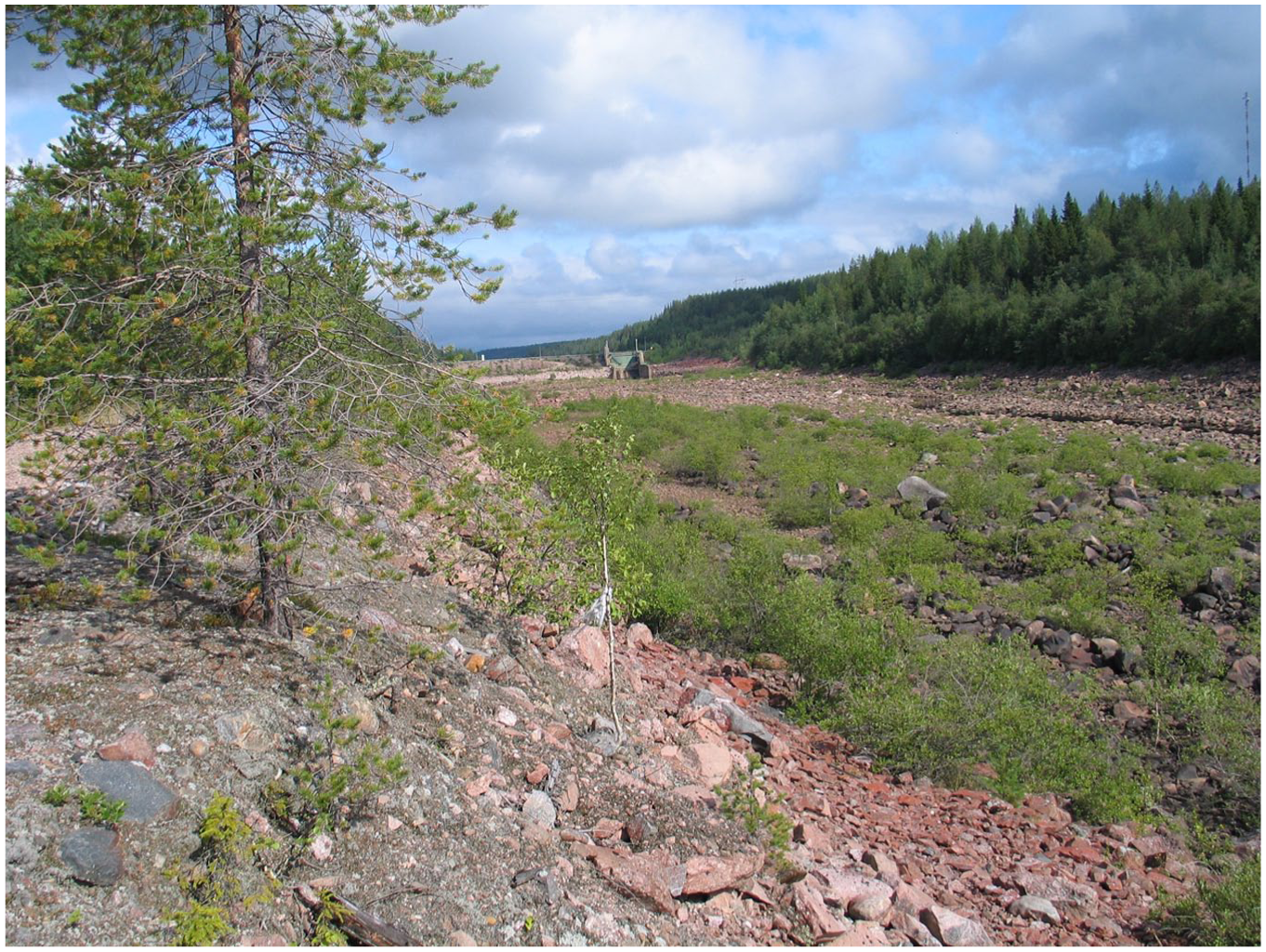
A riverbed stretching for many kilometres lies dry downstream of the power plant. The river’s water has been diverted elsewhere, photo by Outi Autti.
Solastalgia and ecological grief surfaced when Anna spoke about the river’s transformation. She cried as she described her sadness and bitterness: the river she knew was gone, and recreation was impossible without major restoration. The landscape had become aesthetically unpleasant, with houses now bordered by steep, paved banks ‘like a stone ruin’. She stressed that even privately owned land forms a shared landscape.
The altered river felt strange, unpredictable and dangerous. Anna worried her grandchildren might be injured while swimming, and winter ice had become unreliable due to water releases. She was frustrated that the hydropower company neglected the environment and that locals were insufficiently consulted; dredging, willow clearance and other restoration work were still urgently needed.
Restoration moved slowly and depended heavily on local initiative. Anna also feared future developments, such as recurring proposals for an upstream reservoir. Her sorrow stemmed from both the environmental damage already suffered and the threat of further change: ‘It would be a huge sadness if they . . . built that reservoir’.
Anna channelled her grief and anger into clearing bushes to keep the landscape open: ‘I have dug up those big willows . . . but it takes a lot of guts’. The damming of the river and future threats evoked strong ecological grief. Her mother’s earlier activism had inspired her, and Anna wrote critical statements on plans for an artificial lake, challenging the hydropower company’s claims that the reservoir and hydropower were ‘green’. As her activism grew, she joined an annual rowing event for a free river, emphasising the beauty and vulnerability of the still-unregulated section and wishing decision-makers from southern Finland could see it. Her actions show how grief and attachment can transform into collective resistance, turning the event into a counter-memory practice that recalls the once free-flowing river and challenges dominant narratives of hydropower.
Environmental changes had weakened Anna’s trust that meaningful restoration would occur, and she viewed the company’s small-scale projects as attempts to gain public support. Her story reflected a four-generation relationship with the river, where environmental change harmed her well-being and deepened trauma by witnessing her mother’s suffering. She described the sudden drying of the river as psychologically devastating for both of them and believed the rapid, unwanted change and people’s limited ability to resist it contributed to her mother’s premature death. Anna saw this trauma as shared by the wider community, not only her family.
My mother suffered from it terribly [starts crying]. It is difficult to talk about it. Mentally, it has been an awful situation. And they had no intention to fix the damage. The damming caused the death of my mother, in my opinion. She was 60 years old [cries]. I have understood that in some areas there were suicides. Life was so [. . .] shocking.
Anna’s distress highlights the scale of what was lost. For her mother’s generation, the river was a source of livelihood, food, seasonal rhythm, recreation and identity. Families fished, swam and gathered along its banks; the river shaped daily routines and connected people to neighbours and ancestral history. When it was dammed and salmon disappeared, these practices ended abruptly. Many older residents experienced the shift as a deep rupture, with no public recognition or possibility of repair, turning grief inward.
Anna linked her mother’s death and the community’s suffering to decisions made by distant authorities who ignored local voices. Residents were forced into long legal battles, and only the Supreme Court eventually required the company to build bottom dams – constructed decades later. She also mentioned locals becoming ill or even dying by suicide, tied to the shock of environmental change and a sense of injustice. Environmental trauma stemmed not only from the event itself but from its aftermath: powerlessness, disappointment in society and the difficulty of resisting. The damage was authorised and framed as progress, yet never acknowledged as harm, leaving residents without language or space for grief. Power lay with companies and distant decision-makers, making locals feel unheard and invisible in decisions about their own landscape.
Laura – Daughter who tries to think positive
Laura, Anna’s daughter, now lives in Riverbend. Although she grew up elsewhere, she spent every summer there and considers it her home. Born in 1969 during hydropower construction, she grew up beside an already regulated river. She did not experience the transformation as sharply as her mother and grandmother but still noticed environmental changes.
River-related activities – swimming, fishing, rowing, skiing and skating – were central to her ever since her childhood, and the river remained important despite being dammed. Still, she recalled problems, especially in the 1970s, when agricultural runoff made the water dirty and stagnant between the bottom dams. Water quality has since improved, though the dams remain inconvenient for her kayaking.
Laura related to the altered river differently from her mother. She did not express the same bitterness or grief, though she recognised the ongoing sadness of regulation. Instead, she focused on what could still be valued: safety, recreation and some practical benefits. Her ‘think positive’ stance was not indifference, but a coping strategy – an emotional moderation that helped her live with an unchangeable landscape. It is a quieter response to the same trauma, allowing life to continue while the unresolved history lingers in the background.
When my children were small, I tried to think positively: it was safer than a strong current, and it froze early, so we could skate on natural ice.
Laura noted many of the same environmental problems as her mother: the river’s shallowing, scrub-covered bottom dams and the loss of a free, ‘real’ river. She also worried about unpredictability, recalling sudden water releases for maintenance that left boats and jetties stranded.
She had not known her mother linked the damming – and its grief – to her grandmother’s death. Although Anna rarely spoke about her sorrow, Laura recognised it through her activism: annual rowing protests and frequent family discussions about new hydropower threats, especially the possibility of another artificial lake.
Laura felt partly protected from the trauma because she had never seen the free-flowing river, yet she still sensed the loss. Her experience reflects Hirsch’s postmemory: imagining and inheriting grief without living the original event. As she put it, she could ‘sense it . . . and imagine what a free river would be like’ without firsthand experience.
She also observed ecological grief in the wider community: locals avoided the river, let trees grow to block the view and rarely spoke about it. The river had ceased to be a place of activity or connection.
They make very little use of the river, or enjoy the river, only few go rowing or fishing there. Even in the winter there are hardly any skiers there. It’s like the locals do not pay attention to the river at all.
Laura’s involvement in river restoration was moderate, as she tried to avoid conflict. The proposed human-made lake was especially difficult for her because it split local opinion, even within families between those prioritising jobs and those prioritising the environment. She managed this tension through internal negotiation and presented herself as largely content with her surroundings. She voiced negative feelings mostly through others’ experiences, maintaining a cautious, measured attitude to avoid disappointment. She wished the river could be free again but saw this as unrealistic. Instead, she hoped to prevent further construction, improve fish migration and ensure better care of water quality and the landscape.
For Laura, the river was primarily a recreational space. She shared her mother’s concern about increasing overgrowth and hoped the hydropower company would release enough water to maintain adequate flow, making the river cleaner and safer for use.
Although Laura rarely articulated grief explicitly, her strategies of emotional moderation, avoidance of conflict and positive reframing can themselves be read as trauma responses. Avoidance and cognitive rationalisation, such as focusing on practical uses of the regulated river, downplaying negative affects and emphasising safety, are coping strategies and ways of managing inherited distress without naming it. Laura’s bodily vigilance, especially her concerns about dangerous ice or sudden water releases, shows how trauma can persist somatically even when emotional language is muted. Her annual participation in activist rowing events, despite her tendency towards moderation, also suggests a residual affective attachment to her mother’s grief and resistance. These subtle but embodied behaviours indicate not the absence of trauma, but its transmission through quieter registers.
Ella – Granddaughter who tries to understand what happened
Ella, Laura’s daughter and Anna’s granddaughter, was interviewed at her home in Riverbend. She was born in 1997. Riverbend was her permanent home until she moved to Southern Finland to study at university. ‘If there is a place to call home, this is it’.
For Ella, the long family history in Riverbend was important and it strengthened her sense of belonging. Many of the things about Riverbend that were important to Ella were the same as to her mother and grandmother:
There are so many memories from my childhood and teens here—canoeing, skiing, picking mushrooms, working in the garden. Those things I will miss if I don’t get to be here.
For Ella, being near water and in a quiet, spacious environment was essential. The riverside had been a versatile place where she learned to swim, row and navigate winter ice. Riverbend shaped her desire to live by water, ideally by flowing water. More accustomed to the regulated river than her mother, Ella long saw it as a ‘real river’, having no experience of free-flowing ones. The bottom dams kept water in place during her childhood, so she never saw the dry riverbed. Seeing dams and waterless stretches elsewhere, she did not realise these conditions were unnatural.
In her family, the river’s transformation was rarely discussed. Anna never voiced her grief, though Ella understood the river’s importance to her through her activism and restoration efforts. Anna even took Ella along when clearing bushes from the riverbanks. Ella wondered if the gap between the generations is the reason for the silence in her family. It could also be that Anna wanted to protect her children and grandchildren from unnecessary grief. ‘She probably did not want to pass the burden on to us, or maybe she did not know how to talk about feelings or did not want to complain’.
However, Ella remembered occasions from her childhood when her grandmother, mother and aunt discussed the further construction plans to the river. The memory also conveys the cracks of moderation that emerged during her mother Laura’s interview. Ella remembered the situations well because of their unusual affectivity:
They talked about the planned human-made lakes, they were really angry and they opposed it strongly. I didn’t understand then why. But it has stayed in my mind that it was talked about, and they were angry.
Ella had woken up to her lack of knowledge of the history of the river. She had difficulties understanding why the stories she had heard did not fit the dammed river she knew.
If you see an exhibition about the river’s history or hear about log floating, you wonder how logs could pass the dry riverbeds—and then someone explains the river wasn’t always like this.
Ella’s interest in the river was piqued, and she began to learn about its history, current status and potential for restoration. She became aware that the river could flow much more water and started wondering what her home would be like if it did. Her favourite time of year is spring, when the ice is gone and the river is at its highest flow (Figure 2). With lots of water the river resembles a free river and that is when Ella appreciates it most.
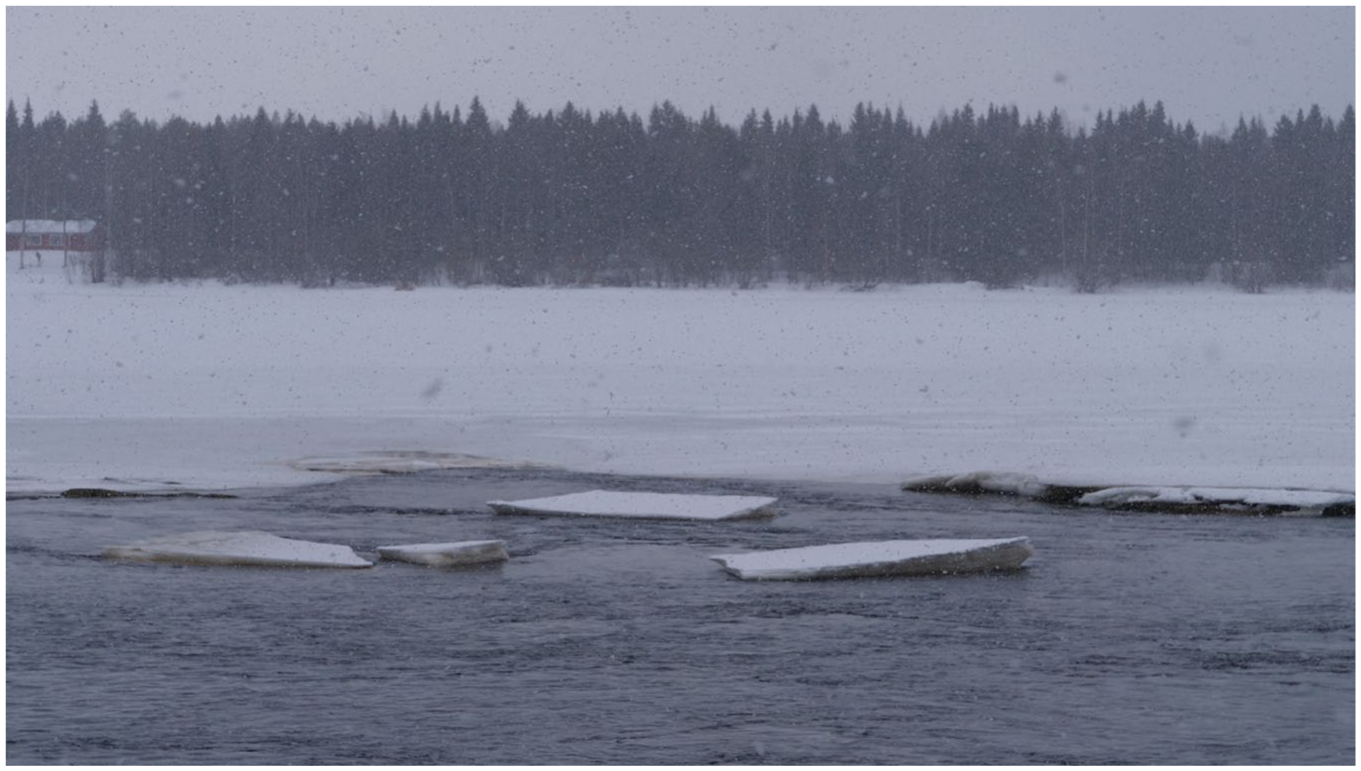
In Ella’s view, the regulated river is at its best in spring, when the floodwaters restore something of its former power. Photo by Invisible Flock.
Ella’s discovery of how little she knew about the river’s past sparked a strong desire to learn. Despite her journalism training, she struggled to find information: ‘I found some aerial photos, but otherwise it was hard to find how it used to look. The history I found began with the damming’. She also noticed that the community avoided talking about the river, except for restoration projects focused on bringing back salmon – an easier, more tangible topic than aesthetics, soundscape or emotional ties. Economic thinking shaped local debate: salmon could bring tourism and income, whereas ‘some soundscape isn’t going to put a penny in anyone’s pocket’.
Environmental care had passed from Anna and Laura to Ella. She criticised the hydropower company for allowing bushes to overtake the riverbanks and said, ‘If anything should change, it’s having a real river flowing . . . now it’s just the river’s name’. Although Ella hoped for restoration, she doubted the river could return to its former state. The costs would be enormous, and the environment might struggle with rapid change after decades of regulation. As she noted, the riverbed could not withstand a sudden return to natural flow, and adaptation would again be required, with some current activities no longer possible.
If the river flowed three times faster, there’d be little rowing or swimming, and it might not freeze fully. We’d have to relearn how to live with it.
Ella had realised the full value of her environment only as an adult. She had started to wonder how she would react to sudden changes in the environment. As she has grown older, the river has become more important, and Ella said what she had learned about the river’s history had added to the pain:
I’m increasingly annoyed that it’s like this. If I didn’t know better, I’d live in the illusion of a real river—though I also can’t imagine it without water at all.
For Ella, the affective register emerges not as explicit grief but as discomfort, confusion and eventually anger. Hirsch’s theory of postmemory emphasises that second and third generations often inherit trauma not as direct emotional recall but as a compulsion to fill the silences of the previous generation. Ella’s search for historical knowledge, her frustration at the lack of public memory and her emotional response to learning about what was lost all point to a postmemorial form of trauma: she feels the wound not because she lived it, but because the silence surrounding it demands interpretation. The fact that anger appears only after knowledge suggests that the trauma was already present, waiting for activation.
Trauma resides in the landscape, fading narratives – and silencing
Across four generations, trauma does not travel only through spoken memory. It moves through silence, embodied practices, emotion and the landscape itself. Silencing, intentional or protective, becomes a transmission mechanism: what is not said becomes what is felt. Following Hirsch’s postmemory and Barad’s notion of (material-discursive) affective atmospheres, 28 trauma condenses into gestures, worries, vigilance around the river and the emotional weight of half-told stories. The altered landscape functions as a daily reminder, activating inherited affect. Trauma is therefore transmitted somatically, spatially and emotionally, rather than only verbally.
Silence and unsaid grief
In our data, silence operated as protection. Anna did not want to burden younger generations, nor was there social space to mourn environmental loss. Yet silence does not erase trauma; it makes it ambient. Ambiguity and fragments, such as moments of anger and unfinished stories, became emotional cues that Ella and Laura sensed before they understood. Their later curiosity and unease arose precisely because the original trauma remained unspoken.
Bodily and practical behaviours
Trauma also travelled through embodied practice. Anna’s clearing of riverbank bushes, Laura’s vigilance around water releases and ice, and annual participation in rowing protests were not just behaviours but expressions of grief and resistance. These habits reproduced memory without narrative. Ecological trauma settled into routines and gestures that were passed from one generation to the next.
Affective atmospheres
For the younger generation, trauma was encountered as atmosphere. Ella remembered the tone of anger in family conversations, even when she did not understand their content. The home became a container of emotion – sadness, worry, irritation – transmitted through mood rather than words. This affective inheritance shows how trauma can be carried in tone, gesture and relational tension.
Landscape as archive
The altered river itself functions as a living archive of trauma: dry channels, silent waters and bushy banks continually remind inhabitants of what has been lost. This is a form of what Nixon 29 calls slow violence: incremental but persistent harm that shapes daily life. Looking at the river activates memory and emotion, even without speech. The land stores history, bearing witness and transmitting trauma materially as well as socially.
Bond and Craps 30 describe secondary traumatisation, where family members or supporters of those directly affected absorb the emotional impact. Trauma can also spread horizontally, creating trauma communities rather than trauma generations. 31 It is transmitted not only through facts but through emotions, empathy and identification – especially when loss has been surrounded by silence.
In this family, Anna’s grief was rarely spoken, yet its emotional weight was still felt. Laura and Ella did not know that Anna linked the damming of the river to her own mother’s death, but they both understood that the river had been deeply important and that the loss was traumatic. The grief circulated within the family as an unnamed emotional presence rather than explicit narrative.
Anna Wylegala writes about ethnic cleansing in Galicia during the Second World War. 32 She notes that one of the factors that traumatised the survivors was the fact that they were forced to continue their lives in places contaminated by murder and violence. Likewise, a significant factor in the development and transmission of environmental trauma and other emotions in this study was that the home environment was a constant reminder of change – dried-up riverbeds, power plants, electricity distribution system and bushy backwaters that one saw every day. 33 The landscape carries marks of land-based violence, but so do people’s activities: local people avoided going to the river.
Environmental trauma alters the histories, narratives and memories of local communities, and this shift contributes to how trauma is passed on. Saami researcher Veli-Pekka Lehtola writes about ‘our histories’: everyday stories of families and communities linked to wider social events. 34 These lived histories contain knowledge of loss, resilience and adaptation, yet are often not seen as ‘proper’ history because they are oral rather than written. 35 This dynamic appeared in the interviews. When asked to share stories about the river, the women struggled to view their memories as significant local history. They felt that real narratives were formal, written and widely known, while their own experiences seemed too ordinary to matter.
Environmental change has produced new local histories about damming, loss and disruption, while older stories linked to the free river have lost resonance. When these everyday histories are not recognised, they risk disappearing: the people connected to them become unanchored in community memory, and the stories fade into curiosities easily forgotten.
Stories about the free-flowing river once had practical value: floods taught preparedness, and stories of strong currents or weak ice warned children to be careful. As the river changed, these local histories lost relevance. Younger generations with no lived experience of the free river find them difficult to place in today’s landscape. Ella, for example, had heard stories of log floating and a house submerged in a flood, but struggled to connect them to a river that no longer floods or carries logs. Even efforts to preserve traditions, such as log-racing events, feel like curiosities rather than living practices.
These discontinuities trouble the younger generation, who must piece together fragments to understand what happened. Laura recalled stories of crossing the river on a raft with a horse and cart, yet this activity has vanished from local memory and landscape. Salmon-fishing stories have followed the same path. Without a corresponding environment, stories lose their logic and their cautionary or educational function, making ‘our history’ harder to inherit.
The river’s electrification has become a grand national narrative, celebrated as progress and anchored in the voices of dominant actors – the hydropower company and the state. As the landscape changed, so did the stories: old stories were replaced by accounts that normalise regulation and control. In Riverbend, local histories are softened, speaking of damming, lost salmon, overgrown channels and the inconveniences of fluctuating water levels.
This narrative shift is part of the land violence itself. When official histories frame electrification as success, they silence grief and ecological harm. The violence is therefore both material and symbolic: it changes the river and overwrites the memories of those who lived with it. For residents like Anna and Laura, erasure compounds the trauma, making their losses not only ignored but rewritten. Bringing these suppressed stories back into view reveals how environmental trauma unfolds simultaneously in the land and in the narratives told about it.
The fading of the old stories is not only due to their lost relevance, but also to the sorrow felt by locals at the change. The dammed river causes resentment, and people do not want to turn the knife in their wounds by reminiscing about the old lost river. There can be more reasons for silence: The issue may be too heavy, so attention is diverted, or difficult emotions are hard to deal with. Silence is also often an attempt to protect loved ones from unpleasant feelings. Fear of stigma, social shame and embarrassment can also be reasons for silence. However, silence underlines situations where the difficult issue is finally discussed, especially if the situations involve emotions that are otherwise rare.
Silence has also prevailed in the local community, not to mention more general discussion. Ella reflected on how little the damming of river has been discussed at school. If local environmental change was discussed at all at her school, the story was always positive, in line with the national narrative. ‘Like how great it was when we got electricity and how there were jobs now’. Our histories are replaced by their histories, by the history of damming the river, by histories dictated by others.
Conclusions
Time passes not only through generations of human life but also through landscapes. The altered river evokes a tale of ecological and emotional transformations. This story is both individual and collective – a silent legacy passed through the generations. The impact of a river’s change is not merely a geological shift; it carries with it the experiences and attachment of those who lived before, now embedded in both the land and the minds of their descendants. It is this convergence of environmental degradation and inherited human suffering that gives rise to the concept of intergenerational trauma, where emotional wounds extend beyond the corporeal, rooted instead in the changing currents of a river.
The findings demonstrate that environmental trauma is not merely human suffering enacted upon inert nature, but a rupture in an ongoing, mutual relationship between people and the river. Recognising this collapses the nature–culture binary and opens a framework in which land, memory and identity are inseparable. The informants’ place relation has become contradicted, as the landscape no longer mirrors the history of the local community, nor their activities. The reactions of the interviewees varied according to the historical timing of events and the personal nature and distance of their experiences. Moreover, their narratives overlap in ways that blur their precise boundaries. This process is central when it comes to postmemory and memories and experiences shared by different generations.
Trauma often extends across generations. The first generation may distance themselves from painful experiences to protect their well-being, while later generations – like Ella and her mother – lack firsthand experience but still uncover the presence and effects of inherited trauma. Trauma can remain dormant for years, resurfacing for many reasons, and this study shows that such dormant wounds can pass on even when people try to prevent it.
When words are scarce, actions become meaningful. Activism and care for the river quietly signalled its importance to younger generations. Transmission mechanisms are complex and not only human: silence plays a major role. Within families, the community, and broader society, people’s experiences have lacked legitimacy, space and language. Silencing appeared in Ella’s school and in the media, where public discussion focused only on hydropower’s benefits. The history of riverside residents deserves to be acknowledged more fully, including its injustices and points of pain, rather than being overshadowed by the narrative of hydropower development. 36
The findings show that trauma persists even without explicit expression, moving through four interconnected mechanisms. Silence created protective withholding that left grief unspoken yet still felt, prompting younger generations to search for answers. Embodied practices such as avoidance, vigilance around water, bush-clearing and activism, carried the past into the present through habit and gesture. Affective atmospheres held emotional intensity within the home; Ella recalls anger in voices even when she did not grasp the words. The landscape itself functioned as an archive, with dry channels and silent waters serving as daily reminders of harm, consistent with scholarship on slow violence and landscapes of memory. Together, these mechanisms reveal environmental trauma as a socially mediated and spatially rooted process.
The data show that ecological violence is social and embodied: it fractures ecosystems, cultural practices and emotional life simultaneously, producing trauma across scales. Solastalgia and ecological grief appear not only in overt emotion but in silence, bodily practice, relational atmosphere and the material presence of a damaged landscape. This aligns with cultural trauma theory, which understands trauma as a collective process unfolding through time, memory and place. Here, the river is both the site of harm and a carrier of memory, keeping trauma active even when stories fade. Tracing silence, embodiment, affect and landscape reveals how ecological trauma crosses generations in muted but continuous ways, shaping belonging and identity long after the original event.
Breaks and discontinuities in local histories strongly contribute to passing on environmental trauma. When familiar narratives and metaphors disappear, stories weaken or vanish, creating a sense of lost history and eroding belonging. Questioning these gaps and reflecting on the river’s transformation marks an awakening to the trauma and the first step towards addressing it. 37 The river itself remains a witness: a participant whose altered currents, unpredictable ice and silenced soundscape continue to shape family memory. Its agency reminds us that environmental trauma is not only human suffering imposed on land, but a rupture in a relationship between living entities.
Trauma is a temporal action, but at the same time it is spatial. Temporal and locational intergenerational trauma is beyond the moment of time, and this work demonstrates how it also remains because of spatial traumas and ruptures to the land. In rethinking mental distress from the vantage of land violence, we also need to reimagine trauma from different viewpoints. It is not confined to the present moment of the violent act but reverberates through time and across generations. This type of distress is not easily named within modern psychiatry because it is not simply a psychological condition – it is a metaphysical displacement. It speaks to the anguish that arises when one’s sense of place and rootedness is violently undone. Albrecht argues similarly in the case of solastalgia.
Land, in this framing, becomes not only the site of violence but also the site of potential healing. The trauma, then, is not static; it is a dynamic force which is both destructive and which also holds a potential for transformation. As this work shows, it is time to move away from medicalised, individualistic models and towards an epistemology of trauma that honours the collective, the ancestral, local and the ecological. The distress here is of broken connections between people, land, histories and identities.
The findings therefore make a wider contribution to cultural trauma studies and environmental humanities by demonstrating that ecological trauma persists not as a singular historical moment but as a relational condition between people and place. The river continues to shape memory, belonging and emotional life long after its damming. Recognising the agency of rivers and the intergenerational persistence of ecological grief challenges medicalised understandings of trauma and calls for new frameworks that account for landscape, silence and embodied memory as central to social suffering.
Footnotes
Acknowledgements
Thank you Anna, Laura and Ella. We also would like to thank Jessica Sim and Tiina Lempinen for their helpful comments.
Author contributions
Outi Autti prepared the research design, conducted the interviews, analysed the data and wrote most of the manuscript text. Ayesha Ahmad participated in the analysis of quotes and writing the text. Romit Raj and Victoria Pratt commented on the manuscript.
Ethics statement
The study has adhered to the guidelines of the Finnish National Board on Research Integrity (TENK) entitled Responsible Conduct of Research and Procedures for Handling Allegations of Misconduct in Finland (TENK 2012). All phases of the research were conducted with honesty, diligence and transparency, in accordance with proper citation practices and ethical principles. The rights and privacy of the participants have been protected, and identification has been made impossible by using pseudonyms for both the individuals involved and the place names.
Funding
The authors disclosed receipt of the following financial support for the research, authorship, and/or publication of this article: This work was supported by the Wellcome Trust (#220767/Z/20/Z to DMK). The funders had no role in study design, data collection and analysis, decision to publish, or preparation of the manuscript.
Consent to participate
Informed consent was obtained verbally before participation. The consent was audio-recorded and the data is in the possession of the first author.

Data availability
The data supporting the findings of this study cannot be shared publicly due to confidentiality agreements and the sensitive nature of the information, which could compromise the privacy of the research participants. Additionally, the dataset is currently being used for ongoing research and analysis. Access to the data may be considered on a case-by-case basis and subject to ethical approval and data protection regulations.