




Abstract
This paper introduces Guadiana in Four Movements, a research-short film that explores the present and future of the River Guadiana’s Lower basin in the Iberian Peninsula. Through a multidisciplinary approach combining social science and the arts, the film integrates diverse audio and visual materials from multimodal ethnographic fieldwork with the sonification of climate scenarios. By drawing connections that demonstrate the tensions between diverse formations and temporalities and by accounting for how these tensions are shaping, and taking shape along, the Lower Guadiana, it tests the boundaries and potential of geographic theory, revealing how creative practice can engage with complex socio-material and socio-natural assemblages. This essay underscores the significance of interdisciplinary collaboration in advancing cultural geography and provides alternative ways to understand and engage with Guadiana’s landscapes and possible futures.
Stretching over 800 km, Guadiana is the fourth-largest river basin in the Iberian Peninsula. Its lower end has served as the ‘natural’ border between Portugal and Spain since the 13th century, with the official demarcation established in 1926 under the Convention of Limits. 1 Today, concerns about the Guadiana’s limits extend beyond territorial boundaries to include hydro-ecological thresholds. 2 Although the Guadiana Lower basin is highly susceptible to flooding, aridity, drought and salinization, the river is increasingly exploited for hydro-power, cattle grazing, hyper-intensive agriculture and tourism, often to the detriment of the region’s varied dwellers. 3 Guadiana in Four Movements, a research-short film, 4 provides a glimpse into the present, and speculates about the future, of the Guadiana Lower basin (Figure 1).
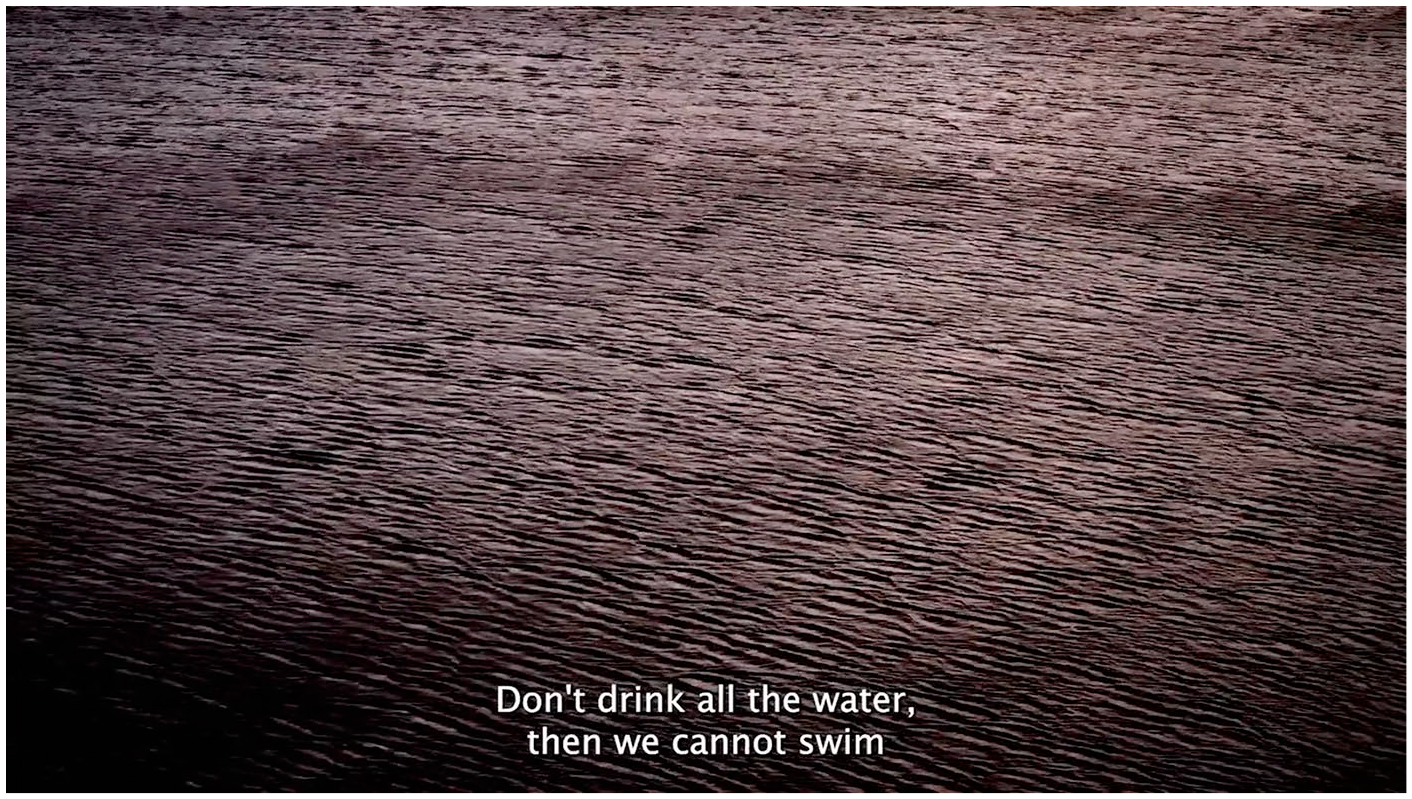
Don’t drink all the water, then we cannot swim. (©Pedro F. Neto & Burak Korkmaz / Inspiration Forum Lab 2021/22, Ji.hlava IDFF)
Inspired by non- and more-than-representational theories, 5 Guadiana in Four Movements sought to explore ‘what a politics of what happens might look like.’ 6 We were interested in experimenting with the possibilities offered by creative practice to harness the human and non-human formations that unfold along and beyond Guadiana’s Lower basin. These formations included, but were not limited to, mega-dams and solar plants largely owned by distant, faceless capital; the International Panel on Climate Change (IPCC) gloomy climate projections; tadpoles, first-time swimmers and artificial beaches; drowned villages, algae blooms and sea foam; islands of green flagged holes and golfers amidst growing aridity; fishless fishermen and waterless farmers; fresh, brackish and salt waters; seasons out of time and scorched earth; financialized avocado, almond and olive orchards; Aberdeen Angus livestock, tropical medusas and blue crabs. But how could we interrogate the becomings of similar socio-material and socionatural assemblages in a way that could ‘exceed purely human versions of subjectivity and spatiality’? 7
We began working around the Lower Guadiana in 2021, following our participation in an interdisciplinary research program 8 that promoted collaboration between artists and social scientists (in our case, an anthropologist and filmmaker, Pedro, and an information designer, Burak). Our main goal was to create a research-based art piece that, building on social theory and engaging with artistic expression, could communicate to audiences both inside and outside the academic and the artistic realms. Guadiana in Four Movements was completed in late 2022 and eventually screened at diverse film festivals, presented at academic conferences, made temporarily available on dedicated online platforms, and displayed in art galleries. 9 In these sites, the piece sparked debates on the potential of multimodality as both research and output in exploring and advancing social science, the interplay of artistic practice, the significance of data and climate modelling, and the need to imagine another future.
Crafting Guadiana
Guadiana in Four Movements was crafted using two complementary approaches that, in our view, could capture and bring us closer to Guadiana worlds. The first approach, based on multimodal 10 ethnographic fieldwork conducted along the Lower Guadiana in mid-2022, aimed to aurally and visually capture some of the ongoing environmental transformations in the region. During that process, we held conversations and interviews with diverse people, including both long-time inhabitants and visitors, interrogating their lived experiences and perceptions of climate change. We expanded this approach by tuning into regional radio stations and recording fragments of radio shows and news bulletins to understand the extent to which climate change was a thing, as well as how it was addressed. Simultaneously, we engaged in the systematic recording of the region’s soundscapes, paying attention to the overlapping of anthro-, bio- and geophonies. 11 Taking serious Feld’s 12 ‘acoustemology’, where sounding becomes a way of knowing, these diverse audio sources compelled us to compose a meta-narrative that could account for, while also constructing, particular meanings relating to the transformation of Lower Guadiana. As Littlejohn suggests, the practice of sonic ethnography ‘means less recording worlds as they are than fathoming how they might be alongside (some of) those who inhabit and compose them’. 13 Furthermore, we collected impressionist depictions of many of the region’s socio-material and socio-natural assemblages as a way of recognizing them as protagonists in their own right (Figure 2). 14
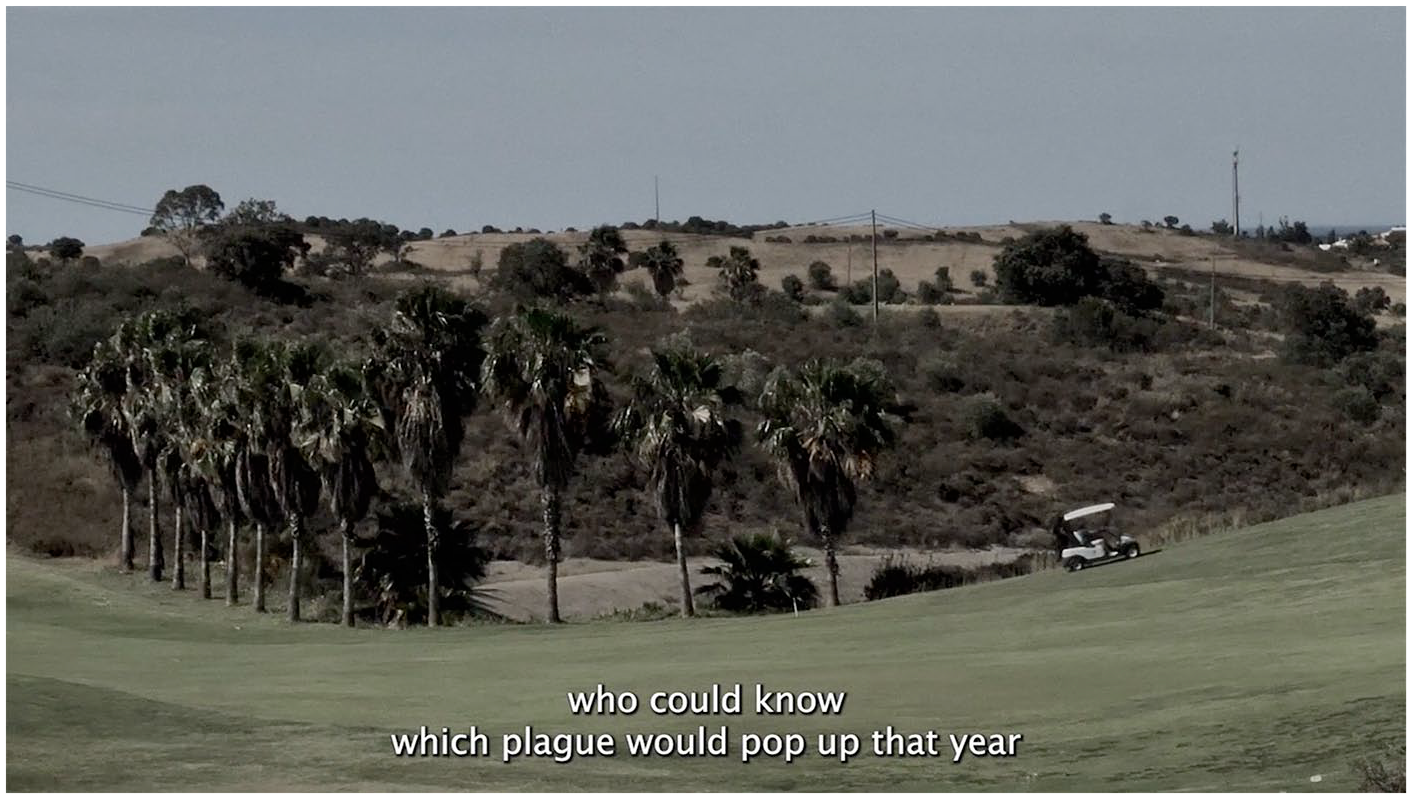
Who could know which plague could pop up that year. (©Pedro F. Neto & Burak Korkmaz / Inspiration Forum Lab 2021/22, Ji.hlava IDFF)
With this first approach, we intended to geographically, culturally and temporally situate the piece. Through our second approach – the data sonification of the four different climate scenarios projected by the IPCC for the region, we tried to address the possible futures of Guadiana. Climate scenarios are speculative narrative forms. 15 Helmreich posits that sound can offer a ‘panoptic view from above, or from the future’ in an almost ‘prophetic’ fashion, challenging common representations of climate change scenarios. 16 In a data-driven process that involved the selection, analysis and systematization of IPCC and complementary raw data, 17 we transduced 18 the four projections based on global average temperature rise of ≈1.8° (current best scenario), ≈2.7°, ≈3.6° and ≈4.4° and the expected impact on the river’s water flow, salinity, biodiversity loss and invasive species. Each of the four tracks associated with these different temperatures offers an aural understanding of the changes that might occur in each scenario. Building on the IPCC predictions and inspired by already-observable events (e.g. the growing presence of jellyfish as a result of sea temperature rise), we further crafted a set of evocative, sometimes-abstract images that visually articulated Guadiana’s diverse temporalities.
Overall, we were driven by a processual exploration of how some of the region’s socio-material and socio-natural assemblages could be enacted, aiming to present them as ‘unfolding forces’, rather than ‘static essences’. 19 As part of that approach, during the editing process, we explored how different types of sources and materials, singular and trivial, visible and invisible, folded, connected, and could be made meaningful. This experimental strategy sought to grasp the heterogeneous, messy and conflictual plight of the region beyond text and context. 20 The result is a multilayered narrative that strives to render intelligible in ‘metaphysical, emotional and situational terms’ 21 Guadiana worlds taking shape (Figure 3).
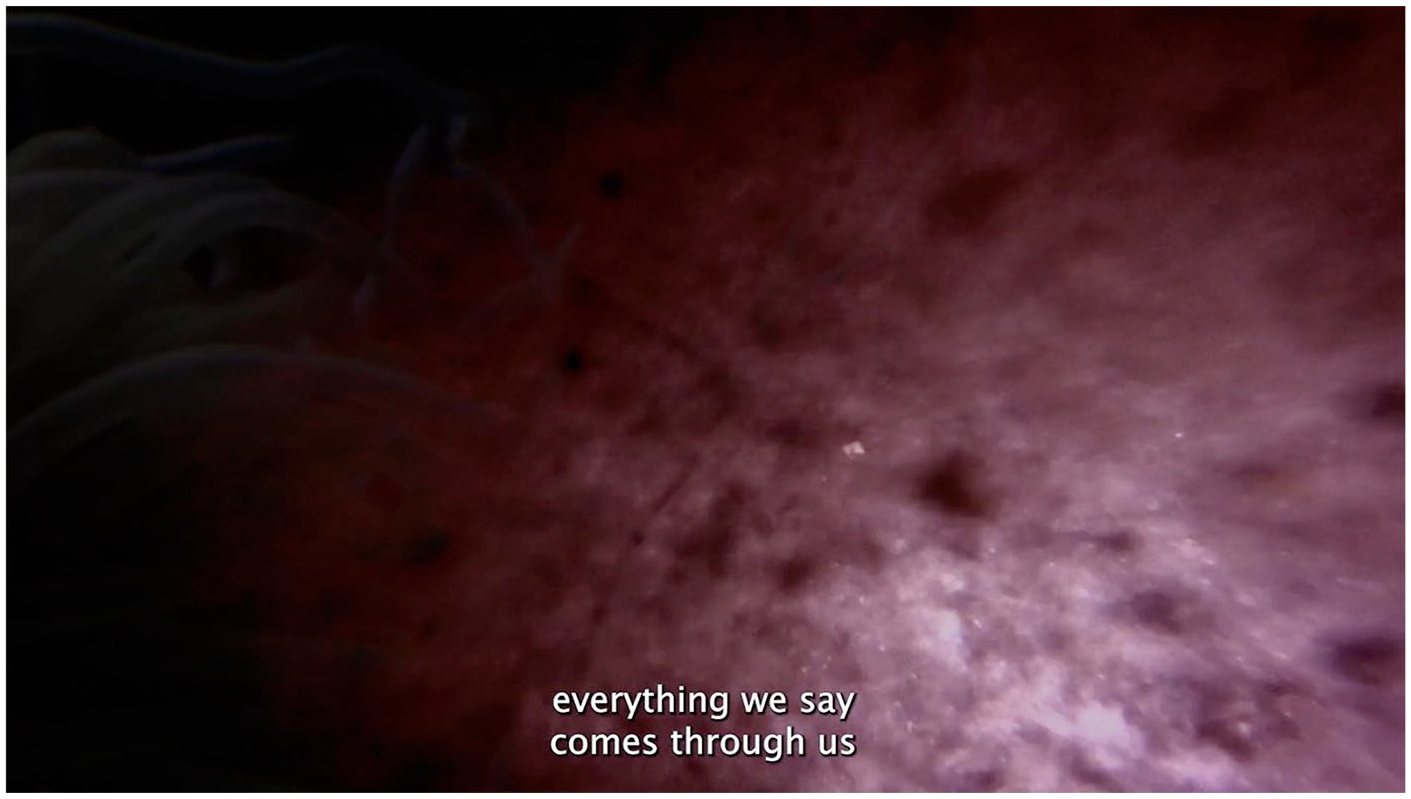
Everything we say comes through us. (©Pedro F. Neto & Burak Korkmaz / Inspiration Forum Lab 2021/22, Ji.hlava IDFF)
Final thoughts
With Guadiana in Four Movements, we explored the potential of multimodal, art-oriented, practice-based research to understand how the region’s places and landscapes are coming into being. By drawing on non- and more-than-representational approaches, the film tested the boundaries and potential traction of geographic theory, revealing how creative practice can be harnessed to engage with complex socio-material and socio-natural assemblages. The film does so by drawing connections that demonstrate the tensions between diverse formations and temporalities, accounting for how these tensions are shaping, and taking shape along, the Lower Guadiana. To foster the imagination of a much-needed otherwise, 22 to unleash ‘new places’ and ‘new kinds of humanity’, 23 and to stretch the boundaries of what is seen as social science scholarship, cultural geography stands to gain greatly by moving beyond the confines of textual words that are so often required to accompany its doings. 24 Finally, the film stands as a testament to the significance of interdisciplinary collaboration and other-than-textual formats of dissemination in advancing the practice of cultural geography.
Footnotes
Funding
The author(s) disclosed receipt of the following financial support for the research, authorship, and/or publication of this article: The development of Guadiana in Four Movements was supported by the European Cultural Foundation via the Inspiration Forum Lab 2021/22 (Ji.hlava IDFF Inspiration Forum). Pedro F. Neto research was funded by the Portuguese Foundation for Science and Technology (FCT) under the research contract 2021.03558.CEECIND/CP1696/CT0002.
Ethics Statement
The authors declare no conflict of interest.
