




Abstract
This article elaborates on an artist-in-residence project funded by the Leverhulme Trust in the Geography Department at Durham University in 2015–16. The project confronted artistic and scientific perspectives to investigate how people in the North-East of England perceive and value their river environments and to recognize potential contributions to catchment management. The project identified a variety of disconnexions and hierarchies in the River Wear catchment and formulated artistic interventions for nonhuman audiences. This article reflects on water holistically and explores transdisciplinary views to propose water in its expanded field. Water in the Expanded Field is plural, complex, and aims at decentering the human importance. It promotes water multiple perspectives, including the more-than-human world and acknowledging water’s ontological importance, developed by the speculative artistic practice of producing works of art for nonhuman audiences and then transposed to water debates. The article converges distinct evidence pointing to the importance of composting existing knowledge and dualistic reasoning to promote pluriversal ontologies of water.
Keywords
Preamble
River(s) Wear: Water in the Expanded Field revisits an artist-in-residence project funded by the Leverhulme Trust in the Geography Department at Durham University in 2015–16. The project emerged from several transdisciplinary conversations between us concerning methodological practices in art and science, philosophy of science and political implications of contemporary artistic and scientific practices in the understanding and management of water. It moves the critical and speculative power of art to scientific discourses, exploring the value of incorporating artistic practices in non-artistic contexts to rethink existing scientific problematics, that is, water and water-management practices, and develops a specific application of these ideas to the River Wear catchment, County Durham, UK. It comprises three moments: first, a series of walks in the catchment, a photographic project, and discussions with local inhabitants and researchers; second, the production of works of art for nonhuman beings in a field by the Brancepeth Beck (a sub-catchment of the Wear); and third, collating some of these events in this article. The complementarity of the three approaches contributes to a comparative, differentiated, and cumulative experience of the catchment.
The project and article are transdisciplinary, and our overview of the different positions is undeniably superficial. The article establishes relationships between distinct perspectives rather than focusing on their comprehensiveness. The rationale behind our approach is that diverse and convergent evidence increases the prospect of a hypothesis in abductive reasoning. 1 The transdisciplinary nature of the project will likely attract different expectations from its distinct disciplinary stakeholders, but there is a risk of not fully meeting them. Nevertheless, we anticipate that the diversity of ideas is a valuable constellation for further developments: a seed for future enquiries.
The investigation considers water in its ontological and relational dimension and experiments with allocating agency to all beings and things through the specificities of the River Wear. 2 This proposition is contextualized in recent debates about the global impact of human activities and the cross-scale interdependence between human beings, nonhuman beings, and things. 3 These assumptions were ontological and foundational to the project, suggesting a continuous intersubjectivity between an individual (irrespective of its biological species) and constituting elements of the world regardless of size, physical state, or time scale. 4 These ideas and concepts promote a conceptual and physical liquidity that investigates water in its broader context(s), in the complexity of its relations with other beings and things.
This article recognizes the importance of Rosalind Krauss’ article Sculpture in the Expanded Field, 5 published in an art theory context but often revisited by other disciplines, including geography. 6 In the River Wear(s): Water in Expanded Field, the reader is invited to dive into the specificities of the catchment to construct a renewed – expanded – understanding of water. This article swims in the expanded fields of water, acknowledging that everyone has an interest in water: humans, nonhumans, and things (including water), unfolding in three parts: first, an overture contextualizing the article and project; second, a critical interpretation of the catchment’s geographies through walking (and photographing), teasing disconnexions in the understanding of water and their impact on its management; third, an attempt to consider nonhuman audiences when producing new works of art and its transposition to the study of water: moving from a single species (human) audience, including its multiple interpretations and meanings, to a multispecies audience (beings and things) regardless of the infinite anthropocentric projections and the viable implementation of this proposition.
Overtures
Turning on a tap to fill a glass with water in a Western house is linked to a country’s socioeconomic and infrastructural development: its ability to access clean, potable water while disposing of it in a controlled and efficient manner. This action is part of the relationship between the water source running from the tap and whoever might drink it. Before reaching the tap, the water must be sourced from a surface or subsurface catchment, treated, and transported along a pipe system. Afterward, the process is reversed, and the water is returned to the catchment. A river can be understood as the visible mass of water flowing in a channel and the invisible mass of water flowing through the catchment. However, its relation to who turns the tap on or off is fundamentally invisible: water underflows. 7 These hidden stories of water emerge when something unexpected happens, for example, the water from the tap is brown, the pressure is reduced, or during a flood. In these accidents, 8 the broader stories of water become urgent, revealing the complexities of Water in the Expanded Field.
Rosalind Krauss’ Sculpture in the Expanded Field proposes a notion of sculpture broader than an object on a plinth. 9 It is best understood in the art context of the 1970s, its disciplinary fields of art history and art criticism, when the author(ities) along with their power regimes (modernism) were questioned by a new generation of cultural agents (of postmodernism) who were introducing alternative modalities of authorship and art practice. These novel propositions expanded the work of art to their entanglements, invoking the audience’s perception and participation, site-specificities, and production processes in the work of art’s formulation, for example, perceptual, process-oriented, performative, relational, and site-specific. Krauss argued that sculpture’s existing notion was too narrow to encompass the contemporary works being produced, such as land art and minimalism, which demand a site-specific complexity and the audience’s perceptual experience to be completed as works of art. 10 Her argument followed postmodernist (art) theory that complemented the author’s intentions and formal aspects with the audience’s active role when engaging with the work of art, which is contingent on language, historical, social, and political contexts, subjectivity, gender, indeterminacy, and chance.
Similarly, Hal Foster explains the limitations of considering a work of art as a closed system to be decoded and the artist as the source of its meaning. 11 The work of art has multiple entanglements and is contingent on the encounter(s) – an event with affects – with the observer(s). These are aesthetic considerations prone to indeterminacy and chance, providing conditions for misinterpretations, cognitive dissonances and, most importantly, for noise to emerge as a generative force. Artists often promote these approaches; a famous example happened in 1917 when R. Mutt (Marcel Duchamp) submitted a porcelain urinal – Fountain – to the Society of Independent Artists. It pointed to the contextual dependency impacting the interpretation and formation of a work of art by its audiences and the fragility of (artistic) discourses that abstract meaning from its entanglements to reinforce themselves. 12 The generative power of noise has been traced to Lucretius’ Clinamen by Michel Serres and expanded in his later work. 13 Jacques Rancière has referred to it as the aesthetic regime of art, emphasizing a redistribution of the sensible and politics of aesthetics. 14 Alva Noë frames it as one of the many Strange Tools art employs to reorganize the world. 15 In this article, we refer to the generative power of noise as the longstanding artistic methodology of creating paradoxes to infiltrate social and political discourses that eventually surface as contradictions.
For Dilip da Cunha, the blue line on a map is the human manifestation of a river, a line splitting land from water that enforces a representational dichotomy on the water rather than embracing its mutating wetness and dryness and infinite entanglements. 16 Jamie Linton raises the question about the origins of this abstraction of water (removed from its context and ontological entanglements), pointing to the complex and often paradoxical conversation between water’s materiality, water’s entanglements, and the human narratives about it. Linton traces that abstraction to Modernity, 17 to the guillotine cutting scientific objects and subjects from their ontological entanglements, and locates the source of water’s disconnexions in epistemologies that promote(d) while reinforcing an alleged extraordinary human rationality that implicitly abstracts humans from nature. 18 Recently, Linton proposed the value of applying Indigenous ontologies and practices – water as a living being – to European water policy. 19 Sarah Whatmore and Catharina Landström framed a similar idea as Knowledge Controversies (about flooding elsewhere in northern England). 20 They argue for a politics of hybridity that recognizes the interdependence between the social and natural world: social agency exists in its performativity; relationality is affective; expertise is redistributed, and knowledge is polyphonic. Similarly, Bennett reinforces the importance of materiality and a more-than-human political theory. 21 The more-than-human bubbles up in a range of conceptual 22 and art-practice settings. 23 We reflect on these ideas concerning who has a voice in managing water in the Wear.
This article follows these converging approaches, expanding an understanding of water, where many of its contexts are ignored and discarded, toward a complexity of water, where its expanded field is ontological rather than a background for human interpretation. We sketch an expanded field of water inclusive of all that is nonhuman and unknown (regardless of its viable implementation). The article navigates its human bias and the complexities of water at the peril of being contemporary mythology, voicing, and reinforcing human anxieties. 24 Nevertheless, water in its expanded fields (including its invisibility, immateriality, and mutability) contributes to understanding water as a living and changeable environmental system, including its human and more-than-human complexities.
The methodological approach for this project has been an experiential meandering through water entanglements while imagining other futures. A practice-based inquiry combining a diversity of artistic and speculative approaches with traditional methods, that is, speculative fabulation, introspection and reflection, production of works of art, walking, ethnography, literature reviews, and informal conversations. The richness and diversity of these approaches could be elaborated as a series of separate pieces. However, the point of this article is to converge them, noting the breadth of possibilities and imagining future propositions.
Part I follows the blue line in the map as a guide for the walks and a photographic project that contributed to identifying desynchronized perspectives on water in the River Wear catchment, its implicit disconnexions and paradoxical relationships with water. Part II discusses the production of works of art for nonhuman audiences near the Brancepeth Beck, overflowing the question of who or what can be the audience of a work of art to water-management practices. It speculates about muted voices, who or what has a voice, and the importance of attempting to hear the more-than-human world in catchment management. This deliberated artistic overflowing to non-artistic contexts is a strategy to help the contamination of social, academic, and political discourses with the contradictions raised by the more-than-human world.
Part I: walking the line
In the first part of this project, the strategy was to walk through the catchment guided by the blue line of the river and produce a photographic project that contributed to identifying several disconnected perspectives in the River Wear catchment area. The blue line representing the River Wear was divided into eight smaller segments and explored throughout the project’s first part. The rationale for the segments was pragmatic in terms of time and resources available concerning the different zones of the catchment. The resulting paradoxical views emerging from the exposure to alterity were complemented by discussions between us, other researchers in the Department of Geography and the network of stakeholders in the catchment.
A river is a dynamic system better understood in its flow, paraphrasing Heraclitus: one cannot walk in the same river twice. Narratives of traveling (including walking) have long been an allegory for individual and collective wisdom traceable to the Epic of Gilgamesh, ancient Egypt, Homer’s Odyssey and the Bible. 25 The catchment walks followed the tradition of the ancient Greek Cynics – sages and walkers – who explored their embodied relations with natural elements to cut across sedentary classic oppositions between the appearance and the essence of things. 26 As Tim Cresswell suggests, walking promotes embodied investigations that consider the politics of mobility and avoid sedentary narratives of place and space, which are metanarratives of an (im)mobility. 27
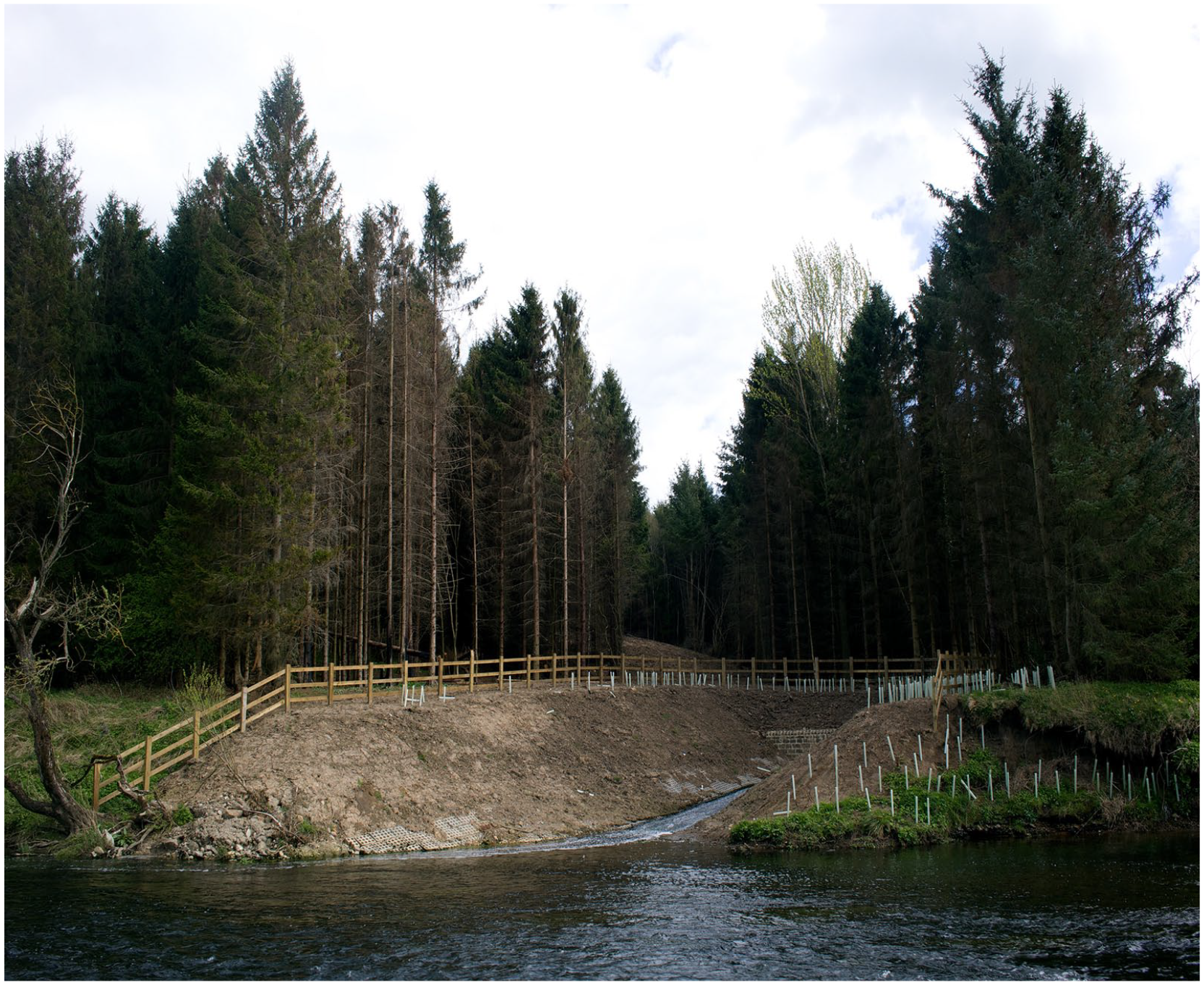
Miguel Santos, River(s) Wear, 2015.
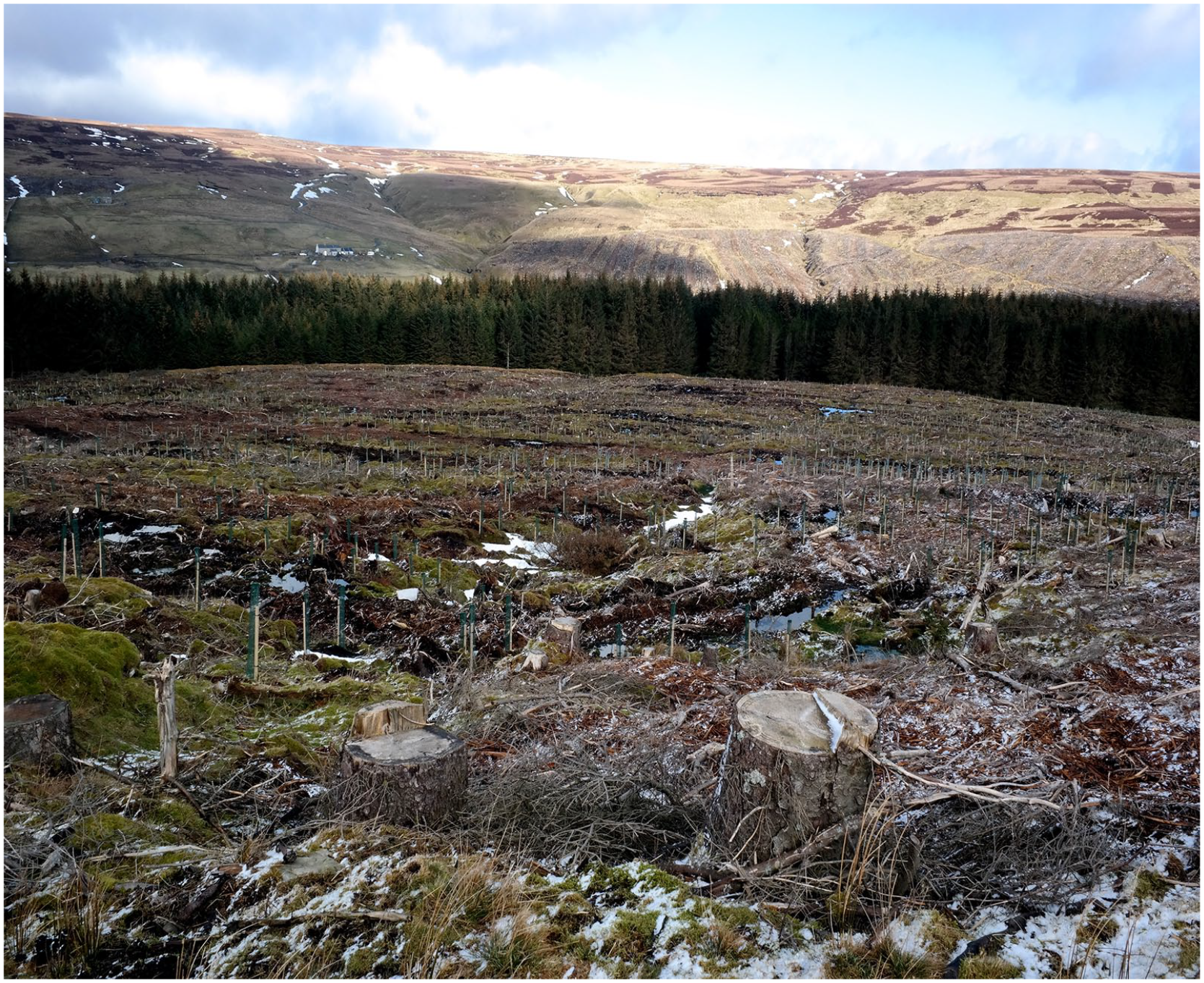
Miguel Santos, River(s) Wear, 2015.
Walking along the river contributed to an embodied awareness of the catchment, informing the artist-in-residence project and this article. The photographic work resulting from the walks was a tool to access the world rather than represent it. 28 The photographic project, River(s) Wear, contributed to the allocation of attention by the artist while learning about the area. It explored the experience of alterity implicit in traveling through an unknown area. It was framed by critical modes of engagement that recognize the interdependence of all beings and things and surpass exotic and touristic formulations of picturesque imaginaries. 29
Walking and photographing provided a first-person methodological exposure to the implications of living in the area, reducing the exotic gaze implicit in alterity. In this first-person approach, the body is understood as an ecosystem (microbiome) that accesses and renders the world in a multiplicity of relationships and feedbacks, generating narratives of coexistence and interdependence rather than individualistic and novel propositions about the world. This methodology promotes an embodied and immersive perspective of the catchment, contributing to easier and more emphatic conversations (second-person methodologies) with local people and catchment managers due to the first-person experiences. Our proposition converges first-, second-, and third-person methodologies, emphasizing the complexity of water and its entanglements. 30
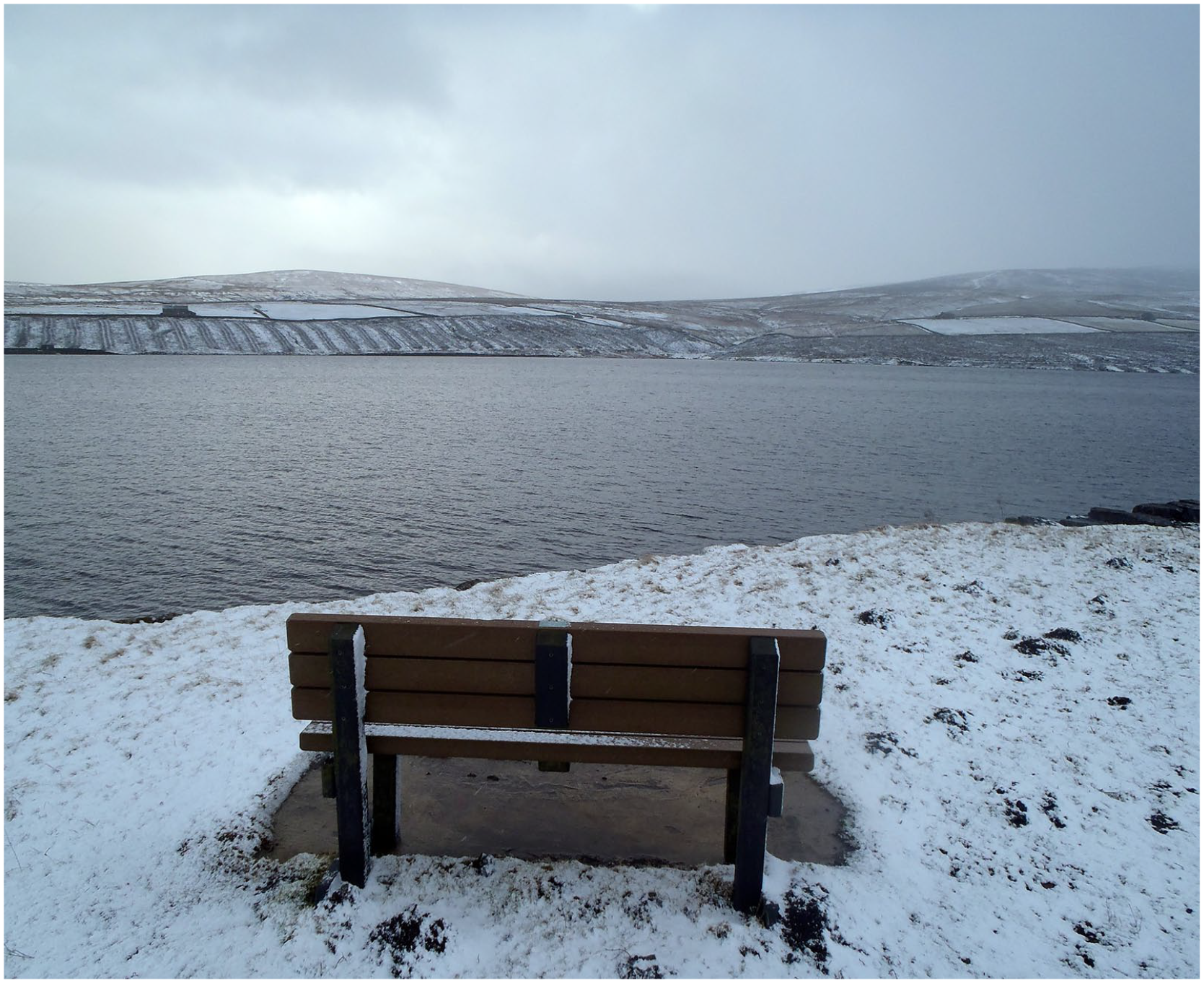
Miguel Santos, River(s) Wear, 2015.
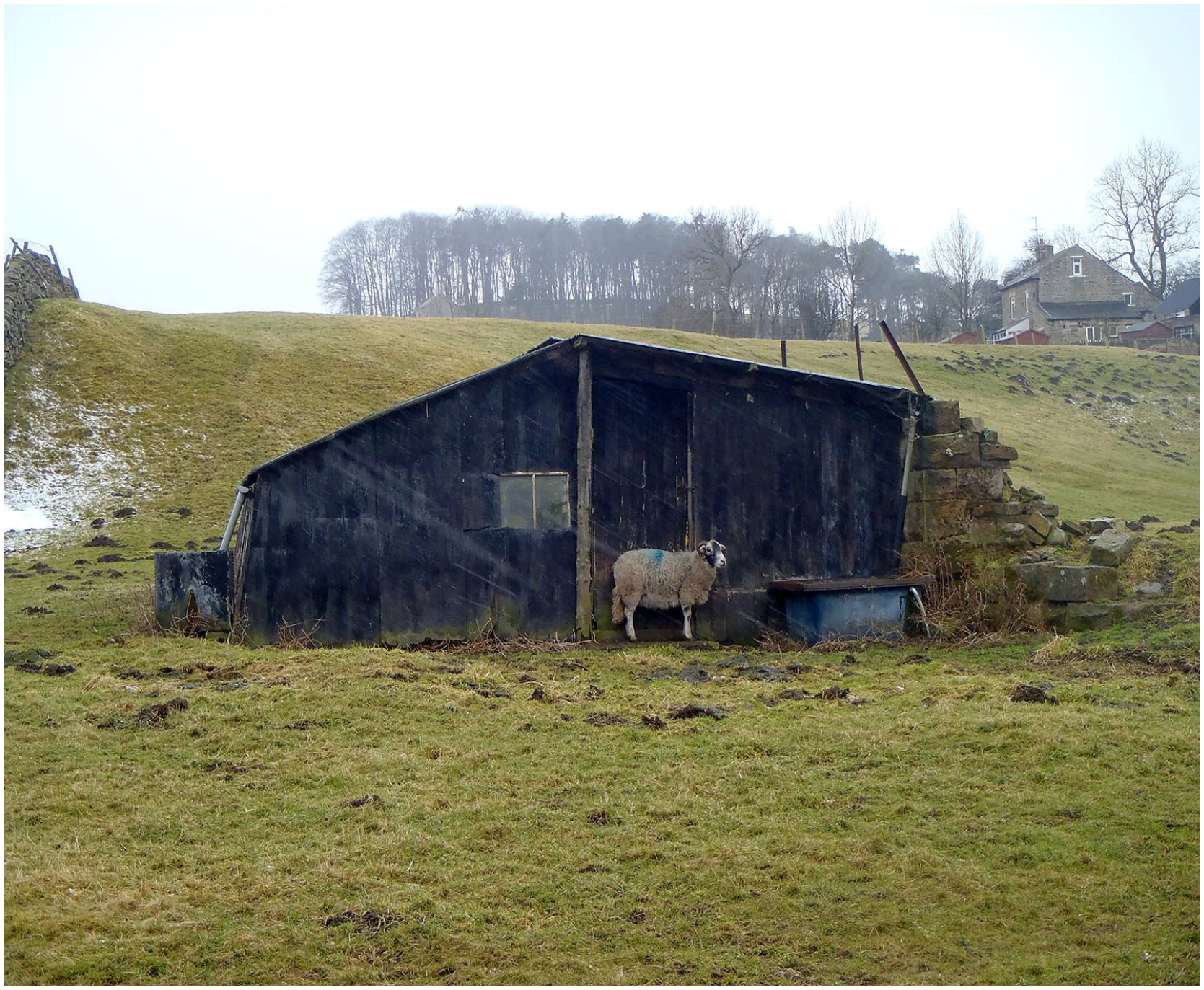
Miguel Santos, River(s) Wear, 2015.
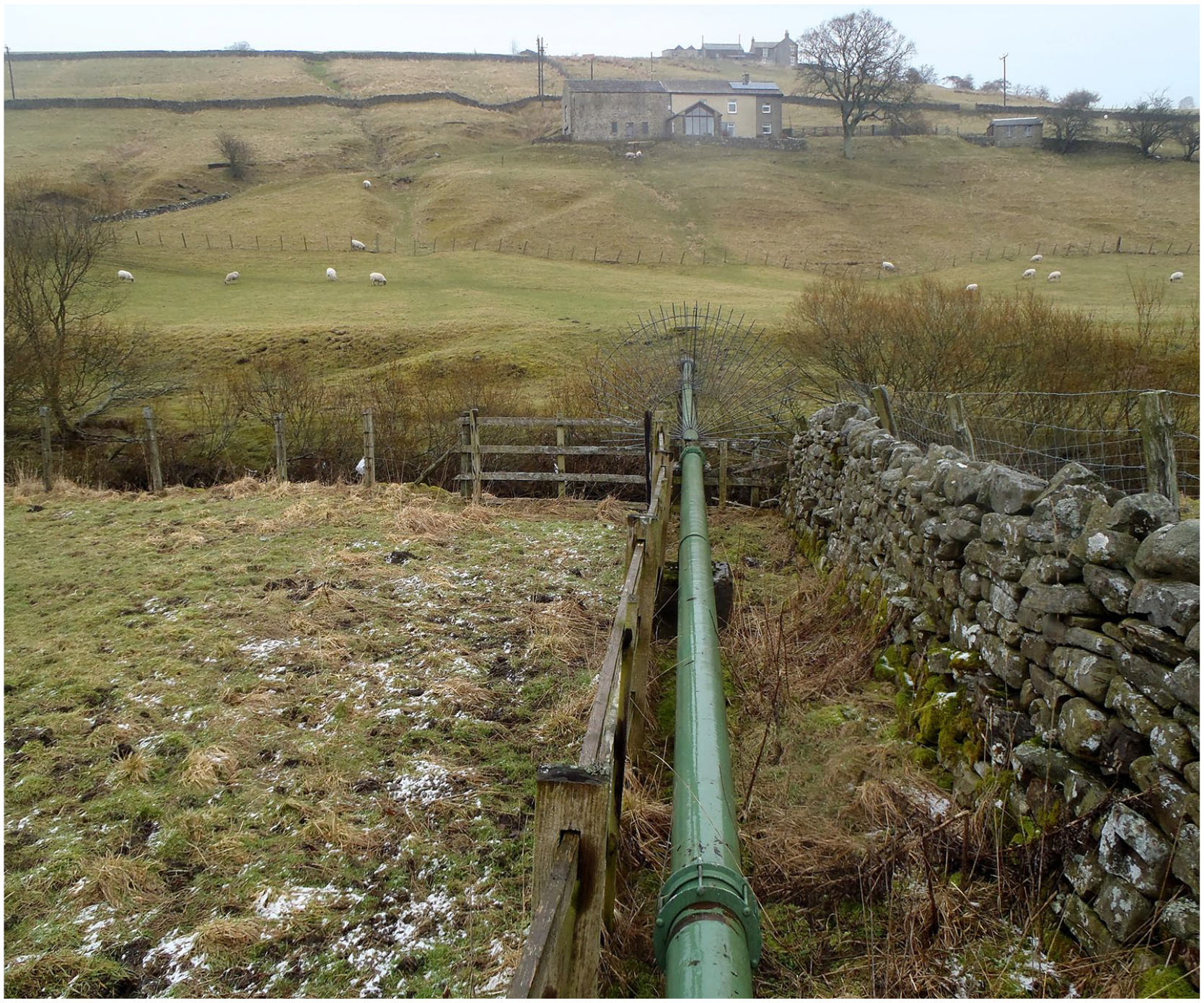
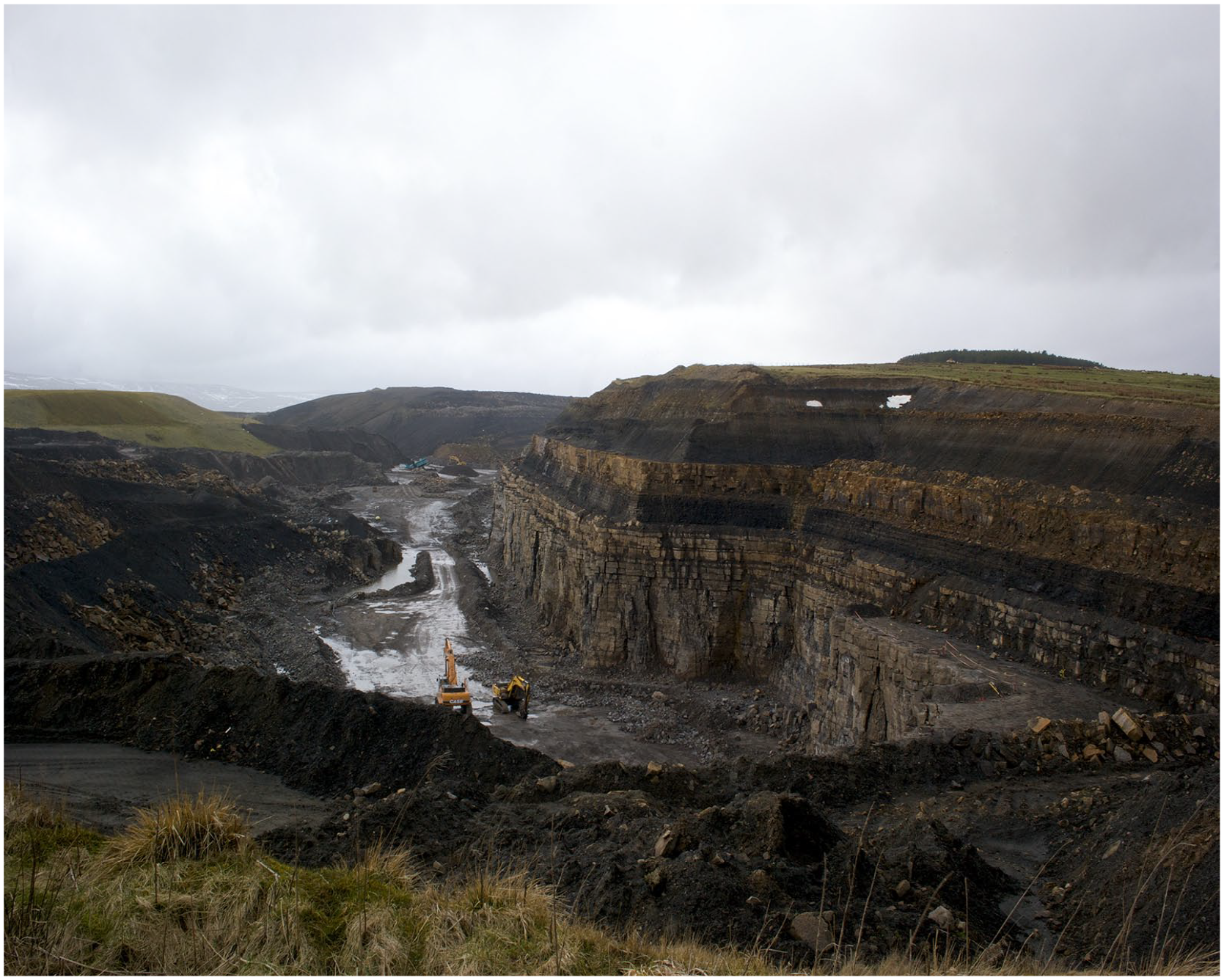
During this process, which included the conversations between us and other stakeholders, it was noted how: the limited public transportation and the weather (snow) affected the mobility of local populations; the Industrial Revolution mining heritage continues to shape cultural identities in contemporary communities; forestry and farming (vegetation removal and sheep-track erosion, industrial forestry, and farming) and mining (iron-oxide pollution, spoil heaps, ventilation shafts of disused mines, hidden operational quarries, former rail tracks) impact the landscape. By reflecting on these different but interrelated perspectives, we learned the value of articulating existing voices in novel ways that contribute holistically to water-management practices.
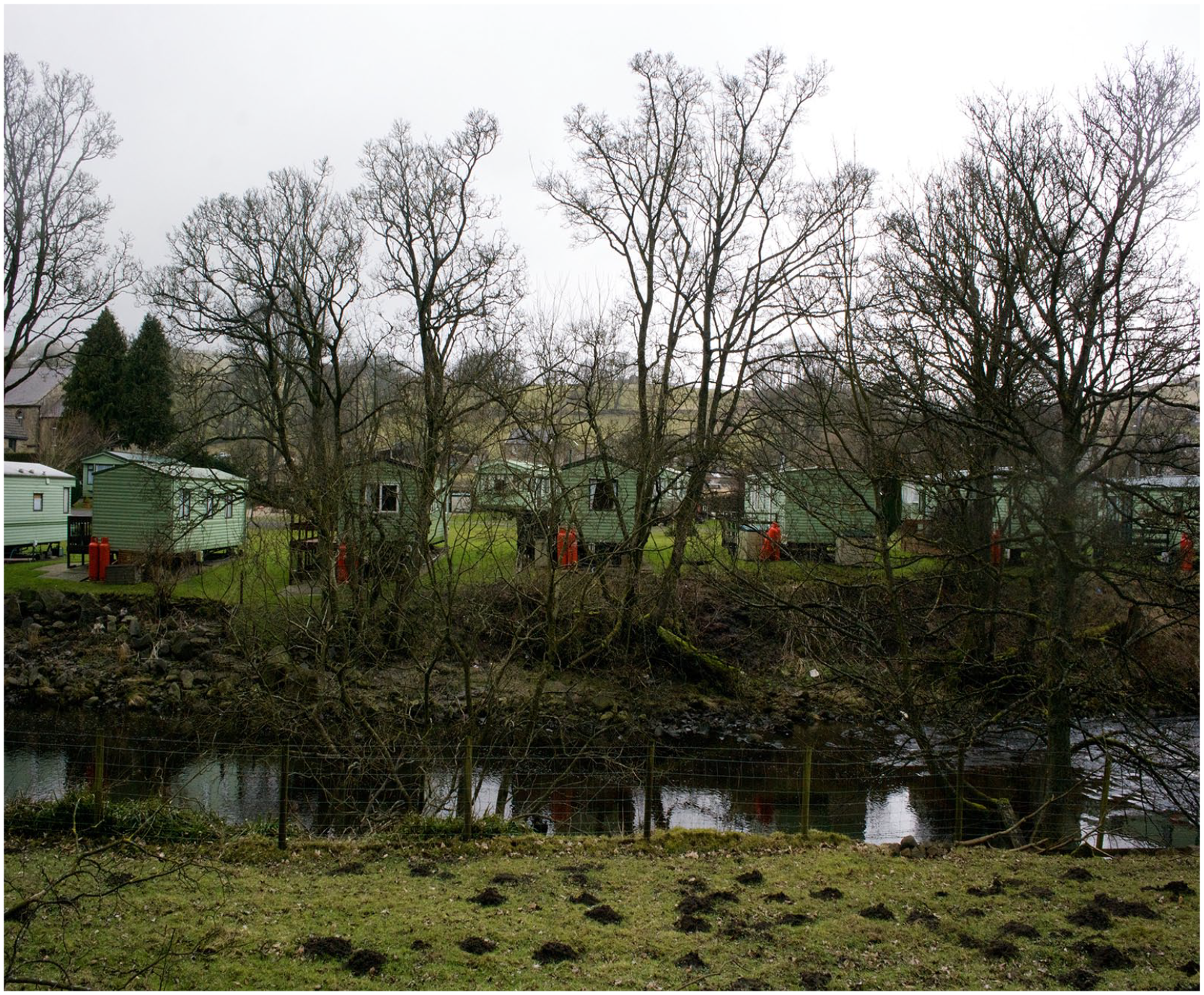
The photographic project visualizes fragmented perspectives on the Wear, pointing to distinct perceptions and relations to water, for example, the farmer or sheep at Wear Head or the butcher and sheep at a recreational park (Down at the Farm) 31 have very different relationships with the ‘same’ (but different) water. The catchment population might share water uses, but it is unlikely that a single person will share all perspectives. However, the people in the catchment refer to a unique river regardless of their locations and water uses. 32 This desynchronized relation between the water, its representation and its imagined realities makes it difficult for any one approach in water-management practices to encompass all these differences: the non-existent unique river, its distinct uses, and the diversity of perspectives. 33 The river, the line designed by humans, might be better understood in its diluted representations, in the mutating evaporating wetness that co-exists and coevolves in a multiplicity of possible worlds (Pluriverse) 34 that formulate an expanded field of water inclusive of its different waters.
The walks and photographic work were methods to learn about the catchment and its specificities and to tease paradoxical perspectives about the area. The photographic process provided information for multiple conversations between the authors and other members of the Department of Geography. It facilitated the conversation about existent disconnexions, which can be well known to specific communities in the catchment but tend to be dispersed and point to an anthropocentric developmental perspective. These disconnexions, in turn, set up fruitful conversations regarding water-governance approaches, specifically on those underpinned by the European Union Water Framework Directive (WFD). 35
Miguel Santos, River(s) Wear, 2015.
Miguel Santos, River(s) Wear, 2015.
Diluting human voices
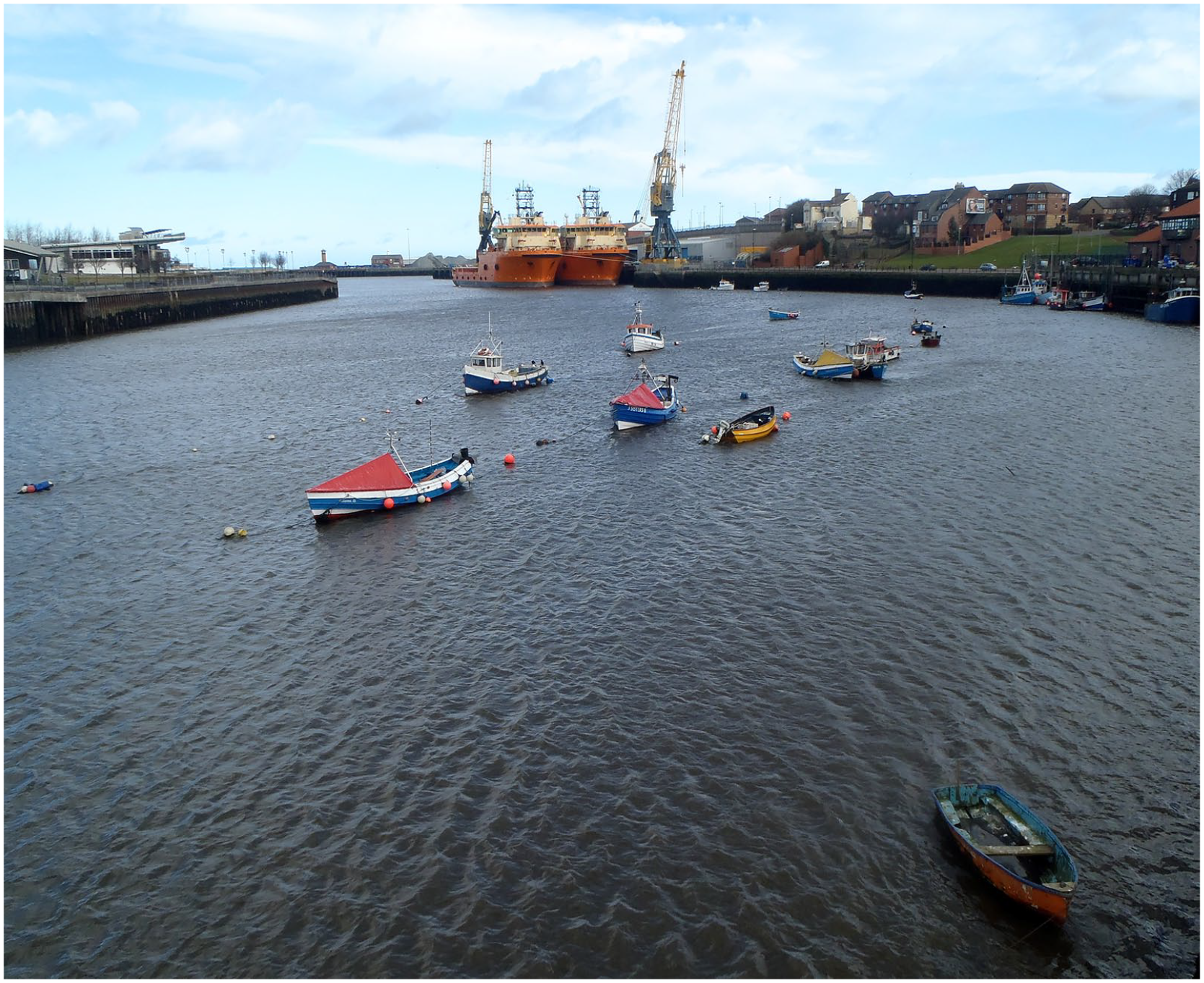
The WFD states that water is a non-commercial product that needs to be preserved, recognizes a diversity of interests in a catchment, and aims to involve the local people in a basin to manage its water resources. 36 In the UK, in opposition to the non-commercial framing of the WFD, private companies have been responsible for water supply and sewage treatment since 1989. 37 The company responsible for the Wear catchment is Northumbrian Water Limited (NWL), which, despite its localized name, is owned by a corporation based in Hong Kong: CK Hutchison Holdings. 38 A person living in the Wear catchment with sufficient resources – nonhuman beings are excluded from the legal ownership – could be an indirect shareholder of NWL through the acquisition of CK Hutchison’s shares. However, most likely, its shareholders live elsewhere and are disconnected from the realities of the catchment. 39 The distance between who is responsible and liable for managing the water and who effectively lives with it and is co-created with it increases the desynchronization of perspectives on the River Wear. Further, the disconnexions resulting from that desynchronization remain predominantly invisible for the populations in the catchment, suggesting a difficulty in connecting the perspectives of local communities, the NWL shareholders, and the nonhuman beings in the area. 40
In the catchment, most voices heard on water-management practices, regardless of their level of proximity or disconnexion, are institutional (e.g. NWL, local Councils, Environment Agency, Durham University, Wear Rivers Trust, Sunderland Port Authority). The decision-making process on how water is managed is primarily shaped by institutional narratives of power between shareholders and local people that tend to exclude the biodiversity coevolving with the water and co-creating what might be a river, for example, the farmer who abstracts water, the oak tree holding together the riverbank, the fishes’ and anglers’ systemic discussions, the dog walking its human who (un)consciously observe the river changing, the artist and geomorphologist thinking and writing about it.
Miguel Santos, River(s) Wear, 2015.
Miguel Santos, River(s) Wear, 2015.
Whilst some attempts consider the natural world when defining political objectives and planning specific policies, they continue to be anchored in discourses that separate the material processes of appropriating nature from the subsequent acts of production and consumption. 41 As Linton notes, the contemporary understanding of modern water, with the abstractness of its chemical formulation (H2O) that separates water from its social and ecological relations, has primarily contributed to reinforcing the estrangement between appropriation, production, and consumption of water (nature). 42
These different relations are reflected in discourses around water that use the idea of stakeholders and have developed since the privatization of UK water companies. Consequently, shareholders gained a privileged place in water debates. Arguably, the stakeholder might be the expanded field of the shareholder, 43 which recognizes the limitations of management practices focusing solely on the interests of its shareholders to include a more comprehensive complexity of relations that impact management practices (e.g. employers, suppliers, clients, shareholders, governments, and policymakers). 44 The stakeholder concept has limitations, even if it recognizes different human voices and minimizes disconnexions between a water company, shareholders, and local communities. It remains a reductive and non-inclusive formulation that primarily reinforces institutional interests. It excludes all interests without a voice (human and nonhuman) and forgets that, in the case of water, everyone and everything has an interest in water. There is an ontological interdependence between water, humans, nonhumans, and things, but most lack a voice. Further, water might have many shareholders and stakeholders but no voice, 45 as noted by Indigenous ontologies that understand water as a living being. 46 In an expanded field of water, it is unhelpful to consider the notion of stakeholder without a further expansion to its more-than-human realities and including the stake’s voice – the water’s voice. We move into part II to consider how this interdependence might be recognized and implemented.
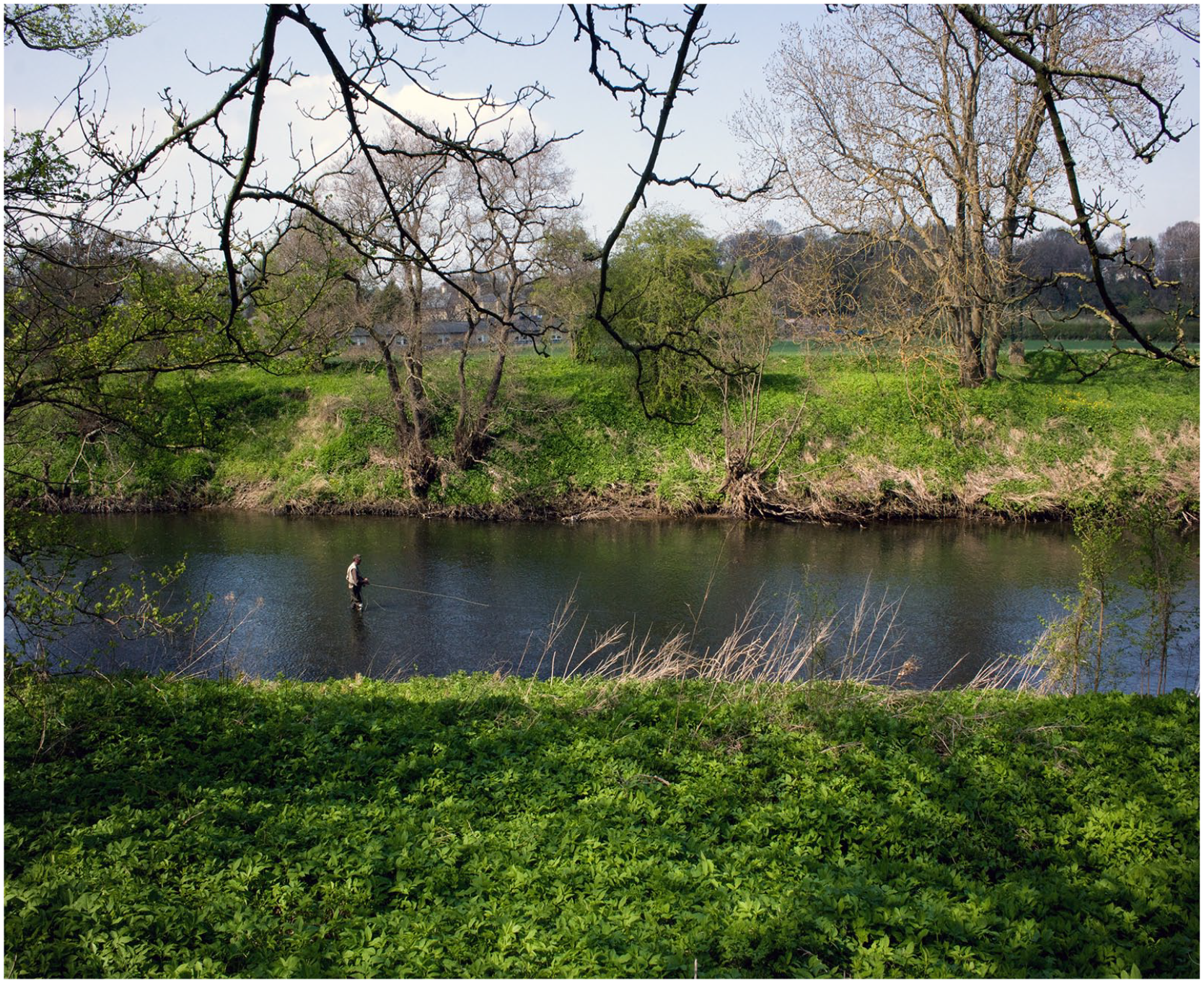
Miguel Santos, River(s) Wear, 2015.
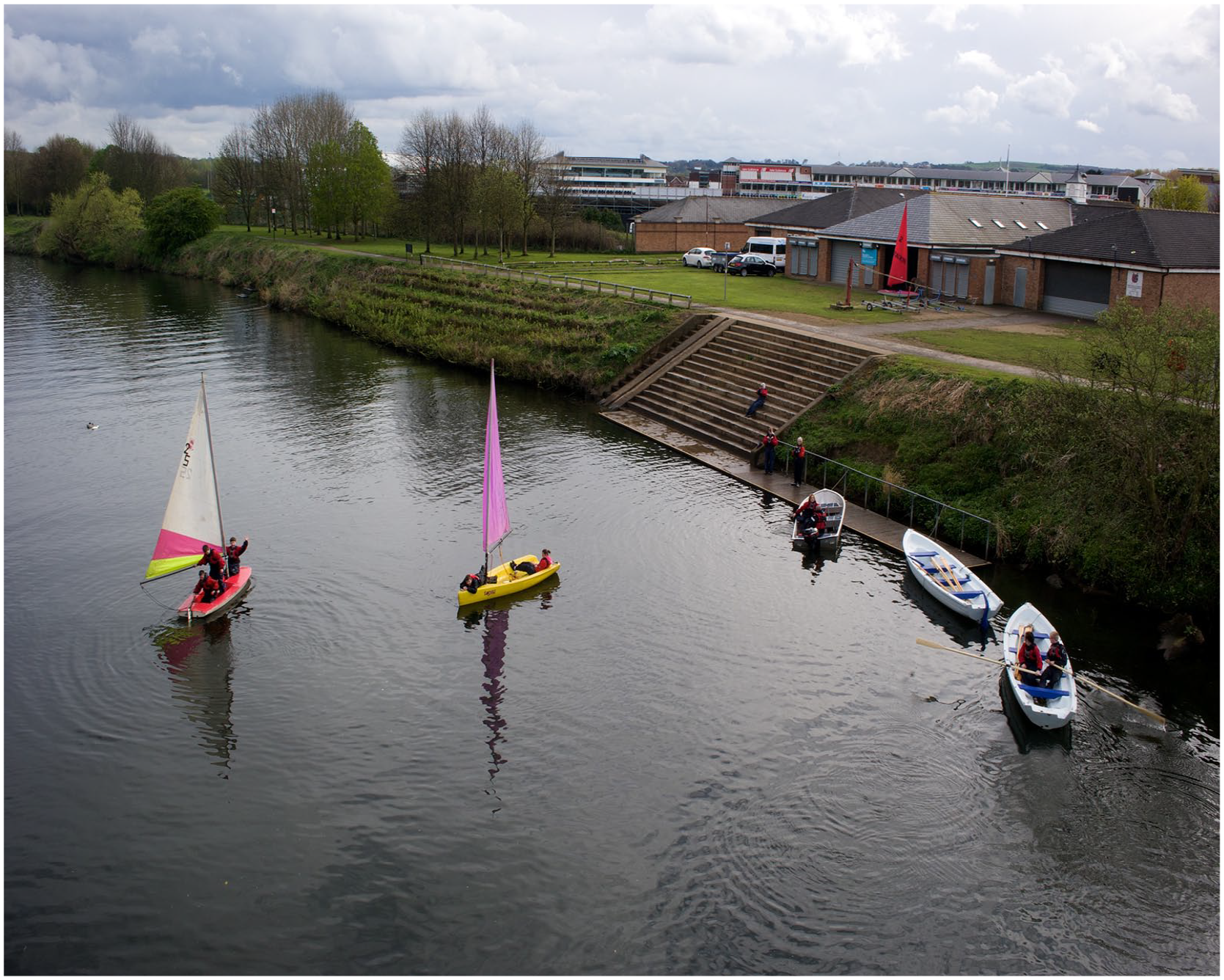
Miguel Santos, River(s) Wear, 2015.
Part II: muted voices in scripted landscapes
In the second part of this project, we reflect on the artistic investigations by the Brancepeth Beck, which considered nonhuman beings as the primary audience of a work of art to incorporate the more-than-human world in future water narratives. It attempts to overflow the problem of who or what can be the audience of a work of art to water-management practices.
In the 1960s, in line with increasing environmental awareness, 47 artists started to consider nature as a medium rather than solely representing it (painting, photographs, drawings, etc), demonstrating a novel way of relating to the world. The initial movements matured in practices that recognize the impact of a work of art on nature itself (ecological art, regenerative art, earthworks) or engage in the articulation of nature as an abstracted technological apparatus (bioart, synthetic biology, microbial art) to, in different modalities (including socially engaged practices), raise awareness about the impact of human activities. Nevertheless, these approaches continue to be primarily anthropocentric: exploiting or engineering nature as a medium for human appreciation (technological, monetary, social innovation, environmental, aesthetic, etc). Humans continue to be the primary audience of these works of art. 48
Although contemporary art practices tend to have human-centered approaches, there are several attempts at engaging with the more-than-human world during the production and reception of the work of art. Recent emphasis on the artist’s role as a contemporary shaman or witch is relevant to expanding liminal and non-patriarchal discourses and practices toward including the more-than-human world. 49 T.J. Demos has argued for the importance of Indigenous cosmologies in contemporary artistic practices engaged in speculative, disruptive, and nonbinary reasoning. 50 In the recent Venice Biennale 2022, the curator Cecilia Alemani proposed a framework influenced by Donna Haraway and by Rosi Braidotti in its attempt at collapsing dualistic narratives between nature and culture and adopting a posthuman agenda. 51 Its title – The Milk of Dreams – 52 is a homage to Surrealistic practices where dreaming is explored as a methodology for engaging with the world with a refreshed and experimental approach that might help to change it. 53 Overall, these methodologies engage with the unknown, intangible, and uncertain that are frequently diverted from artistic and scientific discourses to the realm of the mystic.
Scripted landscapes
The artistic enquiry in the Brancepeth field was developed between July 2015 and April 2016, during 14 daylong visits. The field is part of a farm, but it is not cultivated due to the difficult access to agricultural machinery, making it easier for the farmer to agree with the activities undertaken. Access was made through a 20-minute walk along the farm, crossing several gates that defined distinct areas of the former castle estate. The field lives in a secluded and semi-abandoned state apart from visits from random sheep, occasional deer, birds, insects, fish (all sighted), and other unnoticed beings.
Brancepeth Castle was built in the 12th century, purchased in 1796 by a family of mine owners and bankers, and rebuilt in the early 1820s in Gothic and Neo-Norman styles to include the addition of divergent elements: towers, restoration of its mediaeval battlements, and pleasure gardens. 54 The field, where the artistic investigations took place, was redesigned by Adam Mickle in 1783 to include a system of tree belts and clumps and the Beck’s diversion and damming to form a sinuous, elongated lake. 55 From the 1850s, the owner and others sunk new collieries in the surrounding area, producing air and noise pollution and decreasing the castle’s usage as a place of entertainment. 56
The architectural interventions and Mickle’s design created a highly scripted landscape. 57 A scripted landscape is designed to emphasize a person’s experiential journey, who, when walking in it, engages in a predefined story. A scripted landscape is ideological or, as noted by Erik Swyngedouw and by David Harvey: a political project is necessarily an environmental project and vice versa. 58 Mickle’s script, a romanticist design celebrating Human domination over Nature, was never completed. However, there are visible elements in the (re) naturalized landscape: metal deer fences, woodland, small cascades, and channelization along the beck and fishponds. Nowadays, the Castle estate has been dispersed to distinct owners, tenants, and uses (e.g. golf course, farming).
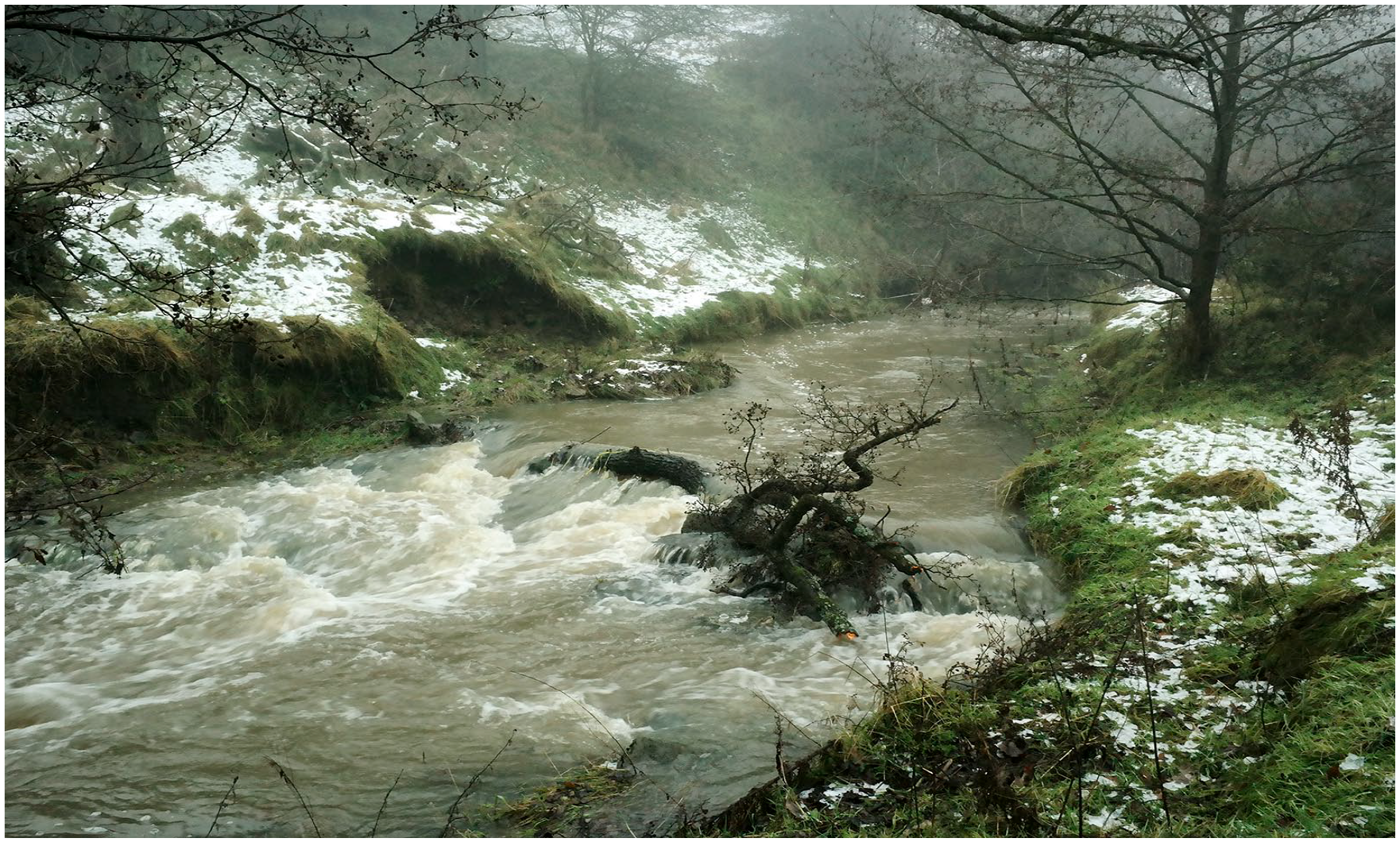
Miguel Santos, Brancepeth Beck interventions, 2015–2016.
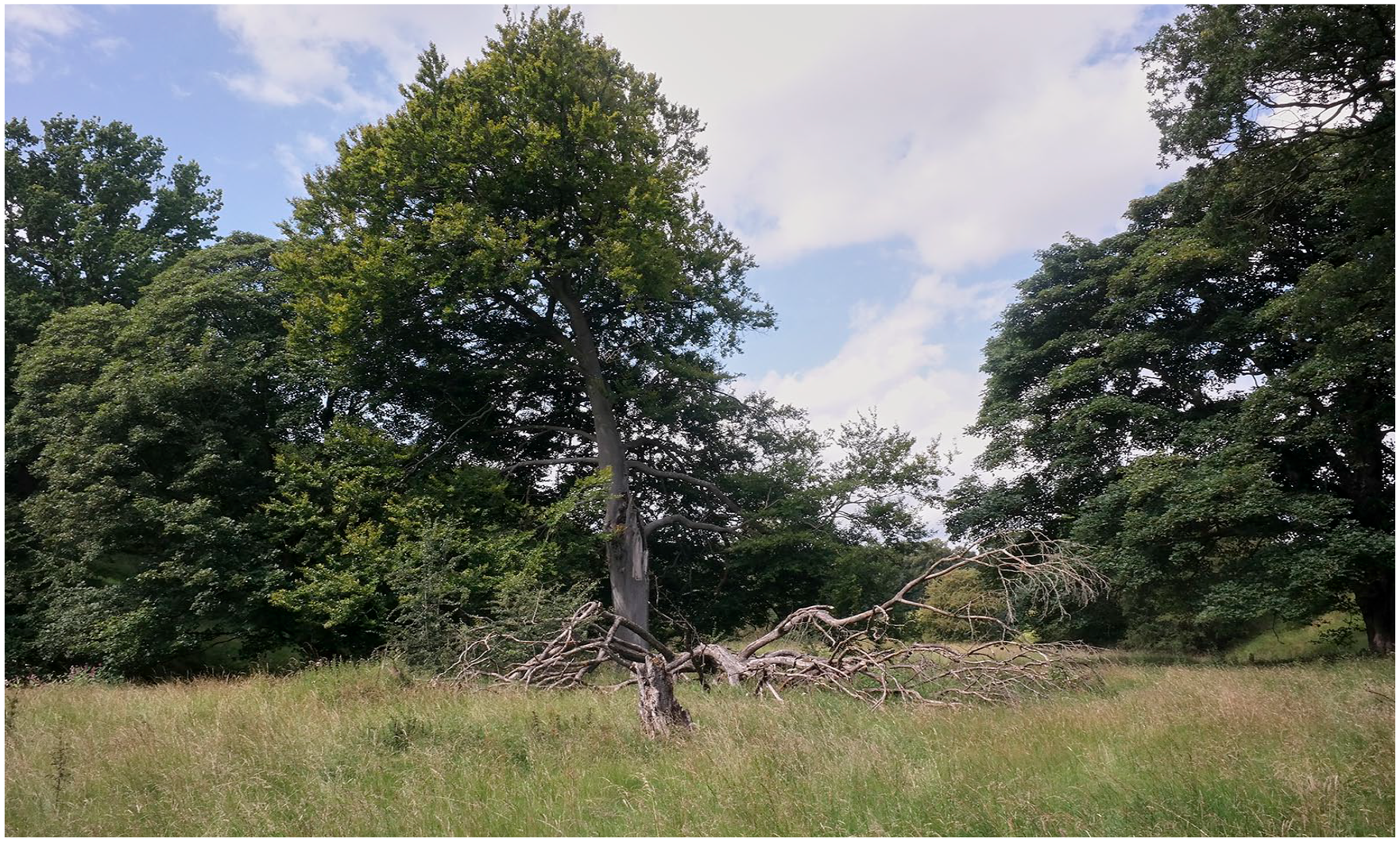
Miguel Santos, Brancepeth Beck interventions, 2015–2016.
The artistic investigations were a microcosm of the walks and an attempt at hearing the muted voices and unrecognizable languages coevolving and co-creating this scripted landscape and its ecosystem. The proposed task of recognizing the unknown is (at best) challenging to formulate via language. Nonetheless, the strategy to develop these artistic investigations was to consider nonhuman audiences as the primary audience of these experimental works of art, implying the allocation of agency and consciousness to all living beings and things. This speculative process, potentially anthropomorphic, 59 and/or contemporary mythology, 60 is better understood as a decentering procedure that allocates similar importance to all beings and things, which, due to their magnitude and diversity, dilutes (by contextualizing) the importance of humans. Thus, and at least from a human perspective, it suggests the interdependence and intersubjectivity between the parts forming it (human and nonhuman beings, things, and systems).
The artistic investigations by the Brancepeth Beck considered nonhuman beings as the primary audience of a work of art to overflow the problem of who or what can be the audience of a work of art to water-management practices. These investigations focused on decentering human perspectives without being bound to any specific technique but instead engaging in a multiplicity of small actions continuously reshuffled and adapted to the circumstances. This artistic methodology of speculating and creating paradoxes within an artistic realm to then infiltrate non-artistic discourses with contradictions is a longstanding practice that is, here, applied to water studies more broadly.
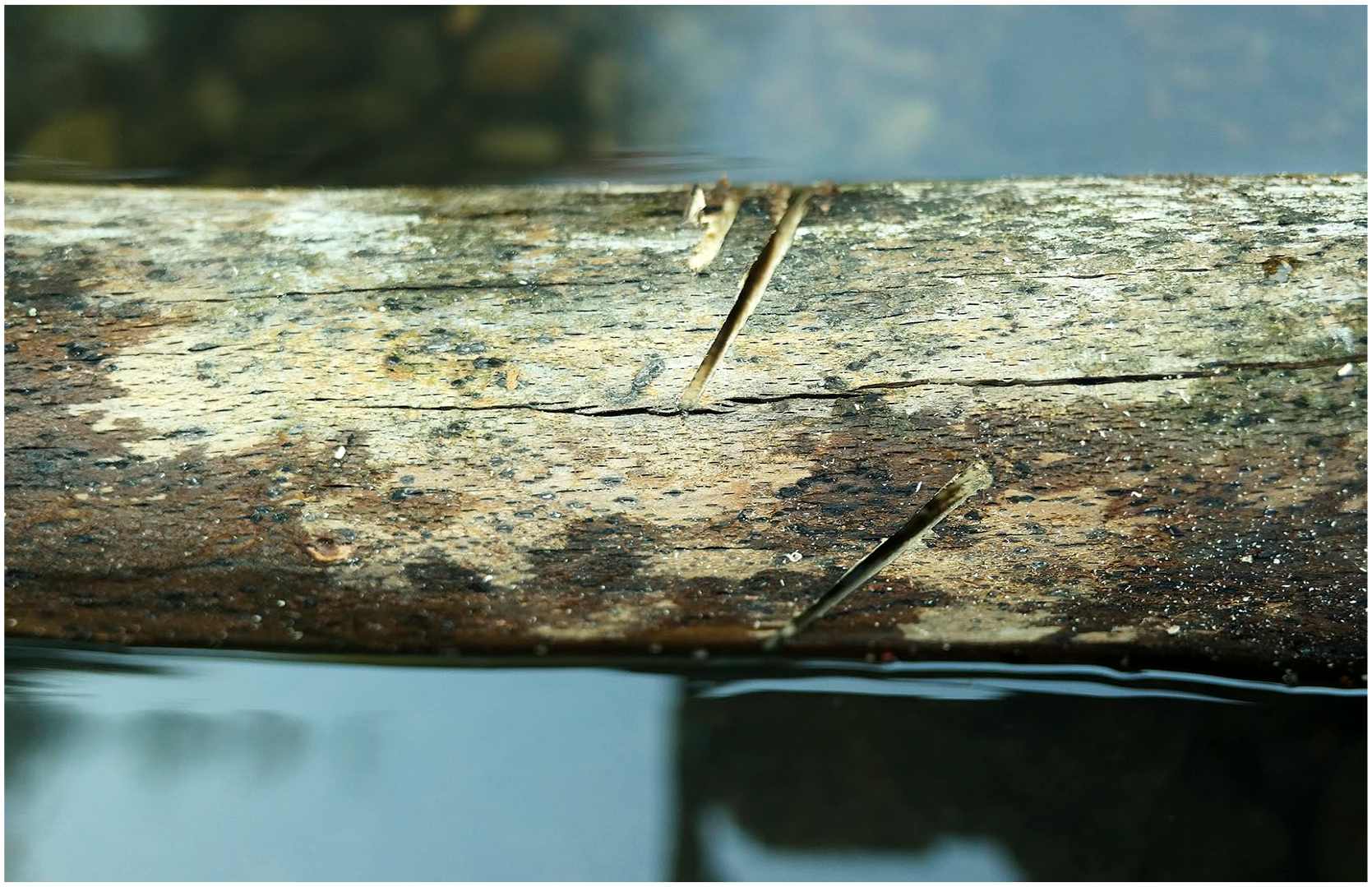
Miguel Santos, Brancepeth Beck interventions, 2015–2016.
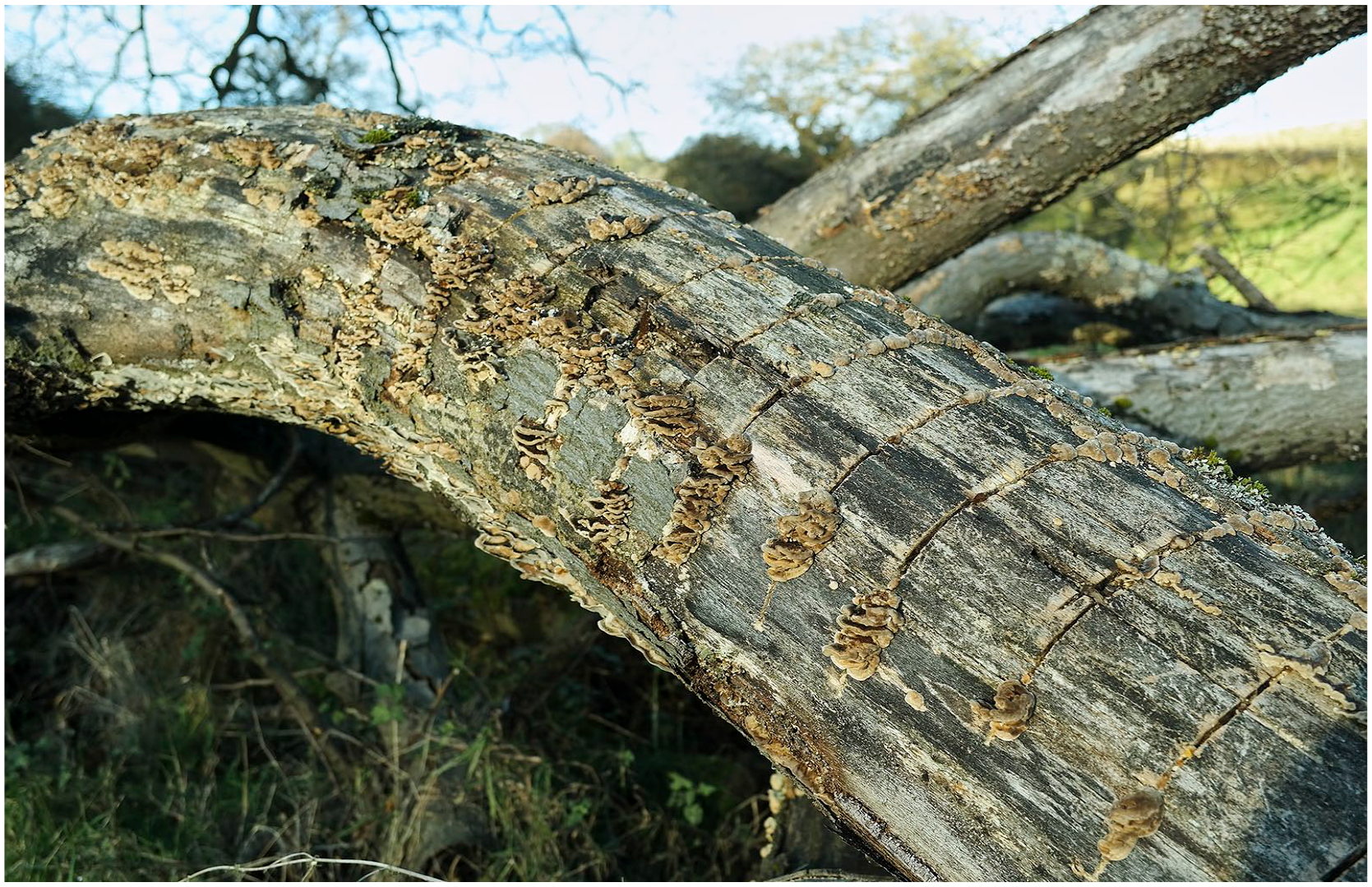
Miguel Santos, Brancepeth Beck interventions, 2015–2016.
Composting knowledge
The artist is not a source of meaning; neither is the work of art nor its audiences. Water flows through the ecosystem, co-creating multispecies meanings and interpretations while being transformed and modified. The expansion of anthropocentric features to nonhuman beings and things dilutes the exceptional qualities humans attribute to themselves and, thus, disrupts existing hierarchies and discourses. Scale anthropomorphizes size, placing humans in the center of their own social discourses and singular narratives while creating and reinforcing human-centered hierarchies of size: a bird might be more important than a microbe (is closer to the human size); a tree might be more important than a bird (is bigger and often lives longer than a human being); a century might be a long period for humans and their activities (e.g. constructing a dam or exploring a mine) but an oak tree can easily live for 200 hundred years, and a river for many more.
The artistic investigations acknowledge the limitations of language(s) in multispecies communication while paradoxically attempting to understand the voices being spoken. It is an experimental and experiential process of accessing and activating elements in the ecosystem, including elements from the past and distinct locations, to recognize geohistorical transformations and their imprint on the area. The practice of considering nonhuman audiences during the production of the work of art is mediated by several difficulties, for example, the artist is unable to stop being a human being coevolving with other species; there are infinite species with different perceptual and cognitive modalities, sizes, and timescales; privileging one species suggests a neo-anthropocentric approach where a human being (artist) selects a species for its audience while ignoring everyone else. Overall, there is an impossibility of knowing who the nonhuman audiences are, and to consider nonhuman audiences implies foremost acknowledging that ontological inability and condition of ignorance.
Thus, producing works of art for nonhuman audiences requires composting existing knowledge as a methodology to embrace the indeterminacy of multispecies conversations. 61 Specifically, there was an attempt to disrupt practices of binary reasoning (Human-Nature; I-Other), 62 which claim the possibility while reinforcing the impossibility of understanding the complexities of the ecosystem. This approach aims to establish relationships with (both) the recognizable and unrecognizable species, languages, and relationships coevolving and co-creating the field. It is an act of giving toward the unknown and the unrecognizable rather than solely yielding the ecosystem for traditional works of art (objects or representations about it or inspired by it) for human appreciation. 63 This speculative approach was decisive in developing the artistic investigation and moving beyond its idiosyncrasies – art and its Strange Tools as a practice of reorganizing the world. 64
These attempts at composting knowledge, a process of fermenting language and its implicit meanings, are often identifiable in pilgrimages, religious enquires, and artistic investigations where narratives of interrelational subjectivity are transformed by praxis, via the body’s disruption, for example, walking, chanting, chemical overdosing, shamanic rituals, performative repetition. The body is metabolically transformed, emphasizing it as a contaminated ecosystem coevolving with other beings. 65 These are attempts (conscious and unconscious) to step outside subjective blind spots and reach a fringe of consciousness. 66 Foremost, these were attempts at diluting human exceptionality by actively participating in a conversation with other species and things.
The activities in the fieldwork were linked with intuition and the perception of distinct phenomena (listening, seeing, smelling, touching, tasting), followed by minimal actions with the ecosystem, repetition of the actions to identify changes, and reflection and speculation. The tools employed during the fieldwork included a handsaw, paper and pen, and a camera. These tools were constrained by the artist’s physical strength to reduce the impact on the ecosystem without resorting to power tools. The methods in these artistic investigations are specific to the person using them, the site where they are used, the time of the year, and the ecosystem where they are employed. Nevertheless, these activities have a common and replicable methodology: decentering one’s position.
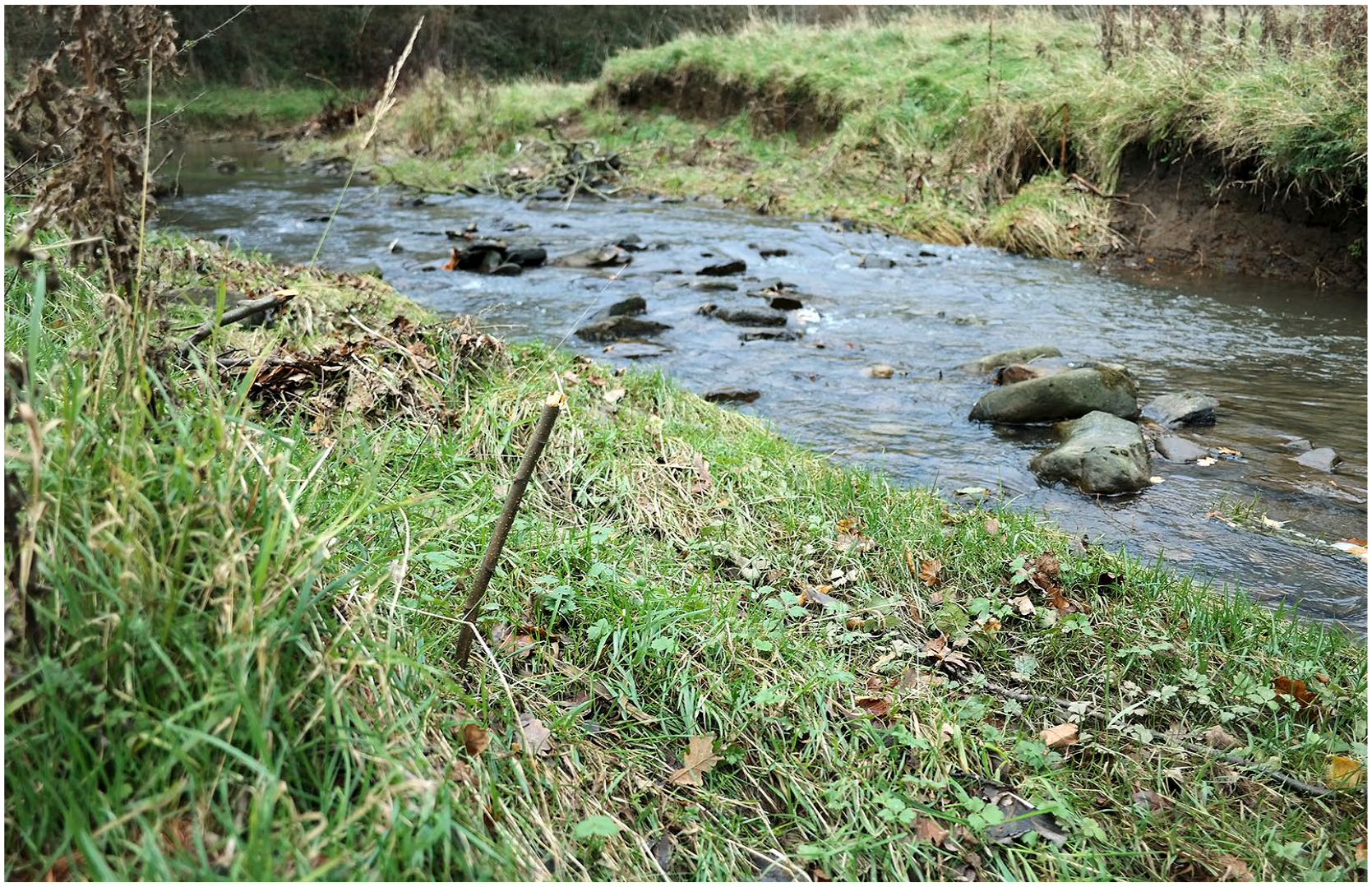
Miguel Santos, Brancepeth Beck interventions, 2015–2016.
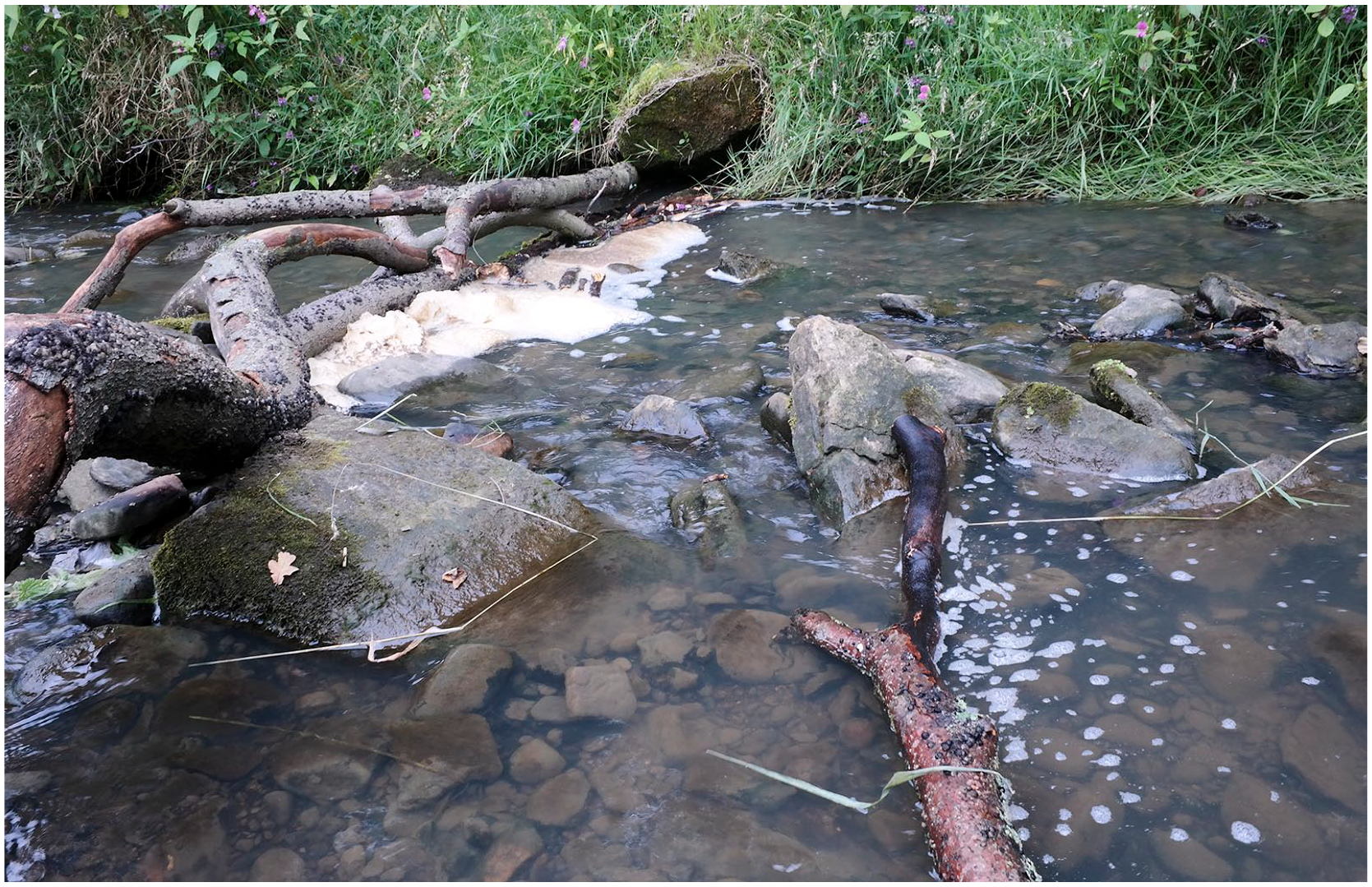
Miguel Santos, Brancepeth Beck interventions, 2015–2016.
The activities included being in the field at different times to improve the perception of change and noticing the relationship with its surroundings, standing still in the cold running water to imagine the role of the sand and the riverbank, walking in the beck in search for multispecies signs in the margins (roots, holes, tracks), lying on the ground smelling the soil, embracing trees and experiencing their warmth and time, listening to local sounds to identify hidden actions and species, reading the movement of the grass to study the impact of its gestures on others, drawing the wind to pay attention, waiting and meditating to embrace time, asking questions through small wood sculptures placed in the water and imagine answers (trapped foam, pollution from sewage works), making cuts in a fallen oak tree quickly occupied by visible fungus, singing, dancing, and reading to mosquitoes at sunset while trying to be one of them and failing. Although these activities are rich and could be further elaborated in several specific works, in the context of this article, we are focusing on the scope and ways these activities can contribute to the following steps. They are manifestations of an attempt at decentering one’s narratives and engaging with the more-the-human world.
The attempts at communicating with the more-than-human world around Brancepeth suggest that what is being measured, quantified, and represented might be overtly linked with an anthropocentrism that reinforces what humans are attending to and able to represent in language. The time spent in the field suggests the importance of non-measurable qualia in multispecies intersubjectivity and communication. 67 The realities of a bird, a tree, a human, a sheep, or a fungus belong to different assemblages. They are generative of multiple perspectives while intersecting and collectively rendering a sympoietic system(s). These different and unknown realities impact the relationships between water and river systems. The artistic investigations were a speculative attempt to establish a multispecies conversation that suggests the importance of embracing ignorance when listening to other (human and nonhuman) beings and things toward composting existing knowledge: collectively decentering the human importance in the world and individually diluting mythologies of the self.
Postamble
Water in the Expanded Field moves art’s critical and speculative power to scientific discourses, demonstrating the value of incorporating artistic practices in non-artistic contexts. The project challenges artistic and scientific methodologies, and this article is an element of that project rather than its demonstration or discussion. It exists in a cross-fertilized field of artistic and scientific practices, converging evidence from distinct perspectives and methodologies to consider what or who might be interested in water without being accounted for in water debates. This idea parallels the development of transdisciplinary approaches needed to address complex issues in (water) management, 68 which, together with ideas of (dis)connectivity continue to inform related work in the Department of Geography at Durham. 69
The walks, photographic project, and discussion between us and others point to disconnexions in the narratives of water. These disconnexions are not exclusive to the Wear catchment. They are often associated with industrialized (modernist) modes of organizing and standardizing the world that invariably script nature, collective identities, and local heritages. In water-management practices, the attempts at considering nonhuman perspectives and the sustainability of the natural world, such as the WFD, continue to be grounded in binary reasoning that detaches humans from the context where they coevolve while continuing to promote dichotomies such as Human//Nature or Us//Them. These separations between what is understood as human and not human are crucial to facilitate nature’s exploitation: water as a resource to be exploited rather than a vital element for all life.
Water in the Expanded Field develops a shared, holistic perspective with nature to promote the river as a sympoietic system. It attempts to hear some of water’s muted voices, even with a limited understanding of them, which might explain some difficulties in water-management practices. The notion of a water stakeholder is problematic and unhelpful, given that regarding water: humans, nonhumans, and things (including water) are all stakeholders. Thus, we expand the notion of stakeholder to other species and things, which raises an all-new set of infinite problems but implies the importance of diluting the voices of humans in water management. Further, decentering human narratives is essential if water policies and governance models are to be genuinely holistic, as suggested in approaches such as the WDF.
The voices in a catchment are infinite, mutating, pluriversal and often invisible, resulting in the unlikely possibility of hearing them all. It is this impossibility of hearing them all along with their complexities that we suggest should be cherished rather than dissimulated. In the case of water, there are compressively more voices being muted than heard. Water-management practices can improve by attempting to hear these silent voices regardless of their measurable potential. Our reflection on the different human and nonhuman voices allowed us to value their dialog and contribution to more sympathetic approaches in water-management practices.
The new works of art for nonhuman audiences in the Brancepeth field might or might not have been perceived by their audiences or understood as works of art. This project embraces that indeterminacy without aiming for any functionality or measurability that brings them to the realm of the human. Producing works of art for nonhuman audiences is a process of decentering oneself and composting binary reasoning, promoting holistic modes of relating to the world. These are attempts at composting human narratives and imagining multispecies dialogical utopias where humans are just another voice in the web of life rather than its owner.
The expectation behind the artistic investigations, this project, and this article is that producing works of art for nonhuman audiences is an insightful contribution to the relationships with the multiple species with whom we (humans) coevolve. Thus, we propose the value of transposing and incorporating these ideas in future scientific models and water-management practices, considering the complexity of the more-than-human world rather than solely from human perspectives.
Footnotes
Acknowledgements
We would like to thank the anonymous reviewers and editors of this journal, and D. and G. McLaren at the Brancepeth farm, who generously granted access to the land. Several past and present researchers at the Geography Department took part in discussions around the project: Laura Turnbull-Lloyd, Sophie Tindale, Louise Bracken, Rebecca Hodge, Divya Tolia Kelly, as did Angela Gurnell of Queen Mary and Peter Nailon of the Wear River Trust.
Funding
The author(s) disclosed receipt of the following financial support for the research, authorship, and/or publication of this article: The authors received financial support for the research by the Leverhulme Trust, Artist in Residence Grant: 2014-AIR-021. Additional support for publication was provided by Portuguese national funds through FCT – Fundação para a Ciência e a Tecnologia, LIDA – Laboratory in Design and Arts, ESAD.CR-IPLEIRA, UIDB/05468/2020.
