




Abstract
Exposición was a 2022 art exhibition that explored seasonal farm labourers’ exposure to strawberry herbicides in Huelva, Andalusia. Drawing upon a multidisciplinary collaboration of art, social geography and soil science, the following discussion contextualises Exposición and offers reflection on the exhibition as an immersive site for figuratively re-sensing lived experiences of heavily polluted places. The exhibition provided space in which configurations of matter, affect and atmospherics might allow contemplation of environmental toxicity, while also being a means of voicing the care, solidarity and hope enacted by affected communities.
Bern, 2022. Would you like a strawberry? asked the figure dressed head to toe in a white hazmat suit. Crimson fruits sparkled on a sterile surgical tray offered as if it were a plate of canapés. The performer wandered from person to person, group to group, inside and outside the Geography Institute, offering dangerously tempting strawberries and sowing seeds of doubt. Are the strawberries safe to eat? 1 The hazmat suit seemed to suggest otherwise. As the strawberries were circulated, two simultaneous reactions were catalysed. On the one hand, the performance looked to provoke suspicion followed by critical engagement with the chemical industries of food production. On the other hand, we hoped the curious canapés might also sparked a sense of enchantment. Desire to eat the strawberries was tempered with an urge to follow the commodity back to its source.
In this article, we invite you to join a tour of our 2022 exhibition at the University of Bern, which storied some of the conditions under which seasonal farm labourers are exposed to sprayed herbicides in the Andalusian strawberry industry. During the tour, we contemplate the exhibition as a site for calibrating affective responses to uneven toxic exposures. Our analysis focuses on ideas of hope, expressed via enchantment, as an orientation for making ‘permanently polluted’ worlds more liveable. 2 Far from escapism, Tara Woodyer and Hilary Geoghegan frame enchantment as ‘fleeting moments that can accumulate and sustain hope in times of real difficulty’. 3 This orientation felt pressing given the uneven and gendered distribution of exposure to herbicides: much of the precarious labour of strawberry picking in Andalusia is done by migrant women. Maintaining hope in such contexts is essential to reframing dominant narratives, contesting power structures and redistributing agency. 4
Our hopeful geography is, following Eben Kirksey, grounded in the ‘actual living’ communities of workers together with assemblages of more-than-humans; namely air, molecules, soil and strawberries. 5 As such, the exhibition brought together multiple perspectives on toxic environments and was itself the product of a multidisciplinary collaboration between a soil scientist, a social geographer and an artist. 6 In producing the exhibition, we combined aspects of our research in novel ways. By assembling ethnographic data in the same space as soil ‘samples’, we created tangible relations between our disciplines with which audiences could engage. In doing so, our intention was to contribute to emerging discourses on geographies of hope as a social response to daily entanglements with the material realities of toxic chemicals and their infrastructures.
Re-sensing toxicity
Upon entering the main gallery space of Exposición, visitors encountered a temporary structure in the middle of the room: a greenhouse three metres wide, five long and almost two high. Its arched steel frame was wrapped with a translucent membrane (Figures 1 and 2). Visitors who stepped inside the structure became shadow puppets to onlookers outside. Inside, views to the outside world, or even across the greenhouse, were obfuscated by a mysterious mist. Vague plumes swirled around bodies and unfurled into the corners. To breathe in the greenhouse was to breathe in a world of chemical fog laced with an earthy perfume; the ground underfoot was blanketed in a layer of topsoil. Listeners discerned trickling water, footsteps, voices, thrumming machinery, passing traffic and the crackling of a Geiger counter; the soundscape echoed agricultural labour sites in the strawberry fields of Huelva.
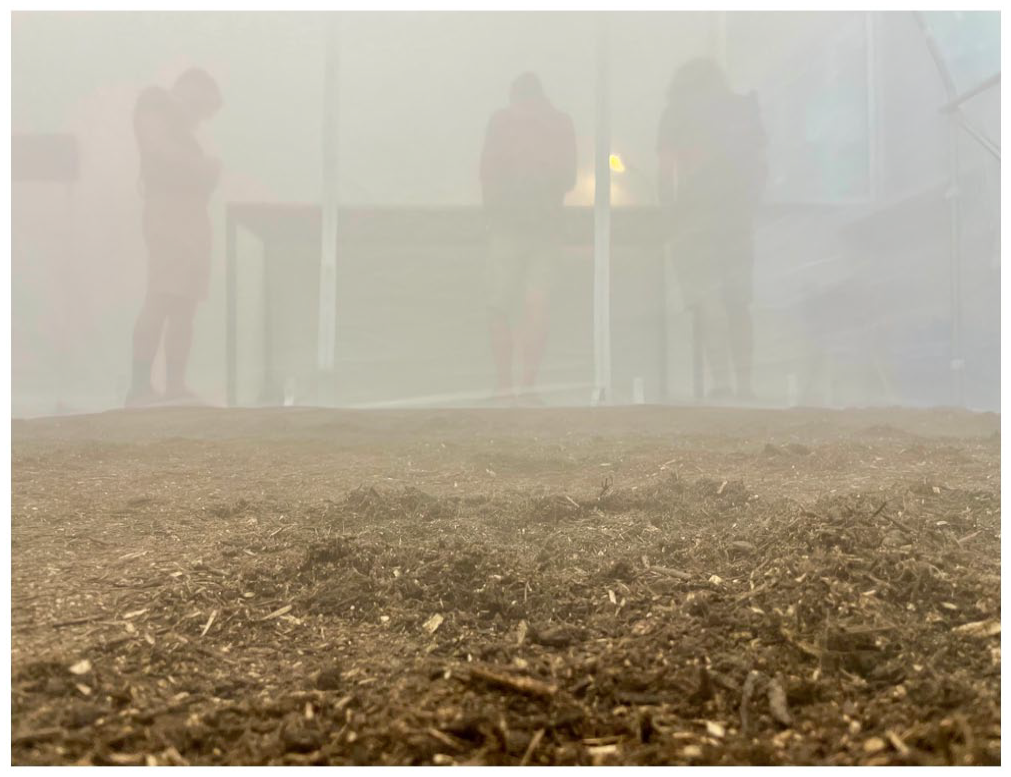
Inside the immersive installation, Untitled (greenhouse). Photo: Lucy Sabin 2022.
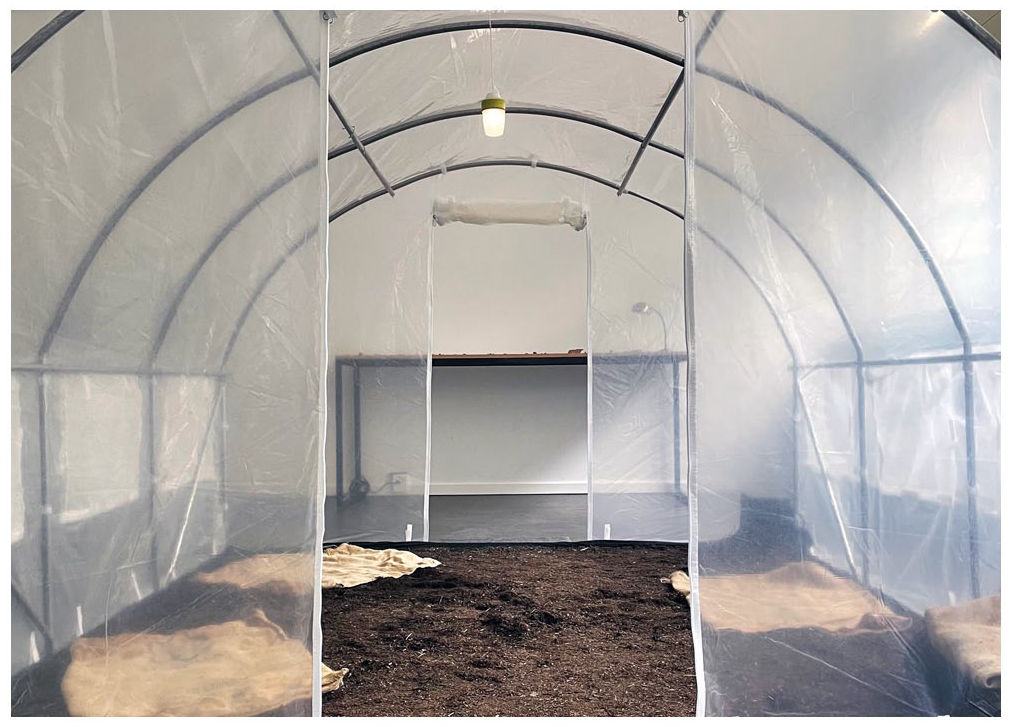
The greenhouse installation (without fog). Photo: Lucy Sabin 2022.
Exposición, meaning both art exhibition and chemical exposure in Spanish, was curated as a creative and critical response to industrial agricultural production in Huelva, Andalusia – a region where toxic exposures intersect and accumulate in high concentrations. The issue of environmental toxicity is especially significant because Huelva is home to one of the largest radioactive fertiliser waste dumps in Europe, an immense chemical park, and an open-cast mineral mine further upstream. Alongside the seas of plastic polytunnels used in growing strawberries (Figure 3), this chemical infrastructure jostles with suburbs, rivers, irrigation systems and arable fields. 7
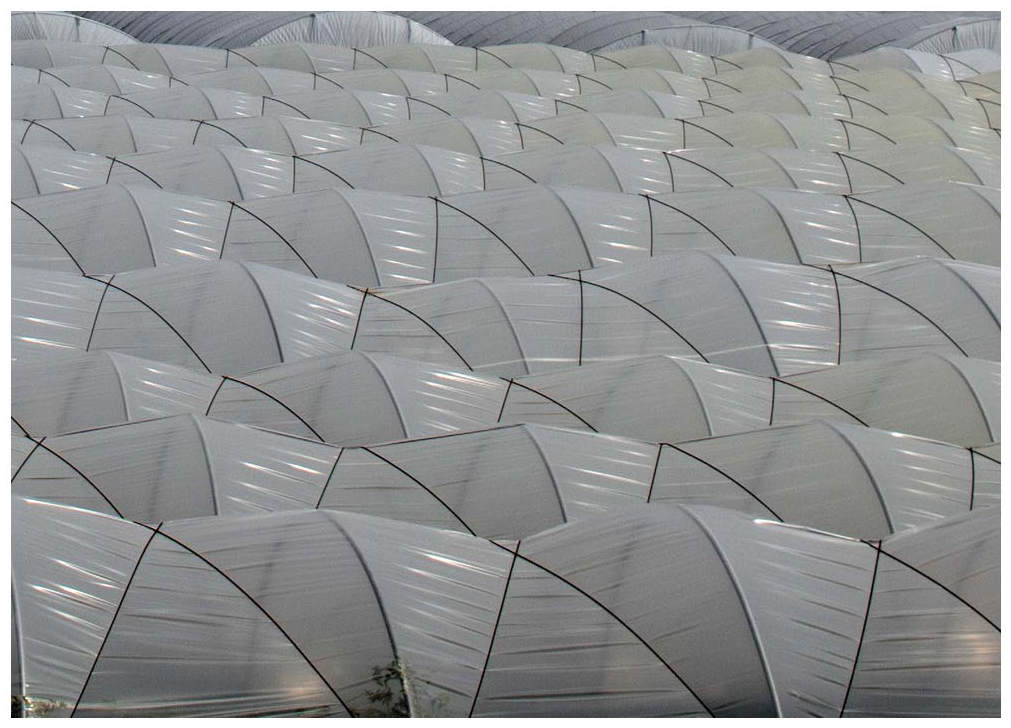
A sea of polytunnels for growing strawberries in Huelva. Photo: Lucy Sabin 2022.
We designed and curated Exposición to try and make palpable the effects of toxicity across this landscape through installation and staging. We did so in part by constructing an immersive space; the greenhouse installation was an atmospheric surround that demonstrated each body’s entanglement within industrial systems of food production (Figures 1, 2 and 4). One visitor reported that she could ‘re-sense’ the atmosphere of the greenhouse through her own body, enabling her to ‘better imagine how it might feel to work in such harsh conditions’. In their account of enchantment, Woodyer and Geoghegan emphasise the importance of sensory experience, whereby ‘a new circuit of intensities form between material bodies’. 8 In the murky atmosphere of the greenhouse, glycerine from the fog machine became a substitute for another chemical compound: glyphosate, the herbicide commonly sprayed on strawberries. The artwork thus invited visitors to ‘sample’ sprayed pesticides through their bodies as they ingested strawberries, sifted soil with their fingertips and inhaled the ‘contaminated’ air.
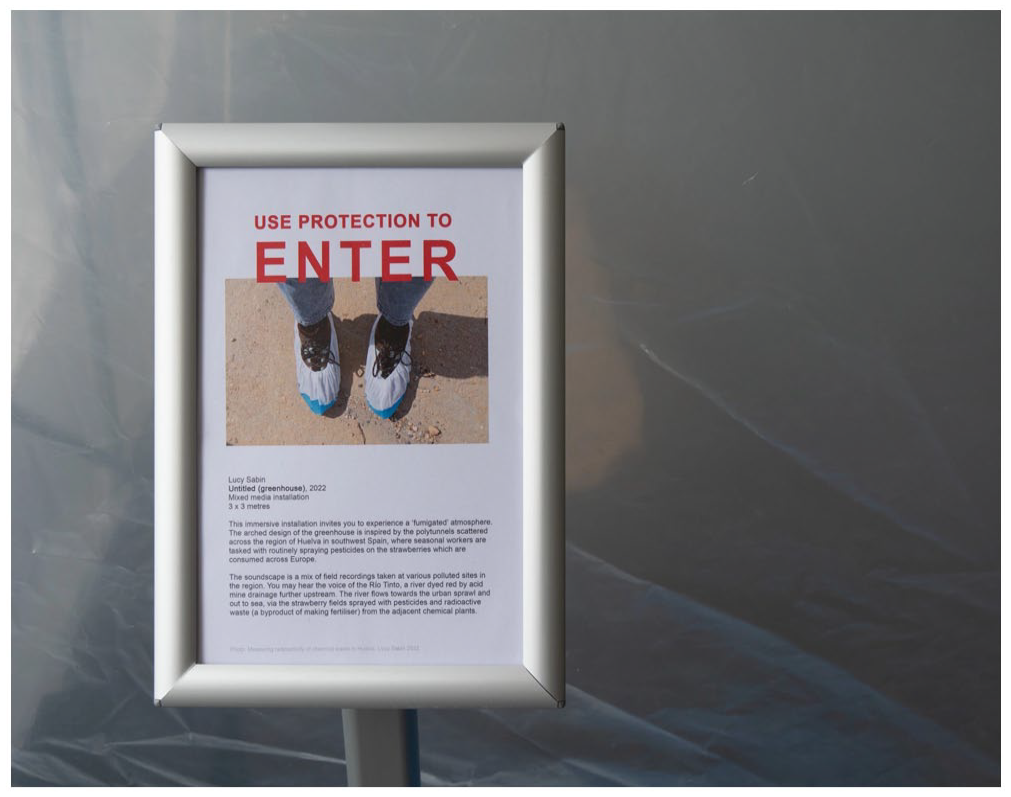
Visitors had to put on a pair of protective overshoes before entering the ‘contaminated’ greenhouse. Photo: Lucy Sabin 2022.
Cultivating hope
While Exposición corresponded to toxic exposures, the exhibition did not drown out possibilities for hope but opened spaces in which hope may be generated, countering reductive and damage-based understandings of toxic exposures. 9 The tour continues. Natural light streamed through a row of windows, diffusing across the ghostly structure of the greenhouse and the ‘toxic’ fog it contained. Below each window pane, interview quotes from Komposch’s ethnographic fieldwork in Huelva with seasonal strawberry pickers were affixed to the sill. 10 The farmworkers are mostly women from Morocco, Eastern Europe and Andalusia. Their words were transcribed from interviews then translated into English from Arabic or Spanish. Printed quotations described the effects of chemical exposure, exploitative working conditions and struggles of agricultural workers.
One quotation, from a unionist and former worker, testified to the adverse health effects of acute exposure to herbicides: ‘There are times when they are fumigating next to you, and you have no protection whatsoever. You start with horrible headaches, stomach aches and it’s horrible, it’s horrendous, but here in the health sector nobody has ever investigated the health problems that people who work in the strawberry fields are suffering from’. Confirming the lack of protective equipment despite increased risk of exposure (see Figure 4), a worker stated: ‘As I bend over to pick the fruit, the dust [from the plant protection product] goes up my nose and makes my eyes water’. And yet, another added, these complaints are not raised with employers, ‘out of fear of being blacklisted, out of fear of not being hired again by the same boss, out of fear that the boss will tell another boss not to hire you. A lot of fear’.
These vignettes not only offered scenes of exposure and narratives of labour exploitation; they also spoke to and communicated workers’ capacity for adaptation and imagining liveable futures. ‘You have to know, that all the women who do this work picking strawberries are very strong. We carry 24 kilos of strawberries’, affirmed one interviewee. Other quotations described the perennial friendships and self-organisation between workers. The seasonal nature of the work mean that the women live together in temporary accommodation and develop close bonds: ‘We organise ourselves together in everyday life, do our grocery shopping together, eat together and help each other’. Another added: ‘To reduce the back pain, we massage each other with olive oil in the evening’.
In the exhibition, accounts of solidarity coexisted with the harsh working conditions of the strawberry industry, inspiring ‘new formations of what it means to be in community together’. 11 While toxic exposure was the subject of the exhibition, the gallery space showed this subject in relation to instances of hope and situated agencies grounded in communities. 12 One interviewee expressed their hopeful desire for a better future: ‘The work here is very important for me because like this I can pay the studies of my children. [. . .] My daughter is studying administration and my son is studying geography’.
Along the other surfaces of the gallery, various media contextualised and supported the workers’ stories. There was a computer monitor displaying an interactive map of the potential impacts of toxic chemical exposures on long-term, reproductive and intergenerational health of workers. 13 A televised exposé of working conditions played on loop on a wall-mounted screen, 14 while an adjacent ‘research table’ offered an assemblage of excerpts from news articles, scientific reports and policy documents as well as photographs, handcrafted artefacts and paraphernalia from ongoing campaigns by local activists (Figure 6). Lastly, a triptych of large-format photographic prints portrayed some of the temporary dwellings that the workers occupy seasonally. The dwellings are isolated cabins nestled within industrial-agricultural topographies. Laundry lines vibrant with garments stand out as intimate and mundane reminders of self-organised and collective routines of care (Figure 5).
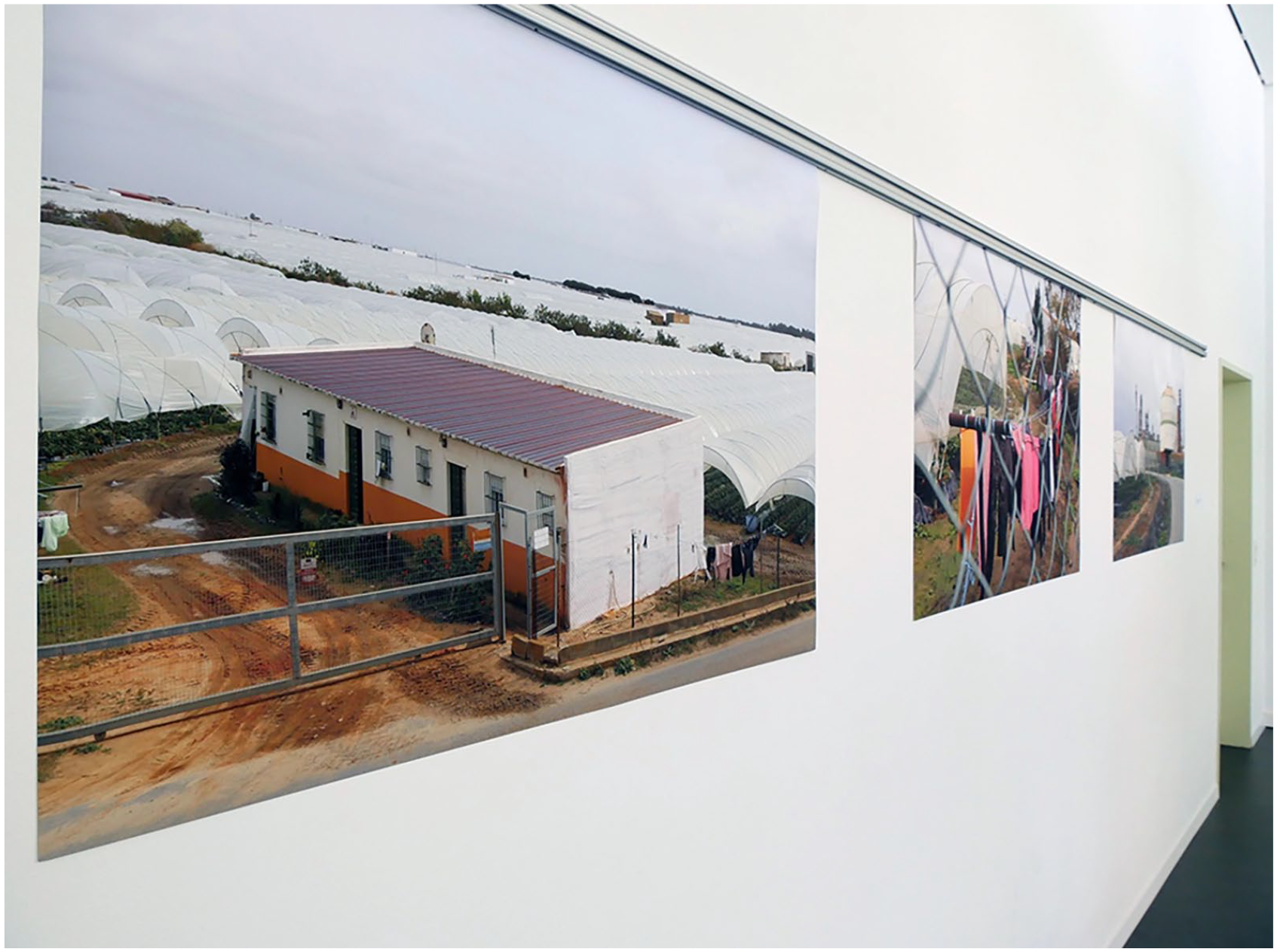
Triptych of digital photographic prints showing the temporary housing provided for seasonal workers in Huelva’s strawberry industry. Photo: Lucy Sabin 2022.
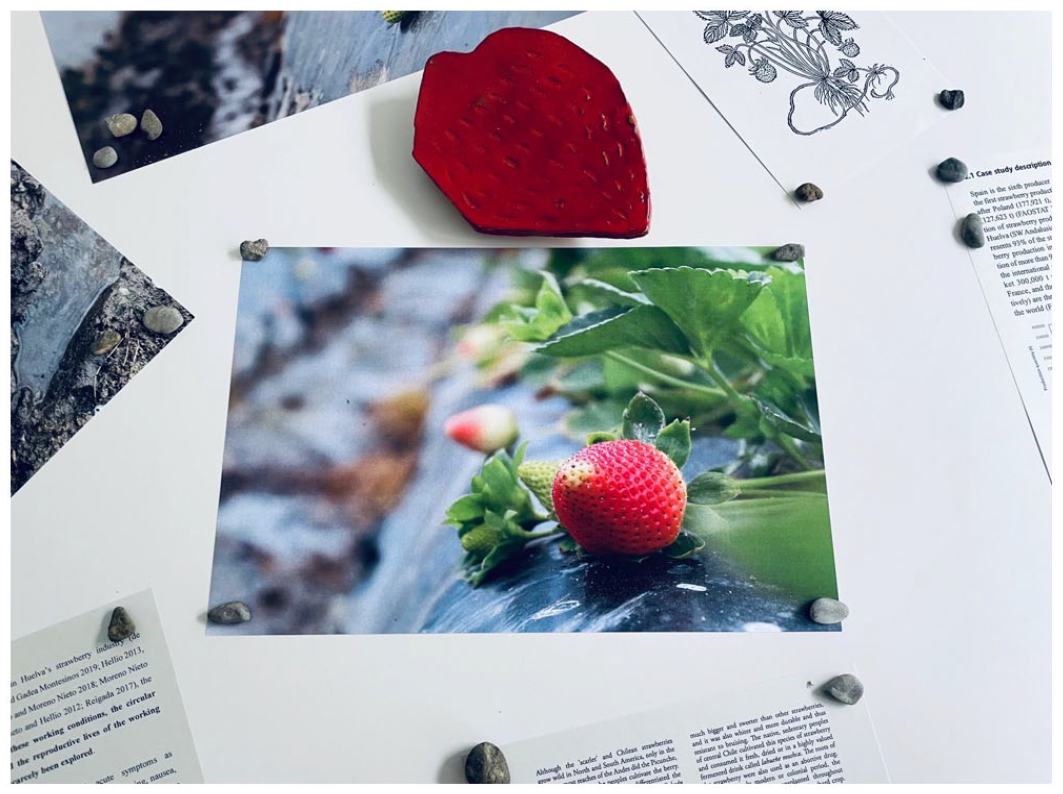
Close-up of the ‘research table’ featuring fieldwork photography, academic research and artefacts from Huelva. Photo: Lucy Sabin 2022.
Final reflections
If enchantment, a sense of awe and wonder, is central to cultivating hope in cultural geographies, 15 Exposición embraced enchantment through creative storytelling, sensory immersion, playfulness, performance, participation and paradox. The art exhibition became a space for attending to the ‘pleasurable sense of mystery and its simultaneous sinister edge’. 16 Exposición did not attempt to literally re-present pollution but instead sought to introduce ambiguity and enchantment via allegedly toxic (but organic) strawberries, the supposedly poisonous (but harmless) fumigated atmosphere of the greenhouse installation, and the voices of workers who shared their stories of dealing with exploitative working conditions. These artistic encounters framed toxicity as a complex issue, hinting at the uncertainties surrounding the effects and extent of toxic chemical relations across space and time. Grappling with the limits of representing something as vast and elusive as toxicity, Exposición foregrounded singular moments and small stories, some elements of which were confronting but also hopeful and future-oriented, which in turn allowed space for ‘imagining worlds otherwise’. 17
Supplemental Material
sj-mp3-1-cgj-10.1177_14744740231183202 – Supplemental material for Exhibiting toxicity: sprayed strawberries and geographies of hope
Supplemental material, sj-mp3-1-cgj-10.1177_14744740231183202 for Exhibiting toxicity: sprayed strawberries and geographies of hope by Lucy Sabin, Nora Komposch and Adrien Mestrot in cultural geographies
Footnotes
Acknowledgements
The authors thank the mLAB at the University of Bern for welcoming our art-research collaboration and Mirko Winkel for coordinating the art residencies at mLAB. The authors are grateful to the extended team at Bern: Isabella Geissbühler for the logistics, Marlis Röthlisberger for the finances, Saliba Saliba and Ashish Kulshreshtha for the IT-support, Milojka Drinčić for the cleaning work, Ladina Gaudy, Leonie Haller, Nina Etter, Mariana Matthei Guzmàn and Livia Vogel for the help installing and taking down the exhibition, René Nussbaumer and Maarika Bischoff for the loan of laboratory equipment and Laura Perler and Carolin Schurr for her content feedback. This project would not have been possible without the participation of farm workers, activists and unionists in Huelva: Thank you! We also wish to thank Batati and Balmeggberg Farms for showing us how they find alternatives to pesticides.
Funding
The author(s) disclosed receipt of the following financial support for the research, authorship, and/or publication of this article: The art residency in 2022 was funded by the mLAB of the Institute of Geography from the University of Bern.

Supplemental material
Supplemental material for this article is available online.
Notes
Author biographies
Supplementary Material
Please find the following supplemental material available below.
For Open Access articles published under a Creative Commons License, all supplemental material carries the same license as the article it is associated with.
For non-Open Access articles published, all supplemental material carries a non-exclusive license, and permission requests for re-use of supplemental material or any part of supplemental material shall be sent directly to the copyright owner as specified in the copyright notice associated with the article.
