




Abstract
Digital mediation profoundly shapes how cultural geographers understand and encounter nature. Practice-based engagements with digitally mediated natures pose methodological, aesthetic and ethical questions for cultural geographers. Reflecting on a conference held in Bonn, Germany, in July 2022, which brought together a host of artists, practitioners, researchers and designers working at the human-technology-nature interface, this paper introduces the special issue, Digital Ecologies in Practice. The paper reflects on the key themes which cut across contributing articles and sketches a framework for methodologically – and practice – inclined geographers. Specifically, we draw out the ways in which practice-based engagements with digital technologies and processes of digitisation afford novel modes of sensing, speculating and remediating natures that have implications for the doing of both digital ecologies and cultural geographies as fields of research and domains of critical practice.
Keywords
Digital ecologies in practice
A rout of snails gradually crawls across a tablet screen. Traces of their movements are perceived by sensors and translated into an evolving visual and sonic composition, livestreamed through a web application. One snail, seemingly nonplussed by its own mediated musicality, glides off the tablet’s edge in search, perhaps, of the terrarium it has been relocated from. These snails, as companions, collaborators, and sources of inspiration, bind together the components of Mari Bastashevski’s exhibition, Pending Xenophora, displayed at the Brotfabrik gallery in Bonn, Germany (July 2022). In another corner of the gallery containing a translucent inflatable tent, participants in a virtual reality (VR) experience navigate a series of interconnected virtual spaces, while sounds and smells intended to evoke a snail’s lifeworld fill the tent’s atmosphere. Snails, in our reading of Bastashevski’s work, invite appreciation of slowness and care in bridging relations between humans and nonhumans and in finding new ethical modes of living together. They present, through their bodies and evolutionary histories, a provocation to modernist obsessions with speed and scale in such things as data production, analysis and storage. Perhaps provocatively, Bastashevski seeks to foster such an appreciation through the use of digital technologies, demonstrating possibilities for slower, more care-full and reflexive forms of digital mediation (Figure 1).
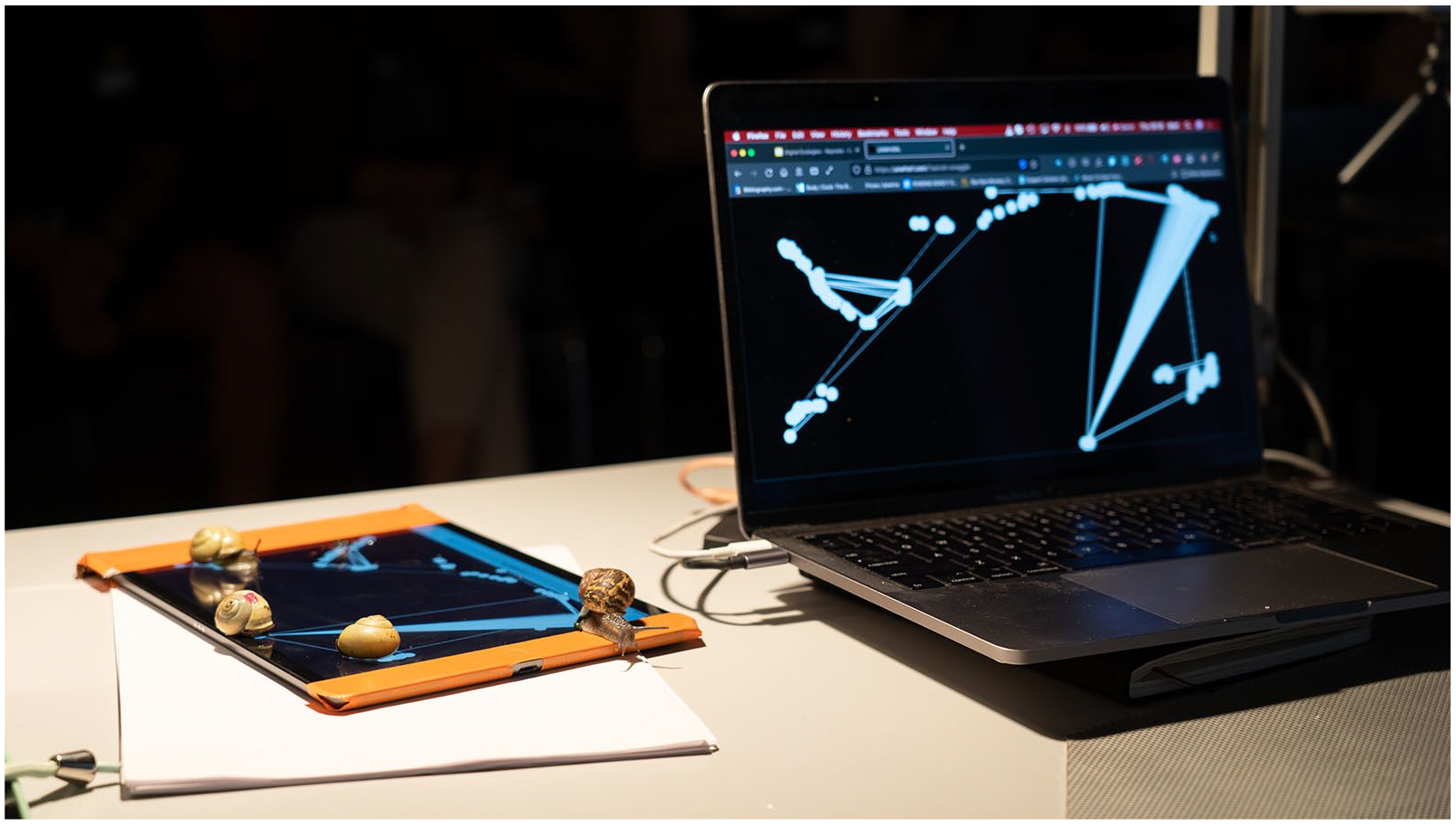
Snails navigate a tablet screen in Bastashevski’s Pending Xenophora.
This special issue of cultural geographies in practice emerged from the ‘Digital Ecologies in Practice’ conference held at the University of Bonn in July 2022, where Bastashevski exhibited Pending Xenophora. 1 The conference brought together digital and sound artists, designers, media studies and science and technology studies scholars, ecologists, and geographers. Broadly, the event sought to generate alternative engagements with digital technologies and processes of digitisation beyond culturally dominant techno-solutionist and techno-apocalyptic narratives of the ‘technonatural present’. 2 These engagements articulated theoretical and empirical opportunities grounded in practice, remaining critical of the political-economic backdrop against which these technologies are developed, used and discarded. They took place across a combination of artistic exhibitions, practical demonstrations, academic presentations, and interdisciplinary conversations about the ‘doing and making’ of digital ecologies as both a field of research and a domain of critical practice.
As an emerging field of research, digital ecologies interrogates the digital mediation of more-than-human worlds, bridging digital and more-than-human geographies and drawing on adjacent work in media studies and political ecology. It approaches contemporary forms of ‘digital entanglement’ 3 through a threefold focus: on digital mediation as a material process; on the novel encounters, affects and political economies inaugurated by digital technologies; and on emerging forms of digital environmental governance. It is indebted to a broad range of research in geography and across the social sciences and humanities which has drawn much-needed attention to how and to what ends nonhuman life is digitised. 4
This special issue gathers scholars, artists, designers, practitioners, and those in between with an interest in how digital technologies can transform nature and human-nature relations. Many contributors use technologies in their practices to intentionally mediate or investigate nature, its governance, and the ethics of mediation. The works included here highlight the methodological, aesthetic, and ethical potentials of situated and engaged empirical investigations into the complex relations of society, ecology, technology, and digital mediation. Contributors investigate, both explicitly and implicitly, how methods for studying digital human-nonhuman relations, or methods that involve digital devices and practices, can be deployed within geographical research; how digital technologies allow scholars, practitioners, and artists to experiment with novel modes of representation and participation and creatively cross disciplinary and species boundaries; and finally, which ecological problems are addressed, created, or exacerbated by the use of digital technologies in such research-practice.
In keeping with the ambition of cultural geographies in practice, we have sought with this special issue to provide a forum for new forms of creative and collaborative practice, engagement, and representation addressing key themes in cultural geography and digital ecologies research. 5 We follow Nash in investing these forms with the capacity to foreground and shift established ideas of authority, expertise, and ways of working in cultural geography. 6 We see the promise of these practices for inaugurating ways of doing and making necessary for navigating and remediating the technonatural present, 7 resonating with recent work experimenting with the affordances of digital technologies for community-led and multispecies environmental politics. 8 This issue is an attempt, first, to forego straightforward celebrations or critiques of digital technologies deployed for environmental purposes in favour of situated empirical analysis of their worldly implications. 9 Second, the collection evidences a set of heterogeneous experiments employing digital technologies in situations not typically associated with critical scholarship. Digital ecologies, in this second sense, is figured as a domain of critical practice which actively intervenes in the digital mediation of more-than-human worlds. Recognising the particular historical and political-economic relations from which digital technologies have emerged and the inequalities and biases embedded in their function, the impetus of such experiments is to engage productively and practically in imagining and making human-technology-nature relations otherwise. We suggest there is significant scope and value to continuing with and diversifying such practices.
Sensing, speculation, remediation
Reflecting the diversity of its contributors, the empirical and methodological scope of this issue is broad. 10 Here, we draw out three themes salient to this collection – sensing, speculation, and remediation – to connect contributing articles with our concerns over methodology, aesthetics, and ethics in cultural geographical and digital ecologies research.
Sensing
Sensing, conventionally viewed as a unique capacity of the embodied and experiencing human subject, 11 is increasingly understood in more-than-human terms: it is something which humans achieve together with assemblies of digital sensors, algorithms, and data infrastructures to enable new ways of knowing and acting 12 but also a capacity of nonhuman organisms registering and responding to their environments. 13 Contributors to this issue deploy expansive understandings of and methodological approaches to digital sensing practices to register and render accessible phenomena and processes as diverse as microbial ecologies in urban rivers (Bradshaw, this issue), 14 the behaviour of red foxes in London (Fry, this issue), 15 tornado forces inscribed in archival materials (Ericson, this issue), 16 and erosional processes shaping tidal landforms (Chasseray-Peraldi and Malaret, this issue). 17 In doing so, they develop new collaborative methods for digital ecologies researchers and ask how researcher-practitioners might sense, engage with, and evoke biogeophysical phenomena across diverse temporalities.
Speculation
At the conference in Bonn, participants were invited to journey into the mind of a plant. Phytomorphism, an extended reality (XR) – virtual reality (VR) hybrid experience designed by the art-research collective, Plant Fictions, offered a stunning audio-visual journey into vegetal worlds based on a design process which incorporated botanical research and the power of psychoactive plants. 18 Inspired by the ability of certain plant compounds, once ingested, to alter one’s perceptual experience and induce a distributed, more-than-human sense of self, Phytomorphism experimented with digital technologies for altering states of consciousness to foster a sense of connection with the vegetal world (Figure 2). At the heart of Plant Fictions’ practice is speculation. With speculation, we evoke ‘a way of giving rise to possibilities’ 19 that is pragmatic and resists commonplace associations between the speculative and the immaterial, detached or abstract. Speculative engagements with methodologies, aesthetics and ethics in digital ecologies research practice characterise many of the articles herein. Contributors develop varied ‘speculative geographies’, which we follow Williams and Keating in describing as ‘a diverse set of conceptual and empirical endeavours that construct plural rather than singular narratives, recuperate multiple rather than complete forms of knowledge, value holding open what is at stake and can be brought into purview and, in doing so, intensify alternative possibilities’. 20
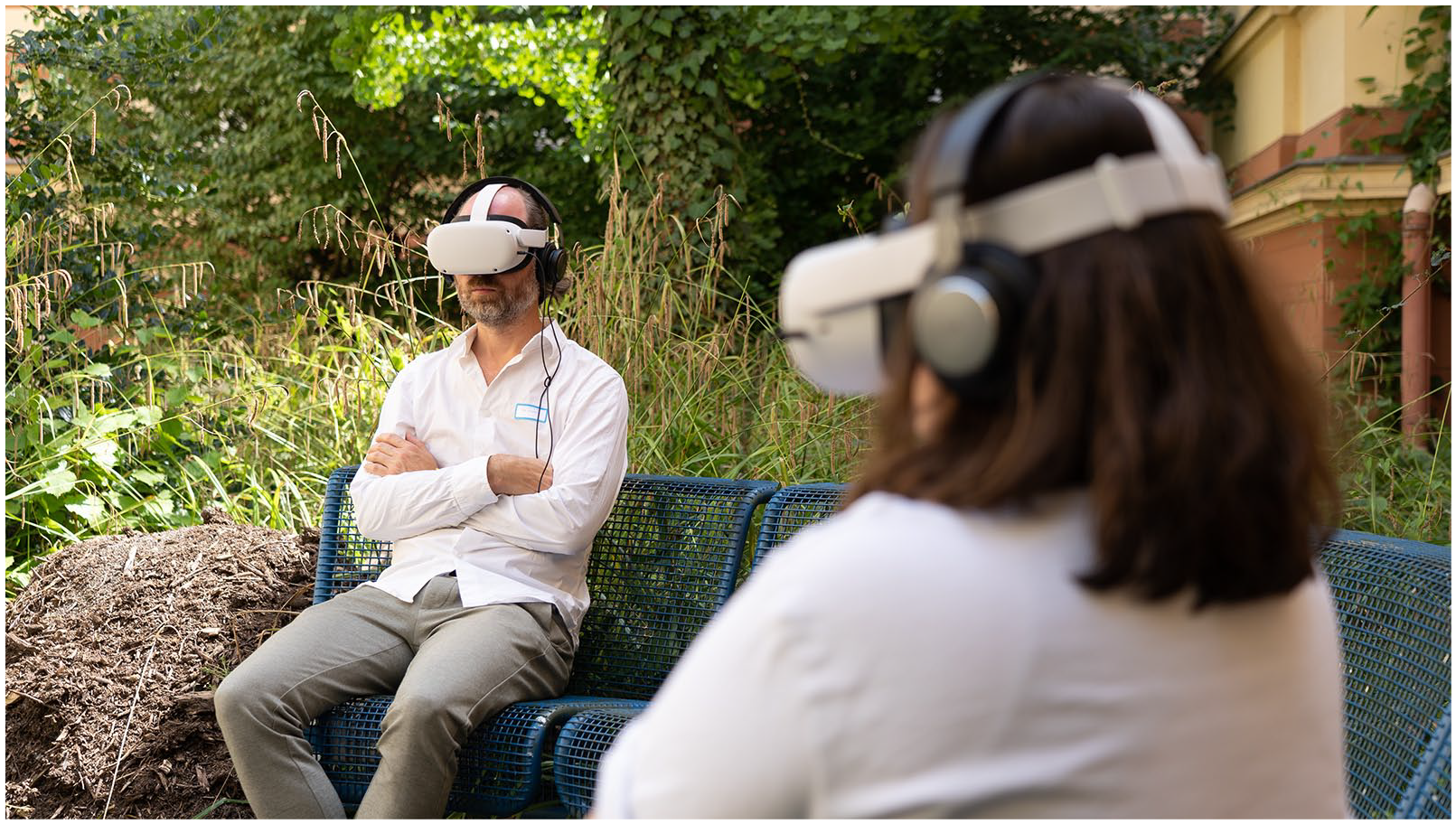
Conference attendees participate in Plant Fiction’s Phytomorphism experience.
Like Plant Fictions, our contributors create new ways of envisioning and inhabiting worlds with the aid of digital technologies. In practice, they utilise 360° photography and a gaming engine to speculate on the future of a rewilding project in the UK (Revans and Hartman Davies, this issue), 21 deploy machine vision algorithms to interrupt the disembodied ‘view from nowhere’ produced by satellite Earth observation (Carter, this issue), 22 and develop a method – ‘un-indexing’ – for reconfiguring search engine results that rarely reflect local environmental knowledges or embodied experiences (Colombo and Gray). 23
Remediation
Digital technologies invoke speed, instantaneity, and liveness. The materialities underpinning this rapidity, however, often go unacknowledged by those using or promoting these technologies. 24 In Bonn, Matthew Halpenny brought this materiality to the fore, presenting their work, Slow Serif, to conference participants. Slow Serif harnesses Microbial Fuel Cells (MFCs) – open-source battery devices made from moss, microbes and organic matter alongside anodes, cathodes and other electrical components – to produce energy from microbial metabolism. 25 The MFCs power an e-ink screen upon which a novella is written using machine learning technologies, which Halpenny programmed to produce novel texts based on inputs from several academic works on climate change, capitalism, and slowness. Halpenny’s performance required patience and care to come into being but also calls into question expectations of energy immediacy to highlight the extractive underpinnings of the technologies many hope will serve eco-friendly futures (Figure 3).
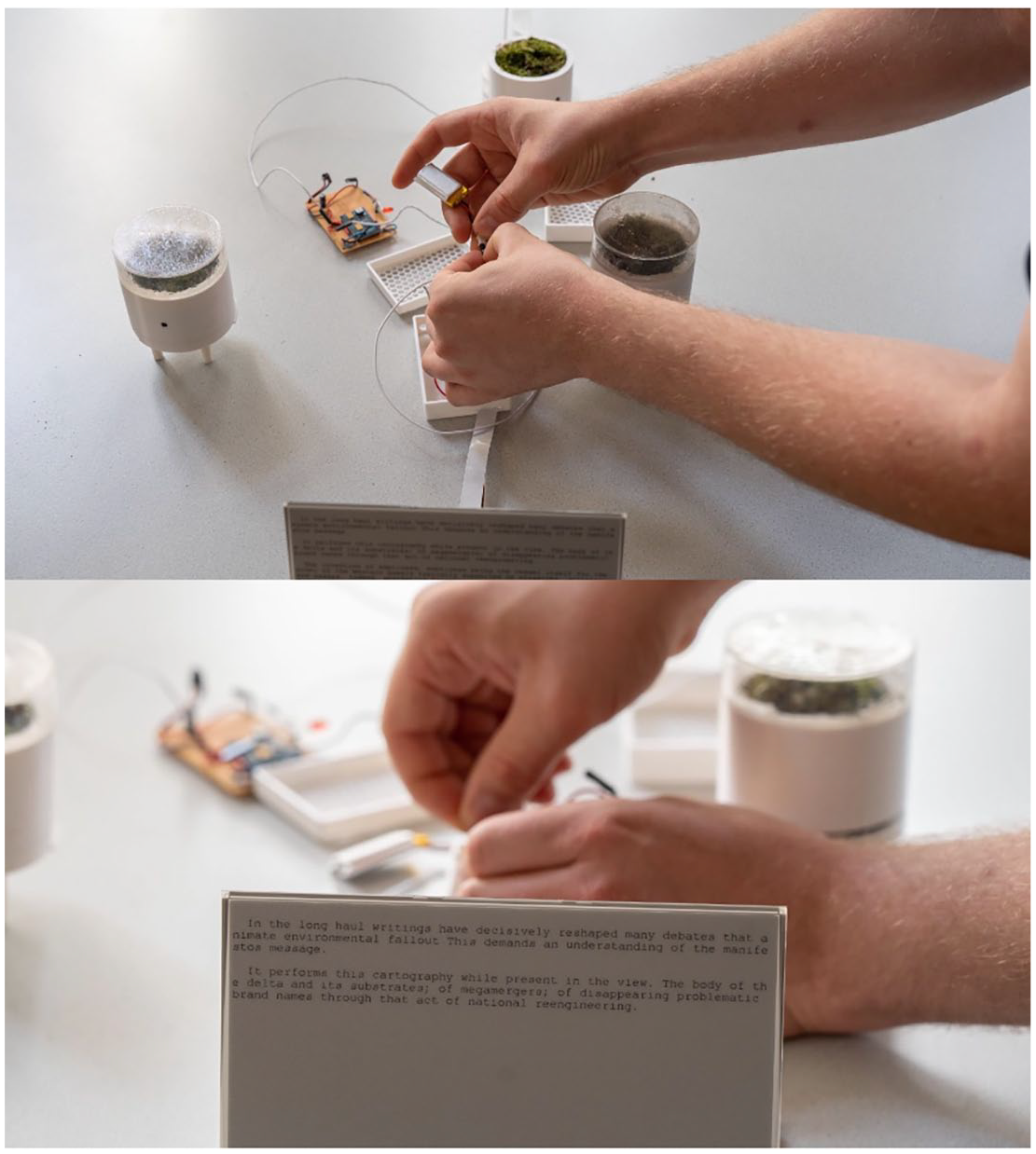
Halpenny demonstrates the operation of Microbial Fuel Cells in Slow Serif.
Halpenny’s work is remediative. It prefigures a future that is cognisant of the massive material impacts of digital technologies and gestures towards the possibility of less harmful technologies. For media theorists, remediation involves the incorporation or representation of one medium in another medium, while the term more colloquially conjures the notion of remedying or repairing something, especially environmental damage. Drawing from these definitions, remediating the technonatural present ‘concerns the tools used to make sense of it, to tell stories about it, and to think creatively beyond spectacular binary narratives of hope or desolation’. 26 The articles in this issue speak directly to the theme of remediation, outlining practices by which environmental data – and dominant ordering and representational logics mobilised by powerful actors – can be redirected to cultivate alternative modes of sense-making, story-telling, and recuperative practices. Contributors repurpose ecological data for public engagement interventions aimed to stimulate affective engagement with managed ecologies (Whitelaw et al., this issue); 27 they use performative installation as a method for cultivating urban multispecies cohabitation, reframing particular species’ presences in less antagonistic ways (Uskakovych, this issue); 28 and they develop practitioner- and user-led design protocols for digital platforms that aim to manage human-wildlife conflicts (Kirkham, this issue). 29 In doing so, these articles and the practices they describe intervene in the digital mediation of more-than-human worlds, translating digital media into matters of epistemic and political concern and articulating alternative configurations of human-technology-nature relations.
Expressions
Following the practical application of digital technologies and techniques to ecological problems, this special issue seeks to foreground and amplify shared modes of ‘conduct’ as much as the ‘content’ emergent from interdisciplinary collaborations. 30 We highlight that artists, researchers, and practitioners experimenting with digital environmental themes are not organised in a hierarchical relationship, where one knowledge or disciplinary language takes precedence. Rather, the communication of environmental knowledge and the knowledge itself are part of the same processes of mediation. The aims of the interventions discussed in this special issue coalesce, then, around what Massumi calls ‘expanding the range of affective potential’, which is, from the outset, linked to ethics. 31
These ethics are concerned with engendering conditions for forms of subjectivity and liveability specific to the ways in which more-than-human worlds are mediated across diverse geographies and technologies. We follow a range of thinkers in affirming that ethics does not refer to a normative moral code but rather to a mode of speculation in which to experiment with a realm of possibilities. 32 Contributing articles insist, with regards to the digital mediation of more-than-human worlds, ‘that we think, hesitate, imagine, and take sides’. 33 In doing so, they advance the geographical pragmatism at the root of cultural geographies in practice, in the sense articulated by Wood and Smith: a pluralist approach promoting ‘open-mindedness to ideas whose usefulness is ultimately determined through practical application’ and a generosity towards multiple ways of knowing and doing. 34
Finding the shared language and terms of reference necessary to bring these works to publication has been an exhilarating and generative, as well as fraught, process. Like many scholars before us, Tolia-Kelly has reflected on the ‘disciplinary baggage that initially obstructs communication, creativity and representation’ in collaborative, interdisciplinary work among geographers, artists and practitioners. 35 However, we also note, and encourage further reflection on, the expectations for such collaborations articulated by different institutions and how these expectations affect work at later stages, particularly writing and dissemination. Although as special issue conveners, we have found cultural geographies conducive to interdisciplinary dialogue, contributors to this issue have (often implicitly) adapted to a particular and sometimes-unfamiliar language in sharing their work to the journal’s readership. While the articles included here resonate strongly with cultural geographical themes, their publication within a geographical journal necessarily frames how we collectively present digital ecologies in practice and the themes, vocabularies and modes of expression relevant to it. The creative practices these articles refer to also have broader and more diverse resonances. We suggest, then, that future work developing digital ecologies as a domain of critical practice might make use of a range of additional venues (such as non-academic publications and exhibition spaces) to engage alternative audiences and encourage further reflection and experimentation with the digital mediation of more-than-human worlds.
Footnotes
Acknowledgements
The authors would like to thank the extended Digital Ecologies family who organised the Digital Ecologies in Practice conference in Bonn, Germany: Pauline Chasseray-Peraldi, Jennifer Dodsworth, Henry Anderson-Elliott, Karolina Uskakovych, Julia Poerting, Noemi Duroux and Kira Bautz. They are also grateful to all of the participants at the conference, including their keynotes, Ron Wakkary and Mari Bastashevski. For funding and support for the conference, the authors are incredibly thankful to: the University of Bonn, the German Research Foundation (project number 446600467), Bionic Natures (a collaboratory of the Oslo School of Environmental Humanities), the Economic and Social Research Council (ESRC), and the European Research Council (grant number 949577).
Ethics statement
The materials informing this paper were produced as part of the Digital Ecologies in Practice conference.
Funding
The author(s) received no financial support for the research, authorship, and/or publication of this article.

Data availability statement
For reasons of ethics and privacy, data are not shared.