




Abstract
Snake Awareness Rescue Protection App (SARPA) is a digital platform used in Kerala, India, to prevent snakebites. SARPA connects users with local snake rescuers who are on hand to safely bag and translocate snakes that enter homes. This article reflects on the ‘doing’ of digital ecologies while researching SARPA, narrating my fieldwork and collaboration with SARPA’s developers to show how my research supported the platform’s design and implementation. Through this reflection, I demonstrate how collaboration with software designers and developers may provide a means for cultural geographers to put their scholarship into practice, enabling them to contribute to improving the usability, accessibility or environmental sustainability of digital technologies.
Keywords
Introduction
Snake Awareness Rescue Protection App (SARPA) is a digital platform introduced in 2017 by the State Forest Department in Kerala, India, to manage human-snake conflict in the region. SARPA’s mobile application (app) allows citizens to upload GPS-tagged photos of snakes that have entered homes (Figure 1). These photos are shared with volunteer snake rescuers, who are on hand to bag and translocate snakes a safe distance from the rescue site. In the summer of 2022, I conducted fieldwork in Kerala to study the app and its mediation of human-snake relations. I also volunteered as a user experience (UX) designer to make suggestions for the app’s improvements based on my fieldwork observations. This article narrates my collaboration with SARPA’s developers – a partnership focused on improving the platform’s usability and accessibility in ways which contributed to a reconfiguring of human-snake relations in Kerala. By outlining a rich and productive transdisciplinary collaboration with technology developers, I argue that in their engagement with the digital mediation of more-than-human worlds, cultural geographers may become active collaborators in the design process of digital platforms, generating potential for more affirmative ecological relations. 1
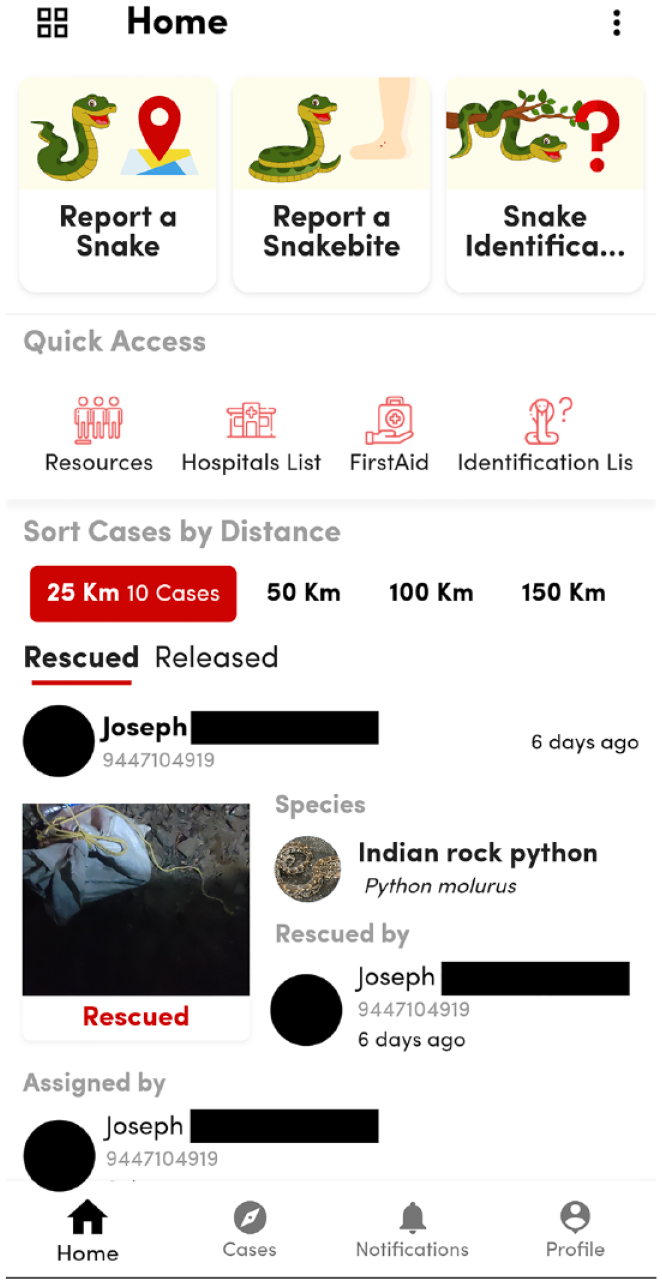
The homepage for the SARPA app. Image by Indiansnakes.org, Kerala Forest Department and Leopard Tech Labs.
Practice beyond the screen
Digital ecologies is an analytical framework often invoked to examine how digital technologies mediate more-than-human worlds, the multispecies encounters facilitated by technologies, and the implications of digital mediation for environmental governance. 2 Such scholarship directs attention towards the situated nature of digital contact zones, emphasising the need to investigate not solely the aesthetics, logics and discourses of ‘on-screen’ media (such as in-app or in-game content), but also the ‘off-screen’ experiential, embodied and material dimensions of digitisation. 3 Digital ecologies thus extends recent cultural geographic work exploring the ubiquity of digital mediation across diverse spatialities. 4 This scholarly concern with the specific spatialities in which digital mediation occurs ‘both through and beyond “the screen”’ 5 led me to not only investigate the features, affordances and imagery of the SARPA app itself, but also the situated contexts in which the platform was developed and deployed.
To examine how the Kerala Forest Department uses SARPA to manage human-snake conflict, my fieldwork employed a multi-modal, multi-sited ethnography of the organisation. Deploying in-person observation and app walkthrough methods, 6 I began my fieldwork with smartphone in hand, alone in my hotel room, scrolling through the app’s extensive library of user-uploaded snake photos. Here, I encountered images of cobras coiled up in flowerpots and pythons stretched across kitchen floors. I also took time to test out some of the app’s features, navigating through its ‘report a snake’ function alongside browsing the Kerala Forest Department’s ‘dos and don’ts’ of snakebite treatment (Figure 2), including imperatives to ‘not cut and bleed the bite wound’ and to instead ‘immobilise the wound. . . and rush the patient to hospital’.

The Dos and Don’ts of snakebite treatment. Image by Indiansnakes.org, Kerala Forest Department and Leopard Tech Labs.
After becoming familiar with the app, I visited SARPA’s developers at Amal Jyothi College of Engineering’s Leopard Tech Labs in Kottayam District. The College’s Tech Lab staff shared SARPA’s design documentation and described the rationale behind the service. SARPA’s Head Developer explained how, in addition to the option for a user to rapidly contact their nearest rescuer, the app can also prove useful in a live bite event: notifying users of the nearest antivenom-stocking hospitals and enabling rapid access to treatment in the critical first hour post-envenomation. This functionality has the potential to significantly speed up the snakebite treatment process, with life-saving implications, but depends on the app’s ease of use and accessibility alongside widespread access to smartphone devices, potentially excluding less digitally-literate populations.
Exploring the app and learning about its intended function from SARPA developers offered useful insight into the ‘ideal’ journey a user might take to contact a snake rescuer. However, simply using the app myself and scrutinising its design documentation did not reveal how the in-app processes interfaced with embodied moments of human-snake encounter. To investigate this software in action, I observed several of SARPA’s snake rescuers as they followed smartphone notification to homes where snakes had made their way into all manner of spaces: from shower rails to piles of coconut husks (Figure 3).
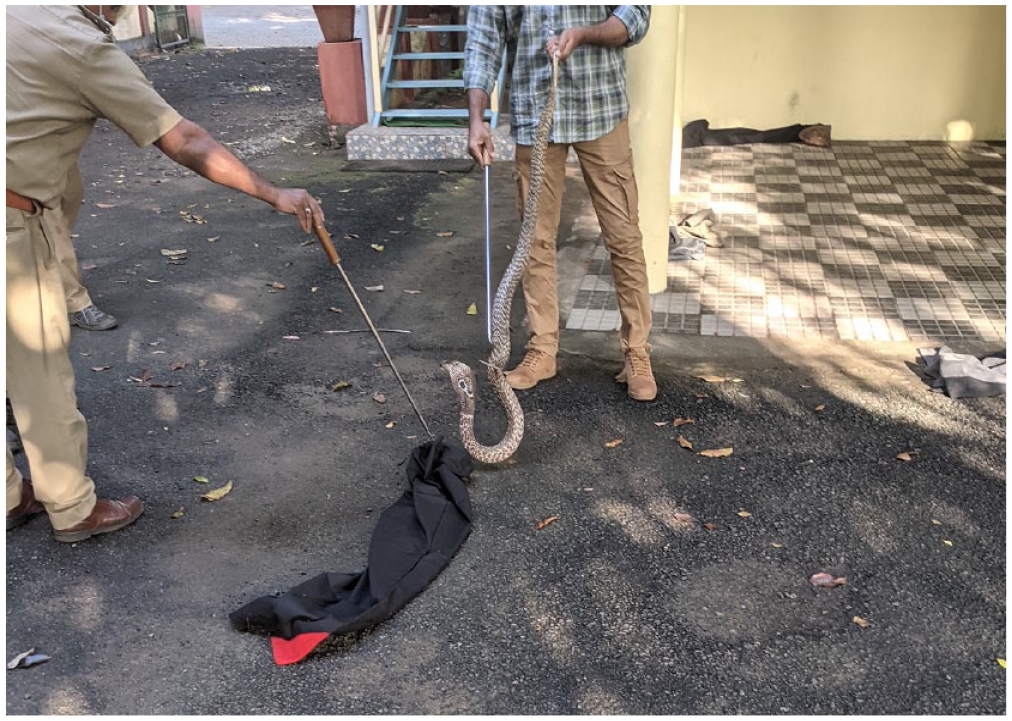
Observing a snake rescue. Image by the author.
Encountering a snake is unnerving and impressive. During my research, the rush of fear and excitement did not diminish with successive encounters, and while I only witnessed swift and safe rescues, where snakes were delicately placed in a cloth bag for easy translocation, it was in these moments of intense encounter where some of the frictions in using the SARPA app emerged. A notable example involved SARPA’s ‘report a snake’ function. Here, I observed that some users, rather than take their eyes off a potentially unruly snake to tap through the SARPA app and file a report, preferred to telephone call their local rescuer directly to receive assurance of their swift arrival. This was particularly common amongst older users who were less familiar with smartphone interfaces. However, the list of rescuers’ contact details was only accessible by navigating through several of SARPA’s in-app pages, posing a problem to those not wishing to remove their gaze from an ophidian intruder, even for a moment. These moments where SARPA did not quite work as intended only became visible to me when I investigated how the SARPA’s in-app and extra-app practices played out in human-snake contact zones.
Collaborative digital ecologies
Recent scholarship has emphasised how the doing of cultural geographies may expand traditional disciplinary boundaries by cultivating collaborative approaches
7
: be it through arts-based collaborations
8
or participatory experiments with citizen scientists.
9
After completing my fieldwork with SARPA, I provided the Head Developer at Leopard Tech Labs with a list of potential app design improvements I had identified and collected from users while observing snake rescues across Kerala. Together with staff at the lab, we collaboratively identified which of my suggested changes could be integrated into SARPA’s future software updates. For instance, numerous SARPA users remarked that if a rescuer did not arrive promptly to translocate an encountered snake, they would likely be forced to remove the snake themselves lethally. These insights inspired SARPA’s designers and I to collaboratively prototype a new screen that will pop up once a snake report has been submitted, providing users with more information about the following steps in the snake rescue process:
Your report will now be shared with your nearest local rescuers. If one is available, they will contact you shortly to arrange their arrival. If you do not receive a call from a rescuer in the next fifteen minutes, please reach out to your local Forest Department Office, and they will arrange a rescue visit.
The intention of this feature is to provide users with the necessary feedback from SARPA so that they feel secure in waiting for a rescuer to arrive, and thus avoid a risky removal of a snake themselves. By discussing the functionality of the app with users (Figure 4), I was able to support developers in considering how the app’s accessibility could be improved in moments of human-snake encounter.
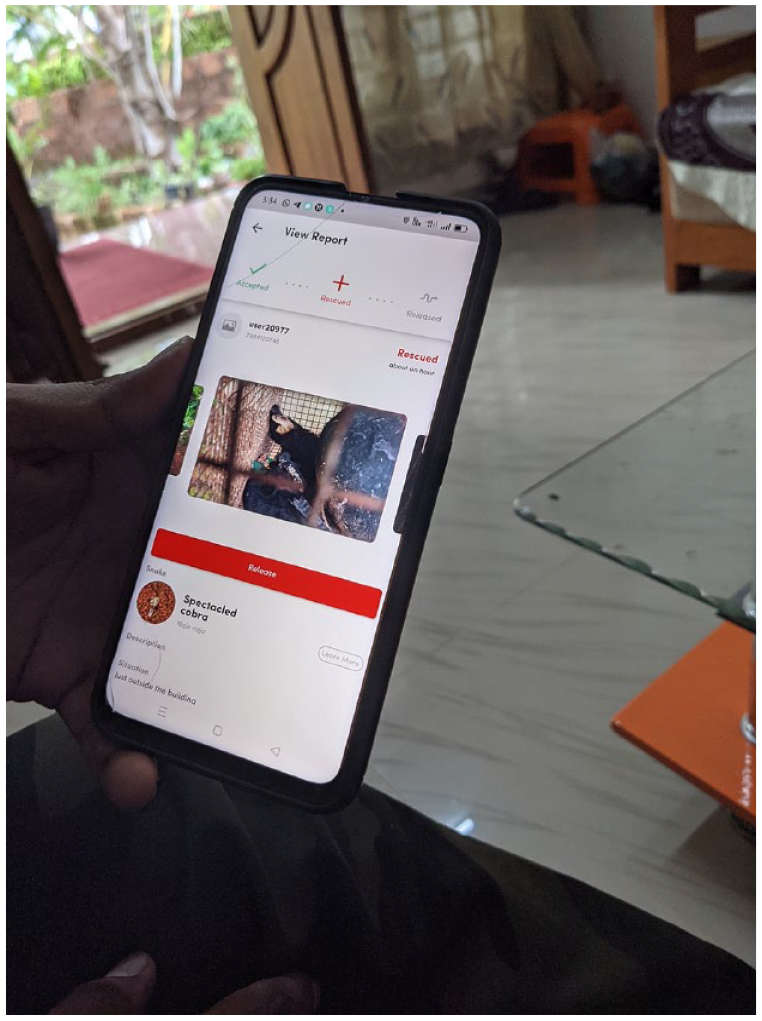
A snake rescuer files a rescue report. Image by Indiansnakes.org, Kerala Forest Department, Leopard Tech Labs and the author.
While my contribution to SARPA’s design is modest, it suggests that scholars undertaking digital ecologies research might consider how their work could contribute (even in small ways) to improving the usability, accessibility or environmental sustainability of the technology under consideration. My collaboration follows the work of Clemen Driessens, Michiel Korthals 10 and Clara Mancini, 11 who demonstrate how the intersection of cultural geography and digital technology design can facilitate experimental design approaches which enable more animal-centred design ethics. Such examples illustrate the opportunity for digital ecologies to transcend analysis of digital environmental governance and spark transdisciplinary collaborations which direct the application of these technologies towards more democratic and just applications for human and non-human actors.
This account of the collaboration between SARPA’s developers and myself serves as an invitation for cultural geographers to conceive of themselves and their analyses as more active participants in the digital design process. In light of recent calls for digital ecologies scholarship ‘to produce situated accounts of digital encounters across contexts’, cultural geographers may also consider how the knowledge generated through local engagements with human and non-human users of digital platforms may be mobilised to enhance the usability and accessibility of this software, providing opportunities for these technologies to be ‘deployed or reoriented towards politically and ecologically just futures’. 12 Transdisciplinary collaborations with digital technology developers provide a promising route for cultural geographers to put their scholarship into practice to achieve these goals.
Footnotes
Acknowledgements
Thank you to the staff at  , the Kerala Forest Department, and Leopard Tech Labs for their collaboration on this project. I am also grateful to the Digital Ecologies team, particularly Jonathan Turnbull, Adam Searle and Oscar Hartman Davies, for providing feedback on this paper. Finally, thank you to Sophie Bennani-Taylor for her comments on an earlier version of this paper.
Funding
The author(s) disclosed receipt of the following financial support for the research, authorship, and/or publication of this article: Travel to and from the fieldsite for this research was funded by Jesus College Oxford’s Charles Green Award. Ethical approval was granted by the University of Oxford’s Central University Research Ethics Committee, reference SOGE1A2021-035.