




Abstract
Recent literature in cultural geography, and elsewhere, has productively applied a spectral lens to the subject of extinction, revealing its hauntological aspects. In this article I expand on this, exploring the spectral effects of the diminishments that precede extinction. This is articulated via an extinction story detailing the steep decline in numbers of arctic terns (pickies) returning to the island of Papa Westray in Orkney, Scotland, to breed. Drawing on memories of their past abundance, this narrative discloses how the spectre of these birds’ waning numbers haunts the island’s places and more-than-human inhabitants. Through the specifics of this example I develop a conceptualisation of the spectral more-than that lies at the heart of such decline, revealing how the ghosts invoked by extinction and biotic diminishment multiply across the relational complexity of local ecology.
Keywords
It is a freezing, overcast day in early June. I am huddled in the lee of a large chunk of sandstone, sheltering from the wind. Behind me the North Atlantic breaks on a slope of bare rock. Ahead rises the island; here a mess of thin soil, broken slabs, wildflowers and patchy grass, but elsewhere fertile and farmed. This is Papay, 1 a tiny isle on the periphery of Orkney, home to just under 100 people and a multitude of birds. Indeed, the sky above me is filled with small, noisy, feathered creatures composed more of wing than body. Their flight is graceful, acrobatic and effortless. From below they appear white against the cloud, but as they settle to the ground, I get a better look at their appearance: a black cap extends downwards beneath their eyes, contrasting with their pale grey plumage and blood-red bills. These are arctic terns, or, as they are known locally, pickies (Figure 1). 2
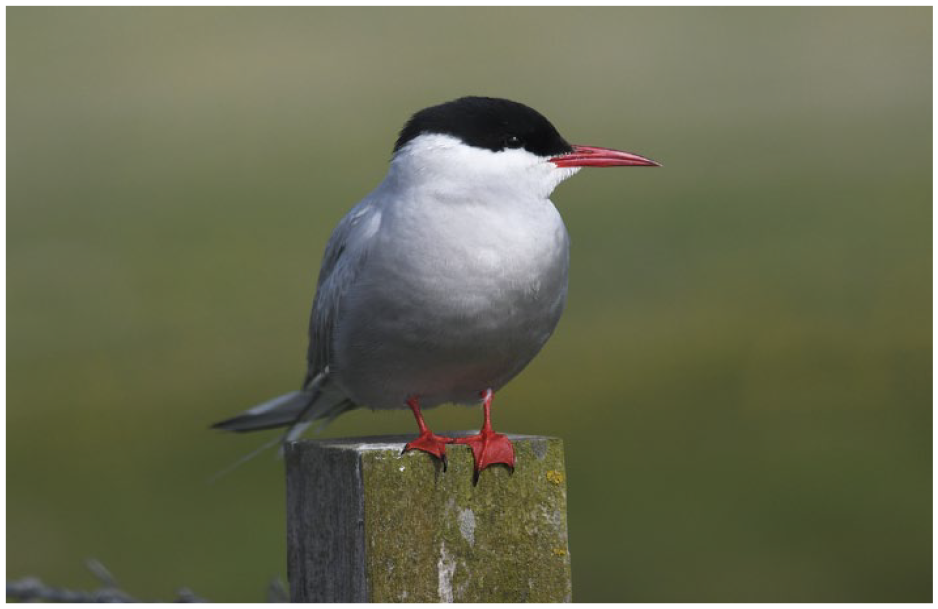
Pickie on North Hill, Papay, Orkney, 2020. Image courtesy of Jonathan Ford.
I am here researching the cultural and emotional significance of the seabird decline affecting Papay’s spaces, including of these birds. Motivated by a wish to make these avian lives present on the page, 3 part of this research involves observational work getting to know them, and I have come to this spot because it is still early enough in the summer to witness something of their behaviour I have only read about. At the beginning of the breeding season male pickies prospect for mates, flying noisily over their colonies showing off fish clasped in their beaks to indicate their proficiency at fishing. Eventually this display alights on the ground where the males strut around showing off their catch, attempting to lure females into their territories. It is these early stages of pair-formation that I’m keen to see. Accounts I’ve read indicate the potential for comedy, with the males trying to approach and mount the females without properly gifting the fish (he knows he’s less attractive without it, and doesn’t really want to give it up), while the female is keen to get the fish without letting the male get too close. 4 Today, however, there are no fish in sight, and nothing resembling courtship is occurring. The pickies are either resting or returning from their fishing trips empty-beaked.
Superficially there’s nothing particularly jarring about this. I could have just arrived too late to witness the display. But this lack of breeding activity is also indicative of a wider trend within pickie population dynamics in the Northern Isles that makes this idleness much more poignant. A profound downward trajectory in breeding productivity has caused dramatic collapses in overall numbers since the mid-1980s. 5 In point of fact, Papay is a place shadowed by local extinction; both historical losses (the last great auk in Orkney was shot here in 1813) and contemporary avian decline haunt the island’s spaces.
Recent literature in cultural geography, and elsewhere, has productively applied a spectral lens to the subject of extinction, revealing its hauntological aspects. 6 In this article I expand on this to investigate the spectral effects of the diminishments that may precede extinction. Focused on the pickies I narrate a story detailing these birds’ decline on Papay, drawing on memories of their past abundance to disclose how the spectre of their waning numbers haunts the island’s places and its various inhabitants. Through the specifics of this example I develop a conceptualisation of the spectral more-than that lies at the heart of such diminishment, which I explore through an analysis of the pickies’ philopatry—their attachment to Papay as a breeding site. Work in extinction studies on animal place illuminates philopatry as a process of animal place-making, and highlights the role the loss of such places plays in disrupting the continuity required to sustain populations and cultures. 7 However, rather than simply rearticulate how in this context animals remain drawn ‘to places that no longer exist’, 8 I consider how philopatry entwines the pickies with the relational complexity of local ecology. As the number of pickies returning to breed on Papay dwindles, their gathering absence both haunts, and is haunted by, shifts in the belonging of entangled others.
To open this narrative, I turn to Ingold’s definition of landscape as ‘an enduring record of. . . the lives and works of past generations who have dwelt within it, and in so doing, have left something there of themselves’. 9 This quote introduces two key themes that run through this article. Firstly, it highlights how landscapes emerge from the intergenerational relational practices of their inhabitants. But secondly, in articulating how these inhabitants leave behind something of themselves, it also hints at their spectrality. Through its temporal emergence the relational landscape becomes populated with ghosts, absent presences that ‘are always there. . . even if they are no longer’. 10 Indeed, extinction causes us to alter our notions of what makes up a place. As this paper proceeds, rather than dryly outline these two bodies of landscape theory and then apply them to the specifics of this place, I take them for a walk through Papay’s spaces, applying them as I go. The first section of this walk, the approach, will engage with landscape phenomenologically as a process of presencing, an ongoing weaving together of more-than-human relational practices that ascribes meaning to both place and to personal and communal biography. It will then proceed—via a migratory aside following the flight ways of the pickies—to its destination, the ternery, where focus will shift to the scarcity of birds. In a final coda, the sense of absence formed by the birds’ dramatic local decline will be reflected upon, highlighting how the memory of former belonging reveals landscapes of extinction as being animated by myriad more-than-human spectral presences. But first, I want to situate my work on the pickies’ decline within recent explorations of the spectral dimensions of extinction.
Spectral extinctions
In dwelling on the increasing lack of pickies from Papay’s landscapes this article examines what emerges in place as species loss occurs. In doing so it maps ‘something of the haunted geographies of absence that extinctions affect in place’, 11 exploring how the spectres of the past linger amidst memories, materials and landscapes. 12 Absence, despite inferring an erasure, also multiplies subjects, revealing the ghostly presence of those that are ‘gone but not forgotten’. 13 As extinctions multiply, spectres proliferate, formed from the feeling or knowledge that something is missing from experience of the present. 14
Specific bodies of research have examined how particular places bear the traces of absence in the wake of extinction. Thom van Dooren draws attention to the ecological legacies of the disappearance of the alalā (a species of crow) from Hawaiʻi’s forests. These birds remain as spectres, made present by the slow demise of long-lived trees dependent on the birds to distribute and geminate their seeds. 15 Whale and Ginn highlight how the lack of sparrows in London’s parks and gardens is generative of new places haunted by the birds’ absence. 16 Garlick argues how the re-colonisation of the Highlands by Scottish ospreys after extirpation reveals forgotten osprey places—formerly inherited sites that have not been returned to. These eyrie abandonments speak of significant cultural loss concurrent with the absencing of species. Reminiscent of what is occurring with the loss of Papay’s pickies, landscapes after such disappearances are found to be haunted by the ghosts of former ways of living. 17
These case studies explore the diverse spectral registers that emerge from extinction’s absences and provoke political and ethical questions around what is at stake as species disappear. 18 This includes the loss of more-than-human cultural landscapes formed from the way non-human subjects both affect and are affected by the spaces they inhabit, leading equally to the emergence of particular characters of place and to specific inherited attunements to place. 19 Drawing this into the context of the spectral, Garlick highlights how attachments outlast the existence of their authors, creating residual places of philopatric belonging haunted by former presence. 20 Whether ospreys returning to destroyed eyries, 21 or little penguins drawn back to now built-over burrows in Sydney Harbour, 22 philopatry can be seen as a performative trace of intergenerational meaning-making, 23 which, once disrupted, results in a loss of the connectivity required to sustain populations, cultures, ecological communities 24 and, indeed, place itself.
Elsewhere, the haunted landscapes formed by extinction or extirpation have been explored as ruins. Often highlighting the damage left by colonialism, modernity and their legacies, 25 these highlight how the violences of anthropogenically driven socio-ecological transition leave their marks on more-than-human landscapes. 26 This lingering of prior events and presences confuses linear temporal sequences of past, present and future, rendering time ‘out of joint’. 27 For Gandy, the ongoing search for the ivory-billed woodpecker (last seen in 1944) in the plantation-scarred forests of Arkansas is haunted not by the birds’ absence, but by the area’s wider ruination. Here, the longing to confirm the woodpecker’s ongoing existence marks a form of ecological nostalgia. 28 Fredriksen, similarly, argues that the occasional return of American flamingos to Florida after their local extinction haunts because it reminds of the region’s ruination. The birds’ comeback—not to the Everglades, but to stormwater treatment lagoons built to prevent increasing anthropogenic pollutants from reaching this fragile ecosystem—speaks to wider ecological changes that have occurred since the flamingo’s disappearance. Their return gives hope, of course, but it is a hope tinged with melancholy. The birds remind us of what things used to be like. 29
On a more fundamental level, attention to the processes of ruination reveal how there is no end to ecological change, only difference from what has come before. 30 New identities are constantly formed, haunted by the spectres they contain of what has previously been. 31 Encounters with Papay’s remaining pickies amidst the ruins of their ecological niche disturb because they remind of the birds’ former abundance. Though these birds are not globally rare, a sense of their vulnerability—based on their particular ecomorphology and philopatric attachment to places destabilised by climate change—inflects their regional falling away with wider significance. 32 Such local diminishments are just one example of the broader phenological disturbances caused by climate change in which the disruption of carefully-timed relations creates spirals of co-decline as lifeworlds fall out of sync. 33 Ecologies become haunted by absences formed through novel temporal mismatches. 34 Here, a feeling of seasons being out of joint does not just elicit a background sense of unease, but is deeply entangled in processes of more-than-human diminishment as phenological behaviours integral to species’ ecologically-situated becomings are disrupted. 35
Biotic diminishment and local extinction differ from extinction in that their consequences are not so final—there remains the possibility of return. 36 Yet, the processes of local decline evoke similar emotional and affective responses as more total disappearances. A sense of loss haunts those who remember greater numbers, or whose regional persistence is entangled with dwindling others. Such diminishments are less tangible than extinction, and their significant effects are often overlooked. The remainder of this article focuses on the spectrality of decline and how it is felt across more-than-human communities. I highlight how spectral pickie landscapes also evoke ghosts for myriad others whose lives are entwined with their displacement.
Approaching the ternery
Stepping into the folds of Papay’s landscape, I re-join a walk around North Hill, a bird reserve on the island, which I undertook with Tim, a conservationist who has lived here for over 20 years. As well as acting as community chair, fire-fighter, first-responder and having his own music show on BBC Radio Orkney, Tim studies the East Atlantic flyway. The East Atlantic flyway is a migration route used by billions of birds annually, and links a discontinuous band of Arctic breeding sites to wintering grounds in the tropics and southern hemisphere. Tim first came to Papay in 1990 to study a noticeable decline in the pickie population. But after spending several years working on community-based conservation projects throughout Africa, including in Senegal, Zambia and Somalia, he eventually returned and settled on Papay to raise a family. Hundland, where he now lives, is the last house on the island’s single road.
The findings of this article draw on a formally recorded conversation with Tim, which was undertaken as part of a wider set of interviews designed to gain understanding of how extinction is experienced in place. These were long, unstructured conversations in which I invited members of the island community to accompany me on walks to places of significance to them, and to share memories, stories or insights about birdlife in the past or the present. These walks were recorded using lavalier microphones clipped onto clothing, capturing voice but also the interjections and interruptions of the more-than-human; the patter of rain, wind interference, bird calls, the rush of feathers of a swooping territorial great skua (bonxie). Within these recorded walks, encounters can be heard with more-than-human pasts, presents and potential futures—the narrativisation of which makes the multitemporal hauntings of extinction explicit. 37 My interview with Tim was illuminating in this regard as it provided insights into what it is like to live in close connection to animal populations in steep local decline. 38
Our walk takes place on a cold day closed-in by a mist that is condensing into rain. We are making our way towards Tim’s old study site on North Hill. Our progress is slowed by avian interruptions. Bonxies pursue us from their moorland territories, attempting to drive us away. Dunlin (boondies) fly up from beneath our feet, and ringed plovers (sinloos) hobble around waving injured wings in the air, an artfully deceptive ‘broken-wing act’ that lures potential predators away from their nests. Our presence here is affective, engendering fear that ripples through the community, and is announced in myriad alarmed voices that rapidly cross the island. These are age-old avian breeding places—variously contested, held, protected, abandoned—but nonetheless key to the ongoing emergence of multiple interconnected ways of life, and their occupants don’t want us here.
Despite emerging through unease at our presence, the landscape is pulled into meaning via this noticeable diversity of lively energy. 39 A sense emerges of the spaces of the hill as a weave of animal geographies, or ‘beastly places’ 40 ; a knitting together of meaningful trajectories of animal (and other) becoming. These are noticeable precisely through our being-there, through ‘direct, bodily contact with, and experience of [the] landscape’. 41 As we move through the space ‘I feel myself looked at. . . seen by the outside’ in a way that intertwines me with the multiple lifeworlds around us. 42 My subjectivity arises as a ‘point of view’ continually produced through engagement with a world that senses back. 43 Following Ingold, such perceptual and practical involvements draw me into a realm of multiplicitous dwelling. 44 Places and bodies continually emerge through currents of activity, interrelations of practices by which both people and animals make themselves at home in the world. But this is not to say that walking—as a practice of being-in-the-world—acts as an equivalent to the sorts of dwelling practices that have drawn these birds to the hill. Our movements through this space exist outside of the avian reproductive work that surrounds us, with our presence perhaps even disruptive of it. Phenomenological accounts of the walking subject risk presenting landscape and subject as always merged, but walking does not embed the self within the landscape in a deep or straightforward fashion. 45 The alarm calls (as well as more aggressive flighted bombardments) that follow us remind me that dwelling requires more than just pedestrian sensory presence. I’m left feeling uneasy amidst this more-than-human thickness, and more like Wylie’s blistered toes, ‘pressed up against the landscape. . . part of it, emergent from it. . . [yet] distinct from it’. 46
As we approach his old study site Tim begins to recall his memories of this space 30 years ago:
I think it was a kind of foggy-ish day and they [the pickies] just arrived en-masse. . . there were about—hang on, there were one—okay there were several colonies on the North Hill, but altogether I would say there were. . . about five and a half thousand pairs, so that’s. . . fifteen thousand birds or something. . . .They were beautiful—they are, of course, a beautiful bird, but. . . their arrival was amazing in those numbers, just coming in, and you know how far they’ve—well we don’t exactly know—but you know they’ve had a very, very long migration, and then they’d arrive, find. . . North Hill, and just settle all over it really. . . .They were. . . such a part of the environment here for that time of year, and folk knew all about them. . . ‘Ahh, that’s the pickies back! Oh yes, ahh, there they come!’
Tim reminds me that pickies are birds with ‘the longest migration of any living creature’. Once they depart from Papay and their other breeding sites (some much further north), the birds make use of the East Atlantic flyway to travel south ‘along the Atlantic coast of Africa’ before crossing the Southern Ocean and spreading out amongst the ice-floes surrounding Antarctica to moult. Emerging from my conversation with Tim is a feeling of how important these migrational returns and departures are to the islanders’ sense of place and seasonality. He recalls locals telling him of the pickies’ annual return when he first arrived on the island to study them: ‘the 9th May, that’s when they always come’; or, ‘the first foggy day in May, around about’. These memories hint at the importance of the birds to the island community, with their arrival marking a significant moment in the year. Tim emphasises that this connection was as much practical as affectionate. At the time of his study, he says, there were still some older islanders who would collect a few eggs for food, the relics of a formerly widespread but sustainable practice supplementing diets—‘I think they would put them in vinegar or something. Pickled pickie eggs’. 47
These are memories that make visible the diverse intertwining geographies created by the coexistence of humans and other animals. 48 Papay’s spaces disclose themselves here as something like Ingold’s dwelt-in landscapes, materialising as expanses woven from memory and suites of more-than-human practices and life-histories. 49 Through annual return, the pickies movements through the world entangle with personal and community identity—particularly for Tim—with memories of vast avian flight ways running through his biography and filling the place in which he lives with significance. As he explains of his time studying them: ‘It was a very impressive time for me, you know. . . It was a very important part of my life, so much so that I came back here to live and have a family here and got married here and everything’. Papay and North Hill unfold as spaces through which meaning is gathered, 50 filled with movements, biographies, attachments and—increasingly—exiles. 51 Such displacement is visible here briefly in the poignant slippage Tim makes into the past tense: ‘they were beautiful’. But before I get to the subject of this absence, I want to turn to the pickies, and to highlight this space’s significance to the birds.
Pickie places
Papay is a pickie landscape; that is, in a similar way as for Tim, it is a meaningful space—one tied to individual (as well as communal) biography and attachment. Though pickies remain at sea throughout the year, they need to come ashore for several months to breed. 52 These are brief episodes of landfall amidst lives shaped around pelagic wandering and an epic annual migration of over 35,000 miles. 53 The island’s significance emerges from the fact that they are, like many seabirds, philopatric and eventually return to the location where they hatched to breed. 54 However, the philopatry shown by these birds takes a looser form than those with strict nest-site fidelity. Local nesting populations are known to be changeable, forming regional metapopulations that move between connected breeding sites within a region year-to-year in response to disturbances such as predation events and food scarcity. 55 The Papay colonies sit within such a dynamic context, shifting location depending on particular local circumstance.
In many ways the pickies’ exceed any spatial imaginings that seek to tie them to a specific place. Their more regional attachments, combined with their larger peregrinations, transcend the fastness of static territory and local belonging. However, despite the fluidity of these metapopulational philopatric attachments, articulations of site fidelity in terms of emergent cultural ‘tradition’, 56 or similarly as a process of animal ‘storying of place’ still hold true. 57 In both instances pickie bodies and places enfold into each other over evolutionary time, 58 deepening adaptation to environments which are themselves shaped by intergenerational presence. 59 These regional colonies thus become remembered places that are conducive to vital biological and cultural reproductive work, connecting individuals to the broader project of a particular species’ ongoing becoming. 60
Understandings within geography and the environmental humanities emphasise species not as ‘concrete zoological or botanical object[s]’, 61 but as temporally-situated trajectories or evolving ‘way[s] of life’. 62 Species here are not fixed categories of being, but are becomings. 63 Through co-evolution with others these species-becomings knot together in ‘geographically assembled ecolog[ies]’, 64 playing key roles in the composition of dynamic, multiplicitous space—a ‘multiply-storied world’. 65 In articulating these trajectories within avian worlds, van Dooren develops the term ‘flight ways’ as a means to think across the multiple temporalities at work here, simultaneously acknowledging the vastness of evolutionary lineages, and the fact that the continuation of such ancestries is always tied to the present, and to the labour of individual birds laying and incubating eggs, and rearing chicks. 66
Pickie becoming—shaped as it is by epic-migration—is well described by the term ‘flight ways’. 67 Broader populations of arctic terns are commonly grouped into two ‘great flights’, 68 tracing two separate migratory pathways from the polar regions to the pack-ice belt surrounding Antarctica. 69 The first of these routes follows the Pacific coast of North and South America, and is used by terns breeding on the shores and lower river-courses of Siberia and Alaska. The second runs south along the eastern side of the Atlantic until it reaches South Africa. Here, the birds travel across the Indian Ocean, sometimes as far as the Tasman Sea, making use of low-pressure cyclonic systems to make an arcing traverse across the Southern Ocean. 70 The presence of these stable annual cyclonic systems is fundamental to the elucidation of tern migration. 71 As they negotiate this crossing the terns undertake a stepping-stone movement, 72 pausing at ‘pelagic living-stations’ in the rich upwellings of the convergence zone where subtropical waters meet those of the colder Antarctic Circumpolar Current. 73 These living-stations act not only as phenologically exploitable larders of seasonal marine richness, but also provide spaces for pause in the terns’ long journey, enabling them to await the emergence of spring-conditions in the Antarctic pack-ice. 74
These migratory details reveal a different sort of site fidelity—a looser form of philopatry in which birds from different breeding grounds remain true to sequences of semi-fluid locations amidst their peripatetic wanderings. Staging areas, stop-overs, moulting spaces and wintering grounds all become spaces of inherited significance alongside breeding sites. 75 Furthermore, these routes also act as evolutionary flight ways, with the terns’ migrational being deeply shaping their bodies through intimate connection with the environmental contexts of their migration routes, namely ‘marine productivity, wind patterns, low-pressure trajectories, and pack-ice distribution’. 76 Diverse tern cultures emerge from differing ‘lived spatio-temporal particularities’ along these complex pelagic life-ways. 77 Pickie culture, that is the unique ‘collectively constituted orientation towards place’ emergent from the Papay pickies acts as just one such cultural possibility. 78 The potential for this cultural flight-way emerges on Papay and its regionally-connected breeding sites, connecting the island to wider patterns of meaning formed by the birds migratory movements through the world.
The ternery
Returning to Papay, let’s re-join my walk with Tim. Soon after arriving at his former study site, we pause close to the eastern shore and turn to face inland. The land is uncultivated, dun-coloured and soggy, shadowed by thick, feature-less cloud. In the distance it rises towards a hilly-ridge, and the island’s highest point, Errival. On the far slope, a group of cows graze. They are made tiny by the expanse of the space, providing the only means to give it scale. Tim begins to recall its former abundance:
So I’d say this is where it really started to get busy with pickies, so from here, and everywhere we can see all around to where those cattle are. . . they were. . .they were. . . that was the whole colony for this side anyway. I just wanted to bring you to this spot where you can visualise all the pickies around here, and this whole cacophony that would have been going on, and is now basically silent. Just the rain, and the odd bonxie—we can hear a pickie now—a couple of them there. Yeah, so this would be just thick with them, only two now.
For those who have lived on the island long enough, Papay is increasingly a space of absence. The 15,000 birds that Tim remembers numbered only 256 in 2022, with an estimate of only 15 chicks fledging. 79 The numbers of pickies, and their breeding success varies annually, but the rapid downward trend of these figures are dramatic. Around 98% of the population has disappeared from the island over the 32 year period since Tim’s study. What has occurred—in part—is the collapse in abundance of the pickies’ main source of food, the sandeel. 80 Sandeels are small, pelagic, planktivorous fish that have been impacted by deteriorating environmental conditions in the oceans, which have adversely affected their food supply, phenology and survival. 81 Though an industrial sandeel fishery operating in the North Sea has been shown to impact seabird numbers, 82 this is unlikely to have an influence here. 83 Rather, increases in sea temperature due to climate change have shifted nutrient cycles, changing the make-up of planktonic assemblages, forcing nutritionally-rich subarctic species further north, or into deeper, colder waters. 84 These shifts in the sandeels’ prey species have had a knock on effect on the fish themselves, with lower planktonic biomass and later spawning affecting populations, 85 resulting in less food for seabirds. 86 The fingerprints of the carbon economy are all over the unravelling threads of this ecology, with climate change causing a multi-decadal decline in the marine ecosystems of the North Atlantic that is highly likely to continue. 87 Pickies are particularly vulnerable to these changes. They are specialised towards surface feeding at short distances from their colonies and lack alternative prey species to feed their chicks. 88 Explained simply, as Tim does for me, ‘the sandeels just aren’t here in the right numbers at the right time. . . at the crucial time for breeding the availability is not enough’.
Visible here is a collapse in phenological synchronicity. The pickies’ migration, timed to coincide with peak prey availability in the waters around Papay, now ends in a mismatch. 89 With such insight, the islanders’ cultural memory of the birds’ regular annual arrival—‘the 9th May, that’s when they always come’—develops a hauntological resonance. The remaining birds do still arrive around this date, but amidst the wider ruination of this region’s ecology, this return is haunted by a trophic discordance, and is no longer conducive to reproductive success. 90 Pickies are long-lived, with individuals breeding well into their 30s. 91 They produce small broods each year (often just a single chick), to which they give considerable attention. If the conditions to breed are not optimal they will not breed, and so conserve their energy for a future year. 92 But if those circumstances don’t change, then this process results in a gradual decline in numbers as they fail to reproduce themselves. Each year the birds arrive and either fail or decide not to breed continues a disruption to the intergenerational work key to the continuance of the population. 93 There is an extinction latency at work here; a lag in which the lifespans of long-lived birds are slowly overtaken by the continued effects of a tide of ecological perturbations that mean they now struggle to reproduce themselves. 94
But these declines are not total. The pickies looser metapopulational philopatry provides them with some flexibility. Their long life-span also offers them the chance to adapt to these transformations, especially those hatched into these new circumstances. 95 This means their disappearance is perhaps also the result of behavioural shifts responding to ecological change. They may withdraw from Papay altogether, shifting to alternative sites, or they might linger in much-reduced numbers. Whatever the outcomes of this decline, the island’s spaces are now felt to be missing something. For Tim, North Hill holds the ‘depth and richness of memory-place’, but his recollections of it are now haunted by the lack of birds in the present. 96 His remembrances of former spectacle are evocative, and I feel I can almost hear the ‘cacophony’ of which he speaks. As we stand there in the rain, time loses its linearity, 97 and I feel my consciousness scatter across moments decades apart. 98 Past and present fold into each other, becoming proximate. The absent multitude swerves, hovers and swoops around us, issuing a high-pitched chattering ‘ki-kikikik’, punctuated by angry utterances—more screamed than voiced—‘kee-errrr, kee-errrr!’ The abundance of the past flickers into presence as an indistinct ‘spectral gathering’, 99 one composed from ‘noisy silences and seething absences’. 100 In his company this place becomes visible as a ‘passing’ 101 ; a fleeting, dynamic trajectory that only takes shape as it is left behind. This is now a different place, one haunted both by its lack of pickies, 102 but also by those that still return to remind of their former abundance.
Indeed, pickie place still maintains a vividness that emerges from close remembrance and continued presence. During the remainder of my long stay on the island, I retrace the route of the walk undertaken with Tim almost daily. Many birds remain, and the flighted routes linking remaining colonies to favoured fishing grounds still fill the sky above the island with life. The absence expressed by Tim and felt whilst in his company becomes elusive, fading during my returning movements through this space, but erupting into presence as I remember his vivid descriptions of former abundance. These are memories that I seem to have subsumed into my being, and which surface involuntarily. 103 In these instants, the ‘contemporaneity of the present’ becomes troubled, 104 clouding the trajectory of place. This unsettling of ‘presence, place, the present, and the past’ in the context of extinction acts as a hauntology, one that further shatters any phenomenological ease at being-in-the-world. 105 As Wylie puts it, ‘the “I am” announced in the placing of being-in-the-world is, always and necessarily, “I am haunted”’. 106 Importantly, this haunting is embodied, for it is through memory that the arc of gathering absence becomes visible, tied as it is to a passing. If the pickies’ disappearance is not merely a subtraction, but the emergence of new spectral place, 107 then it is through memory—as a register of embodied experience—that such hauntings imprint themselves on the landscape. 108
Remembered belonging and the spectral more-than
The walk recounted here traces how landscapes marked by decline contain ghosts that disturb experiences of the present, similar to those affected by extinction. In this concluding section I develop my discussion of the spectral relations that haunt biotic diminishments—such as those between the pickies, sandeels and the islanders—to highlight how hauntological effects multiply across more-than-human landscapes and communities. Following a more-than-representational approach, 109 I begin with an exploration of how waning animal presence haunts landscapes more broadly.
Place, and its ongoing passing, emerges through the sensual immersion and muscular engagement of the afforded body, which folds self into the world. 110 For Thrift, this absorption is deepened by further competencies—emotion, memory and language. 111 In his exploration of the geographies of Scottish reindeer herding, Lorimer draws these deeper aptitudes into a non-human context, one in which animals ‘have a sense of place and, by their repeated actions, afford place some of its significant qualities’. 112 Memory is mapped to ruminant territory and the remembrance of its boundaries, places to eat, rest and muster. Emotion becomes visible in the excitement of the deer at the approach of cold weather, and their semi-mythical ‘snow dance’. Language is where things get trickier, but Thrift’s meaning draws heavily on Wittgenstein, 113 and considers language in the performative sense—the ‘giving a voice to. . . sensuous knowledge’ in which meaning arises through use rather than symbolic association. 114 Here the reassuring ‘click’ of reindeer tendon guides the herd when visibility is poor and the careful placement of splayed hooves into hoofmarks left by prior passage enables efficient movement over snowy or saturated ground. Both are forms of meaningful language that build transient paths across the landscape and read as tracks of embodied knowledge that express evolved intimacy with worldly place. 115
Following the lead of Lorimer’s herd, we can expand Thrift’s humancentric application of these competencies to include other varieties of embodied life. For pickies, memory emerges from the multiple timescales at work in their cultural flight-ways in which place is remembered both by individual birds, and through broader evolutionary trajectories. However, they leave behind fewer languaged traces than the ruminants—a bleached skull, marking their precarity; a fragment of olive eggshell, speckled with ochre; or a slightness of compressed grass indicating a former nest. Instead, language emerges as ephemeral performance, visible along with emotion in the thrill they evidently take in flight. This is particularly perceptible during courtship when they test a potential partner’s aerial dexterity. On sighting a prospective mate, the birds swerve into a rapid circling ascent, inviting the desired one into playful pursuit. At altitude, the lead bird stills, sets its wings and begins to descend. Its partner then overtakes in a rapid, close-quarters pass, which the other then copies, causing the pair to spiral downwards. Tern feathers when newly moulted reflect ultraviolet light—a spectrum in which the birds can see. 116 To them these displays must be bedazzling, a language flashing with the brilliance of their scintillating flight.
Indeed, animal place can be illuminated through attention to the way that skilled bodily practices animate the world. 117 If agency is dispersed into features of the environment that hold a position of importance within a being’s relational sphere then a ‘poetics of dwelling’ is revealed in which place is activated by lived presence. 118 The territory of the reindeer herd, for example, enrols ‘winds, stones, tors, trees, and mosses’, as well as reindeer herders into a sentient geography, held in meaningful relation by the presence of the deer. 119 In a similar way, the pickies animate Papay, drawing its elements into a unique constellation of meaning—the wind that is felt through flighted body; the light that prisms feathers into radiance; and the frigid turquoise water rippled by repeated hovered plunge. Such thought complicates the absence felt amidst the vanished ternery on North Hill. What is occurring here is not just the disappearance of beings that evoke a vivid sense of place for Tim and the other islanders. It is also an absence that is felt as a fading sentience across the plethora of more-than-human worlds that pickie wingbeats brush, including those of immaterial agency—wind, ocean current, sunlight—which are drawn into active social life through entanglements with the birds’ bodies. 120 This is a diminishment that is well expressed by Despret when she writes of extinction that ‘[w]hat the world [loses]. . . is a part of what invents and maintains it as world. . . when a being is no more, the world narrows. . . and a part of reality collapses’. 121
If the landscape of Papay is considered as a site of more-than-human memory that emerges from the myriad sentient geographies that intertwine in the relational complexity of its ecology, then this sense of absence is manifold. Amidst long-term climactically-driven phenological disruptions, multiple mismatches now trouble entangled ecological becomings. On North Hill, for example, the arctic skuas (scootie alans) that also arrive in spring to breed are similarly in decline. These birds are equally dependent on the sandeels to feed their chicks. However, rather than fish themselves, they parasitise other birds (especially pickies), pursuing them and pilfering their prey. 122 Their bodies are deeply adapted to this behaviour, with the agility and speed required for such aerial piracy enabled by long tails and sharply-pointed wings. 123 Indeed, the pickies are just one element of a wider ecosystem haunted by these phenological shifts. Alongside them, planktonic assemblages, sandeels and scootie alans have all found themselves partially unmoored from their local ecological belonging, which has formed around multigenerational attendance to recurring biological events. 124
Similarly, Tim’s desire to return to the former ternery, and his recollection of the profound impression it once had on him, reveals a geography of long-term emotive self-identity with the island’s spaces. But his connection to these is now haunted by the knowledge of what they once were. 125 Visible here is an attachment to the now unreachable spaces of the past, 126 a nostalgia, perhaps, for a remembered place, 127 attention to which highlights how Tim’s own feelings of belonging have also been affected by this change. Indeed, the haunting effects of this decoupling from past belonging can be seen to proliferate across more-than-human worlds. The revenances of avian philopatry, which keep drawing birds back to dramatically altered places, disclose how such ecologies of emotion, self, memory and landscape may multiply and diverge across diverse animal geographies. They point to a spectral ‘more-than’ that haunts ecological change. Indeed, just as Jones notes, perhaps ‘we [do] all. . . face the loss of our geographical selves’ through the ongoing passing of place. 128
The ‘spectral more-than’ (to coin a phrase) is a slippery expression, lacking a definitive subject. But its looseness is evocative, capturing something of the entangled complexity of ecology, and the emphasis it gives to relations as central to worldly becoming. 129 This is not to say the haunting effects of extinction are without subject. Rather, as we have seen, the spectrality that accompanies decline begins with the individual and arises from the passing of place, and always exceeds them, drawing in others to form haunted constellations of remembered connection. These are at once emergent from, and deepened by the way separate evolutionary trajectories gather into interdependent ecological and cultural communities; the disintegration or shift of any part of which alienates a profusion of others from their co-evolved or remembered belonging.
The extinction story told here details the long-term decline in abundance of Papay’s pickies to reveal the spectral effects of diminishments that precede extinction. This narrative also illuminates the ‘more-than’ effects of extinction’s hauntologies by drawing gradual ruination into the ecological. Though this article has focused on the localised effects of this, the scale of avian migration pulls further landscapes and ecologies into the spectral mix. At the other end of their travels, the pickies are haunted by the loss of sea ice around Antarctica where they go to moult, and by dramatic declines in the availability of krill (marine crustaceans), which they feed on during this time—both caused by similar climactically-driven phenological disruptions. Familiar cyclonic systems that once made this long migration navigable are also increasingly unstable, as are the locations of the pelagic living stations that sustained them. 130 Complex ecologies and animations bloom around each of these relational spaces, analogous to those detailed here. Each will be seeing similar disturbances.
To articulate spectral ecologies, I have followed a pathway through insights from more-than-human cultural geographies and the environmental humanities that considers extinction through ‘speculative, risky, and creative’ approaches to ethology. 131 These are generous modes of thinking around animal lives and behaviour that provide ‘narratives of affiliation’, 132 helping to illuminate the ethical significance of what is being lost as animal and other worlds disappear. More-than-human place seethes with a spectrality that haunts the dwelling of both diminishing populations and of those entangled with them, as well as the new realities emergent from ecological change. The growth of the northern gannet (solan goose) colony on a neighbouring island to Papay exemplifies this. 133 The increase in these birds’ population, enabled by their more flexible diets and foraging behaviours, is a hopeful story, but one haunted by the knowledge that it is occurring amidst shifts in marine ecologies that have proven deleterious to many others. 134 Indeed, these conclusions point to a wider truth: if an individual’s being-in-the-world is simultaneously always haunted, 135 and always relational, 136 then the ecological, by virtue of both its relationality and its processual nature, is equally always haunted—an effect made increasingly visible by rapid anthropogenically-driven change.
Footnotes
Acknowledgements
The generous input of three reviewers and the journal editors have improved this article enormously. I also owe special thanks to Merle Patchett and Franklin Ginn for providing feedback on various iterations of this manuscript, as well as their wider support. I am similarly grateful to the members of the University of Bristol’s Centre for Environmental Humanities PGR network for their comments. Eline Tabak in particular has undertaken more than her fair share of readings as this paper has developed. I am indebted to my friends on and associated with Papay for their warm welcome, and for sharing their company, insights and homes with me over the course of my multiple stays on the island. Finally, I want to acknowledge the pickies—you may not have always appreciated my company, but I did yours.
Ethics Statement
The School of Geographical Sciences Research Ethics Committee at the University of Bristol approved this research (Approval: 11299) on 10th May 2022. A written consent form was furnished to respondents for review and signature before starting interviews.
Funding
The author(s) disclosed receipt of the following financial support for the research, authorship, and/or publication of this article: received an AHRC doctoral studentship and an additional research grant from the South West and Wales Doctoral Training Partnership, both of which supported the fieldwork detailed in this article.
