




Abstract
After being captured from the streets of Moscow, Laika was the first living creature to be sent into Earth’s orbit by the USSR in 1957. The 2019 film, Space Dogs, tells the story of Laika’s spectral return to Moscow, and searches for her ghosts in the city’s street dogs 60 years later. Combining archival material with contemporary documentary footage ‘filmed at dog’s level’, the film reanimates Laika’s spectral afterlives. Drawing on a series of in-depth conversations with the film’s directors, writers, and director of photography, we provide critical reflections on filmmaking practice for animals’ geographies. We offer a three-part typology which frames these contributions: attunement, which focuses on the affordances of filmmaking practice for attuning to the lives of nonhuman lifeworlds; perspective, which documents how filmmaking practice allows for more-than-human urban space to be viewed from alternative vantage points; and narration, which enables filmmakers to experiment with affective modes of representing animals’ lives, offering audiences alternative spatiotemporal experiences. Finally, we reflect on the potentials of filmmaking as a fruitful practice, method, and output for animals’ geographers.
Keywords
Space Dogs is a 2019 film by Elsa Kremser and Levin Peter about ‘how a Moscow dog was sent into space and returned as a ghost’ (https://www.raumzeitfilm.com/film/en-spacedogs) 1 . It follows the story of Laika, the first living creature launched into Earth’s orbit on Sputnik 2 in 1957. Laika was captured by the Soviet Space Programme along with many other dogs born on Moscow’s streets, quickly becoming an international icon of the space race. Although Laika was sent to certain death in orbit, Space Dogs traces her spectral return to Moscow, searching for her ghosts in the city’s street dogs 60 years later. The film combines archival clips from Soviet laboratories with contemporary documentary footage filmed at a dog’s level to reanimate Laika through the wanderings of two Moscow street dogs.
This critical reflection on filmmaking practice draws on a series of conversations held in 2020/21 with Kremser, Peter, and the film’s director of photography, Yunus Roy Imer to discuss the potentials of filmmaking practice for ‘witnessing and evoking’ 2 animals’ geographies. 3 Animals on screen have long been a concern of film scholars and media theorists, 4 and increasingly, geographers are deploying ‘film as method’ to attune to and represent the geographies of more-than-human worlds. There has been a revival of interest amongst cultural geographers in the promise of film as both research method and output. 5 As Matthew Gandy 6 writes, ‘documentary film has a distinctive role to play in expanding the research imagination, enhancing pedagogic practice, reaching new audiences, and producing unique cultural artifacts’. Here, we draw from our conversations with the makers of Space Dogs to explore the potentials of filmmaking practice in three interrelated areas of import to animals’ geographies: attunement, perspective, and narration. The following three subsections of the article draw heavily from conversation transcripts to give a sense of the filmmakers’ practice on their own terms. As cultural geographers examining human-animal relations across spatial and temporal scales, we use the final section to reflect on filmmaking practice in the context of animals’ geographies.
Attunement
The documentary footage generated for Space Dogs follows the lives of two street dogs as they navigate the roads, green spaces, and wastelands of Moscow. A considerable portion of the film depicts the dogs resting (Figures 1 and 2). These slow scenes invite viewers to attune to everyday urban canine temporalities.
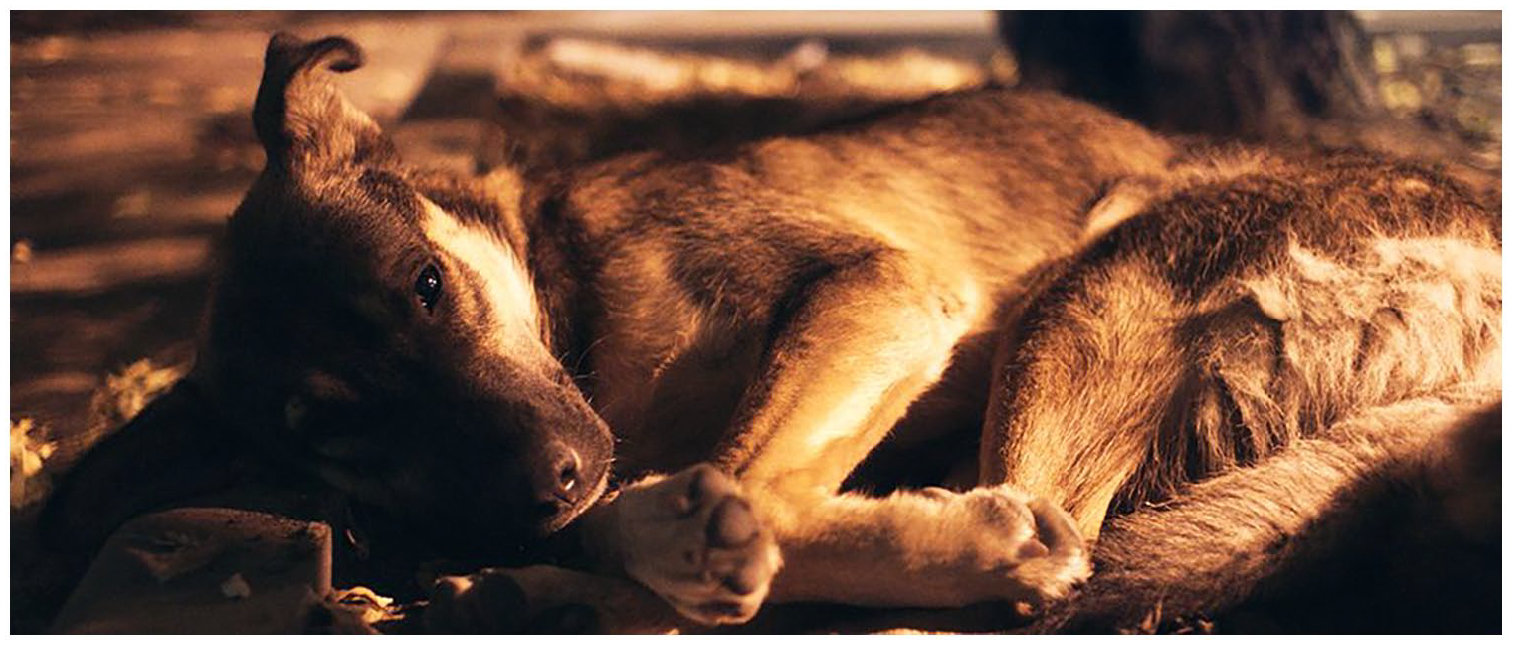
Dog takes a rest. Reproduced with permission.
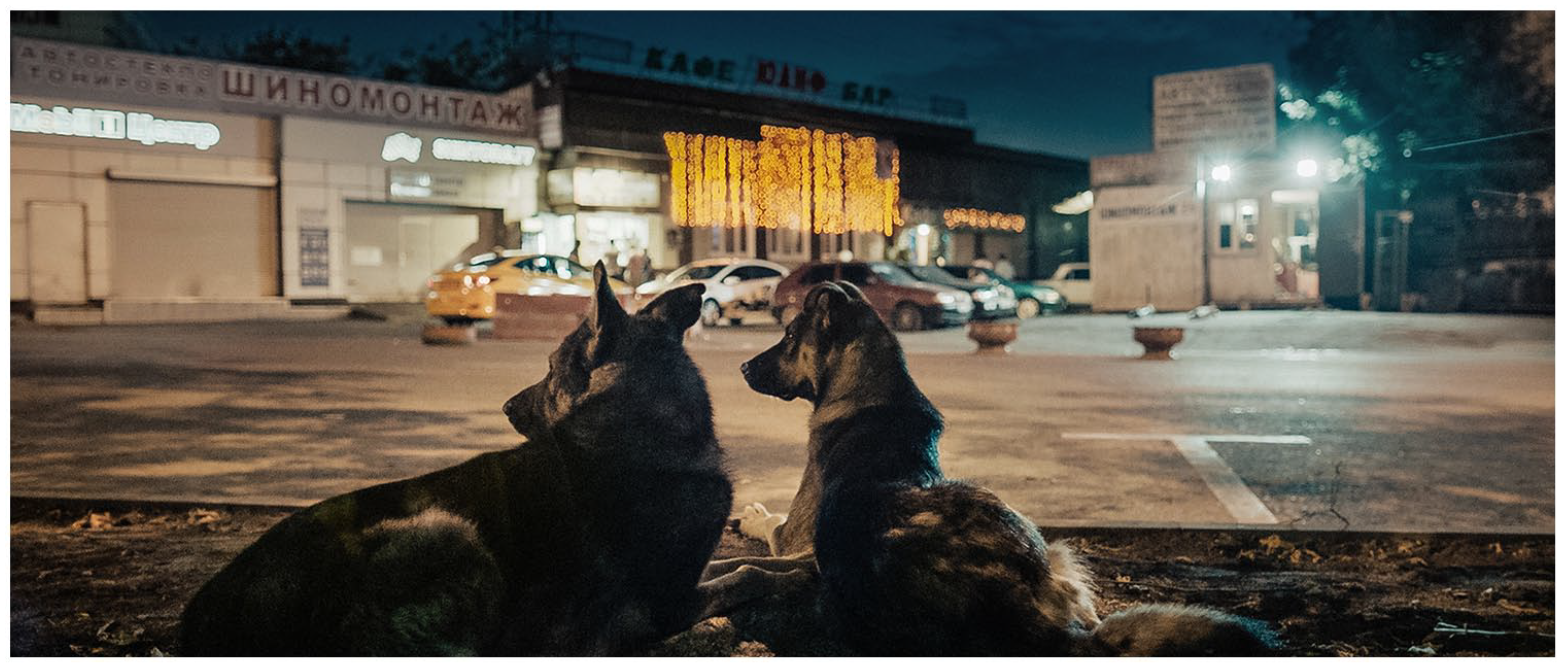
The two main protagonists taking a rest. Reproduced with permission.
The crew had to adjust their filmmaking practice to attune to the dogs’ lives. Imer developed a unique apparatus to immerse the camera in the pack, but occasionally found it difficult to keep up with their movements.
You have to be quick enough to follow them and not lose them. . . we were constantly thinking where they would go, what they would do, and working out how to move with them without disturbing them or without getting crushed by a car.
Mutual trust was required between crew, cameras, and canines to produce the desired on-screen effects and affects evocative of urban canine temporalities (Figure 3).
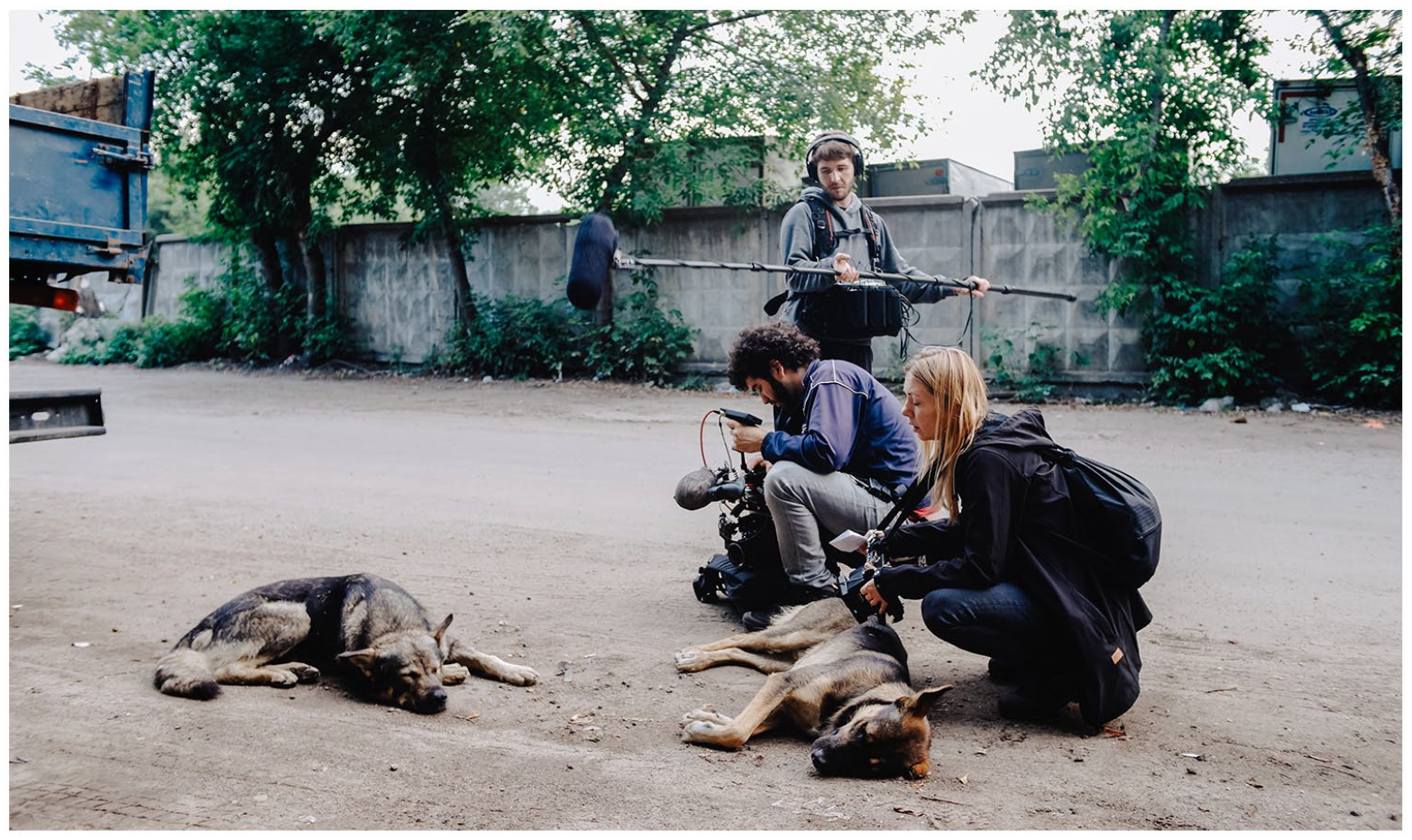
Jonathan Schorr (sound, standing), Yunus Roy Imer (left), Elsa Kremser (right), Imer’s camera equipment, and the dogs. Reproduced with permission.
We had to slowly move closer to them, following what they were looking at, and figuring out what bothered them. The dogs only became comfortable with us and our equipment after these periods of us really slowing down.
They’re not used to humans watching them and just waiting. . . We wanted to make an offer of companionship. After several weeks they accepted this. . . When they went to sleep for two hours and we were still there watching them when they woke up, it was weird; it raised their interests. . . I think they got used to, and enjoyed, the attention.
This approach of reciprocal attunement constitutes a form of ‘nonhuman labour’ 7 wherein the dogs’ collaboration was required to produce the desired on-screen effects.
Some behavioural scientists told us how they film dogs without human interaction in their most ‘natural state’. They said that if the camera is not super hidden, then the dogs will totally change their behaviour. What we did was totally the opposite: we interacted with them intensely. We were so close physically—when they were sleeping, they had their head on our legs. . . They need body contact, and if you avoid body contact, you’re a stranger to them. . . They were checking how we behaved and trying to adapt. They needed orientation. They began behaving normally because they knew we were, in a way, friends.
Intense interaction did not mean constant interaction, though. As Matei Candea 8 notes, observing and representing nonhuman lives involves fluctuation between detachment and engagement. The filmmakers noted that off-screen engagement with the dogs allowed for both vividly intimate and brutal scenes throughout the film (Figure 4). Once the dogs were satiated with attention, they went about their usual lives and were easily followed. One particularly horrific scene instigated less-than-favorable reviews by some critics, 9 depicting a dog mauling a street cat to death.
We would follow the dogs as they playfully chased other animals, but never saw them catch one. Then one day out of nowhere, a cat was in the scene, and it just happened so quickly—BOOM!—and it was already dead. There was no way we could have stopped it. We just kept filming to follow what happened next. I found myself really hating the dog after this, thinking ‘you just killed this cute thing, how could you?’ But after a while I thought I was projecting morality onto the dog. It’s not a human. Street dogs can sometimes kill for fun.
We decided to keep filming, and not lose the length of this scene in editing. . . You sit there watching the dogs react to the cat they just killed. This was needed to tell the whole story, not just a human rationalisation.
Although shocking to some viewers, portraying this scene in its entirety was in keeping with the filmmakers’ aims of attuning to urban canine lives. Crucially, it was their immersion into the dogs’ lives, which was not caught on camera, that allowed for such attunement to be visually represented on film.
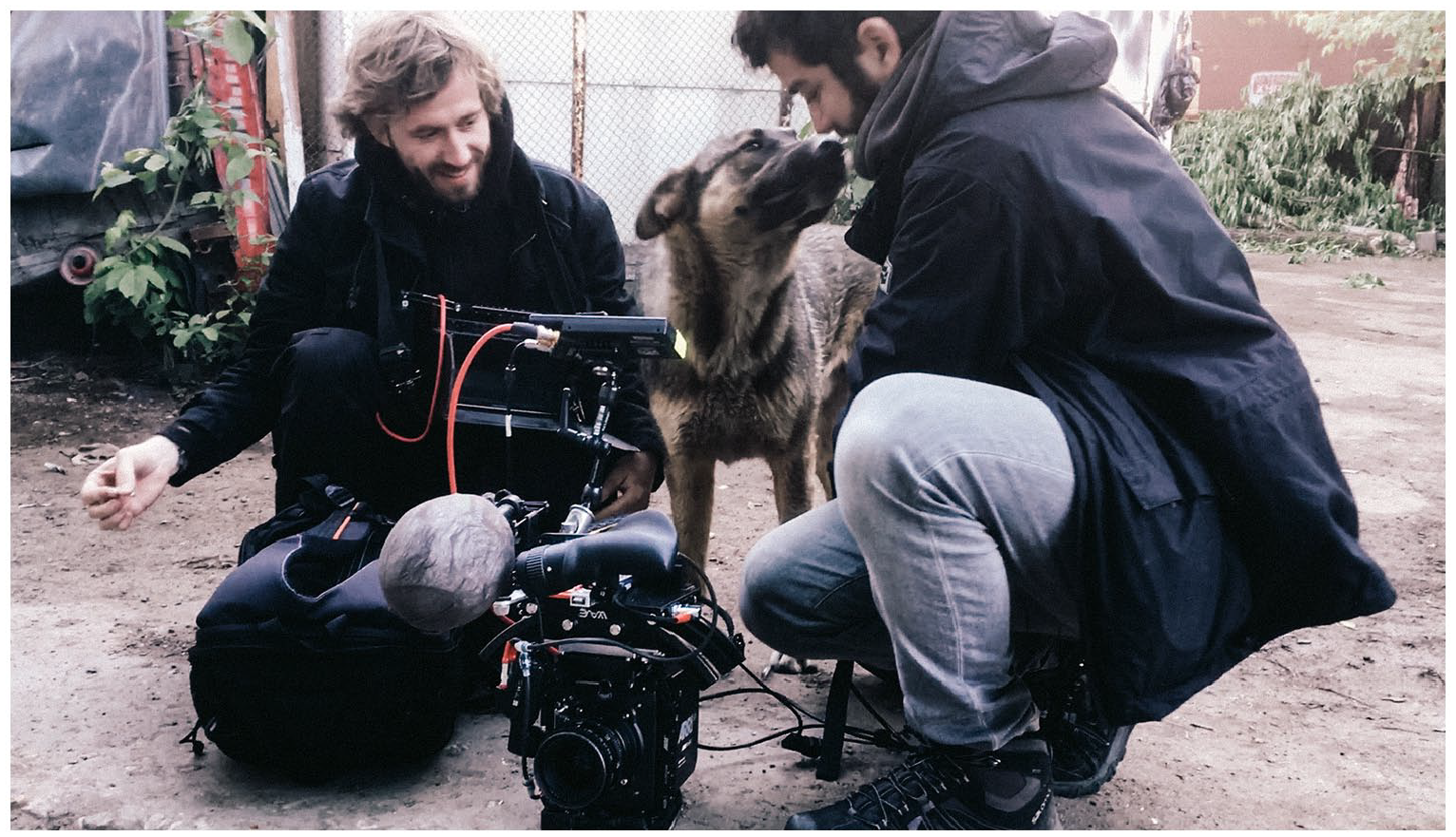
The filmmakers engage with their canine protagonists regularly off-screen but are never seen in the film. Left: Levin Peter, Right: Yunus Roy Imer. Reproduced with permission.
Perspective
Space Dogs offers perspectives of Moscow from the vantage point of street dogs. By portraying quotidian canine life in this manner, urban space itself is recast as more-than-human, produced and experienced by a range of creatures in collaboration, albeit unevenly. 10
The core of our vision was to give the impression that we are part of the pack.
Etymologically, perspective derives from the Latin, perspicere – ‘inspect, look through, look closely at’. Kremser and Peter were keen to stress that Space Dogs, or film generally for that matter, is not able to offer a dog’s perspective, but rather it brings humans down to a dog’s level to see the city anew. They were not attempting to look through the dogs’ eyes, but rather they were inviting viewers to look through the camera lens, to look closely at the dogs, in turn inspecting their worlds with them.
In the beginning, we had this vague idea of making something super un-human that really got into the dogs’ perspectives. But we were not trying to become dogs. We did not want to narrate from a dog’s view. We’re humans making and watching the film with technical help. So, we went down, to get close, to really observe.
Their practice can be understood as a mode of ‘responsible anthropomorphism’, 11 acknowledging the limitations of human sensorial capacities to attune to dogs’ worlds. For instance, they often noted that dogs navigate cities using olfactory registers imperceptible to human (and cinematic) experience.
Some commentators described the film as ‘de-anthropomorphic’. . . but actually, we tried to use anthropomorphism as you cannot get rid of it. . . We must play with it all the time.
We were simply interested in being down there, looking into their eyes.
As a child, my main contact with living beings was with dogs. I was always looking them in the eye. A goal of this film was to approach that childlike human state: experiencing the world with less preformed ideas about animals, and instead just being with other living beings.
This was the core of our vision: we have to meet the dogs on eye level to tell their story. It encourages empathy in the viewer. It’s like with children, you go down to their level to communicate with them, trying to understand their world.
Moreover, by dwelling at dog’s level, the filmmakers attempted to experience and know the city on canine terms.
Actually, we did not know the city at all before. . . the dogs showed us around. We only went where they went, so we have a limited knowledge of the city. . . Space Dogs was shot in two square kilometres.
I would not have been in an industrial part of the city for such a long time, walking between the housing blocks, or walking through the night in Moscow. The dogs were taking us to places you only go if a local is showing you around.
They have a very clear territory which they defend, which surprised us. We thought they’d roam widely, and we’d end up in Red Square.
The filmmaking practice of Kremser, Peter, and Imer allowed for collaborations between dogs and humans to take place, blending cinematic and ethnographic approaches to offer perspectives on nonhuman worlds to human viewers. Representations of canine lives on screen are necessarily incomplete, and imperfect. However, allowing filmic practice to foreground the agencies and territories of the dogs themselves – rather than directing their movements through space and time – highlights the potentials of filmmaking as method and output for animals’ geographers.
Narration
Space Dogs begins with a disorientating scene: a space shuttle disintegrates upon re-entry into Earth’s atmosphere, emitting a mesmerizing display of lilac, amethyst, and purple (Figure 5). The narrator speaks in Russian: ‘as the capsule finally touched the atmosphere, the heat grew so enormous that Laika’s body was burned up. At that very moment, what had been a Moscow street dog, became a ghost’.
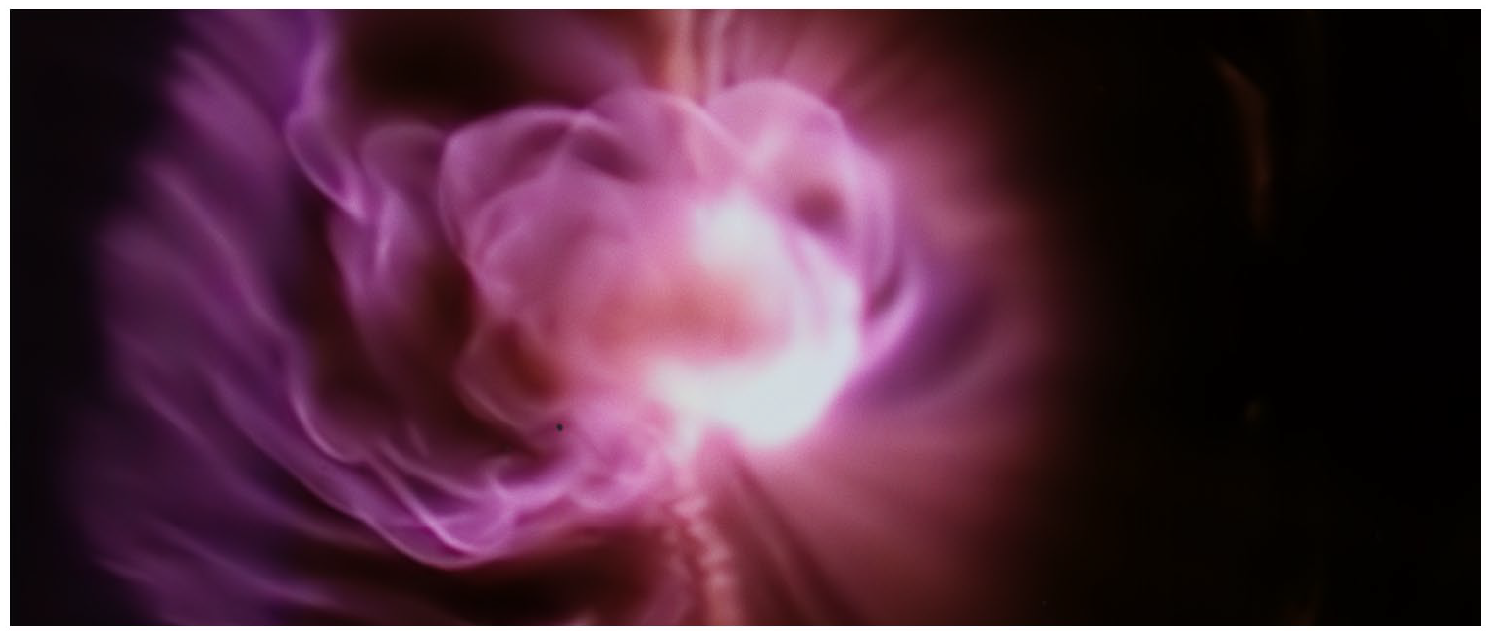
Laika’s capsule returning to Earth. A still from Space Dogs. Reproduced with permission.
We wanted to start the film with a scene where the viewer can imagine the ghost actually becoming a ghost. It felt like a birth—something extreme, maybe spiritual.
It’s death and birth in the same moment; a sensation of ending and beginning at once.
The film’s final scene also deals with a possible future. It uses an iconic image where one dog remains alive, looking to the future. We often thought you could stick the ends of the film together and restart everything to produce a completely different film—a loop—but one whose narrative continues to surprise the viewer on each re-watch.
The final scene of the film, referred to by Kremser above, depicts the heart-breaking tale of a litter of puppies poisoned on a construction site (Figure 6).
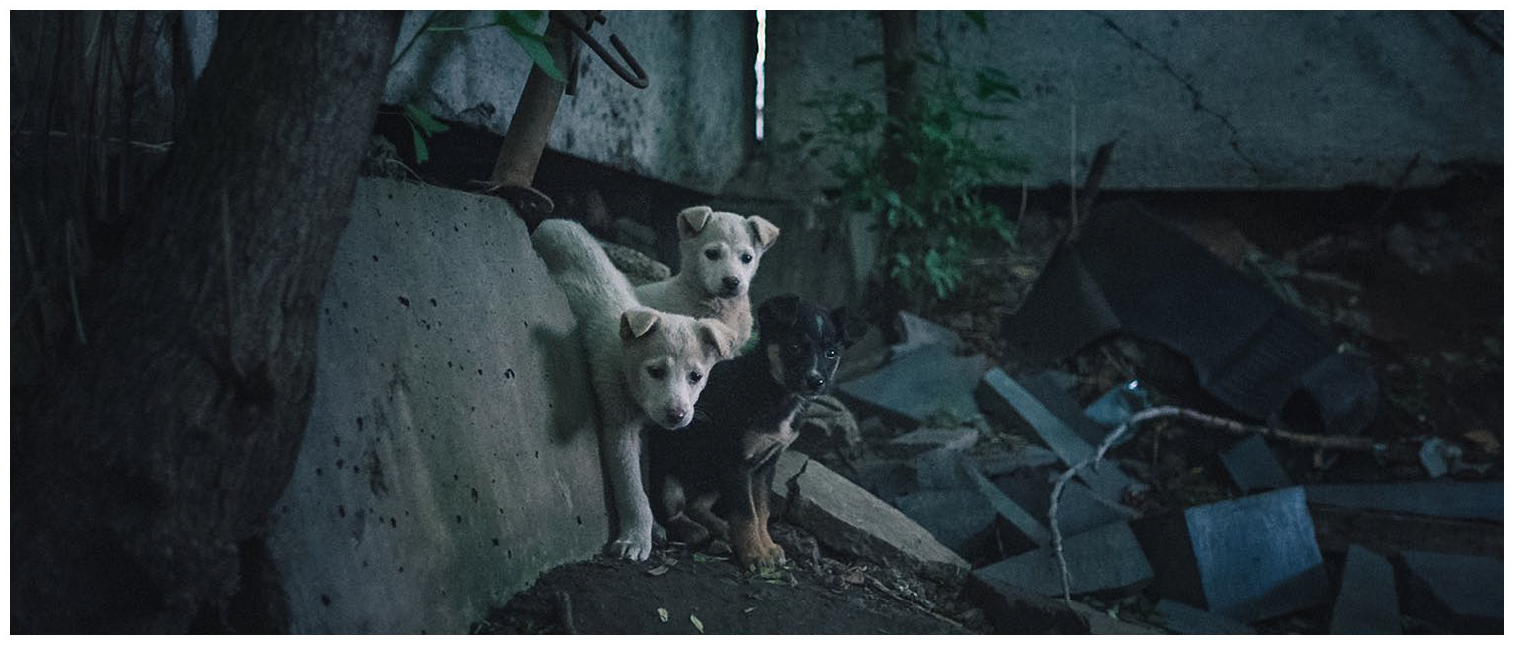
The puppies from the final scenes of Space Dogs. Reproduced with permission.
Kremser and Peter visited their den one morning, horrified to find only one left alive. Although tragic, this scene is consciously placed last to imbue the film’s structure with its own spectral lifecycle of birth, death, and rebirth.
We will never know the many lives Laika could have had if she wasn’t sent to space, and we don’t know anything about what happened before she was sent, either. So, speculatively, she is a potential ancestor to many dogs. . . her descendants could be roaming the streets of Moscow today.
By juxtaposing archival and documentary footage, Space Dogs unsettles chronological accounts of Laika’s story, experimenting with her speculative afterlives.
The archival images allowed us to explore the concept of ghosts in cinema.
Indeed, filmmaking’s ability to manipulate spacetime is integral to Kremser and Peter’s practice, evidenced by the name of their production company, Raumzeitfilm: ‘Spacetimefilm’ in German.
We wanted to create an opportunity to go to the cinema to perceive time differently. Cinema is the only chance we have left to stretch time.
Surprisingly, though, the film contains no footage of Laika herself in a laboratory or otherwise. Rather, archival scenes from the 1950s depict many nameless dogs (Figures 7 and 8).
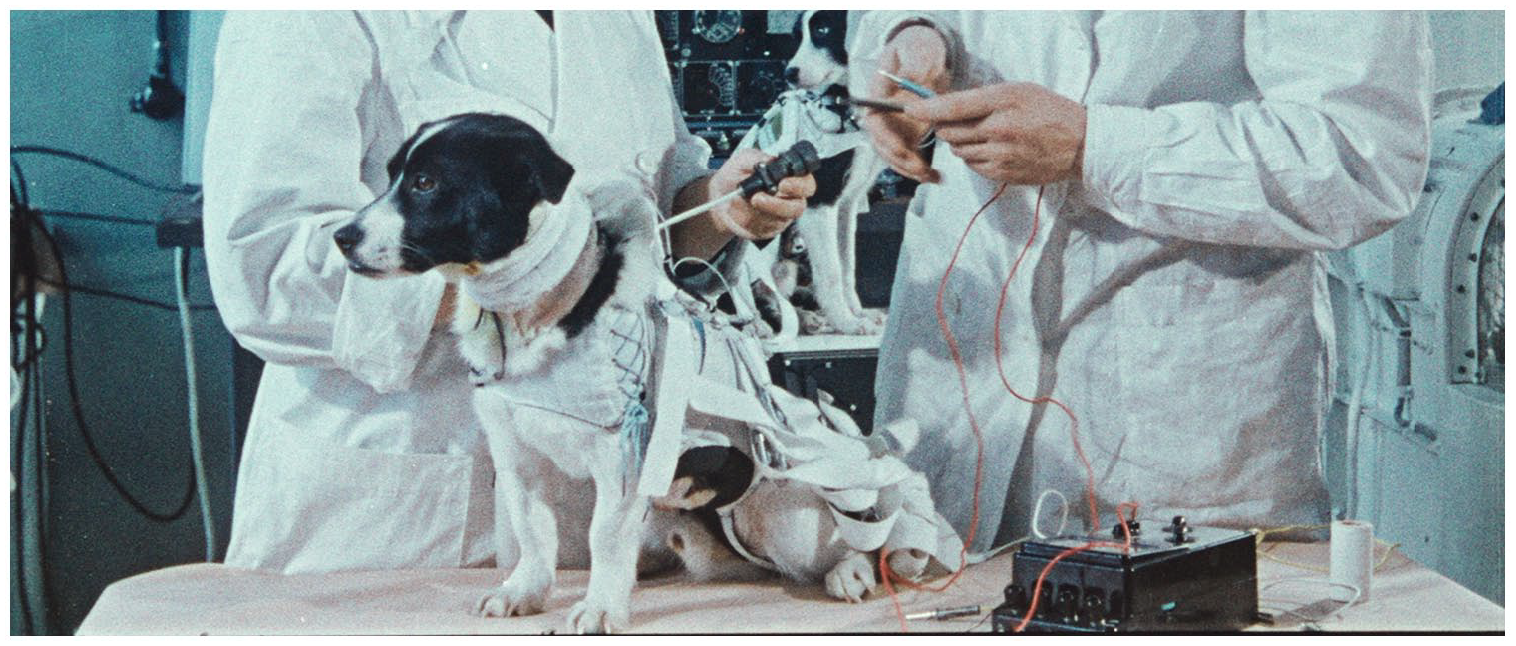
Archival footage of the Soviet Space Programme conducting experiments on dogs captured from the street. Reproduced with permission.
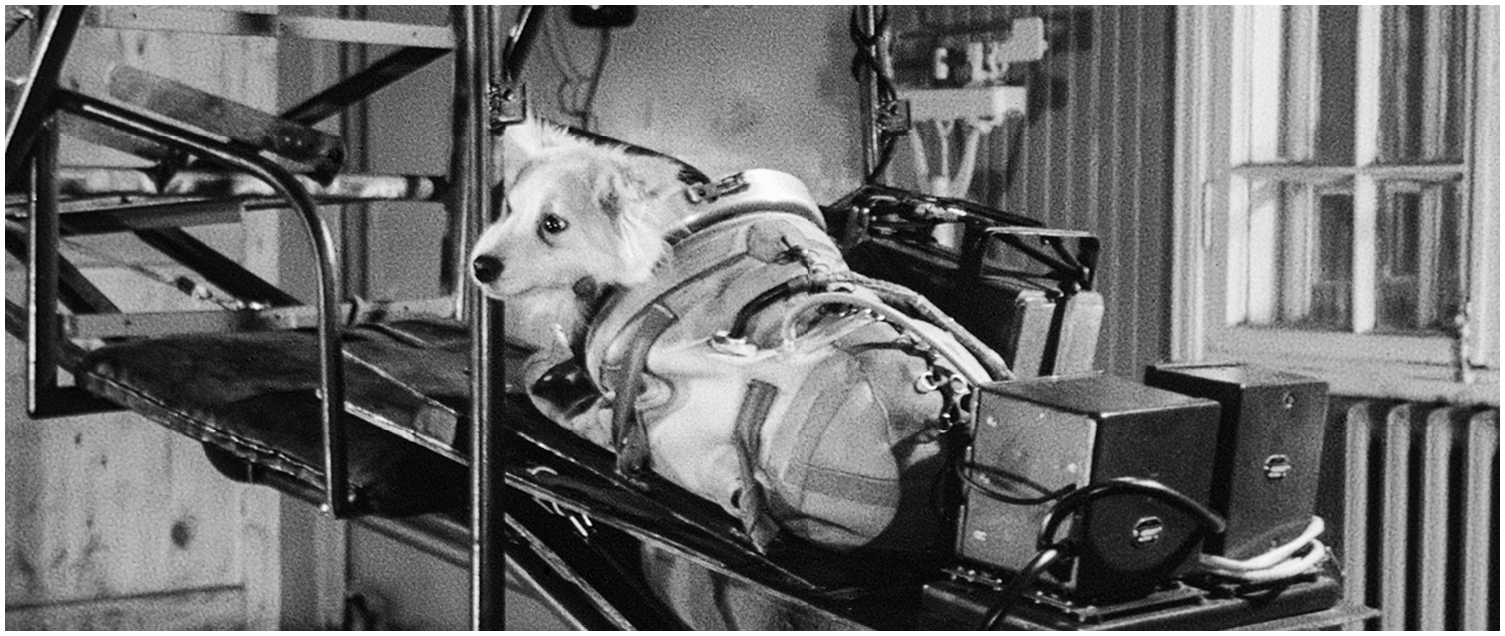
Archival footage of the Soviet Space Programme conducting experiments on dogs captured from the street. Reproduced with permission.
None of the dogs in Space Dogs are Laika, which means the audience can speculate that a part of Laika can be found in all of them. We wanted to allow viewers to see Laika’s ghosts in other dogs, to project her ghosts elsewhere, in their own way. So, by Laika being absent, she is also present in all of them.
It was important we didn’t show Laika herself in the film. This is because everything the spectator already knows about Laika—even if it is just what the narrator says—is more powerful than her actual image. So, it would be less ghostly if the images of Laika were present. This allows us, as filmmakers, to use the legend which surrounds her to haunt viewers.
Engaging these archival images allowed us to experience what people in the Soviet Union grew up with: a ghost story.
The dead body of a living being from Earth was in the most inhospitable environment—space—floating for half a year. On her return, her body was blasted into miniscule particles that dispersed throughout the atmosphere. Scientists told us that over the decades, gravity caused these particles to return to Earth. So, we played with this idea. Laika’s ghosts are not just metaphorical; there’s a chance that Laika’s disintegrated remains can be found anywhere on Earth, in any street dog population.
The absent presence of Laika in Space Dogs thus allows viewers to project her ghosts into other animals, differentiating the creative potentials of the film from wildlife documentaries, which often over-narrate, dramatize, or seek realist representations of animals’ lives. Instead, Space Dogs uses this spectral ambiguity to encourage viewers to empathize with nonhumans.
We don’t want to push the film too much in a single direction. Some viewers told us they named the main dog Laika when they watched the film. Others thought Laika was more abstract. It’s open to the viewer to project her ghosts however they want.
Critical reflections on filmmaking and animals’ geographies
In filming with dogs at their level, Space Dogs can be brought into conversation with recent developments in geographical research that seek to elucidate animals’ own lived geographies. 12 Films that center animals’ perspectives are not new. However, there seems to be an emerging trend, or genre, in documentary filmmaking to experiment with techniques that offer closer insights into (urban) animals’ own lives and spatiotemporal experiences (see Stray, Pariah Dog, and Kedi, for instance). 13 Such films, according to Laura McMahon, 14 often deploy a deliberate slowness that attends to ‘the meandering rhythms of animal life’.
Here, we have presented a three-part typology outlining the shared concerns of the filmmakers of Space Dogs and cultural geographers. Firstly, filmmaking practice is a mode of
The filmmaking practice of Kremser, Peter, and Imer is thus exemplary for cultural geographers seeking to engage with the lives of nonhuman animals, informing our own ongoing experiments in filmmaking with dogs in the Chornobyl Exclusion Zone (Figure 9).
16
Specifically, the ‘more-than-representational’
17
qualities of their practice allow for immersion into animals’ lives, whilst simultaneously acting as a representative tool. Moreover, cultural geographers interested in animals might learn ethnographic lessons from the filmmakers, who made no attempt to remain distant observers of the dogs’ lives. Instead, they became part of their story, and in doing so were able to offer ‘affective ethnographies of animal lives’
18
informed by reflexive engagements with canine ethology. The filmmakers
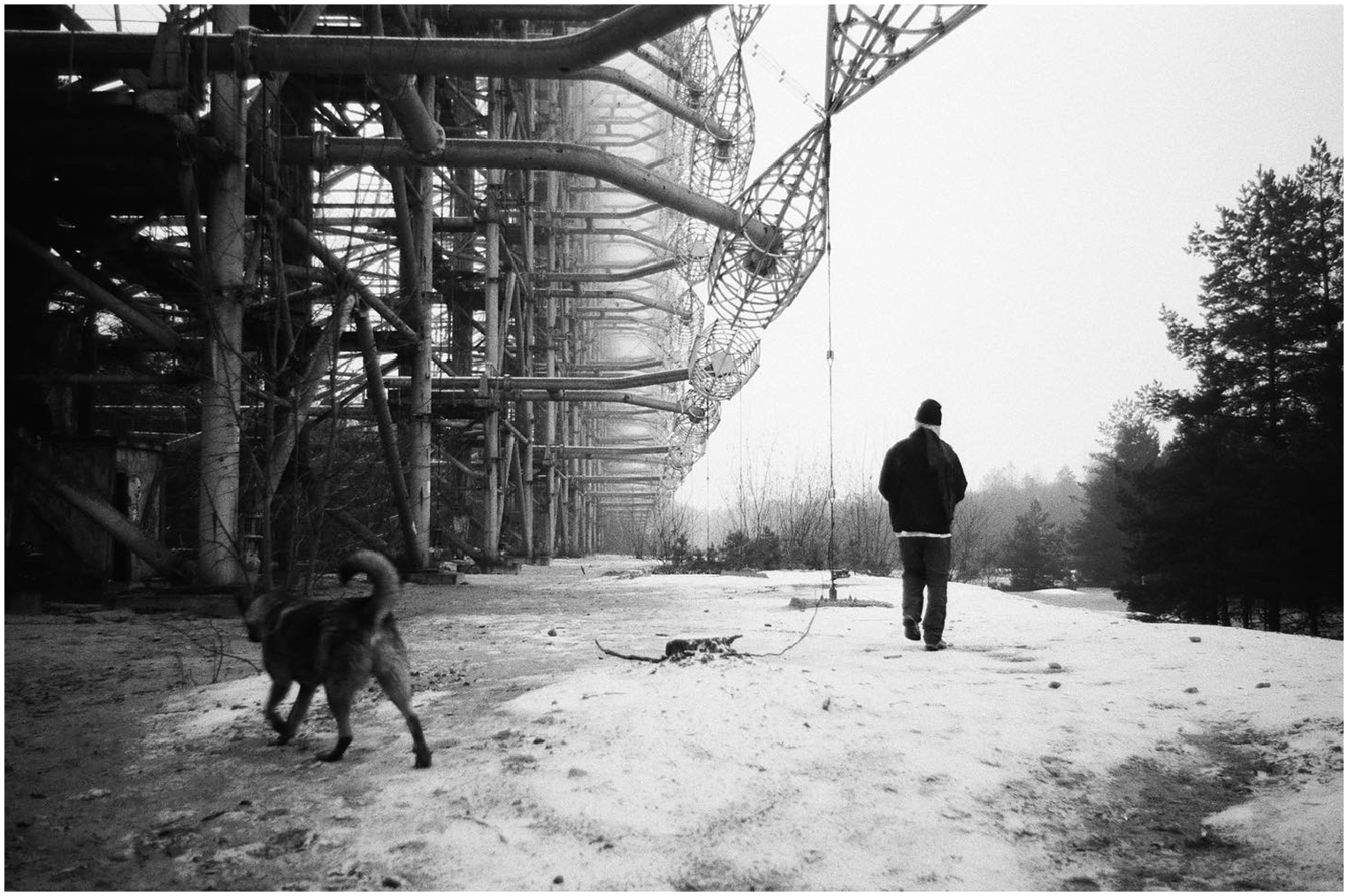
Test shot from our own filmmaking practice – Собаки Що Вижили/The Dogs that Survived – in the Chornobyl Exclusion Zone.
Whilst it was not the filmmakers’ explicit concern to produce geographical knowledge, the end product – Space Dogs – could well be considered a geographical research output. It addresses the concerns of numerous animals’ geographers: exploring how nonhumans are involved in the composition of urban ecologies; documenting the intersections of human and nonhuman marginality at the fringes of urban life; and contextualizing and historicizing spectacular stories of animal lives. The increasing use of filmmaking amongst more-than-human and cultural geographers broadens the scope of dissemination techniques for intellectual work and diversifies methods for studying nonhuman lifeworlds. As such it is an exciting area for future cultural geographies in practice.
Footnotes
Acknowledgements
We would like to thank Elsa Kremser, Levin Peter, and Yunus Roy Imer for many enthusiastic and exciting conversations that have contributed to this manuscript. We are also grateful to the filmmakers Elizabeth Lo (Stray, 2020) and Jesse Alk (Pariah Dog, 2019) for conversations that have informed this ongoing project. Finally, we would also like to thank Sandra Jasper and Nathan Geyer for their thoughtful comments on an earlier version of the article; and Hayden Lorimer, Caleb Johnston, and an anonymous reviewer for their editorial insight.
Funding
The author(s) disclosed receipt of the following financial support for the research, authorship, and/or publication of this article: This research was supported by Jonathon Turnbull and enabled by an Economic and Social Research Council Doctoral Training Partnership Award (ES/J500033/1).
