




Abstract
In lieu of material encounters, nonhuman spectres are made sense of through spectacles, imageries speculated upon with their own geographies and affects. This paper explores histories of trophy hunting in the Spanish Pyrenees, illustrating the emergence of the spectacular in relation to contemporary ideals of nature for hunters, in particular questioning the material implications of hunting for the extinction of the bucardo (or Pyrenean ibex). Theoretically, this paper converses Jacques Derrida’s metaphor of spectrality and Guy Debord’s conceptualisation of the spectacle to understand how hunting ghost animals removes them from particular ecological contexts. Trophy hunting and taxidermic practice serves to produce spectacles of animals at the interface of life and death, detaching them from temporal linearities, and allowing trophy animals to speak to broader sentiments of mastery over landscape. The bucardo was a ghostly figure prior to its extinction, famously difficult to encounter and kill by the 19th century, and as such its absence was marked through trophies to infer its broader presence in the landscape. I trace the changing significances of spectres and spectacles through the development of photographic technologies; prior to the camera’s spread and widespread use, spectral spectacles were produced through hunting practice. A typology is offered for the sensing of ghosts in their cultural contexts: mourning, or the attempt to ontologise remains; marking, or the conditional attribution of language to the spectral; and working, the means through which the ghost transforms itself or is transformed.
Keywords
I heard some heavy animal crashing through the brush towards me, with a noise like a mad cow in a greenhouse, and had just time to unlock and cock the rifle, when a brown shadowy object passed within four yards of me. I was at the moment struggling in the midst of a dense thicket of young beech stems, the branches of which quite prevented any play or sweep of the barrel; but I fired the veriest snapshot in the world. By the merest fluke I happened to cover his shoulder, and in fewer moments it takes to write this line, the dog was tearing at the dead body. . . this incident shows the reliance which these goats place in mere concealment, and explains how this scarce species has maintained itself against extinction for so many ages.
1
It was in 1885 that Edward North Buxton shot a bucardo – an endemic ibex from the Pyrenees – to death. After four ‘unsuccessful’ visits to the Ordesa valley, nestled in the Aragonese Pyrenees a stone’s throw from the French border, he finally had his coveted trophy. 2 I was told by David, an environmental historian and activist in Torla, a village close to Ordesa, that ‘the very same animal is in the Natural History Museum, you know, the one in London, Buxton killed a lot of the animals in there’. Stored away in the museum’s taxidermic archive, the bucardo is mounted on a wire trellis, away from display to visitors (Figure 1).
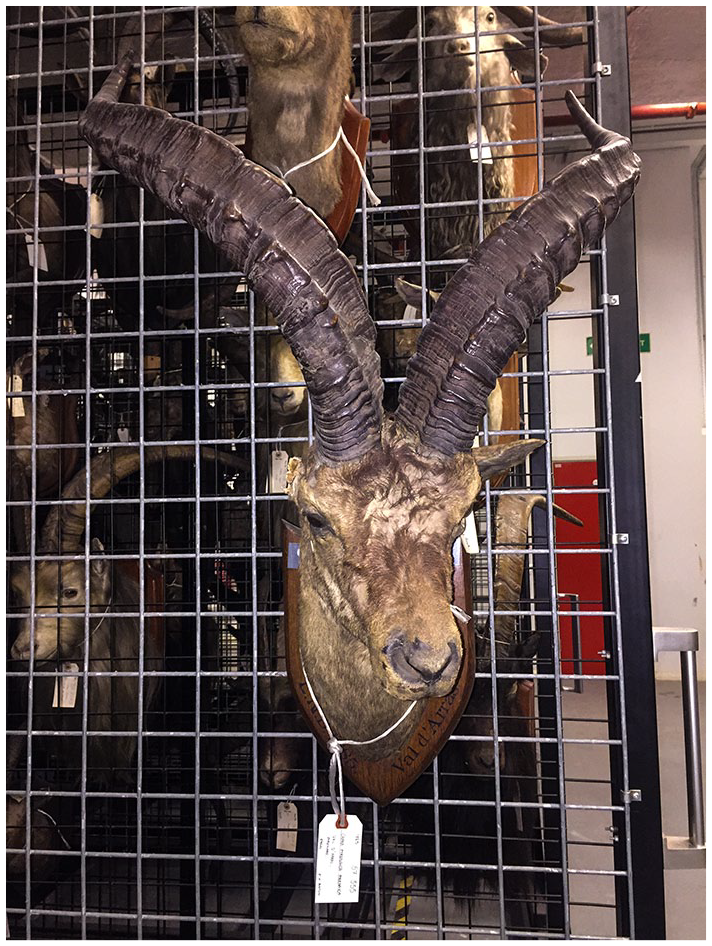
The bucardo killed by Buxton in the Natural History Museum of London. Specimen 1957.333 from the collections of the Natural History Museum, London. Photo by Roberto Portela Miguez.
For years the animal was a prized ornament for Buxton, with a romantic story to be recounted of a dominance over wilderness, over animal and over mountain. Taxidermic trophies are anachronic, disjointed from time and place, making-permanent the moment of animal death in the production of spectacle. Trophies symbolically embody myriad sentiments towards natures, landscapes and nonhuman animals. In this paper, I explore the story of the bucardo, entailing the means in which the spectacles of its death played a prominent role in its eventual extinction. Consideration of the bucardo, and the historical production of spectral spectacles, sheds light on ethical and aesthetic matters of concern pertaining to particular cultural practices and their implications in an epoch of anthropogenic extinctions.
Spectres and geography
The bucardo became the first animal to be declared extinct this millennium, when the last individual was crushed by a falling fir tree in the Pyrenees on 6th January 2000. Distilling extinctions to a simple before/after distinction, however, is a depoliticising act which quietens the everyday and ongoing elements that drive species loss. 3 Through the analytical lens of haunting, discrete categorisations of presence/absence (and temporal separations of before/after) are unsettled, 4 within which geographers – amongst others – explore the coming-together of divergent temporalities and topographies. 5 Extinction is a haunting, a persistence of the past in the present; 6 but also, a spectre of the ‘future-to-come’, 7 in which both ‘absences and threatened absences have empirical consequences’ for wildlife conservation and more-than-human relations. 8 In this sense, the Pyrenees were haunted by the bucardo long before its extinction, a ghost subspecies on the brink of disappearance. 9 Despite substantial conservation efforts implemented in the 1980s, 10 they arrived far too late. In 1911, for example, Ángel Cabrera referred to the bucardo as ‘practically extinct’. 11 This sentiment had persisted for much longer in France, where it was hunted to extinction 90 years earlier, when the last bucardo was killed near the Lac de Gaube (Hautes-Pyrénées) in 1910. 12 Renowned French naturalist Philippe-Isidore Picot de Lapeyrouse spoke of the bucardo in 1799 as ‘the lost species of the Pyrenees’. 13 Famed and celebrated for its ghostly absence, present though its spectacle, known through its transient markings in the Pyrenean cultural landscape – the bucardo’s story finds relevance in a world evermore accustomed to the ecocide of anthropogenic extinction.
Elaine Gan and colleagues note that the figurative ghost brings multiple (human and nonhuman) pasts to the fore, affirming that landscapes are haunted by the absences of past extinctions. 14 Cultural geographers heeding the spectral turn have attended to the question of how ‘particular sites, events and practices unsettle the relation between presence and absence’. 15 Derek McCormack situates the spectral turn within broader attempts to engage materiality, whereby spectral matters attended ‘the necessary impossibility of the fullness of presence’. 16 Hauntings are inseparable from the pre-existing assemblages of material conditions. 17 Attention to the experience of haunting – the grappling of the affective – highlights the multiplicities of spectres, particularly through their taking-place in different bodies, 18 and in different spatiotemporal contexts. Jo Frances Maddern and Peter Adey write that ‘ghostly relations tangle up the string of temporal linearity. Pasts and futures. . . bare a supplementary relation to the present. Spaces and times are folded, allowing distant presences, events, people and things to become rather more intimate’. 19 Due to this conceptual potency, geographers have explored the intellectual potentialities of spectres in myriad contexts, such as the restless histories of colonialism, 20 urban decay and ruination, 21 and landscape. 22
Recently, spectral geographies have investigated extinction, 23 to which I situate the bucardo. I empirically engage the idea of spectrality on the brink of extinction: what is the presence of impeding and inevitable absence? Doing so, I trace the bucardo’s ghosts before and after its extinction, employing visual, ethnographic and discursive methods. This historical exploration is found through the literary encounters of the 19th century European bourgeoisie, a societal group which treasured the bucardo as an intractable trophy, subject to the spectacle of ‘the hunt’. I develop these explorations alongside contemporary ethnographic work with hunters and ecologists in the Pyrenees, engaging the sentiments and affects of the hunt as a spectacle in the theoretical arena of Jacques Derrida’s work on hauntology and spectrality. Quotes from interviews and participant observation work are italicised throughout the text, with each individual given a pseudonym. This interrogation of ghosts through multiple histories in the cultural landscape of the Pyrenees is found at the convergence of multispecies assemblages, both living and dead. John Wylie notes that in addition to understanding the geographies of spectres, spectral geography should be spectral itself, 24 working ‘within a hauntology that unsettles narrative and subject, that reveals the shaping of place through haunting rather than dwelling, that dislocates past and present, memory and visibility, through forms of documentary experimentation’. 25 In staging conversations between historical and contemporary perspectives, written and recalled accounts and analysis, I aim to further understand the everyday unsettling of extinction.
Sensing ghosts requires particular forms of seeing.
26
These are fleeting attempts to ‘represent the unrepresentable’,
27
an aesthetics – sensing, remotely.
28
The work of making ghosts bodily sensible, speaking with them,
29
is moreover a question of ethics; what McCormack notes as ‘multiplying possibilities for living’.
30
According to the theoretical anatomy outlined by Jacques Derrida in Spectres of Marx,
31
the spectre is engaged through the analysis of three things:
Spectacles and the hunt
Ibex have always been perceived by hunters in Spain as the top prize. In recent centuries, the most elusive and difficult to kill were those which lived in the dramatic Pyrenean landscape: bucardo. The bucardo had long been a spectacle, as the most desired trophy by hunters in the Pyrenees by the 18th century. 33 Here I am defining spectacle in relation to the works of the Situationist International, who understood the broad concept as ‘a media and consumer society organised around the consumption of images, commodities and staged events’. 34 Although Guy Debord has since stated that the society of the spectacle emerged in the 1920s, 35 in this paper I explore the concept of spectacle through the ways in which events are staged in accordance with a particular idea of what is spectacular. The act of shooting from a gun and from a camera, moreover, present particular similarities in their movement to capture – and, therefore, produce a form of spectacle.
Death is only ever known by its representations, and ‘in that sense, it is always spectacular, while it eludes any vision we have of it’. 36 Death is only ever an image or representation. But, for Debord, the spectacle is not simply limited to ‘a collection of images; rather, it is a social relationship between people that is mediated by images’. 37 In French, too, one might consider the polymorphous nature of what Debord alludes to with le spectacle: in its daily vernacular it would denote a performance, a representation, a choreographed mise-en-scène. David Overend, Jamie Lorimer, and Danielle Schreve evoke the writings of Debord to animate the urban wildness of deep-time, noting that ‘Debord refuted accusations of “presentism”, emphasising the temporal continuity of the situation’. 38 Situations can be seen as the temporally contingent embodied experiences that disassemble the spectacular, cutting against Debord’s notion of ‘spectacular time’ in which ‘dead labour continues to dominate living labour’ and ‘the past dominates the present’. 39 In the sense that they belong neither wholly to the past or present, then, spectacles and spectres are alike.
The matter itself of the hunter’s trophy – a coming-together of embalmed flesh, bone, paint, wax, polyester resin, glass cloth, organ – is a spectral choreography built upon a strange tension of staging particular visions of ‘life’ through death. 40 Merle Patchett has written extensively on the practice of the taxidermic craft, investigating taxidermy as a process rather than unpacking the final product, 41 making ‘sensible the spectral agencies of the dead animal bodies’ in the taxidermist’s workshop. 42 Trophy hunting of the bucardo is witnessed back to medieval ages and is well documented in its heyday through the publications of famous Victorian hunters. 43 Part of the bucardo’s spectacularism has been the seemingly persistent presence of extinction, which was falsely declared numerous times throughout the 20th century, 44 contributing to the ideas of allusivity surrounding the bucardo itself. Matt Cartmill has convincingly argued that the spectacle of ‘the hunt’ is one of the strangest contradictions in human-nonhuman relation: at the face of tame/wild, culture/nature and most notably, life/death. 45 He writes that hunting is ‘an armed confrontation between humanness and wildness, nature and culture,’ and ‘the hunter stands with one foot on each side of the boundary, and swears no perpetual allegiance to either’. 46 It was at these ontological borders that the bucardo became known.
Derrida discusses hunting metaphorically throughout Spectres of Marx. He writes that associating ‘the figure of haunting with that of hunting’ is ‘the very experience of conjuration’, 47 the granting of a voice to the spectral, evoking and ‘convoking’ ghosts. 48 He posits hunting ghosts as ‘paradoxical’, as ‘the ghost does not leave its prey, namely, its hunter’. 49 Spectres return, haunting those which hunted them. I follow Julian Holloway and James Kneale in ‘thinking about the efforts of other ghost-hunters’ to ‘bear witness’ to the bucardo’s haunting. 50 Amongst the paradox of hunting ghosts, the unsettling of spectrality can be traced: through mourning, marking and working.
Spectral encounters: mournings, markings and workings
The bucardo is known around the world for the stories surrounding its extinction. It was first extinction of the 21st century, the first taxon to be outlived by its living cryopreserved cells, and – albeit very briefly – the first and only taxon to be brought back from extinction through cloning.
51
For a long time before, however, the animal had been associated with extinction. Sergio, an ecologist in the Pyrenees, told me in an interview that for the last few decades of the bucardo’s life it was considered ‘a living extinction.’ In 1801 Louis-François Ramond, a mountaineer attributing to popularising the romantic movement of pyrénéisme,
52
wrote of Ordesa and surrounding valleys in the Spanish Pyrenees: ‘These desolate places are the retreat of the bucardo, so pursued and so rare that the hunters hardly know it anymore’.
53
For centuries, the endemic animal had become what Núria, who lives in a village not far from Torla, described as ‘an emblematic species for the Pyrenees,’ locally associated within the Pyrenean cultural landscape. Núria further highlighted the often-imagined aspect of the bucardo in the landscape: ‘In the Pyrenean villages, where we are now, it was known by legend. And do you know why everyone wanted to kill it? To
Mourning: ontologising remains in its place
Of Derrida’s ‘three things’ in his analysis of the spectre – which I call mourning, marking and working – his outline of mourning is the most explicit. For to speak of
Derrida notes that engaging ghosts is always within ‘the strategy of a hunt or chase [une chasse]’;
60
ghosts are eternally the subject of the hunt. But this ghostly rendezvous, the ‘apparition of the inapparent’, requires the construction of an abstract body. Derrida’s point is that the ontologising of remains is manifest through the giving of a body, an artificial body, a production of the spectre. In the context of the bucardo, mourning work materialised through the cultural valorisation of two defining features: the bucardo as an emblematic animal which one cannot think or talk about without reference to its habitat. . . With some knowledge of evolutionary biology, the importance of the Pyrenees becomes more obvious: the inseparability of ‘the Pyrenean ibex’ and ‘the Pyrenees’ is cause for its position as an emblem of wildlife in these mountains.
For the spectre to be sensible, these auxiliary aspects of encounter are foregrounded in lieu of the material animal, which is to become known and famed through its trace. 61 This is the mourning which facilitates spectral entanglements, but it is one realised through spectacle, removed from the material experiences of the nonhuman Other to the artificial encounter of the produced spectre. And echoing a primary characteristic of the spectacle outlined by Debord, 62 these changing meanings are endemic of a degradation of experiences founded by what is to be to what is to have, towards an increased value in to appear or to seem [paraître]. Mourning is the inscription of a presence through an experience of absence. In the case of the bucardo, before and after its extinction, this was realised through the experience of the Pyrenees as an intractable landscape. Endemism plays a central part in the configuration or attribution of spectral corporeality. Considerations of the endemic are recognitions of biogeological assemblages in evolutionary makeup, of ecological place-setting and contextualisation within space.
Marking: spectral speech
After mourning, Derrida elaborates that ‘next, we can’t speak of the generations of skulls and spirits. . . without the condition of language – and the voice, in any case of that which marks the name or takes its place’.
63
Accounting for the cultural translations of the spectre’s speech, or attempting to speak on its terms, is in effect the translation and marking through time and space. It is what makes the figure of the ghost hold relevance in contemporary settings, simultaneously a revenant from the past and an arrivant in the present. To consider marking, then, is to consider the multifarious manners in which signs can be produced. The political and ethical potential of haunting is important here, as Mark Fisher argues 68 because the ghost ‘is the proper temporal mode for a history made up of gaps, erased names and sudden abductions.’ The ghosts of anthropogenic extinction are species abducted from their ecologies, and through spectral speech one may begin to consider the ghosts of extractive capitalism and the exploitation of nonhuman life within those absent ecologies themselves. The bucardo’s spectre is often marked by the iconography of the animal, particularly as imagined by those inextricably linked with its death: hunters. As explained to me by Gabriel, an environmental activist in Aragón: ‘the Hunting Federation of Aragón, have a bucardo as their crest. Yeah. In their crest they have a species whose extinction was caused by their own activity of hunting.’ I saw the crest on a large banner at a hunting fair in Sariñena, in Aragón’s Los Monegros desert, where the icon was emblazoned with the capitalised words ‘PROUD TO BE HUNTERS’ [ORGULLOSOS DE SER CAZADORES].
Lessons can be learned from the work of Maan Barua into the spectacular accumulation of nonhuman labour, which he defines a ‘the process of valorisation involving “spectacles”: a mediation of nature–society relations through fantastic images that monopolise production and intensify banal consumption’. 69 This historical valorisation of the bucardo as an ephemeral beast was the cumulative socioeconomic process which eventually led to its extinction, a supply-demand relationality with severe ecological implications. It was the spectral marking within the process of spectacular accumulation which contributed to its exploitation. Transient trophies to be hunted, this became a commodity encounter which was marketed to the British bourgeoise based on the lived topologies of bucardo themselves; 70 they became valued by hunters due to their rarity and their morphology.
Working: affect and play
The last of Derrida’s analytical sketch for critiquing the spectre relates to the way in which ‘the thing works, whether it transforms or transforms itself, poses or decomposes itself: the spirit, the “spirit of the spirit” is work’. 71 The working of spectres pertains to a particular performance, a play, in which ‘the living maintain the dead, play dead, let themselves be entertained and occupied and played or tricked [jouer] by the dead, speak them and speak to them’. 72
Derek McCormack writes that sensing spectres can be active or passive – incurring through affecting or being affected – an ongoing oscillation ‘involving bodies of different degree of affective intensity and duration’.
73
McCormack’s treatment of affect as a defining feature of spectral sensing opens up to irrationality and impulse, the felt intensities and atmospheres of ecological absence. Affect, too, makes no distinction between humans/nonhumans, actual/virtual, or present/absent. It is that openness to being played, to being affected, in which the ghost transforms: it finds new meanings each time it is embodied which shifts through time. As poetically remarked by Nicholas, a park ranger in the Pyrenees: When I used to look up at the bare rocks on both the French and Spanish sides of Monte Perdido, I used to see bucardo there, all the time. I was imagining them, of course, but I had to have faith that they would one day be there. It used to be an emotional thing for me, every day, looking at nothing up there and dreaming of what could have been and still could be. The ibex were always there because we never stopped talking about them, dreaming about them, you know – giving them life in other ways – metaphorically rather than physically.
Hearing modern day hunters reflect the sentiments of the British hunters in the 19th century, I was struck by the deeply affective aspect of human-bucardo encounters. Buxton, for example, wrote profoundly of hearing noises echo through the Ordesa valley purely as imaginative figures: ‘shots which were never fired’ and ‘the baying of dogs which proceeded from no canine throats’. 74 Beyond the perspective of hunters, however, the affective storytelling from many Pyrenean residents retained a certain romantic vision of the ghost animal. I’ve met founding members of Amigos del Bucardo [Friends of the Bucardo], the activist group in Torla who campaigned to establish the Museo del Bucardo [Bucardo Museum], who never saw a living bucardo, yet their descriptions of the bucardo are embellished with such familiarity. ‘It has always been here, and always will be,’ David, one of the activists told me, when I asked if the animal’s extinction remained relevant two decades later. ‘Never again will we fail [as conservationists] like we did with the bucardo,’ David added, ‘and we will never forget.’ How, then, had the spectacle of spectrality affected ecological relations between humans and bucardo for centuries?
Spectral spectacles
Death cannot be known through experience, and to methodologically engage the imagery in which death materialises, one must engage in the cultural vernacular of the spectacular. Debord noted that ‘when analysing the spectacle one speaks, to some extent, the language of the spectacular itself in the sense that one moves through the methodological terrain of the very society which expresses itself in the spectacle’. 75 Immersion in the societies within which spectacles are allowed to express and manifest is therefore a methodological imperative for critique, owing to the interpretation of hunters’ accounts and the perceptions of the English bourgeoisie in this section. In so doing, the mourning, marking and working of the bucardo’s ghosts can be explored though time, illustrated particularly though the relationship of the animal, hunters and the trophy.
Landscape and the trophy
The earliest published account of the bucardo’s existence was in the context of hunting, 76 in Gaston Phébus’s Medieval Livre de la Chasse [Hunting Book], 77 where illustrations emphasise the craggy inhospitality of Pyrenean topography (Figure 2). Phébus writes that ‘the ibex challenges the hunter from the heights of his rocky perch. . . following him is impossible: in a few dizzy leaps, from traverse to traverse, he disappears out of range of arrow or stone’. 78
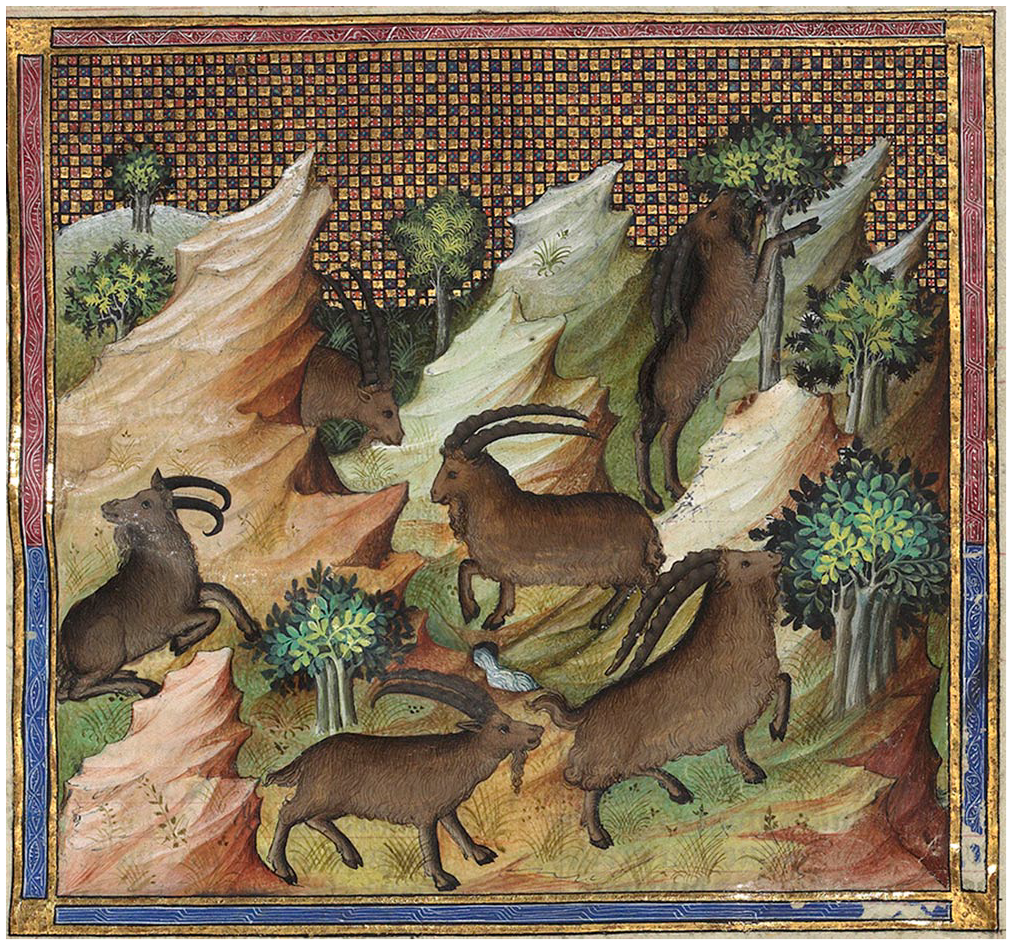
Bucardo depicted in a manuscript of Livre de la Chasse, a 14th century work of Ghaston Phébus. Source gallica.bnf.fr / Bibliothèque nationale de France. Département des manuscrits. Version 1407, Paris, BnF, Français 616.
The bucardo became an internationally desired trophy animal following the publications of certain prolific ‘noblemen’, who relished hunting in northern Iberia due to the fact many of them held large expanses of land in the south of France. Many owned summer homes in Pau, Pyrénées-Atlantiques, which had been established as one of the most famous sports resorts in Europe during the early 19th century. 79 From here, hunters would travel over the peaks to Aragón on the Spanish side of the Pyrenees, which has a much drier, hostile landscape, historically perceived as the Pyrenees fit only for ‘true’ mountaineers. 80 The bourgeoise sportsman’s gaze was exploited as a means of rural development and livelihood in the Pyrenees throughout the 19th century in accordance with global trends. 81
Victor Brooke was the first noblemen to popularise bucardo hunting among the British bourgeoisie. His letters and diaries provide an empirically rich contextualisation of the bucardo’s status as an almost-impossible catch. It is thought that bucardo were driven to extinction in the Basque Country and Catalonia in the mid-to-late 18th century, 82 and by the time Brooke and his contemporaries were initially attracted to the idea of hunting bucardo only a small nucleus population remained, in what is now Ordesa and Monte Perdido National Park [Parque Nacional de Ordesa y Monte Perdido]. 83 The first time Brooke visited Ordesa in pursuit of the bucardo, his only impression of the bucardo was a set of its footprints, its traces: catalysing his idée fixe with the animal. ‘No words can describe the savage beauty of this glorious valley,’ he wrote of the habitat. 84 With deep affection he later deemed Ordesa ‘the bouquetin’s castle’ – favouring the French word for the animal over bucardo. After the famous killing of the bucardo by Brooke and his team, his brother, Harry, recounted that Victor would ‘describe the death of the great trophy of this expedition, the big bouquetin, which he spoke of as next to the Markhor of the Himalayas, as one of the grandest beasts he had ever laid eyes on. This was the first bouquetin killed in the Pyrenees for many years, and was a most magnificent specimen’. 85
Another popularisation of the bucardo can be traced through Victorian hunter Edward North Buxton, in his widely read 1892 book Short Stalks. Buxton introduces his chapter on the bucardo – which he refers to as the Pyrenean ibex – through a thick illustrative description of Ordesa’s landscape. As he elucidates: The slopes of this valley, and of one or two others like it, are home of the Pyrenean ibex, one of the rarest of animals and the most difficult to obtain. . . that these animals are difficult to hunt may be gathered from the fact that I paid four distinct visits to the valley, and worked pretty hard each time, before I obtained a single specimen of a male.
86
What emerges though these accounts are deeply-held impressions of the bucardo as an intractable aspect of the Pyrenean landscape, difficult to kill, a spectre. Depictions of the bucardo by bourgeoise hunters reflected those of Phébus, in that they favoured embellishments of the dramatic Pyrenean landscape over details of the animal itself (Figure 3). The mourning work is evident through the importance of place in how the bucardo’s ghosts rose to cultural prominence.
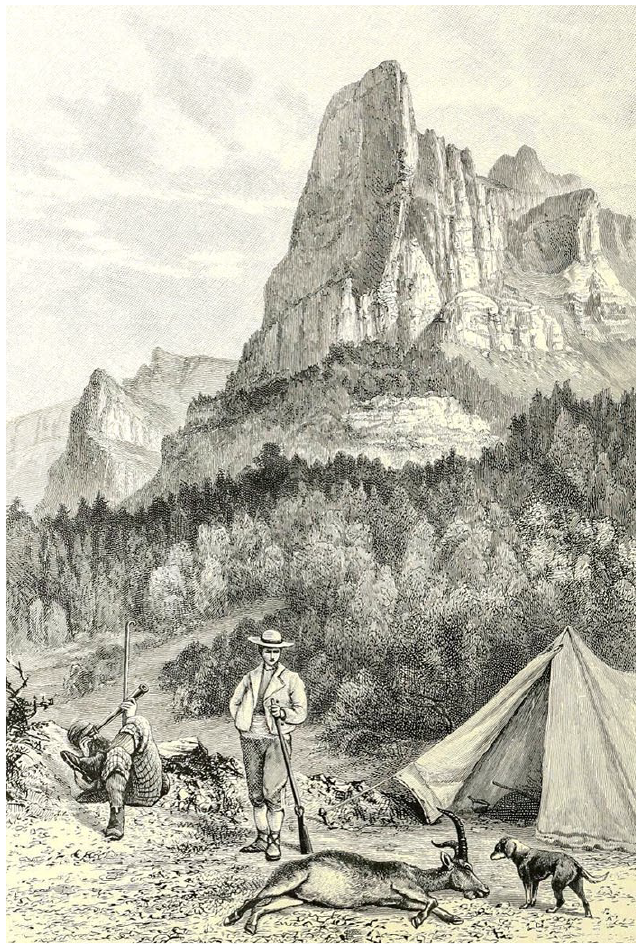
Edward North Buxton standing over a dead bucardo in front of el Torzal del Mallo, in the centre of the Ordesa valley as depicted in his book Short Stalks (1892: 232).
Production of spectacles – and the marking of spectres – in relation to the lives, topologies and histories of bucardo can be traced through depictions such as these discursively emanating from the value sets of hunters. Phébus portrays six males, one of which is possibly a chamois (on the far left), all of which are deeply intertwined within harsh mountain landscape. The geological outcrops punctuate the vegetated valleys, in contrast to depictions of other animals associated with European hunting throughout the archetypal work, where the method and practice of the hunt takes prominence. 87 Hundreds of years later, hunters still regarded the bucardo as an important aspect of the Pyrenean landscape, whereas valorisation would come through the marking of spectres in place; the animal is usually referred to as ‘the bucardo of the Pyrenees’, 88 which Raúl, a hunter, told me ‘made the hunt more impressive.’ Miguel, another hunter, remarked that ‘hunting in the Pyrenees has much more value because it is difficult. . . The landscape – the valleys, the mountain, and all that – that’s what matters in terms of value. . . The trophy of the bucardo, for those English hunters, surely had this importance too.’
Interrogating this link between cultural value and ‘the trophy’ sheds light on the hunt as a performative act, as a spectacle which brings certain realities into being through acts of representation. The materiality of the trophy, those animal remains encountered whilst mounted on a wall or behind a Perspex barrier in natural history museums, is inseparable from this coding and spectacularising act of the hunt. As Raúl explained, ‘that single second [a shot] is a proxy for hours of trekking and hard work, weeks of planning and preparation and years of experience and training. If you were a hunter, you’d understand that.’ The trophy comes to embody a particular dominance over nature, of an encounter with a spectral animal. Raúl added ‘that’s why, as a hunter, you would take the opportunity to kill it. To be able keep that moment forever, rather than lose it to your memory, to nothing more than an unbelievable story.’ The ability to kill an animal, to create ‘the trophy’, extracts the nonhuman bodies from their geographical and historical context and produces a sign which intends to represent a particular vision of nature. 89
Explaining this mentality, Josep, a hunter in the Val d’Aran, postulated that Victorian ‘sportsmen’ had ‘hunted the bucardo because they wanted to capture that moment.’ I asked – what is that moment? Josep replied that it’s a mindset of: ‘hide myself, kill the beast, bring it down, clean it and keep my trophy forever. It’s all a process. And what remains is there forever.’ Roland Barthes contends that 19th-century objectivism – of which naturalism and sportsman’s hunting was profoundly influenced by – was led by a discourse pertaining to ‘the prestige of it happened [c’est arrivé] which has an importance and a truly historical scope’. 90 Trophies, as objects to prove a certain event and a certain ‘it happened’, are incredibly alike. Barthes argued that particular truths are produced through photography as ‘a certificate of presence’, 91 which Helen Gregory and Anthony Purdy extend to taxidermic sculpture in art galleries and museums, 92 arguing that the sculpture’s materiality itself is indexical akin to the analogue photograph as it is produced through contact: a semiotic and material contextualisation realised by chemical configurations in the camera. Taxidermic truth claims, therefore, became central to valorisations of bucardo encounters; they embody the working of spectres, those which continue to affect and be affected. Taxidermy, in this sense, is always haunted; as geographer Merle Patchett has shown, it invites ‘affective experience of the past’. 93
Shooting bucardo
Following the methodological provocations of Patchett, 94 In his workshop in Zaragoza – the administrative capital of Aragón – I met with Alfonso, the taxidermist who had worked on preserving the bodily remains of the last bucardo. In Alfonso’s workshop I noticed that many animals were not just mounted heads on the wall, looking blankly back upon the living. No, particularly the smaller animals associated with caza menor (the hunting of any animal defined as smaller than a common fox, usually with dogs) referenced their place of origin, as if to indicate some greater meaning in their spectacle. Hares, rabbits, pigeons, blackbirds and prized red-legged partridges occupied the shelves of Alfonso’s studio, within a collage of silicon bathing pools, polyester rocks, plastic reeds, and other aspects of their landscapes: a spectral choreography of ontologising remains in their place, producing signs, and setting the stage for spectral play.
Quick to show me a piece of limestone rock in the workshop, Alfonso told me that it was brought from the Ordesa valley whilst they were preserving the corporeal remains of the last bucardo, by special request. It was, he told me, in order to best recreate the bucardo’s lithic milieu in the mount: ‘you have to keep in mind the landscape, the habitat, where it spent its life. It is essential in order to respect the dead.’ Today, the last bucardo sits behind a Perspex casing in the Museo del Bucardo, in the visitor’s centre of the Ordesa and Monte Perdido National Park – close to the landscape its mount was referencing (Figure 4). This corporeal attribution, albeit artificial, allows the bucardo’s spectres to keep returning; working, staging for affective connections with those who visit the national park, institutionalising its place in the Ordesa landscape. 95
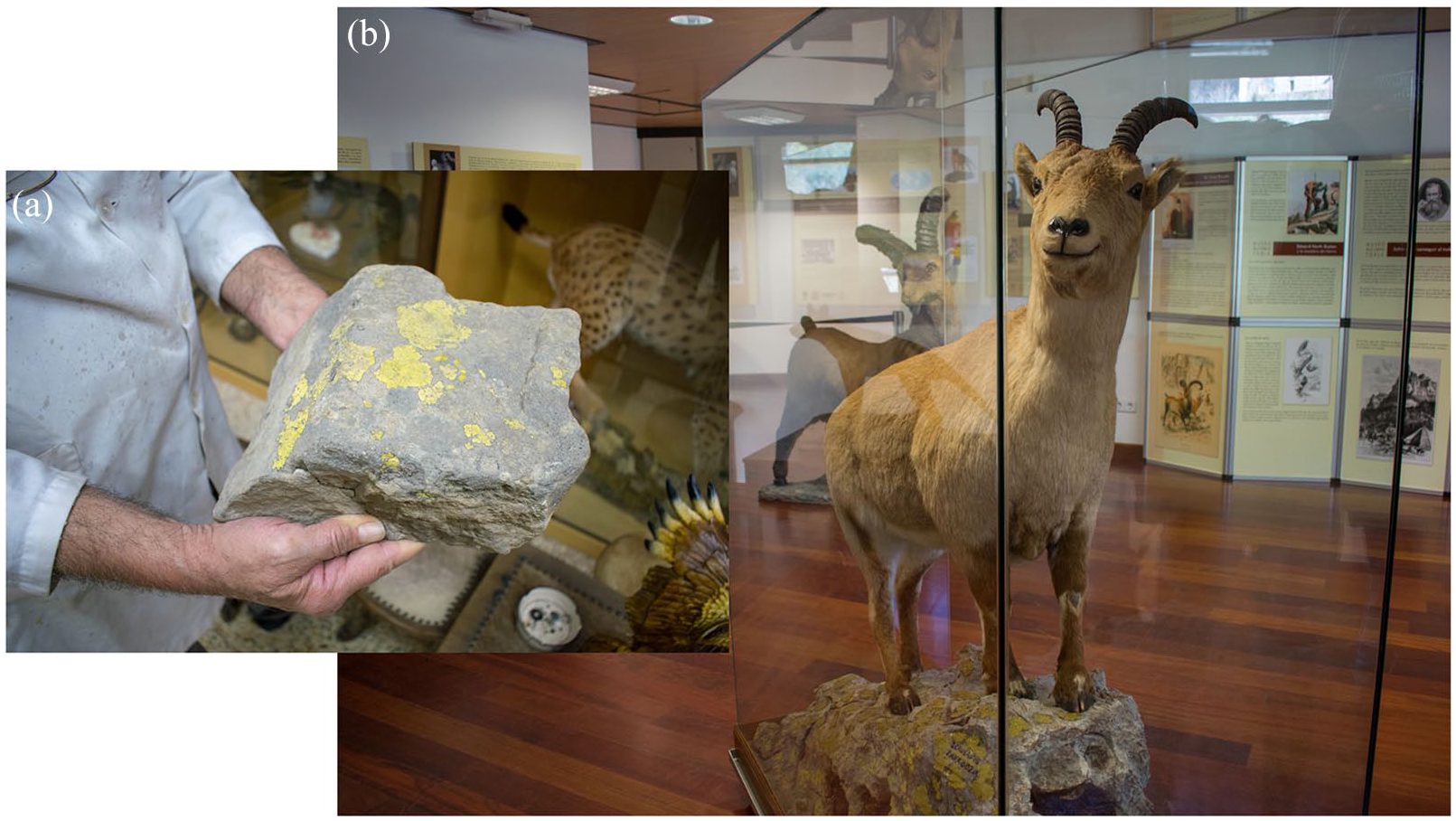
(a) The taxidermist’s reference rock from Ordesa and (b) the finished product in the Museo del Bucardo, Ordesa and Monte Perdido National Park. Photo by Adam Searle.
Spectral animals emerge as spectacular trophies. The material atemporalities evoked upon encounters with taxidermy are hauntings, a contradiction of anachrony within the spectacle of taxidermy, at once present and absent in the world. 96 Taxidermic practice may at first seem a despatialising and dehistoricising event, a production of spectacles removed from their worldly value. Yet hunters perceive this immortalisation of the hunt as a means of eternalising the spectacular – the spectral – as evidence of a particular truth, akin to practices of contemporary wildlife photography. 97 Just as the trophy animal served as a spectacularising of spectral encounters for hunters – an evidence of intellect, skill and a ‘dominance’ over the mountain – photographs of the bucardo reflect the relative impossibility of these encounters: an outcome of a complex assembly of technical knowledge and skill, 98 which Berger says ‘combine to produce pictures which carry with them numerous indications of their normal invisibility. The images exist thanks only to the existence of a technical clairvoyance’. 99 Susan Sontag talks of ‘the camera as a sublimation of the gun’. 100 She adds that ‘guns have metamorphosed into cameras in this earnest comedy, the ecology safari, because nature has ceased to be what it always had been’. 101 As the spectacle of the trophy was evidence of a particular truth claim – to have encountered and therefore outsmarted the spectral animal – so too was that of the photograph.
Geographer Elisabeth Roberts has shown how visual images themselves can be read through the lens of haunting. Photographs in this sense are not completely dead or alive, rather, these ‘visual images are ‘lively’, meditating, creating and transforming reality’.
102
The bucardo’s ghosts haunt, and are haunted by, the circulation of imagery. There are very few photographs of the bucardo in Ordesa. The most famous of these were taken by French wildlife photographer Bernard Clos between 1978 and 1982, perhaps the most reproduced being that shown in Figure 5. Raphaël, an ecologist in the French Pyrenees, described the first time he saw this photo to me as ‘like an apparition.’ Bernard Clos, writing about this photograph in the magazine Pyrénées, notes that the bucardo had long been perceived by many as a mysterious, almost mythical, animal; today only few mountaineers have the opportunity to see the astonishing and curiously ornate silhouettes of the few individuals still existing in our Pyrenees. Intrigued by this mysterious animal, I almost doubted its existence. . . the encounter [rencontre] of a bucardo, especially an old male, is a rare and moving event. . . With a leap he’s away, jostling the bushes, without panic, without turning around, to disappear definitively into the heart of the forest, leaving you dumbfounded [médusé].
103
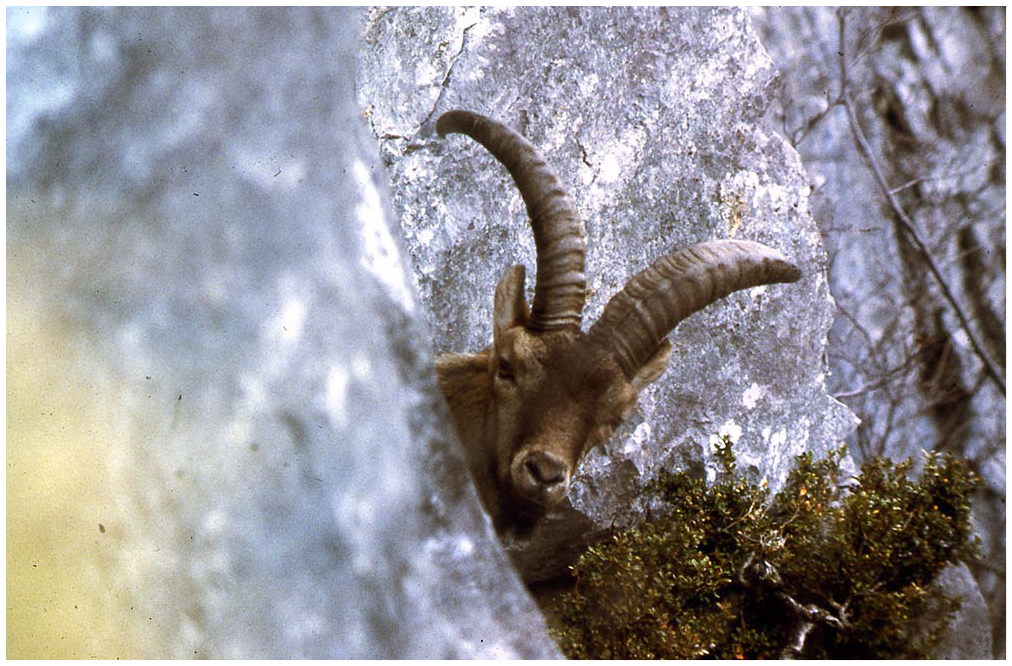
The famous bucardo male as photographed by Bernard Clos in 1981. Reproduced courtesy of Parc national des Pyrénées [© B. Clos- Parc national des Pyrénées].
When speaking to David in Ordesa about this photograph, he explained that the photo was just one of three taken in quick succession, and that this was the only image which showed the animal’s face: ‘This is how rare the encounters were. Just like that, it was gone’. Clos’s romantic image of the ephemeral encounter described here encapsulates what shooting bucardo aimed to do, capture this affect and allow it to affect for itself, to leave its own impressions on the imaginations and bodies of others further afield.
Conclusion
The multifaceted stories entwined in the bucardo’s history offer new insights on how we make sense of nonhuman ghosts, the ghosts of extinction and hunting as an interplay of spectrality and spectacle. The cultural imaginary of the bucardo was that embroidered with spectrality, an absence within which to speculate, as the animal was understood for many generations as a ghost. Spectacles, the sociocultural formations in which imagery takes precedence in lieu of material impressions, are a means through which spectres may be experienced. This begins with the hunt, not necessarily in the literal sense developed through this paper, but with a desire which brings certain worlds into being; or, in Derridean terms, the attribution of an artificial body in the process of mourning.
The bucardo’s extinction was brought about by the cultural value sets surrounding the spectacular of the spectral. Throughout this paper I have taken Debord’s advice of speaking in the language of the spectacular in order to understand it, the spectacle of the trophy itself, one which is removed from the vital and material wildness to which it claims to represent. Despite the visual storytelling fabricated through taxidermic practice, the references to landscape are founded upon a further detachment from material realities, one which perpetuates the decline of the emblematic animal desired. This was the nature of trophy hunting before the development of photographic technologies, the shot of the gun attempting to preserve a moment eternally. But just as the shot of the camera intends, this reality which it is attempting to represent is one further lost through this abstraction. However, the shot of the hunter carries a much graver ethical consequence, especially when it is seeking to materialise a moment of spectrality.
The bucardo spoke for, and continues to speak for, a broad set of sentiments towards the Pyrenees as emblematic and endemic – its spectres are marked throughout the mountains, its markings have left their traces, and its continued working through its affective and embodied presence. After its extinction, relationships with the bucardo continue to flourish in the ways its absence is marked in the landscape, the means in which it is commemorated and through the legacy of the Ordesa and Monte Perdido National Park. Understanding spectres through the theoretical lens of spectacle, and vice-versa, is a theoretically rich arena within which one can explore the cultural significances of wildlife in an era of mass extinction largely defined by losses. To learn to speak to spectres, and allow them to speak, requires specific attention to mourning, the performance of ontologising remains in geographical and historical contexts; the marking through which spectacles are encountered; and the working of spectrality with an openness to the affects of play.
More and more species are driven to extinction by anthropogenic means each year. The attribution of value to the spectral carries political and ecological consequences, the encounters of which are hunted; historically through the gun, later through the camera, yet always desired as a fleeting moment within which to base the subsequent truth claim to have been there and seen them. Taxidermic practices, prior to the development of photographic technologies, served to many as a means of producing material truths of spectacular natures – a claim of it happened. Notably, these actions were built upon the values of spectral animals as rare and desired products of their speculation, further removed by spectacle from material concerns of extinction, exploitation and endings.
The typology offered here, it is hoped, can be deployed and developed in a range of broader contexts of spectral encounter. Cultural geographers interested in the interplay of presence and absence may consider the role of the spectacular – the production of a particular material reality – in understanding the prominence ghosts have in our more-than-human worlds. Using the bucardo’s story, geographers can develop understandings of the hunt’s spectacle, spectrality on the edge of extinction and the cultural value systems which produce the trophy animal. Taxidermic trophies were particular forms of truth claims regarding the animal encounter prior to the development of the camera, evidence of ‘it happened’ akin to the 19th century objectivism, that which sought to materialise and speculate upon the encounter with a spectral animal.
Footnotes
Acknowledgements
I would like to thank all the people in the Pyrenees who opened up to me about their relationships with the bucardo. Roberto Portela Miguez (Natural History Museum, London) and Delphine Pelletier (Photothèque, Parc National des Pyrénées) granted me access to photographs of the bucardo through time. Thank you to Bill Adams and Jonny Turnbull for countless hours of conversation on ghosts and hunting. Bill, Jonny, and Eva Giraud all provided extensive feedback on earlier versions of this manuscript. The insight of anonymous referees was incredibly useful in clarifying this paper’s contributions. I am also very grateful to John Wylie for editorial guidance and for providing feedback on some of this material which was presented at the 2019 RGS-IBG conference. Any errors remain my own.
Funding
The author received no financial support for the research, authorship, and/or publication of this article.
