




Abstract
This paper outlines the practice of a novel digital method in animal geographies: etho-ethnographic citizen science. I describe a project using this participatory method with local residents in inner-city London, where we worked together to use camera traps to record video footage of red fox behaviour. The research sought to build an etho-ethnographic account of fox life by tethering data collection and interpretation to local knowledge. The paper focuses on the familial relations of one particular fox, a young male living on an allotment, who plotholders call Sonny. It begins by outlining how research objectives emerged through the process of collaborative research design with plotholders, premised on their own knowledge of fox personalities, and their storied accounts of individual foxes. It then considers how the practical planning of camera placement was directed through the plotholders own socioecological knowledge of the site. Lastly, it outlines how participants continual use of the traps, and their own analysis of footage, embeds digital data within vernacular understandings of Sonny’s world. In doing so the paper outlines how etho-ethnographic citizen science can potentially amplify, affirm and digitise vernacular knowledges of urban fox ethologies and geographies.
Keywords
Introduction
Waltham Forest, London, 2022: My phone alerts me to a video sent by a research participant. Its caption reads: ‘Interesting behaviour on plot 2 last night!’. The 20 second video was taken on a camera trap we had set up to record fox behaviour. It shows two foxes we both know. A nearly 1 year old male from last year’s litter trails an older fox, a 3-year-old female from the same family group. He pushes his nose up towards her snout, signalling he wants her to regurgitate food. The female, who has helped her mother raise this cub, does not comply. Instead, she stops and slowly grooms him, nibbling at the hair behind his ear, which seems to calm his restless demeanour.
The above digital encounter resulted from a novel method in animal geographies: etho-ethnographic citizen science (EECS). I developed the method as part of an ongoing research project aiming to understand how red foxes and people co-determine the material, sociocultural and political character of urban space. The ongoing project, which began in late 2021, is based in the urban gardens and terraced streets of inner-city East London. Central to the EECS approach is understanding animals’ own geographies – to describe urban habitation through the lifeworlds and practices of foxes themselves, and to document urban resident’s own localised, personal knowledges of these animals.
The research deploys digital technologies in an effort to move beyond collective or aggregated categories of animals that obscure non-human difference, and instead focus on individual animals as research subjects. 1 This has meant building personal, in-depth portraits of just four fox groups, the neighbourhoods they live in, and the people they live alongside. This short in-practice paper focuses on one of these fox families, whose territory centres on an allotment (a communally managed food garden) in Waltham Forest, London. Over several years, a small group of allotment plotholders have interacted with, fed and come to know this fox family intimately. Here, I focus on a fox these plotholders have named Sonny, a non-breeding adult male. Like other fox groups in resource-rich urban areas Sonny’s family is large, comprising of the dominant breeding pair and six subordinate adults. The EECS approach signals a novel direction for the practice of more-than-human geographies, a means by which we can further cultural geographical understandings of animal life with digital technology and ethnographic immersion. This also advances the nascent field of digital ecologies by underlining the potential of applied methods (Figure 1).
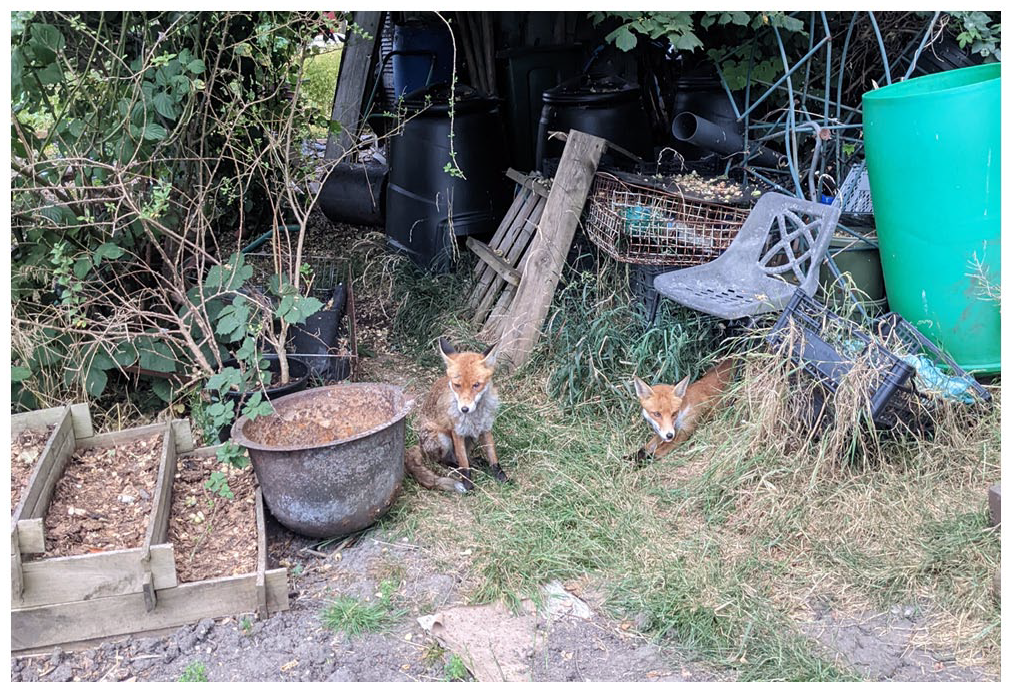
Sonny on the right, and his father on the left. Photograph by author.
An etho-ethnographic citizen science
Our EECS approach uses camera traps, a common method used in ecology and behavioural science, to record video footage of fox behaviour. Although social scientists are beginning to analyse the use of camera traps in wildlife management and research, 2 they have not been adopted as a method in the social scientific study of animals. 3 The impetus behind EECS has been to re-envision and combine a conventional digital technology with a citizen science approach to form a collaborative ethnographic tool. Camera traps are primarily used to determine population characteristics, while citizen science in wildlife research is often also aimed at gathering population-level data, with participants supplying conservation institutions with wildlife sightings. These projects have been critiqued for being top-down, extractive models of knowledge production, where the role of participants is often restricted to generating quantitative data points for large data sets, tailored to the aims, interests and knowledge paradigms of state, market and NGO institutions. 4 EECS instead pursues a participatory and collaborative recording of socioecological data, whereby urban fox life is uncovered through working with local people. 5 Drawing on and adapting the work of Whatmore and Hinchliffe, the aim is to develop an ethnographic account of human-animal relations that emerges through ‘vernacular ethologies’, the ‘ecological knowledges and attachments of city residents honed through practical engagements with the landscapes they inhabit’ (Figure 2). 6
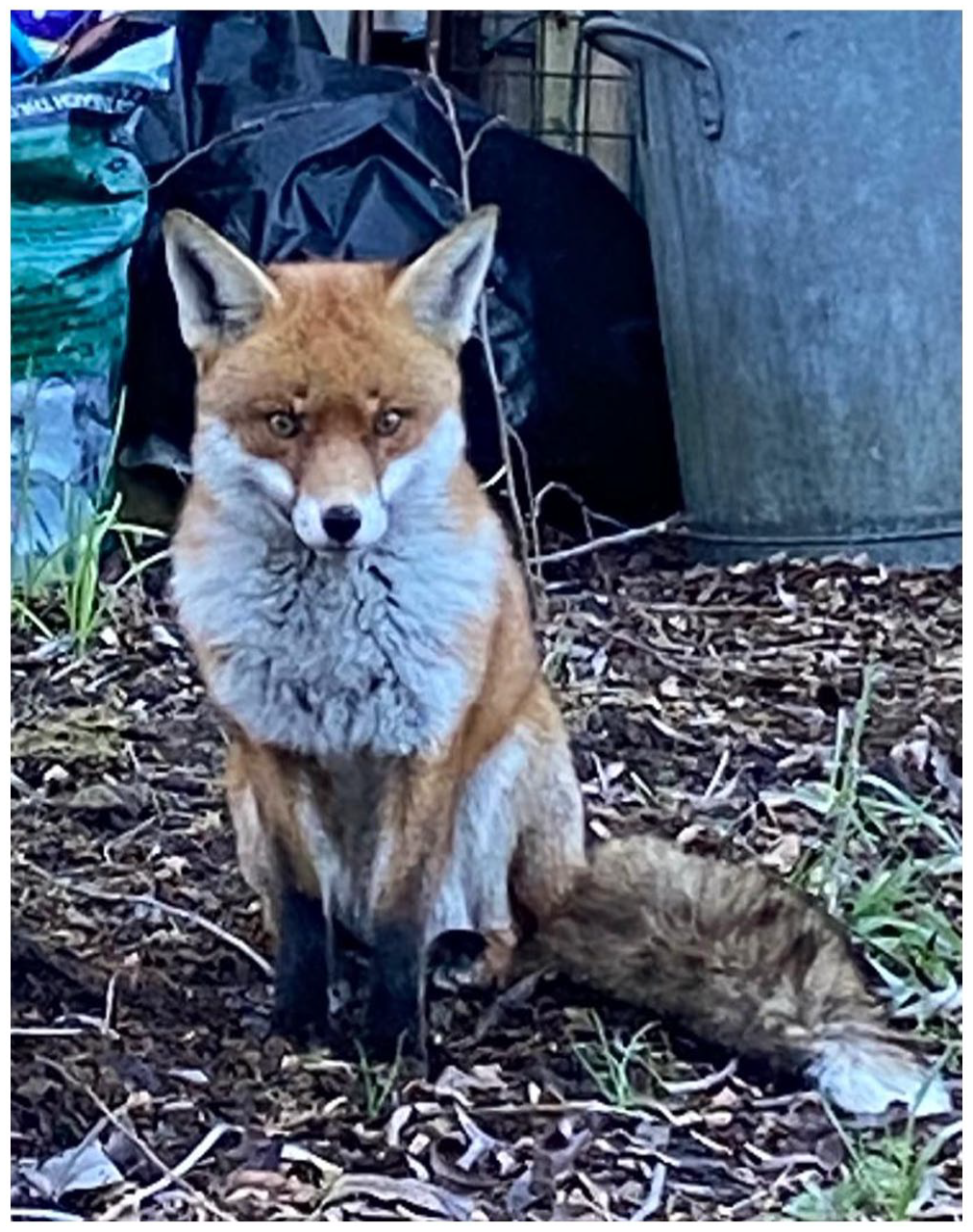
Sonny on the allotment. Photo by allotment plotholder.
Fox difference as a research objective
In late 2021, the allotment project began with developing and refining research objectives in collaboration with the plotholders who had been feeding Sonny’s family. This meant listening and participating. Collaboration developed as participants began to share their worlds: detailing the lives of each local fox, allowing me to accompany them as they fed them, sharing their histories of co-habitation and more. What emerged was a rich and storied account of individuality and personality amongst this fox family. Although there has been extensive ecological research on urban foxes, 7 this species has had little treatment by researchers studying animal personality, and our knowledge of individual behavioural variation and its relationship with fox sociality is very limited. Conversely, within the stories and routinised practices of the plotholders, who interact with these animals every day, and have known each of them most of their lives, these foxes are known as distinct characters who display marked variation in their behaviour. To describe a quotidian example: as a plotholder walked down an allotment path to the specific spot where they fed the foxes everyday, one fox would agitatedly circle their legs and excitedly try and push their muzzle into their pockets, whilst another similarly bold but altogether calmer fox would keep pace but slowly, patiently ambling by their side. The individuality described and experienced by the plotholders did not simply reflect the social categories used in most representations of fox sociality: dominant male and female, subordinate and henceforth. Instead, the foxes were understood as distinct individuals, fully formed subjects with their own intentions and habits: from one fox who routinely climbed a plum tree to take fruit, to the pair of brothers unseen in the allotment until late at night, each fox’s behaviour had their own distinguishing qualities and inflections.
This understanding and appreciation of fox difference formed the cornerstone of one of the project’s aims: to understand how different foxes behaved at the breeding den. As much as the participants knew about these foxes, they had never been able to observe them at the den site, and so the camera traps provided an opportunity to deepen their own understanding. We had established that Sonny was a particularly bold fox around humans, often very active in the daytime, and unlike other subordinates was strongly bonded to the breeding pair. But we had no understanding of his role with respect to the rearing of cubs. Over long conversations perched on the benches of the allotment’s communal area, what emerged was a shared desire to better understand the role played by each fox in the raising of a family.
Placing cameras and knowing foxes
The plotholders understanding of the complex array of individual fox characteristics became particularly evident in the process of choosing where to place camera traps. They divulged this knowledge as they explained the spatio-temporal use of the allotment by each fox. ‘I’ve never seen her up there’, one participant shared, ‘she’ll come out behind those bushes so let’s put it there’. 8 Locating the den was dependent on this local knowledge. And so, we situated a camera trap behind a line of sheds that backed onto the allotment barrier, where there was a long strip of disused space.
In 2022, we were able to place traps directly by the birthing den for the entire duration of its use by the family (6 months). In doing so we captured dynamics of fox life that were not detectable through direct observation, producing results that were unexpected and novel. Most significantly, we recorded evidence of Sonny playing with and bringing food to the cubs, a behaviour no other subordinate male exhibited. This was meaningful because while alloparenting (the care of cubs by animals other than the parents) is often provided by subordinate females, this behaviour has rarely been documented by subordinate males, and does not correspond with the dominant presentation of intra-group fox sociality (Figures 3 and 4). 9
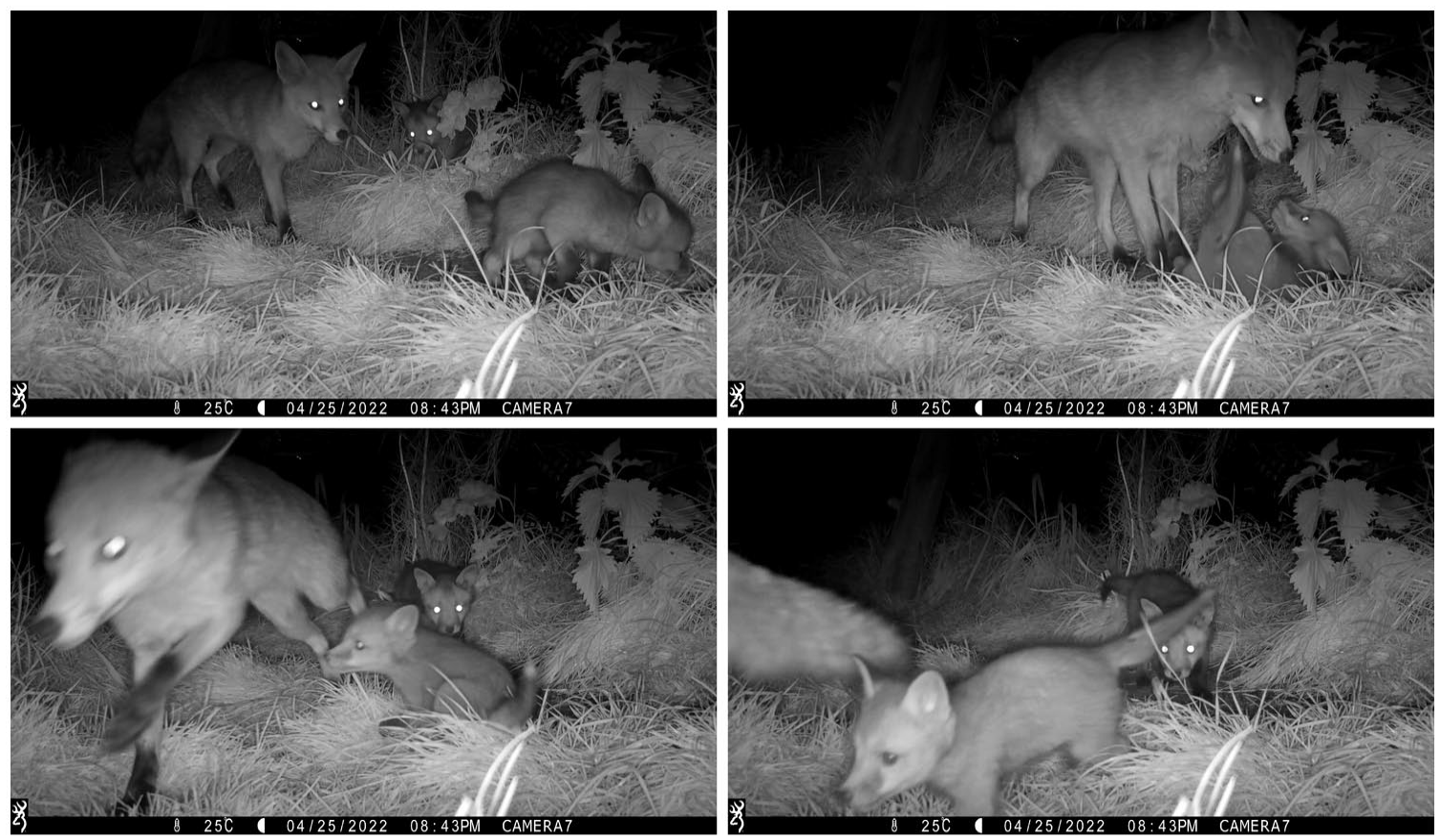
Sonny playing with cubs outside the den.
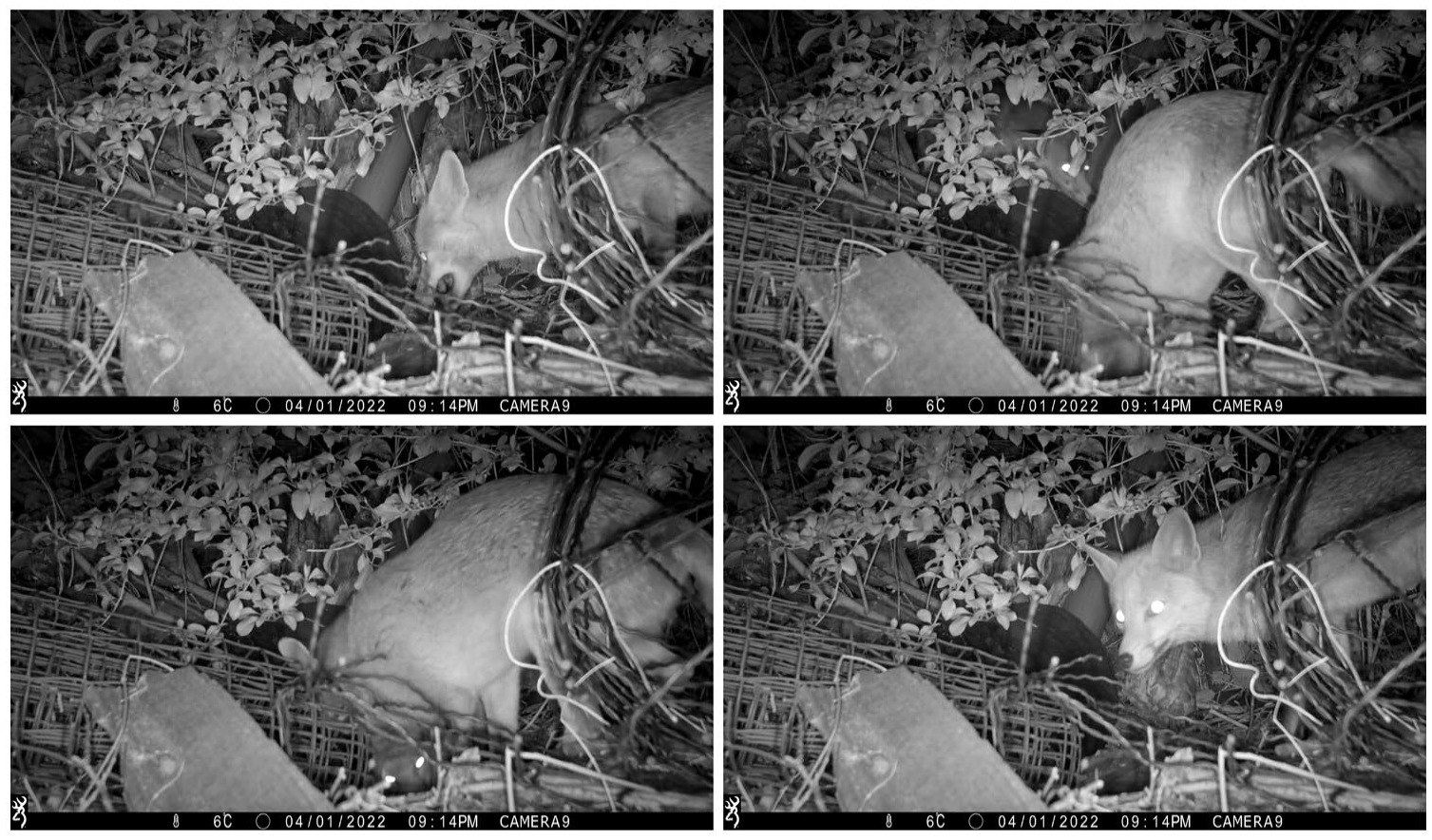
Sonny bringing food to the den entrance, which his sister takes into the den.
For ecologists, Sonny’s alloparental care could be characterised as reflecting the fitness benefits of group living amongst a socially adaptable canid. For the participants, Sonny’s care was unremarkable. It reflected Sonny’s personality: a particularly social fox, very close to the breeding pair, and with strong social bonds with the wider group. Within their world of co-habitation, alloparental care by Sonny was consistent with his character and his relations with others. The participatory and collaborative research design, and the use of camera traps, allowed for an understanding of a novel behaviour rooted in vernacular ethologies of co-habitation.
Digitised vernacular knowledge
We did not envision how retrieving and analysing footage would become part of the daily practices of co-habitation for participants. The camera traps produced copious amounts of digital material, and participants shared this with me for further analysis, which included using more formal ethological tools like an ethogram. At the same time, plotholders themselves would watch the footage everyday on the display screen, and this practice became embedded into their daily interaction with the foxes. Their own reporting back on this material became an improvised but eventually core part of the methodology. Even in the winter, when the research on the site paused, they continued to use the cameras daily. This digital mediation of wildlife encounter has exceeded its original research-oriented aim, and instead become a more grounded, everyday form of knowing the non-human.
As the project continues it is becoming clearer that the digitally captured behaviours, like those observed by the participants in situ, are being weaved into the ways in which they story and conceive of these animals. Aware of the criticism of digital and citizen science wildlife projects as extractive, our EECS approach has sought to establish a careful, sensitive centring of localised modes of understanding wildlife. The aim here has been to ensure that digital data does not occlude or erase the place-based specificities of human-animal relations. In the case of Sonny, it seems that the digitised footage, even when capturing unforeseen behaviours, appeared to complement or augment the way local people understood him. This points towards a use of camera traps that is not extractive and does not excise or appropriate local knowledge; rather this offers cultural geographers (and others) a means of tethering digital methods to vernacular practices of co-habitation, and so affirms and amplifies localised ways of knowing animal life.
Footnotes
Acknowledgements
The author is deeply thankful to research participants for their ongoing enthusiasm and generosity in sharing with me their worlds, and those of the foxes. Thanks to the Digital Ecologies collective for their encouragement and input with the paper, and for the invitation to the Digital Ecologies in Practice conference in July 2022. Thanks also go to Maan Barua for all his support and guidance with the wider project.
Funding
The author disclosed receipt of the following financial support for the research, authorship, and/or publication of this article: The research is funded by the European Research Council, as part of the project ‘Urban Ecologies: governing non-human life in global cities’ (grant no. 759239).
