




Abstract
This paper explores the relationships between humans and more-than-humans through the analysis of the rhythmic elements of the contemporary art installation Ajuar para un conquistador. An interdisciplinary approach bridges Art Studies and More-Than-Human Geographies to examine Ajuar and its environmental concerns, including the relationships between human and non-human worlds. Through ‘rhuthmanalysis’ – a new concept and word developed in the paper – textual and image analysis, and conversations with the artist, this study examines the social, cultural, and ecological meshwork of rhythms articulated within and by the art installation. ‘Rhuthmanalysis’ expands upon Henri Lefebvre and Catherine Régulier’s rhythmanalytic project by incorporating Indigenous knowledge and an ecocritical standpoint while redefining the understanding of rhythm. The analysis explores how Ajuar, concerned with the endangerment of Patagonian birds, promotes a performative understanding of the artwork’s capacities in the context of the interplay between the affective dimensions and politics of the creation of the Argentine nation-state. The paper argues that Ajuar participates in the social and political production of space and place, opening new forms of being together and challenging colonial narratives through a rhythmic lens. Moreover, this study seeks to offer a singular perspective on how approaching art as a rhythmic configuration of an intricate choreography of coexistence can provide unique insights into space and the environment. The paper concludes that ‘rhuthmanalysis’ is a privileged tool to address the need for a transdisciplinary methodology capable of giving account of the mutual unfolding of human and non-human existences and decolonising posthumanist geographies and rhythm studies.
Keywords
Introduction
More-than-human geographies (MTHG) delve into the complex interactions between human and non-human entities, aiming to go beyond the traditional divide between culture and nature while challenging anthropocentric viewpoints. 1 Drawing on various approaches, including posthumanist feminism, new materialism, and nonrepresentational theory, MTHG embrace the potential for transformation inherent in reevaluating the agency of non-human elements, the dynamic qualities of ‘matter’ and their capacity to affect and be affected. 2 In line with the growing emphasis on relational and material perspectives in the human and social sciences, MTHG understand the emergence of vitality in the world as a result of doing, interconnectedness, and exchanges among different agents within specific temporal and spatial contexts. 3 MTHG disrupt conventional notions of representation by acknowledging the intersubjective connections, entanglements, and interdependencies among different modes of existence. Consequently, not only humans but also non-humans, ‘inanimate’ matter, and ‘inert’ objects are seen as ‘performing’ together, shaping the worlds they purportedly represent. The world is redefined as a ‘more-than-human’ and ‘more-than-representational’ domain. 4
Art plays a pivotal role in the exploration of the existential spatialities of various entities, having the capacity to immerse researchers in experiences of more-than-human worlds by creating opportunities for immersion and expression within shared environments. It serves as a means to unveil and create new spatial dimensions in which creative encounters unfold. 5 While previous studies have explored methodologies at the intersections of MTHG and art, 6 as well as the interplay between rhythm and more-than-human explorations, 7 one particular aspect remains under-examined: the rhythmic element. This paper aims to contribute to bridging more-than-human explorations and art through a rhythmic lens. By focusing on rhythm as a privileged scope and a ‘connective conceptual modality’, 8 I argue that rhythm can uniquely bridge interdisciplinary gaps, contribute to rethinking relationships between various entities, and draw political, ethical, and social consequences.
I explore these themes through a close examination of the art installation Ajuar para un conquistador 9 [Trousseau for a Conqueror] by Argentine artist Mónica Giron (1993). I demonstrate how artwork and artistic practices can both reflect and reshape the complex entanglement of human and non-human worlds. Ajuar comprises Merino wool textile pieces adorned with buttons, including sweaters, scarves, and socks, tailored for endangered birds native to Patagonia. This series encompasses over 30 pieces knitted using the two-needle technique, following illustrations from Claes Olrog's book Las Aves Argentinas. Una Guía de Campo [Argentine Birds. A Field Guide]. 10 Three pieces from this series were featured in the Crear Mundos exhibition at the Proa Foundation in Buenos Aires between 2020 and 2021: clothes for a Condor, Green-backed Firecrown Hummingbird and Patagonian Owl (see Figure 1). The dimensions and colours of these pieces closely mirror the depiction of birds in Olrog's book. This specific configuration forms the focal point of this investigation.
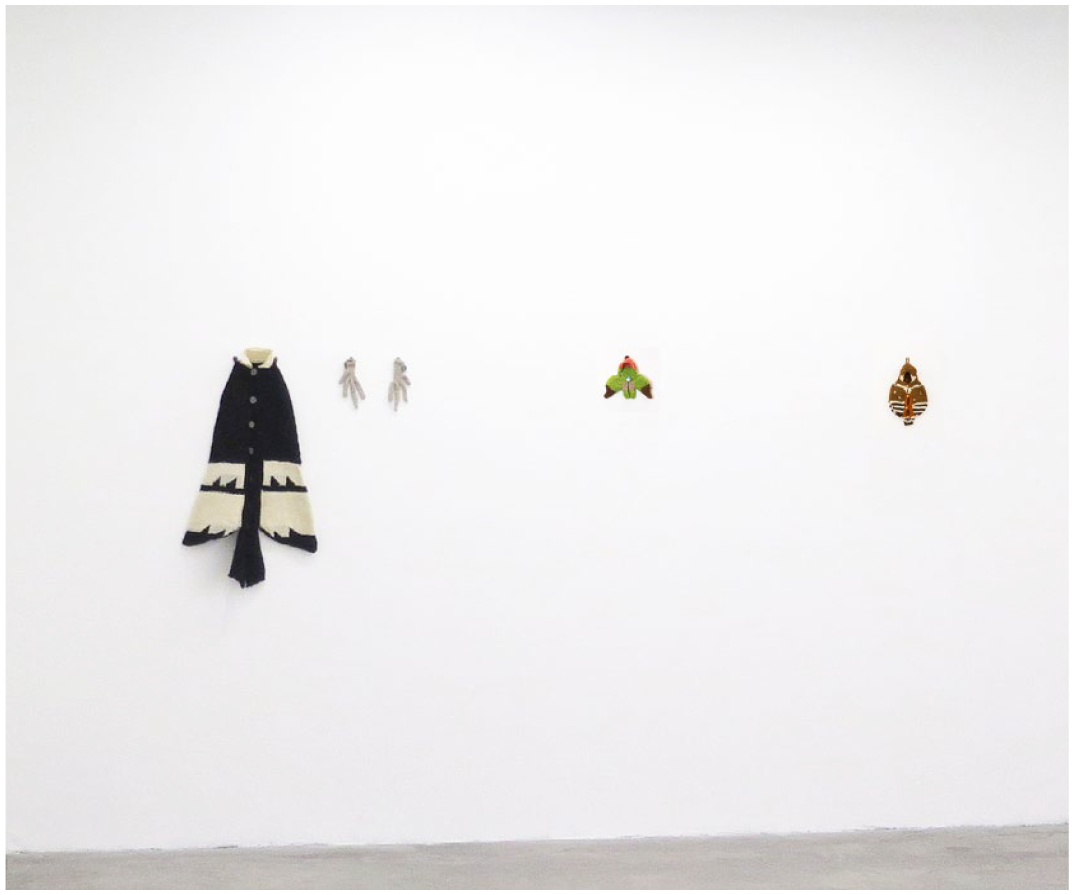
Ajuar para un conquistador. Pullover and socks for Condor, Green-backed Firecrown Hummingbird, and Patagonian Owl. Photo by Bruno Dubner, Crear Mundos exhibition. Courtesy of Mónica Giron.
Methodologically, this study combines textual and visual analysis, correspondence with the artist, and ‘rhuthmanalysis’ – a new concept I coined previously and that I expand on in this paper – as the primary tools to approach the socio-cultural and ecological meshwork of rhythms articulated in and by Giron’s art. The dialogue with the artist played a significant role in unpacking both her creative processes and personal narratives, encompassing the period of the artwork’s creation, her relationship with her mother, and the intimate experiences that marked the artwork. My embodied and typological studies through ‘rhuthmanalysis’ were supplemented by an examination of the exhibition catalogue and the promotional video of the exhibition, that served as troves of additional context, images, and text, enhancing my understanding of the artwork. 11 ‘Rhuthmanalysis’ is not only a means for understanding how Ajuar figures and reconfigures human and more-than-human relationships, but also a decolonial tool that, by integrating Indigenous knowledge, challenges Western-centric accounts of the world. Figuration is here understood as the emission and interpretation of signs whose meaning requires going beyond the individual and specific dimensions to focus on interspecies relations and material enmeshments, which involves considering how meanings and stories are embedded in material forms. Additionally, by concentrating on a particular geographic region defined by socio-political tensions (e.g. territorial disputes), this paper adopts a case study-based approach that improves empirical knowledge within MTHG. It will not only extend the scholarly discussion in the field but also, as I aim to demonstrate, introduce new possibilities for forthcoming research, affirming the inherent potential of the rhythmic exploration of MTHG.
I begin by presenting the ‘rhuthmanalysis’ methodology and its two-phase implementation at the intersection of art studies and more-than-human geographies. Following this introduction to the methodology, I restitute the analysis of the rhythms of the Ajuar installation, which is structured into three sections. In the first section, I delve into the parallel the artist draws between her own body and the Patagonian region, exploring the concept of a ‘vacant body’. This sensation is evoked through the absence of the birds for which the garments were knitted and is related to the artist's personal experience of her mother’s coma and subsequent passing. I also delve into the mother–daughter relationship, their shared knitting experiences, and their significance within Ajuar while considering the idea of the ‘trousseau’ in relation to feminist art movements. Additionally, the section discusses the affective and sensory experiences linked to the texture of wool. The second section shifts the focus to the ‘vacant body’ sensation in the context of ‘Patagonia's body’, often portrayed as a desert devoid of life – Indigenous and non-human lives. This portrayal serves to pave the way for the state and corporate control of the region. I analyse how Ajuar complicates the colonial narratives and processes associated with the ‘Conquest of the Desert’ by the Argentine nation-state, the establishment of San Carlos de Bariloche, and the creation of the Dr. Francisco P. Moreno Patagonia Museum. 12 The final section focuses on the materials used in Ajuar – Merino sheep wool and buttons – and their socio-political and ecological meshwork. It deals with the intricate histories and performative narratives shaped and reshaped by these materials, tracing their entwined flows and movements within the Patagonian economy, colonial history, and ecological concerns. Furthermore, I discuss the ecological impact of sheep farming on other species and habitats, foregrounding the ongoing struggle of Indigenous communities for territorial rights. The paper concludes that Ajuar participates in the social and political production of space and place, opening new forms of being together, challenging colonial narratives, and creating alternative spatialities and senses of place through a rhythmic lens.
Exploring the ‘rhuthmanalysis’ methodology at the intersection between art studies and more-than-human geographies
The first level concerns ‘rhuthmanalysis’’ challenge of the colonial Eurocentric vision that characterises the context of emergence of Lefebvre and Régulier’s proposal by expanding the analysis to different conceptions of the cosmos and taking into consideration Indigenous lives, histories, and knowledge systems. The second level refers to the ecocritical role of the methodology. Although there is no escape from the human-situated point of view (at least for now), ‘rhuthmanalysis’ fosters an analysis that attunes to the more-than-human rhythms, and ‘points of life’, 15 which implies a strong creative dimension and, once more, connects the methodology to the arts. The third level concerns the definition of the rhythm underlying the analysis. ‘Rhuthmanalysis’ incorporates but also goes beyond the understanding of rhythm as a repetition, alternation of strong and weak elements or organisation of elements in time. Drawing from Benveniste’s work, ‘rhuthmanalysis’ proposes a return to a pre-Platonic conception of rhythm as rhuthmos. 16 This notion refers to a momentary configuration of what flows, or the form in the instant that it is assumed by what is moving, mobile, fluid, in the particular moment and movement with which it takes that form. Thus, Ajuar is here understood as a momentary form of a constant set of becomings and a figuration of the enmeshment of human and more-than-human worlds. Being impersonal and transversal to all existences and acknowledging that the elements of a relationship are dynamic and mutually constitutive, I suggest that a rhythmic approach is in order. Rhuthmos is thus presented as a privileged scope to rethink the relationship between different entities and derive political, ethical, and social implications from it.
‘Rhuthmanalysis’ is developed in two main phases: (1) experimental and art-based and (2) rhuthm-analytical. The first phase comprises an initial embodied non-instrumental approach to Ajuar’s rhythms. I visited and personally engaged with the exhibition, immersing myself in the rhythms of Ajuar and following the avenues opened by them. This approach required the adoption of a determined regime of attention which is multisensory and multispecific. In addition, my experience of the artwork included a hands-on engagement. Prior studies highlight that both the analysis and the restitution of ‘rhuthmanalysis’ experiences align closely with artistic and literary disciplines and practices, being particularly effective in methodologically developing and presenting the analyses. 17 Mirroring Giron’s approach, I tried my hand at drawing the condor and the clothes from the exhibition Crear Mundos following the very book that Giron used as a model to knit the bird vests. This recreation fostered an intimate, sensorial connection with the artwork, enabling me to explore the intricacies of its form, texture, and the processes behind its creation. This tactile understanding was complemented by an immersive literary exploration of the subject. Reading poetry about birds helped establish an additional layer of engagement. This provided additional insights into the nuanced rhythms and relationships within the artwork, weaving intellectual, emotional, and tactile responses together to gain a more complex perspective on the artwork.
The second phase consisted of searching for an underlying order of rhythms experienced in the first phase, as suggested by Lefebvre and Régulier, resourcing on an alternative typological analysis that I have been developing. 18 While I make use of this typology, it is crucial to clarify that it functions mainly as a reference point, guiding rather than defining my approach. In the framework of ‘rhuthmanalysis’, rhythms are often overlapping and interconnected, intricately woven together in a complex meshwork of relations. This typology offers a structure that assists in navigating this complexity, but should not be seen as rigid categories. The typology provides a framework of understanding, acting as a scaffold that can support a more complex study. However, my analysis acknowledges and embraces the fluid quality of these rhythms and is prepared to move beyond the typology when the interconnected reality of rhythms demands it. This balance ensures that the analysis is both structured and flexible, enabling a precise and enhanced comprehension of the dynamic rhythmic reality of the artwork. The proposed typology considers, among others: bio-rhythms (rhythms of organic, vegetal, animal, human, fungi, and bacteria matters), cosmo-rhythms (cyclical, ancestral, dialogues with Indigenous knowledge), socio-rhythms (cultural, historical, and political context), geo-rhythms (inorganic and inhuman forces and materialities), affect-rhythms (multisensorial, haptic, and somatic dimensions) and techno-rhythms (formal elements and technical dimension). 19
Following, I restitute these two phases of the analysis of Ajuar’s rhythms. The restitution of the analysis holds great significance and is equivalent to the development of the methodology itself. Further, given that ‘rhuthmanalysis’ acknowledges and accepts the inherent inability to fully capture all rhythms, a fragmentary quality pervades this restitution.
Restituting the ‘Rhuthmanalysis’ of Ajuar para un conquistador
Empty nests and knitted vests. Ajuar bird clothes as affect and gendered artefacts
As the exhibition Crear Mundos is entered, at Proa Foundation, a first white room titled Materialidades [Materialities] displays 10 artworks by female artists that were previously shown in Proa. One of those on the right wall was Ajuar. The title of the exhibition, as well as the name of each room and its explanation, immediately set the tone and invite us to think about what matters are used to think other matters with, and what worlds make worlds and stories, as the curator proposes, following Donna Haraway. 20 When encountering the Ajuar installation, we may experience the sensation of a vacant body. The bird garments displayed on the wall of the Proa Foundation emphasise the lack of actual birds despite being crafted ‘in their image and likeness’, as per the artist's words. 21 These clothes do not contain a physical body to which they conform, unlike mannequins or sculptures that provide them with shape. Instead, they adhere to the pull of gravity, angling downward towards something that yields rather than resists. This absence becomes evident; emptied of bodily existence, only the ‘wrappings as remains of an unfathomable looting’ persist. 22 Giron explains that she drew a parallel between her body and the body of Patagonia, stating that the region’s imagery allowed her to evoke a clear sensation of an ‘empty body’ due to the area’s nature or the Western imaginary projected onto it. 23 The interrelation between bodies and territories is fundamental in Latin American feminist and Indigenous movements and can be articulated through the concept of cuerpo-territorio [body-territory]. 24 This notion emphasises the inherent interconnectedness between individuals and their collective body, as well as the inseparability of the body from the territory. For the Mapuche activist and writer Moira Millán, the territory lives in the bodies of Mapuche women. Accordingly, violence against the bodies of Indigenous women is also terricide and vice-versa. 25
The installation’s title, ‘conqueror’, referring to the Spanish or Argentine nation-state, suggests a human emptying of the Patagonian territory. However, I see an expansion of the notion of emptiness to the more-than-human dimension of extermination. The artist’s meticulous preparation of clothing for various bird species draws attention to the real, imagined, or anticipated absence of Patagonian birds. By doing so, Ajuar prompts us to re-evaluate what it means to inhabit a territory from the perspective of non-exclusive human mediators. According to a private email conversation with Giron, the feeling of a ‘vacant body’ could also be connected to her mother’s 3-year coma and eventual passing. The artist’s relationship with her mother is at the core of Ajuar for two additional reasons. First, her mother knitted daily, which had a major influence on her, allowing the artist to learn how to knit. Second, the fact that the material was readily available and that the knitting gesture was accessible led Giron to create her first work using this material and technique. Furthermore, the book used by the artist as a model to knit was a gift from her mother. The ‘trousseau’ in the title may thus not only refer to a set of materials that accompanies the conqueror, but also to a set of fabrics accompanying a newlywed woman. The trousseau for the future wife is usually passed from mother to daughter, constituting ‘a long history’ between them, ‘a legacy of knowledge and secrets, of the body and of the heart’. 26 The trousseau, in this sense, materialises not only the legacy of the colonial settler context but also cultural associations between femininity and domesticity as well as the transmission of values and gestures of the feminine/feminised universe. The sphere of care (ajuar) and the sphere of extermination (conqueror) coexist in the same title, which may indicate different (and antagonistic) affects and gestures (care-violence), also pointing to the contamination that can exist between both spheres, such as violence in the sphere of intimacy.
In this sense, Giron’s textile art, initially associated with the sphere of domesticity, enters the art world, which places the work in line with the feminist artistic movements of the 1970s that challenged the borders and hierarchies traditionally drawn between crafts and fine arts, major and minor arts, and private and public spheres. 27 The women creators of textile art in the 1970s wondered ‘if with the thread used to baste, embroider and/or weave, situations can be symbolically mended’, seeking to ‘repair absences, human errors’. 28 In Giron’s case, the textile art of Ajuar seems to bring to the discussion human gestures that affect other humans, but also human domination over so-called nature. It is important to remember that the association of the feminine with nature, and therefore as a terrain of beauty to be dominated and tamed, is a historical construction. As numerous authors have stated, there is a strong relationship between gender oppression, the master’s logic of colonisation, and the exercise of objectification and control over the ‘natural world’. 29 In the same way, the Indigenous are placed on the side of savage and nature. The Indigenous, woman, nature: a triad summoned by Ajuar and articulated within it.
The choice of knitting clothes for birds has the advantage of creating ‘intimacy without proximity’, which constitutes a closeness and presence that does not disturb ‘the critters that animate the project’. 30 This practice does not require touching the birds, while it immediately summons touching through the texture of the materials as well as the knitting gesture itself. Giron highlighted the wool’s texture in private correspondence, noting that her mother acquired it from a local store near their residence in Bariloche. Upon relocating to Buenos Aires and wanting to keep knitting Ajuar pieces, Giron made efforts to find wool with a texture and tactile sensation comparable to the wool she had grown accustomed to while knitting with her mother during her childhood and adolescence.
After remaining a steadfast customer of a specific store for several years, Giron made a striking discovery: the store’s wool supplier was the same as the one that supplied her mother’s preferred shop in Bariloche all those years ago. With this revelation, we can speculate whether the affections and intimacies shared between mother and daughter, specifically their common art of knitting with this specific wool, have woven tactile and material memories into the fabric of the work of art. This suggests that the very texture, feel, and history of the wool not only shape the material dimension of Ajuar but also affect the sensory experiences of those experiencing the artwork. The Ajuar pieces appeal to a sense of tenderness in the observer, invited by the materials, colours, and size, and further amplified by the affective resonances suggested in our speculation. An example is the story of a collector who acquired some pieces from the series because she saw in them something related to childhood that generated deep affection. 31
The connection between baby clothes and bird clothes can be derived from the size, colours, and texture shared by Ajuar pieces and newborn clothes. This association is also implied in the installation title, since trousseau not only refers to a set of materials that accompanies the conqueror, but also refers to the clothes prepared for a newborn. Additionally, that relationship can result from the fact that both are considered delicate beings in need of protection and care. Although baby clothing can serve as a safeguard, the same cannot be said for birds wearing Ajuar clothing. The artist herself emphasises the dissonance of choosing clothes that are meant to protect and ultimately endanger the birds’ existence. Perhaps that is why this trousseau is ‘for a conqueror’, a resource that accompanies him in mastering the new territory, the consequences of which would be catastrophic for the fauna. I use the future tense because trousseau accompanies the transition from one sphere to another as something that comes. Nevertheless, this conqueror is not only a future but also a concrete past. ‘Dressing’ the colonised (therefore ‘civilising them’) is a repeated gesture and, in the extreme, leading to fatal consequences.
Throughout this section, particular attention was paid to socio-rhythms and affect-rhythms while exploring Ajuar through the lens of ‘rhuthmanalysis’. Delving into the complex weaves of these polyrhythms, Ajuar shows the entanglements of historical, geographical, and socio-political contexts, gender relations, and the human and more-than-human worlds. As this study transitions to the next section, rhythmic exploration will focus on geo-rhythms and their connections with cosmo-rhythms.
A museum in the desert and national identity as a mirage. The legacy of the colonial settler in Patagonia and of the museum in fictionalising the Argentine identity
As mentioned, Giron draws a parallel between her body and the body of Patagonia due to the area’s nature and the Western imaginary projected onto it. 32 This imaginary of the Patagonian territory has been characterised by the idea of a desert, yet it has also been marked by a promise of infinite abundance and happiness, thus emerging as an ideal destination for explorers, travellers, and scientific expeditions. The geographical imaginaries that marked the discourse on the Americas, including Patagonia, constituted a ‘technique of empire’ 33 for the European colonisation of the region. The creation and imposition of the imaginary of Patagonia as a ‘desert’ is the result of an effort to make the Indigenous peoples invisible, along with their cosmological relations with the land. What might seem like sites of non-life for Western worldviews are, for several Indigenous groups, places of great significance, home to diverse lives and complex interdependencies. The so-called desert is, in fact, a space-time where various worlds can come into contact, simultaneously physical, imaginary, spiritual, corporeal, and mineral. 34 To achieve the colonial programme and facilitate state and corporate occupation of the territories, it was necessary to transform the area into an ‘extractive zone’ 35 where resources could be commodified, extracted, and expropriated. This required a forceful and aggressive devaluation of the intricate connections between different worlds, which restructured the land, its inhabitants, and its flora and fauna to be used as ‘extractable data and natural resources for material and immaterial accumulation’. 36
The military campaign known as the ‘Conquest of the Desert’ is regarded as the apex of the European colonisation of America during the 19th century. 37 It was led by the Argentine Republic between 1878 and 1885, intending to obtain territorial control of the Pampa and eastern Patagonia, called Wall Mapu/Walljmapu, until then inhabited by the Pampa, Ranquel, Mapuche, and Tehuelche peoples. The city of San Carlos de Bariloche was established in 1902 through a decree issued by the Argentine state. This white colonist settlement is the birthplace of artist Mónica Giron. One of the instruments for the founding of the city – and of the Argentine nation-state itself – was the creation of the Patagonia Museum in 1940, integrated into an architectural complex called the Civic Centre, whose function was to favour population growth and integrate the region into the national economy, especially by promoting tourism. The Civic Centre, of which the museum was a key element, was considered an affirmation of state sovereignty, constituting a kind of ‘corporeal establishment’ of the state. 38 Under the Directorate of National Parks [Dirección de Parques Nacionales], since its foundation, the dimension of the ‘natural’ or ‘nature’ has been present in the implementation of the National State in Patagonia. The Patagonia Museum is a paradigmatic case of what some authors characterise as nationalist processes of the ethnicisation of identities, the invention of traditions and shared pasts, and the promotion of feelings of belonging to a territory. The creation of the museum constituted a ‘propaganda instrument of the Argentine State’. 39
The museum’s collection included objects related to the ‘Conquest of the Desert’ and its protagonists, such as uniforms, flags, weapons, letters, and paintings, as well as the bones of Indigenous people. The collection affirmed the conqueror as triumphant (alive) and the Indigenous as defeated (extinct). The incorporation of these objects in the museological context is part of a process of circumscribing and confining the ‘Indigenous other’ to the space of archaeology, transforming this ‘other’ into remains, and proceeding to a physical and symbolic emptying of the conquered space, as stated by Piantoni. 40 Moreover, this strategy deployed by the museological dispositive coincides with a broader regulation of the ontological division between life and non-life, in which the former takes precedence. The regulation of this separation, which Povinelli 41 calls ‘geontopower’, actively deems Black and Indigenous peoples to the categories of non-life, thereby reducing them to the quality of exploitable inert matter. 42
Giron, a descendant of white migrants who settled in San Carlos de Bariloche, grapples with a singular position in the colonial narrative that the artist aesthetically problematises. A visit to the Patagonia Museum during her young adulthood had a profound impact on her, prompting her to question her national and family history. Ajuar emerges as an artistic production born from these impressions and the indignation linked to them, as well as from the necessity to navigate the array of emotions that this museum (and the story it recounts) elicited in her. Drawing from Giron’s lived experience of the museum in a very specific socio-historical and affective context, the artwork paradigmatically underscores the crucial role of embodied and environmental interconnectedness in navigating, understanding, and even challenging historical narratives. 43
This section focused on geo-rhythms, particularly taking the ‘desert’ as a starting point and its connections with cosmo-rhythms related to Indigenous histories, practices, and relationships with the land. Western/human-centred perspectives often view deserts as lifeless spaces. They ignore the existing life in it – Indigenous, more-than-human entities, animal, vegetal existences, among others - and create an imaginary that conceals it or actively erase it with an extractivist and colonial objective. The installation of the Patagonia Museum played an active role in these violent processes. Acknowledging and understanding these interdependent rhythms can challenge colonialism and provide insights into developing modes of ethical cohabitation among and with different worlds. In the next section, the analysis of bio-rhythms, especially animal and organic matter rhythms, is prioritised.
Species and rhythms that matter. Staying with the troubles of Merino sheep wool and buttons
Despite the formal intention of horizontality between nature and culture, many contemporary artistic practices reproduce the hierarchies of anthropocentric representation or illustration that they propose to contest. 44 It is worth asking if Giron’s aim of drawing attention to the danger of extinction of the birds in Patagonia does not contrast with the creation of clothing that would be the cause of death of those very birds that the artist seeks to protect. This suggests an extension of a gesture that is significant in the context of human creatures but does not attend to or consider the multiplicity inherent in what really counts or matters to the birds themselves. With Vinciane Despret and her work on living as a bird, one might ask whether Ajuar honours the ways of living of the beings with whom it dialogues. 45 In the same way, the creation of National Parks also occurs in this double and antagonistic movement. On the one hand, their creation is part of a national plan that seeks to establish protected areas, safeguard ‘natural landscapes’, and conserve species. On the other hand, their execution is only possible under a violent action of expulsion, dispossession, and denial of the rights of the original settlers, given that national parks were conceived as spaces without inhabitants.
Giron, as far as it is possible to know, knitted guided by the drawings in Las Aves Argentinas, 46 not directly observing/listening to these birds (their songs, gestures, habits, etc.). Furthermore, in the case of the condor, in which there are drawings of the bird both at rest and in flight, the artist chooses to knit clothing according to the image at rest. These decisions suggest a significantly deferred regime of attention in relation to the beings that she intends to protect, making them fit into an imaginary, in which their existence is that of a species and not of any specific bird; that is, they are situated within an imaginary where little account is given to the individual stories of birds, giving place to general narratives about the species. By portraying birds at rest, in a way, Ajuar is close to the traditional museum representation of animals based on taxidermy; in another way, it can open up new narratives and imaginaries concerning more-than-humans through the choice of new media, leading us, for example, to question what birds do when they rest or what it is that cuts their flights short.
Irus Braverman offers a critical perspective on biopolitical projects that focus on the species as a unit of government, recognising that this approach enables a comprehension of power dynamics that would not be accessible if the analyses were limited to individual animals or to the population. 47 Braverman considers that one of the most used and influential biopolitical technologies in the government of species is the Red List, a global list of species that are in danger of extinction. This list identifies and ranks the bodies of animals that deserve to live and ‘be mourned’, having the power to ‘create, calculate, and re-establish the line between non-human lives that are killable and those that must be cultivated’. 48 This hierarchisation of species worthy of being conserved is performative, since it has a real impact on the life and death of specific species. Following Braverman’s argument, we could equally ask about the performative effect of Giron’s art on the concrete lives of the birds that she was able to ‘shelter’.
Our attention will now be directed towards the movements and flows of the Ajuar materials, as well as the creation processes and their multiple provisory configurations, that is, the rhythms of matter. The materials I would like to highlight are Merino sheep wool and buttons. In addition to understanding sheep as a resource for human use, Merino sheep wool has additional complexities. There is a trouble regarding Merino sheep and its wool that we must stay with, as Annika Capelan Köhler, following Haraway, suggests in her research. 49 The author states that, during her fieldwork in the Southern Cone region of South America, wool emerged associated with a set of concerns and discussions around such notions as ‘“vital,” “organic,” “natural,” “ecological,” “environmentally friendly,” and therefore “sustainable.”’ 50 However, the researcher identified ambiguities in the use of these designations. On the one hand, Merino wool is known as an ‘artificial and cultivated’ variety of wool that has been generated under human observation and selection. On the other hand, these denominations appear to be only a way of discursively highlighting textile fibres and gaining commercial advantage, since the author could not find, in practice, any concrete impact of the discussions around ‘sustainability’. Some interviewees in the context of her research told Capelan Köhler that they were concerned with wool having durability and maintaining it so that it would last over time, but ‘sustainability’ was ‘a very European topic’. 51
Following Olga Cielemęcka and Christine Daigle’s exploration of posthuman sustainability, we may ask what kinds of futures are sustained in the thematisation of sustainability. 52 It is also important to consider whether we are taking responsibility for both future and past generations, including more-than-human entities. It is in this past, always being actualised, that another trouble with Merino wool arises, given that it was introduced into America by colonisation and is of European origin. Buttons also have a history that dates back to colonisation, to the extent that they were used as currency to trade with native peoples. Against the use of the loom, which was more common in the region before the Spanish conquest, Giron uses two needles. In this sense, when approached in their rhythmic dimension, the materials and techniques used in Ajuar can be identified as participants and makers of immersed and generative relations of colonial and ‘ecological’ fabrics.
Merino sheep wool is a commonly used material by the Benetton Group to manufacture their oldest and top-selling products. Approximately 10% of Argentina’s territory is owned by foreign capital, with Benetton being the majority owner. 53 However, since 2007, there has been a territorial dispute with the Indigenous Mapuche people, who have been living there for more than 13,000 years and have their own sheep farming and weaving traditions. The master’s tools will never dismantle the master’s house, says Audre Lorde. 54 Can Merino sheep wool and buttons, as well as the two-needle technique, dismantle the master's house, especially when the colonial fabric of these materials not only refers to a past that is summoned and cited but to a past that is reaffirmed on a current spatial-temporal scale?
Another trouble with Merino wool is the relationship that sheep establish with other entities. As Despret reminds us, there is no living that is not co-living, since the existence of each being is supported by that of others in an ecological assembly in which each organism plays a crucial role as a condition for the existence of others. 55 In the 20th-century Patagonia, the time of a ‘sheep boom’ and ‘Merinomania’, studies pointed to sheep grazing as the cause of the destruction of the countryside by hindering the production of plant seeds, thus inhibiting their reproduction. The life of the sheep population was therefore subject to different government laws. In the 21st century, the sheep sector in Patagonia employs about 23,000 workers. There are more than 600,000 farms, and the annual production of animal fibres is approximately 140 million kilogrammes, with sheep wool as the principal fibre. 56 In 2021, the same year as the Crear Mundos exhibition, several dead condors were found in the Andean region of Bolivia. It is believed to have been the result of the consumption of poisoned meat spread throughout the territory by sheep owners to exterminate predators that hunted the flocks. In an attempt to protect sheep that give (are forced to give) wool, milk, or meat, different birds are killed, for which pullovers are made, in the art field, to draw attention to the danger of their extinction. Apparently, disparate elements and polyrhythms encounter on different space-time scales, taking part in and generating complex geopolitical processes of co-inhabitation and multispecies enmeshments.
Through a focus on bio-rhythms and their interplay with techno- and socio-rhythms, this section dealt with the entwined trajectories of wool, birdlife, and wider ecological systems, relating directly to the Patagonian economy and Giron’s artwork. The analysis underscored the organic relationships between different living entities and acknowledged their relationality. Simultaneously, the examination of socio-rhythms offered a complex view of the historical, cultural, and political context of wool production and the ongoing territorial struggles in Argentina. They allow for the exploration of the colonial legacy embedded within socio-political and capitalist configurations, capturing the complex elements that influence Argentina’s current state.
Conclusion
By investigating the rhythms of Ajuar para un conquistador, this paper provided a singular lens for reconfiguring our understanding of the relationships between diverse worlds, their enmeshments, and continued mutual reconfigurations, calling into doubt the terms of these relationships as isolated elements that would come into contact. The artistic installation figures the entanglements of human and more-than-human worlds, at the same time that it contributes to their reconfiguration in three principal ways: (1) by what it thematises, that is, the danger of extinction of Patagonian birds, in their relationship with the multiple colonisations of the region; (2) by the technique – two-needle knitting – and the chosen materials – Merino wool and buttons, and the stories they tell; and finally, (3) by the place that the artwork assumes in the individual history of the artist and in the creation of the Argentine nation-state, with Ajuar emerging as a question about the legacy of the colonial settler and the museum in the fictionalisation of national identity. This complex interplay generated by Ajuar activates an affective dimension; it produces and is produced by emotional responses that are not only tethered within a specific geographical location, Argentina, but also affected by political history and continued socio-cultural implications of this place. This resonates with the intricate connections between the extinction of Patagonian birds, the multi-layered colonisation of the region, and the ethics of wool production, contributing to a more complex and holistic understanding of human and more-than-human relations.
The methodological tool used, ‘rhuthmanalysis’, proved instrumental not only for understanding these complex entanglements and how they are figured and reconfigured in the artwork but also for offering a decolonial approach by recognising and considering Indigenous knowledge and histories within the analysis of rhythms. Additionally, by anchoring the analysis on a specific geographical and socio-political context, the case study honed the general insights of MTHG into a context-specific exploration. Moreover, this study underscored the crucial role of art in MTHG, revealing how creative and artistic dimensions can usher in new spatial interactions that provide immersive experiences of more-than-human worlds. Advocating rhythm as an innovative connective conceptual modality, this paper posited how a rhythmic lens can bridge disciplinary gaps, reconfigure the relationships between different entities, and, as a result, elicit the political, ethical, and social implications therein. Through an intimate exploration of the rhythmic dimensions within a specific artwork, it broadened our understanding of MTHG and revealed the untapped potential within this unexplored intersection. Ultimately, this study confirms the bountiful possibilities inherent in the rhythmic exploration of More-Than-Human Geographies using the analysis of selected works of art to further complexify debates within this field.
Footnotes
Ethics Statement
Written informed consent to publish the details of our correspondence was obtained from Mónica Giron.
Funding
The author(s) disclosed receipt of the following financial support for the research, authorship, and/or publication of this article: The research that underpins this paper was financed with national funds from the FCT - Fundação para a Ciência e Tecnologia, Portugal, within the framework of the project: Refª: UIDP/05021/2020.
