




Abstract
Geographical research is increasingly focused on how digital technology shapes human-nature relations. This article explores how internet search engines and their associated algorithms and indexing technologies order and produce homogenising accounts of forest places. We put forward ‘un-indexing’ as a critical and inventive method for un-ordering and re-ordering search engine results to complicate digital perspectives on forest-society relations. We present Everything at the Forest Park, a series of four speculative catalogues we created to invite collective inquiries into the digital mediation of a forested area in Scotland – Queen Elizabeth Forest Park. Fostering a slower form of engagement with web material, the catalogues suggest how geographers and other scholars might critically repurpose, reappropriate and interrogate the algorithmically curated and advertising-oriented orderings of search engines to foster more careful and convivial forest-society relations.
Keywords
Un-indexing search engine results to explore forest-society relations
A growing body of geographical work interrogates the digital mediation of human-nature relations. 1 Here, we focus on a particular kind of mediation, exploring how search engines co-produce our understanding of forest places. This effort builds on human geographers’ interest in merging web-based content and locational data – the ‘geoweb’ 2 – and the role of digital media in peoples’ encounters with themselves and the world. 3 In line with the argument that digital technologies tend to foster ‘spectacular, stereotypical, and repetitive representations’ 4 of nonhuman entities, we focus on the role of search engines in indexing and producing homogenous renditions of forest places. We forward ‘un-indexing’ as a practical method for geographers and other scholars wishing to repurpose search results to produce more heterogeneous accounts of digitally-mediated places; in this case, a forested area in Scotland – Queen Elizabeth Forest Park.
Search engines such as Google Search have been described as ‘authors of the order of things’ 5 and can be read in relation to longer histories of indexing. 6 They have been critiqued for reinforcing bias 7 towards certain actors, excluding sources from the results 8 and populating their front page with ads for their own services. 9 Google has also been enlisted as a research machine in an approach dubbed ‘search as research’, 10 which seeks to repurpose search results for social, cultural and new media research. Drawing inspiration from arts-based approaches to search engine critique 11 and practices of ‘web scraping for artistic, emotional, and critical ends’, 12 we ask which formats and strategies may serve to collect and re-organise search results, apart from the ordering logics of search engines. With this ‘un-indexing’ practice applied to Queen Elizabeth Forest Park, we offer a methodological contribution to the study of digital place-making, focusing on the impact of search engines on the online representation of forest sites.
Everything at the Forest Park: recomposing forest media with speculative catalogues
Forests are not just complex ecologies but also encompass many other kinds of communities, cultures, infrastructures and issues. How can digital methods be used to map and understand these different actors and relations? As part of the European project SUPERB 13 on upscaling ecosystem restoration, our role was to explore how arts and humanities-based digital methods and practices can be used to gather and interpret online materials to promote meaningful encounters with digital forests that might inform forest restoration efforts.
Our first case study was Queen Elizabeth Forest Park in Scotland, one of the restoration sites of the SUPERB project. To provide an account of the digital presence of the forest, we collect, un-index and re-order various materials from search results. Our work began in 2022 by querying Google Search with the park’s name, gathering and collecting results, including web pages and the text contained in them, images from Google Image Search, suggested queries and related search names (as appearing in the search result page), and headlines from Google News.
These digital materials formed the basis of Everything at the Forest Park, which we created as a collection of four speculative catalogues (Figure 1). Each catalogue starts with a research protocol diagram outlining the steps undertaken for collecting, transforming and re-indexing search results. A visual index follows the research protocol, showing an overview of the materials included in the catalogue, and ends with a collection of grouped and re-ordered digital objects (search terms, sentences, images, news headlines). Recognising that forests are increasingly ‘composed and circulating’ 14 by multiple digital technologies and across multiple online sites, the purpose of this exercise is to critically compose and place into circulation alternative versions of digital forests than that foregrounded by Google’s search algorithm. We aim to offer the catalogues as ‘contact zones’, 15 encouraging more reflective, inventive and convivial encounters with socio-ecological sites and communities (such as Queen Elizabeth Forest Park), which might promote the design of more socially inclusive forest restoration efforts.
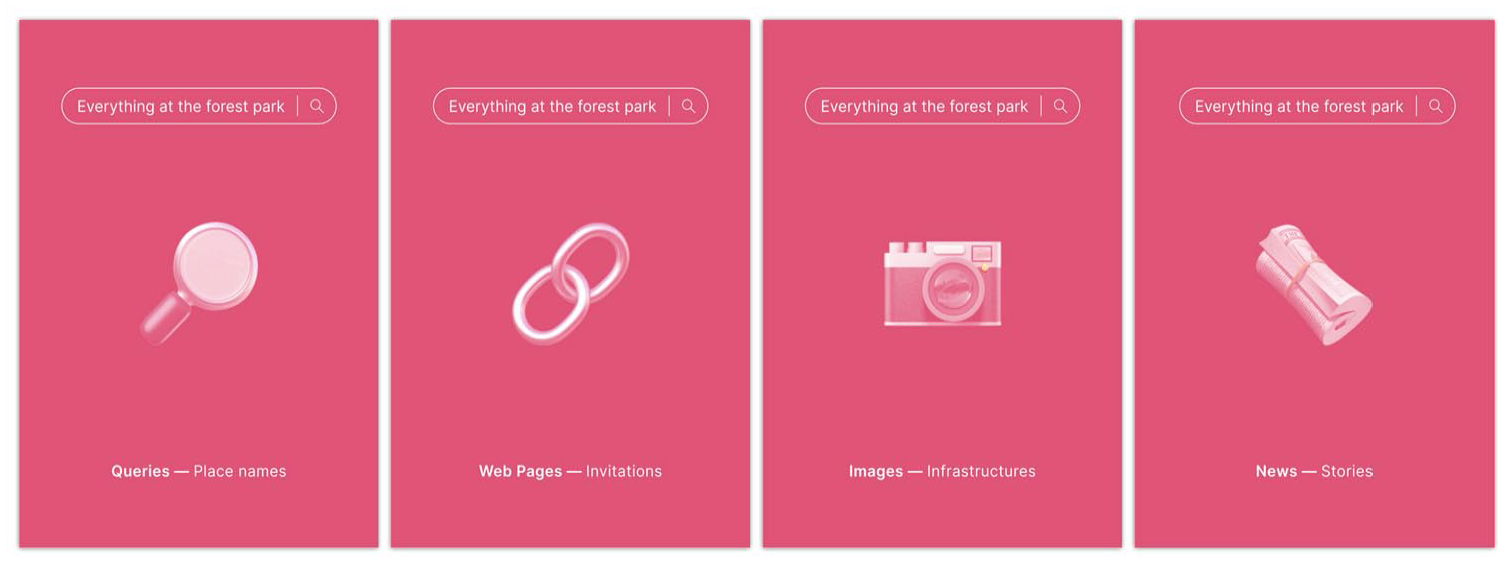
Covers of the four catalogues.
Queries – Place names. What is a forest called?
Our first catalogue explores place naming and the question of what a forest is called according to search engines (Figure 2). It is an attempt to trace algorithmically associated place names, starting with three types of Google image results recommendations: Suggested Searches, Popular Searches and Popular Topics. For example, if one queries ‘Queen Elizabeth Forest Park’, the search engine will suggest alternative names (‘Loch Lomond & The Trossachs National Park’), local sites (‘Loch Ard’), landmarks (‘The Lodge Forest Visitor Centre’) and activities (‘Three Lochs Forest Drive’). The process for data collection follows a list-building strategy named associative query-snowballing, 16 commonly used for building lists of URLs. Here, the collection is of screenshots of suggested query names found on the image search results page: one starts from a known forest name, collects all suggested terms and repeats this process. In the final catalogue, place names are displayed alphabetically and grouped based on input terms and type of suggestion. The list of place names deals with questions of scale (‘Scotland’ vs ‘Loch Lomond’) and touristification (‘TripAdvisor’, ‘visitor centre’). It also offers a glimpse into Google’s politics of association when the search engine suggests homonymous places (‘Loch Lomond reservoir’ in California) or other Scottish forests (‘Glenmore Forest Park’). 17
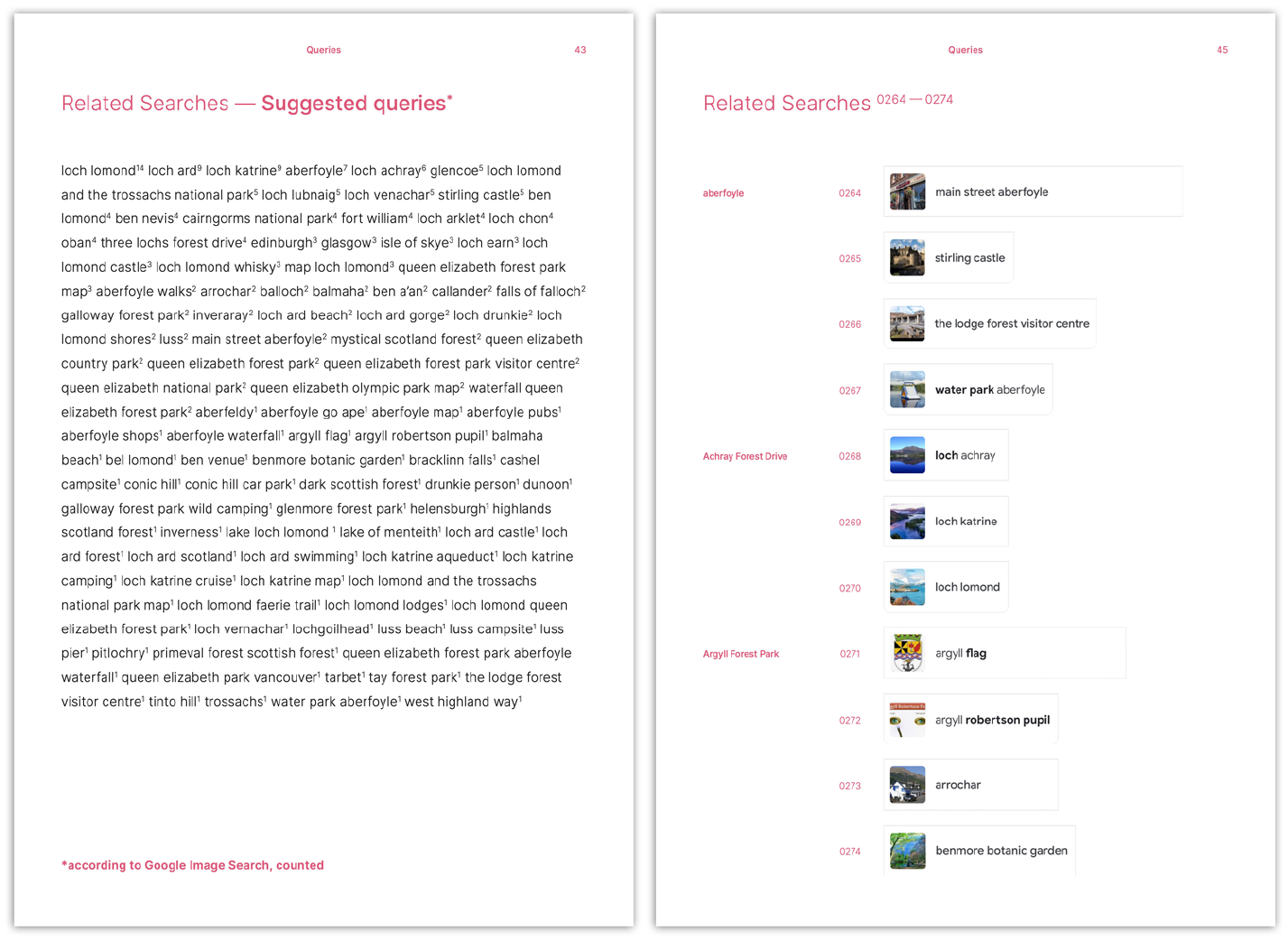
Pages from the catalogue ‘Queries – Place names’. The full catalogue can be accessed via the following link: https://archive.org/details/eatfp-placenames
Web pages – invitations. How is a forest presented for visitors?
The second catalogue explores how the web invites different relations with woodland areas, addressing page visitors as tourists and adventurers, hikers and holidayers, customers and conservationists. The catalogue gathers the text of web pages resulting from querying ‘Queen Elizabeth Forest Park’ on Google Search (Figure 3). As we are interested in how the forest is presented to (online) visitors, texts from web pages are parsed into sentences and filtered to retain only those that include the word ‘you’. Sentences are then grouped into themes (such as animals, orientation and activities) and displayed as alphabetical lists. The catalogue foregrounds different ways in which the site is experienced (e.g., beautiful views), different kinds of activities (e.g., cycling, trekking, spa, tourism), locations (e.g., Aberfoyle) and entities (e.g., plants, mountains, cafe, red squirrels, guide books). 18
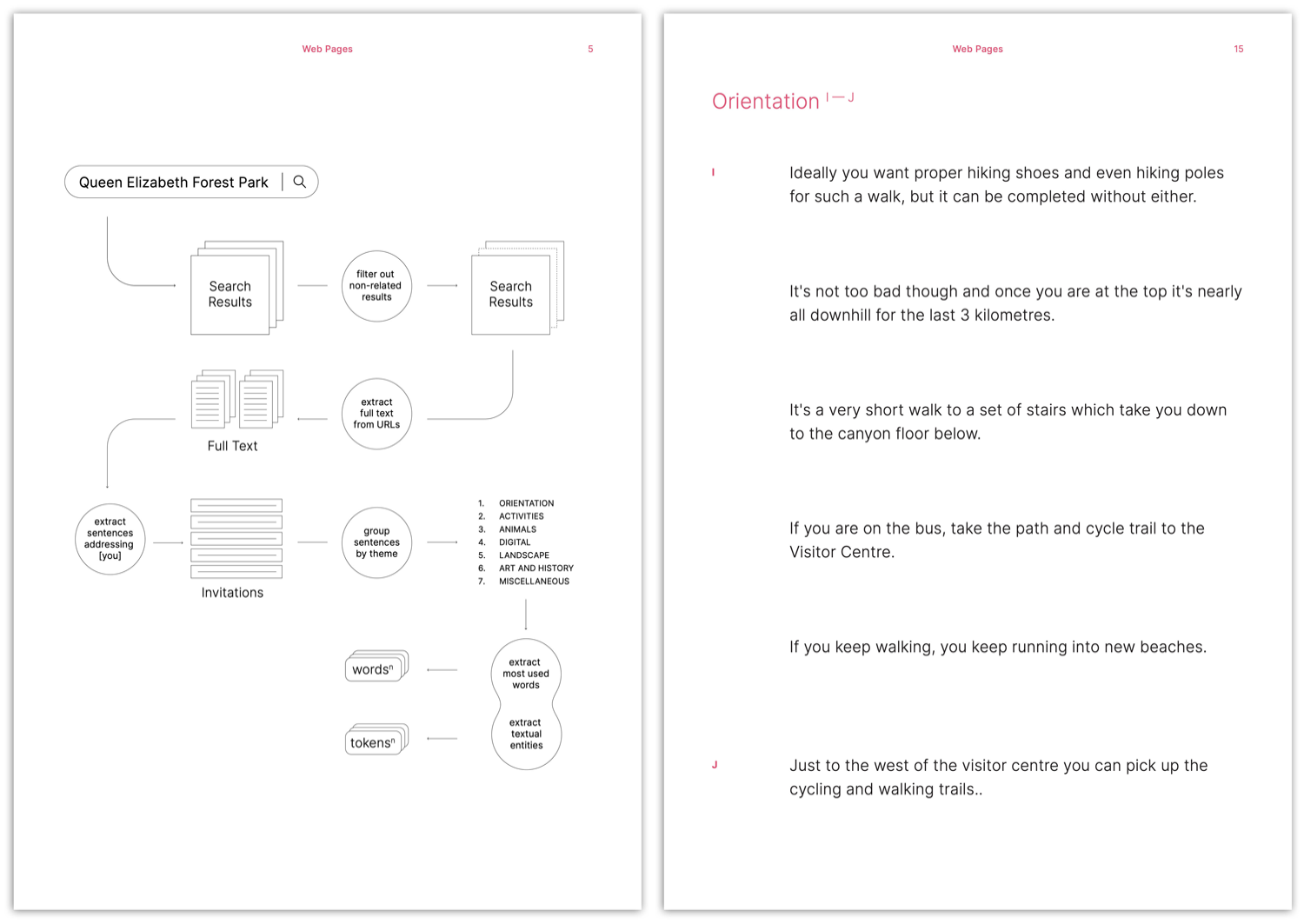
Pages from the catalogue ‘Web Pages – Invitations’. The full catalogue can be accessed via the following link: https://archive.org/details/eatfp-invitations
Image results – infrastructures. What makes a forest public?
The third catalogue is an experiment in infrastructural tourism, 19 repurposing results for the query ‘Queen Elizabeth Forest Park’ (Figure 4). Amidst the beautiful nature photography that dominates image search results, the catalogue focuses on the entities that fade into the background but are involved in making the site public, visitable and appreciable (such as signs, maps, benches, bridges, pins, guidebooks, wall art and image watermarks on stock photography). Applying the notion of ‘infrastructural inversion’ 20 quite literally, this catalogue extracts and reorganises decontextualised cut-outs from image results to produce an inventory of items that enable different ways of being in and relating to the park (navigating, learning, resting, purchasing). 21
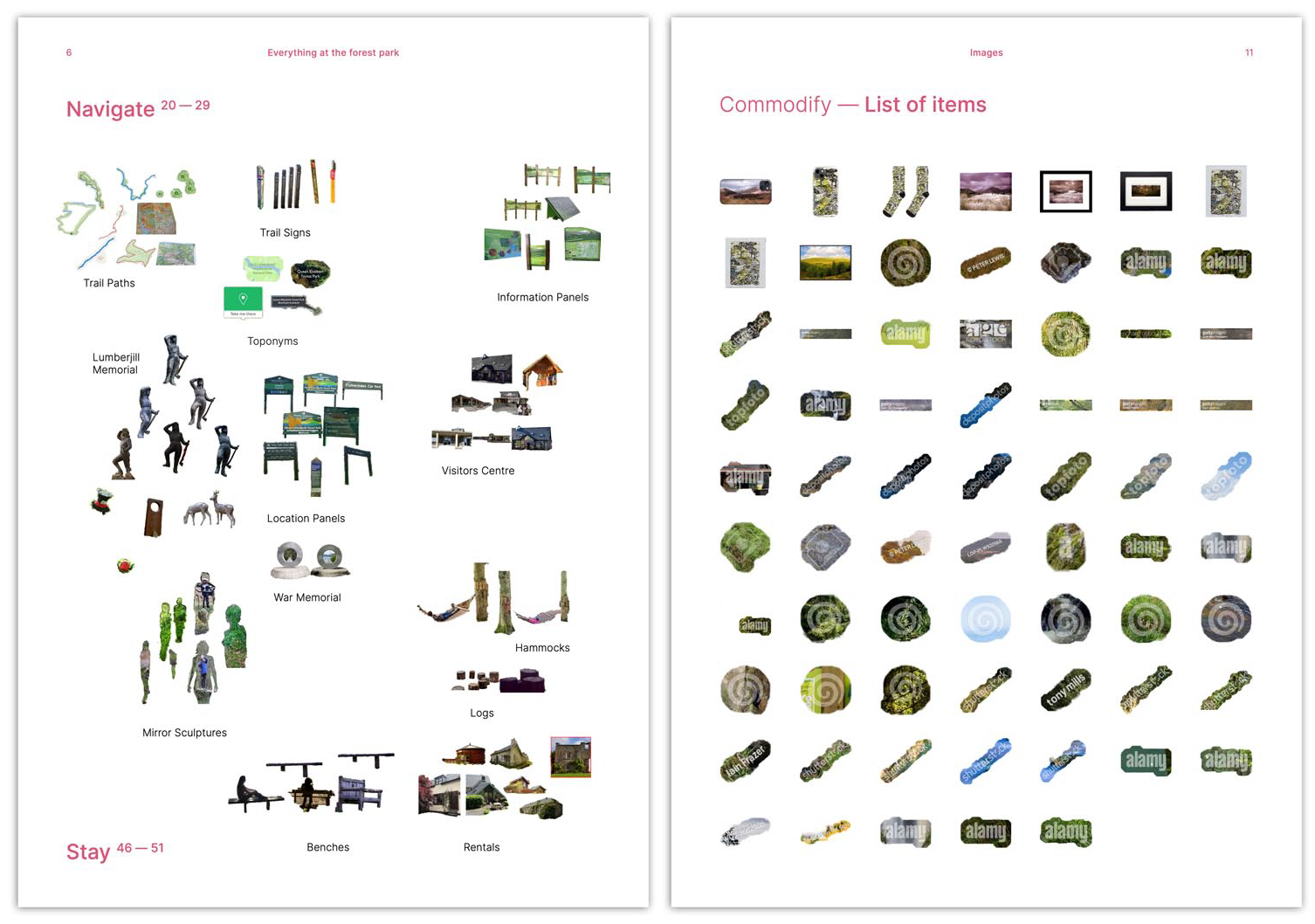
Pages from the catalogue ‘Image results – Infrastructures’. The full catalogue can be accessed via the following link: https://archive.org/details/eatfp-infrastructures
News results – stories. How is a forest headlining?
The fourth catalogue recomposes headlines about the forest collected from news results. It is an attempt at re-ordering indexed results to render a longitudinal view of forest narratives, which is usually flattened by the ranking algorithm of Google News (Figure 5). By querying ‘Queen Elizabeth Forest Park’, news titles, dates and sources are collected. Regardless of popularity, each headline is included in the catalogue, displayed chronologically from oldest to newest and grouped by theme. The catalogue pays attention to what is attended to (and what is usually not, due to the ranking algorithm of Google pushing at the bottom less popular news) in the forest according to online news sources: from recreational activities (bike rides, trails, house hunting) to animal issues (lynx reintroduction, a missing cat) to human fears (for instance, stalking and policing on the trails). 22
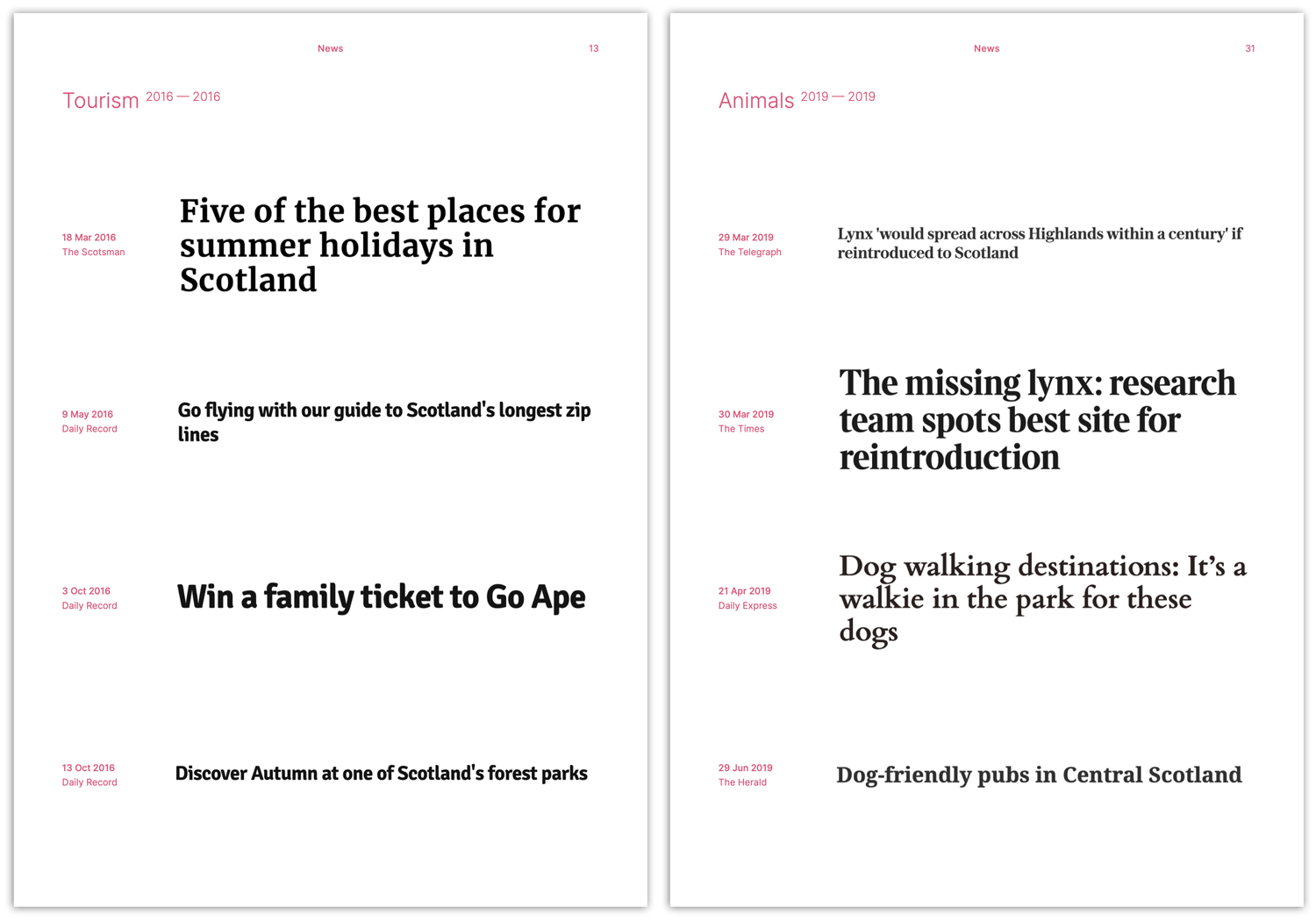
Pages from the catalogue ‘News Results – Stories’. The full catalogue can be accessed via the following link: https://archive.org/details/eatfp-stories
Conclusion: speculative catalogues to engage with forest life
Everything at the Forest Park is an attempt at reassembling the digital traces of Queen Elizabeth Forest Park into four speculative catalogues, which gather and re-order different kinds of fragments of search engine results. We termed this process ‘un-indexing’ as it seeks to produce other ways of ordering accounts of forest places beyond (or against) Google’s mission to ‘organise the world’s information’. 23 Indeed, the name Everything at the Forest Park is deliberately misleading, prompting critical consideration of improbable epistemic claims of the ‘culture of search’ 24 by which everything is presumed retrievable and orderable via search engines and pointing to that which remains hidden but invests the park with meaning. Catalogues can serve as formats for slowing down and putting algorithmically mediated results on display rather than ordering for efficient lookup of what is presumed to be most relevant. In contrast to algorithmically optimised results, they imply an undoing of optimisation by re-arranging results, prompting reconsideration of what it means to engage with those potentially affected by and involved in forest places.
In the context of recent research on digital ecologies that looks at ‘digital mediations of more-than-human worlds’, 25 the catalogues offer an example and method of how the curated and commodified natures produced by search engines might be re-ordered and re-appropriated ‘to foster convivial and care-full more-than-human relationships’. 26 For instance, the catalogues might be taken as field guides to explore the forest in situ, following recent experiments with ‘how-to’-style formats in digital environmental research, 27 and attend to forests as places of unfolding relations between many kinds of beings, devices, infrastructures, activities, issues and invitations. They may serve as elicitation devices among actors associated with or affected by the forest (from visitors to park managers and forest workers) to invite reconsiderations of the composition of forest life in digital societies and as methodological entry points for collective inquiry into the multiplicity of places and their associated meanings.
Footnotes
Acknowledgements
The authors thank Liliana Bounegru at King's College London and Rina Tsubaki from the European Forest Institute, who joined us in gathering and exploring digital material associated with forest restoration sites across Europe. Thanks to Sam Lavigne and the School for Poetic Computation community for encouragement and feedback on early prototypes of parts of this work. This paper draws inspiration from research approaches and methods developed with our colleagues and friends across the Public Data Lab network, in particular DensityDesign Lab in Milan, the Digital Methods Initiative at the University of Amsterdam, the Department of Digital Humanities, King’s College London, the médialab at Sciences Po, Paris and the Visual Methodologies Collective. We are grateful for feedback on different aspects of this work to the Digital Ecologies Team, particularly Oscar Hartman Davies and Jonathon Turnbull, who helped us to prepare and revise this article for this special issue. We also want to thank the editors of cultural geographies for their support and encouragement. We greatly benefitted from presentations and discussions of earlier versions of this work at the Valuing Nature workshop in June 2022 (King’s College London and Université de Paris); Digital Ecologies in Practice in July 2022 (University of Bonn and German Research Foundation); and with the European Forest Institute at the French National Research Institute for Agriculture, Food and Environment (INRAE) in April 2023.
Correction (July 2023):
The article has been updated to reflect the author’s full affiliations.
Funding
The author(s) disclosed receipt of the following financial support for the research, authorship, and/or publication of this article: This work would not be possible without the financial support of the project SUPERB (Systemic solutions for upscaling of urgent ecosystem restoration for forest related biodiversity and ecosystem services), funded by the European Union’s Horizon 2020 research and innovation programme under grant agreement No 101036849.
