




Abstract
The Sound of Water (https://flow-mer.org.au/napnap) microsite documents an environmental intervention at Nap Nap Swamp, a wetland in the western reaches of Australia’s Murrumbidgee River. A collaboration between a designer (Whitelaw) and an ecologist (Wassens), it was supported by the Commonwealth Environmental Water Office. We use audiovisual data storytelling to engage audiences with Nap Nap as it transitions from a dry to wet state. Focusing on a 9-day period in mid-2020, we combine audio and hydrological data to show the ecosystem’s response to a managed environmental flow, narrating this change through the wetland’s charismatic frog species, including the threatened Southern Bell Frog. In this paper we reflect on the technical and creative contributions of the project in visualising environmental audio, as well as its significance for wider practice. We highlight the value of creatively re-purposing ecological data and the importance of multi-stakeholder networks, and we argue that our celebration in this project of environmental management, intervention and care should be a key concern for future digital ecologies practices.
The Sound of Water is a web-based audio-visual story, combining ecological field observations – including audio, images and hydrological data – with interactive visualisations (see https://flow-mer.org.au/napnap). This project documents an environmental intervention at Nap Nap Swamp, which forms part of the Lowbidgee floodplain, a network of wetlands that cover 2,000 km2 near the confluence of the Kalari (Lachlan) and Murrumbidgee rivers in Australia’s New South Wales. The Lowbidgee floodplain is an inland delta formed where the Murrumbidgee River flows through very flat plains country and spills out into a complex network of channels, wetlands and lakes. The Wiradjuri, Nari Nari and Muthi Muthi peoples have been caring for the Lowbidgee for all time and retain a strong cultural and physical connection to Country. This area is a nationally significant wetland complex and a critical habitat for endangered species including the Southern bell frog, Australasian bittern and Ngambi (grey snake).
Developed through a collaboration between a designer (Whitelaw) and an ecologist (Wassens), and supported by the Australian Commonwealth Environmental Water Office, this creative experiment in digital ecologies investigates how environmental data might support public engagement. Scholarship in cultural geography and the environmental humanities has recently taken an increased interest in the acoustic dimensions of space. Part of this burgeoning interest has involved examining the potentials of digital acoustic technologies for generating richer understandings of nonhuman lifeworlds. 1 The Sound of Water builds on this scholarship by exploring how acoustic ecologies can be sensed, visualised and mobilised in support of wetland ecosystems and their management.
The project entered divisive ecological debates in Australia, where mainstream media has often focused on environmental crises in the Murray-Darling Basin (which includes the Murrumbidgee), typically producing polarising narratives which pit economic hardships faced by rural communities against ecological crisis and environmental restoration. 2 Similarly, government policy debates often emphasise social and ideological conflict rather than discuss and address the complex politics of the region’s limited (and managed) water resources. 3 Following a decade of crippling drought in the 2000s, and the near ecological collapse of floodplain ecosystems, there was increasing awareness of the need to ensure that water flows were returned to preserve the remaining wetlands. The Nap Nap Swamp is a contentious site in part because it is one of many Murrumbidgee wetlands that receive water allocated by the Commonwealth Environmental Water Office. Utilising localised ecological data, our project sought to document the dramatic ecological effects that water management is having in the Nap Nap Swamp. We thus looked to highlight the ecological renewal of a threatened landscape by creating a broad and inclusive space for audience engagement with the Murrumbidgee ecosystem and the managed interventions that are reshaping it.
Developing The Sound of Water
Within the managed system of the Murrumbidgee, where competition for limited water resources is fierce, the government regulator allocates water to specific sites to support environmental outcomes. The Sound of Water documented one such environmental flow at Nap Nap Swamp in August-September 2020, using sound and data visualisation to show how wetland species (especially frogs) flourish in response to this intervention. We developed the project using data gathered by Wassens and their team in the course of ongoing long-term monitoring. This data included hydrological measurements (depth logging), field surveys, photography and acoustic monitor recordings. Automated audio recorders deployed in the wetland capture 5-minute snippets of sound every hour, and operate continuously, generating huge archives of environmental sound data. In The Sound of Water, this audio was used to document and animate the presence of specific frog species – notably the threatened Southern Bell Frog (SBF), which has a distinctive call (Figure 1). In long-term monitoring, Wassens and their team used an automated call recogniser program to identify likely SBF calls in the audio data before human verification. The vast majority of this sound is thus never heard by human ears. As in many environmental and conservation settings today, an ecology of machine listening now connects environmental sensors to data stores whose files are processed using machine learning techniques to identify, label or classify species and their presence in landscapes.
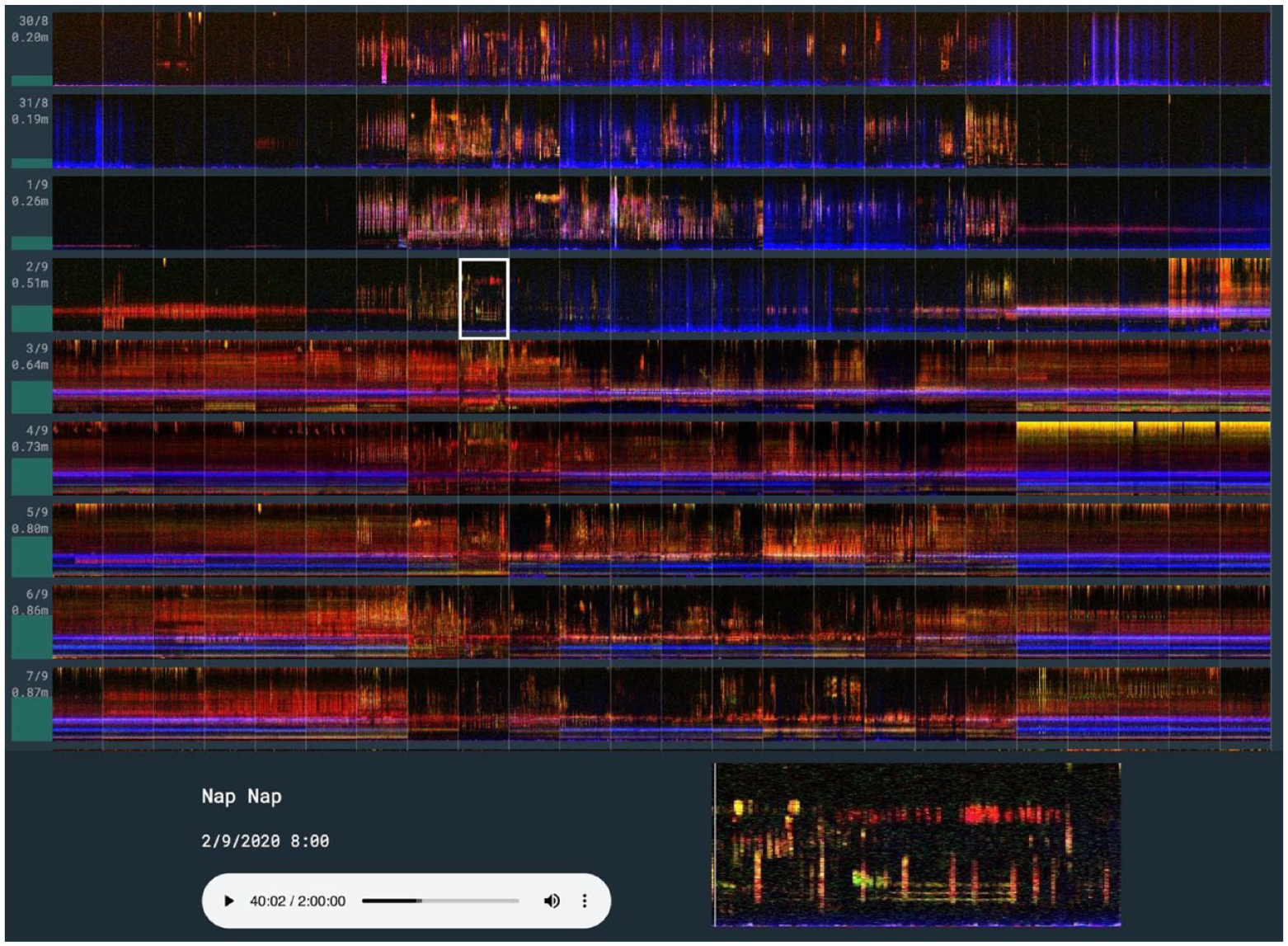
Prototype visualisation, Nap Nap Swamp audio and hydrology data. Each row of the visualisation represents audio from one day in the time series. Green columns at the left of each row show water level data.
From the singing of a fairywren to the raucous kookaburras, the songs of owls, thrush and whistlers to the calling of varied frog species, the richness of this acoustic data archive for public engagement was immediately clear to the research and creative team. The Sound of Water presented environmental audio through interactive spectrograms: scientific visualisations adapted into a new cultural context. We utilised the model of false colour spectrograms (FCS) developed by Michael Towsey (and collaborators) to visualise long-duration environmental audio and to show ecologically meaningful patterns. 4 FCS use statistical indices of sonic features through time, mapping them into colour to show audio over months or years. 5
We adapted an open-source implementation of Towsey’s technique 6 to combine audio visualisations with hydrological time-series data. These visualisations vividly show the relationship between rising water levels and acoustic activity, enabling us to identify a period in August-September 2020 corresponding to the arrival of a managed environmental flow (Figure 1). One key innovation was to use the visualisations as an interactive interface to the audio. The prototype visualisations thus enabled a form of interactive ‘immersion’ in the audio archive: visual attention and analysis sparked listening, and listening sparked visual scanning, fostering a cross-modal understanding of the soundscape. This enabled us to identify species and learn the distinctive visual signatures of their calls, and to track the increasing activity of Nap Nap’s frogs as the water level rises. As well as demonstrating how we might engage a broad audience with acoustic-visual data, we shared our methodological approach with the Commonwealth Environmental Water Office which manages environmental water and monitors its effects. The agency supported the production of the Sound of Water website as part of their ongoing public outreach and communication work.
The Sound of Water’s textual narrative and audio visualisations orient the audience in the wetland before drawing them through a chronological sequence introducing key frog species as the water level rises (Figure 2). We used a design pattern of scroll-driven data-storytelling, or scrollytelling, 7 which provides interaction and a linear structure. Identified audio cues guide the audience through the wetland’s species, scaffolding an audio-visual understanding while still enabling open-ended exploration. Launched online in December 2021, The Sound of Water attracted significant attention in mainstream and social media. 8 Social media comments offered on Twitter, The Conversation and Facebook were collected and grouped according to three themes:
Affective engagement in the work: ‘beautiful’, ‘moving’, ‘really lovely’, ‘wonderful, wonderful’, ‘life affirming’ and ‘much appreciated’.
Presentation of information: ‘informative and opinionated’, ‘love the idea of visualising non-visual data’, ‘fabulous article’, ‘notice subtle rising water level too’, ‘what a wonderful use of ecological data’.
Awareness of environmental conditions, processes and intervention: ‘hoping it help protect these precious zones’, or ‘No wonder they’ve all developed such distinctive calls, so much competition to be heard all night long’.
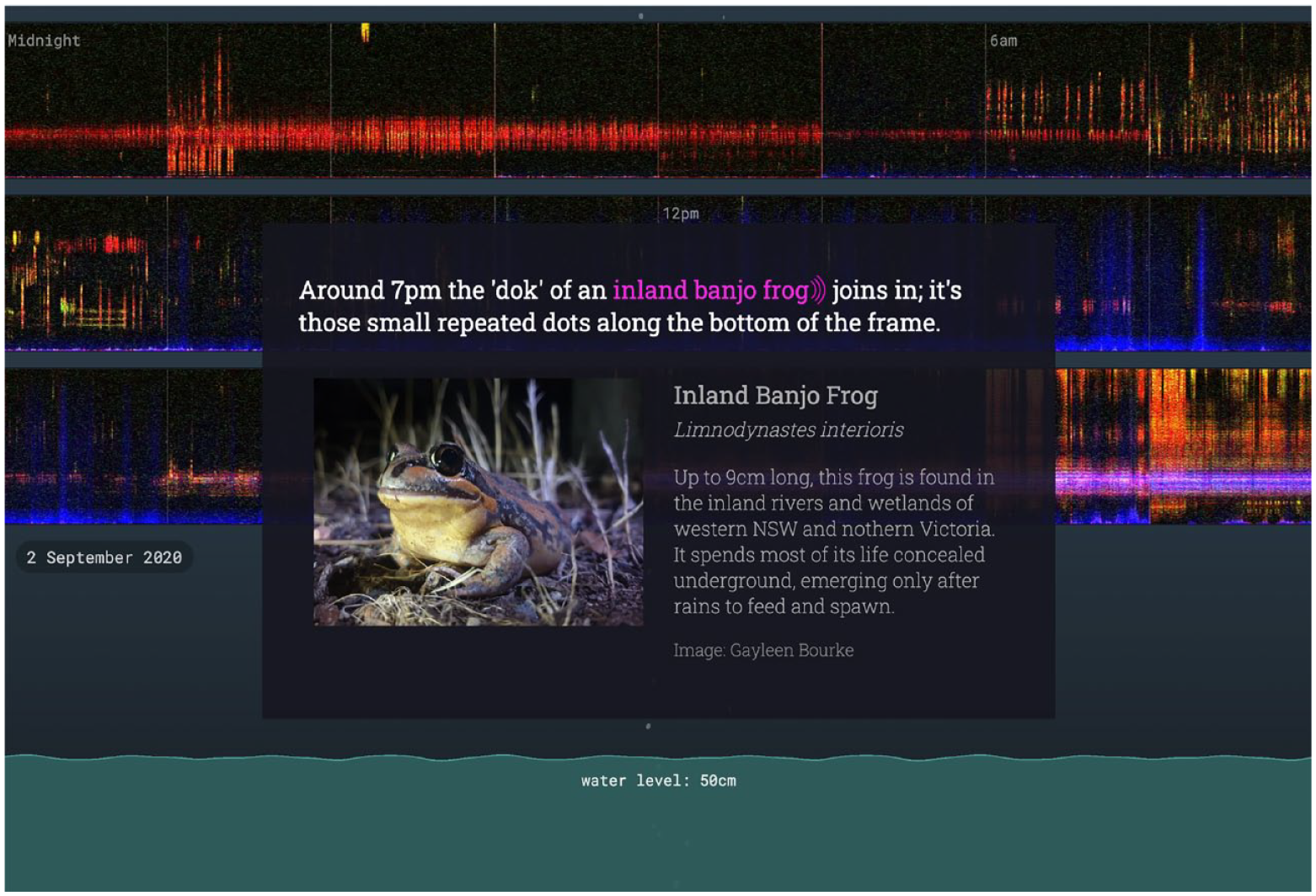
The Sound of Water (2021), screen capture. This image shows the main components of the design, including interactive spectrogram (background), narrative (foreground) and linked water level data (bottom of screen).
Reflections for digital ecologies in practice
The Sound of Water combines ecological field data, re-purposed scientific visualisations, web-based audio-visual interfaces, social media posting and media participation. It is plurally produced: university-based researchers in several disciplines (ecology, design, sociology) worked in collaboration with a government agency. This broad and multi-disciplinary team and partnerships provided valuable and varied resources, expertise, practical creative capacity and interpretative insight.
The project also demonstrates how environmental data can be reframed and retooled within digital ecologies. We approach data as both indexical (evidencing an environment) and experiential (conveying a sensation). By adapting scientific visualisation techniques to emphasise cross-modal sensing, we can make temporal patterns visible and audible in a way that exceeds the data’s originally intended use, translating it into evocative, affective experience. The tractability and mobility of data, and the ability to rapidly prototype new ways of working with it, were formative to this collaboration. Finally, rather than reproduce Western conventions that aestheticise a remote wilderness, we draw audiences into an environment that is colonised, depleted, managed and perhaps sustained through intervention. We see three features and learnings from this work as key to future practice-oriented digital ecologies research. Firstly, we see great value in a collaborative, distributed and applied project structure connecting scientific researchers, creative practitioners and government managers. Secondly, we encourage others to experiment with the creative repurposing of data to engage diverse stakeholders and publics with threatened environments, and finally, we see great potential for digital ecologies to draw critical attention to and elevate of the efforts of environmental management, intervention and care.
Footnotes
Funding
The author(s) disclosed receipt of the following financial support for the research, authorship, and/or publication of this article: from the Australian Commonwealth Environmental Water Office for the research presented in this article.
